

 Français
 Deutsch
 Українська

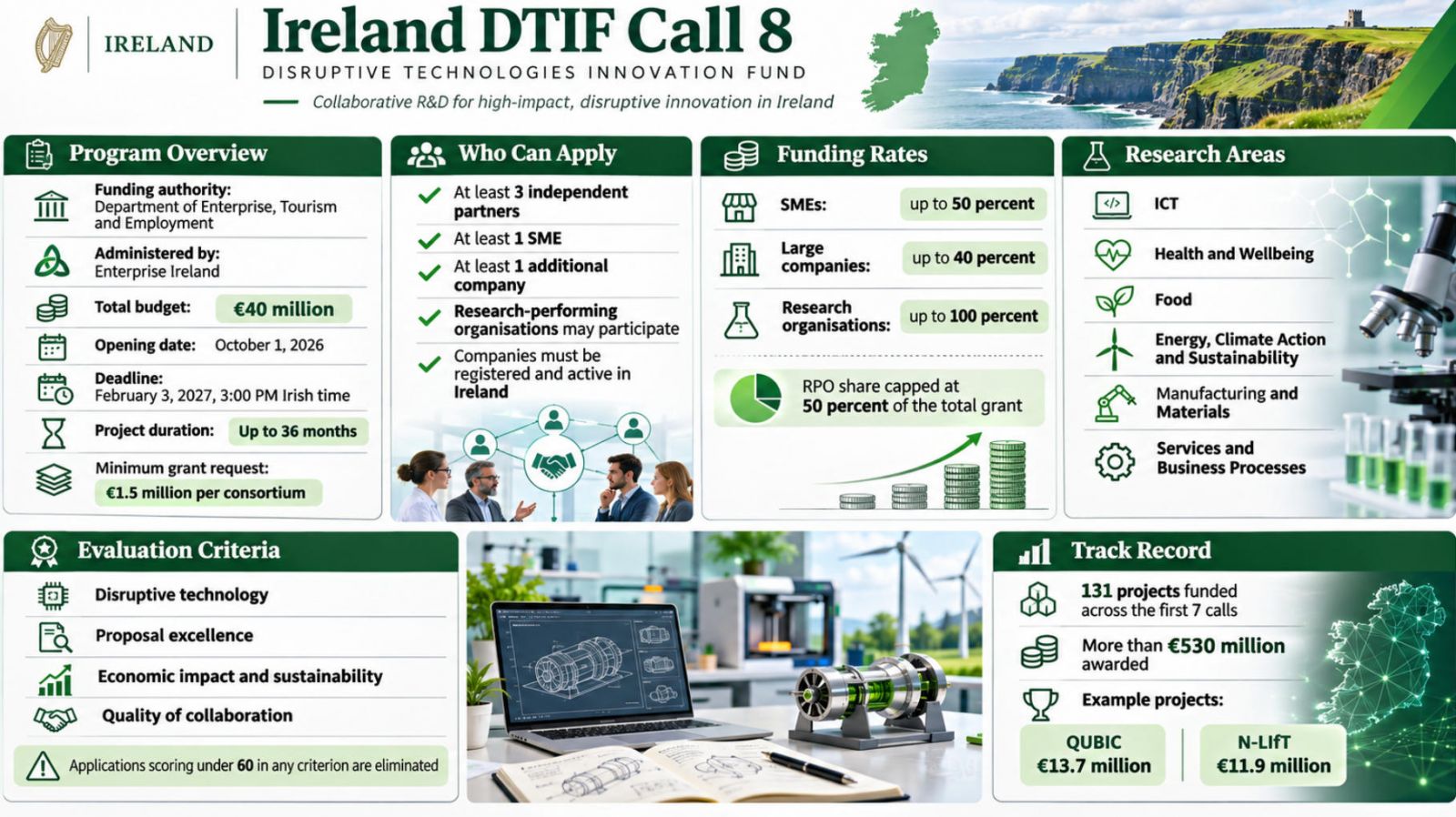
Ireland has opened a new €40 million funding competition for companies and research institutions developing technologies with the potential to transform industries, create new markets and address complex economic and societal challenges. The eighth call of the Disruptive Technologies Innovation Fund (DTIF) offers substantial financial support for collaborative research and development projects, with a minimum grant request of €1.5 million per consortium.
Applications opened on October 1, 2026, and will close on February 3, 2027, at 15:00 Irish time. The competition is managed by Ireland's Department of Enterprise, Tourism and Employment and administered by Enterprise Ireland. Projects can receive funding for up to three years, with support available for advanced technologies in healthcare, artificial intelligence, quantum computing, manufacturing, energy, sustainable agriculture and other strategically important sectors.
Unlike smaller innovation grants aimed at individual startups, DTIF is designed for ambitious projects requiring cooperation between several independent organisations. Every eligible consortium must include at least three independent partners seeking funding, including one small or medium-sized enterprise (SME) and at least one additional company. Research-performing organisations, including eligible Irish universities, can participate alongside businesses.
The programme has already established a substantial funding record. Across its first seven competitive calls, 131 collaborative projects involving 495 project partnerships were approved for more than €530 million in government funding. Previous awards include €13.7 million for the QUBIC quantum computing initiative and €11.9 million for N-LIfT, a project developing new immunotherapy technologies for cancer treatment.
However, substantial funding comes with demanding eligibility rules, financial obligations and technical assessment standards. Understanding these requirements is essential for companies considering an application, particularly SMEs that must finance a significant proportion of their own research activities before claiming grant reimbursement.
What Is Ireland's Disruptive Technologies Innovation Fund?
The Disruptive Technologies Innovation Fund was established in 2018 under Project Ireland 2040 as part of Ireland's National Development Plan. Originally structured as a €500 million challenge-based funding initiative, DTIF supports collaborative industrial research and experimental development intended to translate scientific discoveries into commercially relevant technologies.
Its central objective is to reduce the risks associated with developing complex innovations that individual businesses may be unable to pursue independently. These projects often require specialised equipment, multidisciplinary research teams, substantial technical experimentation and long development periods before commercial revenues become possible.
The programme therefore encourages cooperation between SMEs, multinational companies and research-performing organisations. A startup developing a new medical device might collaborate with a university laboratory and an established manufacturing company. An artificial intelligence developer could work with an industrial technology business and an academic research centre to build and validate a new system. Such arrangements allow partners to combine scientific knowledge, industrial experience and commercial capabilities.
DTIF is not intended to finance ordinary business expansion or incremental product improvements. The proposed technology must demonstrate significant innovation potential and contribute to new products, processes, services or business models. Applicants must explain how the project advances beyond existing technological capabilities and why public financial support is justified by its research risks, complexity or scale.
The programme also has an explicit economic purpose. Successful projects are expected to strengthen Ireland's innovation capacity, create opportunities for commercialisation, support high-value employment and improve the international competitiveness of participating businesses. The official programme objectives envisage commercial impact within approximately three to five years after project completion.
For applicants, this means that scientific excellence alone is insufficient. A technically sophisticated project must also present a credible route towards commercial adoption, meaningful benefits for its business partners and measurable economic value.
DTIF Call 8: Funding Budget, Application Deadline and Key Conditions
Call 8 differs from the previous competition in several important respects. While Call 7 operated through a rolling application process, the eighth call has a fixed submission window and a defined budget of €40 million. Eligible proposals will be assessed after the deadline and ranked according to their weighted evaluation scores.
Funding will then be allocated to the highest-ranked eligible projects until the available budget is exhausted. Consequently, meeting the minimum eligibility requirements and achieving acceptable assessment scores does not guarantee an award.
Table 1. Main Funding Conditions and Deadlines for DTIF Call 8
| Parameter | DTIF Call 8 requirements |
|---|---|
| Country | Ireland |
| Programme | Disruptive Technologies Innovation Fund |
| Funding authority | Department of Enterprise, Tourism and Employment |
| Programme administrator | Enterprise Ireland |
| Total competition budget | €40 million |
| Application opening date | October 1, 2026 |
| Application deadline | February 3, 2027, 15:00 Irish time |
| Minimum grant request | €1.5 million per consortium |
| Maximum project duration | 36 months |
| Preferred project duration | Generally 24 to 36 months |
| Minimum consortium size | Three independent partners requesting funding |
| Mandatory business participation | At least one SME and one other enterprise |
| SME grant intensity | Up to 50 percent of eligible costs |
| Large company grant intensity | Up to 40 percent of eligible costs |
| Research organisation grant intensity | Up to 100 percent of eligible costs, subject to the consortium-level cap |
| Expected results announcement | Late second quarter or early third quarter of 2027 |
| Project commencement | Within six months of the ministerial award announcement |
The minimum €1.5 million requirement applies to the total DTIF grant requested by the consortium, not to each participating organisation. A project involving two SMEs and a university could therefore distribute its funding request across the three partners according to their research responsibilities and eligible expenditure.
The programme does not establish a universal maximum grant of €1.5 million or a fixed grant amount per partner. Individual awards can be considerably larger when justified by the project's scale and approved costs. Nevertheless, the €40 million budget imposes an overall limitation on the eighth competition.
The official application deadline was revised after the initial announcement in June 2026. Earlier information referred to January 31, 2027, but the subsequently updated Call 8 documentation confirms February 3, 2027, at 15:00 Irish time.
Applicants should use the revised deadline and the latest official documents when preparing their submissions.
Another significant change is the introduction of a mandatory pre-eligibility consultation with the Enterprise Ireland DTIF team. This preliminary assessment is intended to help applicants identify potential eligibility problems before submitting a full proposal.
The eighth competition also allows Irish semi-state organisations and public bodies to participate as non-funded partners. Their involvement does not reduce the requirement for three eligible, independent partners seeking DTIF funding, and they must finance their own participation.
Finally, projects receiving an award must be prepared to begin within six months of the ministerial funding announcement. Failure to commence within this period may result in withdrawal of the offer.
These changes make early consortium development, financial planning and application preparation particularly important.
Which Technologies and Research Projects Can Receive DTIF Funding?
DTIF supports industrial research and experimental development across six broad Irish research priority areas. Although the programme is strongly associated with advanced digital technologies and medical innovation, its scope extends to manufacturing, food production, energy systems, environmental technologies and technology-enabled services.
Table 2. Research Priority Areas and Potential Applications Under DTIF
| Research priority area | Examples of relevant technologies |
|---|---|
| Information and Communication Technologies | Artificial intelligence, machine learning, quantum computing, cybersecurity, robotics and advanced software |
| Health and Wellbeing | Medical devices, diagnostics, advanced therapies, digital healthcare and biotechnology |
| Food | Advanced food processing, sustainable production, food technologies and intelligent agricultural systems |
| Energy, Climate Action and Sustainability | Decarbonisation, energy efficiency, sustainable technologies and climate-related innovation |
| Manufacturing and Materials | Advanced manufacturing, automation, innovative materials and industrial process technologies |
| Services and Business Processes | Technology-driven services, intelligent business systems and new digital business models |
These categories are research priorities rather than separate funding competitions with individually allocated budgets. Applicants must select the relevant priority area and demonstrate that their proposal meets the programme's broader technological and commercial criteria.
Technology Readiness Levels and Research Eligibility
DTIF distinguishes between industrial research and experimental development.
Industrial research involves acquiring new knowledge and technical capabilities for developing products, services or processes, or substantially improving existing solutions. Activities may include laboratory prototypes, investigations of complex systems and validation of technologies that remain at an early development stage.
Experimental development involves applying scientific and technological knowledge to create, demonstrate, test or improve products and processes. This may include pilot systems, prototypes and validation in environments representative of actual operating conditions.
For Call 8, the specific applicant guide generally expects projects to fall within Technology Readiness Levels (TRL) 3 to 8. This encompasses experimental proof of concept, laboratory validation, prototype development, system demonstration and technologies approaching operational readiness.
The general DTIF eligibility webpage refers to TRL 3 to 9, while the dedicated Call 8 guide and assessment criteria use TRL 3 to 8. Applicants proposing technologies close to full commercial deployment should therefore clarify their eligibility during the mandatory pre-eligibility consultation.
Fundamental research is not eligible under the programme. Routine adjustments to existing products, manufacturing processes or services are also excluded, even when those changes provide commercial benefits.
For example, purchasing an established robotic production line would not ordinarily constitute a disruptive research project. Developing and validating a novel robotic perception system that enables substantially different manufacturing capabilities could be relevant, provided the proposed research meets the other DTIF requirements.
This distinction matters because a commercially attractive investment is not necessarily eligible research and development.
Who Can Apply for DTIF Innovation Grants in Ireland?
DTIF funding is primarily available to eligible Ireland-based enterprises and research-performing organisations.
Companies seeking a grant must be registered with the Irish Companies Registration Office, operate in Ireland and hold the necessary client relationship with Enterprise Ireland, IDA Ireland or Údarás na Gaeltachta at the time of application.
Being incorporated in Ireland does not automatically establish eligibility. The required agency relationship is a separate condition.
Similarly, businesses supported exclusively through a Local Enterprise Office are not eligible merely because they receive LEO assistance. Companies in this position should investigate their potential eligibility with the appropriate development agency before committing resources to a consortium application.
International ownership does not necessarily prevent participation. A foreign-owned company with an eligible Irish entity and the required agency relationship may be able to participate. However, an overseas business without the necessary Irish registration and operational presence cannot simply apply as a funded partner.
The programme also permits eligible research-performing organisations, including Irish universities and specialised research institutions, to participate in collaborative projects.
Examples of institutions involved in the wider DTIF ecosystem include Trinity College Dublin, University College Dublin, University of Galway, University College Cork, Dublin City University, University of Limerick, Tyndall National Institute, RCSI, Teagasc and the National Institute for Bioprocessing Research and Training.
An institution's eligibility must be established under the applicable programme documentation rather than assumed from its academic or research status.
SMEs and Large Enterprises
The European SME definition is relevant to determining enterprise status, funding intensity and consortium eligibility.
An SME generally employs fewer than 250 people and meets the applicable financial thresholds. Medium-sized enterprises have annual turnover not exceeding €50 million or an annual balance sheet total not exceeding €43 million. Small enterprises generally employ fewer than 50 people and meet the relevant €10 million financial threshold.
However, enterprise classification also considers linked and partner companies. A business with relatively few employees may not qualify as an independent SME when its ownership or corporate relationships require the financial and employment data of other entities to be taken into account.
This can be decisive for DTIF eligibility. A consortium must genuinely contain an eligible SME, not simply a small subsidiary whose wider corporate relationships place it outside the SME definition.
Large companies can participate and receive grants, but their maximum funding intensity is lower than that available to SMEs.
DTIF Consortium Requirements: Why Three Independent Partners Are Essential
One of the programme's defining requirements is its collaborative structure.
Each application must involve at least three independent partners requesting DTIF funding. At least one must be an SME, and at least one additional partner must also be an enterprise. The third funded partner may be another eligible company or a research-performing organisation.
A consortium consisting of two SMEs and a university can satisfy the minimum composition requirement. So can a partnership involving an SME, a large company and a university. Three independent eligible enterprises may also form a qualifying consortium without a university, provided they meet all other conditions.
By contrast, one SME working with two universities would not satisfy the requirement for a second enterprise. Two companies working with an Irish public body that receives no DTIF funding would also fail the requirement for three independent funded partners.
Independence must be assessed substantively. Separate legal registrations do not necessarily establish that companies are independent when ownership, control or other relationships connect them.
The Importance of Meaningful Collaboration
DTIF expects collaboration to be integrated into the research project rather than limited to administrative participation.
Each partner should contribute identifiable scientific, technical, industrial or commercial capabilities. Research activities should be distributed according to the expertise needed to achieve the project's objectives.
For example, an SME developing an advanced medical sensor could be responsible for core device design and system integration. An established medical technology manufacturer might contribute production engineering and testing expertise, while a university laboratory could undertake specialised biomedical validation.
Such a structure provides a clearer justification for collaboration than a proposal in which two companies perform almost all activities while a third organisation has a nominal role.
The evaluation criteria explicitly require SMEs to play an integral part in the project. A large consortium cannot strengthen an otherwise weak application simply by adding an SME to satisfy formal eligibility.
Managing Intellectual Property and Commercial Rights
Collaborative R&D creates important questions about intellectual property ownership.
Partners should distinguish between intellectual property they owned before the project and new knowledge, inventions, software, designs or technologies developed during its implementation.
These questions become particularly important when universities conduct fundamental technical work while commercial partners expect to manufacture, license or sell the resulting technology.
A consortium agreement should establish how partners will manage ownership, access rights, confidentiality, publication, patent protection and future commercial exploitation.
Enterprise Ireland makes a consortium agreement template available as part of the Call 8 documentation. The agreement should be reviewed carefully by the participating organisations and, where appropriate, their legal advisers.
Unresolved intellectual property issues may create serious difficulties even when the underlying research is technically successful. A commercially valuable prototype cannot necessarily be exploited if the relevant partners have not agreed who may use the technology or under what conditions.
How Much Grant Funding Can Companies and Universities Receive?
DTIF grant intensity depends on the legal and organisational category of each funded partner.
SMEs may receive funding for up to 50 percent of their eligible costs, while large companies may receive up to 40 percent. Research-performing organisations may receive support for up to 100 percent of eligible costs, but their combined funding cannot exceed 50 percent of the total DTIF grant awarded to the project.
The RPO cap applies to the grant amount, not simply to its share of total project expenditure.
Table 3. DTIF Funding Rates and Illustrative Consortium Budget
| Partner | Eligible project costs | Maximum DTIF grant | Required own contribution |
|---|---|---|---|
| Small enterprise | €1,800,000 | €900,000 | €900,000 |
| Medium enterprise | €1,200,000 | €600,000 | €600,000 |
| Research-performing organisation | €1,000,000 | €1,000,000 | €0 |
| Total | €4,000,000 | €2,500,000 | €1,500,000 |
Illustrative calculation based on the maximum applicable funding rates. It is not an actual DTIF award.
In this example, the consortium undertakes a €4 million research project and requests €2.5 million in DTIF support. The two enterprises together contribute €1.5 million from their own resources.
The university's €1 million grant represents 40 percent of the total DTIF funding request, satisfying the maximum RPO share.
Although the grant covers 62.5 percent of the consortium's total eligible costs, neither enterprise receives more than 50 percent of its own eligible expenditure. The higher overall grant share is possible because the research-performing organisation has a different funding intensity.
A second example demonstrates the financial consequences of involving a large company.
Suppose an SME has €1.6 million in eligible expenditure, a large enterprise has €2 million, and a university has €1.4 million. Applying the maximum rates produces an SME grant of €800,000, a large-enterprise grant of €800,000 and university funding of €1.4 million.
The total research budget would be €5 million, with €3 million requested from DTIF and €2 million financed by the commercial partners. The university would account for approximately 46.7 percent of the grant, remaining below the permitted ceiling.
Both examples illustrate how the same programme can produce different funding structures depending on the composition of the consortium.
Actual awards may be lower than the theoretical maximum because costs must be eligible, justified and approved. Applicants should not treat maximum grant rates as guaranteed reimbursement percentages.
State Aid and Co-Financing Restrictions
DTIF operates within the European Union's General Block Exemption Regulation framework for State aid.
Each enterprise must finance its required contribution from its own resources. One consortium member cannot directly or indirectly subsidise another partner's mandatory contribution.
The programme also prohibits financing the company's required contribution using other State or European Union funds.
Applicants must confirm that the same proposed project has not been submitted to another National Development Plan fund in circumstances prohibited by the programme rules.
These restrictions make it essential to distinguish DTIF funding from other public support mechanisms, including tax incentives, subsidised financing and separate research grants.
Companies using additional financial instruments should obtain appropriate advice on State aid accumulation, double funding and the treatment of project expenditure.
Which R&D Expenses Are Eligible Under DTIF?
A substantial grant budget does not mean that every project-related expense is eligible.
DTIF funding is directed towards costs that are necessary, reasonable and directly connected to the approved research activities. The rules differ between enterprise partners and research-performing organisations.
For enterprises, eligible categories can include scientific and technical staff costs, specialised materials, external consultancy, contractual research, intellectual property-related expenditure and the depreciation of research equipment.
However, the detailed treatment of these categories depends on the selected overhead methodology and the programme's specific restrictions.
Personnel Costs
For company partners, the maximum eligible annual base salary is €150,000 per person, excluding the employer's Pay Related Social Insurance contributions.
Only the proportion of working time directly attributable to the project can be charged. Employees are generally expected to devote a meaningful and sustained share of their time to the research, with the programme indicating that participation of at least 10 to 20 percent is normally expected for relevant staff.
The costs of company chief executives or managing directors are generally excluded. A limited exception exists for small enterprises where up to 30 percent of the executive's time may be eligible if the contribution is considered critical to the project.
Ordinary administrative, purchasing, financial and IT support activities are normally treated as overheads rather than separate research staff costs.
Research-performing organisations follow different salary rules. In particular, salaries of permanent academic staff are not eligible for grant support under the standard RPO provisions.
Consultancy and External Research
Specialist consultancy can be eligible where the expertise is directly necessary for project delivery.
The Call 8 guide establishes maximum daily consultancy rates of €900 for the first 20 days, €700 for the next 20 days and €600 for subsequent days.
For a 50-day assignment, this produces a maximum indicative allowable amount of €38,000 before any further reductions arising from the programme's financial review.
The funding authority may reduce the number of consultancy days or the applicable rate if the proposed expenditure is not considered reasonable or necessary.
External consultancy is not intended to replace the core research responsibilities of funded consortium members. Consultancy expenditure must generally represent a modest proportion of the relevant project budget.
Equipment, Materials and Overheads
Research equipment is generally supported through eligible depreciation rather than reimbursement of its entire acquisition cost.
For example, equipment costing €100,000 with an approved depreciation period of 60 months and used on the project for 24 months could produce €40,000 in attributable depreciation under a straight-line calculation, assuming the relevant conditions are satisfied.
General commercial production equipment, ordinary business expansion assets and equipment intended to become routine production machinery are not eligible simply because they are technologically sophisticated.
Building construction and renovation costs are also generally excluded.
Enterprise partners may choose between two overhead methodologies. The Simplified Overheads Approach applies a flat rate of 20 percent to specified eligible cost categories, excluding depreciated capital expenditure from the overhead calculation. The Defined Overheads Approach uses an overhead allowance of 20 percent of eligible salary costs and allows certain materials to be included separately, subject to its documentation requirements.
Research-performing organisations have their own rules, including an overhead allowance of 30 percent of eligible project costs under the programme's stated methodology.
Because these models treat expenditure differently, applicants should compare them using the official budget documentation before selecting an approach. A method that is administratively simpler may not produce the same eligible budget as one that accounts for materials separately.
Costs That Require Particular Attention
DTIF does not generally fund sales and marketing expenditure, routine commercial production equipment or costs incurred outside the approved project period.
Clinical trial-related expenditure may be eligible under specific conditions, including certain external clinical trial costs up to phase 2A when necessary for product development.
Research-performing organisations face additional restrictions on travel, consultancy and equipment. Their patent protection expenditure may also be subject to a maximum eligible amount of €25,000 per RPO partner for qualifying project-generated intellectual property.
Applicants should be particularly cautious about treating early market launch activities as research costs. Commercialisation planning may be necessary to justify the project, but preparing a market strategy does not automatically make advertising, customer acquisition or ordinary selling expenses eligible for grant support.
Cash Flow, Grant Payments and Financial Capacity
For SMEs, one of the most important practical aspects of DTIF is the timing of grant payments.
The standard programme arrangements provide for reimbursement of eligible costs already incurred, with financial claims generally submitted at 12-month intervals.
This creates an important difference between receiving approval for a grant and having immediate access to its full value.
A company with an approved grant of €900,000 may still need considerable working capital to cover salaries, materials and research expenditure before the relevant costs are reimbursed.
Consequently, DTIF applicants need more than an eligible budget. They must demonstrate that they can finance their required contribution and maintain sufficient liquidity throughout the project.
Advance Funding for Small Enterprises
The programme includes a potential pre-financing arrangement for small companies employing fewer than 50 people.
Subject to an individual assessment, Enterprise Ireland may provide an advance of up to one-third of the company's research grant before the corresponding expenditure is incurred.
For a small business with an approved research grant of €900,000, the theoretical maximum advance would be €300,000.
However, this support is discretionary rather than automatic. Enterprise Ireland examines the justification for advance financing and evidence of sufficient assets to cover the company's liability under the grant.
Small businesses should therefore prepare a realistic cash-flow forecast even when they intend to request pre-financing.
Financial Eligibility and the Undertaking in Difficulty Test
Each enterprise partner must provide sufficient financial information for its Undertaking in Difficulty status to be assessed, or provide the exemption verification required under the applicable State aid rules.
The assessment may involve the company's financial statements, accumulated losses, capital position, insolvency-related circumstances and information about its wider corporate group.
Financial information must be available by the competition closing date. Failure to provide the required documents or exemption verification can make an application ineligible before it reaches technical assessment.
The Department has also published a correction to the Call 8 applicant guide clarifying that certain financial statement requirements are cumulative rather than alternatives. Companies should therefore use the latest version of the guidance and avoid relying on earlier copies.
These requirements are particularly important for research-intensive startups that may have substantial development expenditure but limited current revenues. A promising technology does not automatically compensate for a failure to meet the programme's financial eligibility rules.
How to Apply for DTIF Call 8
Applications are submitted through the official online application system made available through Enterprise Ireland and the Department of Enterprise, Tourism and Employment.
The Department provides a Call 8 Guide for Applicants, indicative application forms in Parts A and B, a consortium agreement template and financial documentation relating to the Undertaking in Difficulty assessment.
The indicative forms are intended to help consortia prepare their submissions, but the formal application must be completed through the prescribed online process.
Preparing a Strong Research Proposal
A credible application needs to present the technological concept, proposed research methodology, work packages, milestones, deliverables, budget allocations and commercialisation pathway as parts of one coherent project.
The scientific case should explain the technological limitations of existing solutions and identify the genuinely novel capabilities that the proposed research intends to establish.
Rather than describing a technology as simply innovative, applicants should demonstrate why the planned research advances the state of the art. Relevant evidence may include technical benchmarks, preliminary experimental results, competing technologies, published research and identified scientific uncertainties.
The work plan should translate these objectives into practical activities. Each partner needs clearly defined responsibilities, adequate resources and a credible contribution to the overall research outcome.
A suitable project schedule should include measurable milestones and identifiable deliverables. The programme expects deliverables to follow SMART principles: Specific, Measurable, Achievable, Relevant and Time-bound.
For example, promising to develop an advanced medical sensor provides limited information about measurable progress. A stronger deliverable could involve validating a prototype against predefined performance criteria by a specified project month, supported by an appropriate testing methodology.
The relevant technical thresholds must be scientifically justified rather than selected arbitrarily.
The commercial case should demonstrate how the resulting technology could generate meaningful market opportunities and economic benefits. Applicants should consider potential customers, existing alternatives, regulatory requirements, intellectual property, future development costs and realistic market-entry pathways.
Application Submission and Formal Checks
The lead partner is responsible for preparing the complete application and coordinating the consortium's submission.
The partner information must be consistent across Parts A and B of the application, and all consortium members must sign as required.
Where a research-performing organisation participates, the involvement of its researchers must receive approval from the appropriate authorised institutional signatory.
The mandatory pre-eligibility consultation must take place before submission. Applicants should contact the Enterprise Ireland DTIF team early enough to address questions concerning consortium composition, company status, research eligibility or project structure.
After submission, applications are checked against the formal eligibility conditions. Incomplete or non-compliant proposals may be removed before independent expert assessment.
How DTIF Applications Are Evaluated
DTIF Call 8 uses an international expert evaluation process with four weighted criteria.
Eligible applications first undergo written assessment by at least three independent international experts. Proposals meeting the required standard are then invited to an expert panel interview.
The assessment considers technological originality, the overall research approach, potential economic impact and the quality of collaboration.
Table 4. DTIF Call 8 Evaluation Criteria and Maximum Weighted Scores
| Evaluation criterion | Maximum weighted score | Main focus |
|---|---|---|
| Strength of the disruptive technology | 100 | Novelty, technological ambition, research foundation and disruptive potential |
| Excellence of the overall proposal and approach | 50 | Methodology, milestones, work packages, deliverables and feasibility |
| Economic impact and sustainability | 100 | Commercial opportunities, exports, competitiveness, employment and sustainability |
| Quality and efficiency of collaboration | 50 | Consortium expertise, management, partner roles and resources |
| Total | 300 | Overall project evaluation |
Each criterion is initially assessed on a scale from 0 to 100 before the relevant weighting is applied.
A particularly important rule is that proposals receiving fewer than 60 marks out of 100 in any individual criterion are removed from the process and cannot receive funding.
This makes the assessment fundamentally different from a system in which a high total score can always compensate for a serious weakness.
An applicant could present exceptional scientific research but still fail because the economic case is insufficiently convincing or the collaboration structure is poorly designed.
For illustration, consider a proposal awarded 85 points for disruptive technology, 75 for overall approach, 80 for economic impact and 70 for collaboration.
After weighting, its total would be 237.5 points out of 300. This is only an example of the scoring calculation, not an indication of the score required to obtain funding.
Passing the individual assessment thresholds is not enough by itself. Eligible projects must also compete for the limited €40 million budget.
What Evaluators Expect Beyond Technical Novelty
The technology criterion examines whether the project represents a genuine advance with international market potential. It also considers whether the research risk or scale justifies public support.
The methodology criterion evaluates the credibility of the project plan, including whether the objectives can be delivered within the proposed 24 to 36 months.
Economic impact carries the same maximum weight as disruptive technology. Applicants should demonstrate potential to create new markets, exports, employment opportunities and business growth over a realistic period.
The evaluation also considers environmental sustainability and whether projects align with Ireland's broader climate objectives.
Finally, collaboration must be credible. Evaluators consider whether the consortium has the necessary expertise, a capable lead partner, appropriate management arrangements and a meaningful distribution of responsibilities.
For SMEs, an integral technical or commercial role is especially important.
These criteria suggest that the strongest proposals are not necessarily those describing the most ambitious technologies. They are those that combine technological ambition with credible execution, strong collaboration and convincing economic opportunities.
What Previous DTIF Competitions Reveal About Funding Priorities
The programme's funding history provides useful evidence of the scale and types of projects that have succeeded.
Across the first seven DTIF calls, the government approved more than €530 million for 131 collaborative projects.
Call 7 was particularly significant. Its final awards were announced in December 2025, bringing the total approved funding for that competition to approximately €159 million across 27 projects.
The Department reported that 41 applications were submitted for evaluation during Call 7 and that 27 ultimately received approval. This produces an historical approval ratio of approximately 65.9 percent among those submitted applications.
However, this figure should not be interpreted as the expected success rate for Call 8.
The seventh call used a rolling process and operated under a different overall funding arrangement. Call 8 has a fixed €40 million budget, with eligible applications ranked competitively after the closing date.
The number and value of applications submitted in the new competition will therefore have a substantial influence on the final outcome.
Healthcare Dominated Call 7 Funding
An analysis of the Department's published list of Call 7 awards shows that healthcare and wellbeing projects received the largest share of funding.
Based on the publicly reported individual awards, 20 of the 27 projects were classified under Health and Wellbeing and accounted for approximately €123.1 million.
Four ICT projects received approximately €26.6 million, while two manufacturing and materials projects received around €6.1 million. One project under Energy, Climate Action and Sustainability received approximately €2.9 million.
Healthcare therefore represented about 77.6 percent of the funding recorded in the published Call 7 project list.
This concentration demonstrates the importance of medical technology and life sciences within Ireland's recent collaborative research portfolio. It does not establish that healthcare applications were formally prioritised over other sectors or had a higher success rate, because comprehensive sector-by-sector application data have not been published.
Other sectors remain explicitly eligible under Call 8 and must be assessed against the same competition criteria.
Real DTIF Projects: Quantum Computing, Cancer Research and Advanced Manufacturing
The scale of previous DTIF awards illustrates the types of collaborative technological challenges that the programme is designed to address.
Table 5. Selected DTIF Call 7 Projects and Confirmed Grant Awards
| Project | Approved DTIF funding | Technology or research objective |
|---|---|---|
| QUBIC | €13.7 million | Quantum computing hardware, software and algorithms |
| N-LIfT | €11.9 million | Neutrophil-based immunotherapy for solid tumours |
| SensABLATE | €11.1 million | Advanced minimally invasive ablation technologies |
| Can-Vas | €10.7 million | Cell-based therapies for neonatal brain injuries |
| Ventripump | €9.3 million | Medical technology for cardiogenic shock |
| AINM | €9.1 million | Artificial intelligence for clinical decision support |
| PIONEER | €7.2 million | Advanced pathology and immuno-oncology technologies |
| MIMRAD5D | €6.9 million | Radar-based automotive sensing technologies |
| LOTUS | €6.4 million | Technologies supporting home-based cancer treatment |
| FutureLives | €2.9 million | Agricultural efficiency and greenhouse gas reduction |
Funding figures represent total approved consortium grants, not payments to individual companies. The descriptions refer to project objectives rather than completed commercial outcomes.
QUBIC: €13.7 Million for Quantum Computing
QUBIC, or Quantum Utilisation for Breakthroughs in Ireland's Computing, received €13.7 million under Call 7.
The consortium includes Equal1 Laboratories Ireland, Biosimulytics, Nexalus, Algorithmiq Computing, Dell Technologies, Irish Manufacturing Research and CeADAR, Ireland's National AI Centre.
Its objective is to develop quantum computing hardware, algorithms and software capable of addressing complex applications in energy, climate modelling, advanced materials and pharmaceuticals.
The project is particularly relevant because it combines emerging computing technologies with potential industrial applications. It also demonstrates the participation of SMEs, established technology companies and specialist research organisations in a single large-scale initiative.
However, the award represents funding for planned research and development. It does not establish that the consortium has already achieved all its proposed scientific milestones or demonstrated commercial quantum advantage.
N-LIfT: €11.9 Million for Advanced Cancer Immunotherapy
The N-LIfT project brings together LifT Biosciences, Hooke Bio and University of Galway.
The project aims to develop a neutrophil-based immune cell therapy platform for difficult-to-treat solid tumours, including advanced and metastatic cancers.
Its research focuses on using specialised immune cells and developing technologies that could support future therapeutic applications.
The initiative illustrates why substantial collaborative funding can be necessary in biotechnology. Translating promising laboratory research into potential clinical treatments requires complex technical development, manufacturing capabilities, testing and regulatory planning.
The €11.9 million award should not be confused with evidence that the proposed therapy is already approved or clinically proven. Its ultimate medical and commercial results depend on successful subsequent research and validation.
MIMRAD5D: €6.9 Million for Automotive Sensing
MIMRAD5D received €6.9 million to develop advanced radar sensing technology for automotive applications.
The consortium includes Provizio, Robert Bosch Ireland and University of Limerick.
The project seeks to advance sensing systems that could improve the ability of vehicles and driver-assistance technologies to detect and interpret their surroundings.
This example is important for companies operating outside healthcare. It demonstrates DTIF's potential relevance to mobility technologies, advanced electronics, industrial research and international manufacturing supply chains.
FutureLives: €2.9 Million for Sustainable Agriculture
The FutureLives project received approximately €2.9 million under Call 7.
Its objective is to improve nutrient efficiency and reduce greenhouse gas emissions in pasture-based livestock production through technological innovation.
The project demonstrates how DTIF can support research relevant to agriculture, climate action and environmental sustainability without being a conventional agricultural investment grant.
Such projects must still satisfy the programme's industrial research or experimental development requirements. Routine equipment purchases or ordinary farm improvements do not become eligible simply because they have environmental benefits.
What Have Earlier DTIF Projects Actually Achieved?
Funding announcements provide evidence of government support and proposed technological objectives. Assessing programme effectiveness, however, requires examining what funded projects have produced after implementation.
Several completed DTIF initiatives have published information about prototypes, technology platforms, research outputs and commercial development activities.
Mera: A Microfluidic Drug-Screening Platform
The Mera project, involving Hooke Bio, Munster Technological University and University of Galway, received €1.9 million under the first DTIF call.
Its objective was to develop an integrated high-throughput platform for testing drug compounds and combinations using microfluidic technology and three-dimensional cell cultures.
According to the Department's published project report, Hooke Bio developed the Mera platform and advanced several technological configurations. The Mera 3 system was described as capable of accommodating 160 microtissues, while Mera 2 was designed for 640 microtissues.
The report also records three patent applications associated with the company's technological development.
The project provides an example of research funding supporting a tangible technology platform rather than simply producing a feasibility study.
Nevertheless, anticipated savings in pharmaceutical development costs and potential reductions in animal testing should be treated as projections rather than independently demonstrated economy-wide results.
Hooke Bio subsequently attracted additional financing from other sources, including European Innovation Council support. Such financing is separate from its original DTIF grant and should not be added to DTIF expenditure when calculating the programme's direct contribution.
GTCASP: Cell Analysis, Sorting and Gene Transfection
The Gene Transfection Cell Analysis and Sorting Platform project received €3 million in the first DTIF competition.
Its consortium included Cellix, Trinity College Dublin and University of Galway.
The project aimed to develop an automated system for analysing, sorting and genetically modifying cells, with potential applications in advanced cell and gene therapies.
The Department's completed-project report confirms that all eight work packages were completed. It also explains that the resulting technology was achieved in a modular format, rather than solely as the initially envisaged fully integrated closed-loop system.
Three principal technological modules were developed around cell analysis, sorting and transfection.
The project also reported a European patent application relating to determining the transfection status of cells.
This distinction is important: filing a patent application is a measurable research-commercialisation milestone, but it is not equivalent to obtaining a granted patent or generating commercial revenue.
The case also demonstrates the practical realities of collaborative R&D. Supply-chain disruption and pandemic-related laboratory restrictions required technical adaptations and a project extension.
Such experiences show why contingency planning and realistic milestones are important in complex technological projects.
VISP: Artificial Intelligence for Video Analysis
The Video Intelligent Search Platform project received €1.5 million in DTIF support.
Its partners included Kinesense, Overcast HQ and Trinity College Dublin.
The consortium developed technologies combining artificial intelligence, cloud computing and video analytics to improve the identification and retrieval of information from large volumes of video material.
According to the Department's published results, the project generated several AI-related technological developments and 12 research publications.
The report also records the creation of 18 jobs during the project.
Unlike a funding announcement describing future possibilities, these are reported outputs associated with implementation. Nevertheless, they do not establish the ultimate profitability or market share of the resulting technology.
University of Galway: A Research-to-Industry Collaboration Model
University of Galway provides a broader institutional perspective on DTIF's development.
The Department reports that the university has participated in 40 DTIF projects and secured more than €52 million in funding through its involvement.
University-associated spin-out companies have also participated in 26 DTIF awards with a combined project value exceeding €114 million.
The latter figure refers to the combined value of relevant collaborative projects, not funding received directly by the university.
The university's portfolio includes medical technology, digital therapeutics, advanced manufacturing, artificial intelligence and other research-intensive sectors.
This illustrates how established academic research capabilities can support the creation and development of specialist technology companies. It also highlights the potential advantages of maintaining long-term relationships between universities, emerging SMEs and established industrial partners.
Why Ireland's Innovation Economy Matters for DTIF Applicants
DTIF operates within an economy characterised by significant international technology investment, a strong life sciences sector and concentrated corporate research expenditure.
According to Ireland's Central Statistics Office (CSO), business expenditure on research and development reached approximately €7 billion in 2023.
Foreign-owned enterprises accounted for €5.9 billion, or approximately 84 percent, of that expenditure. Irish-owned businesses contributed approximately €1.1 billion.
The ten largest research-spending enterprises accounted for around 58 percent of total business R&D expenditure in 2023.
The preliminary estimate for business R&D expenditure in 2024 was approximately €6.59 billion.
These figures demonstrate the scale of research activity in Ireland, but also its concentration within a relatively small number of large companies, many of them foreign-owned.
DTIF's emphasis on collaboration is relevant in this context because smaller companies often need access to specialist expertise, research infrastructure and industrial partners to undertake complex projects.
Innovation Activity Among Irish Businesses
The CSO's Innovation in Irish Enterprises 2024 release, published in July 2026, provides additional insight into the innovation landscape.
During 2022-2024, 44.9 percent of enterprises included in the survey reported innovation activity. This represented a decline from 47.3 percent in the preceding 2020-2022 survey period.
Large enterprises were considerably more likely to report innovation activity than smaller businesses.
Approximately 73.8 percent of large enterprises engaged in innovation activity, compared with 40.9 percent of small enterprises.
The survey also found that 20.2 percent of enterprises introduced product innovations and 33.6 percent introduced process innovations during 2022-2024.
Among businesses engaged in innovation activities, 46.6 percent reported cooperation with other enterprises or organisations on R&D, innovation or other business activities.
These figures do not measure the direct impact of DTIF. However, they provide important context for understanding the programme's collaborative design.
A funding mechanism that encourages SMEs to work with larger companies and research organisations addresses an economically significant challenge: access to the resources and expertise needed to develop complex innovations.
The Difference Between Innovation Expenditure and R&D Expenditure
The CSO reported approximately €8.1 billion in innovation expenditure among enterprises covered by its 2024 innovation survey.
This should not be confused with the approximately €6.59 billion preliminary estimate of business R&D expenditure for 2024.
The surveys measure different activities and use different statistical scopes. Innovation expenditure may include activities beyond formal research and development, while the business R&D survey follows its own defined methodology.
For companies evaluating Ireland's innovation ecosystem, both indicators are valuable, but they should not be combined as though they represent independent or directly comparable spending categories.
Common DTIF Application Risks and How to Reduce Them
DTIF applications face several types of risk, from administrative ineligibility to weak technical assessment and insufficient financial capacity.
One of the most serious mistakes is beginning an extensive application without confirming the status of every consortium member. If one company lacks the required agency relationship or if the partners are not sufficiently independent, the entire proposal may fail the eligibility review.
Another common vulnerability in complex collaborative research is an unrealistic budget.
Applicants may underestimate the cash required before reimbursements arrive, overstate eligible equipment expenditure or assume that maximum grant intensities apply to every cost without further scrutiny.
Technical proposals can also fail when they do not distinguish the intended innovation from existing solutions. A description of technological features is not a substitute for a documented analysis of the state of the art and the research uncertainties that must be resolved.
Commercialisation planning presents a separate challenge. A project may demonstrate that its technology could function scientifically without proving that customers will adopt it, that regulatory approval is achievable or that the consortium has a credible strategy for bringing it to market.
Finally, weak project governance can undermine an otherwise convincing proposal.
Large consortia must coordinate technical milestones, financial records, intellectual property arrangements, reporting responsibilities and potential changes to the research plan. An unclear division of responsibility can create substantial delays.
Financial Reporting and Audit Readiness
Approved DTIF partners must maintain appropriate accounting records and evidence of project expenditure.
The programme requires records of transactions and staff time, including timesheets documenting work performed on the project.
Reallocating expenditure between partners requires prior approval, and costs incurred outside the approved project period are generally ineligible.
Claims must be supported by relevant evidence and remain consistent with the agreed research activities.
For technology companies, this means that grant compliance should be integrated into ordinary project management and financial systems from the beginning rather than reconstructed when a payment claim becomes due.
Export Controls and Sensitive Technologies
Projects involving advanced computing, specialised materials, cybersecurity or other potentially sensitive technologies should also consider applicable export controls, trade restrictions and technology-transfer obligations.
The Call 8 guidance explicitly draws attention to Irish and European requirements concerning controlled technologies and related authorisations.
Not every project in these fields requires an export licence. The relevant obligations depend on the specific technology, intended use, destination and nature of the transfer.
Nevertheless, identifying potential restrictions early can prevent complications during international collaboration or future commercialisation.
Responsible Use of Artificial Intelligence in Grant Applications
The Call 8 guide includes specific expectations concerning generative artificial intelligence.
Applicants are instructed to reference sources appropriately, including the use of generative AI tools. The guidance recommends identifying the relevant tools and versions, the parts of the application in which they were used, and the extent of their involvement.
This is particularly relevant when AI systems are used to draft technical sections, review research literature or assist with commercial analysis.
Applicants remain responsible for the accuracy, originality and evidential basis of their submissions. Unsupported technical claims, invented references or incorrect descriptions of previous research can undermine an application's credibility.
How Professional Grant Writers Can Support DTIF Consortia
Preparing a competitive DTIF proposal requires coordination across technology development, finance, commercialisation, legal compliance and project management.
Professional grant writers can add value by helping organisations translate their research ambitions into an application that addresses the programme's formal requirements and evaluation criteria.
Their role is particularly important when multiple partners approach the project from different perspectives.
A university research group may focus on scientific originality, while an SME is concerned with product development and a multinational partner prioritises industrial deployment. A well-prepared proposal must bring these interests together into a coherent research and commercialisation strategy.
An experienced grant-writing specialist can help identify inconsistencies between work packages, budgets, milestones and expected outcomes. They can also assist with developing evidence-based market arguments, strengthening the presentation of research risks and preparing the consortium for expert assessment.
Specialist knowledge of European State aid rules, collaborative R&D funding and research budgeting can be particularly valuable.
However, grant writing should not be treated as a substitute for scientific expertise or legal advice. Companies remain responsible for their technologies, financial declarations, contractual commitments and compliance obligations.
The cost of preparing a grant application should also not be assumed to qualify for reimbursement under DTIF. Proposal preparation generally occurs before the approved project period and should be budgeted separately unless the funding authority expressly confirms otherwise.
For organisations seeking specialised support, i-grants.com connects businesses, research institutions and other grant applicants with professionals working in grant development and related funding disciplines.
The most useful support is not a promise of grant approval. It is the ability to improve the quality, consistency and compliance of an application while helping the consortium make informed decisions about its research and funding strategy.
Is DTIF Call 8 the Right Funding Opportunity for Your Organisation?
The eighth DTIF competition represents a substantial opportunity for eligible companies pursuing ambitious collaborative technology development in Ireland.
Its €40 million budget, minimum grant request of €1.5 million and potential three-year project duration make it especially relevant to research initiatives that are too complex or capital-intensive for smaller innovation support programmes.
However, the programme is not appropriate for every innovative business.
A company seeking funding for ordinary equipment purchases, general expansion, sales activities or incremental product improvements is unlikely to meet DTIF's research requirements.
Likewise, a startup without an eligible Irish presence, the required agency relationship or suitable independent partners cannot qualify simply because its technology has substantial international potential.
For eligible organisations, the decision to apply should begin with a realistic assessment of the technology, consortium structure, financing requirements and commercialisation objectives.
The most compelling proposals will demonstrate why the technology matters, what scientific or technical barriers remain, how each partner will contribute to solving them and what economic opportunities could emerge from successful development.
Past awards show that DTIF can support projects ranging from quantum computing and advanced medical therapies to artificial intelligence, industrial sensing and sustainable agriculture. Completed projects also demonstrate that collaborative research funding can contribute to prototypes, patent applications, scientific publications and new technical capabilities.
Yet these outcomes are not automatic. Research remains uncertain, commercialisation takes time and competition for public funding is demanding.
With the application deadline set for February 3, 2027, at 15:00 Irish time, prospective consortia should prioritise early eligibility verification, meaningful partnership agreements, realistic financing and a research proposal supported by credible technical evidence.
For businesses capable of bringing together the right expertise and resources, DTIF Call 8 offers more than a contribution towards R&D expenditure. It provides an opportunity to undertake ambitious technological research that could shape future products, markets and industrial capabilities in Ireland and internationally.