

 Français
  Deutsch
  Українська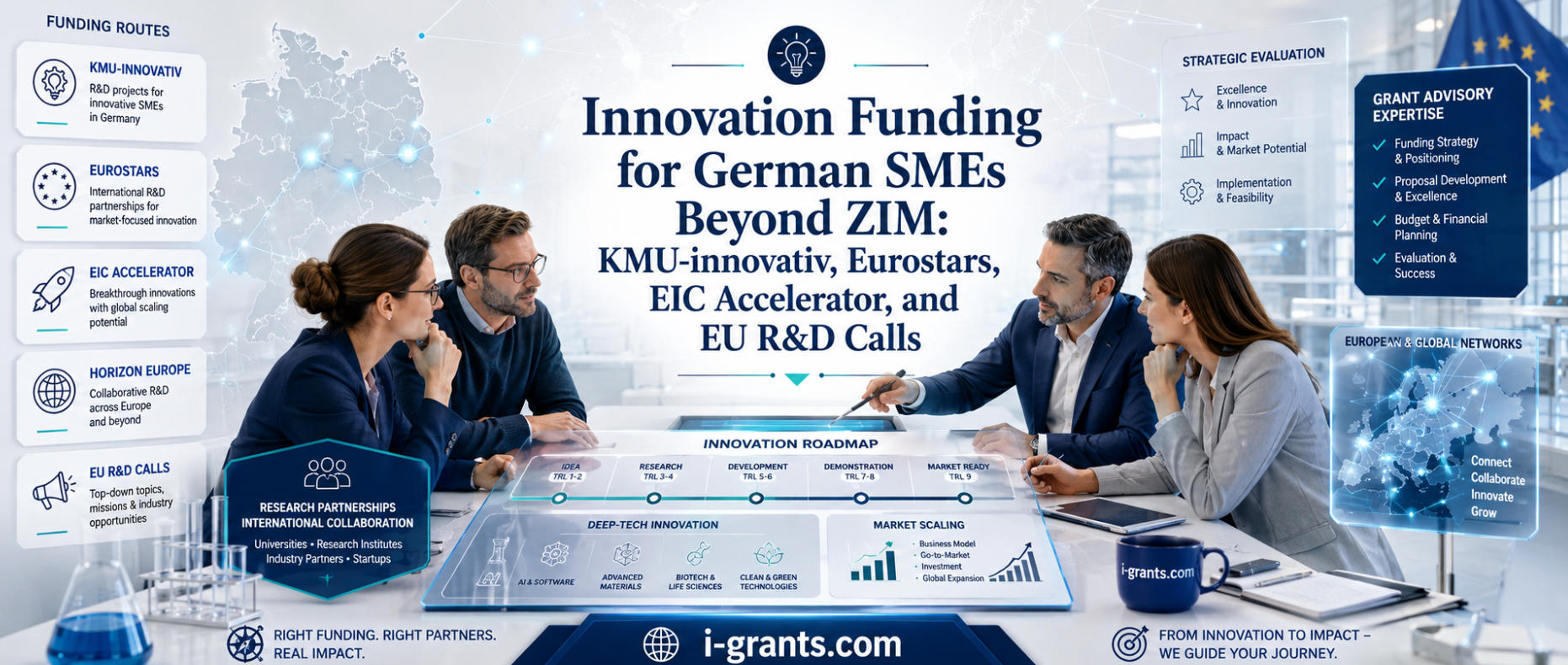
For many German small and medium-sized enterprises, innovation funding starts with ZIM. That is understandable: ZIM is widely known, SME-friendly, and designed for applied R&D projects. But ZIM is not the only serious route. A company with a high-risk technology, an international R&D partnership, a deep-tech scale-up case, or a strong fit with a European research topic may need a different funding instrument.
This is where KMU-innovativ, Eurostars, the EIC Accelerator, and Horizon Europe calls become relevant. They are not interchangeable. Each route has its own logic, applicant profile, evaluation culture, timing, and risk. Choosing the wrong programme can waste months. Choosing the right one can turn an innovation project into a fundable R&D, market-entry, or scale-up strategy.
The need for better funding navigation is real. According to KfW Research, 1.6 million German SMEs, or 41% of all SMEs, introduced at least one innovation in the 2022 to 2024 period, while SME innovation expenditure reached EUR 35.4 billion in 2024. KfW also notes that innovation activity is concentrated among fewer, mainly larger companies, which makes structured access to funding especially important for smaller firms. At the same time, Germany’s business sector invested EUR 90.4 billion in internal R&D in 2023, while external R&D spending rose to EUR 31.8 billion, showing how important cooperation, outsourcing, and research partnerships have become in the German innovation system.
Why “Beyond ZIM” Does Not Mean “Better Than ZIM”
The right question is not whether KMU-innovativ, Eurostars, EIC Accelerator, or Horizon Europe is “better” than ZIM. The right question is whether the project profile fits the programme.
ZIM is often suitable for applied SME innovation, including individual R&D projects and cooperation projects. But other routes may be stronger when the innovation has a higher scientific-technical risk, requires cross-border partners, targets European research priorities, or needs a combined grant and investment route for scale-up.
A German SME should look beyond ZIM when at least one of the following conditions applies:
-
The project is research-heavy and clearly exceeds the current state of the art.
-
The company needs partners in another country to develop the technology.
-
The innovation is a breakthrough product, platform, or deep-tech solution with European or global scale-up potential.
-
The project fits a specific Horizon Europe topic and requires a European consortium.
-
The company needs not only subsidy funding, but also investor-facing validation.
These routes are more demanding than many national SME programmes. They require stronger technical evidence, clearer market logic, better partner alignment, and more disciplined project documentation.
Table 1. Innovation Funding Routes for German SMEs Beyond ZIM
| Funding route | Best fit | Applicant model | Typical support logic | Timing logic | Main risk |
|---|---|---|---|---|---|
| KMU-innovativ | High-risk R&D by German SMEs in defined technology fields | German SME alone or with research partners | Grant for industrial research or pre-competitive development | Project outlines are usually assessed around 15 April and 15 October | Project is too routine, too commercial, or not sufficiently above the state of the art |
| Eurostars | International SME-led R&D project with market potential | Consortium led by an innovative SME, with partners from at least two Eurostars countries | National public funding for each eligible partner | Usually two cut-offs per year | Consortium fails international or national eligibility rules |
| EIC Accelerator | Breakthrough innovation by a start-up or SME ready for scale-up | Single SME or start-up from an eligible country | Grant plus possible equity investment | Short proposals anytime, full proposal batching dates during the year | Weak scale-up story, insufficient investor readiness, unclear freedom to operate |
| Horizon Europe R&D calls | EU topic-driven R&D or innovation project | Usually a consortium of partners from several eligible countries | RIA, IA, CSA, or other action type depending on the call | Deadlines depend on the specific topic in the Funding and Tenders Portal | Poor topic fit, weak impact section, unrealistic consortium or budget |
KMU-innovativ: When a German SME Has a High-Risk R&D Project
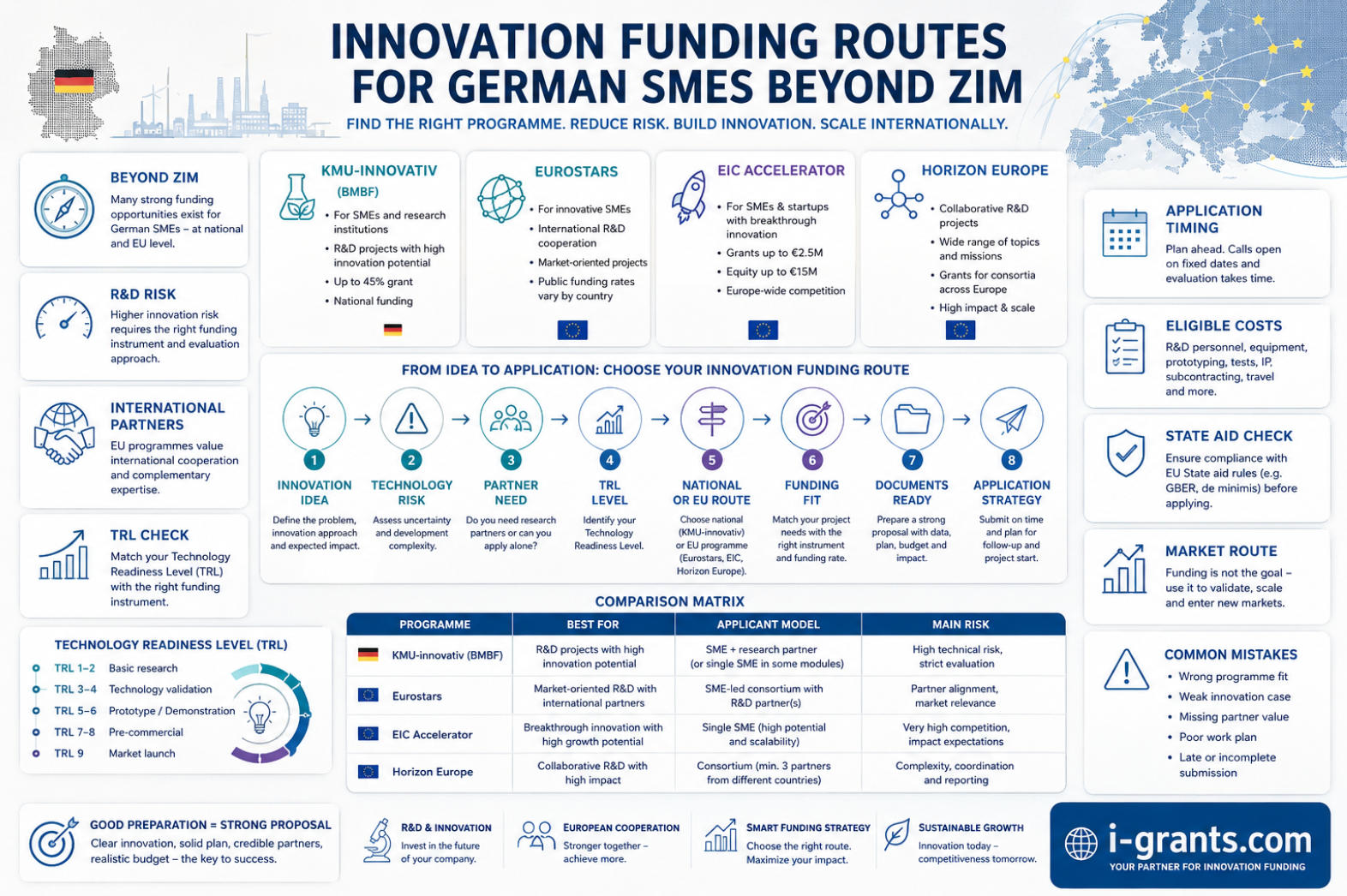
KMU-innovativ is a federal innovation funding route for ambitious R&D projects by SMEs. It is especially relevant when a company is working on a technically difficult project that is not simply an incremental product improvement. The official German funding database describes KMU-innovativ material research, for example, as support for risky industrial research and pre-competitive development. It can support SME projects as individual projects or collaborative projects with universities, research institutions, or mid-sized companies.
A key distinction is the level of R&D risk. KMU-innovativ is not designed for ordinary digitalisation, standard product adaptation, or market launch costs. The project should show a convincing technological problem, a clear development gap, and a solution that significantly exceeds the current state of the art. In the material research line, the funding database states that projects must have high scientific-technical and economic risk and must significantly exceed the state of the art.
Funding rates depend on the programme line, legal basis, project category, and applicant type. In the KMU-innovativ material research example, commercial companies normally receive 50% of eligible costs, SMEs may receive a bonus under certain conditions, and universities or non-university research institutions can receive up to 100% of eligible expenditure. This makes the instrument attractive for SME-research cooperation, but it also means the budget must be built carefully around eligible cost categories, partner roles, and state aid limits.
KMU-innovativ is usually a two-stage process. First, the SME or consortium submits a project outline. If the outline is positively evaluated, the applicant is invited to submit a formal funding application through easy-Online. Several KMU-innovativ lines use assessment dates around 15 April and 15 October. For the “Zukunft der Wertschöpfung” line, the official funding database lists 15 April and 15 October as assessment dates and confirms that successful outlines move to a formal application stage through easy-Online.
For applicants, the strategic task is to prove that the project is not just desirable, but fundable. The outline should explain the technical uncertainty, the state-of-the-art gap, the work packages, the partner logic, the exploitation route, and the expected benefit for the company’s competitive position. A strong KMU-innovativ application reads less like a sales brochure and more like a disciplined R&D case.
Eurostars: When Innovation Needs International Partners
Eurostars is one of the most relevant routes for German SMEs that want to develop a new product, process, or service with partners in other countries. It is a bottom-up programme, which means the project does not need to fit a narrow thematic call. Instead, it must be a civilian R&D and innovation project with a strong consortium and a credible market route.
The official German funding database describes Eurostars 3 as a programme for SMEs that carry out R&D projects with European partners under the Eureka initiative. For German commercial companies, the grant can cover up to 50% of eligible costs, while universities and non-university research institutions may receive up to 100% of eligible expenditure. The maximum funding amount for German participants in one Eurostars project is EUR 500,000.
The consortium rules are central. A Eurostars project must involve partners from at least two participating countries, the project must be led by an innovative SME, SMEs must account for at least 50% of the total R&D project costs, and no single participant or country may carry more than 70% of the total project costs. The funded product or process should normally reach market maturity within two years after project completion.
For German applicants, there is a second layer of risk: international eligibility does not automatically guarantee German national funding. The German procedure includes a Eurostars application in English through the Eureka system, plus national funding steps involving DLR Projektträger and easy-Online. The German funding database also notes that funding depends on the availability of funds in the participating countries, and a project that meets the minimum score may still not be funded if budgets are insufficient.
As of July 2026, the German Eureka/DLR website lists the next Eurostars proposal cut-off as 10 September 2026 at 14:00 CEST. This makes Eurostars a time-sensitive route. A serious consortium should not wait until the final weeks. The budget split, partner roles, SME status evidence, commercialisation plan, and national eligibility checks should be aligned early.
Eurostars is strongest when the cross-border partnership is essential, not decorative. A German SME should be able to explain why the foreign partner is needed, what each partner contributes, who owns which results, how the market route will work, and why the project cannot be delivered as a purely national project.
EIC Accelerator: When the SME Is Building a Breakthrough Scale-Up Case
The EIC Accelerator is different from classic project grants. It targets start-ups and SMEs with breakthrough innovations that can create new markets or transform existing ones. It is particularly relevant for deep-tech companies, high-risk technologies, and scale-up cases where private investors may not yet finance the full risk.
The EIC’s latest public information states that the Accelerator supports start-ups and small businesses with grant funding of up to EUR 2.5 million, complemented by equity investments from the EIC Fund ranging between EUR 1 million and EUR 10 million. Higher equity support may be available under the EIC STEP Scale-up scheme. Beyond money, selected companies receive Business Acceleration Services, including access to experts, investors, corporates, and innovation ecosystem actors.
The application process is demanding. The EIC Accelerator starts with a short proposal that can be submitted at any time and is batched for evaluation every first Tuesday of the month at 17:00 Brussels time. The short proposal includes a 12-page form, a pitch deck of up to ten slides, and a video pitch of up to three minutes. If the proposal receives a “GO”, the applicant may prepare a full proposal.
For 2026, the EIC lists full proposal batching dates on 7 January, 4 March, 6 May, 8 July, 2 September, and 4 November. The full proposal includes a 20-page form, pitch deck, implementation plan, financial information, letters of intent, freedom to operate analysis, and a three-minute video pitch.
For a German SME, EIC Accelerator readiness is not just about innovation. The company must show a credible route to market, a defensible technology position, a strong team, a financing need that cannot be fully met by the market alone, and a scale-up story that makes sense at European or global level. A technically interesting product is not enough if the commercial model, go-to-market path, regulatory route, investment case, or intellectual property position is weak.
The EIC is also highly competitive. In June 2026, the EIC reported that 38 start-ups and SMEs secured support in a recent Accelerator round, with EUR 90 million in grant funding and EUR 202 million provisioned for potential equity investments. Another 95 applications were above threshold but could not be funded because of insufficient budget. For applicants, this means a “good” proposal may still fail. The proposal must be exceptional.
Horizon Europe R&D Calls: When the Project Fits a European Topic
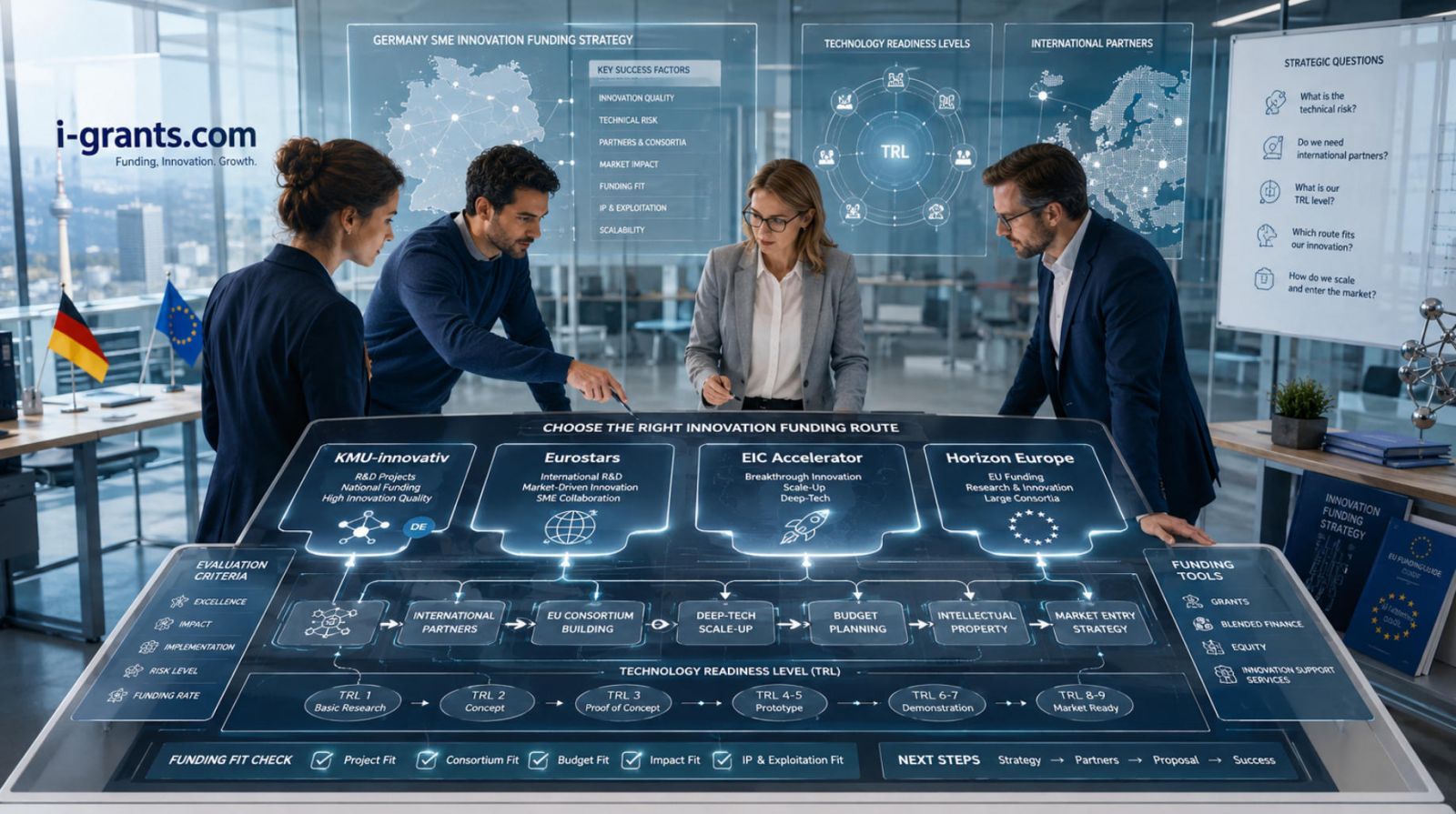
Horizon Europe is not one SME grant. It is the EU’s main research and innovation funding programme for 2021 to 2027, with an indicative funding amount of EUR 93.5 billion after the Multiannual Financial Framework midterm review. It includes clusters, missions, partnerships, the European Innovation Council, European Innovation Ecosystems, and other programme areas.
For German SMEs, Horizon Europe becomes relevant when the company can contribute to a specific European research or innovation topic. This may involve health, digital industry, space, climate, energy, mobility, food systems, bioeconomy, raw materials, circular economy, or other EU priorities. The European Commission states that funding opportunities are set out in work programmes and that application procedures are managed through the Funding and Tenders Portal.
The action type matters. Research and Innovation Actions usually support the creation of new knowledge or exploration of new technologies and can cover up to 100% of project costs. Innovation Actions support activities closer to prototyping, testing, piloting, validation, and market replication, and the EU funding rate is usually up to 70% of project costs. Coordination and Support Actions can cover up to 100% of project costs.
A German SME should not enter Horizon Europe only because “EU money is available”. The first test is topic fit. The second is consortium fit. The third is internal capacity. Horizon proposals require serious work on excellence, impact, implementation, dissemination, exploitation, communication, data management, ethics, partner governance, and budget logic. For many SMEs, joining a strong consortium is more realistic than coordinating one.
Horizon Europe can be powerful when the SME owns a specific technical capability that a consortium needs. For example, an SME may provide a sensor platform, AI module, testing environment, manufacturing process, pilot site, user interface, cybersecurity component, clinical validation path, or circular materials solution. The company’s role should be essential, measurable, and linked to exploitation after the project.
Table 2. Which Programme Fits Your Innovation Project?
| Project situation | Best first route to check | Why it fits | What to prepare before applying |
|---|---|---|---|
| German SME has a high-risk R&D idea in a defined technology field | KMU-innovativ | The project may fit a federal R&D line with SME focus and two-stage outline process | Technical concept, state-of-the-art analysis, risk logic, work packages, exploitation plan |
| German SME needs a foreign R&D partner to develop a marketable product | Eurostars | The programme is built for SME-led international R&D projects | Consortium agreement logic, partner budgets, SME evidence, market route, national eligibility checks |
| Start-up or SME has a breakthrough deep-tech solution ready for scale-up | EIC Accelerator | The route combines grant support with potential equity investment | Short proposal, pitch deck, video, FTO analysis, implementation plan, financial model, investor logic |
| SME has a role in a European research or innovation priority | Horizon Europe call | The project can be funded through a topic-driven European consortium | Topic analysis, partner search, role definition, impact contribution, budget and exploitation plan |
| Company mainly wants ordinary product adaptation or commercial roll-out | Usually not these routes | The project may lack R&D risk or European added value | Consider ZIM, state-level innovation support, loans, advisory funding, or private finance |
Documents and Readiness Checks Before Choosing the Route
Before writing a grant application, a German SME should prepare a route selection file. This is a short internal dossier that helps decide whether the project belongs in KMU-innovativ, Eurostars, EIC Accelerator, Horizon Europe, ZIM, or another funding route.
The file should include:
-
A one-page project concept with the technical problem, proposed solution, target users, and expected result.
-
A state-of-the-art note showing what already exists and why the proposed solution is meaningfully new.
-
A technology readiness estimate, including what has already been tested and what remains uncertain.
-
A partner map showing whether research institutions, international companies, pilot users, or consortium partners are needed.
-
A preliminary budget with personnel, equipment, subcontracting, travel, materials, and external R&D costs separated.
-
A funding risk check covering SME status, state aid, cumulation, financial capacity, project start rules, IP, and freedom to operate.
This preparation is useful even if the company later decides not to apply. It clarifies whether the project is a grant case, a loan case, an investor case, or an internal development case.
Common Mistakes German SMEs Make
A strong innovation project can still fail if the funding route is wrong. The most common mistakes are predictable:
-
Treating all innovation grants as the same and reusing one generic proposal.
-
Applying to KMU-innovativ without proving high scientific-technical risk.
-
Entering Eurostars with a weak international consortium or unclear partner value.
-
Applying to the EIC Accelerator with a product story but no scale-up, investment, or market-creation logic.
-
Joining a Horizon Europe consortium without a clearly defined SME role.
-
Starting project work before the permitted point or mixing public funding sources without a state aid check.
The final mistake is underestimating the application workload. These programmes are not only administrative forms. They require strategy, evidence, technical clarity, budget discipline, and a convincing exploitation story.
Where a Grant Writer Adds Value
A grant writer cannot turn a weak project into a strong innovation. But a skilled grant writer can help a strong project become understandable, fundable, and compliant.
For KMU-innovativ, the grant writer helps translate technical work into a structured R&D case with clear novelty, risk, work packages, and exploitation. For Eurostars, the role often includes consortium narrative, partner alignment, evaluation logic, and national eligibility coordination. For the EIC Accelerator, the work becomes closer to investor communication: market creation, business model, scale-up milestones, financing gap, competitive position, and pitch materials. For Horizon Europe, the grant writer must understand the topic text, EU policy logic, impact pathways, consortium roles, and proposal scoring.
The best time to involve a grant writer is before the route is chosen. If the writer joins only after the company has selected the wrong programme, much of the work becomes damage control.
Strategic Takeaway
German SMEs do not need to chase every innovation funding call. They need to identify the route that matches their project type.
KMU-innovativ is a strong route for high-risk German SME R&D in defined technology fields. Eurostars is best when international SME-led cooperation is essential to the innovation. EIC Accelerator is for breakthrough start-ups and SMEs that need scale-up funding and can defend a strong investment case. Horizon Europe is the right route when the SME can contribute to a specific European research or innovation topic through a serious consortium.
The practical rule is simple: do not start with the grant name. Start with the project logic. Define the technology risk, partnership need, market route, TRL, budget, IP position, and timing. Only then choose the funding instrument.
For German SMEs, the opportunity is significant. But the competition is real, and the application standards are high. The companies that succeed are usually not those that apply everywhere. They are the ones that select carefully, prepare early, and build a proposal that matches the funder’s logic from the first page.