

 Français
  Deutsch
  Українська
France’s i-Nov Innovation Contest is one of the most substantial public funding opportunities available to innovative startups and small and medium-sized enterprises in France. It can support ambitious research, development and innovation projects with eligible costs measured in millions of euros.
However, i-Nov is not a permanently open grant programme. It is launched through separate competitive waves, and each wave may introduce different deadlines, thematic priorities, financial conditions, application documents and eligibility requirements.
As of July 2026, no new i-Nov wave has been officially announced. The latest completed reference is Wave 14, which closed on 1 October 2024, with its winners presented in 2025. Companies can use the conditions of this wave to understand how the programme works, but they must verify every requirement when the next call is officially published.
What Is the i-Nov Innovation Contest?
The Concours d’innovation i-Nov is financed by the French State through France 2030 and operated by Bpifrance in cooperation with ADEME. Its purpose is to identify high-potential innovation projects led by startups and SMEs and accelerate companies capable of becoming leaders in France and international markets.
The programme cofinances research, development and innovation projects rather than ordinary business expansion. Under Wave 14, total eligible project costs had to range from EUR 1 million to EUR 5 million, while the planned implementation period had to be between 12 and 36 months.
Projects were submitted by a single SME rather than by a formal consortium.
The programme is particularly relevant to companies that have progressed beyond early feasibility work but still face substantial technological, engineering, regulatory, testing or demonstration risks before full commercial deployment.
It is generally not intended for testing an early business idea with a small budget, financing standard product development without meaningful technological uncertainty, purchasing ordinary production equipment, covering general marketing activities or constructing a first industrial facility without a substantial research and innovation component.
Where i-Nov Fits in the France 2030 Funding System
France 2030 includes several funding programmes designed for different stages of company and technology development. Choosing the correct route is essential because even a strong project may be rejected when submitted to an instrument intended for another development stage.
Table 1. Position of i-Nov in the French innovation funding pathway
| Programme | Main purpose | Typical applicant or project stage | When it may be more appropriate than i-Nov |
|---|---|---|---|
| i-PhD | Support entrepreneurial projects arising from public research | Young researchers developing a deeptech business project | The company has not yet been created and the project is still connected to research commercialisation |
| i-Lab | Support the creation and early development of innovative technology companies | Founders or recently created technology companies | The priority is establishing the company and completing early technological development |
| i-Nov | Finance high-potential research, development and innovation projects | Established startups and SMEs with a substantial innovation programme | The company has a defined technology, team, market and significant project budget |
| i-Démo | Support structural R&D and innovation projects in strategic markets | Companies or partnerships pursuing larger and more complex projects | The project is larger, collaborative or organised around a major demonstrator |
| Première Usine | Support first industrialisation projects in France | Industrial startups and innovative SMEs | The principal challenge is establishing a pilot production line or first commercial factory |
The French innovation competitions place i-PhD and i-Lab upstream of i-Nov. i-PhD supports young researchers developing deeptech entrepreneurial projects, while i-Lab focuses on the creation of innovative technology companies.
i-Démo addresses larger and more structural R&D projects, including collaborative initiatives and demonstrators. Première Usine focuses on the establishment of a first industrial production facility in France.
A company should not select i-Nov simply because it offers substantial public support. The project must be at the correct development stage and contain genuine research or innovation barriers.
Who Can Apply for i-Nov?
Wave 14 was intended for projects submitted by a single SME within the meaning of the European Union definition. The applicant was expected to be an established company capable of managing a substantial innovation project and financing the share of costs not covered by public aid.
Applicants must verify their SME status at group level rather than examining only the headcount and financial statements of the individual legal entity. Shareholdings, voting rights, partner enterprises and linked enterprises can change the calculation.
A strong i-Nov candidate normally has a legally established company, a complete management and technical team, a technology that has progressed beyond basic feasibility, clearly defined technical barriers, sufficient financial capacity and a credible route to substantial market impact.
Being an innovative startup is not sufficient by itself. The applicant must be able to implement a project with eligible costs of at least EUR 1 million under the Wave 14 reference conditions and finance the portion not covered by State support.
Project Size, Duration and Funding Intensity
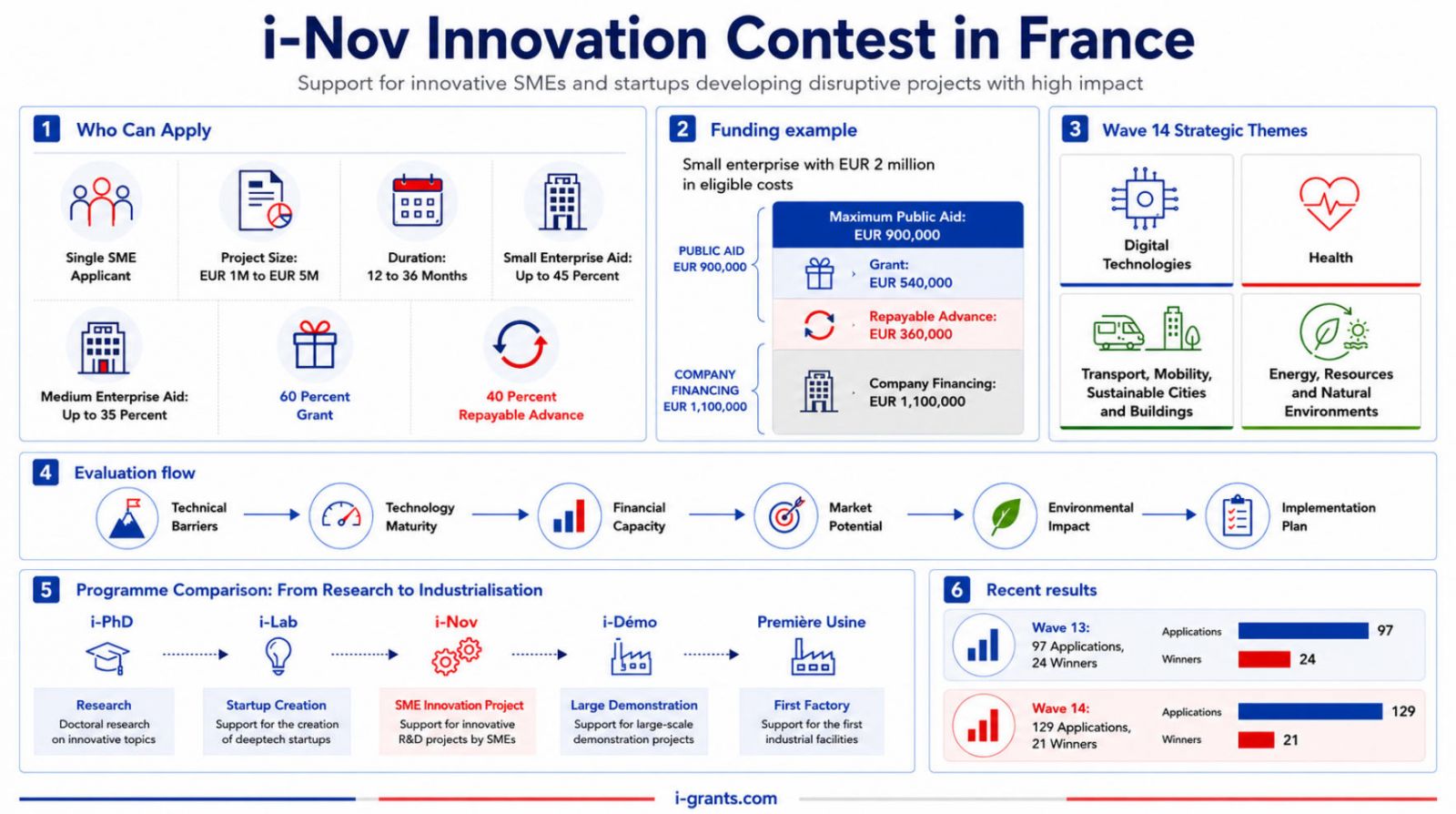
Wave 14 established different maximum aid rates for small and medium-sized enterprises. This distinction is important because a medium-sized company had to finance a larger share of its project from private or other eligible sources.
Table 2. Main financial parameters of i-Nov Wave 14
| Parameter | Wave 14 reference condition | Practical implication |
|---|---|---|
| Applicant structure | One SME submitting an individual project | The application could not be submitted as a formal multipartner consortium |
| Total project costs | EUR 1 million to EUR 5 million | Projects below the minimum threshold required another funding route |
| Project duration | 12 to 36 months | The work plan needed defined technical, operational and financial milestones |
| Maximum aid rate for a small enterprise | 45% of eligible costs | The company had to finance at least 55% of eligible expenditure |
| Maximum aid rate for a medium-sized enterprise | 35% of eligible costs | The company had to finance at least 65% |
| Aid composition | 60% grant and 40% repayable advance | The full award was not non-repayable funding |
| Initial payment | 20% of awarded aid | The company still needed sufficient liquidity to start and continue the project |
| Final balance | At least 20% | Part of the support remained dependent on project completion and reporting |
These figures describe Wave 14 and should not automatically be treated as confirmed conditions for a future competition. The next wave may modify the financial thresholds, aid rates, thematic areas or payment structure.
Why a 45% Aid Rate Does Not Mean a 45% Grant
One of the most common misunderstandings is that a small enterprise can receive a grant equal to 45% of the total project budget.
Under the Wave 14 structure, 45% was the maximum total aid intensity for a small enterprise. Only 60% of that aid was provided as a grant. The remaining 40% took the form of a repayable advance.
Consider a small enterprise with EUR 2 million in accepted eligible costs.
Table 3. Illustrative i-Nov funding calculation for a small enterprise
| Funding component | Calculation | Amount |
|---|---|---|
| Total eligible project costs | Reference budget | EUR 2,000,000 |
| Maximum total public aid | EUR 2,000,000 × 45% | EUR 900,000 |
| Grant component | EUR 900,000 × 60% | EUR 540,000 |
| Repayable advance component | EUR 900,000 × 40% | EUR 360,000 |
| Costs financed from other sources | EUR 2,000,000 minus EUR 900,000 | EUR 1,100,000 |
In this example, the effective grant represents 27% of total eligible project costs, not 45%. The repayable advance represents another 18%, while the company must finance the remaining 55%.
The actual award may be lower than the theoretical maximum. The operator can adjust the eligible cost base, aid intensity and payment conditions according to State aid rules, financial analysis, available programme resources and the overall quality of the application.
A repayable advance should not be described as a grant or free capital. Its repayment conditions are established in the funding agreement. The company must assess how future repayments will affect cash flow alongside equity financing, bank loans and private investment.
Eligible Project Costs
Wave 14 included several categories of expenditure that could be accepted when directly connected to the approved innovation project.
Eligible costs could include internal personnel working on the project, external research and subcontracting, depreciation of equipment used for the project, business travel, materials, components, consumables and certain calculated related costs.
Subcontracting was generally limited to 30% of total project costs. It could reach 40% when the subcontracted work was performed by a research organisation or laboratory.
These limits reflect an important programme principle. The applicant must retain substantial control over the innovation and cannot outsource nearly all technical work to consultants, laboratories or engineering contractors.
A credible budget must show a direct relationship between each cost, technical objective and work package. It should identify the employees responsible for specific tasks, explain why external expertise is needed, justify equipment depreciation and connect material costs to development, testing or validation activities.
Routine operating expenditure, general commercial costs, ordinary marketing activity and investments unrelated to the R&D programme should remain outside the eligible cost base.
Strategic Themes in Wave 14
Each i-Nov wave defines thematic areas linked to France 2030 priorities. A project must not only be innovative but also fit the detailed scope of one of the published themes.
Wave 14 included four principal thematic areas.
Table 4. Strategic themes of i-Nov Wave 14
| Wave 14 theme | Examples of areas covered |
|---|---|
| Digital technologies | Advanced digital systems, data technologies, cybersecurity, digital infrastructure and high-value digital innovation |
| Health | Medical technologies, biotechnology, digital health, diagnostic solutions and other innovative health applications |
| Transport, mobility, sustainable cities and buildings | Sustainable mobility, transport systems, urban technologies, construction materials and low-impact buildings |
| Energy, resources and natural environments | Renewable and nuclear energy, hydrogen, energy storage, circular economy, water, biodiversity, bioeconomy, climate adaptation and ecological transformation |
The energy, resources and natural environments theme covered a broad range of challenges, including energy generation and storage, sustainable biomass, water security, biodiversity, circular products and services, material efficiency, air quality and sustainable industrial or agricultural production.
Applicants should not interpret a broad title as automatic eligibility. A digital company does not qualify merely because its product uses artificial intelligence. A climate-focused company does not qualify merely because it refers to sustainability in its commercial materials.
The application must establish a precise connection between the proposed work and the detailed thematic specifications of the relevant wave.
What Evaluators Look For
i-Nov selection is not based only on technological novelty. Evaluation combines innovation quality, technology maturity, financial capacity, market potential, implementation ability and measurable impact.
Table 5. Main i-Nov evaluation areas and expected evidence
| Evaluation area | Questions considered by evaluators | Evidence expected from the applicant |
|---|---|---|
| Innovative character | What scientific, technological or engineering barriers remain? How does the solution differ from the state of the art? | State-of-the-art analysis, technical specifications, testing results, intellectual property position and quantified targets |
| Technology maturity | What development level will the project reach? Is the proposed pathway realistic? | Starting maturity, target maturity, prototype status, validation plan and milestone schedule |
| Financial capacity | Can the company finance its share and remain solvent throughout implementation? | Financial statements, equity plan, cash-flow forecast, fundraising strategy and committed financing |
| Economic impact | Can the project generate substantial revenue and a defensible competitive advantage? | Market segmentation, customer evidence, revenue assumptions, pricing model and competitor analysis |
| Social and industrial impact | Will the project create employment and strengthen a French industrial or technological value chain? | Recruitment plan, location of activities, suppliers, industrial partnerships and territorial impact |
| Environmental impact | Will the project reduce emissions, energy use, material consumption or another environmental burden? | Baseline data, impact methodology, lifecycle assessment where relevant and measurable targets |
| Replicability and scaling | Can the solution be deployed beyond a single site or customer? | Commercialisation strategy, production plan, regulatory pathway and international expansion potential |
Applicants need to identify the precise technical barriers that remain unresolved. A general statement that the project is innovative is not enough.
The application should also define the target maturity at the end of the project. Under Wave 14, projects could aim to reach an advanced level of technological readiness, including validation in operational conditions or preparation for market deployment.
Economic forecasts must be credible. Evaluators consider projected revenue, the size of the addressable market, customer demand, competitive differentiation and the company’s ability to commercialise the result after the funded work is completed.
Environmental and social claims must also be measurable. Statements about sustainability, employment or strategic autonomy should be supported by baselines, assumptions and a transparent calculation method.
The Financial Capacity Test
The scale of i-Nov creates a financial challenge that many early startups underestimate.
Even when a small company receives the maximum reference aid rate, it must still finance at least 55% of eligible project costs. It must also cover ineligible expenditure, manage the timing of public payments and absorb potential delays, cost increases or fundraising difficulties.
Wave 14 evaluation materials referred to the relationship between the applicant’s equity and the amount of aid requested. A minimum ratio of approximately one euro of equity for every euro of requested aid was used as an important financial capacity benchmark.
This did not necessarily mean that the entire amount had to appear on the company’s latest balance sheet at the time of submission. Planned capital increases and a credible financing trajectory could also be considered. However, an unsupported promise to raise funds after selection would not normally provide sufficient assurance.
A credible financing plan should combine current equity, shareholder support, expected capital increases, available cash, operating revenue, bank financing, private investment and the projected timing of public payments. It should also include a downside scenario showing how the company would continue the project if fundraising, customer revenue or technical milestones were delayed.
The financial plan should be tested before the company invests heavily in preparing the application. A technologically excellent project can still fail when the applicant cannot demonstrate the capacity to complete it.
Latest Results and Competition Levels
i-Nov has supported a substantial portfolio of innovative French companies, but competition for funding remains strong.
Wave 11 received 149 applications and selected 42 winners, representing an approximate success rate of 28%. Total public support reached EUR 43.4 million.
Wave 13 received 97 applications and selected 24 winners for EUR 27.6 million in aid. Wave 14 received 129 applications and selected 21 winners for EUR 23.4 million.
Together, Waves 13 and 14 produced 45 winning companies and more than EUR 51 million in public support.
Table 6. Recent i-Nov competition results
| Competition reference | Applications | Winners | Approximate success rate | Public support |
|---|---|---|---|---|
| Wave 11 | 149 | 42 | 28% | EUR 43.4 million |
| Wave 13 | 97 | 24 | 25% | EUR 27.6 million |
| Wave 14 | 129 | 21 | 16% | EUR 23.4 million |
| Waves 13 and 14 combined | 226 | 45 | 20% | More than EUR 51 million |
The lower success rate in Wave 14 demonstrates that formal eligibility does not guarantee funding. Applicants compete against other companies for a limited budget, and the final selection reflects technological quality, strategic relevance, financial credibility and the strength of the implementation plan.
What Recent Winners Reveal About Competitive Projects
Wave 14 winners operated in fields such as secure medical data processing, biotechnology, sustainable transport, environmental monitoring, advanced digital infrastructure, energy systems, circular production and biological agricultural solutions.
The projects were not limited to basic laboratory research. They combined unresolved technical work with a clear route toward demonstration, industrial adoption or commercial deployment.
Examples included more efficient volumetric video systems, protected processing of sensitive health data, electric propulsion solutions for small vessels and biological methods for controlling agricultural pests.
Several characteristics appear repeatedly across winning projects.
First, the innovation addresses a specific technical obstacle rather than a general commercial opportunity. Second, the project ends with a result that can progress toward industrial or market deployment. Third, the expected benefit is quantified through performance, cost, health, environmental or productivity indicators. Finally, the applicant has a clear role in France’s innovation, industrial or strategic ecosystem.
A persuasive application therefore requires both technological depth and commercial discipline. A long scientific description without a credible market pathway is incomplete. A strong sales forecast without evidence of genuine technical uncertainty is equally weak.
Application and Selection Process
For Wave 14, applicants submitted a complete file through Bpifrance’s PICXEL platform. The process included initial screening, detailed evaluation, a jury hearing, a final financing decision and contractual arrangements.
The application package included a detailed technical and commercial project presentation, a project budget, a public summary, a completed aid request form, an environmental and socioeconomic impact assessment, financial statements, tax documentation, consolidated accounts where applicable and proof of signing authority.
Applicants should not wait until the final weeks of a future call to assemble this information. Technical work packages, subcontractor quotations, financial projections, environmental indicators, State aid analysis and regulatory plans may take several months to prepare and validate.
The strongest preparation process begins before the call opens. A company can develop a funding-ready project file and later adapt it to the exact thematic specifications, financial conditions and official templates of the next wave.
Common Reasons an i-Nov Application May Fail
A project can satisfy the formal eligibility rules and still remain uncompetitive.
Common weaknesses include presenting a normal product roadmap without identifying genuine R&D barriers, selecting a theme based only on broad sector similarity, using unsupported market forecasts, requesting the maximum aid rate without a financing plan and relying too heavily on subcontractors for core technological work.
Other weaknesses include mixing R&D costs with marketing or routine operations, failing to establish intellectual property ownership, omitting the regulatory pathway in controlled markets, making environmental claims without measurable evidence and treating the repayable advance as if it were a non-repayable grant.
Each weakness may affect several evaluation areas simultaneously. An unrealistic sales forecast, for example, can weaken both the economic impact assessment and the financial plan.
i-Nov or Another Funding Route?
A company should compare i-Nov with alternative national, regional and European instruments before preparing a full application.
Table 7. When to consider i-Nov and when to look elsewhere
| Project situation | Likely assessment |
|---|---|
| The company needs less than EUR 1 million for feasibility work or an early prototype | A smaller Bpifrance innovation grant or loan may be more appropriate |
| The founder is commercialising public research and has not yet created the company | i-PhD or i-Lab may provide a better fit |
| The company has a EUR 1 million to EUR 5 million R&D project with clearly defined technical barriers | i-Nov may be appropriate |
| The project depends on a large formal consortium | A collaborative i-Démo or European funding programme may be more suitable |
| The technology is ready and the principal cost is building the first production site | Première Usine may be the more relevant route |
| The project is mainly a regional modernisation investment | A regionalised France 2030 programme or regional aid may be more appropriate |
| The company cannot finance at least 55% to 65% of eligible costs under the Wave 14 model | The project may need to be resized, delayed or combined with equity and other financing |
| The project is mainly focused on marketing, sales or international expansion | i-Nov is unlikely to be the correct instrument |
Companies should evaluate the funding route according to the project’s actual stage rather than the size of the potential award.
A project that is too early for i-Nov may still qualify for feasibility funding, an innovation grant, a loan or i-Lab support. A project that has already completed its R&D phase and mainly needs production capacity may be more suitable for Première Usine or another industrial investment programme.
Five Questions to Answer Before Preparing an Application
Before investing in a full i-Nov application, management should answer five questions.
-
What technical uncertainty will the project resolve?
The answer should identify measurable scientific, engineering, software, manufacturing or regulatory barriers rather than a list of product features that remain to be developed. -
Why is the project strategically relevant to the published theme?
The connection must be based on the detailed competition specifications rather than a broad interpretation of the sector title. -
Can the company finance the part of the budget not covered by public aid?
Management should test the project against available equity, expected fundraising, cash needs, debt capacity and payment timing. -
What will exist at the end of the project?
The application should define the expected technology maturity, prototype, validated system, regulatory result or demonstration outcome. -
How will the project create measurable value after completion?
Evaluators need evidence of revenue potential, customer demand, employment, exports, industrial value, environmental impact or strategic autonomy.
An uncertain answer does not necessarily mean that the company should abandon public funding. It may indicate that further preparation is required or that another financing instrument is more suitable.
How to Prepare for the Next i-Nov Wave
Because no new i-Nov wave is currently open, companies can use the preparation period to strengthen their projects without forcing them into an expired competition timetable.
The first priority is to define the project independently of the funding application. The company should establish its technical baseline, unresolved barriers, target maturity, work packages, staffing requirements and expected outputs.
The second priority is to develop a complete financing plan. This should include the eligible-cost model, the company’s contribution, equity requirements, cash-flow timing and the potential repayment obligations connected to the repayable advance.
The third priority is to validate market demand. Customer interviews, pilot discussions, letters of interest, regulatory consultations and competitor analysis can substantially improve the commercial case.
The fourth priority is to quantify economic, social and environmental impact. Employment, revenue, exports, emissions, energy use, material consumption, water use and other indicators should be connected to transparent assumptions and calculation methods.
Finally, the company should monitor official Bpifrance, ADEME and France 2030 announcements. The next wave may change the eligible budget range, aid intensity, thematic areas, documents, evaluation procedure or project duration.
Applicants should never submit an old application template or assume that the conditions of Wave 14 remain automatically valid.
Conclusion
i-Nov is one of France’s most valuable innovation funding competitions for startups and SMEs, but it is also one of the most demanding.
Under the latest completed reference wave, eligible projects had total costs of EUR 1 million to EUR 5 million and lasted between 12 and 36 months. Small enterprises could receive public aid covering up to 45% of eligible costs, while medium-sized enterprises could receive up to 35%.
This support combined a grant with a repayable advance. Applicants therefore still needed substantial equity, liquidity and external financing to complete their projects.
A competitive i-Nov proposal requires more than an innovative product. It needs clearly defined technological barriers, a realistic development plan, strong financial capacity, measurable economic or environmental impact and a credible route from R&D to market deployment.
For companies that meet these conditions, i-Nov can provide substantial funding, public recognition and additional credibility with investors, banks, customers and industrial partners.
For companies that are too early, too focused on routine commercialisation, primarily concerned with industrial construction or unable to finance their share of the project, another Bpifrance, France 2030, regional or European programme will usually provide a better route.