

 Français
  Deutsch
  Українська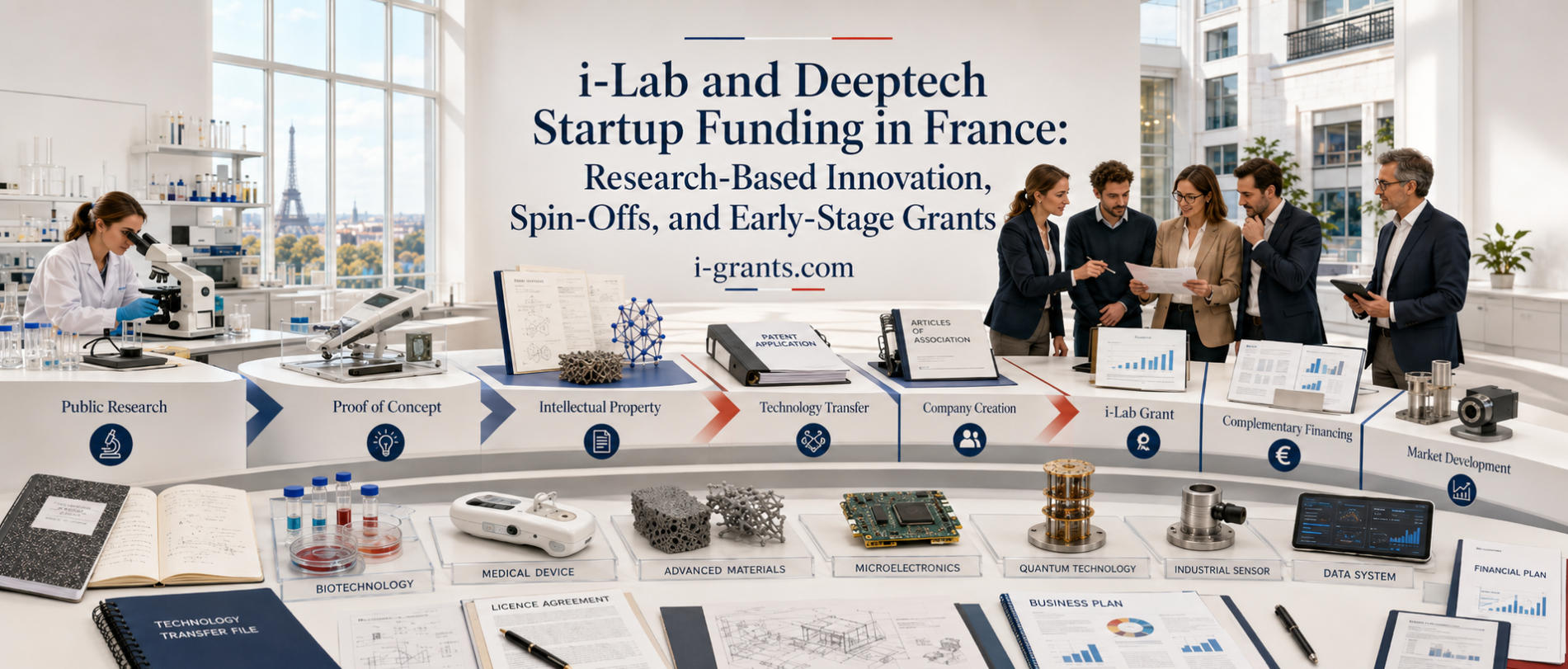
France’s i-Lab Innovation Contest is one of the country’s most established funding instruments for transforming technological research into viable companies. Since its creation in 1999, the competition has helped thousands of founders move from laboratory results, protected inventions and early prototypes toward the creation of technology businesses in France.
i-Lab is particularly important for deeptech projects emerging from universities, public research organisations, hospitals and corporate research teams. It can also support independent founders who possess a sufficiently mature technological innovation and a credible plan to establish a company around it.
The programme should not be treated as a general startup grant. It is designed for projects in which technical feasibility has already been demonstrated, but significant research and development work remains before the resulting product, process or technology-based service can reach the market.
As of July 2026, the 28th i-Lab competition is closed. Applications were accepted until 3 February 2026. Its rules provide the latest complete reference for prospective applicants, but the conditions, company-age limits, deadlines and application documents must be checked again when the next competition is announced.
What Is the i-Lab Innovation Contest?
The Concours d’innovation i-Lab is financed by the French State under France 2030 and operated by Bpifrance in cooperation with the French Ministry of Higher Education and Research.
Its central objective is not merely to finance a research project. It is to support the creation and early development of a French technology company built around a significant innovation.
This distinction affects the entire application. Evaluators consider the technology, but they also examine the founders, intellectual property rights, market demand, financing strategy, environmental effects and the company’s ability to continue after the grant period.
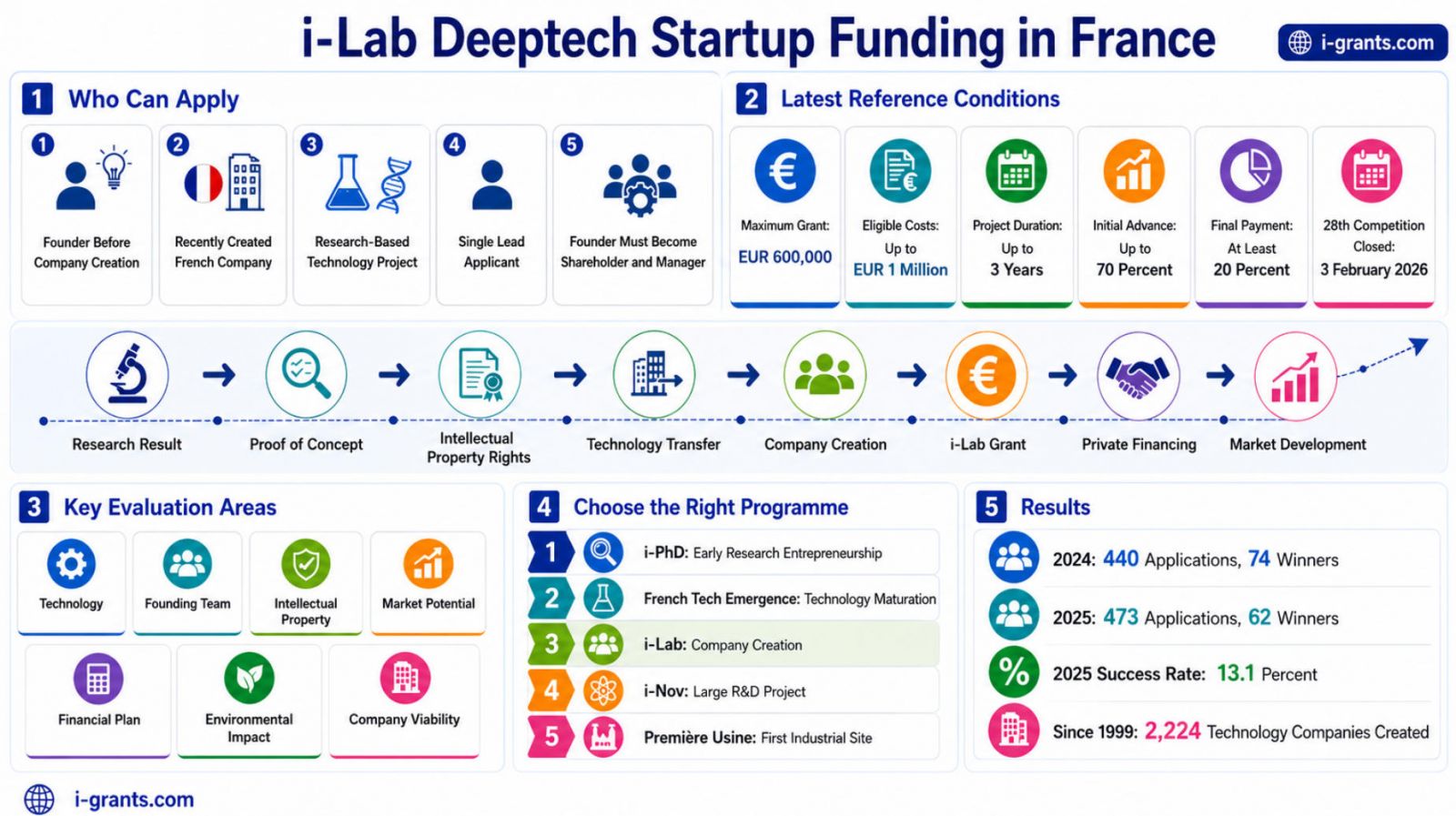
Under the 28th edition, the maximum grant was EUR 600,000, based on up to EUR 1 million in eligible project expenditure. The project and associated funding agreement could generally extend over a period of up to three years.
The competition was open both to founders who had not yet incorporated their company and to recently established businesses meeting the relevant age requirements.
Where i-Lab Fits in the French Deeptech Funding Pathway
France has created a sequence of programmes for moving research-based innovation from scientific work toward company creation, growth and industrial deployment.
Table 1. Position of i-Lab in the French innovation funding pathway
| Programme | Main development stage | Typical applicant | Main purpose |
|---|---|---|---|
| i-PhD | Early entrepreneurial exploration | Doctoral candidates and young researchers | Assess the entrepreneurial potential of research results and develop an initial project |
| Bourse French Tech Emergence | Early deeptech maturation | Future or recently established deeptech companies | Reduce initial technical risk and support feasibility work |
| i-Lab | Company creation and early development | Founders or recently created technology companies | Complete intensive R&D and build a viable company around the technology |
| i-Nov | Large innovation project | Established innovative SME | Finance a substantial R&D project with eligible costs generally measured in millions of euros |
| Première Usine | First industrial deployment | Industrial startup or innovative SME | Establish a first pilot production line or commercial manufacturing site |
The most important difference is that i-Lab focuses on company creation around a technological innovation. It is not intended only to finance laboratory work, and it does not primarily fund large-scale industrial investment.
A project may be too early for i-Lab if the scientific principle has not yet been demonstrated. It may be too advanced if the technology is complete and the main need is construction of a factory or large-scale production equipment.
Current Status of the Competition
The 28th i-Lab edition opened in November 2025 and closed on 3 February 2026 at noon Paris time.
As of July 2026, the competition is no longer accepting applications, and the official list of winners has not yet been published. Prospective applicants should therefore use the 28th-edition rules only as a preparation reference.
The next edition may change:
-
the eligible company creation dates;
-
the application timetable;
-
the financial conditions;
-
the environmental requirements;
-
the required forms and supporting documents.
Companies should avoid preparing an application around an expired deadline or assuming that the same rules will automatically continue.
Who Can Apply?
i-Lab can support a natural person leading a technology company project or a recently created company that satisfies the competition’s age and establishment requirements.
For the 28th edition, a company generally had to be registered in the French Trade and Companies Register after 1 December 2023. A broader eligibility period applied to certain previous beneficiaries of Bourse French Tech Emergence and selected Pépite entrepreneurship programmes.
The applicant’s nationality was not the main eligibility restriction. A foreign founder could potentially participate, provided that the supported company was created in France and the project satisfied all legal, financial and technological conditions.
Where the company had not yet been incorporated, the applicant was expected to become both a shareholder and a manager of the future business. Where the company already existed, the applicant normally had to be involved in its ownership and management.
An applicant could submit only one project. A wider founding team could participate, but one person had to be formally identified as the lead applicant.
What Level of Technology Maturity Is Required?
i-Lab is not intended for a purely theoretical idea or an untested scientific assumption.
Before applying, the project should normally have:
-
A demonstrated technological principle or proof of concept.
-
Evidence that the remaining technical barriers can be addressed through a structured R&D programme.
-
A credible route to obtaining or controlling the necessary intellectual property.
-
An initial understanding of the target market and customer problem.
-
A realistic plan for establishing and financing the company.
At the same time, the product or process should not already be completely developed. The purpose of the grant is to support the remaining research, experimentation, prototyping, validation and company-building work.
This creates a narrow but important funding window. The project must be mature enough to justify company creation, yet still contain substantial technological uncertainty.
Public Research Spin-Offs and Technology Transfer
A major share of i-Lab winners originates from French public research.
In the 2024 competition, approximately 65 percent of winning projects came from public research, while 53 percent involved patents owned by public institutions. Around 60 percent of the winners had received support from a public incubator.
In the 2025 winner portfolio, the share of projects originating from public research increased to approximately 74 percent.
These figures show that i-Lab is one of France’s central instruments for converting academic and public-sector research into companies. However, the existence of a patent or scientific result does not by itself create an investable business.
A research-based team must establish:
-
who owns the patents, software, data and technical knowledge;
-
whether the new company will receive ownership or a licence;
-
whether the licence will be exclusive and valid for the intended markets;
-
what financial payments or royalties will be required;
-
whether the founders have the right to use the research results;
-
whether third-party rights could restrict commercial deployment.
Technology transfer negotiations may involve a university, research organisation, hospital, technology transfer company or several joint owners. These negotiations should begin well before the final stages of the competition.
An unresolved licence or unclear ownership structure can delay incorporation, weaken investor confidence and prevent the grant agreement from being completed.
Corporate Spin-Off Projects
i-Lab can also support a new company created around technology originating from an existing business.
Under the rules of the 28th edition, the original company’s ownership in the new business had to remain below 25 percent. This requirement helped distinguish an independent entrepreneurial project from a controlled subsidiary of an established company.
A credible corporate spin-off should clearly define which assets and rights will belong to the new company.
Table 2. Key issues in a corporate technology spin-off
| Issue | Question to resolve |
|---|---|
| Technology ownership | Will patents, software and technical knowledge be transferred or licensed? |
| Equipment and data | Which physical and digital assets can the new company use? |
| Founder independence | Will the founding team have genuine authority over strategy and operations? |
| Former employer relationship | Will the original company remain a customer, supplier, shareholder or research partner? |
| Financing | Who will finance the R&D work before and after the grant? |
| Commercial dependence | Can the new company serve customers beyond the original business? |
The new company must have enough independence to build its own market, attract investors and control its development. Excessive dependence on the originating business may weaken the commercial and governance case.
Grant Amount and Eligible Expenditure
The maximum i-Lab grant under the 28th edition was EUR 600,000. The eligible expenditure base could reach EUR 1 million.
This does not mean that every selected project automatically receives EUR 600,000 or that every applicant is awarded 60 percent of its costs. The final grant depends on the accepted expenditure, applicable State aid rules, the project’s needs and the financing decision.
Table 3. Main financial parameters of the 28th i-Lab edition
| Parameter | Reference condition |
|---|---|
| Maximum grant | EUR 600,000 |
| Maximum eligible expenditure base | EUR 1 million |
| Form of support | Non-repayable grant |
| Maximum project and agreement period | Up to three years |
| Initial advance | Up to 70 percent of the awarded grant |
| Final payment | At least 20 percent retained until final verification |
| Additional financing | Expected from founders, investors, revenue or other compatible sources |
Eligible expenditure could include internal personnel, technical studies, experimentation, prototypes, pilot systems, equipment depreciation, market research, intellectual property work, external expertise, training and partner identification.
For companies that already existed when applying to the 28th edition, expenditure was generally eligible only from 4 February 2026. Costs incurred before the applicable starting date should not be included without explicit confirmation.
A technology-based service could qualify, but only when its value depended on a genuine technological innovation. A conventional online marketplace, advisory service or commercial platform without significant technical uncertainty would not normally fit the programme’s purpose.
How the Grant Is Paid
The grant is not necessarily paid in full at the beginning of the project.
Under the 28th-edition rules, the payment structure could include an initial advance of up to 70 percent of the awarded amount, no more than two additional interim payments and a final balance of at least 20 percent.
Further payments depended on evidence of expenditure and continued review of the company’s financing plan. The beneficiary could be required to show eligible expenditure equal to at least twice the amount of previous payments before receiving an additional instalment.
This means that even a large advance does not remove the need for financial planning. The company must still cover ineligible expenses, taxes, recruitment costs, delays and expenditure incurred before reimbursement or final verification.
The grant should therefore form part of a wider financing package rather than being treated as the company’s only source of capital.
Complementary Financing and Cash-Flow Planning
The maximum grant may appear substantial, but many deeptech projects require significantly more capital before commercial revenue becomes stable.
The company may need additional financing for regulatory approval, industrial design, clinical or technical validation, recruitment, manufacturing preparation, commercial development and international expansion.
A strong application should connect the grant to a broader financial strategy.
Table 4. Typical financing sources that may complement an i-Lab grant
| Financing source | Possible role |
|---|---|
| Founders’ capital | Cover incorporation and initial operating costs |
| Business angels | Finance early recruitment and commercial preparation |
| Venture capital | Support larger technology, regulatory and market milestones |
| Bank or innovation loans | Provide additional liquidity when repayment capacity is credible |
| Other public programmes | Finance compatible activities not already covered by i-Lab |
| Customer or industrial partner funding | Support testing, joint development or initial deployment |
| Operating revenue | Reduce dependence on external capital where early sales are possible |
The financing plan should show when each source will be available and which costs it will cover.
A vague statement that the company intends to raise money later is not sufficient. Applicants should provide realistic fundraising amounts, dates, investor discussions, cash-flow assumptions and alternative scenarios.
How i-Lab Projects Are Evaluated
i-Lab evaluation covers more than scientific quality. The national jury considers the entire company creation project.
Table 5. Main i-Lab evaluation areas
| Evaluation area | What evaluators examine | Evidence applicants should prepare |
|---|---|---|
| Technology | Novelty, proof of concept and remaining technical barriers | Test results, prototype data, technical comparisons and development milestones |
| Founding team | Commitment, experience and ability to lead the company | Founder roles, time commitment, recruitment plan and missing skills |
| Intellectual property | Ownership, licensing and freedom to operate | Patents, licence terms, transfer agreements and third-party rights analysis |
| Market | Customer need, market size and growth potential | Interviews, letters of interest, market analysis and revenue model |
| Finance | Credibility of the budget and additional funding strategy | Cash-flow forecast, fundraising plan and financing commitments |
| Environmental effects | Compliance with the principle of avoiding significant environmental harm | Baseline comparison, lifecycle considerations and risk mitigation |
| Social and strategic value | Employment, health benefits, industrial autonomy and territorial impact | Quantified indicators and documented assumptions |
| Company viability | Ability to become a sustainable business | Regulatory, manufacturing and commercial development plans |
The selection process generally includes an initial assessment, regional technical review, in-depth evaluation, an entrepreneurial diagnostic interview and a final decision by the national jury.
Finalists may be assessed by several jury members. The oral presentation is therefore not a simple repetition of the written file. Founders must be prepared to defend their assumptions, explain the technology clearly and demonstrate personal commitment to the company.
Founder Commitment and Team Quality
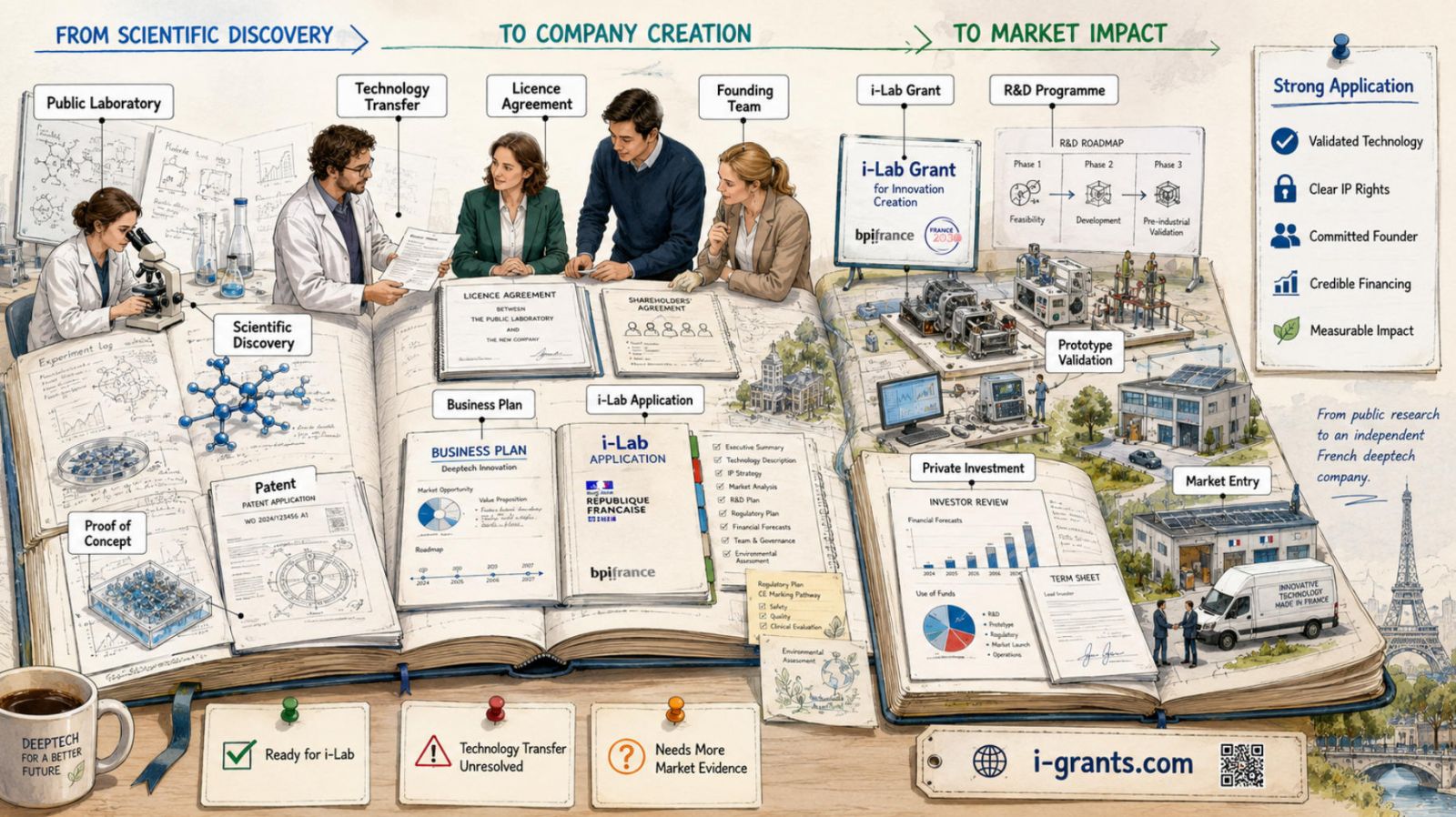
The programme supports the creation of a company, not only the technical work. The role of the founder is therefore central.
A strong lead applicant should be ready to become actively involved in the company’s management. A researcher who wants to remain entirely outside the business while treating the company as a secondary project may struggle to satisfy the entrepreneurial requirements.
The team does not need to possess every skill at the time of submission. However, it should understand which capabilities are missing and how they will be added.
Important areas may include scientific leadership, engineering, product development, regulation, manufacturing, finance, sales and company management.
For public researchers, the transition from a laboratory position to company leadership may require institutional authorisation, a part-time arrangement or a formal change in professional status. These questions should be addressed early.
Environmental Requirements and the DNSH Principle
The 28th edition expressly applied the Do No Significant Harm principle.
Projects had to consider whether their technology could create significant harm in six environmental areas:
-
climate change mitigation;
-
adaptation to climate change;
-
water and marine resources;
-
the circular economy;
-
pollution prevention;
-
biodiversity and ecosystems.
Applicants were expected to consider the technology’s lifecycle and compare it with an appropriate baseline solution.
A project cannot rely only on a general statement that the innovation is sustainable. The application should identify relevant inputs, energy use, materials, emissions, waste, water use and possible indirect effects.
A medical technology, for example, may provide a major health benefit while also using scarce materials or generating difficult waste streams. A digital solution may reduce physical resource consumption but increase electricity use through computing infrastructure.
The environmental assessment should therefore identify both benefits and possible negative effects.
Latest Competition Results
The most recent published i-Lab results demonstrate a high level of competition.
In 2024, 440 applications were submitted and 74 projects were selected. The total public support reached EUR 28 million.
In 2025, applications increased to 473, while the number of winners fell to 62. Nine projects received the Grand Prix distinction, and 14 received special jury recognition. Total support amounted to EUR 23 million.
Table 6. Recent i-Lab competition results
| Results year | Applications | Winners | Approximate success rate | Total support | Average support per winner |
|---|---|---|---|---|---|
| 2024 | 440 | 74 | 16.8 percent | EUR 28 million | Approximately EUR 378,000 |
| 2025 | 473 | 62 | 13.1 percent | EUR 23 million | Approximately EUR 371,000 |
The decrease in the success rate from approximately 16.8 percent to 13.1 percent shows that i-Lab is a highly selective competition.
Formal eligibility is only the first test. A project must compete with other research-based companies on technology, team quality, intellectual property, market potential and financing credibility.
Long-Term Results of i-Lab
From the launch of the competition in 1999 through 2024, official figures reported:
-
24,643 submitted applications;
-
EUR 583 million in total support;
-
2,224 innovative technology companies created.
Different official assessments have estimated that approximately 63 to 65 percent of the companies created through the competition remained active at the relevant evaluation date.
The figures suggest that approximately two-thirds of the supported businesses continued operating, although survival differs by year, sector, development stage and the date of measurement.
Official reporting has also identified 25 former i-Lab winners whose companies later reached Euronext or Nasdaq Europe markets.
These results position i-Lab as a long-term company creation instrument rather than a one-time research competition.
i-Lab and the Growth of the French Deeptech Sector
France had approximately 2,589 deeptech startups by March 2025, with 385 new deeptech companies created during 2024.
The France 2030 strategy aims to reach 500 new deeptech companies per year by 2030.
i-Lab contributes to this objective by supporting the stage at which research results must become independent legal and commercial organisations.
The wider system includes public research incubators, technology transfer organisations, Bourse French Tech Emergence, deeptech investment funds, i-PhD, i-Nov and industrialisation programmes.
The connection between these programmes is visible in the transition from i-PhD to i-Lab. Among former i-PhD winners who created a company, around half did so within three years, and at least 44 later became i-Lab winners.
This progression shows that France is building a structured pathway from scientific research to entrepreneurship rather than relying on a single funding competition.
Examples of Recent i-Lab Winners
Recent winners illustrate the range of technologies supported by the programme.
MagnetFab emerged from research conducted at Institut Néel and CNRS. The company develops methods for integrating micromagnets directly onto electronic components. Its technology may support applications in microelectronics, microsystems and quantum technologies while reducing component size and dependence on certain rare-earth materials.
Orinova is developing new combination treatments for cancer, demonstrating the importance of strong scientific evidence, intellectual property protection and a credible clinical pathway.
Nova Data Analytics develops knowledge-graph technology for electronic commerce and complex data analysis. Its selection demonstrates that software-based projects can qualify when their competitive value is based on genuine technological innovation rather than a conventional digital business model.
These examples show that i-Lab can support biotechnology, advanced materials, health technology, industrial processes and complex digital systems.
Common Reasons an i-Lab Project May Be Uncompetitive
A project may struggle in the selection process when:
-
the proof of concept remains too weak;
-
the intellectual property route has not been negotiated;
-
the founder is not ready to lead the company;
-
the project is based mainly on a conventional service or digital platform;
-
customer demand is assumed rather than demonstrated;
-
the budget is not linked to technical milestones;
-
the company has no credible financing plan beyond the grant;
-
environmental risks are ignored;
-
regulatory or manufacturing requirements are missing;
-
the new business remains excessively dependent on a laboratory, employer or original company.
Several weaknesses often appear together. Unclear intellectual property may prevent fundraising. Weak founder commitment may undermine confidence in execution. An unsupported market forecast may weaken both the commercial strategy and the financing plan.
Is the Project Ready for i-Lab?
A project is more likely to be ready when the technology has a demonstrated principle, the remaining R&D programme is clearly defined and the new company can obtain sufficient rights to commercialise the results.
Table 7. i-Lab readiness assessment
| Project situation | Likely assessment |
|---|---|
| The scientific idea has not yet produced a reliable proof of concept | The project may be better suited to i-PhD, maturation support or early feasibility funding |
| The proof of concept exists, but significant technological work remains | The project may fit i-Lab |
| Intellectual property ownership or licensing is unresolved | Application preparation should pause until a credible transfer route exists |
| The founder is prepared to manage and own part of the company | This supports i-Lab eligibility and credibility |
| The project is mainly ordinary software development or consultancy | It is unlikely to fit the programme |
| The company is already established and plans a EUR 1 million to EUR 5 million R&D project | i-Nov may be more appropriate |
| The technology is complete and the main need is a first manufacturing site | Première Usine or another industrial programme may provide a better route |
| The project has no additional financing strategy | The company is unlikely to demonstrate sufficient financial viability |
The funding route should be selected according to the project’s actual maturity rather than the size of the possible grant.
How to Prepare for the Next i-Lab Competition
Prospective applicants should use the period before the next competition to resolve the issues that usually take longest.
The technology should be documented through test results, technical comparisons and a clear description of the remaining barriers. Intellectual property negotiations should establish what the company will own or license and under what conditions.
The founding team should define ownership, management responsibilities, decision-making rights and the transition from research employment to company leadership.
Market preparation should include customer discussions, competitor analysis, regulatory assessment and initial evidence of demand.
The financial model should combine the possible grant with founder capital, private investment, other compatible support and realistic cash-flow projections.
Finally, the environmental assessment should examine the entire lifecycle of the technology rather than only its intended benefits.
Conclusion
i-Lab is one of France’s most important instruments for converting technological research into investable companies.
Under the latest completed reference rules, applicants could request a grant of up to EUR 600,000 based on eligible expenditure of up to EUR 1 million. The programme could support founders before incorporation as well as recently created companies established in France.
However, i-Lab does not finance an idea alone. It supports a company creation project in which the proof of concept, intellectual property route, founder commitment, R&D programme, market opportunity and financing strategy are sufficiently mature.
For public research spin-offs, success depends on more than scientific excellence. Technology transfer, governance, founder status and additional capital must be resolved alongside the research plan.
For corporate spin-offs, the new business must demonstrate genuine independence and control over the assets needed for development.
For all applicants, the grant should be treated as one component of a wider financing strategy. Companies that cannot secure technology rights, demonstrate customer need or attract complementary capital are unlikely to be ready.
When these elements are in place, i-Lab can provide more than financial support. Winning can strengthen the company’s credibility with investors, research institutions, industrial partners, banks and future customers, helping a research-based innovation become a sustainable French technology business.