

 Français
  Deutsch
  Українська
France offers several public funding routes for innovative companies, but relatively few are designed for projects that require several years of research and development, multimillion-euro budgets, industrial demonstrators, and collaboration between companies and research organisations.
The France 2030 i-Démo programme addresses this gap.
i-Démo supports ambitious research, development, and innovation projects that have moved beyond early proof of concept but are not yet ready for full commercial production. It can finance individual projects led by French SMEs and larger collaborative projects involving companies, laboratories, universities, technical centres, and industrial partners.
The programme is therefore positioned between early-stage innovation funding and large-scale industrial deployment. It is not simply a larger version of i-Nov. It has different project thresholds, longer implementation periods, more complex financing structures, and a stronger emphasis on economic, technological, and industrial impact in France.
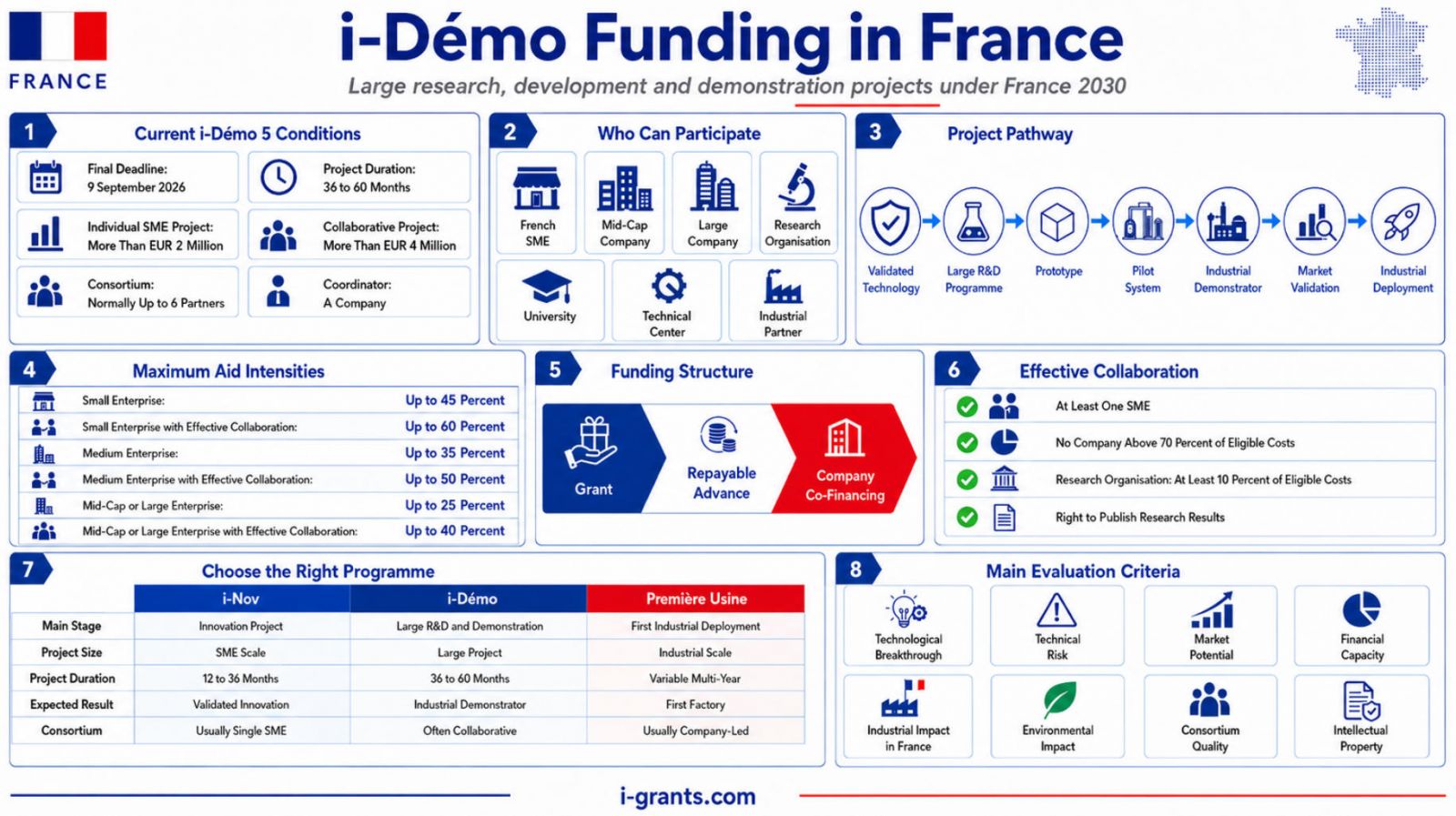
As of 22 July 2026, the fifth generic i-Démo call remains open. Its final submission deadline is 9 September 2026 at 12:00 Paris time.
What Is i-Démo?
i-Démo is a France 2030 funding instrument managed by Bpifrance on behalf of the French state. Its purpose is to support strategic research, development, and innovation projects capable of generating new products, services, technologies, industrial processes, or organisational models.
The programme is particularly relevant when a project requires significant technical work before commercial deployment. This may include the development of a large prototype, validation in a representative environment, construction of a pilot line, creation of an industrial or pre-industrial demonstrator, or integration of several technologies into a complete system.
A suitable i-Démo project normally combines technological ambition with a credible route to the market. The public authorities are not only evaluating whether the proposed innovation is scientifically interesting. They also want to understand whether it can create economic value, strengthen French industrial capabilities, generate skilled employment, reduce strategic dependencies, and contribute to environmental or social objectives.
This makes i-Démo one of the most demanding France 2030 programmes. A company must demonstrate that the project is genuinely innovative, technically risky, financially credible, commercially relevant, and structurally important.
The Current i-Démo 5 Call
The current call is officially titled i-Démo Générique n°5: Support for Structuring R&D and Innovation Projects.
It opened on 22 October 2025. Several intermediate submission dates were scheduled during the call, but those stages have already passed. For new applicants, the remaining deadline is the final closing date on 9 September 2026.
Projects are generally expected to last between 36 and 60 months. This is significantly longer than the usual duration of many SME innovation calls and reflects the scale of the technical and industrial challenges supported by the programme.
Table 1. Main Conditions of the i-Démo 5 Call
| Condition | Current requirement |
|---|---|
| Call status | Open as of 22 July 2026 |
| Final deadline | 9 September 2026 at 12:00 Paris time |
| Typical project duration | 36 to 60 months |
| Individual project threshold | More than EUR 2 million in total eligible costs |
| Collaborative project threshold | More than EUR 4 million in total eligible costs |
| Individual applicant | A French-registered SME |
| Consortium coordinator | A company |
| Consortium size | Normally no more than six partners |
| Company funding form | Grant combined with a repayable advance |
| Main activities | R&D, experimental development, pilots, prototypes, and demonstrators |
One of the most important distinctions concerns the minimum project size. An individual SME project must normally exceed EUR 2 million in eligible expenditure. A collaborative project must exceed EUR 4 million.
This difference is sometimes overlooked in secondary funding guides, which may incorrectly present EUR 4 million as the minimum for every i-Démo application.
Where i-Démo Fits Within France 2030
The French innovation funding system contains several instruments designed for different stages of company and technology development.
i-PhD supports the emergence of entrepreneurial projects based on doctoral research. i-Lab helps research-based founders and newly created deeptech companies develop an early business project. i-Nov supports innovative SMEs undertaking substantial R&D and demonstration activities. i-Démo addresses larger and more structurally important projects. Première Usine supports the transition to the first industrial production facility.
The practical sequence can be understood as follows:
Scientific research → proof of concept → startup creation → innovation development → large demonstrator → first industrial production
A company does not need to participate in every programme, and the instruments do not form an automatic funding chain. However, the sequence helps applicants understand the expected maturity of an i-Démo project.
A project may be too early for i-Démo if the core scientific principle has not yet been validated. It may be too late if the main remaining need is the purchase of standard production equipment and construction of a commercial factory.
i-Démo is strongest in the middle of these two situations. The technology is credible, but major R&D, integration, validation, scale-up, or demonstration work remains necessary.
Individual SME Applications
A French-registered SME can submit an individual i-Démo application without forming a consortium. The company must be capable of managing a large, multiannual R&D programme and financing the portion of the project not covered by public aid.
An individual application may be appropriate when one SME owns or controls the main intellectual property, has the necessary technical team, can manage all key work packages, and has sufficient financial capacity to complete the project.
The company may still use subcontractors, suppliers, consultants, testing organisations, or research providers. However, these entities are not formal funded partners and do not share the same rights, obligations, or ownership of results as members of a consortium.
An individual SME project must also demonstrate that the company itself can exploit the results. A weak application may describe sophisticated research but fail to explain how the applicant will manufacture, commercialise, license, or otherwise generate value from the resulting technology.
Collaborative i-Démo Consortia
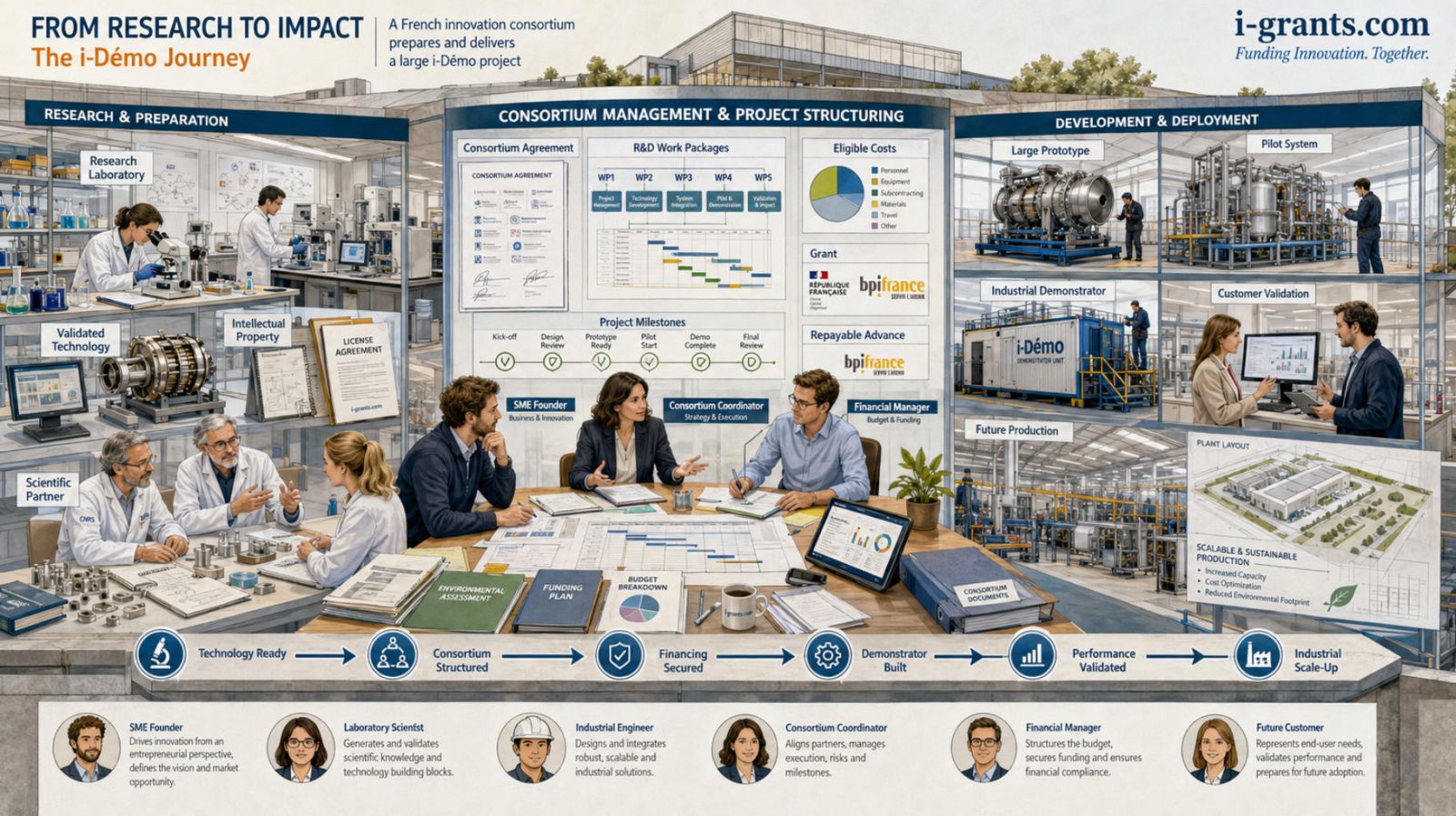
Larger projects can be submitted by a consortium coordinated by a company. The consortium may include SMEs, mid-cap companies, large enterprises, universities, public or private research organisations, technical centres, and other relevant partners.
At least one SME or mid-cap company must participate. The consortium is normally limited to six funded partners, although particular European cooperation formats may follow different arrangements.
A strong consortium is not simply a collection of organisations with impressive names. Each participant must have a clearly defined role that is necessary for the project.
One partner might develop the core technology. Another may provide specialised research capability. An industrial company may prepare integration into a production environment. A technical centre may conduct testing and certification. A future customer may validate the demonstrator under real operating conditions.
The application should explain why the project cannot be completed as effectively by one organisation acting alone.
Table 2. Individual and Collaborative i-Démo Projects
| Criterion | Individual SME project | Collaborative project |
|---|---|---|
| Lead applicant | French SME | Company |
| Minimum total eligible costs | More than EUR 2 million | More than EUR 4 million |
| Formal partners | One funded applicant | Normally up to six funded partners |
| Research organisations | Usually subcontractors or service providers | May participate as funded partners |
| Governance complexity | Moderate | High |
| Intellectual property arrangements | Primarily controlled by the applicant | Must be negotiated between partners |
| Suitable when | One SME controls the technology and implementation | Several complementary capabilities are essential |
| Main risk | Insufficient internal capacity | Weak coordination or unclear partner roles |
Before creating a consortium, companies should consider whether each proposed partner brings a capability that cannot be obtained through ordinary procurement or subcontracting. An unnecessarily large consortium can slow decision-making, complicate the budget, and create disputes over intellectual property.
Aid Intensities for Companies
The amount of public support is calculated separately for each partner. It depends on the size of the company, the type of activity, the applicable state aid rules, and whether the project qualifies as effective collaboration.
The published rates are maximum levels. They are not automatic entitlements.
Table 3. Maximum Aid Intensities for Companies Under i-Démo 5
| Company category | Without effective collaboration | With effective collaboration |
|---|---|---|
| Small enterprise | Up to 45% of eligible costs | Up to 60% of eligible costs |
| Medium-sized enterprise | Up to 35% of eligible costs | Up to 50% of eligible costs |
| Mid-cap or large enterprise | Up to 25% of eligible costs | Up to 40% of eligible costs |
The final rate may be lower after Bpifrance evaluates the nature of the work, the financial position of the participant, the incentive effect of the aid, and the overall project structure.
The applicant must therefore build a financing plan that remains viable even if the maximum theoretical aid intensity is not awarded.
What Effective Collaboration Means
Effective collaboration has a specific meaning under state aid rules. It does not simply mean that several organisations have agreed to work together.
For collaboration between companies, at least one participant must be an SME, and no single company should bear more than 70% of the project’s total eligible costs.
For collaboration between a company and a research organisation, the research organisation should normally bear at least 10% of eligible project costs and retain the right to publish the results of its own research activities.
These conditions can allow higher aid intensities because the project involves genuine sharing of risks, resources, capabilities, and results.
Adding a university or laboratory with a very small budget and a purely symbolic role is not sufficient. The research partner should have a substantive scientific or technical contribution, clearly described work packages, measurable deliverables, and an appropriate share of the project costs.
The consortium agreement must also address ownership of results, access to pre-existing intellectual property, licensing rights, publication conditions, confidentiality, and the commercial use of jointly developed technologies.
Grants and Repayable Advances
For companies, i-Démo assistance is generally provided through a combination of a grant and a repayable advance.
The grant is non-repayable if the beneficiary complies with the funding agreement and completes the eligible project activities. The repayable advance must be repaid according to the conditions defined in the funding agreement. Repayment may be linked to project completion, technical success, commercial performance, or another agreed mechanism.
For the current call, Bpifrance indicates that the grant component generally represents around half of the total aid awarded to companies, with the remainder provided as a repayable advance. The exact structure can be adjusted during the appraisal and negotiation process.
This distinction is essential because the aid intensity is not the same as the grant percentage.
Consider a small company participating in a qualifying collaborative project. It has EUR 2 million in eligible costs and receives an aid intensity of 60%.
The maximum total public aid would be EUR 1.2 million. If the aid were divided equally between the two instruments, the company could receive approximately EUR 600,000 as a grant and EUR 600,000 as a repayable advance. The remaining EUR 800,000 would need to be financed by the company.
The applicant should therefore assess not only the amount of aid but also the future repayment obligation and the timing of project cash flows.
Support for Research Organisations
Research organisations may receive funding for eligible non-economic activities under different calculation methods.
Depending on the selected approach and the applicable conditions, support may cover up to 50% of full costs or up to 100% of additional project costs. The precise method must be consistent with the organisation’s accounting system and the rules established in the call documentation.
The distinction between economic and non-economic activity is important. Contract research performed for a company under market conditions may not be treated in the same way as independent research conducted within a collaborative project.
Research partners should therefore define their role, cost model, rights to results, and publication arrangements before the application is submitted.
Eligible Project Costs
The programme can support costs that are directly necessary for the approved research, development, and demonstration programme.
Common eligible cost categories may include:
-
salaries and related personnel costs for employees working on the project;
-
depreciation or eligible use of equipment and research infrastructure;
-
contract research, technical studies, testing, and specialised subcontracting;
-
acquisition or licensing of patents, technical knowledge, and intellectual property rights;
-
materials, components, prototypes, consumables, and operating costs;
-
indirect costs calculated according to the authorised simplified method.
For economic activities, indirect costs may be calculated using a flat rate equal to 20% of eligible personnel costs. For certain non-economic research activities, a rate of 40% of personnel costs may apply.
The budget should be connected to the work plan. Evaluators need to understand why each major cost is necessary, how it relates to a technical milestone, and why the amount is reasonable.
A large equipment budget without a clear R&D function may be challenged. Similarly, excessive subcontracting can create doubts about whether the applicant has sufficient internal technical capacity to deliver the project.
The Project Start Rule
Companies must pay particular attention to the incentive effect required under state aid law.
Project activities should not begin before the authorised eligibility date. Applicants should avoid committing to irreversible project work, signing binding supply contracts, purchasing major equipment, or launching funded technical tasks before receiving confirmation that the complete application has been registered under the applicable procedure.
Ordinary preparatory activities may be treated differently, but the distinction can be difficult in practice. Companies should document the chronology carefully and seek clarification from Bpifrance before making substantial commitments.
A technically excellent project can lose access to aid if the applicant is unable to demonstrate that public support influenced the decision to undertake the project.
How i-Démo Projects Are Evaluated
The assessment goes beyond formal eligibility. Evaluators examine whether the project justifies substantial public intervention and whether the partners have the capability to complete it.
Table 4. Main Areas of i-Démo Evaluation
| Evaluation area | Questions the application should answer |
|---|---|
| Technological innovation | How does the solution differ from the best available alternatives? |
| Technical risk | What uncertainties remain, and why can they not be resolved through routine engineering? |
| R&D programme | Are the work packages, milestones, responsibilities, and deliverables coherent? |
| Market potential | Is there a credible market, customer need, and commercialisation strategy? |
| Financial capacity | Can the partners finance their share and absorb delays or cost overruns? |
| Industrial impact | Will the project create production, expertise, employment, or strategic capacity in France? |
| Environmental impact | Does the project reduce environmental harm and comply with applicable sustainability principles? |
| Consortium quality | Are the partners complementary, committed, and properly coordinated? |
| Intellectual property | Are ownership, access rights, protection, and exploitation arrangements credible? |
| Public funding need | Would the project be smaller, slower, or impossible without the aid? |
The strongest applications connect these areas instead of treating them as separate sections.
For example, the technical programme should lead to a defined demonstrator. The demonstrator should validate performance required by identified customers. Customer validation should support the commercial strategy. The commercial strategy should justify the industrial investment planned in France.
Increased Selectivity in 2025 and 2026
i-Démo remains a major innovation instrument, but recent official reporting indicates that competition has become more demanding.
Bpifrance reported approximately EUR 80 million in i-Démo aid during the first half of 2023. The amount increased to about EUR 192 million during the first half of 2024.
However, activity across i-Nov, i-Démo, and Première Usine fell by 53% during the first half of 2025. Bpifrance linked this reduction to more limited budget availability and increased selectivity, particularly under i-Démo.
This does not mean that the programme is inactive. It means that applicants should not rely on basic eligibility or incremental innovation.
France’s updated deeptech strategy, presented in 2026, also points towards a stronger focus on breakthrough technologies. The government announced an objective to mobilise at least EUR 30 billion in public and private financing for deeptech companies by 2030.
For applicants, this reinforces the importance of demonstrating a genuine technological discontinuity, rather than a modest improvement to an existing product or process.
Table 5. Recent Indicators Relevant to i-Démo Applicants
| Indicator | Reported figure | Practical significance |
|---|---|---|
| i-Démo aid in the first half of 2023 | About EUR 80 million | Shows the programme’s substantial financing capacity |
| i-Démo aid in the first half of 2024 | About EUR 192 million | Reflects a major increase in support for large R&D projects |
| Change in combined i-Nov, i-Démo, and Première Usine activity in the first half of 2025 | Down 53% | Indicates tighter budgets and stronger selection |
| Structural innovation support committed from 2021 to 2024 | Nearly EUR 5.2 billion | Places i-Démo within a broader national funding system |
| Deeptech companies created in France since 2019 | More than 2,600 | Demonstrates the size of the potential applicant ecosystem |
| New deeptech companies created in 2025 | About 410 | Suggests continuing growth and competition |
| Public and private deeptech financing objective by 2030 | At least EUR 30 billion | Signals continued strategic priority for advanced technologies |
France 2030 has an overall budget of EUR 54 billion. Around EUR 10 billion has been associated with structural support for research and innovation, while approximately EUR 44 billion has been directed towards strategic objectives and sectors.
Between 2021 and 2024, almost EUR 5.2 billion was committed through structural innovation support instruments, excluding equity investments. Annual commitments increased from approximately EUR 840 million in 2021 to around EUR 1.6 billion in 2024.
These figures show that France continues to invest heavily in innovation. They also show why applications are assessed in terms of national impact, not only private company growth.
Examples of Companies Supported Through i-Démo
GreenWaves Technologies
GreenWaves Technologies develops energy-efficient processors designed to perform audio, image, and artificial intelligence processing with limited dependence on cloud computing.
The company has used several French innovation instruments during its development, including Bourse French Tech Emergence, deeptech support, i-Lab, i-Démo, and Première Usine.
Its funding path illustrates how i-Démo can support the transition from technology development towards industrial scale-up. It also shows that companies may combine different public instruments over time, provided each programme finances a distinct stage and different eligible activities.
Alice & Bob
Alice & Bob develops quantum computing technology based on cat qubits, which are designed to improve the stability and scalability of quantum systems.
The company has been associated with several French deeptech programmes, including i-PhD, i-Lab, i-Nov, and i-Démo.
This example demonstrates how a research-based project can progress from scientific work and company creation to a large collaborative development programme. It also reflects the type of technological ambition increasingly prioritised by the French government.
Crossject
Crossject develops needle-free emergency drug delivery systems. In 2024, the company announced EUR 6.9 million in public i-Démo financing for the ZENEO adrenaline project.
According to the company’s announcement, approximately 60% of the support was provided as grants and the remainder as repayable advances. The project was expected to continue until 2026.
Crossject also projected the creation of more than 160 jobs between 2024 and 2032 and cumulative sales of approximately EUR 1 billion by 2032.
These employment and revenue figures are company forecasts, not completed results. Nevertheless, they illustrate the scale of economic impact that an i-Démo applicant may be expected to substantiate.
i-Nov, i-Démo, or Première Usine?
Choosing the wrong programme can lead to a technically strong project being rejected because its development stage does not match the call.
Table 6. Comparison of i-Nov, i-Démo, and Première Usine
| Criterion | i-Nov | i-Démo | Première Usine |
|---|---|---|---|
| Main stage | Innovation development and demonstration | Large-scale R&D, integration, and demonstration | First industrial production |
| Main applicant type | Individual SME | Individual SME or company-led consortium | Innovative company or SME preparing a first factory |
| Typical project size | EUR 1 million to EUR 5 million | More than EUR 2 million individually or EUR 4 million collaboratively | Large industrial investment |
| Typical duration | 12 to 36 months | 36 to 60 months | Depends on industrial deployment |
| Main output | Validated innovation or demonstrator | Large demonstrator, pilot system, or pre-industrial validation | First production line or manufacturing site |
| Central question | Can the innovation be technically and commercially validated? | Can the technology be developed and demonstrated at a structurally significant scale? | Can the company establish its first industrial production capacity? |
| Consortium | No, normally one SME applicant | Yes, consortium possible | Usually centred on the industrial company |
| Main risk | Project may be too large or collaborative | Project may be too early, too commercial, or insufficiently strategic | Technology may not be mature enough for factory investment |
A company should not choose i-Démo only because its budget exceeds the upper range of i-Nov. Project maturity, technical uncertainty, development structure, and expected outputs are more important than budget alone.
Is the Project Ready for i-Démo?
Before preparing a full application, the lead company should be able to answer the following questions convincingly:
-
Has the core scientific or technological principle already been validated?
-
Does the project still contain substantial R&D risk rather than routine engineering?
-
Is a large prototype, pilot, integrated system, or demonstrator necessary?
-
Can the partners finance the non-funded share and manage the project for up to five years?
-
Is there credible customer, market, regulatory, or industrial evidence supporting the proposed solution?
-
Will the project generate meaningful economic, technological, environmental, or strategic benefits in France?
A project that cannot yet answer these questions may need further proof-of-concept work, private investment, i-Lab, i-Nov, regional aid, or another development instrument before approaching i-Démo.
Common Application Weaknesses
The most frequent weaknesses are not necessarily administrative. They are often strategic.
A project may be rejected because the technology is not sufficiently differentiated from existing solutions. The work plan may contain ordinary product development rather than genuine experimental development. The consortium may include partners with overlapping or symbolic roles. The company may lack enough cash or equity to finance its contribution. Market forecasts may rely on broad global statistics rather than evidence from customers. Intellectual property ownership may remain unresolved. Environmental claims may be unsupported. Work may also have started before the authorised eligibility date.
Another common problem is confusing technical scale-up with commercial scale-up. i-Démo can fund technical and pre-industrial development, but it is not primarily a programme for sales expansion, routine equipment purchases, advertising, or construction of a standard commercial production facility.
Preparing a Competitive Application
A competitive application should begin with a clear description of the technological barrier. The applicant should explain what cannot currently be achieved, why existing solutions are inadequate, and what new capability the project will create.
The work plan should then translate this problem into structured work packages, technical milestones, decision points, and measurable deliverables.
The budget should follow the technical plan rather than being developed independently. Every major cost should be linked to a task, risk, experiment, prototype, test, or validation requirement.
The market section should identify real users, purchasing processes, competing technologies, regulatory constraints, and the route to commercial deployment. Letters of interest, pilot agreements, test commitments, strategic partnerships, and preliminary customer validation can strengthen the case.
The financing plan should show how the partners will fund their own contributions, manage working capital, and continue operating if reimbursement or project payments are delayed.
Finally, the application should explain why the project matters to France. This may include manufacturing capacity, research expertise, supply-chain resilience, strategic autonomy, decarbonisation, export potential, skilled jobs, or the development of a new industrial ecosystem.
Final Assessment
i-Démo is one of the most substantial public funding routes available to innovative French SMEs and collaborative R&D consortia. It can support projects that are too large, too long, or too technically complex for conventional SME grant programmes.
However, the programme is not appropriate for every innovative company.
A successful applicant must demonstrate more than technical novelty. The project must have a coherent R&D structure, a credible route to market, strong financial backing, a measurable impact in France, and an implementation team capable of managing a multimillion-euro programme over several years.
The current i-Démo 5 call creates a significant opportunity for companies preparing large demonstrators, integrated technologies, industrial pilots, and strategic innovation projects. With the final deadline set for 9 September 2026, potential applicants have limited time to confirm their eligibility, structure their consortium, validate the budget, resolve intellectual property questions, and prepare a complete financing plan.
For projects at the right stage, i-Démo can provide the resources needed to cross one of the most difficult gaps in innovation funding: the transition from a technically credible invention to a demonstrated, scalable, and industrially relevant solution.