

 Français
  Deutsch
  Українська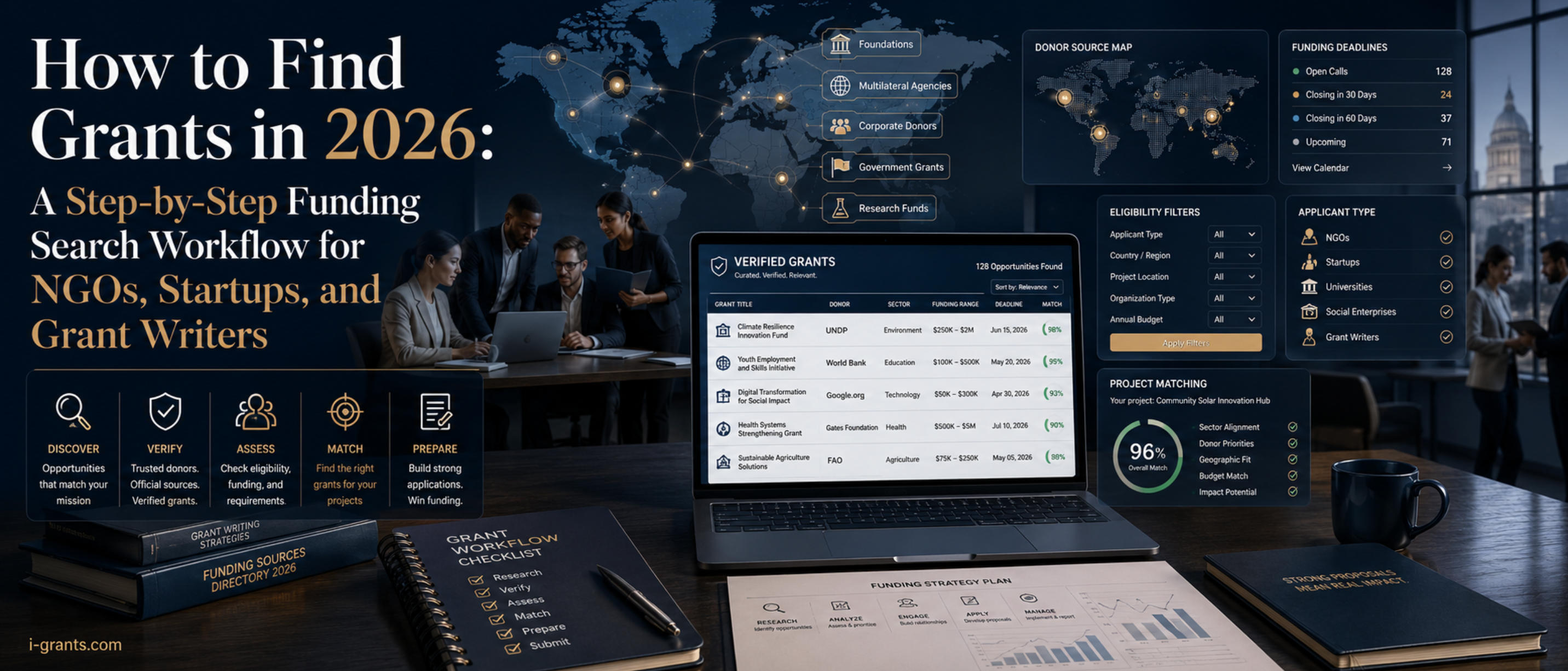
Finding grants in 2026 is not difficult because there is too little information. It is difficult because there is too much information, and much of it is incomplete, outdated, duplicated, poorly categorized, or published in places where applicants do not usually look.
An NGO may search Google and find a grant that closed six months ago. A startup may discover an accelerator call but miss the small print that excludes its country. A university team may spend two days reading a Horizon Europe topic before realizing that the call requires a consortium it cannot build in time. A grant writer may find a promising foundation but discover that the funder does not accept unsolicited proposals.
This is why the ability to find active grants in 2026 should not be treated as a random browsing task. It should be treated as a structured funding intelligence workflow.
The goal is not simply to “find grants.” The real goal is to find active grants that are relevant, verified, open for applications, and strategically suitable for a specific applicant, country, sector, project stage, and deadline. For NGOs, startups, universities, municipalities, cultural institutions, research teams, and freelance grant writers, this workflow can save days of wasted effort and help transform grant search from guesswork into a repeatable professional process.
Why Grant Search Has Become More Complex in 2026
The grant landscape is fragmented. Public funding, development assistance, foundation grants, innovation programs, research schemes, climate funds, cultural calls, humanitarian funding, procurement-linked opportunities, and challenge prizes are not collected in one universal database.
Some opportunities are published on large official portals. Others appear only on donor websites, national agency pages, foundation newsletters, research council announcements, embassy websites, or thematic program pages. Some calls are updated every year. Others are one-off. Some are open internationally. Others are restricted to specific countries, regions, municipalities, applicant types, or partnership models.
This means a simple search query is rarely enough. A person who wants to find active grants must look beyond the first page of Google and understand how different donors publish opportunities.
There are several major source categories:
| Source category | Typical use |
|---|---|
| Government grant portals | National public funding, federal programs, regional development schemes |
| EU and multilateral portals | Horizon Europe, Erasmus+, Interreg, UN opportunities, international cooperation |
| Foundation databases | Philanthropy, nonprofit funding, donor mapping, RFP tracking |
| Sector-specific sources | Research, health, climate, culture, agriculture, digital transformation |
| Aggregators and newsletters | Fast discovery, opportunity monitoring, early alerts |
The key problem is not access to information. The key problem is verification. Many applicants can find grant links. Far fewer can reliably find active grants that are still open, relevant, and worth the application effort.
Step 1. Start With the Project, Not With the Grant
The weakest grant searches start with vague queries such as “grants for NGOs,” “startup funding,” or “education grants.” The strongest searches start with a structured project profile.
Before searching, define the project in operational terms:
-
Applicant type: NGO, nonprofit, startup, SME, university, municipality, school, social enterprise, research institute, cultural organization, or consortium.
-
Country of registration and project geography.
-
Sector: education, climate, health, agriculture, digital transformation, culture, youth, humanitarian response, human rights, research, energy, innovation, or another field.
-
Target beneficiaries: women entrepreneurs, displaced people, youth, researchers, farmers, veterans, local communities, artists, patients, students, or SMEs.
-
Project stage: idea, pilot, scale-up, research phase, market validation, implementation, replication, or capacity building.
-
Funding need: small grant, seed funding, research grant, operating support, equipment funding, travel funding, partnership project, or multi-year program.
-
Application capacity: simple form, concept note, full proposal, logical framework, budget narrative, consortium package, technical annex, or financial documentation.
This first step matters because grant eligibility is usually more important than topic similarity. A project may look thematically relevant but still be impossible to apply for if the applicant type, country, legal status, co-financing capacity, or partnership structure does not match the rules.
A practical way to begin is to create a short funding search profile before opening any portal.
| Search field | Example |
|---|---|
| Applicant | Registered NGO |
| Country | Ukraine |
| Sector | Youth mental health and community resilience |
| Funding need | Project grant for local implementation |
| Amount range | Small to medium grant |
| Deadline tolerance | At least 30 days before submission |
| Application capacity | Can prepare concept note and budget, needs grant writer for full proposal |
| Ideal donor type | International foundation, EU program, bilateral donor, UN agency |
This profile becomes the filter for every source you search. It also helps a grant writer understand whether the applicant needs an open call, a funder prospect list, or a long-term funding strategy.
Step 2. Use Official Sources as the Verification Layer
Google can help discover funding pages, but it should not be the final authority. Search results often surface old calls, copied announcements, expired PDFs, or aggregator pages that have not been updated.
The official donor source is the verification layer.
For United States federal grants, Grants.gov is the central portal for federal discretionary funding opportunities. For EU programs, the EU Funding & Tenders Portal is the official place to search calls, review documents, find partners, and submit applications. For Erasmus+, applicants should check official European Commission and agency pages for calls, deadlines, and program rules. For biomedical research, NIH funding opportunities are published through official NIH and Grants.gov channels. For UN-related opportunities, UNGM and agency-specific procurement or partnership pages can be important sources.
A professional workflow should separate three things:
| Source type | Role in the workflow |
|---|---|
| Discovery source | Helps you notice an opportunity |
| Verification source | Confirms that the opportunity is real, open, and current |
| Application source | Provides the form, portal, documents, and submission rules |
This distinction is essential. An aggregator may help you find active grants, but the official donor page must confirm the opportunity before you invest time in an application.
A safe rule is simple: if you cannot find the opportunity on the official donor source, do not treat it as verified.
Step 3. Build a Source Map Instead of Searching Randomly
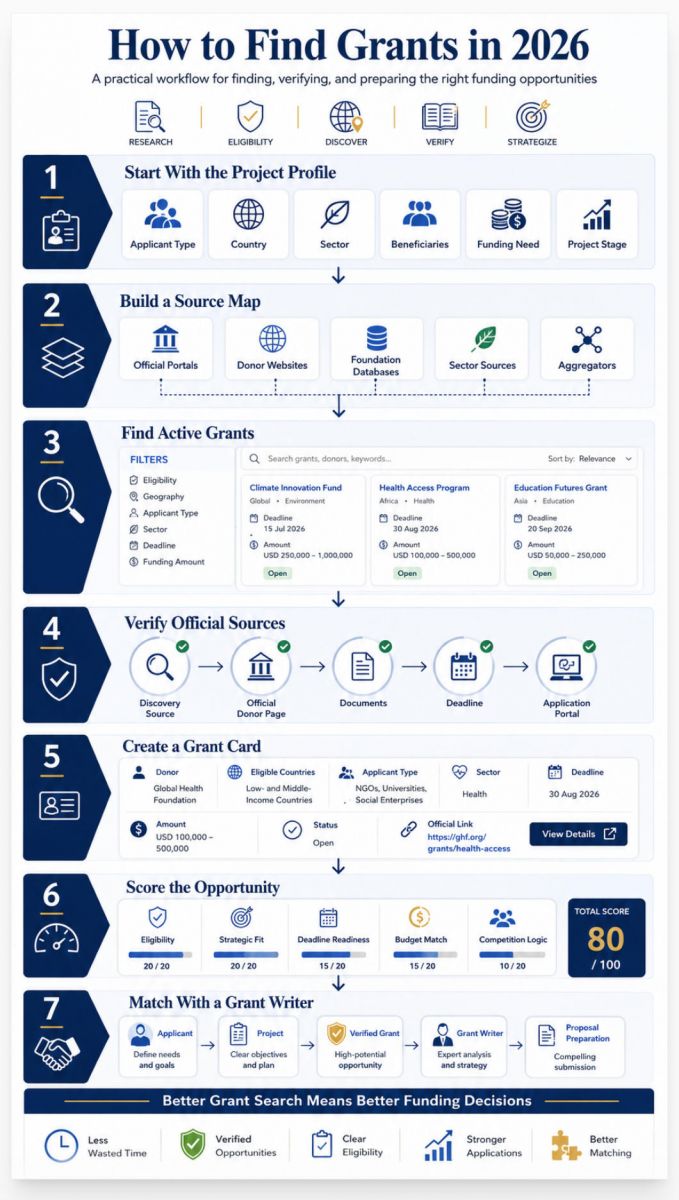
A grant search workflow should use a source map. This is a categorized list of portals, donor pages, and recurring funding channels that are relevant to the applicant’s profile.
For example, an NGO working in civic participation should not search the same sources as a biotech startup, a university research lab, or a municipality preparing a climate adaptation project. A cultural organization may need foundation calls, city-level funding, Creative Europe opportunities, embassy programs, and heritage funds. A cleantech startup may need innovation grants, climate accelerators, R&D tax credit programs, pilot funding, and corporate challenge prizes.
A practical source map can be divided into five layers.
| Source layer | Best for |
|---|---|
| Official government portals | Public grants, federal programs, national funding |
| Multilateral and EU portals | Cross-border programs, research, cooperation, development |
| Foundation intelligence tools | Nonprofit funding, private philanthropy, donor research |
| Sector-specific sources | Research, health, climate, culture, youth, innovation |
| Aggregators and newsletters | Discovery and monitoring |
The source map should also include a frequency rating.
| Source status | Meaning | Suggested monitoring rhythm |
|---|---|---|
| Active | New calls appear often and match the applicant’s field | Weekly |
| Medium-active | Relevant calls appear occasionally | Twice per month |
| Low-active | Rare but sometimes important opportunities | Monthly |
| Archive | Useful for donor history, not current calls | Use for research only |
This prevents a common mistake: checking the same familiar websites repeatedly while missing specialized donors that publish less often but match the project better. Organizations that want to find active grants consistently need a monitored source system, not a chaotic bookmark folder.
Step 4. Search by Eligibility, Not Only by Keywords
Keyword search is useful, but it is not enough. Grant portals use different terminology. One donor may say “civil society organizations,” another may say “non-state actors,” another may say “implementing partners,” and another may say “eligible applicants.”
A professional search uses several keyword layers.
| Search angle | Example terms |
|---|---|
| Applicant type | NGO, nonprofit, CSO, SME, startup, university, research organization, municipality |
| Sector | climate, education, health, culture, digital, agriculture, youth, gender equality |
| Funding instrument | grant, call for proposals, NOFO, RFP, challenge, fellowship, cooperative agreement |
| Geography | eligible countries, beneficiary country, target region, neighborhood, associated countries |
| Project stage | pilot, scale-up, research, capacity building, mobility, innovation, implementation |
| Beneficiary group | youth, women, refugees, veterans, students, researchers, entrepreneurs, rural communities |
For example, a startup looking for climate innovation funding should not only search “startup grants.” It should also search “climate innovation challenge,” “cleantech accelerator grant,” “SME innovation funding,” “green transition funding,” “energy efficiency pilot,” and “early-stage climate technology support.”
A grant writer searching for NGO opportunities should use both donor language and applicant language. “Grant for NGOs” may miss calls titled “civil society action,” “community resilience fund,” “local partner call,” “capacity strengthening opportunity,” or “call for implementing partners.”
This is especially important for international search. To find active grants across countries and sectors, users need to search in the language of donors, not only in the language of applicants.
Step 5. Create a Grant Verification Card
Every promising opportunity should be converted into a structured grant card. This is especially important for teams, grant writers, and platforms that need to compare many opportunities quickly.
A grant card should include the following fields:
| Field | Why it matters |
|---|---|
| Grant title | Identifies the opportunity clearly |
| Donor | Shows who funds the program |
| Donor geography | Helps understand donor priorities |
| Eligible countries | Prevents wasted work |
| Applicant type | Confirms whether the organization can apply |
| Sector | Matches the project theme |
| Funding amount | Helps assess scale |
| Deadline | Determines urgency |
| Status | Open, upcoming, recurring, closed, archived |
| Language | Shows proposal preparation needs |
| Source type | Official donor, portal, aggregator, newsletter |
| Official verification link | Confirms reliability |
| Documents required | Helps estimate workload |
| Partnership requirement | Indicates whether a consortium is needed |
| Strategic fit score | Helps prioritize |
This structure turns grant search into a decision system. Instead of collecting random links, the team can compare opportunities by fit, urgency, workload, and probability.
For i-grants.com, this logic is especially important because the grant database is not just content. It is the operational foundation for matching applicants with grant writers. A grant card helps both sides understand whether an opportunity is relevant, urgent, realistic, and worth professional preparation.
Step 6. Score Each Grant Before You Commit
Not every open grant deserves an application. Some calls are technically open but strategically weak. A strong grant search workflow includes a scoring model.
A simple version can use five criteria:
Grant Fit Score = Eligibility + Strategic Fit + Deadline Readiness + Budget Match + Competition Logic
Each criterion can be scored from 1 to 5.
| Criterion | Low score | High score |
|---|---|---|
| Eligibility | Unclear or weak match | Applicant clearly qualifies |
| Strategic fit | Project must be distorted | Project naturally matches call priorities |
| Deadline readiness | Too little time or missing documents | Enough time and documents are available |
| Budget match | Funding amount is too small or too large | Budget scale matches project need |
| Competition logic | Very generic, crowded opportunity | Strong niche fit or proven donor alignment |
A grant with a total score of 22 out of 25 is worth serious preparation. A grant with a score of 12 may be interesting for monitoring but risky for immediate submission.
This scoring approach is useful for applicants and grant writers. Applicants can avoid emotional decisions. Grant writers can explain why one opportunity should be prioritized over another. Platforms can use scoring to help users find active grants that are not only open, but strategically realistic.
Step 7. Separate Open Calls From Funder Prospecting
There are two different types of grant search.
The first is open-call search. This means finding active opportunities with published deadlines, eligibility rules, and application forms.
The second is funder prospecting. This means identifying donors that may support similar work, even if they do not currently have an open call.
Open-call search is deadline-driven. It is ideal when an applicant needs an opportunity now.
Funder prospecting is relationship-driven. It is especially important for foundations, major donors, institutional philanthropy, corporate giving programs, and long-term nonprofit development. A foundation may not have an open call today, but its previous grants may show strong alignment with an organization’s mission, geography, and beneficiary group.
Grant writers should use both modes. An NGO may apply to an open EU or UN call this quarter, while also building a six-month prospect list of foundations that previously funded similar beneficiaries, countries, or intervention models.
The best funding strategies usually combine immediate opportunities with long-term donor mapping. To find active grants is essential, but to understand donor patterns is equally important for sustainable fundraising.
Step 8. Watch for Hidden Workload
Many applicants choose grants by funding amount and deadline. That is dangerous.
A large consortium grant may require partner search, administrative documents, a detailed budget, work packages, risk analysis, gender or inclusion sections, dissemination plans, ethics considerations, and multiple annexes. A small foundation grant may require only a short concept note and budget.
The real question is not “How much money is available?” The real question is “Can we submit a competitive application with the time, evidence, team, and documents we have?”
Before committing, check:
-
Is registration required before submission?
-
Does the applicant need a special identifier, portal account, organization profile, or legal validation?
-
Is a consortium required?
-
Are audited financial statements needed?
-
Is co-financing required?
-
Are letters of support required?
-
Are project partners confirmed?
-
Is the budget format simple or complex?
-
Are supporting documents available in the required language?
-
Is the deadline realistic for quality writing?
A grant writer can add value here. Many applicants underestimate the hidden workload of eligibility checks, document preparation, budget logic, annexes, partner coordination, and compliance review.
The purpose of a workflow is not only to find active grants. It is also to decide whether the applicant can realistically submit a strong proposal before the deadline.
Step 9. Use Aggregators as Radar, Not as Final Evidence
Grant aggregators, newsletters, social media posts, NGO portals, and professional communities can be very useful. They help discover opportunities faster, especially when donors publish calls across multiple pages or in different languages.
But aggregators should not be treated as final evidence.
A safe workflow is:
-
Discover the opportunity through an aggregator, newsletter, LinkedIn post, donor mailing list, or professional community.
-
Open the official donor page.
-
Confirm the title, deadline, eligibility, country list, funding amount, and application process.
-
Download or save the official documents.
-
Record the official link in the grant card.
-
Mark the aggregator as the discovery source only.
This distinction is important for trust. A platform or grant writer that shares outdated or unverified calls can quickly lose credibility. A professional grant database should show where the opportunity was found and where it was officially verified.
Aggregators help users find active grants faster, but verification protects applicants from wasting time on outdated, copied, or incomplete information.
Step 10. Match Grants With Grant Writers
Grant search is not only an information task. It is also a workflow task.
An applicant may find a perfect grant but lack the capacity to prepare a strong application. A grant writer may know how to prepare proposals but need a pipeline of relevant opportunities and clients. A platform can connect both sides around a specific grant.
This is where a structured grant database becomes operational.
For applicants, each grant card answers:
| Applicant question | Why it matters |
|---|---|
| Is this opportunity relevant to my project? | Prevents wasted effort |
| Can my organization apply? | Confirms eligibility |
| How much time do we have? | Defines urgency |
| What documents are needed? | Shows preparation workload |
| Do we need a grant writer? | Connects opportunity with expertise |
| Is this simple or complex? | Helps estimate cost and time |
For grant writers, each grant card answers:
| Grant writer question | Why it matters |
|---|---|
| Which donors are active now? | Builds opportunity pipeline |
| Which sectors and countries are funded? | Supports client matching |
| Which applicants may need help? | Creates service opportunities |
| What proposal expertise is required? | Matches skills with demand |
| Is this a concept note or full proposal? | Defines workload |
This turns grant intelligence into a marketplace workflow. The grant is not just content. It becomes the starting point for collaboration between an applicant and a professional who can help prepare the application.
A platform that helps users find active grants can also help them move from discovery to decision, from decision to proposal, and from proposal to funding strategy.
Common Mistakes When Searching for Grants in 2026
The most common grant search mistake is chasing volume. A long list of links looks impressive, but it may contain expired calls, wrong countries, mismatched applicant types, and low-probability opportunities.
Another mistake is searching only in English. Many national, regional, and local opportunities are published in local languages. A Ukrainian NGO, a French municipality, a German university, or a Polish cultural organization may miss relevant opportunities if the search is not multilingual.
A third mistake is ignoring donor history. If a foundation has funded similar organizations in similar countries for several years, it may be a stronger prospect than a generic open call with thousands of applicants.
A fourth mistake is starting too late. Many grants require registration, partner confirmation, budgets, support letters, or internal approvals. Finding a grant seven days before the deadline is often too late unless the application is very simple.
A fifth mistake is treating eligibility as flexible. It is not. If the call is only for registered nonprofits, a startup cannot apply directly. If only certain countries are eligible, a project outside those countries will not pass the first screen. If a consortium is mandatory, a single applicant cannot submit alone.
The sixth mistake is confusing “interesting” with “applicable.” A grant can be thematically attractive and still be a poor choice. The professional task is to find active grants that match the applicant’s real profile, not only the project’s general theme.
A Practical Weekly Grant Search Routine
For organizations and grant writers, grant search should become a weekly habit.
A practical weekly routine may look like this:
| Day | Task |
|---|---|
| Monday | Check active official portals and priority donor pages |
| Tuesday | Review aggregators, newsletters, and sector-specific sources |
| Wednesday | Verify promising calls on official donor pages |
| Thursday | Score opportunities and update grant cards |
| Friday | Match top grants with projects, applicants, or grant writers |
This routine is simple, but it creates discipline. Over time, it builds a living funding map instead of a chaotic bookmark folder.
For platforms, the same logic can support a structured admin workflow: source monitoring, opportunity extraction, official verification, classification, publishing, and matching.
The weekly rhythm helps teams find active grants early enough to prepare quality applications, instead of discovering good calls when the deadline is already too close.
How i-grants.com Can Help Structure the Search
The future of grant search is not just a bigger list of opportunities. It is better classification, verification, and matching.
A useful grant platform should help users answer the questions that matter:
-
Is this grant currently open?
-
Who is the donor?
-
Which countries are eligible?
-
What applicant types can apply?
-
What sector does it support?
-
What is the deadline?
-
What is the funding amount?
-
Is the source official?
-
What documents are required?
-
Does this opportunity require a professional grant writer?
For applicants, this reduces confusion. For grant writers, it creates a pipeline of real opportunities and potential clients. For donors and partners, it improves visibility among organizations that are more likely to submit relevant proposals.
The strongest value is not simply publishing grants. It is helping users understand whether a grant is worth pursuing and what they need to do next.
This is why i-grants.com can become more than a blog or grant listing. It can become a practical grant intelligence workflow where active funding opportunities become the foundation for applicant decisions, grant writer services, and international project development.
Final Takeaway
To find grants in 2026, do not start with a random Google search. Start with a project profile. Build a source map. Search across official portals, donor websites, foundation databases, sector-specific sources, and aggregators. Verify every opportunity through the official donor page. Convert each promising call into a structured grant card. Score it before committing. Then match the opportunity with the right applicant, project team, or grant writer.
The best grant search is not the search that finds the most links. It is the search that helps users find active grants early enough, verify them properly, understand eligibility, estimate workload, and turn the opportunity into a strong application.
For NGOs, this means fewer irrelevant calls and better funding decisions. For startups, it means more realistic routes to non-dilutive support. For universities, it means clearer research and partnership opportunities. For grant writers, it means better client matching and stronger proposal pipelines.
In 2026, the organizations that win funding will not be the ones that browse the most. They will be the ones that know how to find active grants, verify them, prioritize them, and prepare competitive applications before the opportunity closes.