

 Français
  Deutsch
  Українська
Grant reporting is often treated as an administrative task that begins after the “real” work of winning a grant. That is a serious strategic mistake.
A grant report is not just a document used to close a project file. It is a trust document. It tells the funder whether the grantee used resources responsibly, delivered meaningful progress, understood the difference between activities and results, managed challenges honestly, and can be trusted with future funding.
For NGOs, universities, research teams, startups, cultural institutions, municipalities, youth organizations, and social enterprises, grant reporting is one of the most underestimated tools in the funding cycle. A strong proposal may win the first grant. A strong report can help win the next one.
Funders do not only want proof that money was spent. They want to understand what changed, what was learned, what proved difficult, what remains unfinished, and whether the organization has the capacity to continue. In competitive grant environments, a clear, evidence-based, funder-ready report can become a bridge to renewal funding, follow-on partnerships, larger grants, or stronger institutional credibility.
What Is Grant Reporting?
Grant reporting is the process of documenting and communicating how a funded project is progressing or what it achieved after completion. It usually combines narrative reporting, financial reporting, performance data, evidence of outputs and outcomes, risk updates, lessons learned, and explanations of significant changes.
Depending on the funder, the report may be called:
-
Progress report
-
Interim report
-
Periodic report
-
Annual report
-
Final report
-
Technical report
-
Financial report
-
Results report
-
Research Performance Progress Report
-
Project outcomes report
The format varies widely. A small private foundation may ask for a short narrative and a simple budget update. A government agency, research funder, or international donor may require a structured technical and financial report submitted through an official portal.
For example, the National Institutes of Health uses the Research Performance Progress Report, or RPPR, for recipients to submit progress reports on NIH grant awards, including annual, final, and interim progress reports. The National Science Foundation requires project reporting through Research.gov, and NSF guidance states that the final annual project report is due no later than 120 days after the award end date. In Horizon Europe, the European Commission’s Funding & Tenders Portal describes periodic reporting as a process that includes completing the report, submitting it to the EU, EU assessment, and interim payment.
The practical lesson is simple: grant reporting is part of grant management, not an afterthought.
Why Grant Reporting Matters for Future Funding
A grant report serves several purposes at once. It confirms compliance with the grant agreement. It gives the funder evidence that the project was implemented responsibly. It creates a record of progress. It helps both sides learn. It also affects the funder’s willingness to support the organization again.
A funder-ready report does not merely say, “We completed the project.” It answers deeper questions:
Did the project do what it promised?
Did the grantee track relevant data?
Were funds used as agreed?
Were changes explained early and professionally?
Did the organization learn from implementation?
Is there a credible case for continuation or scaling?
Reporting quality becomes especially important when the grantee wants renewal funding. A renewal proposal that is not supported by a strong previous report feels speculative. A renewal proposal built on strong reporting feels evidence-based.
That is why grant reporting should be designed from the first day of the grant, not assembled in panic during the final week.
Statistical and Research Context: Why Reporting Is a Serious Management Issue
The grant ecosystem is large, fragmented, and increasingly evidence-driven. Candid processes data on approximately three million grants each year, representing more than 180 billion dollars in funding. In an ecosystem of that scale, funders need reporting systems to monitor implementation, compare results, and make future allocation decisions.
Reporting also creates administrative pressure for grantees. The National Council of Nonprofits has reported that late payments by governments are a frequent problem, affecting 45 percent of nonprofit respondents, with substantial average past-due amounts owed by state, federal, and local governments. This matters because reporting, reimbursement, payment timing, and cash flow are often connected in public and institutional funding.
Academic research also shows the complexity of government grants for nonprofits. Research by Thornton and Lecy notes that earlier Urban Institute research found nonprofit managers receiving government grants consistently reported fiscal harm from awards that did not cover full program costs, late payments, and significant administrative burden. At the same time, the authors’ own analysis found that government grants can also improve nonprofit size, operating margins, and financial reserves.
The point is not that grants are good or bad by default. The point is that post-award management, including reporting, has real organizational consequences.
In development cooperation, the OECD defines results as outputs, outcomes, or impacts of a development intervention and emphasizes that data and evidence on results should inform future decisions. This principle is central to modern grant reporting: reporting should not only satisfy compliance. It should support accountability, learning, and better decisions.
The Difference Between a Weak Report and a Funder-Ready Report
Many grant reports are technically submitted but strategically weak. They include activity lists, photos, invoices, and general statements of success. They may be acceptable for compliance, but they do not build confidence.
A funder-ready grant report is different. It connects the original proposal to actual implementation. It explains progress against targets. It separates outputs from outcomes. It shows budget discipline. It acknowledges deviations. It uses evidence. It makes the funder’s job easier.
| Reporting element | Weak report | Funder-ready report |
|---|---|---|
| Project summary | General description of activities | Clear comparison between the approved plan and actual implementation |
| Results | “The project was successful” | Specific outputs, outcomes, indicators, and evidence |
| Financials | Basic spending total | Budget-versus-actual summary with variance explanations |
| Challenges | Hidden or minimized | Clearly explained with corrective actions |
| Beneficiary data | Anecdotal or vague | Quantitative data plus relevant qualitative insight |
| Learning | Not included | Practical lessons that improve future work |
| Future funding logic | Emotional appeal | Evidence-based case for continuation, renewal, or scaling |
This distinction is critical. Funders do not expect every project to be perfect. They do expect honesty, structure, and evidence.
Start With the Grant Agreement and Reporting Requirements
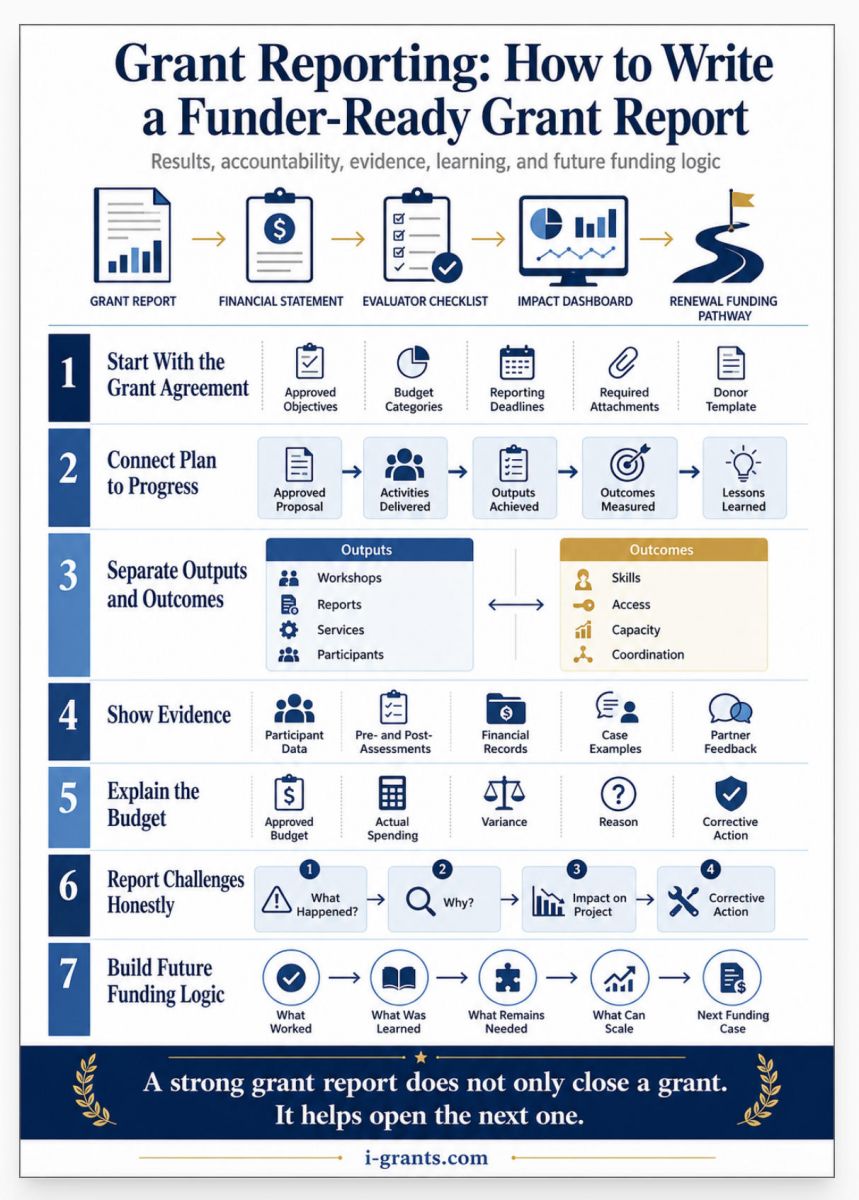
Before drafting any report, read the grant agreement, award letter, reporting schedule, approved proposal, budget, logframe, work plan, and donor instructions. Do not start with a blank document. Start with what the funder approved.
The report should respond to the original commitments:
-
What objectives were approved?
-
What activities were funded?
-
What outputs were promised?
-
What outcomes were expected?
-
What indicators were agreed?
-
What budget categories were approved?
-
What reporting dates were required?
-
What supporting documents must be submitted?
Different donors use different reporting logic. In EU-funded projects, for example, the reporting process may involve beneficiaries completing financial statements, project partners contributing to the technical part, and the coordinator submitting the report to the granting authority. The European Commission’s periodic reporting process also uses dedicated Continuous and Periodic Reporting modules for many grants.
For grantees, this means internal reporting cannot wait until the official deadline. If partners, finance teams, project managers, evaluators, and coordinators all need to contribute, the reporting system must be built into project operations.
Build the Report Around the Original Project Logic
The best grant reports are structured around the project logic that was approved in the proposal. That logic usually follows a chain:
Need -> Activities -> Outputs -> Outcomes -> Impact
A weak report focuses almost entirely on activities:
“We conducted workshops, held meetings, created materials, and organized events.”
A stronger report explains the relationship between activities and change:
“The project delivered twelve workshops for 240 youth participants. Pre- and post-training assessments showed improved understanding of financial planning concepts, while follow-up interviews indicated that participants used the training to prepare household budgets, compare loan terms, or apply for local entrepreneurship support.”
The difference is not decoration. It is evaluation logic.
Use activities to show implementation. Use outputs to show delivery. Use outcomes to show change. Use evidence to show credibility.
Include Both Quantitative and Qualitative Evidence
A strong grant report should combine numbers and narrative. Numbers show scale, reach, completion, cost, and measurable change. Narrative explains context, meaning, barriers, and human relevance.
Quantitative data may include:
-
Number of participants served
-
Number of workshops delivered
-
Number of services provided
-
Completion rates
-
Demographic distribution
-
Geographic coverage
-
Pre- and post-assessment results
-
Funds spent by category
-
Deliverables completed
-
Indicators achieved
Qualitative evidence may include interviews, case examples, participant feedback, partner observations, field notes, evaluator comments, or community consultation findings.
The Global Fund emphasizes that high-quality information collected more frequently helps countries and partners anticipate issues, remove bottlenecks, correct course, and assess programmatic and financial performance. That principle applies beyond global health. Reporting is strongest when data is timely enough to support management, not merely retrospective enough to satisfy a deadline.
Explain Budget Performance, Not Just Spending
Financial reporting is one of the most sensitive parts of a grant report. Funders need to know whether money was used for approved purposes and whether spending patterns make sense.
A good financial section should answer:
Was the approved budget followed?
Were there underspends or overspends?
Were reallocations approved where required?
Did unit costs change?
Were matching funds or co-financing secured?
Are there unpaid obligations?
Do financial results align with technical progress?
Do not hide budget variances. Explain them.
For example:
“Personnel costs were 8 percent below budget because recruitment of the project coordinator was completed six weeks later than planned. The underspent amount was reallocated, with funder approval, to participant transportation support after attendance barriers were identified during the first quarter.”
This kind of explanation builds trust because it shows control, transparency, and adaptive management.
A weak report says, “Funds were spent according to the project needs.” A strong report shows how, why, and with what effect.
Report Challenges Honestly
Many grantees fear that reporting problems will damage the relationship with the funder. In reality, hiding problems is usually more damaging than explaining them.
Funders know that projects face delays, staff changes, procurement issues, political disruptions, exchange-rate changes, recruitment challenges, partner delays, data limitations, or unexpected beneficiary needs. What matters is whether the grantee recognized the problem, communicated early, adjusted responsibly, and documented the decision.
A strong challenge section has four parts:
-
What happened?
-
Why did it happen?
-
How did it affect the project?
-
What corrective action was taken?
Avoid vague language such as “minor delays occurred” if the delay affected implementation. Be specific, but not defensive.
For example:
“Participant recruitment was slower than expected during the first two months because school administrators required additional approval from district authorities. The project team adjusted the outreach timeline, added two parent information sessions, and shifted the first training cohort by three weeks. The final number of participants remained unchanged.”
That kind of reporting shows maturity.
Make the Report Useful for the Funder
A grant report is not only a record of your project. It is also an input into the funder’s own decision-making. Funders may use reports to brief boards, justify future grantmaking, refine program strategies, identify risks, communicate impact, or decide whether to renew funding.
Grant reporting helps funders assess impact, identify areas for improvement, refine funding strategies, and improve future grant allocations. This is why a report should be easy to read, well structured, and decision-oriented.
A funder-ready report should help the funder answer:
-
Did this grant produce value?
-
What did we learn from it?
-
Should this organization receive future support?
-
Is the model scalable or replicable?
-
Are there risks we need to understand?
-
Does this grant align with our strategic goals?
Do not make the funder search for the answer. Put the answer into the structure.
Use Reporting to Strengthen Renewal Funding
If you hope to secure future funding, the grant report should not read like an endpoint. It should create a credible bridge to the next stage.
This does not mean turning the report into a proposal. It means showing continuity.
The final section may include:
-
What remains needed
-
What the project proved
-
What should be refined
-
What could be scaled
-
What partners are ready to continue
-
What additional funding would enable
-
What evidence supports the next phase
For example:
“The pilot demonstrated strong demand among rural youth centers and confirmed that the blended training model can be delivered with modest staff support. A second phase would focus on regional replication, trainer certification, and integration with municipal youth employment services.”
This is not an emotional request. It is continuation logic.
Common Mistakes in Grant Reporting
The first mistake is writing the report too late. If data, receipts, participant records, partner updates, and photos are collected only at the end, the report will be weak.
The second mistake is reporting activities without results. Funders need to know what changed, not only what happened.
The third mistake is hiding deviations. If the project changed, explain why and whether approval was obtained.
The fourth mistake is separating finance and narrative too sharply. The financial report should make sense in relation to implementation progress.
The fifth mistake is using vague impact language. Phrases like “major impact,” “community transformation,” and “empowerment” need evidence.
The sixth mistake is ignoring funder instructions. If the funder requires a portal submission, template, signature, audited statement, or specific reporting period, follow it exactly.
The seventh mistake is failing to capture learning. A project that learned nothing may look less credible than a project that faced problems and improved.
A Practical Structure for a Funder-Ready Grant Report
While every funder has its own format, a strong internal structure often looks like this:
1. Executive summary
Briefly summarize the project, reporting period, main achievements, major challenges, and financial status.
2. Project objectives
Restate the approved objectives and explain whether they remain unchanged.
3. Activities implemented
Describe what was delivered during the reporting period, organized by work package, objective, location, partner, or component.
4. Outputs and outcomes
Report progress against indicators, targets, deliverables, and expected results.
5. Beneficiary or participant data
Include reach, demographics, geography, inclusion data, feedback, or relevant user statistics.
6. Financial report
Show budget versus actual expenditure, explain variances, and connect spending to implementation.
7. Challenges and changes
Explain delays, risks, modifications, approvals, and corrective actions.
8. Learning and adaptation
Describe what the team learned and how the project improved.
9. Sustainability and next steps
Explain what will continue, what needs additional support, and how the project connects to future funding logic.
10. Attachments
Include required supporting documents only: financial statements, photos, publications, participant lists, deliverables, evaluation summaries, invoices, or audit documents as requested.
Where i-grants.com Fits Into the Grant Reporting Process
Many organizations look for grant writing support only before submission. But post-award reporting is also a specialized skill. A strong grant report requires donor literacy, budget logic, evaluation thinking, narrative discipline, and the ability to translate messy implementation reality into a clear funder-facing document.
i-grants.com helps applicants and grantees connect with professional grant writers and grant consultants who understand the full grant cycle, not only proposal writing. For NGOs, universities, startups, research teams, municipalities, cultural institutions, youth organizations, and social enterprises, the right expert can help prepare progress reports, final reports, renewal narratives, budget explanations, outcome summaries, and funder-ready impact stories.
This matters because reporting is not just about closing the current grant. It is about protecting the next opportunity.
Final Checklist Before Submitting a Grant Report
Before submitting, review the report as if you were the funder.
Ask:
-
Does the report follow the funder’s template and deadline?
-
Does it compare actual progress against the approved proposal?
-
Are outputs and outcomes clearly separated?
-
Are statistics accurate and supported by records?
-
Are budget variances explained?
-
Are challenges described honestly?
-
Are changes documented and approved where necessary?
-
Does the narrative match the financial report?
-
Are lessons learned included?
-
Does the report create a credible basis for future funding?
If the answer to any of these questions is weak, revise before submission.
Conclusion: Reporting Is a Funding Relationship Tool
Grant reporting is not just compliance. It is relationship management, evidence communication, financial accountability, and future funding strategy in one document.
A funder-ready report shows that your organization can do more than win grants. It shows that you can manage them, learn from them, explain them, and turn funded work into credible evidence for the future.
The strongest reports are honest, structured, data-informed, financially clear, and strategically useful. They do not hide problems. They explain them. They do not inflate success. They prove it. They do not simply close a grant. They help open the next one.