

 Français
  Deutsch
  Українська
Most grant applications fail long before the proposal is written.
The reason is usually not poor writing. It is poor matching.
Every year, international donors, government agencies, foundations, research programmes, regional funds, embassies, corporate foundations and development institutions publish thousands of funding opportunities. For NGOs, startups, universities, municipalities and social enterprises, this creates the impression that money is everywhere. In reality, most of that money is not accessible to most applicants.
A grant is not relevant simply because the title sounds attractive. A climate grant is not automatically suitable for every environmental project. A youth grant is not automatically suitable for every education initiative. A startup grant is not automatically suitable for every early-stage company. A research grant is not automatically suitable for every university department.
The decisive question is not “Is this grant interesting?” The decisive question is “Can this specific applicant, with this specific project, legally apply, compete well and deliver the project under the donor’s rules?”
This is where grant eligibility matching becomes essential.
For applicants, eligibility matching saves time, reduces frustration and prevents low-probability applications. For grant writers, it creates a professional method for advising clients before the writing process begins. For platforms such as i-grants.com, it is the operational bridge between active grant opportunities, project owners and freelance grant writers who can help turn a funding opportunity into a competitive application.
This article explains how to match a project with the right grant. It is designed for NGOs, startups, universities, cultural organizations, municipalities, social enterprises and grant writers who need a practical workflow, not general advice.
1. Start With the Project, Not With the Donor
Many applicants begin their search with donor names. They look for Horizon Europe, Erasmus+, USAID, British Council, national ministries, embassy grants or large international foundations. This is understandable, but it often leads to wasted time.
Donors do not fund vague intentions. They fund specific types of applicants, activities, geographies, beneficiaries, outcomes and implementation models. That is why the first step is not to search for a famous donor. The first step is to define the project accurately.
A strong project profile should answer several basic questions.
What type of applicant is applying? Is it an NGO, startup, university, school, municipality, research institute, private company, cultural institution, public body, social enterprise or individual applicant?
Where is the applicant legally registered? Where will the project be implemented? These two locations may be different, and both can matter.
What sector does the project belong to? Education, healthcare, climate, culture, research, innovation, agriculture, democracy, youth, gender equality, veterans’ support, social inclusion and humanitarian assistance all lead to different donor ecosystems.
Who are the beneficiaries? A project for rural women entrepreneurs, displaced students, early-stage climate startups, young researchers or local cultural institutions will require different funding routes.
What is the project stage? Is it only an idea, a pilot, a tested model, a scaling initiative, a research phase, a market validation stage or a mature programme that needs expansion?
What amount of funding is needed? Can the applicant provide co-financing if required? Are the main costs salaries, equipment, travel, training, research, software development, construction, communications or grants to third parties?
Does the project need partners? Some grants allow single applicants. Others require consortia, cross-border cooperation, academic partners, public authorities, private-sector partners or local implementing organizations.
This project profile becomes the filter for the entire grant search. Without it, the applicant is browsing. With it, the applicant is matching.
For example, an NGO working with displaced youth may initially search for “education grants”. But a more precise profile may reveal that the best routes are youth resilience programmes, psychosocial support grants, humanitarian education funds, community recovery calls, embassy small grants or EU civil society funding.
A startup building AI tools for energy efficiency may search for “green startup grants”. But the real eligibility logic may depend on company age, technology readiness level, intellectual property ownership, country of registration, pilot partners, market validation and whether the grant allows commercial applicants.
Good grant matching begins when the project is specific enough to be evaluated.
2. Separate Thematic Fit From Legal Eligibility
One of the most common mistakes in grant search is confusing thematic fit with legal eligibility.
Thematic fit means the project topic matches the donor’s priorities. Legal eligibility means the applicant is allowed to apply under the official rules.
These are not the same.
A project can be thematically perfect and legally ineligible. A nonprofit may work on climate adaptation, but the grant may be limited to universities and research institutes. A startup may have an excellent health innovation, but the call may fund only public hospitals or registered research consortia. A cultural organization may fit the topic, but the applicant’s country may not be eligible.
This is why serious grant matching requires a strict eligibility review before any proposal writing begins.
Applicants should check at least ten areas:
| Eligibility area | Key question | Why it matters |
|---|---|---|
| Applicant type | Is this type of organization allowed to apply? | Some calls exclude companies, individuals, informal groups or public bodies. |
| Legal status | Is formal registration, accreditation or nonprofit status required? | Some applicants may need a fiscal sponsor or lead partner. |
| Country of registration | Is the applicant’s country eligible? | Donor geography is often one of the first screening rules. |
| Project location | Can the project be implemented in the proposed territory? | Some grants fund only specific regions, cities or countries. |
| Partnership model | Is a consortium required? | Many international calls require partners from several countries or sectors. |
| Eligible activities | Are the planned activities allowed? | Donors may exclude construction, equipment, commercial promotion or sub-granting. |
| Eligible costs | Does the budget match the donor’s cost rules? | A good project can fail if the cost structure is not allowed. |
| Funding amount | Is the requested budget within the donor’s limits? | Too small or too large a request can weaken the application. |
| Co-financing | Is own contribution required? | Applicants without matching funds may be ineligible or less competitive. |
| Deadline readiness | Can the applicant prepare documents in time? | Eligibility is useless if the application cannot be submitted correctly. |
This table should be used before the applicant falls in love with the grant.
A headline may say “support for innovation” or “funding for civil society”, but the official guidelines may define eligibility much more narrowly. A serious applicant reads the call document, not only the summary page. A serious grant writer checks the rules before promising a proposal.
The best rule is simple:
Eligible means allowed to apply. Competitive means worth applying. Deliverable means safe to fund.
A strong opportunity should pass all three tests.
3. Build a Source Map Instead of Searching Randomly
Grant opportunities are scattered. They appear on official donor portals, programme pages, embassy websites, foundation announcements, government portals, development agency notices, university funding pages, sector newsletters and grant aggregators.
Google can help, but it should not be the only source. Search results may be outdated, incomplete or dominated by third-party summaries. For professional grant work, applicants and grant writers need a source map.
A source map is a structured list of places where relevant opportunities are likely to appear. It should separate official sources from discovery sources.
| Source type | Role in grant search | Verification value |
|---|---|---|
| Official donor portals | Publish calls, rules, documents and deadlines | Highest |
| Programme websites | Explain priorities, eligibility and application logic | High |
| Foundation websites | Publish open calls and funding priorities | High |
| Government portals | List national, regional and municipal funding | High |
| Embassy pages | Publish local small grants and thematic calls | High |
| Development agencies | Publish international cooperation opportunities | High |
| Aggregators | Help discover opportunities faster | Medium |
| Newsletters and social media | Provide early signals and reminders | Low to medium |
The workflow should be:
Discover widely. Verify officially. Classify carefully.
A grant should not be treated as verified only because it appeared in a newsletter, LinkedIn post or third-party database. The official donor page or application document should confirm the deadline, eligibility rules, funding amount, geography, application format and submission method.
This is especially important for international grant intelligence. A useful grant database is not just a list of links. It should classify opportunities by donor, eligible countries, applicant type, sector, deadline, funding amount, language, application method, source reliability and official verification link.
For i-grants.com, this distinction is critical. The platform’s value is not only helping people find grants. Its stronger value is helping applicants and grant writers understand which grants are active, verified and relevant to a specific project profile.
4. Read Every Call From Three Perspectives
A grant call should be read in three ways: legally, strategically and operationally.
The legal reading asks: are we allowed to apply?
The strategic reading asks: are we likely to score well?
The operational reading asks: can we deliver the project if funded?
Many applicants stop after the first question. That is dangerous. Legal eligibility alone does not make a grant worth pursuing.
A legally eligible applicant may still be strategically weak if the project does not align with the donor’s real priorities. A strong idea may still be operationally risky if the applicant lacks staff, financial systems, partners or monitoring capacity.
The legal layer includes applicant type, country, registration status, consortium rules, formal documents, eligible costs and submission requirements.
The strategic layer includes donor priorities, evaluation criteria, policy alignment, innovation level, evidence base, expected impact, target groups and long-term value.
The operational layer includes staffing, procurement, reporting systems, financial controls, risk management, safeguarding, data collection, partner coordination and implementation timeline.
For example, a local NGO may be legally eligible for a regional democracy grant. But if the donor is looking for policy influence, public accountability and coalition-building, a small training-only project may not be strategically strong enough.
A startup may be eligible for an innovation grant. But if the call expects validated technology, pilot users and a clear commercialization path, an idea-stage concept may be too early.
A university may be eligible for a research consortium. But if the team has no confirmed international partners and the deadline is close, the application may be operationally unrealistic.
Good grant matching means looking beyond permission. It means evaluating probability.
5. Create a Grant Fit Score Before Making a Decision
A grant fit score helps applicants and grant writers make disciplined decisions. It does not replace expert judgment, but it reduces emotional decision-making.
A simple scoring model can use a scale from 1 to 5.
| Factor | Score 1 | Score 3 | Score 5 |
|---|---|---|---|
| Legal eligibility | Doubtful or unclear | Mostly eligible, with some questions | Clearly eligible |
| Thematic fit | Weak connection | Relevant but not central | Direct match |
| Geographic fit | Outside main focus | Eligible but not priority geography | Strong priority geography |
| Applicant track record | Little relevant experience | Some relevant experience | Strong evidence and past results |
| Partnership readiness | Required partners missing | Partners possible but not confirmed | Partners already aligned |
| Budget fit | Budget does not match rules | Budget can be adjusted | Strong fit with funding range and cost rules |
| Deadline readiness | Not realistic | Difficult but possible | Realistic submission plan |
| Competitive edge | Generic project | Some differentiation | Clear, evidence-based advantage |
If the average score is low, the applicant should not force the application. It may be better to redesign the project, find partners, prepare missing documents, build a smaller pilot or search for another donor.
This matters because weak applications are expensive even when no fee is paid. They consume staff time, management attention, partner goodwill and strategic focus. A low-probability proposal can take almost as much effort as a strong one.
For grant writers, a fit score is also a client communication tool. Instead of saying “this grant is not a good match”, the grant writer can show which factors are weak and what could improve the match.
This makes the relationship more professional. The grant writer is not only a text producer. The grant writer becomes a funding strategy adviser.
6. Identify Eligibility Red Flags Early
Some grants look promising at first glance and become problematic only after a careful review. Applicants should learn to detect red flags before the writing process begins.
The most common red flags include:
-
The applicant’s country is not eligible.
-
The applicant type is not allowed.
-
The call requires a consortium, but partners are not available.
-
The organization is not legally registered or lacks required documents.
-
The planned activities are not eligible.
-
The main budget items are not allowed.
-
The donor requires co-financing that the applicant cannot provide.
-
The deadline is too close for signatures, partner agreements or official documents.
-
The call language or portal is beyond the applicant’s current capacity.
-
The project is relevant to the topic but weak against the evaluation criteria.
A red flag does not always mean the grant is impossible. Sometimes the issue can be solved. The applicant may add a partner, adjust the budget, narrow the project, use a fiscal sponsor, prepare missing documents or select another role in the consortium.
But red flags must be addressed before writing begins.
The worst approach is to ignore eligibility weaknesses and hope that a persuasive proposal will compensate. In many grant systems, ineligible applications are rejected before evaluators assess quality. Strong writing cannot fix a non-compliant application.
7. Match the Grant to the Applicant’s Stage of Development
Different applicants need different grants at different stages.
A newly registered NGO may need a small community grant, capacity-building support, a local foundation grant or a pilot project fund. A mature NGO with audited accounts, trained staff and international partners may be ready for a larger donor programme.
An idea-stage startup may need an accelerator, innovation voucher, prototype grant or pitch competition. A startup with validated technology and pilot customers may be ready for scale-up funding, public innovation support or sector-specific grants.
A university research team may need mobility funding, research collaboration grants, laboratory infrastructure support, doctoral networks or international consortium calls.
A municipality may need regional development funds, climate adaptation programmes, urban innovation grants or cross-border cooperation opportunities.
The grant should match the applicant’s maturity.
Early-stage applicants often target large grants too soon. This can be a strategic mistake. Large grants often require strong financial controls, previous donor experience, established partnerships, audited accounts, advanced reporting systems and the ability to manage complex implementation.
A smaller grant may be more valuable if it creates evidence, results, financial history, donor trust and a stronger portfolio for future applications.
Grant writers should diagnose applicant maturity before recommending opportunities. The key question is not only “What does the client want to fund?” It is also “What is the client ready to manage?”
This is one of the most useful roles of an international grant marketplace. Applicants can discover opportunities that fit their stage. Grant writers can help them understand whether to apply now, prepare first or look for a more suitable funding route.
8. Translate the Project Into the Donor’s Logic
Once a promising grant is identified, the applicant should not immediately start filling out the form. First, the project must be translated into the donor’s logic.
This does not mean distorting the project. It means expressing the project in the language of the call.
The same project can be positioned differently depending on the donor.
A youth employment project can be framed as social inclusion, skills development, post-crisis recovery, entrepreneurship, local economic development or education reform.
A climate project can focus on adaptation, resilience, clean technology, community action, research, policy change or green jobs.
A cultural heritage project can emphasize preservation, digital access, tourism, education, identity, minority rights or creative industries.
A startup project can highlight technology readiness, market failure, public benefit, competitiveness, job creation, export potential or sustainability.
The donor-ready version of the project should include:
-
A clear problem statement supported by evidence.
-
A defined target group and geography.
-
Objectives that match the call priorities.
-
Activities that are eligible under the rules.
-
Outputs and outcomes that can be measured.
-
A budget that follows eligible cost categories.
-
A realistic implementation timeline.
-
Partner roles, if partners are required.
-
A monitoring and evaluation approach.
-
A sustainability or continuation plan.
-
Evidence that the applicant can manage funds responsibly.
This is where professional grant writing becomes strategic. The work is not only about better sentences. It is about alignment between the project, the donor, the rules and the evaluation logic.
9. Use Grant Writers Before the Emergency Stage
Many applicants contact a grant writer too late. They find a grant, decide to apply and then ask someone to write the proposal a few days before the deadline.
This reduces the grant writer’s role to emergency writing. It also increases the risk of a weak application.
A better approach is to involve a grant writer at the matching stage.
A skilled grant writer can help review eligibility, interpret donor priorities, assess competitiveness, identify missing documents, structure the project concept, build a work plan, coordinate partner inputs and create a realistic application schedule.
For applicants, this reduces wasted effort. For grant writers, it creates a more professional relationship. The grant writer is not simply filling in forms. They are helping the applicant choose the right opportunity and prepare a credible application.
This is especially important for complex international grants. Cross-border programmes, research consortia, development agency calls and innovation funds often require precise alignment between eligibility, partnership structure, budget rules, policy priorities and evidence.
One missed requirement can make the application non-compliant. One weak strategic assumption can make it uncompetitive.
On i-grants.com, this is the practical meeting point between grant intelligence and freelance expertise. Active grant opportunities become the foundation for collaboration between applicants who need funding and grant writers who know how to prepare donor-ready proposals.
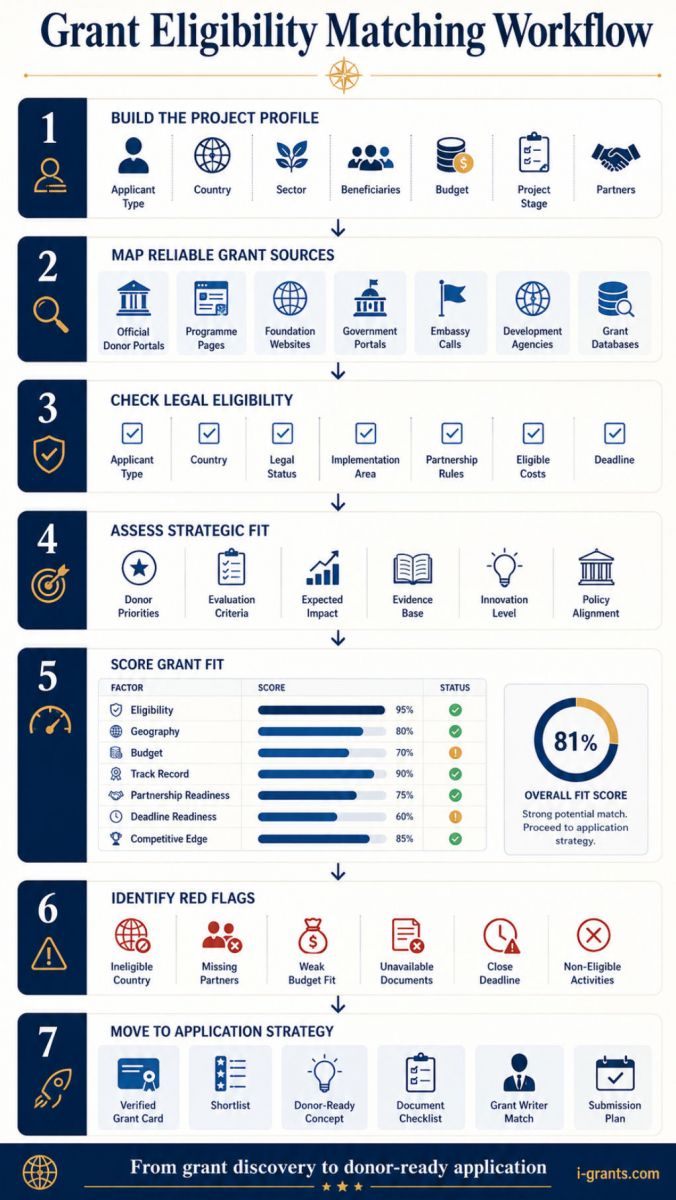
10. Build a Repeatable Grant Matching Workflow
Organizations that apply for grants regularly should not treat each funding search as a new improvisation. They should build a repeatable workflow.
A practical grant matching process can look like this:
| Step | Applicant role | Grant writer role | Output |
|---|---|---|---|
| Project profile | Define problem, geography, target group, budget and stage | Ask diagnostic questions | Clear project brief |
| Source mapping | Identify likely donor categories | Recommend donor routes | Search strategy |
| Opportunity discovery | Review active calls | Screen opportunities | Longlist of grants |
| Official verification | Check donor pages and documents | Confirm rules and deadlines | Verified grant cards |
| Fit scoring | Compare opportunities | Assess eligibility and competitiveness | Shortlist |
| Concept alignment | Adapt the project to the call | Build donor-ready logic | Application concept |
| Application planning | Gather documents and approvals | Create schedule and task list | Submission plan |
| Proposal preparation | Provide data and decisions | Write, edit and package the proposal | Final application |
This workflow improves both speed and quality. Applicants understand what information they need to prepare. Grant writers understand the strategic logic. Donors receive proposals that are more relevant, compliant and realistic.
It also helps avoid the common cycle of panic searching, rushed writing and repeated rejection.
11. Why Grant Eligibility Matching Matters Now
The funding environment is becoming more competitive and more specialized. Donors increasingly expect clear evidence, measurable results, financial accountability, policy alignment, risk management and implementation capacity.
At the same time, funding information is fragmented. A relevant grant may appear on an official donor portal, a national government website, a foundation page, an embassy announcement, a university notice, a development agency platform or a sector newsletter.
Without a structured approach, applicants face two problems at once. They miss good opportunities and pursue bad ones.
Eligibility matching solves both problems.
For NGOs, it helps identify donors that actually fund their legal type, country, beneficiaries and activities.
For startups, it filters opportunities by company stage, innovation maturity, eligible costs, sector and market logic.
For universities, it clarifies research programme rules, consortium requirements, country participation and institutional eligibility.
For municipalities, it separates realistic public-sector funding routes from calls designed for nonprofits, companies or research bodies.
For grant writers, it creates a professional method for advising clients, selecting better opportunities and building stronger applications.
The goal is not simply to apply more often. The goal is to apply better.
The Right Grant Is the One Your Project Can Actually Win
Grant success does not begin with writing. It begins with matching.
The right grant is not necessarily the largest grant. It is not always the most famous donor. It is not the opportunity with the most attractive headline.
The right grant is the one where the applicant is eligible, the project fits the donor’s priorities, the budget is realistic, the deadline is manageable, the evidence is strong and the organization can deliver what it promises.
For applicants, this means grant search should begin with a clear project profile and a disciplined eligibility review.
For grant writers, it means professional value begins before the first proposal draft. The strongest grant writers help clients decide where to apply, where not to apply and how to turn a project idea into a donor-ready concept.
For i-grants.com, this is the foundation of a useful international grant marketplace. Active grant opportunities are not just database records. They are starting points for real collaboration between applicants who need funding and grant writers who know how to transform eligibility, strategy and evidence into competitive applications.