

 Français
  Deutsch
  Українська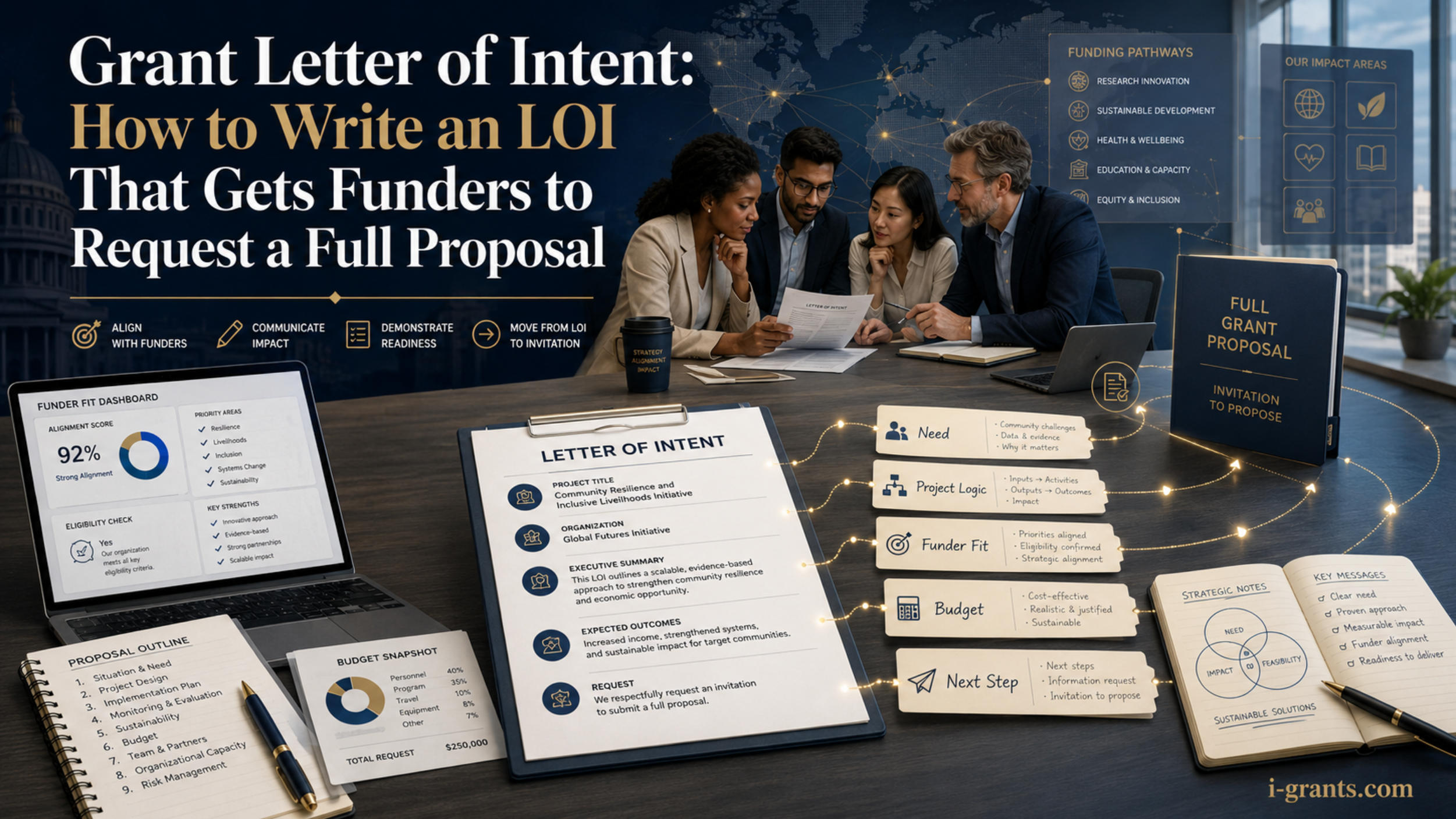
A grant letter of intent, often called an LOI, letter of inquiry, letter of interest, concept note, or pre-proposal, is one of the most important documents in the grantseeking process. It is usually shorter than a full proposal, less technical than a complete application package, and easier to submit. Yet for many funders, it is the first serious filter between your organization and a possible grant.
That is why the LOI is deceptively difficult. A weak full proposal may fail after a long review. A weak LOI may fail before the funder ever asks to see your full project logic, detailed budget, partnership structure, evaluation plan, or sustainability strategy.
The purpose of a grant LOI is not simply to introduce your organization. It is to help the funder decide whether your idea deserves a full proposal. In practice, a strong LOI answers one strategic question: does this applicant appear aligned, credible, realistic, and valuable enough to invite into the next stage?
For NGOs, universities, startups, research teams, cultural institutions, youth organizations, municipalities, and social enterprises, this document can define whether months of project preparation turn into a real funding opportunity or disappear into a polite rejection. A good LOI does not guarantee funding. But it can earn the one thing every applicant needs first: the right to be seriously considered.
What Is a Grant Letter of Intent?
A grant letter of intent is a concise pre-proposal document that summarizes the applicant, the problem, the proposed solution, the requested funding, and the fit with the funder’s priorities. It is not a casual email and not a generic fundraising letter. It is a strategic screening document.
Depending on the donor, this document may be called:
-
Letter of intent
-
Letter of inquiry
-
Letter of interest
-
Concept note
-
Initial inquiry
-
Pre-proposal
The terminology changes, but the function is similar. The funder wants to understand whether your project fits its mission, eligibility rules, budget range, program priorities, geographic scope, and review cycle before inviting a full application.
For some foundations, the LOI is mandatory. For others, it is strongly encouraged before a full proposal is accepted. In research and public funding programs, an LOI may also help funders estimate the number of reviewers needed, check eligibility, or organize review panels by topic.
The most important thing to understand is this: an LOI is not a shorter version of everything you want to say. It is a selective document built around funder decision-making.
Why the LOI Matters More Than Applicants Think
Many applicants treat the LOI as a formality. They assume the “real” work begins with the full proposal. That is a mistake.
The full proposal allows space for nuance. You can explain the methodology, implementation plan, risk management, evaluation design, partnership roles, staff capacity, governance, and budget narrative. The LOI gives you much less room. It tests whether you can make the funder understand and care before asking them to invest time in a full review.
The scale of the grant ecosystem explains why this screening function matters. Candid processes data on approximately three million grants each year, representing more than 180 billion dollars in funding. That volume shows how large the funding landscape is, but it also shows why funders need efficient ways to manage inquiry flow. They cannot review every promising idea at full-proposal depth.
Funding competition also varies widely by donor type, program area, geography, and grant size. Candid’s foundation data has shown that some foundations fund a relatively high share of requests while others are far more selective. GrantStation’s grantseeking research also shows that organizations with more disciplined grant pipelines tend to secure more awards over time. The lesson is not to send generic LOIs to as many funders as possible. The lesson is to build a serious pipeline where each LOI is carefully matched, targeted, and written for a real opportunity.
A well-written LOI does three things at once:
-
It shows that the applicant understands the funder’s priorities.
-
It proves that the project has a coherent intervention logic.
-
It reduces the perceived risk of inviting a full proposal.
If your LOI does not achieve those outcomes, the funder has little reason to ask for more.
The Real Goal: Get Invited, Not Fully Funded Yet
One of the most common LOI mistakes is trying to “win the grant” in two pages. That is not the right goal.
At the LOI stage, the funder is usually not making a final funding decision. They are making a screening decision. They are asking whether your organization and project are worth a deeper review.
That means the LOI must be persuasive, but not overloaded. It should not attempt to include every detail that would belong in a full proposal. Instead, it should give the funder enough confidence to think:
“This project fits our priorities. The applicant understands the problem. The intervention is plausible. The organization appears capable. A full proposal would be worth reviewing.”
That is the standard. Your LOI should make the decision to invite you feel logical, not charitable.
Start With Funder Fit Before You Start Writing
The most important LOI work happens before the first sentence is written. A beautifully written LOI sent to the wrong funder is still a weak LOI.
Funder fit has several layers. You need to check whether the funder supports your geography, target group, legal status, field of work, project type, budget size, timeline, and intended outcomes. You also need to understand whether the funder prefers innovation, direct service, research, advocacy, capacity building, systems change, community-led work, emergency response, or long-term institutional development.
If the funder does not support your kind of applicant, your country, your project category, or your budget range, strong language will not solve the mismatch.
| Fit factor | What the funder is checking | What your LOI must prove |
|---|---|---|
| Mission fit | Does the project advance the funder’s stated goals? | Your project logic directly reflects the funder’s priorities |
| Geographic fit | Is the work located in an eligible country, region, city, or community? | The location and target population are clearly stated |
| Applicant fit | Is your organization eligible by legal status, size, sector, or track record? | Eligibility is confirmed early and without ambiguity |
| Funding fit | Is the requested amount realistic for the funder’s grant range? | The ask is proportional to the project scope |
| Intervention fit | Does the project type match what the funder usually supports? | The activities resemble the funder’s actual grantmaking patterns |
| Timing fit | Can the project timeline match the funder’s review and award cycle? | The project does not require funding faster than the funder can decide |
| Evidence fit | Does the funder expect research, data, community validation, or pilot results? | The LOI includes the right level of evidence for this donor |
This table is not just a planning tool. It is a quality-control tool. If you cannot complete it confidently, you may not be ready to submit an LOI to that funder.
A strong LOI does not try to persuade the funder to change its priorities. It shows that your project already belongs inside them.
The Core Structure of a Strong Grant LOI
Most strong LOIs follow a similar internal logic, even when donor forms or page limits differ. The exact order may change, but the essential elements remain the same.
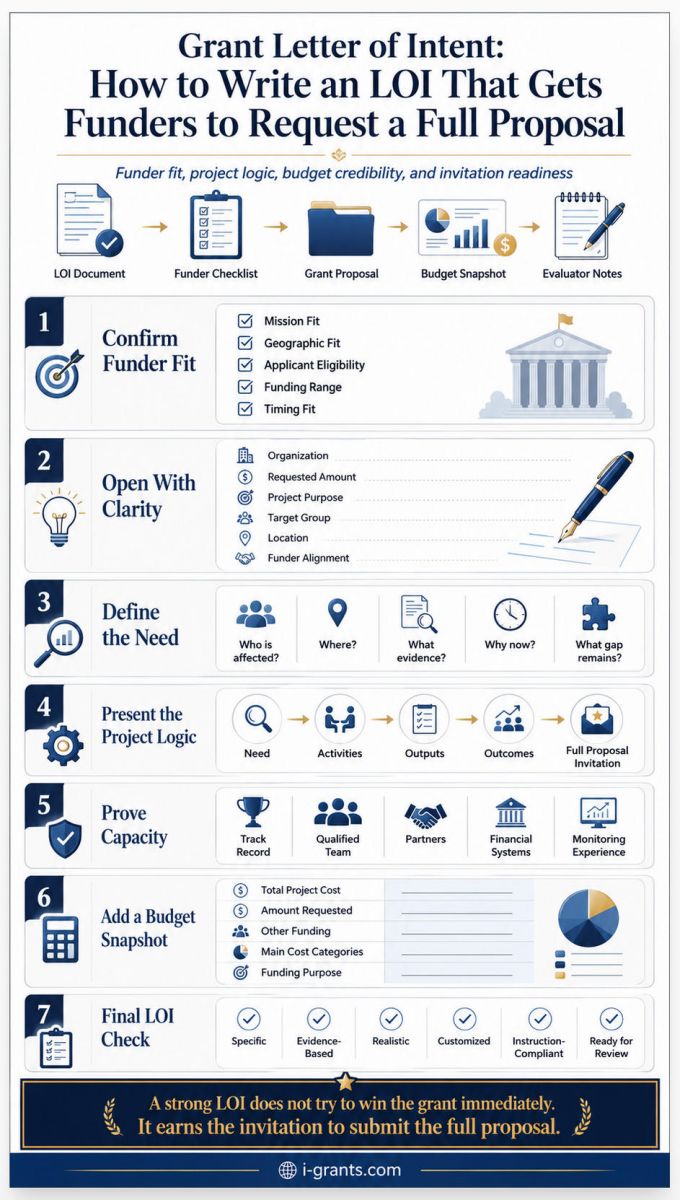
1. Opening Summary
The first paragraph should answer the funder’s basic questions immediately:
Who are you? What are you requesting? What project will the grant support? Who will benefit? Where will the work happen? Why is this funder relevant?
A weak opening sounds like this:
“We are writing to inquire about possible support for our important community program.”
A stronger opening sounds like this:
“[Organization Name] requests 75,000 dollars to launch a twelve-month youth mental health navigation program serving 300 low-income adolescents in [City]. The project aligns with [Funder Name]’s focus on early intervention, community-based care, and equitable access to behavioral health services.”
The difference is not only style. The stronger opening gives the funder decision-relevant information in the first few lines. It names the amount, timeline, target group, location, and alignment.
Do not spend the first paragraph being polite. Be clear.
2. Problem or Need Statement
The need statement should explain the problem with evidence, not drama. Funders do not need inflated language. They need to understand the severity, specificity, and relevance of the problem.
A strong need statement answers five questions:
-
Who is affected?
-
Where is the problem occurring?
-
What evidence proves the problem exists?
-
Why does it matter now?
-
What gap remains unresolved by existing services, policies, or funding?
The mistake many applicants make is describing a problem that is too broad. “Youth unemployment is a serious issue” may be true, but it is not yet fundable. A stronger framing would be:
“Young people aged 18 to 24 in rural districts of [Region] face limited access to employer-linked vocational training, while local employers report difficulty recruiting entry-level technicians.”
That version is more useful because it identifies the target group, geography, labor-market gap, and possible intervention logic.
Use statistics carefully. One relevant local statistic is better than several generic global numbers. If you cite data, make sure it supports your project design. Do not add statistics only to make the LOI look research-based.
3. Proposed Solution
The solution section should show what you will actually do with the funding. This is where many LOIs become vague. They describe values, intentions, and aspirations, but not implementation.
A funder needs to see the bridge between the problem and the intervention. What activities will happen? Who will deliver them? Who will participate? How long will the project last? What methods will be used? What will change by the end of the grant period?
For an NGO, the solution may include workshops, legal support, case management, outreach, training, community facilitation, humanitarian assistance, or direct services.
For a university, it may include research design, fieldwork, curriculum development, student mobility, laboratory work, public dissemination, or policy translation.
For a startup or innovation team, it may include prototype development, pilot testing, user validation, technical integration, or commercialization planning.
For a cultural institution, it may include exhibitions, preservation work, artist residencies, community programming, educational activities, or digital access to heritage materials.
The proposed solution should feel designed, not imagined. It should be specific enough that the funder can picture the work, but concise enough to leave room for the full proposal.
4. Expected Results
An LOI should not only describe activities. It should explain what those activities are expected to produce.
Separate outputs from outcomes.
Outputs are direct products of the work: number of people trained, workshops delivered, toolkits created, prototypes tested, policy briefs published, consultations held, datasets collected, or organizations supported.
Outcomes are changes that result from the work: improved skills, increased access, stronger institutional capacity, reduced service gaps, better evidence for decision-making, improved coordination, or higher participation by underserved groups.
A weak results statement says:
“This project will have a major impact on the community.”
A stronger results statement says:
“By the end of the twelve-month pilot, the project will train 120 youth workers, provide direct navigation support to 300 adolescents, and produce a referral protocol that can be adopted by three municipal youth centers.”
The second version gives the funder something measurable and plausible.
Do not overclaim. If your project is a pilot, call it a pilot. If your project will improve access for a specific group, say that. Do not claim it will transform an entire system unless your design, partners, budget, and authority can support that claim.
5. Organizational Credibility
A funder is not only evaluating the idea. They are evaluating whether your organization can deliver the idea.
This section should prove capacity without turning into a full institutional history. Select credibility signals that are relevant to the proposed project.
Useful credibility signals may include:
-
Previous grants completed successfully
-
Experience with the target population
-
Qualified staff, researchers, trainers, or technical experts
-
Partnerships with local organizations, municipalities, schools, clinics, universities, or community groups
-
Existing access to participants or beneficiaries
-
Financial management systems
-
Monitoring and evaluation experience
-
Prior pilot results
-
Community trust
-
Publications, prototypes, curricula, or tools already developed
If your organization is new, do not pretend otherwise. Instead, show credibility through the team’s experience, fiscal sponsor, advisory board, community partners, pilot evidence, or confirmed implementation relationships.
The key question is simple: why should the funder believe you can do this work?
6. Funder Alignment
Many applicants write alignment as a compliment:
“We admire your foundation’s commitment to social change and believe our project aligns with your mission.”
That sentence is weak because it could be sent to almost any funder.
Strong alignment is specific. It connects your project to the donor’s actual priorities, strategy, geography, values, or past grantmaking.
For example:
“This project reflects your foundation’s focus on community-led climate adaptation because it combines local risk mapping, resident training, and municipal planning tools in flood-prone neighborhoods.”
That sentence works because it links the funder’s priority to the project’s design. It does not simply praise the funder. It explains the fit.
Before writing this section, review the funder’s program pages, eligibility rules, recent grants, strategic plan, annual report, and application guidance. Look for repeated language, but do not copy it mechanically. Your LOI should sound informed, not pasted together.
7. Budget Snapshot
An LOI usually does not require a full budget, but it should include a clear funding request unless the funder instructs otherwise.
At minimum, the funder should understand:
-
How much you are requesting
-
Total project cost, if relevant
-
What the grant would support
-
Whether other funding is secured or pending
-
Whether the request is for a pilot, expansion, research phase, capacity building, core support, or a specific project component
Avoid vague phrases like “any amount would help.” Funders want to see that you understand the cost of your own idea.
A strong budget snapshot might say:
“The total project cost is 120,000 dollars. We are requesting 75,000 dollars from [Funder Name] to support training delivery, participant outreach, monitoring, and part-time project coordination. The remaining 45,000 dollars will be covered through confirmed municipal in-kind support and a pending request to [Other Source].”
This is not a full budget narrative, but it gives the funder confidence that the financial logic exists.
8. Closing and Next Step
The closing should be short, respectful, and action-oriented. Thank the funder, express readiness to submit a full proposal, and identify the contact person.
Do not pressure the funder. Do not add emotional appeals. Do not attach documents unless requested. Do not send a full proposal “just in case.”
A simple closing works:
“We would welcome the opportunity to submit a full proposal and detailed budget if this concept fits your current priorities. Thank you for considering this inquiry.”
The closing should make the next step easy.
How Long Should a Grant LOI Be?
Most grant LOIs are one to three pages unless the funder specifies otherwise. Some donors require an online form with character limits. Others request a concept note of five pages or more. Some public programs may use the LOI only for administrative planning, while private foundations may use it as a substantive screening tool.
The rule is absolute: follow the funder’s instructions exactly.
If no instructions are available, two pages is usually a practical length. One page may be enough for a small request or a simple project. Three pages may be appropriate for a complex research, policy, international development, or multi-partner initiative.
The LOI should be concise, but not thin. Brevity is not the same as underdevelopment.
What Funders Really Evaluate in an LOI
Funders rarely evaluate an LOI only for writing quality. Writing matters because clarity matters. But the real review is strategic.
A program officer is usually asking:
-
Is the applicant eligible?
-
Is the project within our current priorities?
-
Is the need real and well defined?
-
Is the proposed response credible?
-
Does the applicant have the capacity to deliver?
-
Is the requested amount plausible?
-
Is the timing realistic?
-
Would a full proposal be worth the review effort?
This is why an LOI must be written as a decision document, not a promotional brochure.
A funder does not need to know everything about your organization. They need to know whether your organization, project, request, and timing fit their grantmaking logic.
Statistical Perspective: Why Targeting Matters
Grantseeking is a pipeline discipline. The strongest applicants do not simply write better proposals. They build better opportunity pipelines, screen funders more carefully, and manage inquiry stages with discipline.
Three data points are especially relevant:
| Data point | Why it matters for LOI strategy |
|---|---|
| Candid processes data on approximately three million grants each year, representing more than 180 billion dollars in funding | The grant ecosystem is large, but also fragmented. Applicants need targeting, not random outreach |
| GrantStation’s 2025 research sample included 1,258 participating organizations | Grantseeking behavior can be studied as a repeatable organizational process, not only as individual writing skill |
| Foundation funding rates vary significantly by funder type, field, and request volume | A strong LOI must be matched to the right funder, not written as a universal appeal |
These statistics point to the same conclusion: volume alone is not a strategy. Precision matters. A smaller number of well-targeted LOIs can outperform a large number of generic inquiries because funder fit determines whether the writing has a chance to work.
Common Mistakes That Get LOIs Rejected
The first mistake is poor funder targeting. If the donor does not support your geography, legal status, population, or intervention type, the LOI is unlikely to succeed.
The second mistake is unclear project logic. Many LOIs describe a serious problem and a passionate organization but fail to explain what will actually happen with the funding.
The third mistake is overclaiming impact. Funders can recognize when a small pilot is presented as if it will transform an entire national system. It is better to promise credible outcomes than exaggerated change.
The fourth mistake is weak budget logic. If you request 100,000 dollars but describe activities that appear to cost 400,000 dollars, the funder will doubt your planning.
The fifth mistake is generic alignment language. A sentence that could be sent to twenty foundations is not alignment. It is filler.
The sixth mistake is too much organizational history. The funder does not need your entire origin story. They need to know why your organization is the right vehicle for this project now.
The seventh mistake is ignoring instructions. If the funder asks for an online form, do not email a PDF. If the funder asks for two pages, do not send five. If attachments are not requested, do not attach a full proposal.
A Practical LOI Framework You Can Use
A strong LOI can be drafted with the following internal structure.
Paragraph 1: Executive summary
Name the organization, amount requested, project title, target population, location, and core purpose.
Paragraph 2: Need
Explain the problem with evidence, geography, population, and urgency.
Paragraph 3: Project design
Describe the intervention, main activities, delivery model, and timeline.
Paragraph 4: Expected results
State realistic outputs and outcomes. Make the difference between activities and results clear.
Paragraph 5: Organizational capacity
Show why your team can implement the project successfully.
Paragraph 6: Funder fit
Connect the project to the funder’s priorities, strategy, geography, or past grantmaking pattern.
Paragraph 7: Budget and next step
Give the funding request, total project cost if relevant, and readiness to submit a full proposal.
This framework is not a template to copy mechanically. It is a logic map. The final LOI must still be customized to the funder.
How to Make the LOI More Persuasive
The best LOIs are not the most emotional. They are the most decision-ready.
Use precise language. Write “legal aid clinics for displaced women entrepreneurs” instead of “support services.” Write “pilot a digital referral tool in three municipal youth centers” instead of “improve coordination.”
Use measured outcomes. Write “serve 300 participants and help at least 180 complete the training pathway” instead of “empower hundreds of people.”
Use funder language carefully. If the donor emphasizes equity, resilience, innovation, evidence, local leadership, or systems change, connect your project to those ideas through substance. Do not simply repeat the words.
Use numbers where they clarify scale: target population, timeline, requested amount, total cost, projected outputs, and evaluation indicators. But avoid statistical clutter.
Use human relevance without turning the LOI into a story-only document. A brief example can help, but the funder still needs the model, capacity, and budget logic.
The Role of Evidence in a Strong LOI
Evidence does not always mean academic research. Depending on the project, evidence may include community surveys, local government data, needs assessments, service records, pilot results, labor-market analysis, public health indicators, climate risk maps, school data, or consultation findings.
The right evidence should do three things:
First, it should prove that the problem is real. Second, it should show that your target population is clearly defined. Third, it should support the intervention you are proposing.
For example, if you propose a youth employment program, evidence should not only show that young people are unemployed. It should also support your selected intervention, such as employer-linked training, apprenticeships, mentoring, certification, or job placement.
If you propose a cultural heritage digitization project, evidence should not only say that heritage is important. It should show preservation risk, access barriers, community demand, educational value, or institutional readiness.
Evidence should make the project feel necessary and designed.
How i-grants.com Can Help Applicants Prepare Stronger LOIs
For many applicants, the hardest part of the LOI is not writing the final sentences. It is making the strategic decisions behind them.
Is this funder a real fit? Is the project too broad? Is the budget request credible? Does the applicant have enough evidence? Should the organization submit now or first build a relationship with the funder? Is the LOI framed as a project, a pilot, a research initiative, a capacity-building request, or a scaling opportunity?
These decisions require grant writing experience.
i-grants.com is a marketplace where applicants can connect with professional grant writers who understand donor expectations, proposal logic, budget framing, eligibility analysis, and funder positioning. For NGOs, universities, startups, research teams, cultural institutions, municipalities, youth organizations, and social enterprises, the right expert can help turn a promising idea into an LOI that is clear, credible, and funder-ready.
The value is not only better wording. It is better judgment.
Final Checklist Before Sending Your LOI
Before submitting, review the LOI as a funder would.
Ask yourself:
-
Is the funder clearly relevant for this request?
-
Does the first paragraph explain the project without confusion?
-
Is the need specific, evidenced, and connected to the funder’s priorities?
-
Does the project design show what will actually happen?
-
Are the expected results realistic?
-
Is the requested amount clear and plausible?
-
Does the organization’s credibility match the project scale?
-
Is the LOI customized to this funder?
-
Are all instructions followed exactly?
-
Would a program officer understand why a full proposal is worth requesting?
If the answer to any of these questions is weak, revise before submitting.
The LOI Is a Strategic Filter
A grant letter of intent is not a miniature version of everything you hope to say later. It is a strategic filter. Its job is to prove fit, focus, feasibility, and credibility quickly enough that the funder wants the full story.
The best LOIs are concise but not shallow. They are persuasive but not exaggerated. They are specific to the funder, grounded in evidence, realistic about costs, and clear about the next step.
In a competitive funding environment, an LOI can either open the door to a full proposal or close it quietly. Treat it as a serious grant document, not a formality. A strong LOI does not guarantee funding, but it can earn the invitation that makes funding possible.