

 Français
  Deutsch
  Українська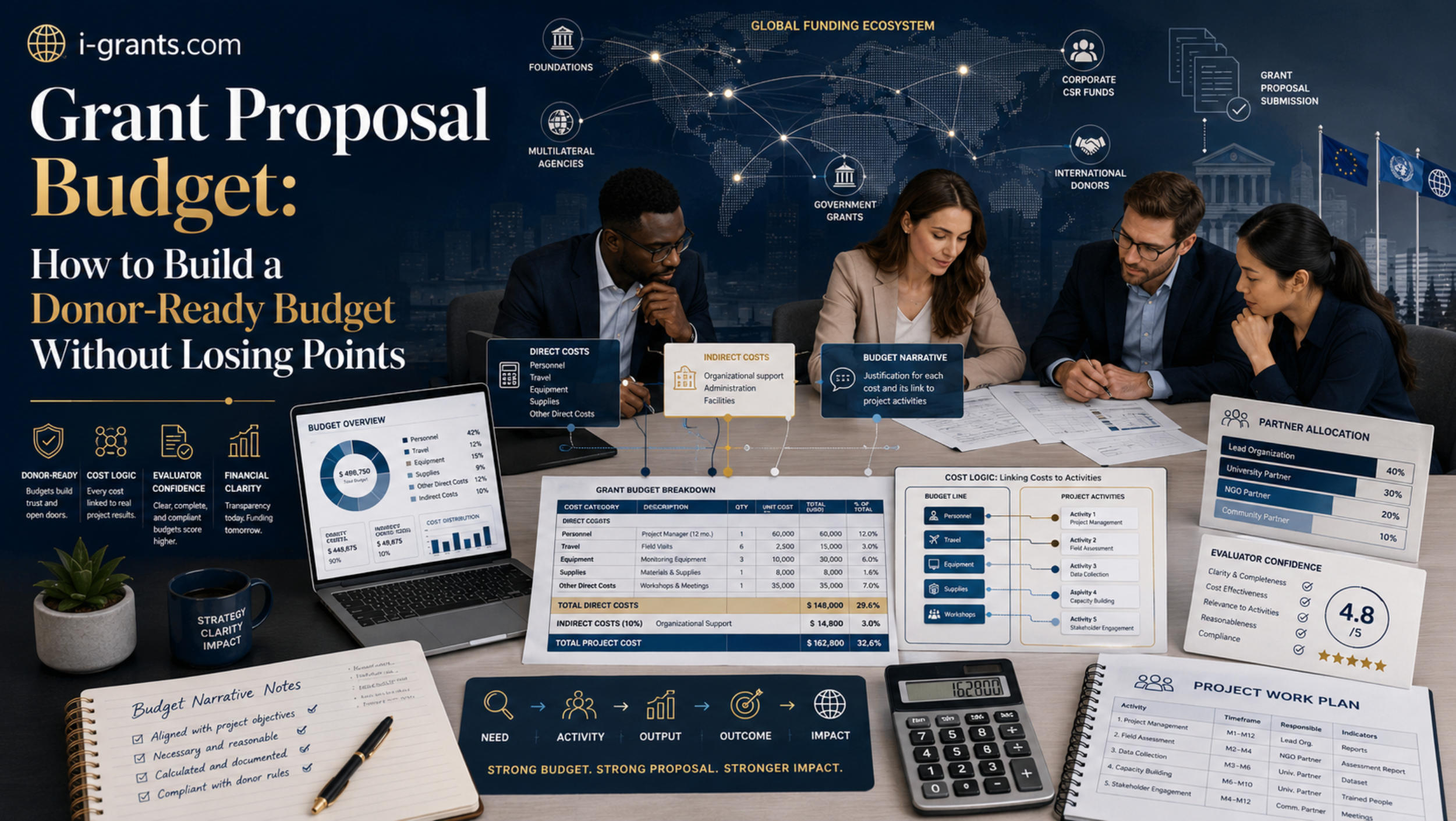
A grant proposal budget is not a financial appendix that can be completed at the end of the writing process. It is one of the strongest tests of whether your project is real, fundable, manageable, and credible. A strong narrative can attract an evaluator’s attention, but the budget shows whether the applicant understands what implementation actually requires.
For NGOs, universities, youth organizations, research teams, municipalities, social enterprises, and startups, the budget is often where a promising grant proposal starts to lose points. The problem is rarely only mathematical. More often, the problem is logic. The activities say one thing, the budget says another. The proposal promises inclusion, but there is no money for accessibility. It promises high-quality training, but there is no allocation for preparation, facilitation, translation, evaluation, or participant support. It promises digital innovation, but the technology cost is presented as one vague line. It promises sustainability, but all resources are consumed before the final reporting period.
A donor-ready budget is not simply “low” or “detailed.” It is coherent. It follows the work plan, respects funder rules, explains assumptions, separates direct and indirect costs, justifies major lines, and proves that the applicant can deliver the promised results without financial improvisation.
That is why a grant proposal budget should be built from the project logic, not from a spreadsheet template alone.
What a Grant Proposal Budget Really Does
A grant proposal budget performs three functions at the same time.
First, it translates activities into resources. Every workshop, research task, community event, mobility activity, training module, pilot test, publication, platform, evaluation process, and coordination meeting has a cost structure. If the budget does not reflect the work plan, evaluators may doubt that the applicant understands implementation.
Second, it demonstrates proportionality. Funders want to know that the requested amount is appropriate for the expected results. In many grant programs, applicants must show that costs are reasonable, necessary, and connected to the planned work. This is especially important in complex institutional funding, where a budget is evaluated not only as a financial plan, but also as evidence of project feasibility.
Third, it signals compliance. Most grant budgets must distinguish eligible from ineligible costs, direct from indirect costs, personnel from subcontracting, travel from participant support, and project costs from general organizational expenses.
A donor-ready budget therefore answers an evaluator’s unspoken question: “If we fund this project, can this applicant manage the money responsibly and deliver the work as proposed?”
Start With the Work Plan, Not the Numbers
The most common budget mistake is starting with the available grant amount. An applicant sees that the maximum award is 100,000 USD, 250,000 EUR, or 1 million EUR, and then builds a budget to fit that ceiling. This creates a dangerous pattern: the budget becomes an exercise in spending the maximum rather than funding the method.
A stronger approach starts with the work plan.
If the project has five major activities, each activity should be broken down into tasks, roles, people, time, materials, travel, services, outputs, and review points. Only then should the numbers appear. This bottom-up approach protects the proposal from inflated, underdeveloped, or arbitrary budget lines.
For example, “training workshop” is not a budget unit. A donor-ready budget asks what the training requires. Who designs the curriculum? Who facilitates? How many participants attend? Is the training online, hybrid, or in person? Are there accessibility needs? Is translation required? Are materials printed or digital? Is venue rental needed? Are travel and accommodation covered? Will the training be evaluated? Will the content be revised afterward?
The budget should make those assumptions visible. When assumptions are invisible, the evaluator has to guess. When the evaluator has to guess, the proposal loses credibility.
Table 1. From Activity to Budget Logic
| Project activity | Weak budget approach | Donor-ready budget approach |
|---|---|---|
| Youth training | “Training costs - 5,000 USD” | Facilitator time, curriculum preparation, venue or platform, materials, translation, participant support, evaluation |
| Research study | “Research - 12,000 USD” | Researcher days, data collection tools, fieldwork, transcription, analysis, ethics requirements, publication |
| Digital platform | “Website/app - 20,000 USD” | UX design, development, testing, accessibility, hosting, security, maintenance, user onboarding |
| International meeting | “Travel - 8,000 USD” | Number of travelers, route assumptions, accommodation nights, per diem rules, meeting purpose, role in work plan |
| Dissemination event | “Conference - 10,000 USD” | Audience, venue, moderation, interpretation, materials, livestreaming, communication, follow-up outputs |
| Evaluation | “Monitoring and evaluation - 3,000 USD” | Indicators, data collection, evaluator time, tools, analysis, reporting, learning workshop |
A budget does not need to explain every paper clip. But it must explain the cost drivers that matter.
Understand Direct Costs and Indirect Costs
Direct costs are expenses that can be clearly linked to the project. They may include personnel, consultants, travel, equipment, supplies, participant support, services, communications, evaluation, and activity-specific materials. Indirect costs are different. They support the organization’s operations but cannot be easily assigned to one project.
This distinction matters because many applicants either forget indirect costs or misuse them.
If indirect costs are allowed, they should be calculated according to the funder’s rules. Some funders use negotiated indirect cost rates. Some cap indirect costs. Some prohibit them. Some allow a flat-rate method. Some include overhead inside lump sums. For research grants, universities often rely on institutional policies and negotiated rates. For nonprofit grants, the rules may be simpler, but they still need to be followed.
A budget that ignores overhead can look lean, but it may also be unrealistic. Projects require financial administration, office systems, management time, accounting, HR, reporting, procurement, audit readiness, and institutional support. If none of this appears anywhere, evaluators may wonder whether the applicant has underbudgeted implementation.
At the same time, an excessive or unexplained indirect cost line can create resistance. The key is not to hide overhead or inflate it. The key is to apply the correct rule and explain it clearly.
Build the Budget Narrative Alongside the Spreadsheet
The spreadsheet shows the numbers. The budget narrative explains why the numbers make sense.
A strong budget narrative should explain calculation assumptions, not repeat the spreadsheet in prose. For staff costs, it should clarify roles, level of effort, rate basis, and time period. For travel, it should explain who travels, why, where, how often, and under what cost assumptions. For equipment, it should explain why the item is necessary for the project and how it will be used. For subcontracting, it should explain why external expertise is needed and why the service cannot be delivered internally. For dissemination, it should explain audience, format, and expected use.
This is especially important in complex grant applications. Even when the form is simplified, the applicant still needs a defensible internal logic.
The budget narrative is also where you reduce evaluator anxiety. If a cost might look high at first glance, explain it before the evaluator questions it. If a budget line is essential to inclusion, quality, safety, compliance, or sustainability, say so. If a partner receives a significant allocation, explain the role that justifies it.
Make Personnel Costs Credible
Personnel is often the largest budget category. It is also one of the most scrutinized.
A donor-ready personnel budget should connect people to tasks. Titles alone are not enough. “Project Manager,” “Researcher,” “Trainer,” “Coordinator,” or “Communications Officer” should be connected to specific work packages, outputs, deliverables, or activity phases.
The most common personnel mistakes are underestimating coordination time, assigning senior staff to too many operational tasks, using unrealistic daily rates, failing to include finance or reporting time, and presenting staff effort that does not match the work plan.
For a multi-partner project, coordination is real work. Someone must manage meetings, partner communication, reporting calendars, risk logs, procurement, deliverables, internal approvals, quality review, and funder communication. If the proposal depends on coordination but the budget barely funds coordination, the project looks fragile.
At the same time, personnel costs must be reasonable. Funders will notice if the project director charges a high level of effort while the narrative says partners will do most of the work. They will notice if a small activity carries a heavy senior staff allocation. They will notice if the proposal includes technical outputs but no technical personnel.
The rule is simple: every role must be necessary, and every necessary role must be budgeted realistically.
Do Not Treat the Budget as Separate From Impact
Budgets lose points when they fail to support the impact promised in the proposal.
If the proposal promises measurable outcomes, the budget should include monitoring and evaluation capacity. If it promises policy influence, it may need stakeholder meetings, policy briefs, translation, or dissemination time. If it promises inclusion, it may need outreach, accessibility, interpretation, childcare, local transport, or adapted materials. If it promises a tool or curriculum, it may need user testing, revision, design, and maintenance.
This is where donor-ready budgeting becomes strategic. A budget is not only a cost document. It is evidence that the project has been designed seriously.
A project that promises “wide dissemination” but only budgets for social media posts looks weak. A project that promises “high-quality digital learning” but excludes testing and accessibility looks incomplete. A project that promises “community participation” but provides no resources for community engagement looks performative.
The budget should prove that the impact pathway is funded.
Table 2. Budget Red Flags and How to Fix Them
| Budget red flag | Why evaluators may worry | Better approach |
|---|---|---|
| Large round numbers | Suggests guessing rather than calculation | Break the cost into units, rates, quantities, and assumptions |
| No budget narrative | Forces evaluator to interpret costs alone | Explain major cost drivers and calculation logic |
| Activities not reflected in budget | Suggests the work plan is not financially realistic | Map each activity to people, time, tools, travel, and outputs |
| Too little management cost | Creates implementation risk | Budget realistic coordination, finance, reporting, and quality control |
| Too much management cost | May look inefficient | Tie management cost to partner number, reporting burden, and complexity |
| No evaluation cost | Weakens claims about results and learning | Include appropriate monitoring, data collection, review, or external evaluation |
| Weak dissemination budget | Makes sustainability and uptake less credible | Fund targeted dissemination formats for defined audiences |
| Unclear subcontracting | Raises procurement and necessity questions | Explain why external service is needed and how it supports deliverables |
| No accessibility or inclusion costs | Undermines inclusion claims | Budget practical support for participation barriers |
| Budget does not match partner roles | Makes the partnership look artificial | Allocate resources according to real responsibilities |
These red flags are not only financial problems. They are design problems.
Be Careful With Equipment, Subcontracting, and Travel
Some budget categories carry special risk because they can easily appear inflated or poorly justified.
Equipment should be included only when necessary for project delivery. If equipment is requested, the budget should explain why existing resources are insufficient, how the equipment will be used, whether the full cost or depreciation is eligible, and what happens to the equipment after the project. Rules vary by funder, so applicants must check the call conditions carefully.
Subcontracting also needs discipline. Funders usually want to know why the applicant or partners cannot perform the work internally. Subcontracting may be appropriate for audit services, specialized technical development, translation, event production, evaluation, design, or narrow expert inputs. But if too much of the project is subcontracted, evaluators may ask why the applicant partnership exists at all.
Travel should be tied to project necessity. A trip should not appear in the budget simply because international cooperation sounds attractive. It should have a purpose: partner coordination, field research, pilot delivery, training, stakeholder engagement, dissemination, or required project governance. Travel assumptions should be realistic and consistent with funder rules, especially on per diems, accommodation, economy fares, and eligible destinations.
The practical principle is simple: if you would not be comfortable explaining a cost to a donor in plain language, the cost probably needs revision.
Align Partner Budgets With Partner Responsibilities
In multi-partner proposals, budget distribution is one of the clearest signals of whether the consortium is real.
If one partner receives most of the money but the narrative presents equal cooperation, the proposal may look unbalanced. If a partner is responsible for a major output but receives too little funding, implementation may look unrealistic. If all partners receive equal amounts despite very different roles, the budget may look mechanical rather than designed.
A donor-ready budget shows that resources follow responsibility. The lead partner may reasonably receive more for coordination, reporting, and quality assurance. A technical partner may receive more for platform development or curriculum design. A community organization may receive resources for outreach, facilitation, and participant support. A university may receive funds for evaluation, research, or academic validation.
The budget should make the partnership credible. It should show that every partner has the resources needed to perform their role and that no partner is included only for symbolic geography or reputation.
Do Not Hide Weak Project Design Behind a Detailed Budget
A detailed budget cannot save a weak project. In fact, detail can make weakness more visible.
If the theory of change is unclear, the budget will look like a pile of activities. If the work plan is vague, the budget narrative will feel artificial. If the objectives are not measurable, evaluation costs will seem disconnected. If the partnership is weak, partner allocations will feel arbitrary. If sustainability is not designed, final-year costs will appear to end without a continuation logic.
This is why the budget should be developed in parallel with the project narrative. The budget tests the proposal. It reveals whether the plan has enough staff time, enough expertise, enough support for participants, enough coordination, and enough resources to produce the promised outcomes.
A strong internal review process should compare the budget and narrative line by line. Every major activity in the narrative should have a budget implication. Every major budget line should have a narrative justification. Every output should have resources behind it. Every claimed impact should have a pathway funded by the budget.
How a Grant Writer Can Strengthen the Budget
A grant writer should not replace the finance team. But a skilled grant writer or grant consultant can help make the budget donor-ready by connecting financial logic with proposal logic.
This is especially valuable when the application involves multiple partners, strict eligibility rules, a complex work plan, cost-sharing, lump sums, government compliance, or a funder-specific budget template. The finance team may know internal rates and accounting rules. The program team may know activities and target groups. The grant writer should help translate both into a funder-facing structure.
A strong grant writer will ask uncomfortable questions early. Are the activities budgeted? Are the partner roles funded? Is the evaluation realistic? Are indirect costs allowed? Are accessibility costs included? Does the budget support the impact section? Are there unallowable costs hidden in broad categories? Does the budget narrative explain assumptions clearly?
For i-grants.com, this is where specialist matching becomes practical. A nonprofit applying to a local foundation may need a different kind of budget support than a university preparing a research grant, a youth organization applying to Erasmus+, or a startup seeking innovation funding. The right grant writer understands not only language, but also funder expectations, budget categories, eligibility logic, and evaluator psychology.
Final Checklist for a Donor-Ready Grant Proposal Budget
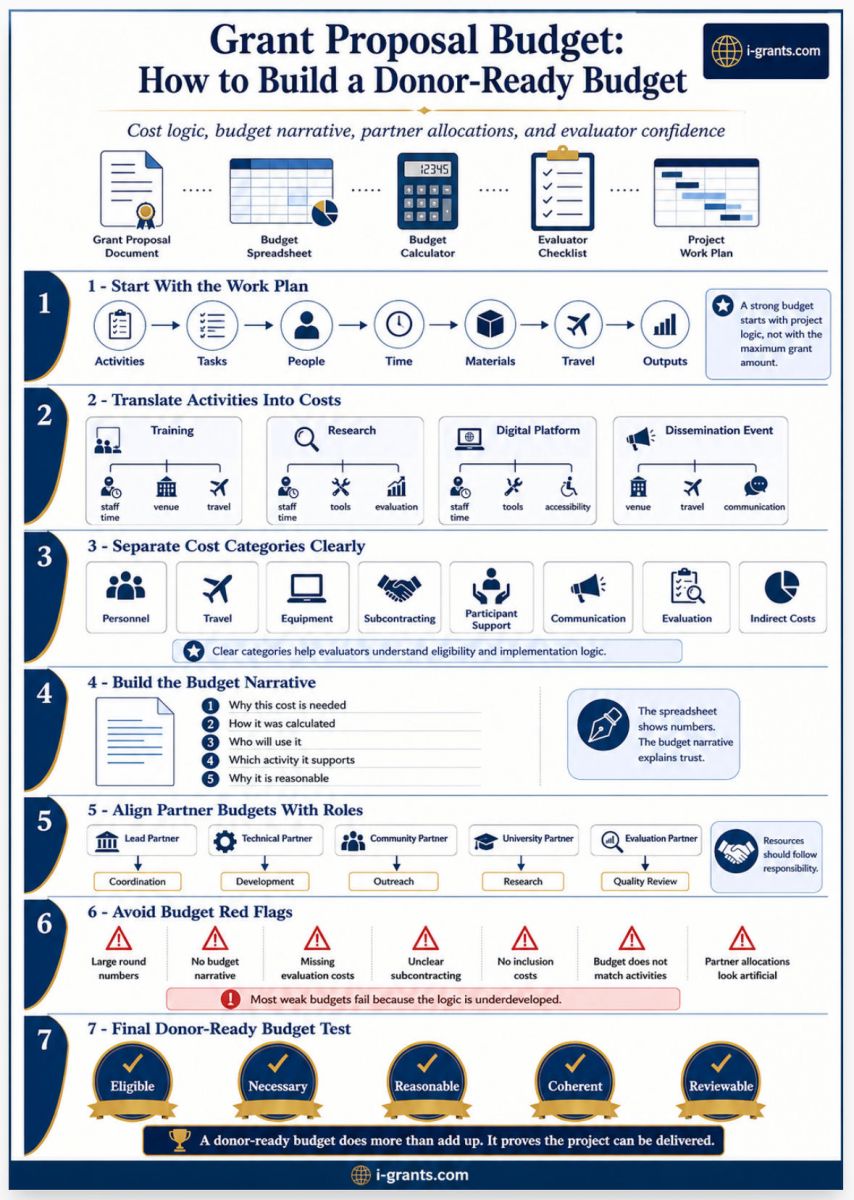
Before submitting a grant proposal, review the budget against five core tests.
First, the budget must be eligible. Every cost should comply with the funder’s rules, the applicant’s internal policies, and the call conditions.
Second, the budget must be necessary. Every major line should be clearly connected to an activity, output, deliverable, or management requirement.
Third, the budget must be reasonable. Rates, quantities, travel assumptions, staff time, and service costs should look defensible in the project context.
Fourth, the budget must be coherent. The spreadsheet, budget narrative, work plan, partner roles, impact section, and timeline should all tell the same story.
Fifth, the budget must be reviewable. An evaluator should be able to understand how the applicant calculated the major costs and why those costs are justified.
A donor-ready budget does not try to impress evaluators with complexity. It gives them confidence.
Conclusion: A Good Budget Protects the Proposal
A grant proposal budget is not just an accounting exercise. It is a strategic document that proves the project has been thought through.
When the budget is weak, evaluators see risk: unrealistic delivery, poor planning, unclear roles, hidden costs, compliance problems, or inflated assumptions. When the budget is strong, evaluators see readiness: a team that understands the work, a partnership that has divided responsibilities logically, and a project that can be implemented without improvisation.
The best grant budgets are not built by asking, “How much money can we request?” They are built by asking, “What resources are truly needed to deliver the promised change?”
That question changes everything. It turns the budget from a spreadsheet into a credibility engine. It helps NGOs, universities, startups, municipalities, youth organizations, and research teams show donors that the project is not only inspiring, but executable.
A donor-ready budget will not win the grant by itself. But a weak budget can absolutely lose it. For competitive funding, the budget must do more than add up. It must make sense.