

 Français
  Deutsch
  Українська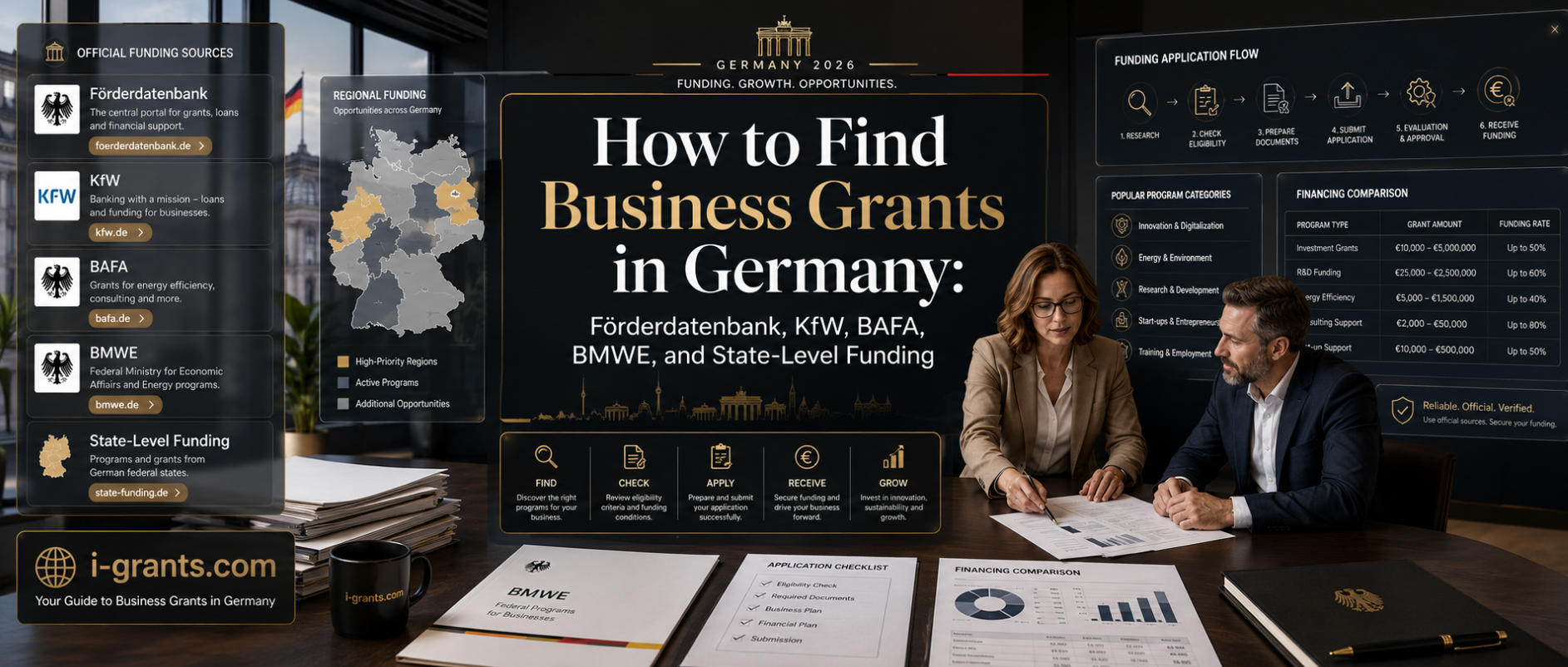
Finding business funding in Germany is not difficult because opportunities are rare. It is difficult because the system is layered. A small business owner, startup founder or international applicant may find a federal programme, a state-level subsidy, a KfW promotional loan, a BAFA energy efficiency grant, a regional investment incentive, an EU-backed scheme or a digital application portal, all within the same search journey.
The challenge is knowing which source to use first and what each source actually does.
Germany does not have one single “small business grant portal” where every company can apply for free money. Instead, it has a public funding landscape built across federal institutions, federal states, development banks, ministries, specialist agencies and EU-linked instruments. Some programmes are direct non-repayable grants. Others are promotional loans, guarantees, repayment subsidies, advisory support or hybrid financing tools.
For SMEs and startups, the practical question is not simply “Where can I find a grant?” The better question is: “Which official German funding source should I check first for my company, project type, location and cost structure?”
This article explains how to search for real business funding opportunities in Germany in 2026 using the Förderdatenbank, KfW, BAFA, BMWE, Förderzentrale Deutschland and state-level funding sources.
Why German grant search starts with the project, not the keyword
Many applicants begin with a generic keyword such as “business grants Germany” or “startup funding Germany”. This can produce long lists of links, but it often leads to the wrong programmes. In Germany, the most relevant funding source depends on the substance of the project.
A company developing a new technical product should not search in the same way as a manufacturer replacing energy-intensive machinery. A founder looking for a first business loan should not search like a university research team preparing a knowledge-based spin-off. A retail business expanding in Berlin may face different options from a production company investing in Saxony or Bavaria.
A stronger search begins with five basic filters: project type, company status, location, cost category and timing. Only after these are clear should the applicant compare programme names.
For example, “digitalisation” may lead to a state-level programme, a consulting voucher, a regional development bank product or a federal funding call. “Energy efficiency” may lead to BAFA, KfW or a state-level climate programme. “Startup finance” may lead to KfW, a state development bank, a founder grant or, for university-linked projects, EXIST.
This is why Germany rewards precise searching. The applicant who understands the project will find better funding opportunities than the applicant who searches for the broadest grant list.
Förderdatenbank: the best first orientation point
The most useful starting point is the Förderdatenbank, the federal funding database. It provides an overview of funding programmes from the federal government, the federal states and the European Union. It is not only a list of grants. It is an orientation tool that helps applicants identify relevant programmes, responsible institutions and links to official programme pages.
Förderdatenbank is especially useful because it reflects Germany’s federal structure. A company can search by region, topic, target group and funding area. This matters because many opportunities are not national. They may apply only in one federal state, one region, one sector or one investment category.
However, the database should be used carefully. A search result is not an approval, and it is not always the place where the application is submitted. The applicant must still open the programme page, read the guideline and verify the administrator, eligible applicants, eligible costs, deadlines and application route.
Table 1. Main official sources for finding business funding in Germany
| Source | Best use | What applicants should verify | Common misunderstanding |
|---|---|---|---|
| Förderdatenbank | First orientation across federal, state and EU programmes | Region, target group, funding type, administrator, programme status | Assuming every search result is an active grant for the company |
| KfW | Promotional loans, startup finance, investment finance, climate and innovation finance | Whether the instrument is a loan, grant or hybrid product, and whether a bank must apply | Treating a KfW loan as free grant money |
| BAFA | Energy efficiency, resource efficiency, consulting and selected economic programmes | Module, grant rate, eligible costs, minimum investment, application procedure | Checking BAFA too late after the project has already started |
| BMWE | Federal policy context, Mittelstand finance, innovation, entrepreneurship and advisory services | Which programme belongs to which institution and where the actual application is filed | Thinking that the ministry itself always receives the application |
| Förderzentrale Deutschland | Digital application route for selected federal programmes | Whether the specific programme is available through the platform | Treating it as a replacement for Förderdatenbank |
| State development banks | Regional loans, grants, guarantees, startup and investment support | Federal state, project location, regional impact and bank involvement | Searching only federal programmes and missing regional opportunities |
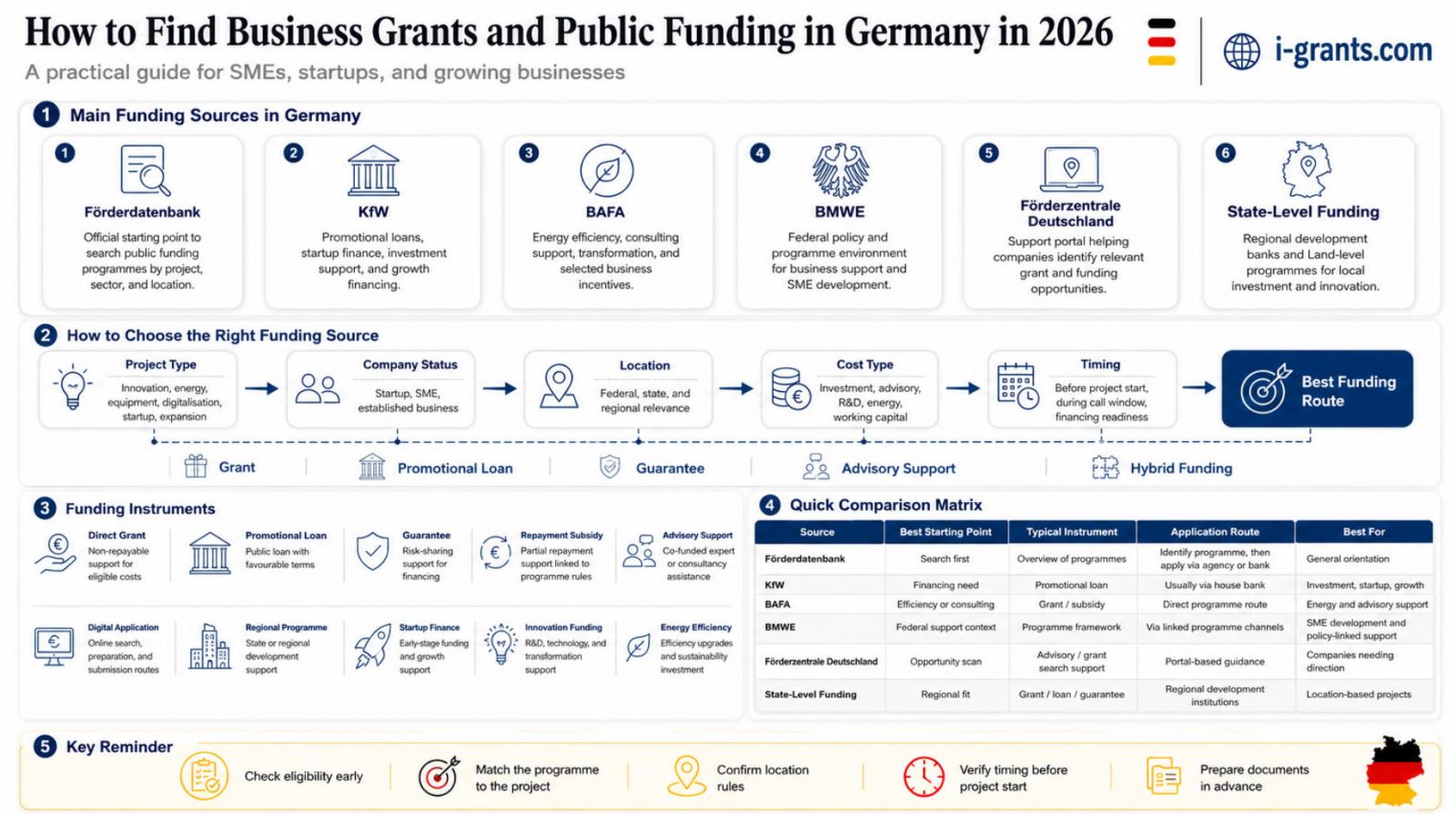
The correct use of Förderdatenbank is strategic. It helps the company build a shortlist. It does not replace the detailed check of the programme guideline.
How to read a German funding result
A German funding result usually contains more information than the programme title suggests. Before deciding whether an opportunity is worth pursuing, an applicant should identify six elements: the funder, the administrator, the funding instrument, the eligible applicant, the eligible costs and the application timing.
The funder is the institution behind the policy objective. It may be a federal ministry, a federal state, the European Union or another public authority. The administrator is the body that manages the application. It may be BAFA, KfW, a state development bank, a project management agency, a university-related office or a digital federal platform.
This distinction is important. A programme can be politically linked to a federal ministry but administered by a specialist agency. A KfW product may require the company to apply through a commercial bank. A regional grant may be listed in the federal database but managed by the relevant Land. An innovation programme may require a project outline before a full application.
Applicants should also read the funding instrument carefully. The words “funding”, “support” or “finance” do not automatically mean a direct grant. A programme may be a loan, a guarantee, a repayment subsidy, a consulting subsidy, a reimbursable cost share or an equity-linked instrument.
The final check is timing. Many German programmes require application before the project starts. A signed contract, binding order or paid invoice can make a cost ineligible. This rule should be checked before procurement, not after the company has already committed to suppliers.
KfW: when “funding” means a promotional loan
KfW is one of the most important institutions in German business finance, but it is often misunderstood by international grant seekers. KfW does not function like a simple grant office for small businesses. Many of its business instruments are promotional loans, often offered through the applicant’s regular bank or another financing partner.
This can still be highly valuable. A promotional loan can reduce financing costs, improve access to capital, support startup investment, provide grace periods or reduce bank risk. But it remains a financing instrument. The company must be able to explain repayment capacity, business viability and how the funds will be used.
KfW’s relevance is substantial. In 2025, KfW’s domestic core promotional business reached EUR 61.0 billion, and the segment for Mittelstand and founders reached EUR 23.5 billion. In the first quarter of 2026, KfW reported new commitments of EUR 24.1 billion, with significant activity in business, climate, innovation and environmental finance.
For small business founders, the ERP-Gründerkredit StartGeld is a practical example. It can provide up to EUR 200,000 for founders, self-employed professionals and young companies, including investment and running costs. The product also illustrates why applicants must understand the route: the application is normally submitted through a financing partner, and KfW assumes part of the credit risk for the bank.
Another example is the ERP-Förderkredit Gründung und Nachfolge, which can finance startup activity, company succession and young companies with a guarantee structure involving a Bürgschaftsbank. This is not a direct grant. It is a bank-based financing route with public risk-sharing.
The lesson for applicants is simple: check KfW when the project needs capital and can be financed through a bank. Do not use KfW as the first source if the company is searching only for direct reimbursement of eligible costs.
BAFA: when energy, efficiency and consulting programmes matter
BAFA, the Federal Office for Economic Affairs and Export Control, is a key source for companies looking at energy efficiency, resource efficiency, selected consulting support and several economic programmes. It is especially relevant for businesses that want to reduce energy consumption, modernise technical systems, invest in efficient equipment or prepare energy-related improvements.
BAFA’s Förderkompass 2025 is useful because it gives an organised overview of important support options in the fields of energy and the economy, with target group information for private individuals, companies and public institutions. For business applicants, BAFA is not only a place to find a programme. It is often the administrator that defines modules, eligible costs, grant rates, minimum investment amounts, technical requirements and application documents.
Energy and resource efficiency programmes are a good example. Depending on the module, support may relate to cross-cutting technologies, process heat, measurement and control systems, energy and resource-related optimisation, transformation concepts or electrification measures for small companies. Some modules offer grants, while others may interact with credit structures or require technical evidence.
For an SME, BAFA should be checked early when the project is mainly about energy savings, resource savings, efficient equipment, process optimisation or energy consulting. Waiting until after the equipment has been ordered can create eligibility problems.
BMWE: policy, guidance and programme ownership
The Federal Ministry for Economic Affairs and Energy is now abbreviated as BMWE. Many applicants will still encounter the older abbreviation BMWK in search results, older documents and programme references. For a 2026 article, BMWE is the current name to use, while BMWK remains relevant as a legacy search term.
BMWE is important because it provides the policy framework for many areas that matter to SMEs: Mittelstand finance, entrepreneurship, innovation, digitalisation, growth investment and advisory support. However, applicants should not assume that the ministry itself is always the place where the application is submitted. BMWE may be the policy owner, while another body administers the programme.
The ministry also provides guidance and information services. Its financing and funding advice can help founders and existing companies identify relevant programmes, clarify procedures, understand contact points and navigate general requirements. This is especially useful when a company is unsure whether a project belongs under startup finance, innovation finance, energy support, regional investment or advisory funding.
A good search process therefore uses BMWE as a strategic source, not only as a programme directory. It helps applicants understand why a programme exists and which public objective it serves.
Förderzentrale Deutschland: digital applications, not a search replacement
A newer development is Förderzentrale Deutschland, a federal digital platform for submitting applications for selected programmes. In May 2026, BMWE reported that the 50,000th funding application had been submitted through the platform. The ministry described it as part of a move toward simpler, faster and paperless federal funding procedures.
This is important for applicants because Germany’s application processes are becoming more digital. However, Förderzentrale Deutschland should not be confused with Förderdatenbank.
The difference is practical: Förderdatenbank helps the applicant find and compare possible programmes. Förderzentrale Deutschland may be the place where an application for a specific participating programme is submitted. It does not mean that every German business funding programme is available there.
Applicants should therefore treat Förderzentrale Deutschland as an application channel, not as the full map of funding opportunities.
State-level funding: why the Land can matter more than the national title
Germany’s federal states have their own development banks, ministries and economic development agencies. For many SMEs, this regional layer can be decisive. A company’s location may determine whether it can access an investment grant, a startup subsidy, a digitalisation programme, a regional loan, a guarantee or local advisory support.
Berlin, North Rhine-Westphalia, Saxony, Bavaria, Hamburg, Hessen and Baden-Württemberg all have their own institutional funding ecosystems. The exact offer changes over time, but the search logic remains consistent: after checking the federal level, an applicant should check the relevant Land.
Table 2. Examples of state-level funding sources in Germany
| Federal state | Typical official source | What companies may find | Why it matters |
|---|---|---|---|
| Berlin | Investitionsbank Berlin, IBB | Startup grants, investment support, innovation finance, growth programmes | Berlin has a strong startup and innovation funding ecosystem |
| North Rhine-Westphalia | NRW.BANK | Promotional loans, equity-related support, innovation and sustainability programmes | NRW is a major business region with a broad SME finance structure |
| Saxony | Sächsische Aufbaubank, SAB | Investment loans, regional grants, digitalisation and growth support | Saxony is relevant for regional investment and industrial development |
| Bavaria | LfA Förderbank Bayern | Growth, innovation, energy, climate and investment finance | Bavaria uses its own development bank for regional business support |
| Hamburg, Hessen, Baden-Württemberg | IFB Hamburg, WIBank, L-Bank | Regional investment, innovation, startup and climate finance | Each Land may have different priorities and application procedures |
State-level funding is particularly important for investment projects, company expansion, local job creation, regional innovation, digital transformation and energy transition. A national search may miss these opportunities if the applicant does not filter by region.
The regional level also matters because some programmes are designed to improve local economic structure. For example, investment support in structurally weaker areas may depend on the project location and the regional aid map. The same company activity may be eligible in one place and not eligible in another.
Which source should an SME check first?
The best source depends on the project. A company does not need to check every portal with equal intensity. It should follow the funding logic of the project.
Table 3. Which source to check first by project type
| Project type | First source to check | Second source to check | Key question |
|---|---|---|---|
| Startup finance or company succession | KfW, state development bank | Förderdatenbank, local founder support | Is the company looking for a loan, grant, guarantee or founder support? |
| R&D and technical innovation | Förderdatenbank, ZIM-related sources | BMWE, state innovation programmes | Is there real technical uncertainty and market potential? |
| Energy efficiency or resource efficiency | BAFA | KfW, state climate programmes | Does the investment reduce energy or resource use and meet technical rules? |
| Regional investment or expansion | State development bank | Förderdatenbank, regional economic agency | Is the project location eligible for regional support? |
| Digitalisation | Förderdatenbank, state programmes | BMWE or regional advisory sources | Is the project an investment, consulting measure or innovation project? |
| Consulting and business development | BAFA, state advisory programmes | Chambers, regional agencies | Is the company eligible for subsidised advice before implementation? |
| EU-oriented research or cooperation | EU funding portals, Förderdatenbank | National contact points, project partners | Does the project require a consortium or EU policy fit? |
This table should be used as a search map, not as a final eligibility decision. A programme guideline always has priority over general advice.
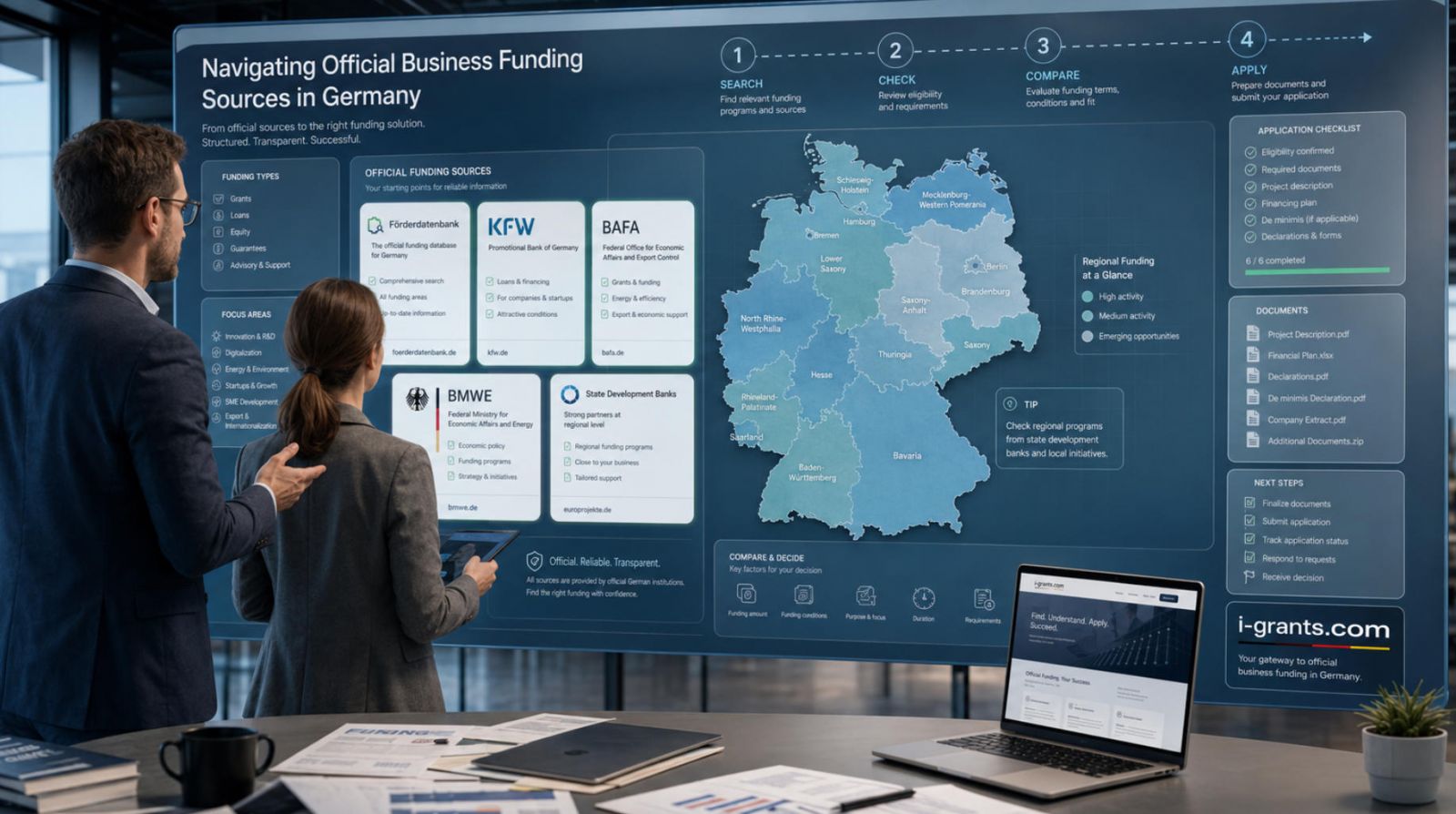
Common mistakes when searching for German business funding
The first mistake is searching only in English. Many official German programmes have limited English information, while the binding details are in German. International applicants may need German-language research even if the management team works in English.
The second mistake is using the wrong funding word. Searching only for “grant” may miss Förderkredite, Bürgschaften, Tilgungszuschüsse or state-level instruments. Searching only for “loan” may miss real Zuschüsse for energy, innovation or regional investment.
The third mistake is ignoring the administrator. A programme may appear in several databases, but only one institution receives the application. Applicants should always identify the official submission route.
The fourth mistake is checking funding after procurement. If the company has already signed a contract or ordered equipment, some opportunities may be lost.
The fifth mistake is treating federal programmes as automatically better than regional ones. In practice, a state-level programme may fit a project more precisely than a national instrument.
The sixth mistake is underestimating documentation. German funding applications often require evidence of cost, project need, financial capacity, technical feasibility, regional impact, energy savings, innovation logic or bankability. A weak file can fail even when the company and project are theoretically eligible.
A practical search workflow for SMEs and startups
A strong German funding search can be organised in a short sequence.
First, define the project in one sentence and classify it by purpose: startup finance, investment, R&D, energy efficiency, digitalisation, consulting, expansion or company succession.
Second, check the Förderdatenbank using region, target group, topic and funding type filters. Save only the programmes that match the company’s location and project type.
Third, open the official programme page and identify the instrument. Is it a Zuschuss, Förderkredit, guarantee, repayment subsidy, equity tool or advisory support?
Fourth, check the application route. Determine whether the company applies directly, through a bank, through Förderzentrale Deutschland, through a state development bank, through a university or through a project partner.
Fifth, check timing and eligible costs before signing contracts. This includes project start rules, procurement conditions, minimum investment thresholds, own contribution and documentation requirements.
Sixth, compare federal and state-level options before choosing one route. A company should not assume that the first official result is the best one.
This workflow does not guarantee approval. It prevents wasted effort and helps the applicant build a realistic funding shortlist.
When a company should involve a funding specialist
A company should consider involving a funding specialist when the project crosses several funding routes. This is common when an SME wants to combine investment, innovation, energy efficiency and regional expansion. It is also common when a startup needs to compare KfW finance, state-level support, equity-related instruments and non-repayable grants.
A specialist can help interpret the programme logic, compare funding routes, check eligibility risks, prepare the evidence file and align the budget with eligible cost categories. For international teams, the specialist can also help bridge the language and system gap between English business planning and German funding rules.
This does not mean that every funding search requires a consultant. Simple cases can often begin with official portals. But when the amount is significant, the project has already advanced, several entities are involved, or the company is unsure whether the instrument is a grant or a loan, expert review can prevent costly mistakes.
Platforms such as i-grants.com and Grantologic can help applicants connect with professionals who understand specific funding instruments, sectors and countries. For Germany, that matters because success often depends less on finding “a grant” and more on choosing the right route before the application is written.
Final takeaway
Germany offers many public funding instruments for SMEs and startups, but they are spread across several layers. Förderdatenbank is the best first orientation point. KfW is essential for promotional loans and bank-based finance. BAFA matters for energy efficiency, resource efficiency and selected economic programmes. BMWE provides policy context, guidance and programme ownership. Förderzentrale Deutschland is becoming an important digital application channel for selected federal programmes. State development banks and regional agencies can be decisive for location-based support.
The strongest applicants do not search randomly. They define the project, identify the right funding layer, read the official guideline and check timing before committing costs.
In Germany, good funding research is not about finding the longest list of programmes. It is about finding the official source that matches the project, the company, the region and the financing reality.