

 Français
  Deutsch
  Українська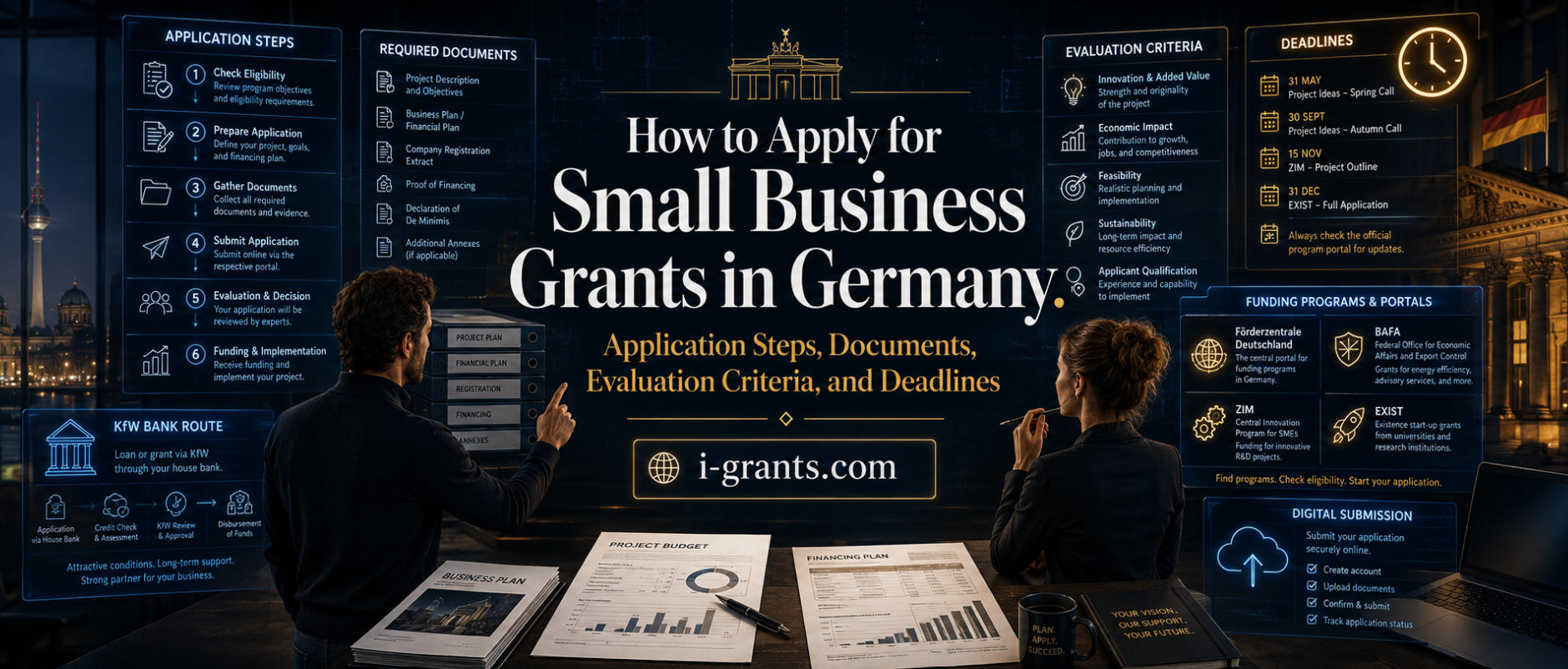
Applying for small business funding in Germany is not a single process. A founder applying for a KfW promotional loan, an SME preparing a ZIM innovation project, a manufacturer seeking energy efficiency support, and a university-based startup team applying for EXIST will follow different routes. Some applications go through a bank. Others go through a project management agency, a federal portal, a state development bank, a university, or a regional authority.
This is why a strong funding application in Germany is not only about writing a persuasive project description. It is also about choosing the right application channel, applying before the project starts, preparing the correct documents, building an eligible budget, proving financial capacity, and respecting programme-specific deadlines.
In 2026, the application process is becoming more digital, but not necessarily easier. Förderzentrale Deutschland is becoming a central digital route for selected federal funding applications. BAFA energy and resource efficiency grant procedures have moved into this portal for applications submitted from 15 September 2025. ZIM applications are also handled digitally through Förderzentrale Deutschland. At the same time, bank-based KfW funding still depends on the applicant’s financing partner, and EXIST applications still involve universities or research institutions.
For SMEs, startups, freelancers, and business successors, the practical lesson is clear: before writing the full application, confirm the route, the timing rule, the document package, the budget logic, and the evaluation criteria.
Start with the project, not with the programme name
Many applicants begin with a popular funding name. They hear about KfW, ZIM, BAFA, EXIST, GRW, or a state-level programme, then try to fit their project into it. This often leads to weak applications. A better approach is to define the project first.
A serious funding application starts with five practical questions. What exactly will the company do? Where will the project be implemented? When will it start? Which costs are necessary? What measurable result will public funding support?
Only after answering these questions should the applicant search for a funding programme. This order matters because German funding instruments are purpose-driven. An R&D grant is not designed to finance ordinary expansion. An energy efficiency subsidy is not designed to fund general marketing. A regional investment incentive may depend on the exact location of the investment. A KfW loan may be relevant even when a direct grant is not available.
Table 1. Matching the project with the right funding route
|
Project situation |
More likely funding route |
Main application issue |
|
Startup formation or young company financing |
KfW startup loan, state-level startup support, EXIST for research-based teams |
Business plan, financing partner, founder profile, and location in Germany |
|
Market-oriented innovation project |
ZIM or other R&D funding |
Technical novelty, R&D work plan, project risk, market potential, and digital submission route |
|
Energy or resource efficiency investment |
BAFA / EEW or related efficiency support |
Technical evidence, eligible equipment, savings calculation, and application before implementation |
|
Regional investment in an eligible area |
GRW or state-level investment aid |
Investment location, job or value creation effect, regional rules, and authority-specific procedure |
|
General SME investment or working capital need |
KfW promotional loan or state development bank loan |
Bank assessment, creditworthiness, collateral logic, and financing structure |
|
External business advice |
SME consulting support |
Eligible consulting topic, qualified advisor, approval process, and documentation of results |
The application should be built around the funding objective, not around a generic description of the company. German funding bodies usually want to see why this specific project deserves this specific public support.
Choose the correct application channel
Germany has no universal grant application portal for all business funding. The correct channel depends on the funding instrument.
Promotional loans are often submitted through the applicant’s bank, savings bank, or another financing partner. This is especially important for KfW products. The company usually cannot bypass the bank and apply directly to KfW for the loan. The financing partner reviews the project, assesses credit risk, and then forwards the application to the promotional bank if it supports the case.
Grant programmes work differently. The application may go to a federal approval authority, a project management agency, a state development bank, or a dedicated digital platform. For example, ZIM applications are submitted digitally through Förderzentrale Deutschland and then processed by the relevant project management agency. For BAFA energy and resource efficiency grants, the procedure for applications from 15 September 2025 is administered through Förderzentrale Deutschland.
EXIST has another route. The startup team does not simply submit a private application as an ordinary company. For EXIST-Gründungsstipendium and EXIST-Forschungstransfer, the university or research institution plays a central role in submitting the application through the prescribed digital system.
Table 2. Main application channels for German business funding
| Funding type | Usual application channel | What the applicant must check |
|---|---|---|
| KfW promotional loan | Bank, Sparkasse, cooperative bank, or other financing partner | The applicant must prepare for a bank discussion before the bank forwards the case. |
| Federal grant or subsidy | Approval authority or project management agency | The programme description defines the authority, documents, and submission route. |
| ZIM innovation funding | Förderzentrale Deutschland | The project must be prepared as an innovation application, not only as a business plan. |
| BAFA / EEW grant | Förderzentrale Deutschland for the relevant grant procedure | Digital access, technical evidence, uploads, and proof of use are central. |
| EXIST startup funding | University or research institution through easy-Online | The team must work with the academic institution and startup support network. |
| GRW and regional programmes | State authority, state development bank, or designated regional body | The location of the investment determines the procedure and conditions. |
A common mistake is to prepare a strong narrative but send it through the wrong route. In Germany, procedure is part of eligibility. A good project can fail if it is submitted to the wrong body, too late, or without the correct formal access.
Apply before the project starts
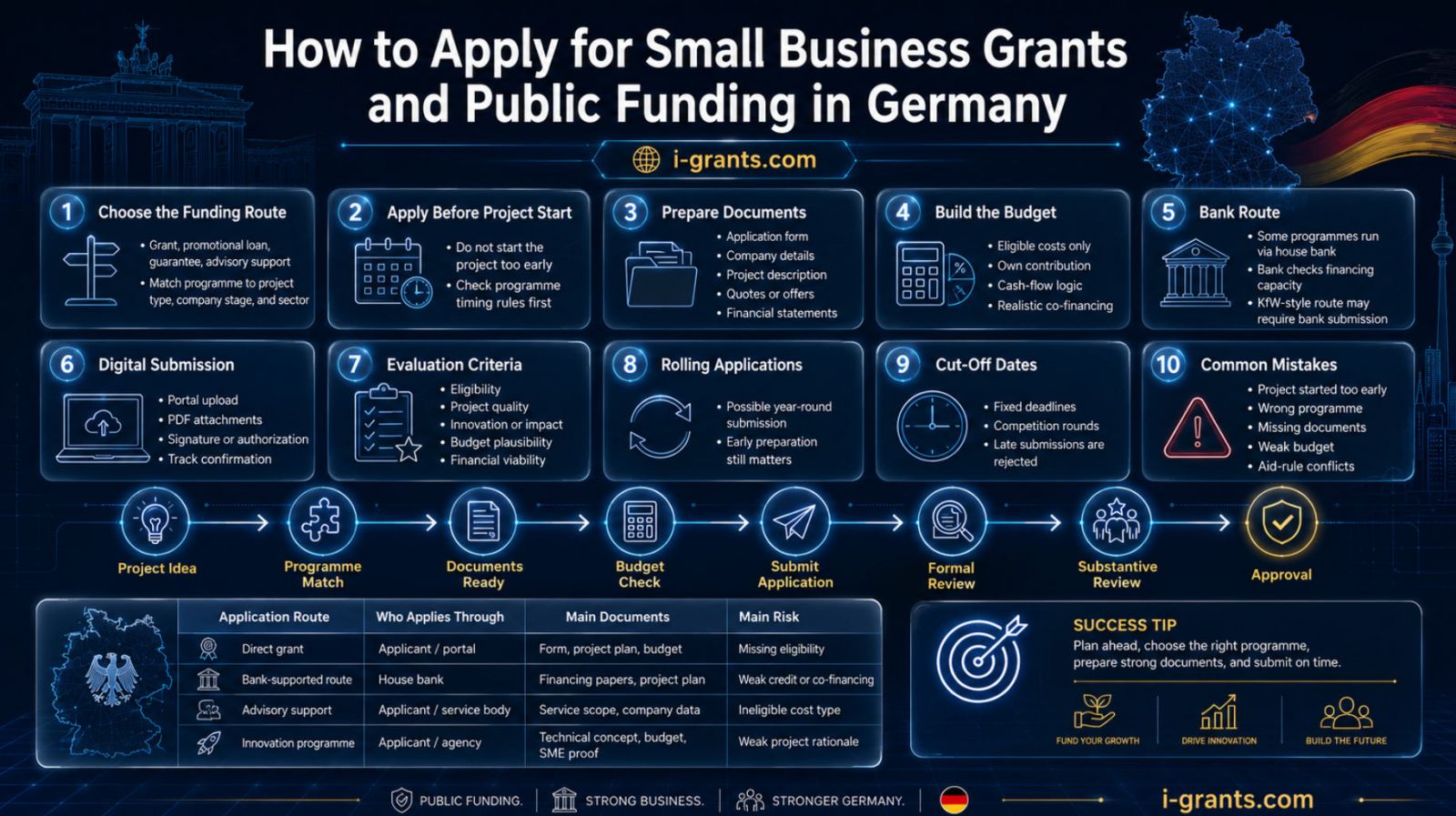
The “apply first, start later” rule is one of the most important principles in German public funding. In many programmes, the applicant must submit the funding application before the project starts or before binding financial commitments are made.
This does not only mean physical implementation. A project may be considered started if the company signs a purchase contract, places a binding order, signs a construction contract, commissions a supplier, or otherwise creates a financial obligation. If this happens before the application is submitted or before the programme allows implementation, the costs may become ineligible.
The rule is particularly important for investments. A company may think it is only preparing the project when it signs an equipment order, but the funding body may treat that order as the start of the project. The same risk can apply to construction, software implementation, technical services, or supplier contracts.
Some programmes allow limited preparatory steps, such as internal planning, non-binding offers, or feasibility discussions. However, this must be checked in the specific programme rules. Applicants should not assume that preparation is automatically safe.
The practical recommendation is strict: do not sign, order, pay, or begin implementation until the application route and programme rules clearly allow it.
Prepare the documents before writing the final application
A funding application is not only a text. It is a structured evidence package. The documents must prove that the applicant is eligible, that the project fits the programme, that the costs are justified, and that the company can implement the project.
For bank-based funding, the business and financial documents are central. A financing partner will look at the company’s ability to repay the loan, the quality of the business plan, liquidity, profitability, collateral situation, and management capacity. For grant funding, the emphasis may be more on project logic, eligible costs, public benefit, innovation, energy savings, regional impact, or founder quality.
Digital portals add another layer. Applicants may need electronic identification, company accounts, PDF uploads, signed declarations, technical documents, and structured forms. If these are not prepared early, the company can lose time close to the deadline.
Table 3. Documents to prepare before submitting a funding application
| Document or evidence | Why it matters |
|---|---|
| Project description | Explains what will be done, why the project fits the programme, and what outcome is expected. |
| Business plan | Shows market logic, business model, management capacity, and commercial viability. |
| Financial plan | Proves that the applicant understands the total project cost and financing structure. |
| Project budget | Links planned costs to eligible cost categories in the programme rules. |
| Company documents | Confirm legal status, ownership, location, and SME status. |
| Financial statements or tax documents | Help assess financial capacity, risk, and business stability. |
| Own contribution evidence | Shows that the applicant can finance its required share. |
| Supplier offers | Support the budget and show that cost estimates are realistic. |
| De minimis or state aid declarations | Help verify aid limits and cumulation rules. |
| Technical documentation | Supports R&D, energy efficiency, digitalisation, investment, or equipment-based projects. |
The exact document list depends on the programme. However, the logic is similar across most serious funding applications: every claim in the application should be supported by a document, calculation, declaration, or credible external reference.
Build the budget around eligible costs
A project budget is not just a list of what the company wants to buy. It is a compliance document. Each budget line should match an eligible cost category in the programme guidelines.
For a KfW startup or SME loan, the budget may include investments, operating resources, personnel costs, rent, marketing, consulting, materials, inventory, or other business needs, depending on the specific product. For an innovation grant, the budget may focus on personnel, R&D work packages, subcontracting, materials, prototypes, and cooperation costs. For an energy efficiency grant, the budget must be tied to eligible technical measures and expected savings. For regional investment support, the budget may need to show eligible investment assets and their connection to the investment location.
Applicants should avoid three budget mistakes. The first is including costs that are useful for the business but not eligible under the programme. The second is failing to separate eligible and non-eligible costs. The third is presenting numbers without clear justification.
A strong budget answers three questions at once: what will be purchased or financed, why it is necessary for the project, and why it is eligible under the programme rules.
Understand bank-based applications for KfW loans
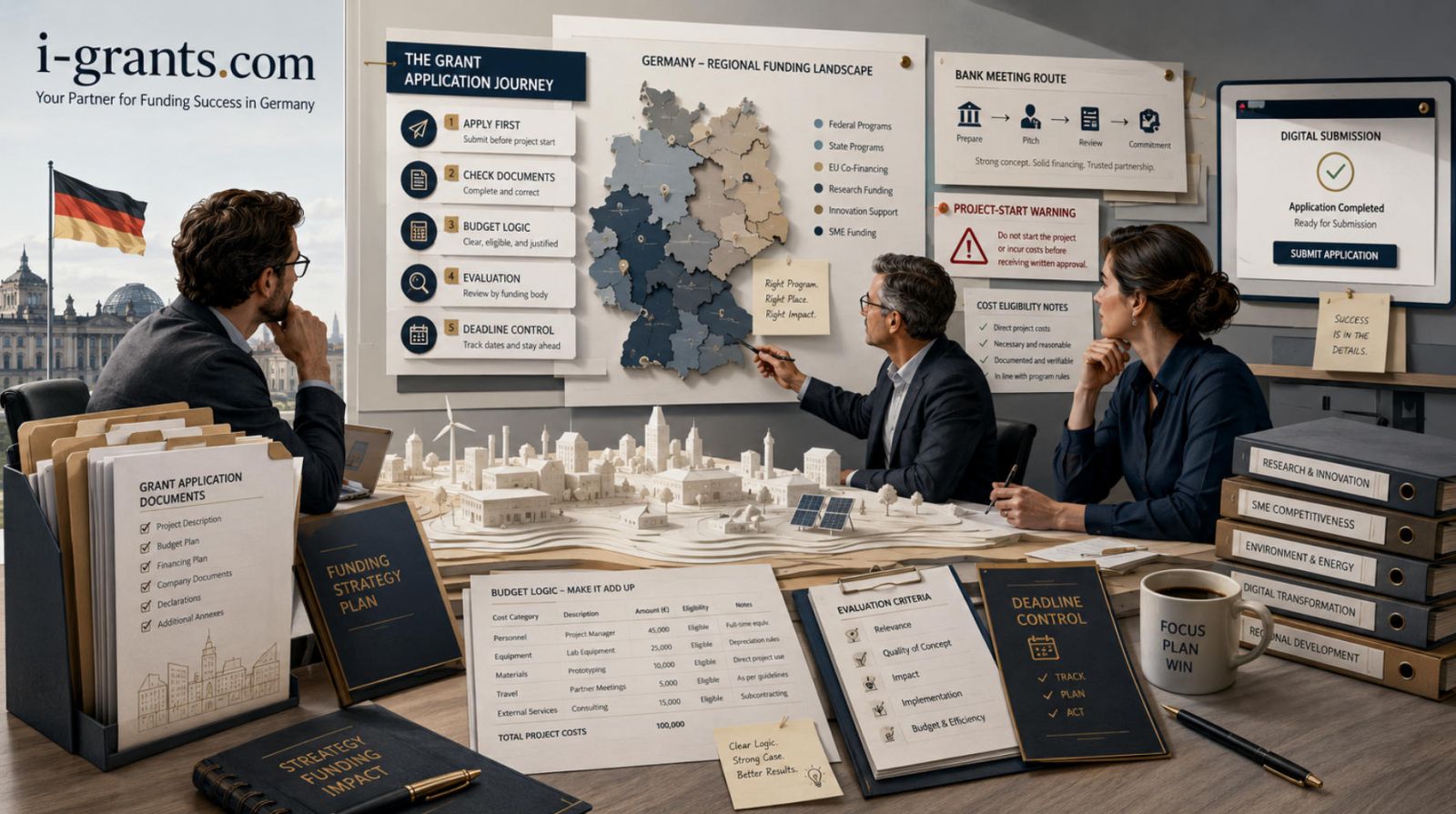
KfW loans are a major part of German business funding, but they are not usually applied for in the same way as direct grants. For many KfW products, the company applies through a financing partner. This can be a commercial bank, savings bank, or cooperative bank.
The bank’s role is not administrative only. It decides whether it is willing to support the financing request. It reviews the company, the business plan, the financials, repayment capacity, and risk. If the bank supports the case, it submits the application to KfW.
This means that a KfW application must be prepared for two audiences. The first is the bank, which needs confidence in the borrower. The second is the promotional funding system, which needs the project to fit the programme rules.
ERP-Gründerkredit StartGeld is a useful example. It can support founders, freelancers, young companies, and business successors with a loan of up to EUR 200,000, including up to EUR 80,000 for working capital. However, the applicant still needs to follow the financing partner route and prepare a credible business and financing case.
If one bank rejects the request, that does not always mean the project is impossible. Another financing partner may assess the case differently. However, repeated rejection often indicates that the business plan, financing structure, collateral position, or risk profile needs to be improved before another attempt.
Use digital portals carefully
Digital submission does not remove complexity. It changes where mistakes happen.
Through Förderzentrale Deutschland, applicants may need to select the correct programme, authenticate themselves, fill in structured forms, upload documents, and manage communication or proof of use digitally. For companies, digital access may require the correct business account and authorisation. For advisors or authorised representatives, the platform may require appropriate identity and permission settings.
The risk is that applicants treat the digital portal as the beginning of the process. In reality, the portal should be the final submission environment after the project, eligibility, budget, documents, and internal approvals are ready.
The same applies to easy-Online for EXIST. The online system is used to submit the formal package, but the real preparation begins much earlier: with the university, startup support network, project description, team profile, financial plan, work plan, and required declarations.
A practical rule for 2026: create or verify digital access early. Waiting until the deadline week to solve identity, account, upload, signature, or authorisation problems is unnecessary risk.
Prepare for formal and substantive evaluation
German funding applications are usually assessed on two levels. First, the authority checks whether the application is formally acceptable. Second, it evaluates whether the project deserves support under the programme’s objectives.
The formal level includes eligibility, deadlines, signatures, correct submission route, completeness of documents, state aid declarations, and whether the project has already started. If the application fails here, the quality of the project may never be assessed.
The substantive level depends on the programme. ZIM-style innovation projects must show technical novelty, R&D risk, market potential, and a credible work plan. EXIST-Forschungstransfer applications are assessed on factors such as team, innovation content, work planning, market and competition, sustainability, and business model. Energy efficiency projects must prove eligible technical measures and savings. Regional investment projects may be assessed by location, investment effect, jobs, value creation, and compliance with regional aid rules.
Table 4. Typical evaluation logic in German funding applications
| Evaluation area | What reviewers check | Typical risk |
|---|---|---|
| Formal completeness | Correct forms, required documents, signatures, digital access, and submission route | The application is not accepted for substantive review. |
| Applicant eligibility | SME status, legal form, location, sector, project start rule, and state aid limits | The company is formally ineligible. |
| Project fit | Objectives, activities, expected result, and connection to programme goals | The project is too general or does not match the programme logic. |
| Budget quality | Eligible costs, cost justification, own contribution, and financing structure | Costs are unclear, excessive, or not eligible. |
| Financial capacity | Liquidity, profitability, business plan, and ability to implement the project | The authority or bank doubts delivery capacity. |
| Expected effect | Innovation, energy savings, jobs, regional value creation, or market impact | The public funding effect is not strong enough. |
A good application should make the evaluator’s work easier. It should show clearly who applies, what will happen, why it matters, how much it costs, why the costs are eligible, how the project will be financed, and what result the funding will create.
Deadlines are not always simple dates
In Germany, the word “deadline” can mean different things depending on the programme. Some funding instruments accept applications continuously while funds are available. Others require submission before project start but do not have one fixed annual deadline. Some research, startup, or regional programmes use cut-off dates, review rounds, or budget-year rules.
This distinction is important. A programme may say that applications can be submitted at any time, but evaluation may happen only at fixed cut-off dates. A regional programme may technically be open, but complete documents may need to arrive by a certain date to be considered in the current budget year. A bank-based application may not have a public deadline, but the applicant still needs enough time for bank review before the investment starts.
Applicants should therefore manage three timelines: the programme deadline, the internal preparation timeline, and the project start timeline. The safest planning approach is to work backwards from the desired project start date and leave enough time for document collection, bank discussions, technical evidence, digital access, review, and approval.
Common application mistakes in Germany
Most failed or delayed applications are not caused by one dramatic error. They are caused by small procedural mistakes that accumulate. The most common risks are starting the project too early, using the wrong application channel, preparing the budget before checking eligible costs, underestimating bank review, failing to document own contribution, ignoring de minimis or state aid declarations, leaving digital access until the last minute, and describing the project too generally.
These mistakes are avoidable. The applicant should treat the application as a controlled process, not as a writing task completed at the end. The strongest applications are built from evidence: eligibility evidence, financial evidence, technical evidence, market evidence, and cost evidence.
This is also where external grant writing support can be valuable. A professional grant writer or funding consultant can help the company structure the project, select the correct route, translate programme rules into a budget, prepare the narrative, and identify formal risks before submission.
Practical checklist before submitting
Before submitting a German business funding application, the applicant should confirm that the company is eligible, the project has not started, the correct submission route is selected, all required documents are complete, each budget line matches an eligible cost category, the financing plan covers the full project cost, digital access works, state aid declarations are accurate, and the expected project result is clearly explained.
This check should happen before the final upload or bank meeting, not after. Once an application is submitted, correcting structural problems becomes more difficult. Once a project has started too early, some problems may be impossible to fix.
Conclusion
Applying for small business grants and public funding in Germany requires more than finding a programme and writing a good description. The applicant must understand the procedure, the timing rule, the application channel, the documents, the budget logic, the evaluation criteria, and the deadline model.
A company seeking KfW finance must prepare for the bank route. An innovation-driven SME applying to ZIM must build a real R&D case. A company seeking BAFA energy efficiency support must prepare technical evidence and digital submission. A research-based startup applying for EXIST must work through the university or research institution. A company seeking regional investment aid must follow the rules of the relevant location.
For i-grants.com and Grantologic users, the key message is practical: the best funding application starts before the writing begins. It starts with route selection, eligibility confirmation, document preparation, budget design, and risk control. The right grant writer can help turn these moving parts into a coherent application that fits the rules German funding bodies actually use.