

 Français
  Deutsch
  Українська
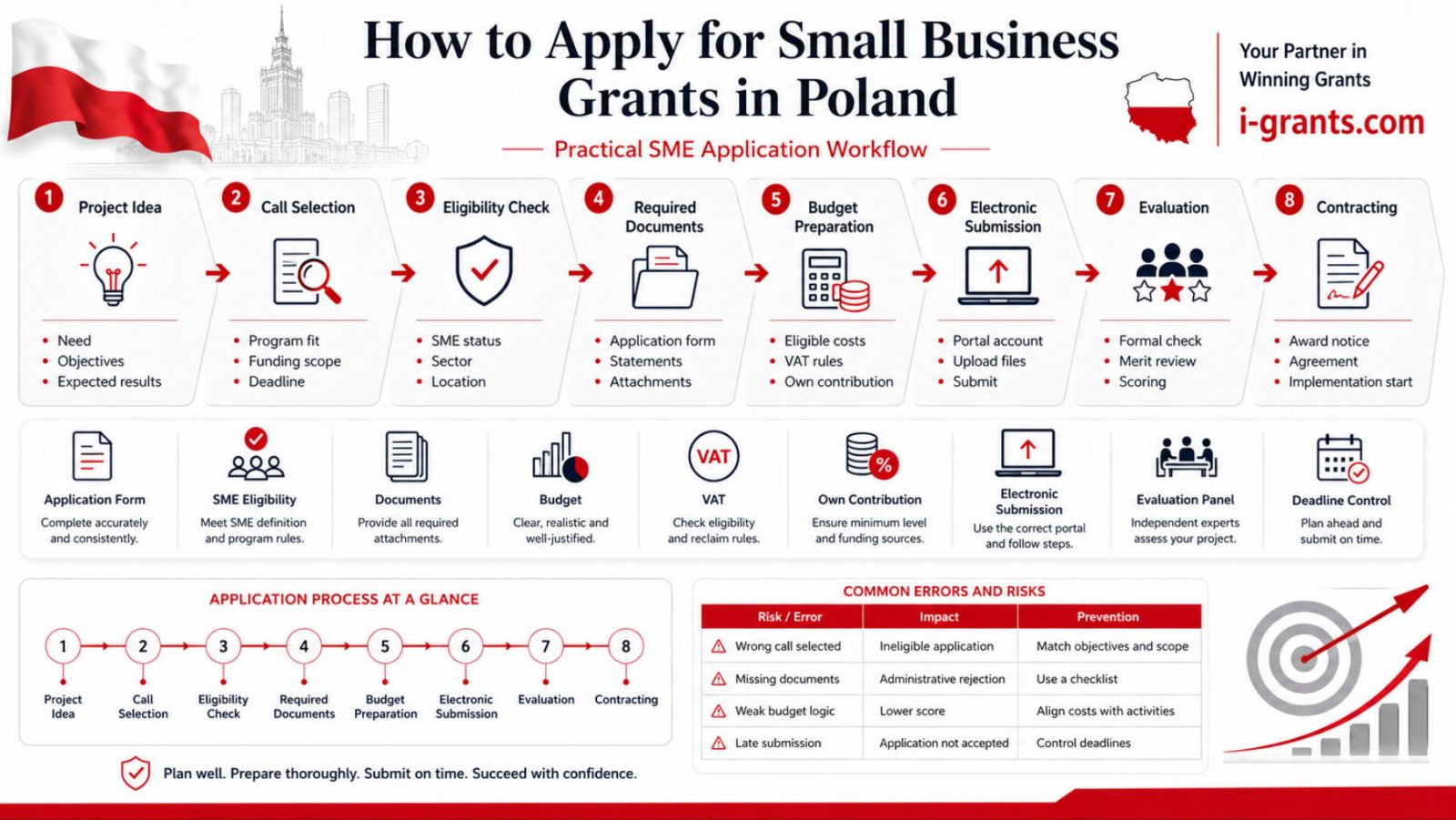
Applying for a small business grant in Poland is not just a matter of filling in an online form. A strong application is built before the submission system opens: the applicant must choose the right call, read the rules, test eligibility, prepare the budget, align the project with evaluation criteria, collect attachments and submit everything before the deadline.
This matters because Poland’s 2021-2027 funding cycle is already highly active. By 7 June 2026, Polish national and regional programmes had launched 4,810 calls with a combined budget of PLN 327.0 billion. Applicants had submitted 78,298 applications, while signed agreements covered 28,121 investments with PLN 266.8 billion in eligible expenditure and PLN 206.9 billion in EU funding, equal to 65.2 percent of the available EU allocation.
The potential applicant base is also large. PARP’s latest SME sector report states that in 2024 Poland had 2.37 million active non-financial enterprises, and SMEs represented 99.8 percent of all companies. Microenterprises alone accounted for 97.2 percent of enterprises. This means that many grant calls attract strong competition, especially in innovation, technology implementation, energy efficiency, digitalization and regional development.
For applicants, the lesson is clear: a grant application should not be treated as an administrative task at the end of project planning. It is a strategic document. For grant writers, the application process is not only about persuasive writing. It is about translating a business idea into a structure that matches programme rules, eligibility conditions, cost categories, indicators and scoring criteria.
This article explains how small businesses can apply for grants in Poland, which documents they should prepare, how evaluation usually works and what mistakes can weaken an otherwise promising project.
Start With the Project Idea, Not the Application Form
Many applicants begin in the wrong place. They find an open call, download the application form and start writing. This often leads to a weak proposal because the project has not yet been tested against the logic of the funding instrument.
The better starting point is the business need. What exactly does the company want to achieve? Is it developing a new product, implementing research results, buying equipment, improving energy efficiency, entering foreign markets, training staff or digitizing operations? The answer determines which grant programme may fit and which costs may be eligible.
The official European Funds portal in Poland advises applicants to start by identifying their needs, checking available support and verifying whether the project qualifies for co-financing. This is not a formality. If the project does not match the objective of the call, even a well-written application may fail.
For example, a company that wants to buy machinery should not automatically apply to an R&D call. A company that wants to export should not use an innovation call unless the project genuinely contains an innovation component. A firm planning an energy modernization should check whether the programme requires an energy audit, a minimum investment threshold or measurable savings in primary energy consumption.
The first strategic question is therefore not “How do we fill in the form?” It is “Which funding logic does this project actually belong to?”
Read the Call Documentation Before Writing Anything
A grant call announcement is only the visible front page. The real rules are usually found in the regulation for project selection, eligibility guide, evaluation criteria, application template, instructions, financial model, annexes and sometimes sector-specific definitions.
The Polish European Funds portal states that call announcements explain who can receive support, for what purpose, when applications can be submitted, whether own contribution is required, how the application should be completed and how it should be submitted. Applicants are also told to read the project selection regulations.
This is where many weaker applications fail. The applicant reads the summary but not the annexes. The budget is built before checking eligible cost categories. The project description is written before checking scoring criteria. Attachments are collected after submission instead of before. These mistakes can create inconsistencies that evaluators notice quickly.
A grant writer should treat the call documentation as the architecture of the application. The narrative, budget, indicators and attachments should all be built from the same source documents. If the criteria ask for measurable innovation, the project description must provide evidence of novelty. If the financial model is required at a later stage, the numbers in the application still need to be prepared early. If the call requires a specific language, electronic system or template, the applicant cannot replace it with its own preferred format.
Table 1. Application Path for Polish Small Business Grants
| Stage | What the applicant should do | Main risk if ignored |
|---|---|---|
| Define the project need | Identify the business objective, investment purpose, innovation goal, market problem or energy-efficiency target. | The company applies to a call that does not match the real project. |
| Search for the right call | Use official portals, PARP, regional programmes, BGK instruments or sector-specific pages to find suitable support. | The applicant wastes time on an instrument where it cannot meet basic conditions. |
| Check eligibility | Verify SME status, location, sector, project type, excluded activities, own contribution and previous public aid. | The application fails before substantive evaluation. |
| Read the full documentation | Review the call regulation, criteria, application instructions, budget rules, financial model and annexes. | The proposal is written against assumptions, not against rules. |
| Build the project logic | Connect objectives, tasks, costs, indicators, outputs, risks and implementation capacity. | The application looks fragmented and evaluators cannot see a coherent project. |
| Prepare the budget and financing | Classify costs, confirm eligible expenditure, check VAT, own contribution and cash flow. | The project may be approved in concept but financially impossible to implement. |
| Collect attachments | Prepare financial documents, declarations, technical files, authorizations, audit documents or other required annexes. | Missing or inconsistent attachments delay or weaken the application. |
| Submit electronically | Use the system indicated in the call, such as LSI, WOD2021 or another dedicated platform. | A technically complete project may be rejected because it was submitted late or incorrectly. |
| Follow the evaluation process | Monitor the system, respond to requests, prepare for panels or second-stage documents. | The applicant misses a deadline after submission. |
| Prepare for contracting | Confirm financing, update documents if required and ensure the project has not started too early. | The company wins the assessment but struggles to sign or implement the agreement. |
Choosing the Right Grant Call
The right call is not always the one with the highest grant amount. It is the one where the applicant can meet the eligibility conditions, justify the project and defend the budget.
A Polish SME should usually compare several dimensions before choosing a call: applicant type, project location, sector, supported activities, eligible costs, minimum and maximum project value, co-financing rate, deadline, evaluation criteria, state aid basis and implementation obligations. The best call is the one where the company’s project naturally fits the programme objective.
Ścieżka SMART is a useful example. In 2026, PARP separated certain types of support more clearly, including R&D projects and implementation of R&D results. For the implementation call announced in 2026, documentation described a new structure with cost categories intended to be simpler and more flexible, simplified and reorganized criteria, shorter application forms and the possibility to attach the financial model after passing to the second evaluation stage. This is an important improvement for applicants, but it does not mean the process became easy. It means that the application must be more focused.
For grant writers, call selection is one of the most valuable stages of advisory work. A client may ask for “a grant for machinery”, but the real project may be a technology implementation, a regional investment, an energy-efficiency upgrade or an innovation project. Each path has different rules. Choosing the wrong one can waste months.
Documents SMEs Should Prepare Before Submission
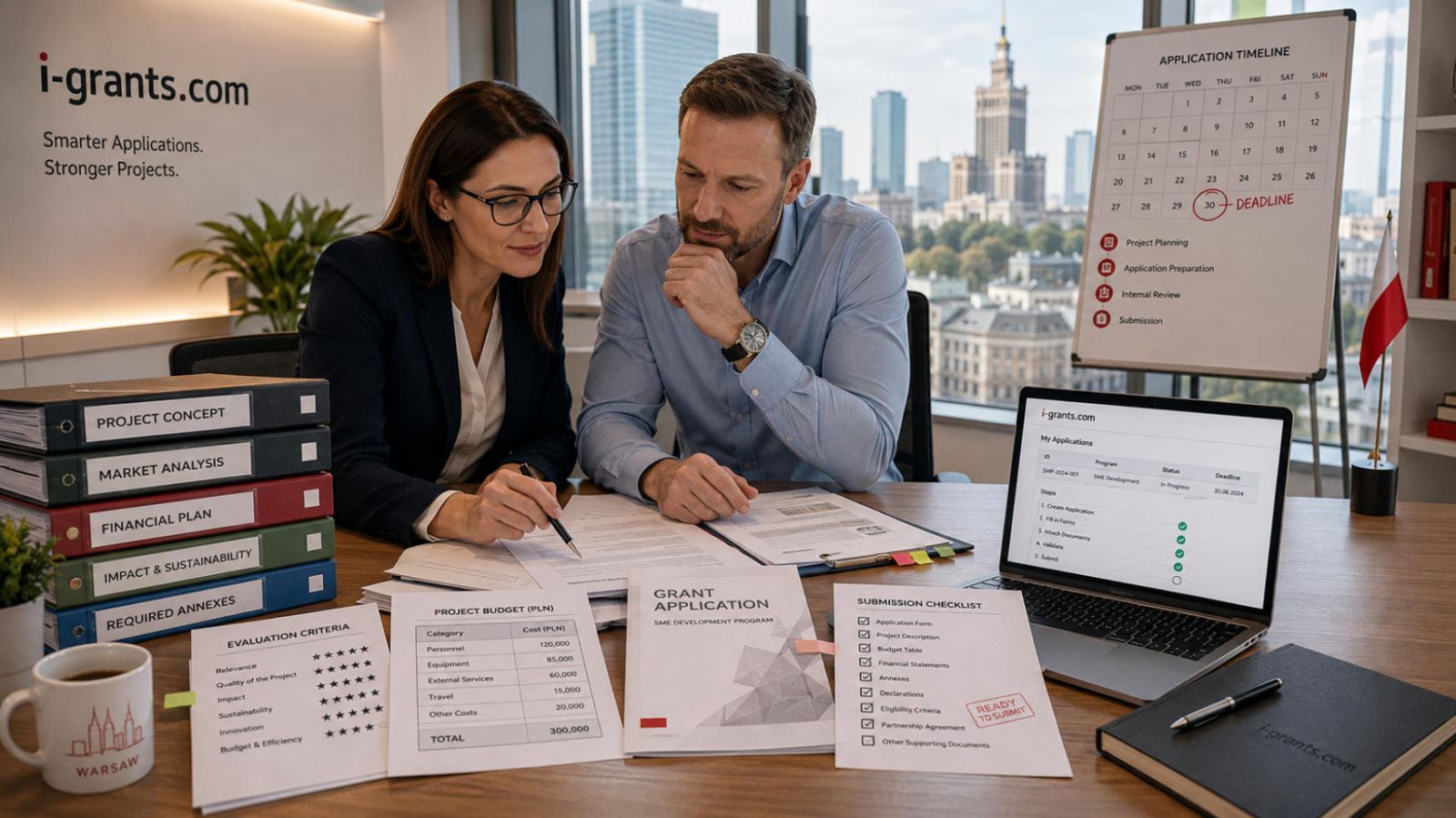
The document package depends on the programme, but the same principle applies across Polish SME grants: documents should prove that the applicant is eligible, the project is credible, the budget is justified and the company can implement the project.
Some documents are formal. Others are strategic. A financial statement may prove capacity, but the financial model also tells evaluators whether the project can survive real cash-flow pressure. A technical specification may describe equipment, but it also proves that the budget is not arbitrary. An energy audit may be required for a green investment, but it also supports the logic of expected savings.
The applicant should prepare documents early even when the call allows some attachments to be submitted later. In Ścieżka SMART B+R 2026, PARP explained that the financial model could be attached at submission but was not always mandatory at that stage, because it could be added after the project moved to the second evaluation stage. In practice, however, waiting too long is risky. The financial assumptions should already be coherent with the application, budget and implementation plan.
Table 2. Key Documents Before Submitting a Polish SME Grant Application
| Document or file | Why it matters | What to verify before submission |
|---|---|---|
| Call regulation | Defines the rules of project selection and implementation. | Check applicant type, location, deadlines, submission system, evaluation process and appeal rules. |
| Evaluation criteria | Shows how the project will be judged. | Write the application around criteria, not around general business storytelling. |
| Application instructions | Explains how each field should be completed. | Respect character limits, required wording, language rules and field-specific expectations. |
| Budget and cost schedule | Converts the project into eligible expenditure. | Match every cost to a task, category, period, supplier logic and financing source. |
| Financial model | Shows viability, financing capacity and assumptions. | Ensure consistency with the application, financial statements and declared own contribution. |
| SME status documents | Prove that the applicant qualifies as a micro, small or medium-sized enterprise. | Check linked and partner enterprises, ownership structure and employment or financial thresholds. |
| De minimis and public aid declarations | Show previous aid and possible limits. | Verify aid history before the budget is finalized. |
| VAT position evidence | Supports whether VAT is eligible or non-eligible. | Confirm whether the company has the legal right to recover VAT. |
| Technical documents | Prove the investment, technology, R&D plan, audit result or implementation method. | Make sure technical assumptions match the project description and budget. |
| Authorizations and signatures | Confirm that the application is submitted by the right person or entity. | Check representation rules, powers of attorney and electronic signature requirements. |
A strong document package does not make a weak project strong. But weak documents can make a strong project look risky.
Electronic Submission: Deadlines Are Part of Eligibility
Most Polish SME grant applications are submitted electronically through the system indicated in the call documentation. Depending on the programme, this may be PARP’s Local IT System, WOD2021 or another dedicated platform used by a managing or intermediate institution.
This makes timing critical. A deadline is not a suggestion. If the system closes at the end of the submission period, a nearly finished application may become useless. Technical problems, missing signatures, incomplete annexes, wrong file formats or last-minute corrections can all create risk.
PARP’s 2026 Ścieżka SMART materials emphasize that applications are submitted through LSI and that, after submission, the system generates confirmation with the application date and number. This confirmation should be saved. The same materials also explain that if a technical problem occurs, it should be reported immediately through the system or the call page. If the institution confirms that the problem was caused by the system, the applicant may receive additional time to submit again.
The practical lesson is simple: do not submit at the last minute. A professional application workflow should include an internal deadline several days before the official deadline. This gives time to check attachments, file names, signatures, consistency of numbers and final language.
Evaluation Criteria: The Application Must Be Written for the Assessment
A grant application is not evaluated according to how much effort the applicant invested in writing it. It is evaluated against criteria.
In Polish SME grants, criteria may include applicant eligibility, project eligibility, innovation level, implementation capacity, financial viability, cost reasonableness, environmental impact, market need, indicators, compliance with horizontal principles, regional relevance and public aid conditions. Some criteria are obligatory. Others are scored. Some may be assessed in stages.
Ścieżka SMART B+R 2026 provides a useful example. PARP described a two-stage evaluation process. In the first stage, projects were assessed against criteria appropriate to the first stage, including whether the project and applicant met essential conditions. A positive first-stage result meant that the project moved to the second stage. In the 2026 call, PARP received 566 applications for more than PLN 3.6 billion, and 332 projects worth more than PLN 2.3 billion met the first-stage criteria.
This example shows two important points. First, passing the first stage is not the same as winning funding. Second, a large share of applicants can be filtered out before the final ranking or contracting stage. Grant writers should therefore build the application around the criteria from the beginning.
Table 3. Evaluation Stages and What Can Go Wrong
| Evaluation stage | What evaluators usually check | What can go wrong |
|---|---|---|
| Formal check | Completeness, submission deadline, applicant data, required fields, signatures and attachments. | Missing files, wrong system submission, inconsistent data or late submission. |
| Applicant eligibility | SME status, location, sector, legal form, excluded activities and public aid limits. | The applicant appears eligible in general but fails a specific call condition. |
| Project eligibility | Fit with programme objective, project type, eligible activities and implementation location. | The idea is useful for the company but not aligned with the funding instrument. |
| Budget and financing review | Eligible costs, own contribution, VAT, financial model, cash flow and cost reasonableness. | Costs are inflated, misclassified, unsupported or financially unrealistic. |
| Substantive assessment | Innovation, market need, technical feasibility, implementation capacity, indicators and impact. | The project sounds attractive but does not prove novelty, demand or implementation readiness. |
| Panel or second-stage review | Clarifications, financial documents, expert questions or updated attachments. | The applicant cannot defend assumptions or submit additional documents on time. |
| Results and appeal | Positive or negative assessment, score, justification and possible protest procedure. | The applicant misses the appeal window or cannot challenge the reasoning effectively. |
| Contracting | Final documents, financing confirmation, project start rules and beneficiary obligations. | The project changed too much, financing is uncertain or early commitments created eligibility risk. |
What Happens After Submission
Submission is not the end of the process. It is the start of formal interaction with the institution.
After submitting the application, the company should monitor the electronic system and the email address indicated in the application. In some calls, the institution may request clarifications, additional documents or corrections. In staged evaluations, applicants may need to upload a financial model, provide financing confirmations or participate in an expert panel.
The 2026 Ścieżka SMART B+R results show how this can work in practice. Applicants whose projects qualified for the second stage were expected to upload the required financial model, if it had not already been attached, within the specified period after publication of first-stage results. PARP also indicated that applicants would receive information through LSI and by email regarding the date of the evaluation panel.
For rejected projects, applicants may receive a justification and, depending on the rules, the right to submit a protest. In the cited Ścieżka SMART B+R 2026 case, applicants with negative first-stage results had the right to submit a protest within 14 days of receiving the negative result letter. This is why grant writers should not disappear after submission. Post-submission support can be decisive.
Common Mistakes Applicants and Grant Writers Should Avoid
The most frequent mistakes are not always dramatic. They are often small inconsistencies that reveal weak preparation.
Common mistakes include:
-
Choosing a call because the grant amount is attractive, not because the project fits the objective.
-
Writing the project description before reading the evaluation criteria.
-
Treating the budget as a cost list instead of a project logic tool.
-
Using inconsistent numbers across the application, budget and financial model.
-
Missing attachments, signatures, authorizations or mandatory declarations.
-
Submitting too close to the deadline and leaving no time for technical problems.
-
Starting the project too early through contracts, advance payments or supplier commitments.
These mistakes are avoidable. The strongest applications are usually not the longest ones. They are the most coherent ones.
How Grant Writers Add Value in the Polish Grant Process
A good grant writer does more than write polished text. In the Polish grant environment, the role is closer to project architect, eligibility analyst and application strategist.
The grant writer should help the applicant select the right call, interpret the criteria, structure the project, challenge weak assumptions, align the budget with eligible costs, coordinate documents and prepare for evaluation questions. This is particularly important for SMEs that do not have internal grant departments.
The value is greatest at the beginning. If the project is poorly framed, even excellent writing cannot fully fix it later. For example, a vague innovation claim will remain weak unless the company can explain what is new, compared to what, at which market level and with which measurable indicators. A budget will remain risky unless every cost has a role in the project. A financial model will remain fragile unless it matches the company’s real capacity.
For platforms such as i-grants.com, this is exactly where professional matching matters. Applicants need people who understand both the business case and the grant rules. Grant writers need projects where their expertise can genuinely improve the quality of the application.
Strategic Advice for Applicants Before the Portal Opens
A strong application should be mostly ready before the official submission period becomes intense. Waiting for the last week is one of the easiest ways to lose quality.
Before the portal opens, the applicant should already know which call it is targeting, what the project will deliver, which costs are eligible, how much own contribution is needed, which documents are missing and who will approve the final version. The company should also know whether it can finance VAT, bridge cash-flow gaps and implement the project if the grant is awarded.
The best practical approach is to build a pre-submission review around five questions:
-
Does the project clearly match the objective of the call?
-
Can the applicant prove eligibility and implementation capacity?
-
Does the budget match eligible cost categories and financing rules?
-
Does the application answer the evaluation criteria directly?
-
Are all attachments, signatures and system requirements ready before the deadline?
If the answer to any of these questions is weak, the application is not ready.
Conclusion: A Successful Application Is Built Before Submission
Small business grants in Poland can provide substantial support for innovation, technology implementation, energy efficiency, digitalization, international expansion and regional development. But the application process is demanding. It requires more than a good business idea.
A successful Polish SME grant application connects the right call, clear project logic, eligible costs, credible financing, strong documents and direct answers to evaluation criteria. It respects deadlines, uses the correct electronic system and prepares for post-submission interaction with the institution.
For applicants, this means that grant preparation should begin before the call deadline becomes urgent. For grant writers, it means that the real work starts before the first paragraph is written. The strongest applications are not built around optimistic claims. They are built around evidence, consistency and rules.
In a funding environment where thousands of calls have already been launched and tens of thousands of applications submitted, Polish SMEs cannot rely on ambition alone. They need disciplined preparation. The companies that understand the process before they enter the portal will have a better chance not only to submit an application, but to submit one that can survive evaluation, contracting and implementation.