

 Français
  Deutsch
  Українська
For many companies, Germany’s GRW programme looks attractive because the headline grant rates can be high. In selected structurally weaker regions, small enterprises may receive regional investment support of up to 45 percent of eligible costs, while infrastructure projects can be supported at even higher rates under specific conditions. Yet this headline can be misleading if it is read as a general promise. GRW is not a universal small business grant. It is a regional economic development instrument, and every serious application must start with one question: will this investment create a measurable benefit for a specific assisted region in Germany?
GRW stands for Gemeinschaftsaufgabe “Verbesserung der regionalen Wirtschaftsstruktur”, usually translated as the Joint Task for Improving Regional Economic Structures. It is supervised at federal level, but companies apply through the federal state where the investment will be located. Each state with eligible regions applies its own administrative rules within the GRW framework, so a project in Saxony, Berlin, Mecklenburg-Vorpommern, Brandenburg, Thuringia, Saxony-Anhalt, Saarland or another eligible area may face different procedures, forms, thresholds and practical expectations. GTAI makes this point clearly: GRW applications are administered by the relevant federal state governments and must be submitted before the investment project begins.
For SMEs, startups with real capital expenditure and foreign investors choosing a German site, GRW can be one of the most important public funding routes. It can help finance a new production site, an expansion, a diversification of production, the acquisition of a threatened business location or selected transformation investments. For grant writers, however, the programme is demanding because eligibility depends on the interaction of location, company size, investment purpose, eligible costs, employment effects, timing and state aid limits.
What GRW Actually Funds
GRW is designed to strengthen structurally weaker regions, not to subsidise routine business activity. The programme supports commercial investments with significant regional economic effects, selected transformation investments, economic infrastructure and certain non-investive measures, especially for SMEs. According to the official Förderdatenbank, company investment cases can include the establishment of a new business site, capacity expansion, diversification of production, a fundamental change or modernisation of the overall production process, or the acquisition of a closed or closure-threatened business site. The programme also recognises investments that support the transition toward a climate-neutral and sustainable economy, including energy efficiency and environmental protection effects.
This is why a GRW application should not be framed as “we need money for equipment”. A stronger argument is: “this investment will expand productive capacity in an eligible region, create or secure durable jobs, strengthen the regional value chain and improve the long-term competitiveness of the site”.
The difference matters. A routine replacement of machinery may not be convincing. A new facility that brings additional production, jobs, training places or transformation capacity to an assisted region has a much stronger GRW logic.
The First Eligibility Test: The Investment Location
The most important GRW filter is the location of the investment. The company’s headquarters may be less important than the business site where the funded project will be implemented. If the investment is outside the eligible GRW map, the project normally cannot be funded through GRW, even if the company is small, innovative or financially solid.
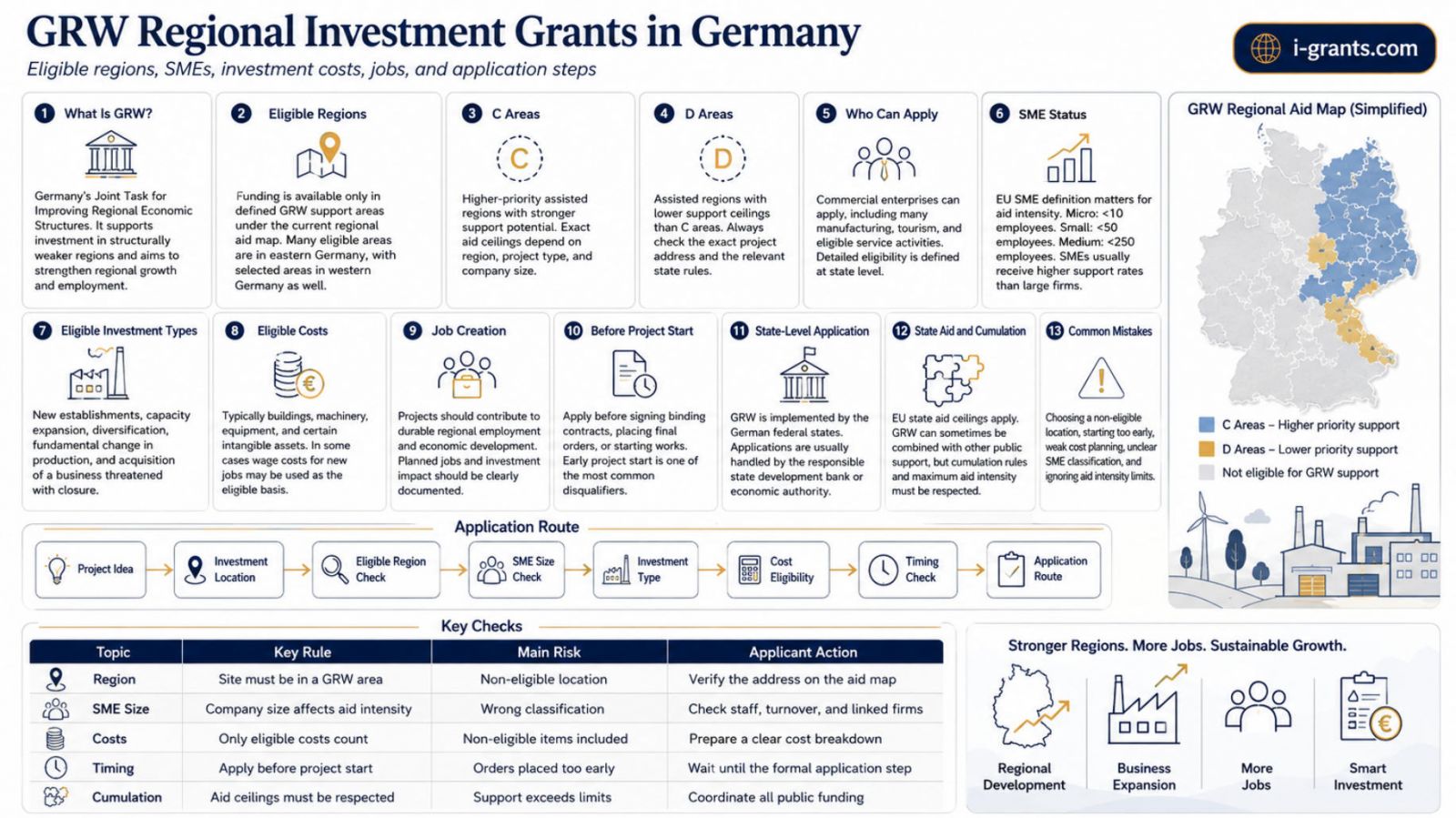
Germany currently uses C and D assisted areas within the GRW system. The regional aid framework is connected to EU state aid rules. The European Commission explains that regional state aid supports economic development and employment by allowing Member States to support investments in new production facilities, or the extension and modernisation of existing facilities, in less advantaged regions. The same EU framework also requires regional aid maps that define where regional aid can be granted and at which intensities. Germany’s regional aid map for the 2022-2027 period is listed in the European Commission’s regional aid map register.
For applicants, this means that a site selection decision can change the funding potential of the whole project. Two similar factories, service centres or technology production sites can receive very different funding treatment if one is located in a higher-intensity assisted area and the other is not.
Table 1. GRW Eligibility Questions for SME Applicants
| Eligibility question | What the applicant must verify | Why it matters |
|---|---|---|
| Is the investment site in a GRW assisted area? | Check the current GRW map and the state-level programme page | GRW is location-based and applies only in designated assisted areas |
| What type of assisted area applies? | Identify whether the site is in a C area, D area or special regional category | The maximum aid intensity depends on the regional classification |
| Is the applicant an SME, large company or founder? | Confirm staff, turnover, balance sheet and linked or partner companies | Company size affects the maximum grant rate and eligibility route |
| Is the project an eligible investment? | Check whether it is a new site, expansion, diversification, process change or eligible acquisition | Routine operating costs or simple replacement investments are not the core target |
| Are the costs eligible? | Separate tangible assets, intangible assets and possible wage-cost basis | Only eligible costs can be used to calculate the grant |
| Will the project create regional economic effects? | Show durable jobs, investment volume, productivity, local value chain or transformation effects | GRW is justified by regional impact, not by company need alone |
| Has the project already started? | Review contracts, orders, construction works and irreversible commitments | GRW support must be requested before the start of the project |
Who Can Apply: SMEs, Founders and Larger Investors
GRW can be relevant for companies in the commercial economy, including SMEs, founders and larger investors, depending on the state programme and project type. The SME definition follows the usual European logic. A medium-sized enterprise has fewer than 250 employees and either annual turnover of up to EUR 50 million or an annual balance sheet total of up to EUR 43 million. A small enterprise has fewer than 50 employees and annual turnover or balance sheet total of up to EUR 10 million.
This definition cannot be checked only inside the German company that applies. Ownership links, partner companies and linked enterprises can change the result. For international groups, this is often the first compliance problem. A German subsidiary may look like an SME on its own, but the wider ownership structure can move it into a larger enterprise category.
Founders may also be eligible in some state-level GRW routes, but the project must still fit the regional investment logic. A newly registered business without a credible financing plan, without a clear site and without a realistic employment or investment effect will not become fundable only because it is young.
Certain sectors are excluded or restricted. The official Förderdatenbank lists excluded areas such as agriculture and forestry, fisheries, mining and quarrying, steel-related activities, energy supply, water supply, waste management, construction, retail, vehicle trade and transport or storage, among others. Applicants should not rely on a broad sector label. The actual activity at the funded business site should be checked against the state programme and the current GRW framework.
Eligible Investment Projects
For SMEs, GRW is most relevant when the company plans a real investment project. The official framework recognises several types of SME investment projects, including the establishment of a new business site, expansion of the capacity of an existing site and diversification into products not previously manufactured at that site. The programme also covers selected cases of fundamental process change and the acquisition of assets from a business site that has closed or would have closed without the acquisition.
The application narrative should therefore be built around a concrete investment scenario. A strong GRW case usually explains the current site situation, the planned investment, the regional labour market effect, the value added for the region, the implementation timeline and the financing structure.
A weak case usually says only that the company wants to buy equipment, reduce costs or modernise operations. That may be true, but GRW authorities need to see why the project deserves regional aid. The applicant should connect the investment to regional development objectives: new jobs, retained skilled employment, supplier networks, industrial resilience, energy transition, productivity or a stronger local business ecosystem.
Eligible Costs: Investment Costs or Wage Costs
The grant amount is not calculated on the company’s total project ambition. It is calculated on eligible costs. For regional investment aid and SME investment aid, the official basis can include eligible costs for tangible and intangible fixed assets, or wage costs for jobs directly created by the investment.
GTAI explains the practical calculation logic in similar terms. For investments in new sites, either project-related capital expenditure, such as buildings or machinery, or wage costs including social security contributions for two subsequent years may be eligible for funding. For environmental or energy-efficiency measures, the eligible cost base is usually linked to the additional expenditure required to exceed German or EU standards.
This distinction is important. A business plan may include land, working capital, marketing, financing costs, staff training, initial losses, software, vehicles and consulting. Not all of these costs will be eligible under GRW. The grant writer should build a separate eligible-cost budget and avoid presenting the total investment as if every line were fundable.
Table 2. Typical GRW Cost Categories and Applicant Risks
| Cost or project element | Possible treatment in GRW logic | Typical applicant risk |
|---|---|---|
| Buildings and production facilities | Often relevant if they are part of the eligible investment project | The site must be in an assisted area and the costs must be properly documented |
| Machinery and equipment | Often central to the eligible investment cost base | Routine replacement or already ordered equipment can create eligibility problems |
| Intangible assets | May be eligible under specific conditions, especially when linked to the investment | The applicant must show use at the funded site and market-based acquisition |
| Wage costs for new jobs | May be used as an alternative calculation basis in relevant cases | Jobs must be directly linked to the investment and create a net employment increase |
| Land acquisition | Often limited or excluded depending on the route and rules | Applicants may overestimate the fundable share of a real estate project |
| Working capital | Usually not the core GRW investment cost base | Mixing investment aid with operating liquidity weakens the application |
| Consulting and planning | May be treated differently depending on the measure and state rules | Starting binding contracts before application can create timing risk |
| Vehicles and transport assets | Often restricted or excluded, especially where the main function is transport | Companies in logistics-heavy models need careful eligibility analysis |
How High Can the Grant Be?
GRW rates are maximum ceilings, not guaranteed grant offers. The official Förderdatenbank states that total public investment aid from GRW and other public sources must stay within maximum gross aid ceilings. It lists different maximum rates for C and D areas, including up to 35 percent for small enterprises, 25 percent for medium-sized enterprises and 15 percent for large enterprises in certain C areas, with possible increases in specific population-decline or border-area cases. In other C areas, maximum rates can be 30 percent for small enterprises, 20 percent for medium-sized enterprises and 10 percent for large enterprises. In D areas, the listed maxima are 20 percent for small enterprises and 10 percent for medium-sized enterprises, while large enterprises are subject to the de minimis ceiling.
GTAI also stresses that the BMWE defines maximum possible incentive rates for eligible regions, while actual incentive levels vary by region, economic indicators, investment type and company size. For the highest incentive regions, GTAI notes grants of up to 45 percent of eligible expenditure for small enterprises and up to 25 percent for large enterprises in site investment cases.
For applicants, the practical rule is simple: never build the financing plan around the maximum rate until the region, company size, investment category, state rules and cumulation position have been checked.
Table 3. Indicative GRW Aid Intensity Logic for Business Investment
| Assisted area logic | Small enterprise | Medium-sized enterprise | Large enterprise | Practical note |
|---|---|---|---|---|
| Higher-intensity C areas and special cases | Up to 35 percent or more in specific cases | Up to 25 percent or more in specific cases | Up to 15 percent or more in specific cases | Some areas can receive increased ceilings due to population decline or border location |
| Other C areas | Up to 30 percent | Up to 20 percent | Up to 10 percent | Often relevant for standard regional investment cases |
| D areas | Up to 20 percent | Up to 10 percent | De minimis ceiling | D-area support is more limited, especially for large enterprises |
| Highest-rate investment regions referenced by GTAI | Up to 45 percent | Depends on region and rules | Up to 25 percent | These are ceilings and not automatic grant rates |
Job Creation, Job Retention and Regional Economic Effects
GRW is not only about assets. Employment effects are often central. The official framework distinguishes between the number of employees and the number of durable jobs. Durable jobs correspond to full-time equivalents. Part-time jobs are counted proportionally, and training positions can be considered in the employment logic.
A project generally needs to show significant regional economic effects through investment volume or job creation. The official framework describes this in measurable terms. For example, a project may be eligible if the investment amount exceeds average depreciation over the previous three years by at least 50 percent, or if the number of durable jobs at the supported business site increases by at least 10 percent. Lower thresholds can apply in specific cases, including certain R&D-intensive sites, greenhouse gas reduction projects and other defined investment categories.
This is a critical point for SMEs. If the company promises jobs it cannot realistically create, the project becomes risky. If it ignores job logic entirely, the application may fail to show regional impact. A good application translates the investment plan into credible full-time equivalent effects, explains the timing of recruitment, shows the required skills and connects the jobs to the funded site.
For wage-cost-based support, the employment test is even stricter. The relevant jobs must be newly created, generate a net increase compared with average employment during the previous twelve months and generally remain filled for at least five years.
The Before Project Start Rule
The most dangerous GRW mistake is starting too early. The official Förderdatenbank states that the application must be submitted before the start of the project. For investment aid, the start of work can mean the conclusion of a delivery or service contract, the start of construction work, the first legally binding commitment to order equipment or any other commitment that makes the investment irreversible.
This rule should be treated as a compliance checkpoint, not as an administrative detail. A company may believe that it has not “really started” because the machines have not arrived, the invoice has not been paid or the construction is not finished. In GRW logic, a binding order or contract may already be enough to damage eligibility.
The safe sequence is: check location, check programme route, prepare the project concept, clarify eligible costs, prepare financing evidence, submit the official application and only then make binding commitments, unless the competent authority explicitly confirms a different safe procedure. Some state programmes may allow the applicant to start at its own risk after application submission, but this should never be assumed without checking the relevant state authority.
The State-Level Application Route
A GRW application is not submitted to one central federal portal for all of Germany. The application goes to the competent body in the federal state where the investment will be located. GTAI confirms that each federal state with funding regions has its own specific regulations and that the application process is administered by the relevant state government.
This decentralised route creates practical differences. Saxony’s development bank SAB, for example, announced that its GRW RIGA product page was updated after a Saxon cabinet decision in May 2026 and that the application route in the funding portal would be available from 18 June 2026 under the changed directive. Berlin’s IBB presents GRW as an investment or wage cost grant for existing companies and founders, focused on creating and securing durable jobs. Mecklenburg-Vorpommern’s LFI states that the formal application must be submitted before the start of the project.
For a grant writer, this means that the federal GRW framework is only the first layer. The second layer is the state directive. The third layer is the practical expectation of the approving authority: what documents they require, how they interpret regional impact, what cost evidence they expect, how they treat financing confirmation and how they manage available budgets.
Documents and Evidence That Usually Matter
A strong GRW file should be prepared before the company makes irreversible commitments. The exact documents depend on the state and project type, but the core evidence usually includes a project description, investment plan, eligible-cost budget, financing plan, SME status evidence, ownership structure, site information, job creation or retention plan, implementation schedule, state aid declarations and proof that the project has not started.
The financing plan deserves special attention. GRW is usually a co-financing instrument, not a replacement for business viability. Authorities need to see that the company can implement the project with its own funds, bank financing, investor capital or other secured sources. A grant application that depends entirely on the grant looks weaker than an application where the grant closes a reasonable financing gap within a credible investment structure.
The project description should avoid generic language. Instead of saying that the company will “modernise operations”, the application should explain what will be built or purchased, what capacity will be added, which products or services will be produced at the site, how many full-time equivalent jobs will be created or secured, what regional suppliers or customers may be affected and why the selected location matters.
State Aid, Cumulation and De Minimis
GRW funding is public aid, so state aid rules are not a formality. The total public support for the same eligible costs must stay within the applicable aid ceiling. This includes other grants, subsidised loans, guarantees, interest subsidies and any other public support that has a measurable aid value.
This is why a company should not combine GRW with other funding instruments casually. A subsidised KfW loan, a regional grant, an energy-efficiency subsidy or a tax-related incentive can all affect the cumulation calculation if they support the same project or the same eligible costs. The gross grant equivalent matters, not only the visible cash grant.
De minimis also matters, especially in D areas and for certain smaller or non-standard support routes. The official Förderdatenbank lists a EUR 300,000 ceiling over three years for large companies in D areas. Applicants should check not only the German entity, but also the relevant undertaking or group context when preparing de minimis declarations.
For grant writers, the safest approach is to prepare a funding map for the project. This map should show each public funding source, the supported cost category, the legal basis, the aid value, the relevant ceiling and the cumulation risk. This is often where a technically good application becomes either compliant or dangerous.
Common Mistakes in GRW Applications
The first mistake is choosing the wrong location or checking the map too late. If the project site is not eligible, other strengths may not matter. The second mistake is starting the investment before the application is submitted. Binding purchase orders, construction contracts or service contracts can create serious eligibility problems. The third mistake is assuming that “up to 45 percent” means the project will receive 45 percent. It does not. It is a ceiling, and the actual rate depends on the region, state rules, company size, project category, budget availability and cumulation.
The fourth mistake is presenting a routine business investment as a regional development project. GRW authorities need to understand the regional effect. The fifth mistake is weak employment logic. Vague hiring plans, inflated job numbers or confusion between headcount and full-time equivalents can damage credibility. The sixth mistake is ignoring state aid history, especially when the company has already received de minimis aid or other public support for related costs.
Table 4. Grant Writer Checklist Before a GRW Application
| Checkpoint | Practical question | Why it protects the application |
|---|---|---|
| Location | Is the exact investment site inside a current GRW assisted area? | Prevents work on a project that cannot qualify geographically |
| State route | Which state authority and directive apply? | Avoids using federal information without state-level rules |
| Timing | Has any binding contract, order or construction work already started? | Protects compliance with the before-start rule |
| SME status | Are linked and partner companies included in the calculation? | Prevents wrong grant-rate assumptions |
| Eligible costs | Which costs can be included in the aid calculation? | Separates fundable investment from total business spending |
| Regional impact | What jobs, productivity, transformation or value-chain effects will the project create? | Aligns the application with the purpose of GRW |
| Financing | Is the non-grant financing realistic and documented? | Shows that the project can be implemented |
| Cumulation | Are other grants, loans or guarantees linked to the same costs? | Prevents state aid ceiling breaches |
| Monitoring | Can the company maintain the funded assets and jobs for the required period? | Reduces repayment and audit risk |
Application Strategy for SMEs and Investors
The best GRW strategy starts before the site is chosen and before the investment budget is finalised. Companies that compare locations only by rent, labour availability and logistics may miss an important funding variable. If a project can reasonably be implemented in several German regions, the GRW map and state-level incentives should be part of the site selection analysis.
The second strategic step is to design the project as an investment case, not as a shopping list. Authorities need a coherent story: why this site, why this investment, why now, what regional effect, what jobs, what financing and what implementation timeline.
The third step is to separate the commercial budget from the eligible-cost budget. The company may need EUR 4 million for the total project, but only part of that amount may be eligible for GRW. A clear budget structure avoids unrealistic expectations and makes the authority’s review easier.
The fourth step is to prepare the state aid position early. If the company is also considering KfW loans, energy-efficiency funding, R&D grants, tax incentives or regional programmes, the cumulation question should be answered before submission, not after approval.
Finally, the application should be submitted before the company makes binding commitments. This is the simplest rule to understand and one of the easiest to violate. In practice, it should be written into the internal project timeline: no binding equipment orders, no construction start and no irreversible service contracts before the GRW application route has been safely handled.
Why GRW Matters for i-grants.com Users
For applicants, GRW can reduce the cost of a serious investment in Germany, but only when the project fits the regional development logic. It is not the right route for every startup, every small shop or every digital service business. It is strongest when a company plans a location-based investment with measurable regional effects.
For grant writers, GRW is a high-value advisory field. The work is not limited to filling in forms. It requires site analysis, SME-status review, eligible-cost structuring, state aid compliance, employment modelling, financing evidence and careful timing control.
This is exactly where professional grant support can change the outcome. A company may see only a grant rate. A skilled grant writer sees the full decision chain: assisted region, state route, eligible investment, cost base, job effect, aid ceiling, cumulation and before-start compliance.
GRW is therefore best understood as a strategic investment funding route. Used correctly, it can support expansion, regional job creation and productive investment in Germany’s structurally weaker regions. Used carelessly, it can lead to rejected applications, lost eligibility or repayment risk. For SMEs and investors, the safest starting point is not the application form. It is a structured funding diagnosis before the project begins.