

 Français
  Deutsch
  Українська
France 2030 is one of the largest public investment programmes available to innovative companies in France. Its total budget of €54 billion supports research, technological development, industrialisation, skills, infrastructure, and investment in strategically important sectors. The programme is intended to strengthen French industrial competitiveness, technological sovereignty, and the transition to a lower-carbon economy.
However, France 2030 is not a single grant that any small business can use for general expansion, equipment purchases, recruitment, or working capital.
It is a collection of competitive calls, national strategies, regional schemes, research programmes, industrialisation instruments, and equity initiatives. Each route has its own eligible applicants, project thresholds, strategic objectives, deadlines, and funding structure.
An SME does not qualify simply because it is innovative, growing, or operating in France. Its project must fit a specific call and demonstrate sufficient technological ambition, strategic value, financial capacity, and economic or industrial impact.
The correct starting question is therefore not:
“Can our company apply for a France 2030 grant?”
It is:
Which France 2030 objective does the project serve, which call matches its maturity and cost, what public support is available, and what measurable benefit will the project create in France?
This article explains how France 2030 works for startups and SMEs, how its main funding routes differ, what grants and repayable advances can cover, and how companies can identify the most appropriate call.
Programme conditions and application calendars change regularly. All dates and figures in this article reflect official information available in July 2026. Applicants should download the latest call documentation before committing expenditure or submitting a proposal.
What France 2030 Is and What It Is Not
France 2030 was designed to transform strategically important parts of the French economy through innovation. It supports the complete development chain, from fundamental research and emerging technologies to demonstration, industrial production, market deployment, training, and infrastructure.
The programme has ten strategic objectives and six enabling conditions. Its objectives include low-carbon energy, green hydrogen, industrial decarbonisation, electric and hybrid vehicles, low-carbon aviation, sustainable food, biomedicines, cultural and creative production, space, and deep-sea exploration.
Its enabling conditions include access to critical raw materials, strategic electronic components, robotics, intelligent machines, sovereign digital technologies, specialised skills, and strong research and innovation environments.
Two cross-cutting targets shape the allocation of the budget. Half of France 2030 expenditure is intended for emerging and innovative market participants, while half is intended to contribute directly or indirectly to economic decarbonisation. Projects that cause significant environmental harm are excluded under the programme’s environmental principles.
For a startup or SME, this means that the project must offer more than routine business improvement.
France 2030 is generally relevant when a project can help create a new technology, strategic production capacity, lower-carbon industrial process, secure supply chain, advanced skill base, or competitive French and European industrial capability.
A standard expansion project may still be financeable through regional aid, Bpifrance loans, bank credit, tax incentives, or other public schemes. It should not be presented as a France 2030 project unless it genuinely responds to the objectives of a current call.
Table 1. France 2030 Strategic Sectors and Opportunities for SMEs
| Strategic area | France 2030 objective | Potential SME and startup projects |
|---|---|---|
| Low-carbon energy | Develop small modular reactors, renewable energy, and low-carbon hydrogen | Energy equipment, control systems, electrolysers, storage technology, specialised components |
| Industrial decarbonisation | Reduce emissions and resource use in French industry | Electrification, heat recovery, alternative fuels, carbon capture, material efficiency |
| Automotive and mobility | Produce electric and hybrid vehicles and strengthen strategic supply chains | Batteries, power electronics, charging systems, lightweight materials, vehicle software |
| Aviation | Develop the first low-carbon aircraft and related technologies | Propulsion systems, sustainable fuels, lightweight structures, electronics, testing equipment |
| Health and biomedicines | Produce biological medicines and advanced medical technologies in France | Biotechnology, diagnostics, medical devices, biomanufacturing equipment, health software |
| Agriculture and food | Develop healthier, more sustainable, and traceable food production | Agricultural robotics, precision farming, alternative proteins, resource-efficient processing |
| Digital technologies | Strengthen artificial intelligence, cloud infrastructure, cybersecurity, electronics, and future networks | Industrial artificial intelligence, semiconductors, secure software, robotics, 6G technology |
| Cultural and creative industries | Strengthen production of digital, audiovisual, immersive, and creative content | Production technology, video games, immersive tools, digital cultural services |
| Space and deep-sea technologies | Build French capability in space and marine exploration | Satellite components, Earth observation, autonomous systems, marine sensors |
| Critical materials and industrial equipment | Reduce dependence on imported materials and technologies | Recycling, material recovery, electronic components, industrial machines, advanced manufacturing |
The ten objectives are not an automatic list of eligible activities. Each call defines a narrower problem, target technology, applicant profile, minimum project size, and expected result. A company working in health, energy, or artificial intelligence must still prove that its proposal matches the precise scope of the selected call.
Who Operates France 2030 Funding?
France 2030 is coordinated by the Secrétariat général pour l’investissement under the authority of the French Prime Minister. The practical management of funding is distributed among several public operators.
Bpifrance is the main operator for business innovation, industrial projects, startup development, calls for projects, loans, and certain equity instruments.
ADEME manages many calls connected with industrial decarbonisation, energy efficiency, the circular economy, waste, renewable energy, and environmental technologies.
The Agence nationale de la recherche manages research programmes and projects led mainly by universities, laboratories, and research organisations.
Caisse des Dépôts and Banque des Territoires participate in territorial investment, infrastructure, professional skills, training, and long-term development projects.
Some programmes are jointly operated. The i-Nov innovation competition, for example, is operated by Bpifrance in collaboration with ADEME, with responsibilities divided according to the themes of each competition.
This division matters because companies should not search only on one website. A manufacturing decarbonisation project may be more relevant to an ADEME call, while a technology development or first-factory project may be managed by Bpifrance.
The Main France 2030 Routes for Startups and SMEs
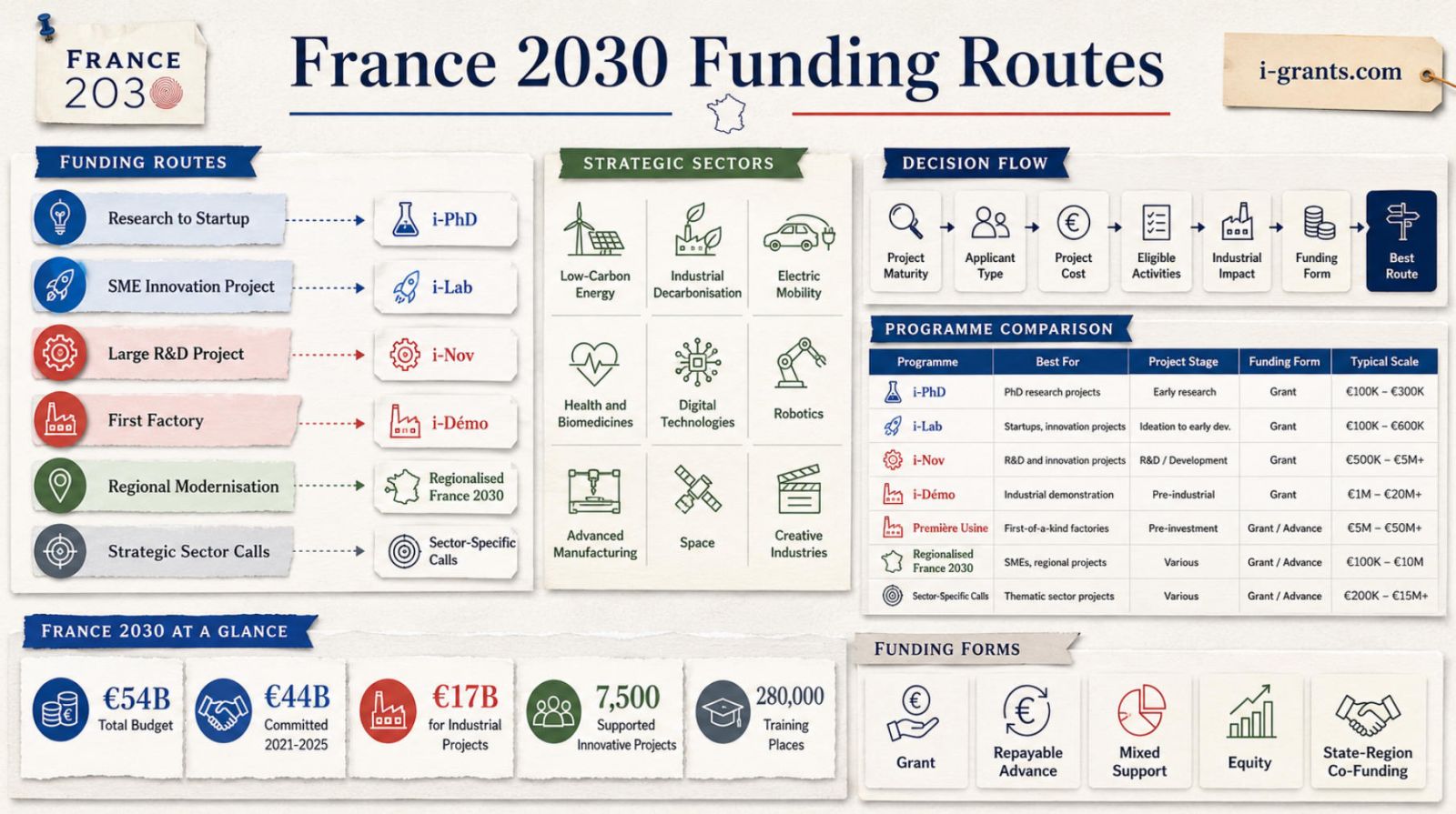
There is no single application pathway. Companies enter France 2030 through instruments that correspond to different stages of technological and industrial maturity.
Table 2. Main France 2030 Funding Routes for Startups and SMEs
| Programme | Typical applicant | Project stage | Typical project scale | Main form of support |
|---|---|---|---|---|
| i-PhD | Doctoral researchers and young scientists | Research commercialisation and entrepreneurial preparation | Very early stage | Award, training, mentoring, and project support |
| i-Lab | Founders of research-based technology companies | Company creation and early technological development | Up to €600,000 of aid | Grant |
| i-Nov | Startups and SMEs | Research, development, innovation, and market preparation | Total project costs generally between €1 million and €5 million | Grant and, depending on the rules, repayable support |
| i-Démo | Individual companies or consortia | Large R&D and demonstration projects | Usually multi-million-euro projects | Grant and repayable advance |
| Première Usine | Industrial startups and innovative SMEs | First industrial production site or pilot manufacturing line | Significant industrial investment | Grant and repayable advance |
| Sector-specific calls | Companies, consortia, and research partners | Technology development or industrialisation in a defined strategic field | Depends on the call | Grant, repayable advance, or mixed support |
| Regionalised France 2030 | Local microenterprises, SMEs, mid-caps, consortia, and training providers | Regional innovation, collaboration, modernisation, or skills | Regional thresholds apply | Joint state and regional funding |
| France 2030 equity instruments | High-growth companies and industrial projects | Growth and industrial scale-up | Significant long-term capital need | Public or co-invested equity |
i-PhD
i-PhD is intended for young researchers who want to explore the commercial potential of their research and prepare the creation or joint creation of a technology company.
It does not function as a conventional corporate grant. Winners receive structured support, including individual and group guidance, access to experts, contact with previous winners, and exposure to the French research commercialisation and technology entrepreneurship network.
In the 2024-2025 innovation competition cycle, 40 i-PhD projects were selected.
i-Lab
i-Lab supports the creation and early development of innovative technology companies, particularly companies based on public research.
Funding can reach €600,000 per project. In the 2025 edition, 62 winners were selected from 473 applications. They received €23 million in total support.
The competition is especially relevant to founders who have moved beyond the first scientific idea and need to complete technological development, prepare a product, secure intellectual property, strengthen the team, and create a viable company.
An i-Lab applicant should demonstrate more than research excellence. The proposal must explain how the technology will be transferred, developed, protected, financed, and brought toward a real market.
i-Nov
i-Nov supports ambitious research, development, and innovation projects led by startups and SMEs. Its purpose is to help companies develop and bring high-technology solutions to market while creating future French companies capable of competing internationally.
For the 2024-2025 cycle, i-Nov co-financed projects with total costs between €1 million and €5 million. Forty-five winners received more than €51 million in total support.
i-Nov is more demanding than a small feasibility grant. A company should already have a structured development programme, a qualified team, a credible commercial opportunity, a clear cost plan, and enough financial capacity to fund the part not covered by public aid.
The themes change between competition waves. Previous editions have included digital technologies, health, mobility, sustainable buildings, energy, natural resources, and environmental solutions. Applicants must use the current competition documents rather than relying on the scope of an earlier edition.
i-Démo
i-Démo supports major research, development, innovation, and demonstration projects capable of strengthening French industrial and service companies in strategic markets.
Projects may be submitted by a single company or by a consortium of businesses and research organisations. They are expected to create significant economic value, improve competitiveness, and contribute to the energy, environmental, or digital transitions.
The generic i-Démo call number 5 is open until 9 September 2026 at noon, Paris time.
i-Démo is not normally the appropriate route for a small internal improvement project. It is intended for structured, multi-stage projects that require substantial expenditure, contain meaningful technological risk, and can lead to a new product, service, process, demonstrator, or industrial capability.
A consortium application must also explain why collaboration is necessary. Adding a university or another company solely to make the proposal appear larger will not create a convincing collaborative project. Each participant should have a clear technical role, budget, intellectual property position, and route to using the results.
Première Usine: From Innovation to Production
Many French technology companies successfully complete research and prototype development but encounter difficulty when financing their first industrial production capacity.
Première Usine was created to address this gap.
The programme supports industrial startups and innovative SMEs that are preparing their first factory, pilot line, or significant industrial production site in France. Eligible projects may include the construction of a first production facility, the introduction of an innovative manufacturing process, or shared pre-industrial capacity that can be used by several startups.
Support is provided through grants and repayable advances. The current call is scheduled from 9 January 2026 to 6 April 2027.
By March 2026, Première Usine had supported more than 100 projects with approximately €500 million in public funding. Thirteen additional winners from the eighth and ninth selection rounds were announced in March 2026, with approximately €81 million of public support for thirteen first industrial sites in batteries, electronics, space, agriculture, and other priority fields.
France has identified more than 3,500 industrial startups, which illustrates both the potential demand for the programme and the importance of private co-financing. France 2030 support alone is rarely sufficient to build and operate a factory. A successful financing plan may also require equity, bank debt, leasing, property finance, customer commitments, and working capital.
A Première Usine proposal should therefore include more than a construction and equipment budget. It should demonstrate:
-
that the product and production process are sufficiently mature;
-
that the planned capacity is supported by credible market demand;
-
that the company controls the relevant intellectual property and regulatory requirements;
-
that the site, suppliers, workforce, and implementation timetable are realistic;
-
that sufficient funding is available for construction, commissioning, working capital, and early operating losses;
-
that the project will create strategic production, employment, or supply-chain value in France.
Regionalised France 2030
National France 2030 calls often have high project thresholds and demanding strategic requirements. Smaller industrial businesses may find a more appropriate route through France 2030 régionalisé.
The regional component is jointly financed by the French state and participating regional authorities. Before July 2026, it had four main routes: innovation projects, regional collaborative i-Démo projects, strategic sector development, and professional training.
On 6 July 2026, the government and the regions announced a fifth route, Projets de modernisation et d’adoption de technologies avancées. It is intended to help industrial microenterprises, SMEs, and mid-caps acquire advanced equipment and software, modernise production, diversify activities, and strengthen industrial competitiveness.
Grand Est is the first region to launch the new route. The scheme has an initial budget of €8 million, financed equally by the state and the region. The application platform is expected to open on 1 October 2026 and remain open until 30 September 2027. The programme is expected to be introduced progressively in other regions.
This development is significant because it creates a France 2030 route for established industrial SMEs whose projects may not involve a scientific breakthrough or a first factory but can still improve sovereignty, resilience, productivity, and environmental performance.
Companies must still distinguish between ordinary replacement expenditure and strategic modernisation. Replacing an old machine with a standard equivalent is unlikely to be sufficient. A stronger proposal may involve advanced automation, digital production management, cybersecurity, energy-efficient equipment, reshoring, production diversification, or a major transformation of the manufacturing process.
Grants, Repayable Advances, and Equity
France 2030 does not apply one universal funding rate or one standard financial instrument.
Support depends on the call, the applicant’s size, the type of activity, the level of technical risk, the project’s location, and European state aid rules.
Table 3. Main Forms of France 2030 Support
| Form of support | Typical use | Main advantage | Main obligation or risk |
|---|---|---|---|
| Grant | Research, high-risk development, feasibility, prototypes, strategic public-interest outcomes | Does not normally require repayment if the agreement is respected | Covers only part of eligible expenditure and requires co-financing |
| Repayable advance | Projects with commercial potential and significant development risk | Reduces immediate financing pressure while sharing project risk | Must be repaid under the conditions of the funding agreement |
| Mixed grant and repayable advance | Large R&D, demonstration, and industrialisation projects | Combines risk-sharing with longer-term financial discipline | The company must understand both eligible costs and future repayment |
| Equity investment | High-growth technology companies and industrial scale-up | Provides long-term capital without scheduled loan repayment | The public or co-investor receives an ownership interest |
| State-region co-financing | Regional innovation, modernisation, and strategic sector projects | Brings support closer to local industrial needs | The applicant must satisfy both national and regional conditions |
A repayable advance is not the same as a conventional bank loan. Its repayment rules are defined in the funding agreement and may reflect the project structure, milestones, or expected commercial outcome.
It should nevertheless be treated as a future financial obligation. The company must include repayment in cash-flow projections and explain how it will finance operations after the public funding period ends.
A grant is also not equivalent to full project financing. France 2030 is designed to mobilise private investment alongside public support. The July 2026 mid-term assessment reported an immediate leverage ratio of 2.3, meaning that each euro of public funding mobilised approximately €1.30 of private investment.
Current France 2030 Calls in 2026
The following table illustrates the range of calls available to businesses in July 2026. It is not a complete catalogue, and deadlines may be changed or calls may close early if available budgets are exhausted.
Table 4. Selected France 2030 Calls Open or Announced in July 2026
| Call | Main purpose | Relevant applicants | Current deadline |
|---|---|---|---|
| Generic i-Démo call number 5 | Major R&D and demonstration projects in strategic markets | Individual companies or consortia | 9 September 2026 |
| Innovations in Biotherapies and Bioproduction | Development of biotherapies, research tools, and biomanufacturing processes | Health technology companies and research partnerships | 8 September 2026 |
| Première Usine | First industrial production facility or pilot manufacturing line | Industrial startups and innovative SMEs | 6 April 2027 |
| Défi Flagships | Advanced and sovereign subsystems for robotics, drones, and intelligent machines | Consortia involving emerging companies, established industrial participants, and research organisations | Intermediate cut-off on 24 September 2026; final deadline on 6 April 2027 |
| 6G Standardisation | Collaborative research and participation in future international 6G standards | Large companies, SMEs, mid-caps, and academic partners | First cut-off on 15 September 2026; final deadline on 15 January 2027 |
| Advanced Technology Modernisation, Grand Est | Industrial equipment, software, modernisation, diversification, and strategic production | Industrial microenterprises, SMEs, and mid-caps in Grand Est | Applications from 1 October 2026 to 30 September 2027 |
The biotherapies call supports projects concerning human or relevant animal biotherapies, research and patient-stratification tools, and new biomanufacturing processes or equipment. Support for economic activities includes a grant component and a repayable component.
Défi Flagships uses a two-phase structure. The first six-month phase provides a grant of between €50,000 and €100,000 to prepare the project. The second phase supports implementation projects generally exceeding €4 million in eligible costs, although certain projects between €1 million and €4 million may be considered where they make an exceptional contribution to resilience or sovereignty.
The 6G call aims to connect companies already involved in international standardisation with SMEs and research institutions that need to build relevant expertise. It combines research work with participation in the development of future technical standards.
These examples demonstrate why a company should not prepare a generic France 2030 application. A robotics consortium, a biotherapy developer, an industrial startup building its first factory, and an existing manufacturing SME modernising its plant face completely different conditions.
What France 2030 Has Achieved
The most recent mid-term assessment reports that €44 billion had been committed during the 2021-2025 period, including €17 billion for industrial projects.
The official France 2030 portal reports approximately 7,500 supported innovative projects and around 280,000 places in training programmes for future professions.
The mid-term evaluation also identified several wider effects:
-
France 2030 beneficiaries increased industrial capital expenditure by an estimated 27 percent as a result of the support;
-
80 percent of industrial France 2030 investment was directed to medium-high-technology and high-technology sectors, compared with 42 percent of national fixed capital formation;
-
electronics, electric vehicles, and industrial decarbonisation represented almost 60 percent of industrial commitments;
-
supported investments are projected to avoid 21 million tonnes of carbon dioxide equivalent by 2030;
-
the estimated long-term economic multiplier is between €3.80 and €5.40 for each euro of public investment.
These figures should not be interpreted as a guarantee that every supported project will succeed. France 2030 includes high-risk research, industrial, and technology investments. Some projects will change direction, experience delays, or fail to reach commercial scale.
The purpose of the programme is to finance strategically important development that private capital may not undertake at the same speed, scale, or risk level without public intervention.
How Applications Are Evaluated
The precise evaluation criteria differ between calls, but most business applications are assessed across several recurring dimensions.
Strategic relevance
The proposal must respond directly to the purpose of the call. A company should connect every major work package and cost category to the stated strategic objectives.
General claims about innovation, sustainability, employment, or sovereignty are insufficient if they are not supported by measurable results.
Innovation and technical risk
The company must explain the current state of the technology, what remains uncertain, how the proposed solution differs from available alternatives, and what evidence will demonstrate successful development.
The evaluators should be able to distinguish genuine research or innovation from ordinary engineering, product customisation, or equipment installation.
Economic and industrial impact in France
France 2030 is intended to strengthen French and European productive capacity. Applications may therefore be evaluated on future production, employment, domestic value creation, exports, supply chains, strategic autonomy, and industrial investment.
For an industrial project, the company should explain where production will take place, which suppliers will be used, which skills will be required, and how the project will remain financially sustainable after the aid period.
Market and commercialisation
A technically impressive project is not sufficient. Applicants should demonstrate customer need, market size, competition, pricing, regulatory access, sales strategy, and a credible path toward revenue.
Letters of interest, pilot customers, commercial partnerships, supply agreements, and investor commitments can strengthen the evidence, although their value depends on how specific and binding they are.
Financial capacity and co-financing
The applicant must be able to finance the expenditure not covered by public support and manage the project’s cash flow.
Evaluators may examine equity, debt, current liquidity, historic accounts, financial projections, fundraising plans, partner contributions, and the company’s ability to absorb delays or cost increases.
Environmental and wider impact
France 2030 uses environmental impact as a cross-cutting consideration. Depending on the call, the assessment may examine emissions, energy use, raw materials, circularity, pollution, biodiversity, product life cycle, and climate resilience.
Companies should quantify environmental benefits wherever possible and avoid unsupported statements that the project is automatically green because it uses digital technology, electrification, recycling, or renewable energy.
Preparing a Strong France 2030 Application
Before submitting a proposal, a company should complete the following preparation:
-
Identify the exact call. Read the full specifications, annexes, frequently asked questions, impact framework, and application template.
-
Confirm the project threshold. Check minimum eligible costs, applicant size, consortium requirements, project duration, location, and technology maturity.
-
Separate project stages. Distinguish research, experimental development, demonstration, industrialisation, production, commercial launch, and ordinary operating expenditure.
-
Build the financing plan. Show the requested grant, repayable support, equity, bank finance, partner contributions, and cash required before reimbursement.
-
Quantify the impact. Estimate production capacity, employment, revenue, exports, emissions, resource savings, patents, supplier effects, and strategic dependencies reduced.
-
Protect the project start date. Do not sign binding orders or begin supported activities before confirming the incentive-effect and eligibility rules.
A strong application should also describe project governance, technical milestones, decision points, intellectual property, regulatory approvals, procurement, subcontracting, risk management, and the financing route after the France 2030 project ends.
Common Reasons for Weak or Rejected Applications
-
The company selects a call because its title mentions the correct sector, but the project does not address the specific problem defined in the documentation.
-
The project is ordinary capital expenditure presented as strategic innovation.
-
The requested project is too small or too early for the selected national call.
-
The applicant cannot demonstrate enough equity, liquidity, or external financing to complete the project.
-
Research, production, marketing, and general operating costs are combined without a clear eligibility structure.
-
The expected French industrial impact is vague or limited.
-
The company starts work or orders equipment before confirming eligibility.
-
The application describes the technology but provides weak market, regulatory, industrial, or commercial evidence.
How to Choose the Correct France 2030 Route
The most appropriate route depends on the maturity and purpose of the project.
A researcher preparing to create a company may begin with i-PhD.
A research-based founder developing a young technology company may consider i-Lab.
A startup or SME with a structured €1 million to €5 million development project may fit an i-Nov competition when a relevant wave is open.
A company or consortium with a larger strategic research and demonstration programme may consider i-Démo.
An industrial startup that has completed development and needs its first production facility may be a candidate for Première Usine.
An established industrial SME that wants to adopt advanced equipment or transform production may find a regionalised France 2030 scheme more appropriate than a national research competition.
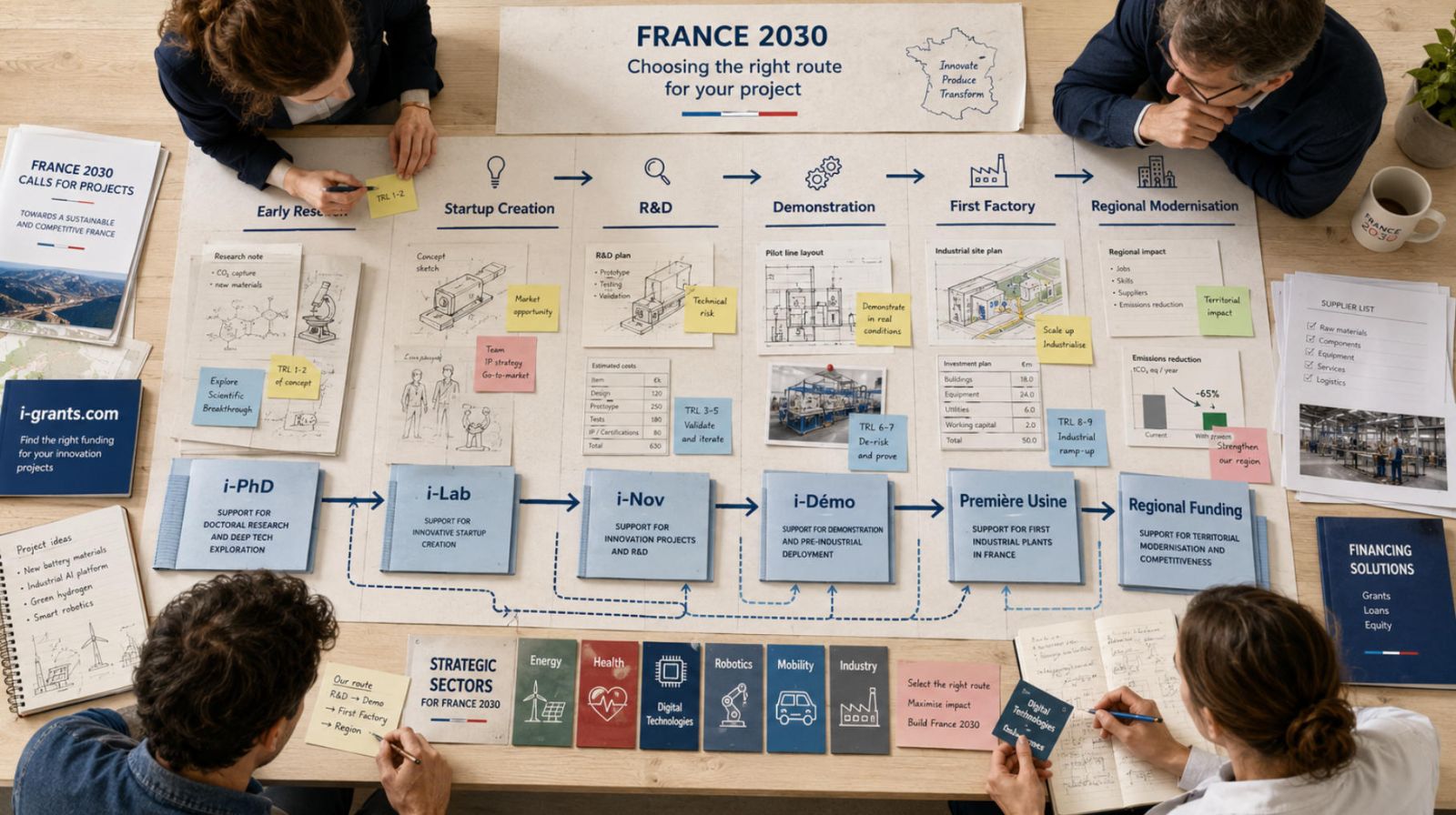
The decision process can be expressed as:
Project maturity → strategic sector → applicant type → total project cost → eligible activities → industrial impact → funding form → relevant France 2030 call
Conclusion
France 2030 offers substantial opportunities for French startups and SMEs, but it should not be treated as a general business grant programme.
Its purpose is to support strategically important projects that can strengthen French innovation, industrial capacity, technological sovereignty, environmental performance, and future skills.
The programme covers the complete journey from research commercialisation and company creation to major R&D, demonstration, industrialisation, and productive investment. i-PhD, i-Lab, i-Nov, i-Démo, Première Usine, sector-specific calls, and regionalised schemes all serve different stages and types of applicants.
The programme is also becoming more focused on measurable impact. The latest evaluation shows increasing attention to private investment leverage, high-technology production, industrial capital expenditure, emissions reductions, and strategic manufacturing capacity.
For an SME or startup, the most important task is not to make an existing business plan sound like France 2030. It is to identify the correct call and redesign the project so that its technical work, cost structure, financing, and expected results form a coherent response to that call.
A company that can clearly demonstrate strategic relevance, innovation, financial capacity, industrial impact, and a credible route beyond public support will be in a much stronger position to compete for France 2030 funding.