

 Français
  Deutsch
  Українська
For many startup founders in Germany, public funding begins with a simple question: is this a normal business idea, or is it a science-based, technology-oriented, or knowledge-driven project that needs a different funding route?
This distinction matters because Germany does not treat every startup in the same way. A small local business, a digital service startup, a university spin-off, a biotechnology team, a robotics project, and a research-based climate technology venture may all need early-stage finance, but they do not necessarily fit the same funding instrument.
For founders coming from universities and research institutions, one of the most important federal funding routes is EXIST. The programme supports innovative startup projects that originate from science and research. It can help teams develop a viable business model, validate a market, build a prototype, prepare company formation, and move from academic knowledge to commercial activity.
EXIST is especially relevant for students, graduates, researchers, women founders in academia, and deep-tech teams that need time and structured support before they can attract customers, private investors, or later-stage public funding. It is not a general startup grant for any business. It is a targeted bridge from research to entrepreneurship.
Why EXIST matters for startup funding in Germany
Germany’s startup environment is changing. Entrepreneurial activity increased in 2025, with KfW Research reporting around 690,000 founders after 585,000 in the previous year. At the same time, young people have become highly visible in the startup landscape, and digital business models are becoming more common. This creates a stronger need for funding routes that can support early-stage ideas before they become bankable companies.
EXIST responds to a specific part of this challenge: the gap between academic knowledge and business creation. Many research-based founders do not begin with immediate revenue. They begin with an invention, a laboratory result, a software method, a scientific insight, a patentable technology, or a problem discovered through research. These projects need time, infrastructure, mentoring, market validation, and often a team that combines technical and business skills.
For this reason, EXIST is not only about money. It also connects founders to university infrastructure, startup networks, mentors, coaching, and national visibility. A strong EXIST application is therefore not just a request for funding. It is a structured argument that the team can turn a scientific or knowledge-based idea into a credible company.
What EXIST is and who it is for
EXIST is a federal support system for innovative startups from universities and research institutions. It is backed by the Federal Ministry for Economic Affairs and Energy and co-financed in parts by the European Social Fund Plus. Its purpose is to increase the number and quality of technology-based and knowledge-based startups in Germany.
The programme is most relevant for founders who have an academic or research connection. This can include students, recent graduates, research assistants, doctoral graduates, scientists, and teams working with universities or non-university research institutions. The exact rules depend on the specific EXIST instrument.
A key point is that the application route often runs through a university or research institution, not only through the founding team itself. The institution provides the formal application framework, startup network, mentoring, infrastructure, and support environment. This makes the choice of host institution and internal startup office highly important.
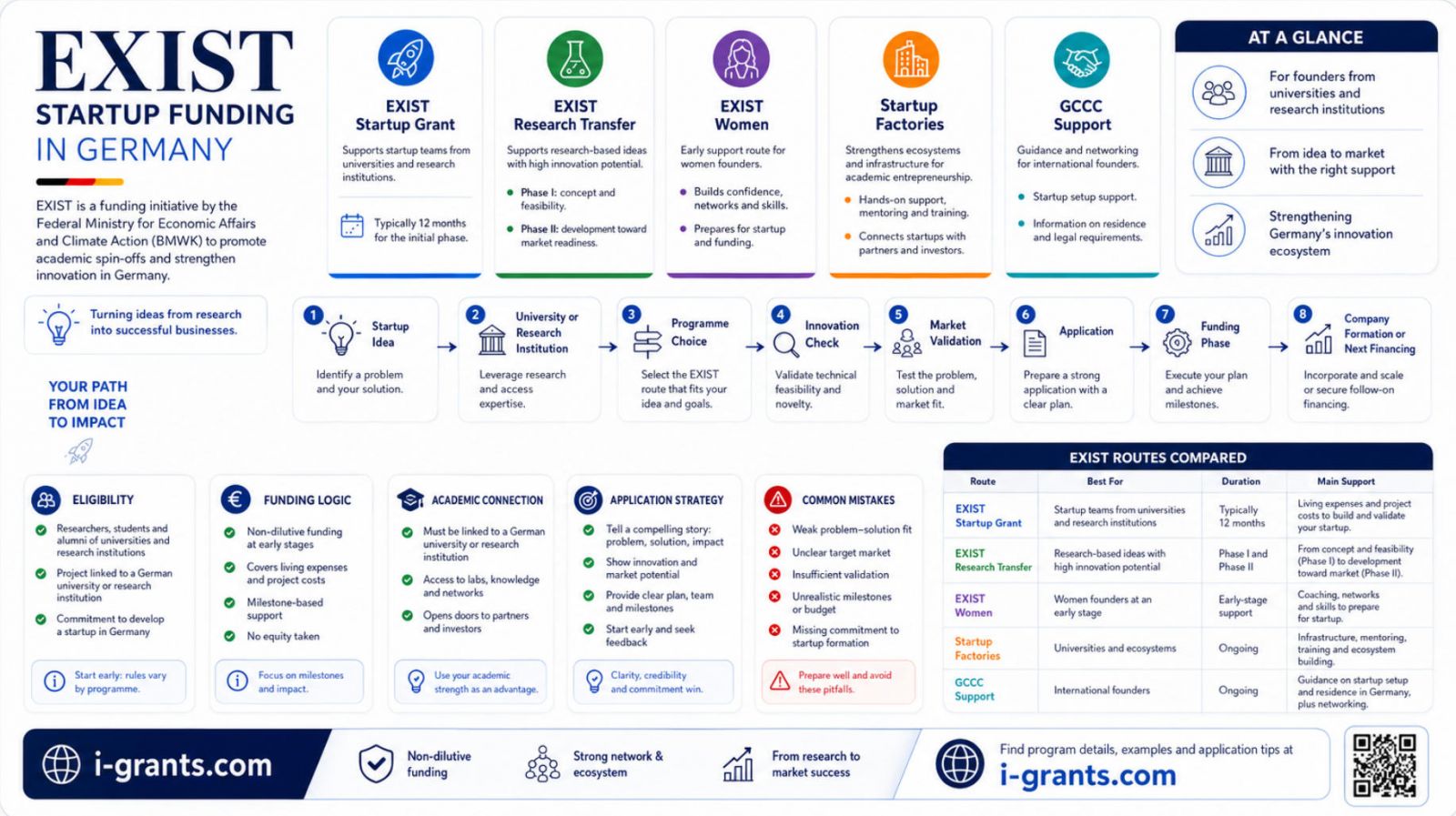
Table 1. Main EXIST funding routes for startup teams in Germany
| EXIST route | Main target group | What it supports | Strategic role |
|---|---|---|---|
| EXIST Startup Grant | Students, graduates, and researchers with an innovative startup idea from a university or research institution | Founder scholarships, product development, business model work, market validation, equipment, coaching, and preparation for company formation | Best for early-stage teams that need time to turn an idea into a market-ready startup |
| EXIST Research Transfer | Research-based teams with complex, high-risk technology and a proof of principle | Technology development, prototype work, personnel, materials, external services, intellectual property work, coaching, and preparation for follow-on financing | Best for deep-tech projects that need more technical development before market entry |
| EXIST Women | Women from universities and research institutions who are interested in entrepreneurship or have an early startup idea | Mentoring, skills development, networking, roadmap building, in-kind support, and possible short scholarship support | Best as a pre-startup readiness route before a larger grant, accelerator, or company formation |
| EXIST Startup Factories | Universities, research institutions, investors, industry partners, and regional innovation ecosystems | Large-scale startup infrastructure, deep-tech networks, investor access, industry partnerships, and regional science-based startup hubs | Not an individual grant for one team, but an ecosystem instrument that can improve the support environment for future founders |
| GCCC support for international founders | Non-EU founders connected to EXIST or similar scholarship-based startup programmes | Guidance and document review in relation to visa and residence permit procedures | Important for international teams that need to align startup funding with legal residence in Germany |
EXIST Startup Grant: early-stage funding for science-based founders
The EXIST Startup Grant is the best-known EXIST instrument. It supports students, graduates, and researchers who want to develop an innovative and knowledge-based startup idea from science or research.
It is designed for projects at an early stage. The team may still be developing the product, testing the market, validating customer demand, refining the business model, and preparing company formation. The company must not already be established at the start of the grant period, although formation may take place during the funded period.
The grant usually supports teams of up to three people. Students must normally have completed at least half of their degree programme. Graduates and research assistants are generally eligible up to five years after graduation or departure from the university or research institution. At least one team member should have a university degree, and the idea must show a clear innovation element and commercial potential.
The financial value of the Startup Grant is significant because it supports the founders personally and gives the team resources to work on the project. Funding is provided for twelve months. Monthly scholarships depend on the founder’s status: students receive a lower amount than graduates, and doctoral graduates receive the highest scholarship. The programme can also support equipment, a limited amount for newly founded businesses, and coaching.
The most important strategic point is that the Startup Grant is not awarded because a founder wants to start any company. The project must have a clear innovative or knowledge-based character. Further development of an existing product without meaningful innovation is usually not enough.
EXIST Research Transfer: deep-tech funding for high-risk research projects
EXIST Research Transfer is a different instrument. It is designed for outstanding research-based startup projects that involve complex and risky development work. This makes it especially relevant for deep tech, biotechnology, medical technology, advanced materials, climate technologies, robotics, artificial intelligence, photonics, semiconductors, engineering, and other research-intensive fields.
The programme has two funding phases. In the first phase, research results with startup potential are developed further. The team works on technical feasibility, prototype development, scientific and engineering questions, business model development, and preparation for company formation. In the second phase, the focus shifts toward further development work, the start of business activity, and preparation for external corporate financing.
This route is not suitable for vague ideas. Before applying, a team should already have a strong scientific foundation and a proof of principle. This may include laboratory results, experimental evidence, a functioning prototype, validated technical assumptions, or research results that show the technology can plausibly become a product or process.
Research Transfer is more demanding than the Startup Grant. It expects a deeper explanation of the technology, a clear development plan, a credible commercialisation route, and a realistic view of technical risks. The team must show that the project is not only scientifically interesting but also capable of becoming a company.
Table 2. EXIST Startup Grant vs EXIST Research Transfer
| Criterion | EXIST Startup Grant | EXIST Research Transfer |
|---|---|---|
| Best project stage | Early startup preparation before or around company formation | Research-based technology development before and after company formation |
| Typical project type | Innovative product, service, software, platform, or knowledge-based business idea | Deep-tech, high-tech, or research-intensive project with technical complexity |
| Main evidence needed | Innovation, market potential, team capability, business model, customer benefit | Proof of principle, technical risk, development plan, commercialisation path, follow-on financing logic |
| Type of support | Founder scholarships, equipment funds, coaching, university infrastructure | Personnel, development costs, prototype work, materials, external services, intellectual property costs, coaching |
| Main application risk | The idea looks too ordinary, too incremental, or too weak commercially | The technology is not mature enough, the risk is unclear, or the market path is underdeveloped |
| Best strategic use | Give founders time to build a market-ready startup concept | Move complex research from laboratory proof toward a fundable technology company |
EXIST Women: not a smaller grant, but a readiness programme
EXIST Women deserves its own place in the funding strategy. It is not simply a smaller version of the Startup Grant. It is a programme for women from universities and research institutions who want to explore entrepreneurship, develop an early business idea, build confidence, access mentors, and prepare their next steps.
This matters because women remain underrepresented in the startup ecosystem, especially in full-time and high-growth startup activity. EXIST Women can help reduce the entry barrier before a founder is ready for a larger programme. It can support idea development, business planning, contact with role models, networking, and preparation for later funding.
The programme includes in-kind support for each funded participant and may also include a short scholarship for selected participants, depending on the university’s criteria and the participant’s status. The practical output should be a personal startup roadmap. That roadmap may lead to EXIST Startup Grant, EXIST Research Transfer, a university incubator, regional funding, private investment, or a decision not to start yet.
For grant writers and startup consultants, EXIST Women should be treated as an early strategic instrument. It helps a potential founder clarify whether the idea is strong enough, what team is missing, which funding route is realistic, and what must be developed before a larger application.
Eligibility: the academic connection is not a detail
The academic connection is central to EXIST. Many applicants misunderstand this. A team cannot treat EXIST as a normal public grant that is approached independently from the outside. The university or research institution is usually part of the application and implementation logic.
For Startup Grant, the project should come from students, graduates, researchers, or a team connected to a university or non-university research institution. For Research Transfer, the link to research results is even stronger. For EXIST Women, the participant is also connected to an academic or research environment.
This means that a good application strategy starts before writing the proposal. The team should identify the right host institution, contact the startup office or technology transfer office, clarify internal deadlines, find a mentor, confirm access to workspace or laboratory infrastructure, and understand the institution’s process for submitting EXIST applications.
International founders should pay particular attention to residence and visa issues. EXIST funding can support a startup project, but it does not automatically solve every immigration question. The Global Certification and Consulting Centre can support non-EU startup teams in connection with scholarship-based startup programmes, but founders still need to align funding, residence status, documents, and timing carefully.
Eligible costs and what funding can actually support
EXIST funding is useful because it can cover needs that normal early-stage founders often struggle to finance. In the Startup Grant, the scholarship helps founders focus on the project. Equipment and coaching funds help the team build the product, validate assumptions, and prepare for launch. University infrastructure can reduce the need for immediate external spending.
In Research Transfer, the cost logic is broader and more technical. The project may need personnel, student assistants, materials, prototype development, software, specialised equipment, third-party services, travel, intellectual property work, and entrepreneurial coaching. These costs must be linked to the development of the technology and the preparation of the startup.
Still, applicants should not assume that every cost is fundable. A strong budget distinguishes between what is necessary for the funded project and what belongs to later business operations. It also explains why each cost is required, how it supports the milestone plan, and why it is reasonable for the project stage.
Table 3. Application readiness for EXIST startup funding
| Readiness question | What the team should prepare |
|---|---|
| Is the project genuinely innovative? | A clear explanation of the unique selling proposition, scientific or technical basis, and difference from existing solutions |
| Is the academic route secured? | Contact with the university or research institution, mentor support, infrastructure access, and understanding of internal submission steps |
| Which EXIST route fits best? | A reasoned choice between Startup Grant, Research Transfer, EXIST Women, or another funding route |
| Is the team complete enough? | Technical, business, product, and market skills, plus a plan to fill missing roles |
| Is there evidence of market need? | Customer interviews, market analysis, problem validation, competitor comparison, and early feedback |
| Are technical risks explained honestly? | Development milestones, feasibility evidence, assumptions, and risk mitigation measures |
| What happens after EXIST? | Follow-on financing plan, company formation route, investor or grant pipeline, and market entry strategy |
How to choose between Startup Grant and Research Transfer
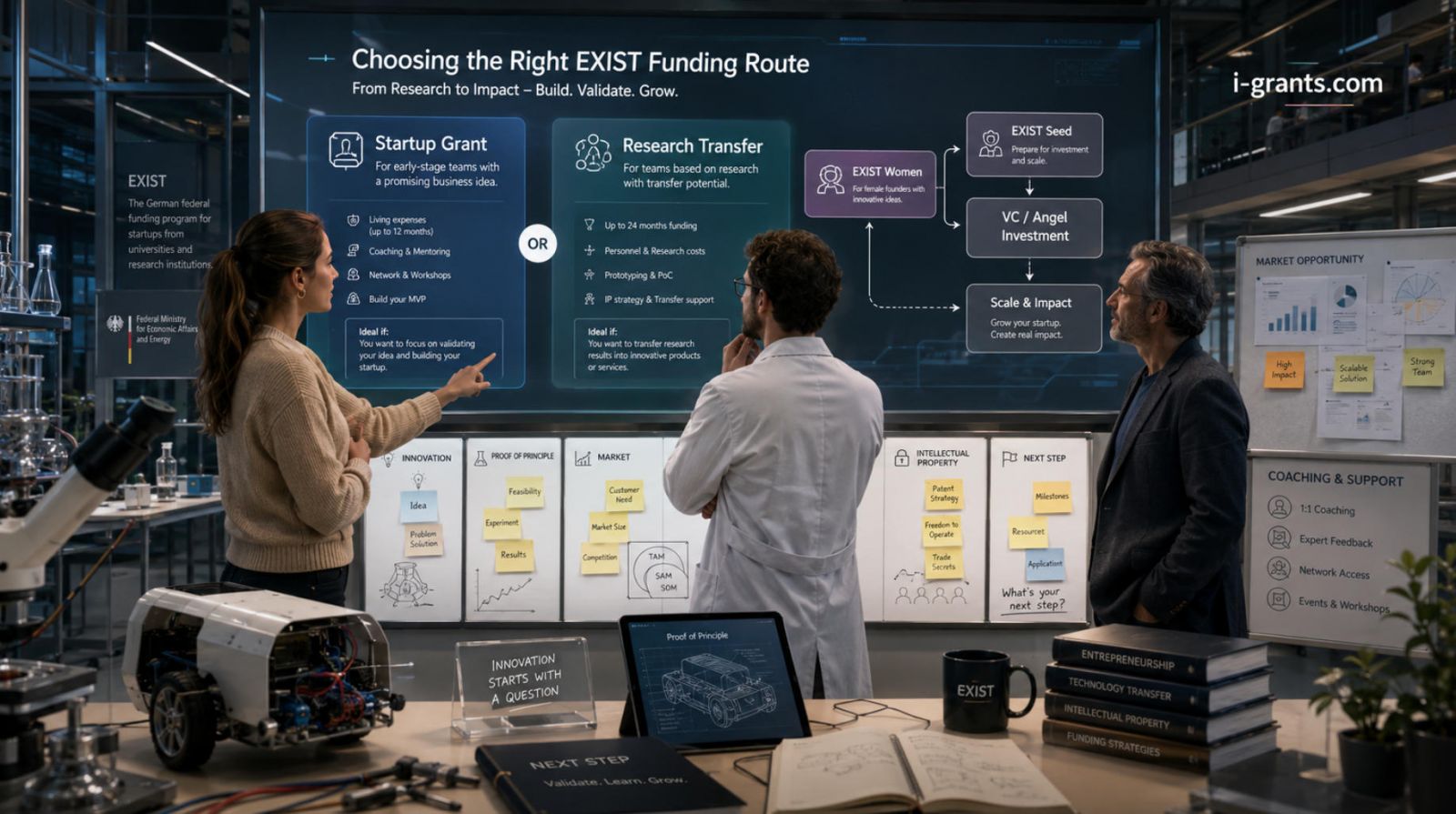
Choosing between Startup Grant and Research Transfer is one of the most important decisions. The wrong choice can weaken the application before evaluation even begins.
The Startup Grant is usually better when the team has an innovative idea that is not yet ready for market but does not require a long, risky research and development phase. It is suitable when the main work is product development, business model validation, customer discovery, market testing, and preparation for company formation.
Research Transfer is usually better when the central challenge is technical development. If the project depends on complex scientific results, laboratory validation, prototype engineering, regulatory pathways, intellectual property, or significant technical uncertainty, the team should consider whether Research Transfer is the more appropriate route.
The difference is not only the amount of funding. It is the logic of the project. Startup Grant asks whether the team can turn an innovative academic idea into a viable startup. Research Transfer asks whether a risky research result can be developed into a technically and commercially credible company.
Application strategy: what evaluators need to believe
A strong EXIST application must make evaluators believe five things.
First, the idea must be innovative enough. It should not look like a minor adaptation of an existing service or a business that could be launched without a science-based advantage.
Second, the team must be credible. EXIST does not expect every founder to be perfect, but it should be clear why this team can execute the project and how missing skills will be covered.
Third, the market must be real. A technically strong project can fail if the application does not explain the customer problem, purchasing logic, competition, pricing, and route to market.
Fourth, the academic institution must add value. The university or research institution should not appear only as a formal applicant. Its infrastructure, mentors, laboratory access, startup network, and technology transfer support should strengthen the project.
Fifth, the project must have a path beyond EXIST. Public funding is temporary. The application should show what happens after the grant period: company formation, first customers, private investment, follow-on grants, pilot projects, licensing, or strategic partnerships.
Common mistakes in EXIST applications
A typical mistake is treating EXIST as a personal scholarship rather than a startup funding instrument. The scholarship supports founders, but the real evaluation logic is the quality of the startup project.
Another mistake is over-focusing on technology. Many research teams write extensively about the scientific background but say too little about customers, willingness to pay, market entry, competitors, and business model.
A third mistake is choosing the wrong programme. Some teams apply for Startup Grant even though the technology still needs major research development. Others aim for Research Transfer without a sufficiently strong proof of principle.
A fourth mistake is underestimating university coordination. EXIST applications need institutional support, and internal processes can take time. Waiting until the last moment can create avoidable delays.
A fifth mistake is weak milestone planning. The funded period should not be a vague year of “further development”. It should have clear technical, market, team, and business milestones that show progress toward company formation or financing readiness.
When to involve a grant writer or startup funding consultant
EXIST applications can be prepared by founders with strong university support, but external expertise can be valuable in several situations. This is especially true when the technology is complex, the market is hard to explain, the team is international, the proposal needs a stronger commercial narrative, or the founders are choosing between Startup Grant, Research Transfer, regional programmes, EU grants, and private investment.
A grant writer can help translate scientific language into a funding argument. A startup funding consultant can help structure the market logic, milestone plan, budget explanation, and follow-on financing route. The best role for a consultant is not to make the idea sound artificially attractive. It is to make the project understandable, fundable, and strategically coherent.
For i-grants.com users, this is also where the platform logic becomes relevant. Applicants may need a grant writer who understands both public funding and startup development. Grant writers may find EXIST projects attractive because they require more than generic form filling. They require strategic thinking, technical understanding, and a clear bridge between research and business.
Strategic conclusion
EXIST is one of Germany’s most important funding routes for science-based and knowledge-based startups. It is valuable because it supports the stage where many strong ideas are still too early for normal bank financing, too technical for a simple business grant, and too immature for private investors.
But EXIST is not a shortcut. It rewards teams that can show a real innovation, a credible academic connection, a strong market problem, a capable team, and a realistic path from funded project to company. The best applicants do not begin with the question “How much money can we get?” They begin with a more strategic question: which EXIST route fits the maturity, risk, and commercial logic of our startup?
For early academic founders, the Startup Grant can create the time and structure needed to move from idea to launch. For deep-tech teams, Research Transfer can support the difficult journey from research result to technology company. For women founders in academia, EXIST Women can provide a practical first step toward confidence, clarity, and a fundable startup path.
The practical rule is clear: choose the route before writing the proposal, secure the university partner before building the timeline, validate the market before claiming commercial potential, and show what happens after EXIST before asking for support. That is how EXIST becomes not just a funding programme, but a bridge from science to business in Germany.