

 Français
  Deutsch
  Українська
Digitalization funding in Germany has changed. For several years, many small and medium-sized enterprises searched first for direct federal grants such as Digital Jetzt or go-digital. In 2026, that approach is no longer enough. Digital Jetzt was designed as an investment grant for SMEs and ran from September 2020 to 31 December 2023, while go-digital was extended for the 2022 to 2024 period with EUR 72 million in federal funding. Both remain important reference points, but they are not the main route for new digitalization projects in 2026.
The current funding landscape is more fragmented, but not empty. German SMEs can still finance digital transformation through KfW promotional loans, state-level digital grants, cybersecurity schemes, consulting support, European calls, and non-financial expert infrastructure such as Mittelstand-Digital. The challenge is choosing the right route for the right project. A basic enterprise resource planning system, a cybersecurity audit, an artificial intelligence tool, a digital twin, and an EU-scale technology project do not belong in the same application strategy.
This article explains how SMEs in Germany can approach digitalization funding in 2026, which instruments are most relevant, how to match a project to a funding route, and which application mistakes commonly lead to rejection, delay, or loss of eligibility.
Why Digitalization Funding Matters for German SMEs in 2026
Germany’s SME sector is still digitalizing, but momentum has weakened. KfW Research reported in its 2025 SME Digitalisation Report that only 30 percent of businesses completed digitalization projects in the latest review period, bringing the share back to its pre-pandemic level. KfW also noted that digitalization expenditure is falling and that the digital divide between large and small SMEs remains wide.
This matters because digitalization is no longer limited to websites, online marketing, or document management. It now affects production planning, logistics, customer service, accounting, energy use, cybersecurity, data management, quality control, and artificial intelligence. A company that delays basic digital infrastructure may later struggle to implement more advanced technologies such as AI-supported forecasting, automated workflows, connected machinery, or secure cloud-based collaboration.
The pressure is visible in current business surveys. The DIHK Digitalization Survey 2026 found that German companies rate their overall digitalization level at 2.8 on the German school grading scale, which suggests a solid but not leading position. DIHK also notes that digital transformation projects require time and money, often become complex because internal processes must be reorganized, and increasingly raise security concerns.
Artificial intelligence strengthens the case for digitalization funding. According to Destatis, 26 percent of German enterprises with at least 10 persons employed used AI technologies in 2025. The share was 23 percent for enterprises with 10 to 49 persons employed, 36 percent for enterprises with 50 to 249 persons employed, and 57 percent for enterprises with 250 or more persons employed. This size gap shows why SMEs need not only enthusiasm for AI, but also funding for data quality, systems integration, staff training, and cybersecurity.
The Real Funding Map: No Single Grant Solves Every Digital Project
The most important practical lesson is that “digitalization grant” is not one category. In Germany, a digital project may be financed through a promotional loan, a state-level grant, a consulting subsidy, a European grant, or free expert support. The right route depends on the size of the company, location, investment volume, technical maturity, expected innovation content, cybersecurity relevance, and whether the project has already started.
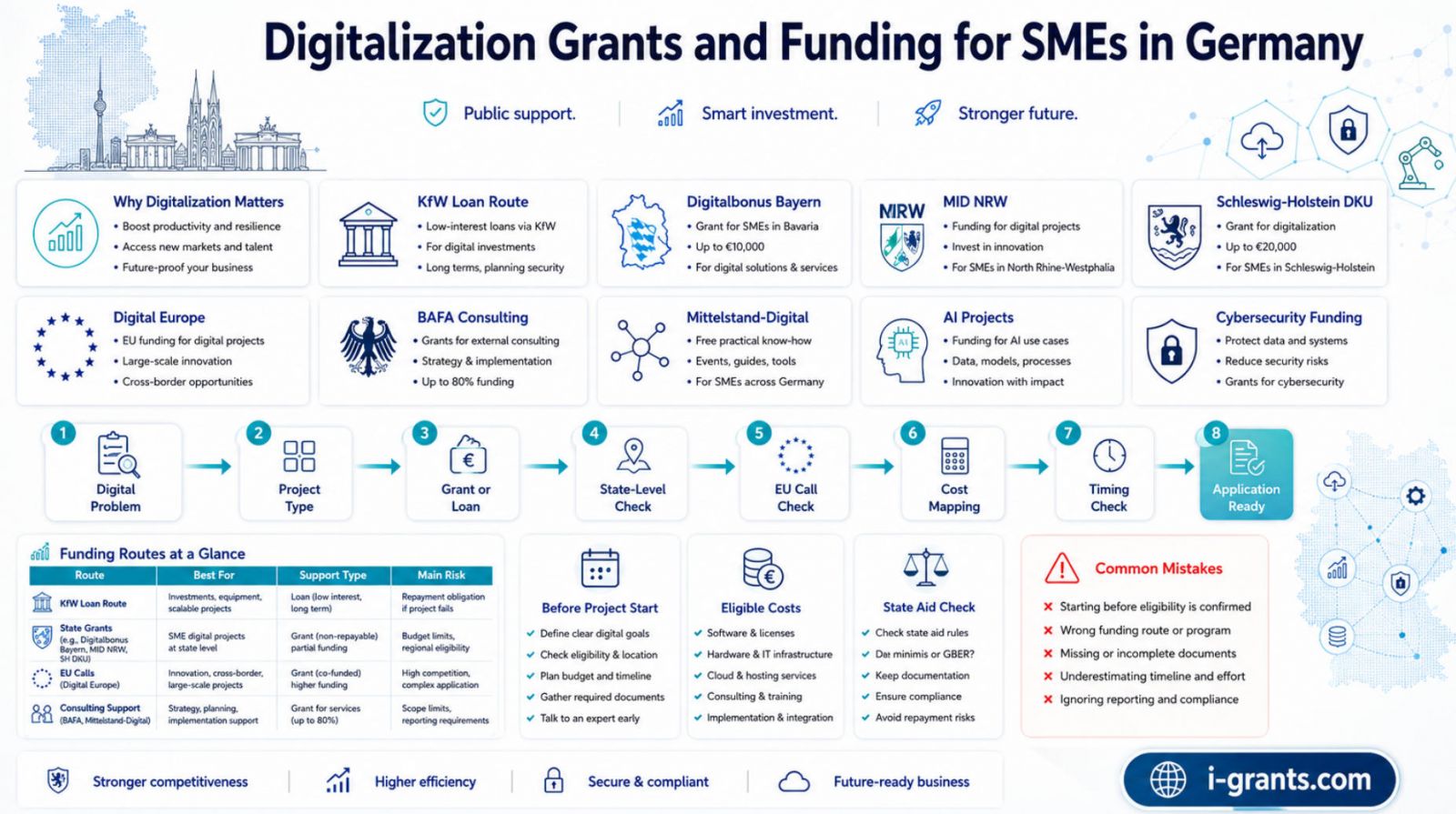
KfW is now the central federal financing route for larger digital investment projects. State-level programmes such as Digitalbonus Bayern, NRW Mittelstand Innovativ & Digital, and Schleswig-Holstein DKU can provide direct grants, but only for companies located in the relevant federal state and only under the specific cost and timing rules of each programme. Digital Europe can be relevant for advanced technologies, cybersecurity, AI, data infrastructure, and digital skills, but it is usually linked to specific EU calls rather than small individual software purchases. Consulting support and Mittelstand-Digital are useful when the company needs a strategy, diagnosis, or implementation roadmap before investing.
Table 1. Main Digitalization Funding Routes for German SMEs in 2026
| Funding route | Best for | Type of support | Typical ceiling or scale | Main applicant risk |
|---|---|---|---|---|
| KfW ERP-Förderkredit Digitalisierung | Larger digital investment, automation, AI, process transformation, data-based business models | Subsidised loan, with possible grant component for advanced projects | Up to EUR 7.5 million for basic digitalization or EUR 25 million for LevelUp and HighEnd digitalization | Treating it like a grant instead of a bank-based credit route |
| Digitalbonus Bayern | Small enterprises in Bavaria, digital processes, IT security, innovative digital tools | Direct grant | Up to EUR 7,500 Standard or EUR 30,000 Plus | Applying for Plus without proving special innovation content |
| NRW Mittelstand Innovativ & Digital | Digital products, digital security, external expertise, innovation staff in North Rhine-Westphalia | Direct grant or wage subsidy | Up to EUR 15,000 for MID-Digitalisierung and up to EUR 48,000 for MID-Assistent/in | Choosing the wrong subprogramme or failing to separate costs |
| Schleswig-Holstein DKU | Small companies linking digitalization with resource efficiency, energy efficiency, or IT security | Direct grant | Up to EUR 20,000 for advisory module and up to EUR 200,000 for implementation module | Starting the project before applying or missing the climate and efficiency link |
| Digital Europe Programme | AI, cybersecurity, advanced digital capacity, supercomputing, digital skills, EU-scale deployment | EU grant or procurement | Depends on the call, with projects often funded between 50 and 100 percent depending on type | Submitting a general digitalization idea without matching a specific EU call |
| BAFA SME consulting support | Early planning, digital strategy, process analysis, organizational preparation | Consulting grant | Based on eligible consulting costs and programme conditions | Confusing advisory support with funding for software or hardware purchases |
| Mittelstand-Digital | Orientation, practical knowledge, AI, cybersecurity, digital maturity, demonstration and learning offers | Non-financial expert support | No direct grant to the company | Expecting cash support instead of using it to prepare a stronger project |
KfW ERP-Förderkredit Digitalisierung: When a Loan Is the Right Tool
The KfW ERP-Förderkredit Digitalisierung is one of the most important federal instruments for digital investment in 2026. It supports freelancers, sole proprietors, SMEs, and larger medium-sized companies with annual group turnover of up to EUR 500 million, provided they are based in Germany or implement the project through a subsidiary, branch, permanent establishment, or office in Germany.
The product has two programme numbers: 511 without risk sharing and 512 with a risk assumption option. The version with risk assumption is available only to companies that can present at least two annual financial statements. This is important because the financing partner, usually the company’s bank, remains central to the application route. KfW is not replacing the bank relationship. It is supporting financing through the bank.
The credit amount can reach up to EUR 7.5 million for basic digitalization and up to EUR 25 million for LevelUp and HighEnd digitalization. For advanced projects, KfW also offers a grant supplement: 3 percent of the disbursed credit amount for LevelUp digitalization and 5 percent for HighEnd digitalization, with a maximum grant amount of EUR 200,000.
This structure is attractive for companies with larger projects, such as integrated ERP implementation, data platform development, AI-supported process optimization, production automation, connected machinery, advanced analytics, cybersecurity infrastructure, or digital transformation of a business model. It is less suitable for a company that only wants a small direct grant without taking a loan.
The timing rule is critical. KfW states that rescheduling and refinancing of projects that have already begun or been completed are not eligible. The company receives the approval first, then concludes the credit agreement with the financing partner and starts the project.
Digitalbonus Bayern: A Practical Direct Grant for Small Companies
Digitalbonus Bayern is one of the clearest examples of a current state-level direct grant for digitalization. It supports small commercial enterprises in Bavaria with digitalization and IT security projects. The programme period runs from 1 July 2024 to 31 December 2027, and companies can submit one application per funding area, digitalization and IT security, during the programme period.
The programme has two variants. Digitalbonus Standard provides a grant of up to EUR 7,500 and can cover up to 50 percent of eligible expenditure. Digitalbonus Plus provides a grant of up to EUR 30,000 for measures with special innovation content, also with a funding rate of up to 50 percent. The Plus variant requires a detailed explanation of the innovation content and novelty.
The official programme guidance is useful because it separates standard digitalization from genuinely innovative digital projects. ERP, customer relationship management, document management, warehouse management, craft software, logistics solutions, and common industry software are typical Standard measures. Digitalbonus Plus may be relevant for projects involving AI, intelligent data analysis, or other technologies with a stronger innovation profile, but the company must show what is new in its business, industry, or technical implementation.
For applicants, the lesson is straightforward: do not label every software purchase as innovation. A standard system can still be a good digitalization project, but it should be submitted under the appropriate funding route and described honestly.
NRW MID: Digitalization, Cybersecurity, and Innovation Staff
North Rhine-Westphalia’s Mittelstand Innovativ & Digital programme is another important example of state-level SME support. The programme has three subprogrammes: MID-Digitalisierung, MID-Digitale Sicherheit, and MID-Assistent/in. It supports external advice, digitalization projects, cybersecurity investments, and the employment of university graduates for digital, innovation, or sustainability projects.
MID-Digitalisierung supports the development and introduction of digital products, services, and production processes. The programme can fund projects ranging from AI-supported customer solutions to augmented or virtual reality applications, and MID-Digitalisierung provides support of up to EUR 15,000. MID-Digitale Sicherheit focuses on cyber risks and can support measures such as systematic analyses, employee training, and software or hardware solutions for closing security gaps. MID-Assistent/in can provide a wage subsidy of up to EUR 48,000 over two years for employing a young university graduate to work on a specific digitalization, sustainability, or innovation project.
The programme is widely used. The MID information page reports 2,586 MID vouchers since June 2020, 486 MID-Assistent/in projects since June 2020, and 1,942 MID-Digitale Sicherheit projects since October 2022. It also notes that from 1 January 2026, NRW.BANK takes over the handling of new funding projects.
For companies in North Rhine-Westphalia, MID is especially relevant when the project is not just a software purchase, but involves external expertise, a tailored digital process, a cybersecurity improvement, or a new internal role to drive digital implementation.
Schleswig-Holstein DKU: Digitalization Linked to Resource Efficiency and Climate Goals
Schleswig-Holstein’s DKU programme shows how digitalization funding can be linked to energy, resource efficiency, and climate objectives. The programme supports small commercial enterprises in Schleswig-Holstein through two modules: advisory support and implementation. The advisory module covers external consulting services that develop individual solutions and implementation recommendations for digital processes, including required hardware and software. The implementation module supports the implementation of those solutions, including hardware, software, and necessary employee qualification.
The grant can cover up to 40 percent of eligible expenditure. The advisory module is capped at EUR 20,000, and the implementation module is capped at EUR 200,000. Applications must be submitted before the funded measure begins, and the implementation module generally requires prior advisory work or prior go-digital advisory support within the specified period.
This is not a generic “buy software” subsidy. The programme links digitalization to measurable improvements such as greenhouse gas reduction, environmentally friendly production methods, resource efficiency, higher energy efficiency, improved IT security, reduced media breaks, more flexible processes, and integration of suppliers or customers into the digital value chain.
The DKU example is useful for applicants in all German states, even if they are not based in Schleswig-Holstein. It shows a broader trend: digitalization funding increasingly rewards projects that solve strategic problems, not isolated technology purchases.
Digital Europe: When SMEs Should Look Beyond German Programmes
The Digital Europe Programme is an EU-level funding programme focused on bringing digital technologies to businesses, citizens, and public administrations. Its main areas include supercomputing, artificial intelligence, cybersecurity and trust, advanced digital skills, and broad use of digital technologies in the economy and society.
For SMEs, Digital Europe is not usually the first route for a basic ERP system, standard website, or local software project. It is more relevant when the company participates in a call that matches EU priorities, works with partners, develops or deploys advanced digital capacity, or uses European Digital Innovation Hubs and related support structures.
The German federal funding database describes Digital Europe as a nationwide grant area that can support companies, municipalities, public institutions, and associations. Funding is mainly provided through procurement or grants, and projects can be eligible for 50 to 100 percent funding depending on the funding type. The same source notes that SMEs usually need to provide a 25 percent own contribution.
The application strategy is therefore different from national SME schemes. A company should not start with the idea “we need a digitalization grant.” It should start by identifying an open EU call, checking the expected project type, understanding whether partners are needed, and determining whether the proposal fits the call’s policy and technology objectives.
BAFA Consulting and Mittelstand-Digital: Before the Investment Starts
Not every SME is ready to buy software, implement AI, or submit a large loan application. Some companies first need a structured analysis of processes, data flows, cybersecurity gaps, staff capacity, and implementation priorities. For these companies, advisory support can be more useful than an immediate investment grant.
BAFA’s federal programme for SME consulting aims to strengthen the prospects of success, performance, competitiveness, employability, and adaptability of small and medium-sized enterprises. It allows companies to receive consulting on economic, financial, personnel, and organizational questions of business management. BAFA also states that the company may only begin the consulting after receiving the relevant information letter, and that concluding the consulting contract already counts as the start of the consulting.
Mittelstand-Digital is not a cash grant, but it can be strategically valuable. The programme presents itself as a guide for digitalization, AI, and cybersecurity. Its official website highlights topics such as AI implementation, IT and cybersecurity measures, legal requirements, digital maturity, ERP systems, customer relationships, digital business models, demonstrations, learning offers, and practical examples.
For a small business, this can be the best first step. Before applying for a loan or grant, the company can use expert resources to define the problem, understand technical options, avoid overbuying, and prepare a stronger application.
Table 2. Which Digital Project Fits Which Funding Route?
| Digital project type | Stronger route | What the applicant must prove | Typical mistake |
|---|---|---|---|
| Basic ERP, CRM, document management, or warehouse system | KfW, Digitalbonus Bayern Standard, relevant state-level grants | Clear process improvement, eligible costs, implementation plan, operational benefit | Presenting standard software as a high-innovation project without evidence |
| Cybersecurity audit, staff training, backup improvement, access control, security software | MID-Digitale Sicherheit, Digitalbonus Bayern IT security, BAFA consulting, Mittelstand-Digital preparation | Concrete risk reduction, external expertise, connection to business continuity | Signing the provider contract before the application is ready |
| AI-supported process optimization or customer solution | KfW LevelUp or HighEnd, Digitalbonus Plus, MID-Digitalisierung, ZIM if R&D is involved | Data basis, technical novelty, measurable business benefit, implementation capacity | Using “AI” as a label without explaining data, workflow, and risk controls |
| Digital twin, robotics, connected production, advanced analytics | KfW HighEnd, Digitalbonus Plus, ZIM, Digital Europe for larger collaborative projects | Technical complexity, integration logic, cost structure, implementation milestones | Weak separation between hardware, software, services, and training costs |
| Digital strategy before investment | BAFA consulting, Mittelstand-Digital, state advisory modules | Need for diagnosis, process mapping, technology roadmap, external expertise | Buying tools before understanding the process problem |
| EU-scale cybersecurity, AI, data, or digital skills project | Digital Europe | Fit with a specific EU call, partners where required, European added value | Submitting a generic company modernization idea to a call-driven programme |
Application Strategy: Build the Funding Case From the Project, Not the Programme Name
A strong digitalization funding application begins with the business problem. The company should be able to explain which process is inefficient, which risk is increasing, which customer expectation has changed, which production bottleneck must be solved, or which data gap prevents better decisions. The technology should then follow the problem, not the other way around.
The second step is cost mapping. A digital project often includes software licences, hardware, implementation services, customization, data migration, cybersecurity measures, staff training, consulting, and internal project management. Funding programmes rarely treat all these costs in the same way. Some support external services but not internal labour. Some support software and hardware only when they are necessary for the digitalization measure. Some exclude pure replacement purchases, maintenance, standard marketing solutions, or running costs.
The third step is timing. Many programmes require the application before project start. In practice, the applicant should check when a binding order, supplier contract, service agreement, purchase, or implementation start would count as project start. The safest approach is to prepare the application, obtain the required confirmation or approval, and only then commit legally to the project.
The fourth step is State aid compliance. Subsidised loans, guarantees, grants, and advisory support can contain State aid. Companies should track de minimis aid, check whether the same costs receive support from multiple instruments, and document the gross grant equivalent where relevant. This is particularly important when combining a KfW loan with a state-level grant or using several small support schemes for the same digital project.
Table 3. Common Mistakes in German SME Digitalization Funding Applications
| Mistake | Why it causes problems | Better approach |
|---|---|---|
| Searching only for a “digitalization grant” | Many active routes are loans, consulting support, state programmes, or EU calls rather than one federal grant | Define the project type first, then match it to the correct route |
| Treating Digital Jetzt or go-digital as the current main route | These programmes belong to earlier federal funding periods and are not the central route for new 2026 applications | Check KfW, federal state programmes, Digital Europe, BAFA consulting, and Mittelstand-Digital |
| Starting the project too early | Orders, contracts, or implementation work can make costs ineligible | Confirm the project start rule before signing contracts |
| Overstating innovation | Standard software may be eligible, but not necessarily under an innovation-focused route | Use Standard routes for standard projects and innovation routes only when novelty is clear |
| Ignoring cybersecurity | Digitalization expands the attack surface and may create compliance and business continuity risks | Include security analysis, access control, backup strategy, staff training, and resilience measures |
| Mixing costs across several programmes | The same invoice or cost item may not be funded twice | Create a cost allocation table before applying |
| Applying to Digital Europe without call alignment | EU funding is call-driven and often expects specific technology, policy, and partnership logic | Start with the open call text and build the proposal around its objectives |
Cybersecurity Should Be Part of the Funding Plan
Cybersecurity is no longer a side issue in digitalization projects. DIHK’s 2026 survey describes the cyber threat situation as still very high and notes that the growing digital attack surface, geopolitical conditions, and professionalisation of attacks, including through AI, contribute to the risk level. DIHK also states that prevention exists, but crisis preparation remains underdeveloped, especially among companies with fewer than 250 employees.
This has practical consequences for funding applications. A company implementing cloud systems, remote access, digital production interfaces, online customer portals, or data-driven AI should consider cybersecurity costs from the start. Depending on the programme, eligible security-related measures may include external audits, risk analysis, backup systems, identity and access management, staff training, security software, secure hardware, penetration testing, and emergency planning.
A weak application treats cybersecurity as a final technical detail. A strong application shows that digital transformation will improve productivity without increasing unmanaged operational risk.
When to Work With a Grant Writer, Digital Advisor, or Cybersecurity Consultant
Digitalization funding is not only about writing a persuasive application. It requires technical scoping, cost classification, provider selection, financing planning, and compliance checks. A grant writer can help structure the funding logic, but for complex projects the company may also need a digital transformation advisor, an IT security specialist, a tax adviser, or a financing partner.
Professional support is particularly useful when the project involves AI, large software implementation, production technology, several funding instruments, a bank-based KfW route, a federal state grant with strict eligibility rules, or an EU call. It is also useful when the company does not yet know whether the main problem is technology, process design, data quality, employee skills, cybersecurity, or financing.
The strongest applications connect all these elements. They show why the project is necessary, how the technology solves a real business problem, which costs are eligible, how the project will be implemented, how risks will be controlled, and why the chosen funding route is legally and economically suitable.
Practical Conclusion
In 2026, German SMEs should not approach digitalization funding as a search for one simple grant. The real funding map is broader. KfW can finance larger digital investments through promotional loans. Digitalbonus Bayern, NRW MID, and Schleswig-Holstein DKU show how federal states can support specific digitalization and cybersecurity projects. Digital Europe can open doors for advanced digital capacity and EU-scale deployment. BAFA consulting and Mittelstand-Digital can help companies prepare before they invest.
The best route depends on the project. A standard ERP system, an AI-supported workflow, a cybersecurity upgrade, a digital twin, and an EU technology project require different evidence, different cost structures, and different application logic.
A successful SME funding strategy starts with a precise digital problem, translates it into eligible costs, checks timing and State aid rules, and chooses the instrument that matches the project’s real level of complexity. In German digitalization funding, clarity is often more valuable than ambition. The companies that win support are usually not those that use the most fashionable technology terms, but those that can show a credible, well-documented, and compliant transformation plan.