

 Français
  Deutsch
  Українська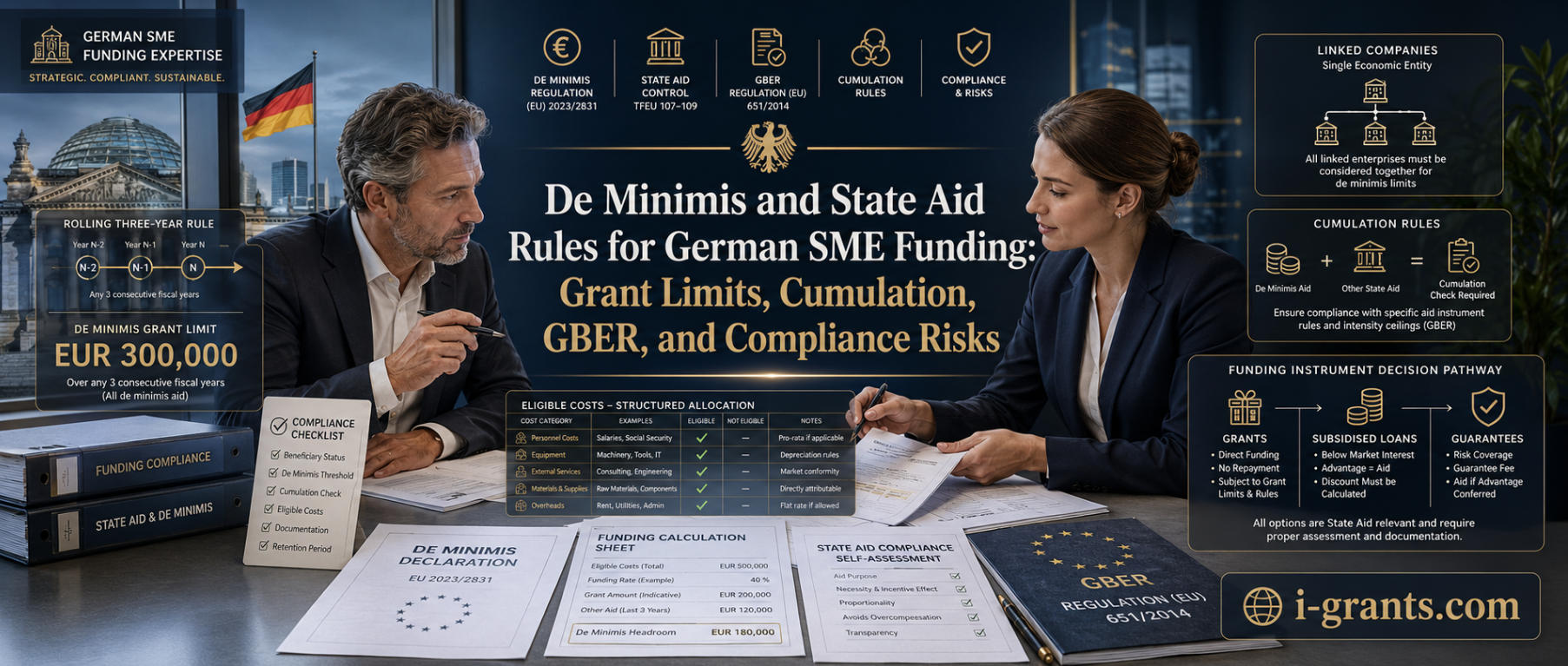
For many SMEs and startups in Germany, the difficult part of public funding is not only finding a suitable grant, loan, guarantee, or subsidy. The real challenge starts when several funding instruments overlap. A company may receive a small advisory grant from a local programme, apply for an energy efficiency subsidy, use a KfW promotional loan, and later seek R&D funding under ZIM or regional investment support under GRW. Each instrument may look separate from a business perspective. Under EU State aid rules, however, they may interact.
This is why de minimis and State aid rules matter. They determine how much public support a company can receive, whether several forms of funding can be combined, which costs can be subsidised, and what information must be declared before approval. In Germany, these rules appear in funding guidelines under terms such as De-minimis-Beihilfe, AGVO, GBER, Beihilfeintensität, Bruttosubventionsäquivalent, Kumulierung, and subventionserhebliche Tatsachen.
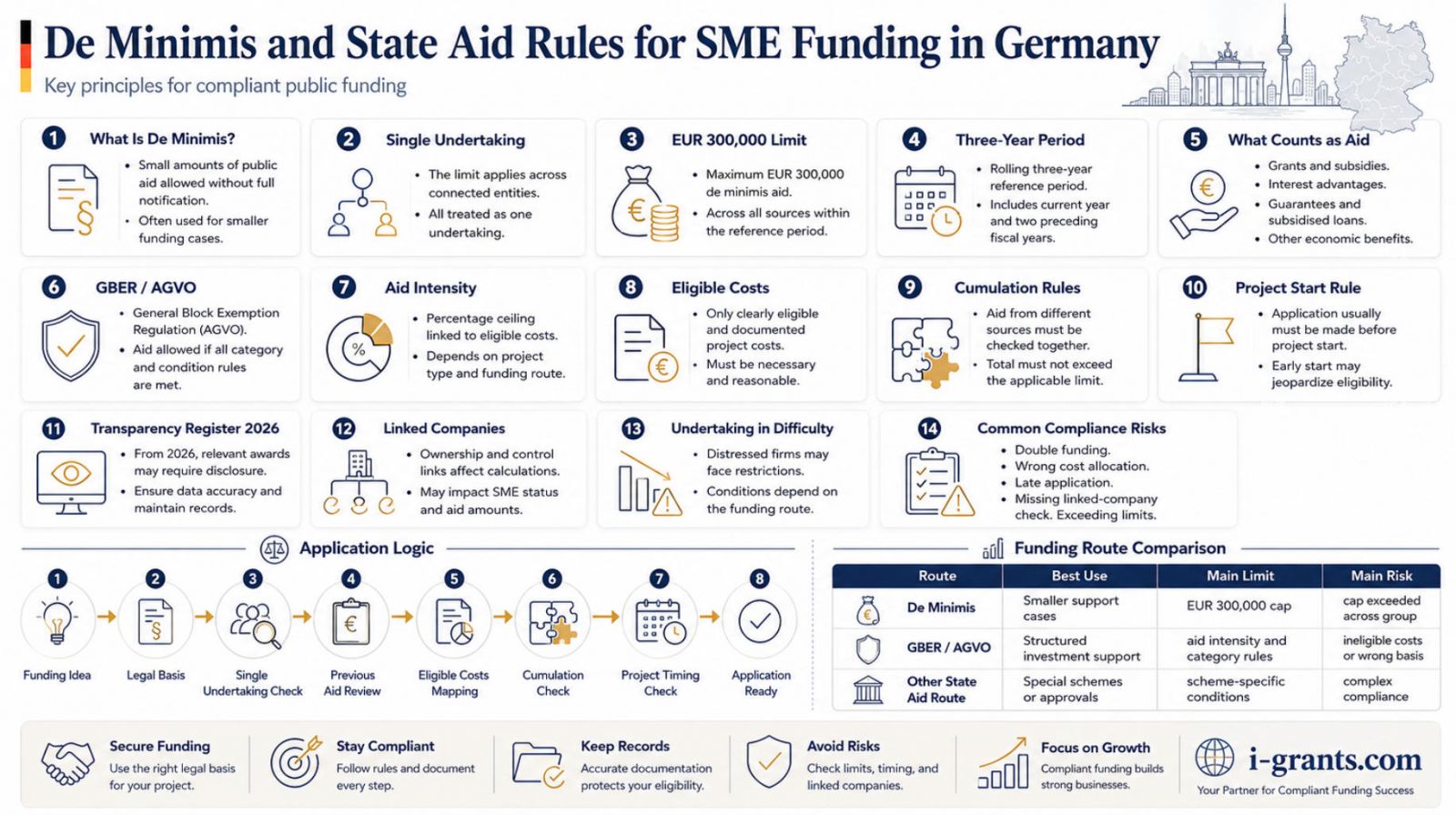
As of 2026, the general de minimis ceiling is EUR 300,000 per single undertaking over a period of three years. This rule is based on Commission Regulation (EU) 2023/2831, which applies from 1 January 2024 to 31 December 2030. For German SMEs, the increase from the previous EUR 200,000 ceiling is useful, but it does not remove the need for careful tracking, documentation, and cumulation checks. The German federal funding database also confirms the EUR 300,000 ceiling and explains that de minimis aid may take the form of grants, guarantees, or interest-reduced loans, provided the aid value can be calculated in advance.
Why State Aid Rules Matter for German SMEs
EU State aid law exists because public support can give selected companies an advantage over competitors. The European Commission explains that State aid is an advantage granted through State resources to undertakings on a selective basis, for example through grants, tax reliefs, guarantees, preferential loans, or public support for specific sectors or regions. A measure is State aid when it involves State resources, gives a selective advantage, may distort competition, and is likely to affect trade between Member States.
For a German SME, this means that public funding is not just a financial question. It is also a compliance question. A grant decision, a loan subsidy, a guarantee, or a repayment subsidy may be legal only because it fits into one of the recognised State aid routes. The most common routes for SME funding are de minimis aid, the General Block Exemption Regulation, known in Germany as AGVO, and aid schemes that have already been approved by the European Commission.
This distinction is practical. De minimis aid is designed for small aid amounts that do not require prior notification to the Commission. GBER allows Member States to grant certain types of aid without individual notification when detailed conditions are met. Notified aid is assessed by the Commission before it can be implemented. The Commission confirms that new aid generally requires prior notification, unless it falls under exceptions such as block exemption, de minimis aid, or an already authorised scheme.
De Minimis Aid in Germany: What the EUR 300,000 Limit Really Means
De minimis aid is often misunderstood. It is not a funding programme. It is a legal rule that allows a public authority to grant a limited amount of aid without individual Commission approval. In German funding practice, de minimis is common in advisory grants, small innovation support, local business development schemes, trade fair support, digitalisation vouchers, and some smaller support measures from municipalities, federal states, chambers, or promotional banks.
The key rule is simple in wording but complex in practice: the total amount of general de minimis aid granted to one single undertaking must not exceed EUR 300,000 over any period of three years. The three-year period is rolling, not a fixed calendar cycle. The relevant moment is generally the granting of the legal right to receive the aid, not necessarily the payment date. The EUR-Lex summary of Regulation 2023/2831 confirms that aid is considered granted when the legal right is conferred on the business, regardless of when it is paid.
The most important phrase is “single undertaking”. A company cannot automatically treat each legal entity as a separate de minimis beneficiary. The group relationship must be checked. The German Förderdatenbank explains that the whole group of connected enterprises is considered when determining a single undertaking. This can include companies linked through majority voting rights, control rights, dominant influence, or the right to appoint or remove management bodies.
For startups and SMEs, this matters in several common situations. A founder may control more than one company. A startup may have a parent company or investor structure that creates linked-enterprise issues. A family-owned SME may operate through several GmbHs. A company may receive local support through one entity and apply for federal support through another. If those entities form a single undertaking, their de minimis aid must be counted together.
De Minimis Is a Limit on Aid Value, Not Always on Cash Received
Another practical misunderstanding is the difference between the nominal amount of a financing instrument and its aid value. In a direct grant, the aid amount is usually close to the grant amount. In a subsidised loan or guarantee, the aid element may be lower than the loan principal. This is why German documents often use the term Bruttosubventionsäquivalent, or gross grant equivalent.
The German Förderdatenbank states that de minimis aid applies only to transparent aid, meaning aid whose subsidy value can be calculated precisely in advance. Grants, guarantees, and interest-reduced loans may qualify, but loans and guarantees must meet additional conditions.
This is especially relevant for companies using KfW products, state promotional bank loans, guarantee bank instruments, or subsidised interest schemes. A business may receive a loan of EUR 500,000, but the State aid element may be the interest advantage, guarantee advantage, or calculated gross grant equivalent. The approval letter or de minimis certificate should indicate the relevant aid value.
GBER / AGVO: The Legal Route Behind Many Larger Funding Programmes
GBER stands for the General Block Exemption Regulation. In German funding documents, it is usually called AGVO, from Allgemeine Gruppenfreistellungsverordnung. It is one of the most important legal bases for public funding in Germany because it allows Member States to grant certain categories of State aid without individual notification to the European Commission, as long as detailed conditions are fulfilled.
The European Commission explains that GBER exempts specific categories of State aid from prior notification and approval when they meet the regulation’s conditions. These categories are highly relevant for SMEs: regional investment aid, R&D aid, innovation aid for SMEs, environmental protection and energy efficiency aid, training aid, consultancy aid, and support for disadvantaged workers. The Commission also notes that GBER has become the most important part of EU State aid rules. In 2024, Member States reported aid under 6,509 GBER measures, representing 69% of all active State aid measures.
For German SME funding, GBER is often more important than applicants realise. Programmes such as GRW regional investment support, BAFA and EEW energy efficiency funding, R&D and innovation grants, and many state-level programmes may rely fully or partly on AGVO. This route can allow larger aid amounts than de minimis, but it also brings stricter conditions.
GBER-based funding usually requires a precise definition of eligible costs, aid intensity, incentive effect, undertaking in difficulty status, cumulation limits, and documentation. A company cannot simply add GBER aid and de minimis aid until the budget looks attractive. The relevant legal ceiling depends on the same eligible costs and the maximum permitted aid intensity.
Table 1. De Minimis vs GBER vs Notified State Aid for German SMEs
| Legal route | Typical use in German SME funding | Approval logic | Main limit | Key applicant risk |
|---|---|---|---|---|
| De minimis aid | Small grants, advisory support, local schemes, digitalisation vouchers, some subsidised loans or guarantees | No individual Commission approval if the ceiling and conditions are respected | EUR 300,000 per single undertaking over three years | Forgetting previous aid or linked companies |
| GBER / AGVO | R&D, innovation, regional investment, environmental, energy efficiency, training, consultancy, SME support | Block exemption if detailed conditions are met | Aid intensity, eligible costs, sector rules, incentive effect | Exceeding aid intensity or starting the project too early |
| Approved aid scheme | Larger or specific national support measures already cleared by the Commission | Scheme has already been approved before implementation | Conditions in the approved scheme | Assuming approval covers all company-specific situations |
| Individually notified aid | Large or complex aid measures outside standard exemptions | Commission assessment before implementation | Compatibility decision and possible conditions | Delay, uncertainty, conditional approval, or recovery risk |
Cumulation: The Rule That Decides Whether Funding Can Be Combined
Cumulation means combining several forms of public support. This is one of the most important State aid topics for German SMEs because many companies try to build a financing package from several sources. A business may combine a regional investment grant, an energy efficiency subsidy, a subsidised loan, a guarantee, and local support for consultancy. This can be possible, but only if the legal limits are respected.
The basic principle is that the same eligible costs cannot receive more aid than the maximum permitted aid intensity or maximum aid amount. De minimis aid may be cumulated with other State aid, but not in a way that allows the total aid for the same eligible costs to exceed the applicable ceiling. In practice, this means the company must map each funding instrument to specific costs.
A simple example: an SME plans to invest EUR 200,000 in machinery. If one programme grants support for the machinery under GBER with a maximum aid intensity of 40%, the maximum State aid for those same eligible machinery costs may be EUR 80,000. If the company then tries to add de minimis support for the same machinery costs, the combination may be restricted if it would exceed the permitted ceiling. If another programme supports separate consultancy costs or training costs, the analysis may differ.
Cumulation is not only about grants. It can also include the aid element in subsidised loans, guarantees, interest reductions, tax reliefs, repayment subsidies, and other public advantages. This is why the gross grant equivalent must be understood before the financing package is finalised.
Table 2. Common Cumulation Scenarios in German SME Funding
| Scenario | Possible combination | What must be checked | Main compliance risk |
|---|---|---|---|
| BAFA or EEW energy grant plus KfW promotional loan | May be possible depending on the programme and costs | Whether both instruments support the same eligible costs and whether aid intensity is exceeded | Treating the loan as “not aid” when it contains an aid element |
| GRW regional investment grant plus state-level support | May be possible if cumulation rules allow it | Regional aid ceiling, SME size, investment location, eligible cost base | Exceeding the regional aid ceiling |
| ZIM R&D grant plus de minimis advisory support | Often possible if costs are clearly separated | Whether advisory costs and R&D project costs are distinct | Double-funding the same staff or external service costs |
| Local digitalisation voucher plus federal digital or innovation support | Possible only if cost allocation is clean | Invoice-level cost separation and de minimis history | Using two schemes for the same software, consultancy, or implementation work |
| Guarantee bank support plus grant support | May be possible | Aid value of the guarantee, grant amount, total aid intensity | Ignoring the gross grant equivalent of the guarantee |
The 2026 Transparency Shift: Central De Minimis Registers
From 1 January 2026, information on general and SGEI de minimis aid must be recorded in a central register at national or Union level. The same obligation applies to agricultural de minimis aid from 1 January 2027, while a central register for fishery de minimis aid is not yet mandatory.
This change is important for German SMEs because de minimis tracking is becoming more transparent. Previously, companies often had to rely heavily on internal declarations and past certificates. From 2026 onward, granting authorities must use centralised registration, which should help verify whether the ceiling has been exceeded. However, this does not remove the applicant’s responsibility to provide accurate information. A company should still keep its own de minimis records, approval letters, grant agreements, and gross grant equivalent certificates.
The European Commission’s State Aid Transparency Public Search also provides access to individual State aid award data published by Member States under transparency requirements. This reinforces a broader direction in EU funding policy: public support is becoming more visible, more traceable, and more compliance-driven.

Germany’s State Aid Context: Why Compliance Is Not a Minor Issue
Germany is one of the largest State aid users in the European Union. According to the European Commission’s 2025 State Aid Scoreboard summary, EU Member States granted EUR 168.23 billion in State aid in 2024, equal to 0.94% of EU GDP. Of this amount, EUR 68.82 billion supported environmental protection and energy savings, EUR 14.16 billion supported research, development and innovation, and EUR 13.42 billion supported regional development.
For German SMEs, these policy areas are not abstract. They correspond directly to common funding themes: energy efficiency, industrial decarbonisation, innovation, R&D cooperation, regional investment, and SME competitiveness. The more public funding is used for strategic transformation, the more important State aid compliance becomes for applicants.
The same logic applies at the programme level. Germany’s Förderdatenbank brings together funding programmes from the federal government, federal states, and the EU. A company may find dozens of relevant instruments, but each one has its own legal basis, cost rules, application timing, and cumulation logic. The funding search should therefore include both a business fit assessment and a State aid fit assessment.
Compliance Risks German SMEs Commonly Underestimate
The most frequent mistakes are not always dramatic. They often begin with small misunderstandings. A company may submit a de minimis declaration based only on grants received by one GmbH, while another linked company has received local support. A founder may forget a small advisory voucher because it was paid two years ago and seemed insignificant. A finance team may assume that a promotional loan is not State aid because it must be repaid. A project manager may allocate the same invoice to two public funding instruments.
Another risk is project timing. Many GBER-based grants require an incentive effect, meaning the aid application must be submitted before work starts. If the company orders equipment, signs a binding supplier contract, starts construction, or commits project expenditure too early, the project may lose eligibility. This issue is common in investment, energy efficiency, and innovation projects.
German subsidy law also adds a national compliance layer. Funding applications often refer to subventionserhebliche Tatsachen, meaning facts that are relevant for the granting of a subsidy. Section 264 of the German Criminal Code deals with subsidy fraud and includes incorrect or incomplete information in subsidy procedures. This does not mean every mistake is criminal, but it shows why grant applications must be handled with care, especially when declarations concern company status, previous aid, eligible costs, project start, and financing.
Table 3. Applicant Checklist Before Combining German SME Funding
| Question | Why it matters | Evidence to prepare |
|---|---|---|
| What is the legal basis of each funding instrument? | De minimis, AGVO/GBER, approved scheme, or another route may apply | Funding guideline, approval letter, programme terms |
| Does the company form a single undertaking with other entities? | Linked companies may share the same de minimis ceiling | Ownership chart, voting rights, control rights, group structure |
| How much de minimis aid was granted in the last three years? | The EUR 300,000 ceiling applies over a rolling three-year period | De minimis certificates, approval notices, internal aid register |
| Are the same eligible costs used for more than one aid measure? | Cumulation may be limited by aid intensity or maximum aid amount | Cost plan, invoice mapping, grant budget, loan subsidy value |
| Has the project already started? | Some funding routes require application before project start | Supplier contracts, purchase orders, construction start, project timeline |
| Is the company an undertaking in difficulty? | Many schemes exclude or restrict undertakings in difficulty | Financial statements, equity position, insolvency status |
| Are all declarations consistent across programmes? | Inconsistent data can trigger delays, corrections, or recovery | Application forms, previous submissions, accounting records |
How to Read German Funding Guidelines
Before applying, the company should identify the legal route in the programme documents. If the guideline mentions De-minimis-Beihilfe, the applicant must check the three-year de minimis total for the single undertaking. If the guideline mentions AGVO or GBER, the company must look for the relevant article, aid intensity, eligible costs, incentive effect, and cumulation rules. If the programme mentions a previously approved State aid scheme, the applicant should verify the scheme conditions and any company-level restrictions.
The most useful parts of a German funding guideline are often not the marketing summary. They are the sections on Rechtsgrundlage, Zuwendungsvoraussetzungen, beihilferechtliche Grundlage, förderfähige Kosten, Kumulierung, Beginn des Vorhabens, Nachweisführung, and Subventionserheblichkeit. These sections define what the company can actually do.
A practical rule is to build the funding structure from costs upward, not from programme names downward. The company should start with a detailed cost plan, separate eligible from non-eligible costs, identify which costs are linked to which aid route, and calculate the total aid intensity before signing commitments.
When a Grant Writer or State Aid Specialist Adds Value
State aid rules do not mean that SMEs should avoid public funding. They mean that funding must be designed properly. A qualified grant writer, funding consultant, tax adviser, or State aid specialist can help the company understand whether a planned combination is realistic before the application is submitted.
This is particularly important when a company is applying for several instruments at the same time, operating through a group structure, planning a large investment, using both grants and loans, working in a regulated sector, or relying on energy, innovation, or regional aid. The cost of professional support is often small compared with the risk of losing eligibility, delaying approval, or having aid recovered later.
The European Commission explains that unlawful aid may lead to recovery with interest if it was granted without the required authorisation or does not meet the applicable conditions. Recovery is not just a theoretical risk. It can affect liquidity, financial statements, investor confidence, and future eligibility for public support.
Practical Conclusion
For German SMEs, de minimis and State aid rules are not a legal footnote. They are part of the funding strategy. The headline grant rate is only one part of the decision. The company must also understand the legal route, the eligible cost base, the cumulation rules, the aid intensity ceiling, the single undertaking concept, and the documentation requirements.
The most reliable approach is to treat every grant, subsidised loan, guarantee, tax advantage, and local support measure as part of one funding map. Before submitting an application, the company should know which aid has already been granted, which costs are being funded, which legal basis applies, and whether the planned combination stays within the permitted limits.
A strong application does not only explain why the project deserves support. It also shows that the applicant understands the rules, can document the costs, and can use public funding without creating compliance risks.