

 Français
 Deutsch
 Українська
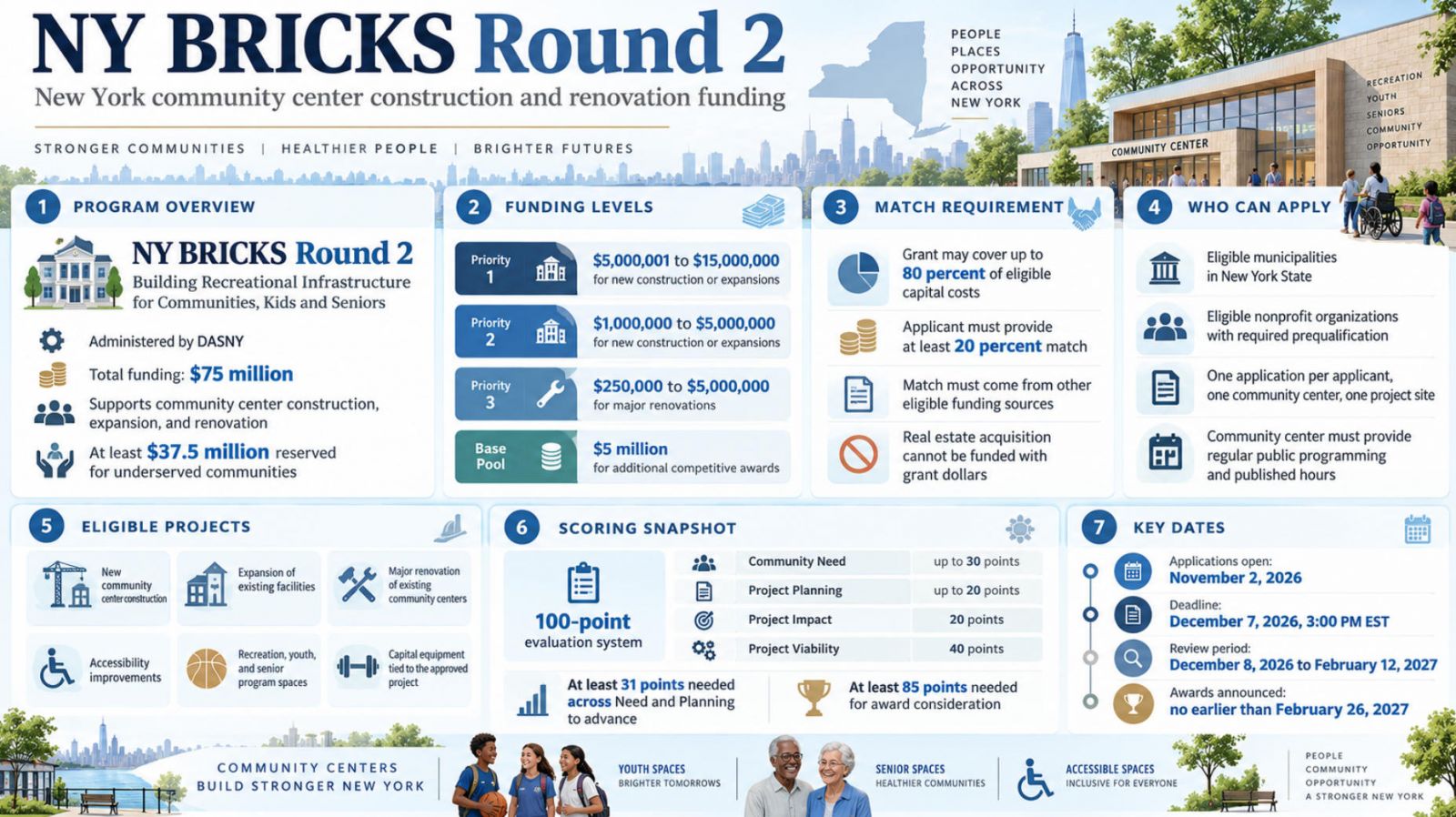
Community centers across New York State have an opportunity to secure substantial public funding for new buildings, major expansions, and the modernization of existing facilities. The second round of the New York Building Recreational Infrastructure for Communities, Kids and Seniors (NY BRICKS) program provides $75 million in capital grants to eligible municipalities and nonprofit organizations. Individual awards range from $250,000 to $15 million, depending on the type and scale of the proposed project.
Applications open on November 2, 2026, and must be submitted by December 7, 2026, at 3:00 p.m. Eastern Standard Time. The program requires recipients to contribute at least 20% of eligible capital project costs from other funding sources. At least $37.5 million of the available funding is reserved for community centers in officially designated underserved communities.
However, the headline maximum of $15 million does not apply to every type of community center improvement. NY BRICKS Round 2 separates new construction and building expansions from renovations, establishes different funding levels for each category, and applies a competitive 100-point evaluation system. Projects must demonstrate not only community benefits but also documented construction readiness, adequate control over the property, and credible financing.
The first round demonstrated the program's potential. In December 2025, New York State announced 30 awards totaling approximately $100 million across 22 counties. Supported projects ranged from smaller renovations by local nonprofit organizations to major investments in new community facilities. Together, these projects were expected to benefit nearly 400,000 New Yorkers, although that figure represents anticipated service reach rather than verified attendance at completed facilities.
For organizations considering Round 2, understanding how the program actually selects, contracts, and reimburses projects is essential. A carefully planned renovation costing $1 million may be more competitive than a much larger proposal with insufficient documentation, even if both promise substantial community benefits.
How NY BRICKS Round 2 Supports Community Infrastructure
NY BRICKS was established as part of New York State's broader efforts to improve access to recreation, social interaction, and community-based services. The program operates within the state's Unplug and Play initiative, which encourages physical activity, social participation, and opportunities for children and families to engage outside digital environments.
The program is overseen by the New York State Office of Parks, Recreation and Historic Preservation (NYS OPRHP) and administered by the Dormitory Authority of the State of New York (DASNY). Funding for Round 2 was included in the state's enacted fiscal year 2027 budget.
Unlike operating grants that support salaries, program delivery, or day-to-day organizational expenses, NY BRICKS is a capital investment program. Its principal objective is to increase the availability and quality of physical community infrastructure.
Eligible projects can involve the creation of an entirely new center, construction that adds usable space to an existing facility, or major renovation that significantly improves the building's capacity and functionality. Supported centers are expected to provide a combination of social, educational, cultural, and recreational activities for people of different ages.
The emphasis on multi-purpose facilities is important. A community center may accommodate after-school programs, athletics, workforce training, neighborhood meetings, activities for older adults, and connections to behavioral health or family support services. The program does not require every activity to take place in a separate room, but the applicant must demonstrate that the facility genuinely operates as a community center rather than as a single-purpose institution.
A defining feature of Round 2 is the state's explicit preference for new community spaces. The largest portion of its funding is initially allocated to new construction and expansions, while renovations compete in a separate category. This arrangement creates distinct opportunities for organizations with projects at different stages of development.
Grant Amounts: Why the Type of Project Determines the Funding Limit
The $75 million Round 2 budget is divided into three priority levels and a supplementary funding pool. Applicants select a category based on the nature of their construction project and the grant amount requested.
Table 1. NY BRICKS Round 2 Funding Levels and Project Categories
| Priority | Eligible project type | Grant amount | Initial funding allocation |
|---|---|---|---|
| Priority 1 | New community centers, new construction, or expansions adding square footage | $5,000,001 to $15,000,000 | $45 million |
| Priority 2 | New community centers, new construction, or expansions adding square footage | $1,000,000 to $5,000,000 | $20 million |
| Priority 3 | Major renovation of an existing community center | $250,000 to $5,000,000 | $5 million |
| Base Pool | Additional competitive awards across all three priority levels | Subject to the applicable category limits | $5 million |
| Total | $75 million |
The funding structure has significant consequences for project planning. Priority 1 and Priority 2 together initially account for $65 million, approximately 86.7% of the program's total budget. Only $5 million is initially assigned specifically to renovations, although renovation projects may also compete for remaining resources through the Base Pool.
This does not mean that each category's initial allocation is an absolute ceiling on the total amount that could ultimately be awarded to projects in that category. When funds remain after the highest-scoring projects have been selected, unused allocations are transferred to the Base Pool. Additional awards are then considered across the priority levels according to evaluation scores and available resources.
DASNY expressly states that partial grants will not be awarded. Therefore, an applicant requesting $4 million should not assume that a smaller award will be offered if the remaining budget cannot accommodate the entire request.
For renovation applicants, the $5 million maximum is particularly important. Even when the proposed renovation costs substantially more than $6.25 million, the application cannot request a renovation grant above the Priority 3 ceiling. The organization must finance the remaining expenditure from other acceptable sources.
For expansion projects, classification depends on the substance of the construction. A major internal redesign that improves an existing center without creating additional square footage is not automatically a new construction project. Applicants should establish the correct category with their architect or construction adviser before preparing the final funding request.
Who Is Eligible to Apply for NY BRICKS Funding?
NY BRICKS Round 2 is open to eligible municipalities and prequalified nonprofit entities that operate or intend to operate qualifying community centers in New York State.
For this competition, the definition of a municipality includes counties, cities, towns, villages, and Indian Nations. Municipal applications can therefore originate from small rural communities as well as larger urban governments.
Eligible nonprofit entities must be duly incorporated with the New York State Department of State or chartered by the state. They must also obtain approved prequalification status through the Statewide Financial System (SFS) before submitting their NY BRICKS application.
The Request for Applications does not separately establish federal 501(c)(3) recognition as a universal eligibility condition. However, the SFS prequalification process requires an IRS Determination Letter among its supporting documents. Nonprofit applicants should therefore verify that their federal tax documentation and New York State registration are sufficient to satisfy the applicable prequalification requirements.
No separate universal minimum number of years in operation is specified in the Round 2 RFA. Nevertheless, an organization must establish that it has the legal capacity, management arrangements, financial resources, and property control necessary to deliver a capital construction project.
Ordinary commercial enterprises, individual homeowners, and applicants seeking financing for private facilities do not fall within the stated categories.
The facility itself must also meet the program's definition of a community center. It should have a primary or dedicated purpose of providing scheduled community programming, maintain regular published operating hours, be accessible to the public, and offer activities for different age groups.
Standalone libraries, schools, gyms, daycare facilities, houses of worship, food pantries, and health care facilities are specifically excluded when those functions constitute their primary purpose. A qualifying community center may incorporate some of these services within a broader community program, but simply adding occasional community activities to a single-purpose building does not establish eligibility.
The applicant must be the primary operator responsible for managing the center, scheduling activities, and overseeing its daily operations. This requirement deserves particular attention when a property owner, management organization, and service provider are separate legal entities.
Property Ownership, Leases, and Long-Term Control
A community organization can develop an excellent construction proposal yet fail the eligibility review because its property documentation does not meet the program's rules.
Nonprofit organizations that own their proposed project site must generally submit a deed identifying the applicant as the legal owner. If the legal name differs from the applicant's current registered name, a satisfactory explanation and supporting documentation are necessary.
For leased facilities, the full lease must be executed in the applicant's legal name and remain in effect for at least ten years from the application date. All amendments, exhibits, and riders must be included. The applicant must also provide a dated and signed authorization from the landlord permitting the proposed work.
The ten-year requirement is not simply a preference for long-term stability. An insufficient lease term can disqualify an otherwise eligible project. In addition, DASNY reviews the remaining term when preparing the Grant Disbursement Agreement.
Municipalities may use the prescribed Certificate of Municipal Site Control to establish authority to construct and maintain the project at the designated location.
If a property has not yet been purchased, the applicant must provide an executed contract of sale with a closing date within six months of the application date. However, a crucial distinction applies: the cost of acquiring real estate cannot be paid using Round 2 grant proceeds.
Table 2. Important Eligibility and Property Control Requirements
| Applicant situation | Required evidence or condition | Principal risk |
|---|---|---|
| Nonprofit applicant | New York incorporation or charter and approved SFS prequalification | Incomplete or unapproved SFS status |
| Municipality | Eligible municipal status and authority to operate the center | Insufficient municipal site control |
| Nonprofit property owner | Deed in the applicant's legal name | Property held by an unrelated or affiliate entity without acceptable documentation |
| Tenant organization | Complete lease covering at least ten years from application | Short lease, missing amendments, or incorrect tenant name |
| Leased property requiring renovation approval | Signed permission from the property owner | Missing authorization for construction |
| Planned property acquisition | Executed purchase contract with closing within six months of application | Inadequate site control or attempted use of grant funds for acquisition |
Organizations should also consider the long-term obligations attached to public capital investment. DASNY's Round 2 guidance requires a grantee that owns the facility to retain ownership for ten years after disbursement of the grant.
Applicants that previously received NY BRICKS funding may face additional restrictions. A previous awardee generally must have fully drawn down its award, formally completed the prior project without further reimbursement requests, or withdrawn from the previous award before becoming eligible for another grant.
Round 2 also limits each applicant to one application for one community center at one project location. Submitting multiple applications does not create several opportunities for the same organization; only its first application will be reviewed and scored.
Which Community Center Improvements Can Receive Funding?
Eligible capital expenditures can include architectural and engineering design, new construction, major structural alterations, substantial interior reconstruction, building expansion, and qualifying equipment associated with the approved project.
The practical distinction is between creating or substantially improving a capital asset and merely maintaining an existing one.
For example, a community center that reconstructs its interior layout to establish accessible meeting rooms, a multi-purpose activity hall, and dedicated spaces for youth and older adults may have a potentially suitable capital project. A facility that simply repaints rooms, replaces worn carpet, or patches deteriorated surfaces does not necessarily meet the program's capital investment standard.
DASNY's Round 2 guidance provides examples that help explain this distinction. Full replacement of windows or building siding can qualify as capital work, while repainting and reglazing existing windows are treated as maintenance. New flooring can be eligible as part of comprehensive structural reconstruction, but the simple replacement of worn flooring is not.
Improvements involving accessibility are especially relevant when they form part of qualifying construction or major renovation. Potential components include accessible entrances, redesigned circulation routes, modified restrooms, and other permanent features supporting access for people with disabilities. Their eligibility must still be evaluated in relation to the overall capital project and applicable documentation.
Modernization of mechanical and electrical systems may also qualify when incorporated into appropriate capital construction. DASNY's FAQ explicitly confirms that purchasing and installing an eligible solar energy system at the community center can be funded, including associated electrical or structural work. The system must be purchased by the applicant and installed at the approved project location. Leased solar systems and community solar arrangements are not eligible under this provision.
In contrast, routine repairs, maintenance contracts, recurring software subscriptions, staff salaries, operating utilities, rent, general administrative expenses, and grant-writing fees are outside the program's capital funding purpose.
Costs associated with preliminary market studies, debt repayment, and property acquisition are also excluded. Round 2 prohibits the use of grant proceeds to reimburse costs incurred on or before April 1, 2026.
Another material restriction concerns tax-credit financing. DASNY's Round 2 FAQ states that projects using New Markets Tax Credits, Brownfield Tax Credits, housing-related tax credits, or similar arrangements are ineligible. Applicants contemplating such financing should not assume that separating construction invoices from a wider development budget is sufficient to overcome this restriction.
These rules make early budget classification essential. If a proposed $2 million modernization contains $300,000 of ordinary maintenance and operating expenses, those costs cannot simply be included in the grant request because they relate to the same building.
For smaller organizations, a professional cost review before submission may prevent expensive changes after the grant has been announced.
The 20% Matching Requirement: How the Financing Actually Works
The program can cover up to 80% of eligible capital project costs. Applicants must provide at least the remaining 20% from other acceptable funding sources.
The distinction between a percentage of project costs and a percentage of the requested grant matters. If an organization requests $1 million and intends to use the full 80% funding rate, its eligible capital budget must total at least $1.25 million. The required matching contribution would be $250,000, not $200,000.
The relevant calculation is:
Maximum NY BRICKS grant = Eligible capital project costs × 80%
Minimum matching contribution = Eligible capital project costs × 20%
This financing structure allows organizations to combine eligible cash reserves, donor commitments, other qualifying grant awards, and documented financial contributions. However, the funding source must comply with both NY BRICKS rules and its own conditions.
For example, funds from the New York State and Municipal Facilities Program cannot be counted toward the mandatory NY BRICKS match. They may, where otherwise permitted, help finance additional eligible costs beyond that required contribution.
Applicants should also avoid assuming that all borrowing instruments are acceptable. Round 2 restricts the use of long-term debt, bonds, and certain other financing arrangements for project costs. Although financial commitment documents may be considered during review, applicants must establish that their proposed financing complies with these restrictions.
The program does not require every dollar of matching funding to be fully secured on the application date. An organization may submit a proposal while continuing a capital fundraising campaign, provided its remaining financing strategy is credible and documented.
Nevertheless, secured funding directly affects the competitive score. A project with confirmed contributions, grant commitments, or available organizational resources has an advantage over a proposal that depends predominantly on future fundraising.
Most importantly, DASNY will not execute the Grant Disbursement Agreement until the organization has demonstrated that sufficient funding is available to complete the project.
Illustrative Construction and Renovation Budgets
Different community center projects can use the same 80% grant and 20% match structure, but the appropriate funding category and maximum award must still be respected.
Table 3. Illustrative NY BRICKS Project Budgets and Matching Contributions
| Hypothetical project | Total eligible capital costs | NY BRICKS request | Required matching contribution | Priority |
|---|---|---|---|---|
| Small community center renovation | $625,000 | $500,000 | $125,000 | 3 |
| Multi-purpose center reconstruction | $1,250,000 | $1,000,000 | $250,000 | 3 |
| Major renovation of an existing facility | $4,000,000 | $3,200,000 | $800,000 | 3 |
| New community center or qualifying expansion | $7,500,000 | $6,000,000 | $1,500,000 | 1 |
| Large new community center | $18,750,000 | $15,000,000 | $3,750,000 | 1 |
All figures in Table 3 are illustrative calculations, not actual budgets submitted by NY BRICKS recipients. They assume the stated project costs are eligible capital expenditures and that the maximum grant share is approved.
Consider the hypothetical reconstruction of an existing neighborhood center with $1.25 million in eligible capital costs. The project might allocate $640,000 to major interior reconstruction, $220,000 to accessibility improvements, $240,000 to mechanical and electrical modernization, $100,000 to architectural and engineering work, and $50,000 to other qualifying capital construction components.
In this scenario, a $1 million NY BRICKS request would require $250,000 in matching capital funding. If the organization also needs $60,000 for excluded administrative expenses, the overall financing requirement increases to $1.31 million. Those additional operating or administrative costs must be financed separately and should not automatically be counted as eligible matching capital expenditures.
A contingency allowance should also be considered during construction planning, subject to applicable eligibility rules. Unexpected structural deficiencies, material price increases, and permit-related modifications can create substantial pressure on nonprofit budgets.
A grant award does not automatically increase when construction costs exceed the approved project budget. Organizations therefore need a realistic financing plan for potential overruns before signing construction contracts.
Why Community Need Is Central to the Program
NY BRICKS is not designed to distribute capital funding equally among all applicants. It prioritizes projects that can demonstrate meaningful public benefit and address measurable gaps in access to community infrastructure.
The Round 2 framework directs at least $37.5 million to underserved communities. Importantly, the program uses a defined scoring methodology to determine whether a location qualifies.
The Community Need worksheet evaluates poverty in the project's ZIP Code Tabulation Area, its designation as a Disadvantaged Community, and whether it falls within an Empire State Development distressed community classification.
The poverty component can generate up to 20 points. The disadvantaged community designation can add 5 points, and the distressed community measure can contribute another 5. A project receiving at least 20 points in this category qualifies as serving an underserved community for purposes of the program.
Applicants must use the official FY2027 Grants Map and its designated geographic data layers. The relevant location is the actual construction site, not the organization's mailing address or the neighborhood where its headquarters happens to be located.
Local demographic and service data can provide further evidence of need. For example, an organization serving older adults might use county-level research, community surveys, and internal attendance records to demonstrate insufficient access to accessible group activities.
The New York State Office for the Aging's Community Assessment Survey of Older Adults provides useful context. The statewide survey, conducted in 2023 and published with county results in 2024, received nearly 27,000 responses from residents aged 60 and older. Only 50% rated recreation opportunities in their communities as excellent or good, while 44% gave similarly positive ratings to opportunities for participation in community matters. Just 33% rated access to skill-building or personal enrichment classes as excellent or good.
These results do not measure the number of missing community centers, but they illustrate why accessible public activities and lifelong learning opportunities remain relevant to older New Yorkers. County-specific results can help applicants develop more geographically precise project justifications.
Physical accessibility presents another important dimension. A May 2025 report from the Office of the New York State Comptroller reviewed selected facilities in 20 municipalities. Auditors identified 1,491 components, approximately 13% of 11,916 applicable accessibility checklist items, where local officials could consider improvements. Restrooms accounted for many of the findings.
This was a targeted municipal audit, not a statewide census of community centers. Nevertheless, it provides evidence of practical accessibility challenges affecting public facilities.
A strong NY BRICKS application should connect such evidence to the proposed construction. Replacing inaccessible restrooms, creating suitable circulation routes, or adapting a building to serve different generations can be presented as measurable improvements rather than simply as architectural upgrades.
Understanding the 100-Point Application Evaluation
NY BRICKS Round 2 uses a three-stage review process. The first stage determines whether the applicant and project meet the mandatory eligibility conditions. Applications that fail this review do not proceed to competitive scoring.
The second stage evaluates community need and planning readiness. The third stage considers project impact and financial and construction viability.
The scoring framework is particularly demanding because applicants must pass an intermediate threshold before the remaining criteria are even considered.
Table 4. NY BRICKS Round 2 Evaluation Criteria and Scoring Thresholds
| Evaluation component | Available points | What reviewers examine |
|---|---|---|
| Community Need | Up to 30 | Local poverty, disadvantaged community status, distressed community status |
| Project Planning | Up to 20 | Schematic design, design development, or construction documents |
| Combined Need and Planning | Maximum 40 counted | At least 31 points required to advance |
| Project Impact | 20 | Community programs, accessibility, inclusiveness, anticipated beneficiaries |
| Project Viability | 40 | Construction readiness, cost documentation, committed financing |
| Final score | 100 | At least 85 points required for award consideration |
The Community Need and Project Planning categories can individually produce up to 30 and 20 points. However, their combined contribution to the final score is capped at 40 points. Applicants must first earn at least 31 points across those categories to advance.
Planning readiness receives substantial weight. A complete set of construction documents relevant to the proposed project, accompanied by the required professional confirmation, can earn 20 planning points. Design development documents can earn 10, while schematic design documents can earn 5. General concept descriptions without meaningful design documentation receive no planning points.
This produces a consequential outcome for applicants in less disadvantaged locations. A center receiving 10 Community Need points cannot reach the 31-point intermediate threshold even with a perfect 20-point planning score. Its total would be only 30.
A facility receiving 15 Community Need points and 20 planning points, by contrast, can proceed with a combined score of 35.
Therefore, project planning is not simply an administrative detail. It can determine whether a proposal reaches the final evaluation stage.
Project Impact: Demonstrating Who Will Benefit
The Project Impact section contributes up to 20 points, based on questions addressing the center's programs, accessibility, service integration, and community relevance.
Applicants are expected to explain how their proposed facility will serve children, adults, and older residents, accommodate people with different abilities, and provide affordable opportunities for participation.
The evaluation also considers whether the center provides space for neighborhood associations and public meetings, responds to changing demographic conditions, and remains adaptable to future community needs.
Question 18 is especially useful as a guide to preparing measurable outcomes. It asks for the estimated number of people the center will serve annually across all programs and services, expressed both as a whole number and as a percentage of the overall community population.
An organization estimating 2,400 annual participants in a community of 30,000 residents would report an anticipated reach equivalent to 8% of the local population. This is only an illustrative calculation; an actual application should use a defensible population denominator and distinguish unique people from repeat visits when presenting its methodology.
Applications become more persuasive when expected benefits are supported by existing enrollment records, waiting lists, service agreements, or credible assumptions about future capacity.
Project Viability: The Importance of Financial Evidence
The remaining 40 points are assigned to Project Viability. This component includes up to 8 points for construction readiness, 10 for the project budget, 20 for the availability of financing, and 2 for evidence of other committed New York State funding.
The financial component is particularly important. The highest score is available when sufficient financing is already committed or highly likely to become available, supported by credible documentation.
Applicants presenting some confirmed resources and a reasonable plan to obtain additional funds may receive a lower score. Projects with weak fundraising prospects, unclear financing assumptions, or inadequate documentation are at a substantial disadvantage.
A current, professionally prepared construction budget can also strengthen the application. The RFA identifies an estimate prepared by a design professional within the preceding six months as a characteristic of the most competitive submissions.
Architectural drawings, preliminary permits, zoning decisions, environmental review progress, and construction schedules can collectively demonstrate that the organization understands the practical steps necessary to complete its project.
Achieving the 85-point minimum does not guarantee an award. Funding is distributed competitively, taking account of the project categories, available allocations, and the state's objectives for underserved communities and geographic diversity.
What the First Round Reveals About Successful Community Center Projects
The first NY BRICKS awards, announced on December 5, 2025, offer concrete examples of organizations that secured capital support.
The $100 million funding announcement covered 30 projects in 22 counties. More than 90% of the announced funding was directed to underserved communities, according to the Governor's Office. The published awards included new facilities, major expansions, and smaller renovations across New York City, Long Island, the Hudson Valley, Western New York, and other regions.
The award list is particularly valuable because it demonstrates that the program is not limited to large municipal construction projects.
Table 5. Selected NY BRICKS Round 1 Award Recipients and Funded Projects
| Grant recipient | Location | Announced grant | Project description |
|---|---|---|---|
| Winifred Crawford Dibert Boys & Girls Club of Jamestown | Jamestown, Chautauqua County | $260,000 | Renovation of an existing community center |
| Red Hook Community Center, Inc. | Red Hook, Dutchess County | $310,000 | Community center renovation |
| Center for Family Life in Sunset Park, Inc. | Brooklyn, New York City | $452,000 | Renovation of an existing facility |
| Port Chester Carver Center | Port Chester, Westchester County | $863,972 | Community center renovation |
| Civic Center of Moreau, Inc. | South Glens Falls, Saratoga County | $712,000 | Renovation of an existing center |
| Town of Volney | Fulton, Oswego County | $4,670,000 | Construction of a new community center |
| Queens Community House | Queens, New York City | $5,000,000 | Renovation of Pomonok Community Center |
| United Helpers Care, Inc. | Ogdensburg, St. Lawrence County | $9,880,000 | Construction of a new community center |
| Village of Hempstead | Hempstead, Nassau County | $15,000,000 | Construction of a new community center |
These are officially announced Round 1 awards, not Round 2 results. The amounts represent grant awards rather than complete project budgets or verified final expenditures.
The smallest awards are instructive. The Winifred Crawford Dibert Boys & Girls Club of Jamestown received $260,000 for renovations at its Allen Street location. Red Hook Community Center received $310,000 for renovations at 59 Fisk Street. These cases show that organizations operating relatively modest facilities can participate in major state capital funding initiatives.
The official announcement does not provide detailed construction budgets for these smaller projects, so it would be inappropriate to attribute particular accessibility improvements, equipment purchases, or structural changes to them without additional evidence.
Port Chester Carver Center received $863,972 for renovations at its existing facility. The precise award illustrates that applicants do not need to request round-number grants. A defensible request should emerge from eligible project expenditures and the organization's financing structure, not from choosing an attractive headline amount.
Queens Community House provides an example of a larger nonprofit facility improvement. Its $5 million award supports renovation of Pomonok Community Center. The organization described the proposed transformation as an investment in a welcoming center for the surrounding community.
The Village of Hempstead and United Helpers Care represent larger new construction projects. Their grants demonstrate how the program can support substantial infrastructure development beyond conventional refurbishment.
However, Round 1 results must not be treated as proof that every previously funded expense remains eligible under Round 2. The earlier competition included land acquisition among the stated purposes of its awards, whereas the second-round RFA expressly prohibits using grant proceeds to acquire real property.
The practical lesson from the award history is that credible organizations of different sizes can compete, but every new applicant must follow the current round's eligibility rules.
Preparing an Application Through SFS and the DASNY Portal
Nonprofit organizations face two separate administrative systems before an application can be considered complete.
The first is New York State's Statewide Financial System, where nonprofits must register and receive approved prequalification. The second is the DASNY Grants Application Portal, where the organization submits its specific NY BRICKS proposal.
These procedures are related but are not interchangeable.
The SFS process evaluates organizational compliance, governance, and financial capacity. Supporting documents include incorporation or charter records, the IRS Determination Letter, recent tax and charitable filings, bylaws, governing board information, leadership resumes, financial statements, and an organizational chart.
Applicants must have the actual status of Prequalified before submitting their NY BRICKS proposal. A status marked In Review or Application in Progress does not satisfy the requirement.
The distinction becomes particularly important for an organization that previously held approved status. Opening a new prequalification application and leaving it incomplete can affect the organization's current standing. DASNY explicitly advises applicants to complete the procedure promptly.
Prequalification must also remain valid through execution of the Grant Disbursement Agreement and payment of grant requisitions.
Once organizational eligibility is established, the applicant should prepare the documents required by the DASNY portal. Appendix 1 provides a detailed preparation worksheet, while Appendix 2 contains the program-specific questions and scoring worksheets.
A complete proposal should clearly establish the legal identity of the applicant, the address and control of the project site, the proposed construction works, the expected community benefits, and the financing necessary to complete the entire project.
Construction budgets should correspond to written estimates, quotations, or professional cost documents. If costs have already been incurred, the organization must identify their dates and eligibility. Contracts and invoices should be issued in the correct legal name, and overlapping costs must not be counted twice.
The application certification must be signed by authorized organizational representatives. Supporting documents are to be submitted as PDFs, with a 32 MB limit for an individual file.
Applicants using professional grant writers should establish responsibility for the portal account, supporting documents, and final submission well in advance. DASNY's FAQ permits consultants to prepare applications on behalf of clients, but user accounts are not transferable between individuals.
A consultant can help organize the narrative, reconcile budgets, and prepare evidence. The applicant organization, however, remains responsible for the accuracy of the information, its legal certifications, and the obligations associated with receiving the grant.
Common Reasons a Promising Project May Fail
Round 2 contains several eligibility conditions that cannot be compensated for with strong community impact scores.
An unapproved SFS status, incomplete lease, inadequate site control, incorrect applicant name, missing landlord authorization, or a facility that does not meet the definition of a community center can prevent an application from reaching the competitive evaluation.
Other weaknesses may not automatically disqualify the applicant but can sharply reduce the score. These include outdated construction estimates, vague financing commitments, incomplete design documents, inconsistent project costs, and unsupported claims about anticipated beneficiaries.
A frequent planning mistake is to underestimate the connection between architectural readiness and the first scoring threshold. An organization may invest heavily in describing its community programs without realizing that missing design documents can make it impossible to achieve 31 points in the Community Need and Project Planning stage.
The strongest application process therefore begins with a critical eligibility and scoring assessment before the organization commits significant time to drafting the narrative.
What Happens After a NY BRICKS Grant Is Awarded?
An award announcement is not the same as immediate access to grant funds.
Selected applicants must complete additional legal, financial, environmental, and administrative reviews before DASNY executes a Grant Disbursement Agreement.
The agency verifies site control, corporate authority, the availability of committed project financing, and compliance with applicable environmental and historic preservation requirements.
Projects are subject to review under the State Environmental Quality Review Act and relevant historic preservation legislation. Some reviews may be completed internally, while others require additional submissions or actions by the grantee.
DASNY recommends that recipients avoid beginning construction until the Grant Disbursement Agreement has been fully executed and returned. Starting work prematurely creates financial and compliance risks, even when certain post-April 1, 2026 costs may otherwise meet the program's date requirements.
The sample agreement generally terminates five years after DASNY executes it, although extensions may be approved in specified circumstances. This contractual period should not be mistaken for unconditional permission to disregard the project's approved construction schedule.
The award is also conditional on the organization completing the necessary contracting procedures. Under Round 2, failure to execute the Grant Disbursement Agreement within the prescribed post-award period can result in withdrawal of the award.
How Reimbursement Works
NY BRICKS is primarily a reimbursement-based grant.
Grantees generally incur eligible capital costs, pay vendors or contractors, and submit payment requests supported by invoices and evidence of payment. The invoices must identify the work completed and correspond to the approved project.
DASNY aims to process properly documented payment requests within approximately six weeks, subject to the availability of state funds and satisfactory supporting documentation. This is an administrative objective rather than a guaranteed payment date.
For organizations with limited liquidity, this payment structure can create a difficult financing gap. A nonprofit might have secured its required matching contribution but still lack enough unrestricted cash to pay a contractor's entire invoice while awaiting reimbursement.
Round 2 provides a potentially valuable mechanism known as Payment on Invoice.
Under this option, an eligible grantee with an executed agreement may request payment against an invoice for work already completed or qualifying materials and equipment already on site. The funds are deposited into a dedicated, non-interest-bearing account that must have the required fraud prevention arrangements, including Positive Pay.
The account must be used exclusively for the eligible NY BRICKS payments. After receiving the funds, the organization must provide acceptable evidence that payment was made to the contractor or vendor within 60 days.
This arrangement is not advance financing. It cannot be used for deposits, down payments, or work that has not yet been performed.
For smaller nonprofits, understanding Payment on Invoice before negotiating construction contracts may be important. The organization must still coordinate contractor payment terms, maintain appropriate accounting controls, and provide its share of project financing.
A project that is fully funded on paper can experience serious difficulties if construction payments and grant reimbursements are not scheduled realistically.
Application Deadlines and the Most Important Preparatory Decisions
Applications for NY BRICKS Round 2 are scheduled to open on November 2, 2026. The submission deadline is December 7, 2026, at 3:00 p.m. Eastern Standard Time.
DASNY plans to conduct application eligibility reviews and scoring from December 8, 2026, through February 12, 2027. Awards are expected to be announced no earlier than February 26, 2027.
Applicants should not interpret the future award announcement date as a guaranteed date for receiving funds. Legal documentation, environmental procedures, and grant agreement execution follow the selection process.
The RFA also establishes October 26, 2026, as the scheduled date for publishing answers to applicant questions. Organizations preparing submissions should check the official DASNY program page for any new clarifications or amendments before finalizing their budgets and certifications.
Rather than waiting until the application portal opens to begin preparation, nonprofits and municipalities can use the published worksheets to complete much of the underlying work beforehand. They can verify property rights, establish the correct funding category, calculate geographic need scores, reconcile construction budgets, and confirm which financial commitments are supported by enforceable documentation.
A practical submission strategy is to complete the most difficult legal and financial components first. Writing the project narrative is important, but missing a ten-year lease or approved SFS prequalification status is far more difficult to correct in the final days of the competition.
The electronic application should also be submitted sufficiently early to allow the applicant to confirm that all required files and certifications have been received. Applications submitted after the deadline will not be accepted.
How to Build a More Competitive Community Center Project
The most effective NY BRICKS proposals begin by treating the community center as a long-term public asset rather than as a collection of construction expenses.
A strong applicant can demonstrate why the project is necessary, how the physical improvements will change service capacity, who will benefit, and how the facility will remain financially sustainable after construction.
For example, a nonprofit preparing to modernize an aging center might already operate after-school programs, senior activities, and neighborhood meetings in rooms that are too small or physically inaccessible. Its grant proposal should explain how a reconstructed floor plan increases usable program capacity, creates accessible circulation, improves space utilization, and supports additional scheduled activities.
This approach is more persuasive than describing the same project merely as a renovation of outdated premises.
Successful planning also requires financial discipline. An applicant should evaluate whether its funding request reflects an achievable project supported by credible estimates and matching resources. A larger grant request may create greater financing and implementation risks, particularly when the organization has limited experience managing capital construction.
The official evaluation system rewards advanced design work, clear budgets, and committed financing. Consequently, an organization considering a $5 million renovation may benefit more from completing professional construction drawings and confirming its matching funds than from expanding the project's scope without corresponding financial evidence.
Operational sustainability deserves equal attention. NY BRICKS does not finance ordinary staffing and maintenance after construction. A renovated facility may create additional utility costs, insurance requirements, staffing obligations, and long-term repair needs. These future expenses should be considered before the capital project is approved internally.
Grant-writing specialists can add value by integrating the legal, technical, financial, and community-impact evidence into a consistent application. This is particularly relevant for nonprofits that have extensive experience delivering social programs but limited internal capacity to structure a multi-million-dollar construction proposal.
Through i-grants.com, organizations can connect with grant-writing professionals and funding specialists who understand the importance of donor-specific eligibility requirements, documented project budgets, and measurable community outcomes. Such collaboration can help applicants prepare more coherent submissions while keeping responsibility for legal compliance and project execution with the applicant.
Final Assessment: A Significant Opportunity with Demanding Eligibility Standards
NY BRICKS Round 2 provides an important capital funding opportunity for New York municipalities and nonprofit organizations seeking to establish or substantially improve community centers.
Its $75 million budget, grant awards of up to $15 million for qualifying new construction and expansion projects, and support for renovations of up to $5 million make it relevant to a broad range of community infrastructure needs.
The first round's 30 announced awards demonstrate that the program can support both major developments and smaller nonprofit renovation projects. The state's commitment to underserved communities also gives applicants a clear framework for connecting local infrastructure needs with broader public investment priorities.
Nevertheless, NY BRICKS is not a general-purpose repair grant. Its requirements concerning site control, capital cost eligibility, matching funds, design readiness, and reimbursement make it more demanding than programs that simply fund community activities.
The strongest candidates will be organizations that can demonstrate a qualifying community center, reliable authority over the property, professionally documented construction plans, credible funding commitments, and a measurable improvement in public access to services.
For applicants preparing ahead of the December 7, 2026 deadline, the central question is therefore not merely how much money the program offers. It is whether the proposed facility can meet the program's legal and financial requirements while presenting a sufficiently advanced, high-impact project to compete successfully for limited state funding.
With the right preparation, NY BRICKS can help transform a community center from an aging or undersized building into a durable public resource serving children, families, adults, and older residents for years to come.