

 Français
  Deutsch
  Українська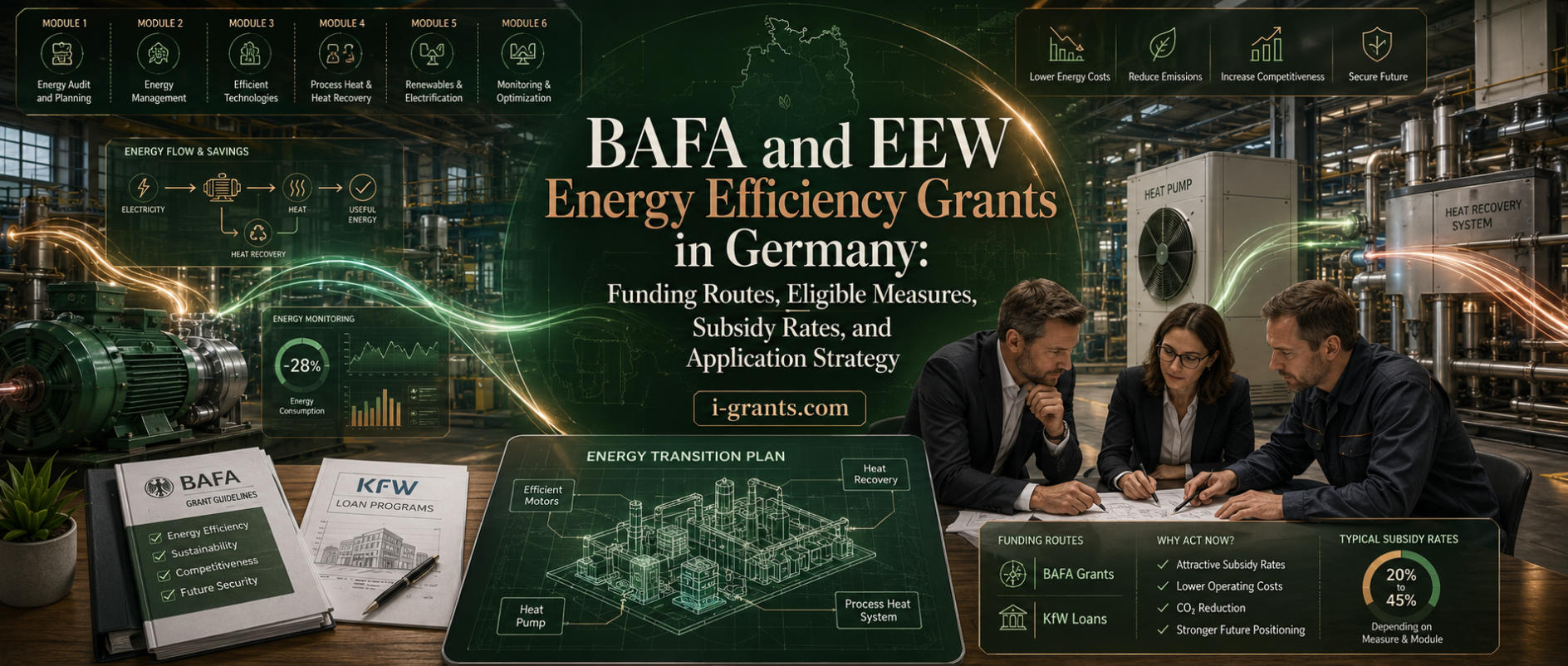
Energy efficiency funding in Germany is not only a climate policy topic. For many SMEs, startups with production activities, service companies, contractors, and economically active nonprofits, it can be a practical way to finance machinery upgrades, process heat solutions, energy monitoring systems, electrification, and broader decarbonisation planning.
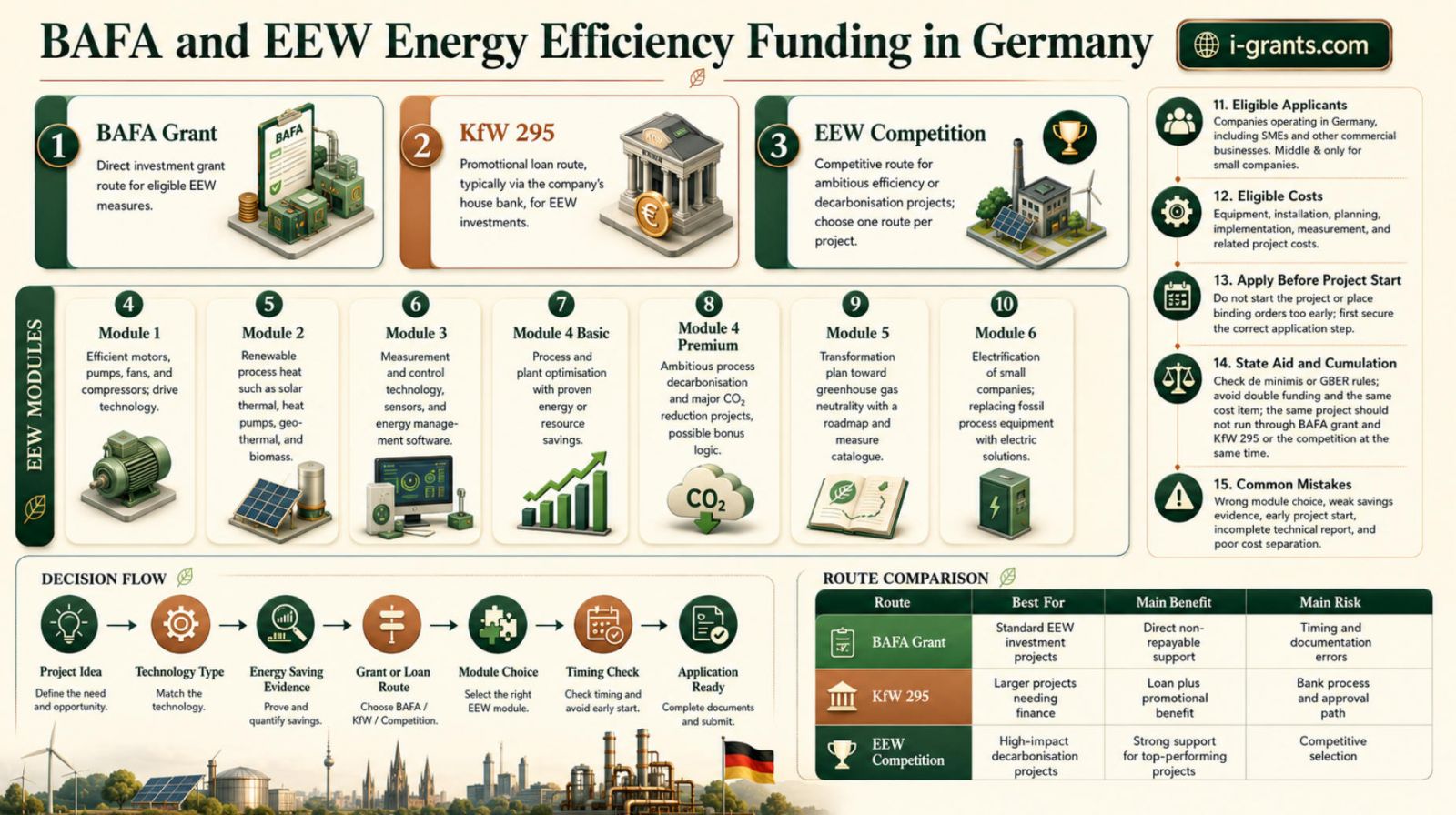
The main federal programme in this area is the Federal Funding for Energy and Resource Efficiency in the Economy, commonly known in German as Bundesförderung für Energie- und Ressourceneffizienz in der Wirtschaft or EEW. It is implemented through several routes, most importantly a direct grant route administered by BAFA and a loan route through KfW, usually referred to as KfW Credit No. 295.
The programme is attractive because it can support very different types of business investment: from replacing inefficient pumps or compressors to installing renewable process heat, from energy management software to complex optimisation of industrial processes. At the same time, EEW is not a simple “equipment grant”. The application strategy depends on the module, company size, project location, eligible costs, energy savings calculation, greenhouse gas reduction evidence, and state aid treatment.
For German SMEs, the first strategic question is not “How much funding can we get?” The first question is: Which funding route actually fits the measure before the company signs contracts, orders equipment, or starts implementation?
Why energy efficiency funding matters for German SMEs in 2026
Energy prices, regulatory pressure, decarbonisation requirements, and investment constraints continue to shape the environment for German SMEs. Many companies know that they need to modernise production, reduce energy consumption, replace fossil fuel systems, or improve measurement and control of energy flows. The difficulty is that these projects often require capital before the financial benefits are visible.
This is where EEW can become commercially relevant. It can improve the investment case by reducing the effective cost of an eligible measure or, in the KfW route, by combining a promotional loan with a repayment subsidy. For grant writers and consultants, EEW also creates a technically demanding but valuable advisory field: applicants need help translating a business investment into a fundable energy efficiency project.
A good EEW application is built around evidence. It should show what the company currently uses, what will change, how the new system reduces energy demand or greenhouse gas emissions, why the costs are eligible, and why the measure fits the selected module. A weak application often starts from the opposite direction: the company has already chosen a supplier and then tries to fit the project into a funding programme after the commercial decision has been made.
What BAFA and EEW funding actually covers
EEW supports measures that increase energy efficiency, resource efficiency, or the use of renewable energy in business processes. The programme can cover standard cross-cutting technologies, renewable process heat, energy management software, measurement and control technology, process optimisation, transformation planning, and electrification of small enterprises.
However, the programme should not be confused with general business support. It does not finance ordinary expansion simply because a company is growing. It does not support every new machine automatically. It is not designed as a liquidity subsidy. The project must be linked to eligible energy or resource efficiency effects, and in many cases the applicant must document savings through a technical concept or expert confirmation.
A useful way to understand EEW is to divide it into three layers:
First, there are module-specific investment grants or repayment subsidies for defined categories of measures. These include modules such as cross-cutting technologies, renewable process heat, measurement and control technology, and process optimisation.
Second, there is the choice of funding route. A company may apply for a direct grant through the BAFA-administered route or use KfW 295 when the project is financed through a promotional loan with a repayment subsidy.
Third, there is the EEW funding competition, which is designed for high-impact projects where the decisive criterion is funding efficiency, meaning the greenhouse gas reduction achieved per euro of requested funding.
Table 1. Main EEW funding modules for SMEs and business applicants
| EEW module | What it can fund | Typical applicant situation | Strategic note |
|---|---|---|---|
| Module 1: Cross-cutting technologies | Replacement of existing equipment such as electric motors, pumps, fans, compressed air systems, heat exchangers, thermal insulation, and frequency converters | An SME wants to replace inefficient technical equipment already used in the company | Best for standard, clearly defined replacement measures. The existing system and replacement logic must be documented. |
| Module 2: Renewable process heat | Solar collectors, heat pumps, geothermal systems, biomass systems, and certain CHP systems used for process heat | A business uses heat in production, processing, refinement, or service delivery | The heat must be used predominantly for processes, not only for general space heating. |
| Module 3: Measurement, control, sensor technology, and energy management software | Energy management software, sensors, data loggers, gateways, control technology, staff training, and related implementation costs | A company needs better visibility and control of energy flows before or alongside deeper efficiency investments | Strong when the project creates measurable energy management capacity, not just generic IT modernisation. |
| Module 4 Basic funding | Replacement of inefficient existing equipment in defined categories without a full savings concept | SMEs with a standard replacement project and a clear reduction in final energy demand | Useful for simpler projects, but only SMEs are eligible and the end-energy reduction threshold must be proven. |
| Module 4 Premium funding | Technology-open optimisation of industrial and commercial processes, waste heat use, electrification, resource efficiency, and fossil fuel replacement | A manufacturing or process-oriented company has a complex optimisation project | More demanding, but often more powerful. It usually requires a strong savings concept and greenhouse gas calculation. |
| Module 5: Transformation plans | Planning of a company-specific path toward greenhouse gas neutrality, including a catalogue of measures | A company is not ready for one investment yet and needs a structured decarbonisation roadmap | This is a planning instrument, not a direct implementation grant for machinery. |
| Module 6: Electrification of small enterprises | Replacement or conversion of existing production systems powered by natural gas, coal, mineral oil, or derived fossil fuels so they can operate electrically | A small enterprise wants to replace fossil-based production equipment with electric systems | A strong fit for small businesses with a clear existing fossil-based production asset and a defined electric alternative. |
BAFA grant, KfW 295 loan, or EEW competition?
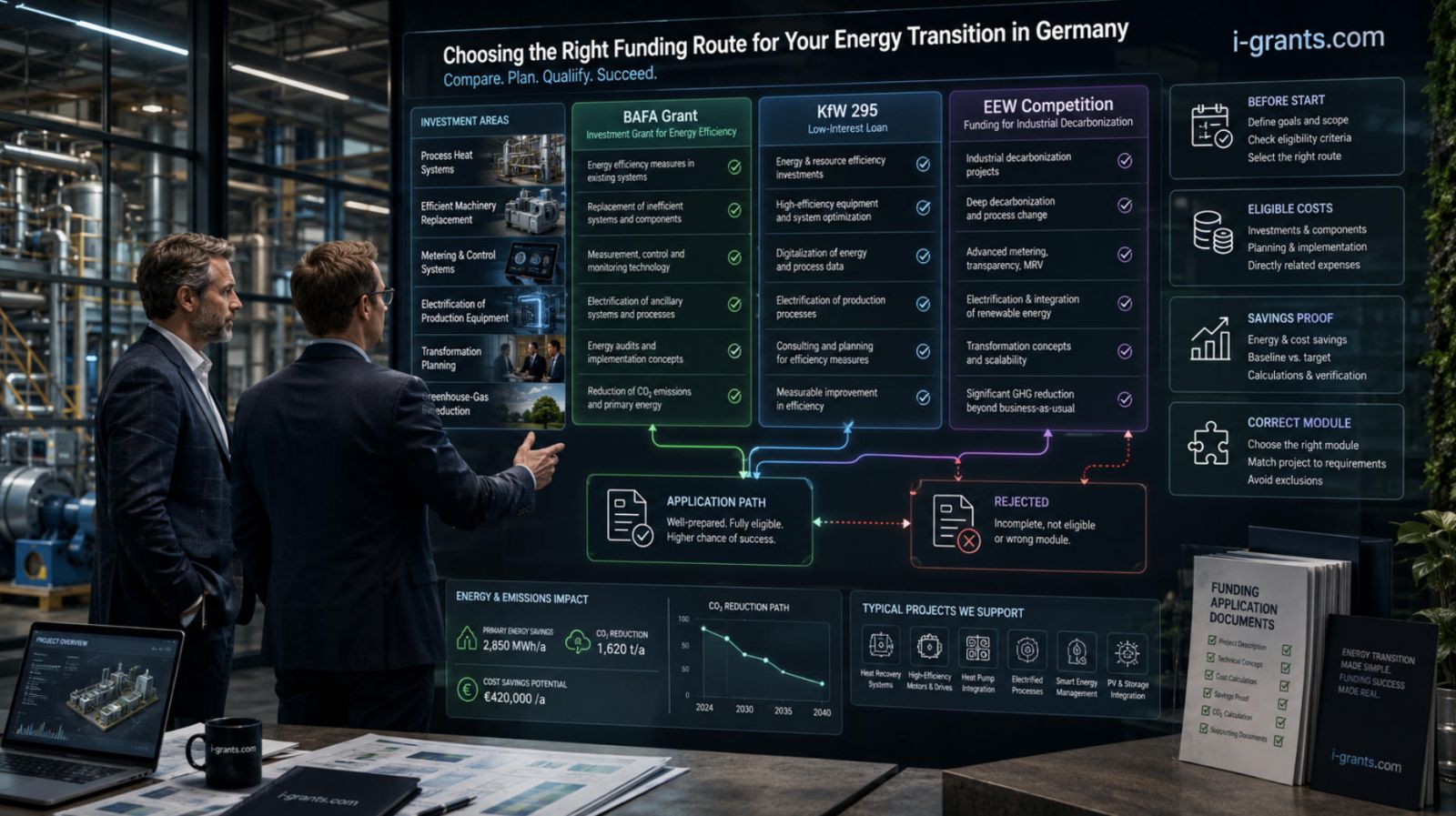
One of the most important strategic decisions is the route. The same business objective may be approached differently depending on whether the applicant needs a direct grant, a loan-based structure, or a competitive funding route.
A BAFA grant is usually the clearest route for companies that can finance the remaining investment themselves and want direct non-repayable support. Since the grant route is administrative and document-heavy, the applicant should prepare technical documentation, quotations, company data, energy savings evidence, and the correct forms before submission.
A KfW 295 loan is relevant when the company wants to finance the eligible investment through a promotional loan. The repayment subsidy reduces the amount to be repaid, but the application is made through a financing partner before the project begins. This route requires bankability, credit assessment, and coordination between the technical project team, the finance team, and the bank.
The EEW funding competition is different. It is not simply a first-come, first-served grant route. Projects compete based on funding efficiency. In practice, this means the applicant should only consider the competition route when the project can demonstrate a strong greenhouse gas reduction per euro of requested funding. A technically interesting project can still be weak in the competition if the requested subsidy is too high relative to the documented emissions reduction.
Table 2. Choosing the right EEW funding route
| Applicant situation | Better route to consider | Why it may fit | Main risk |
|---|---|---|---|
| The company wants a direct subsidy and can finance the remaining cost | BAFA grant route | Clear grant logic without a promotional loan | Starting the project too early or submitting weak technical evidence |
| The company needs debt financing for a larger investment | KfW 295 | Combines financing with a repayment subsidy | The bank must be involved before project start, and credit quality matters |
| The project is large, complex, and has strong greenhouse gas savings | EEW funding competition | Selection is based on funding efficiency and impact | A project with weak CO2 savings per funding euro may lose in ranking |
| The project is a standard replacement of existing equipment | Module 1 or Module 4 Basic through BAFA or KfW | More structured eligibility logic | The applicant may fail to prove that an inefficient existing system is being replaced |
| The company wants to replace fossil-based process equipment with electric systems | Module 4 Premium or Module 6, depending on company size and project type | Electrification is a recognised decarbonisation route | The project must be framed as eligible process-related electrification, not generic modernisation |
| The company only has a long-term decarbonisation idea | Module 5 transformation plan | Supports planning before investment | The output must be a credible plan, not a vague sustainability strategy |
Eligible applicants and Germany location requirement
EEW is open to a broader range of applicants than many SME-only programmes. Depending on the route and module, eligible applicants may include commercial companies, municipal companies, state-owned enterprises, freelancers, contractors, and nonprofit applicants that are economically active. The project must have a location in Germany.
For SMEs, the EU SME definition remains important because funding intensity often depends on whether the company is small, medium-sized, or not an SME. Applicants should check ownership structure before assuming SME status. Partner companies, linked companies, investor relationships, and group structures can change the classification. This matters because small companies may receive higher funding rates in several modules.
A foreign-owned company may still be relevant if the investment is implemented at a German site and the applicant meets the programme conditions. Conversely, a German company cannot usually use EEW for an investment implemented outside Germany. The physical location of the measure matters.
Eligible costs: investment cost, additional investment cost, and necessary ancillary cost
The most common application mistake is treating the supplier’s full invoice as automatically eligible. EEW cost eligibility depends on the module and the funding logic. Some modules can use eligible investment costs, while more complex cases may require a distinction between total investment costs and additional investment costs linked to the efficiency improvement.
Necessary ancillary costs can also matter. Planning, installation, commissioning, measurement technology, energy expert work, and certain implementation-related services may be relevant when they are directly connected to the eligible measure. But ordinary business costs, unrelated construction, general maintenance, or purely capacity-driven expansion should not be presented as energy efficiency costs unless the programme rules clearly allow them.
For a grant writer, the budget narrative should answer four questions: what is being purchased, why it is necessary for the eligible measure, how the amount was calculated, and how the cost connects to the expected energy or greenhouse gas savings.
Module 4: why Basic and Premium should not be confused
Module 4 is one of the most strategically important parts of EEW, but also one of the easiest to misunderstand.
Module 4 Basic is designed for SMEs that replace inefficient existing installations from defined equipment categories. It avoids the full complexity of a premium savings concept, but it still requires evidence that the annual final energy demand will be reduced by at least the required threshold. It is not suitable for every new machine, and it is not intended to support a pure capacity increase.
Module 4 Premium is more flexible and more demanding. It can support technology-open optimisation of industrial and commercial processes, including measures such as waste heat use, process electrification, resource efficiency, and replacing fossil fuels with renewable alternatives. In return, the applicant needs a much stronger technical case. The project must show savings, usually through an energy or greenhouse gas reduction concept that is credible, consistent, and aligned with the programme methodology.
The practical rule is simple: if the project is a straightforward replacement in an eligible equipment category, Basic may be enough. If the project redesigns a process, changes an energy carrier, integrates waste heat, or combines several technical measures, Premium may be the more appropriate route.
Application timing: apply before starting the project
EEW applications are timing-sensitive. In most cases, the applicant must submit the correct application before starting the project. Starting too early can endanger eligibility. A project start can include signing binding supply contracts, placing orders, beginning construction, or otherwise committing to the measure before the required application step.
This point is especially important for SMEs because operational teams often move faster than funding teams. A production manager may want to order a new compressor immediately. A founder may want to sign a supplier quote to secure a price. A finance director may ask for funding only after the procurement decision is already made. In grant logic, this is dangerous.
The safer approach is to build a funding checkpoint into procurement. Before any binding commitment, the company should classify the measure, identify the route, prepare the minimum documentation, confirm whether an expert is needed, and submit the application or financing request according to the relevant procedure.
Evidence requirements: technical documents, experts, and savings concepts
EEW is evidence-driven. The level of evidence depends on the route and module, but most serious applications need more than a supplier brochure. The applicant may need technical data sheets, quotations, existing-system documentation, energy consumption data, operating hours, process descriptions, photos of existing installations, calculations of final energy savings, greenhouse gas factors, and expert confirmations.
For Module 4 Basic, the reduction in final energy demand must be confirmed. For Module 4 Premium, the savings concept is central. For KfW 295, the company must coordinate the technical confirmation with the financing process. For the competition route, the quality of the greenhouse gas reduction calculation can decide whether the project ranks well enough to receive funding.
A strong application does not exaggerate savings. It explains assumptions clearly. It separates energy savings from production decline. It accounts for higher utilisation if the new system increases output. It avoids claiming savings that result from outsourcing or buying inputs that were previously produced internally.
Table 3. Common EEW application mistakes and how to avoid them
| Mistake | Why it causes problems | Better approach |
|---|---|---|
| Treating EEW as a general equipment grant | The programme funds eligible efficiency or decarbonisation measures, not ordinary business expansion | Start with the energy or resource efficiency effect, then build the investment case |
| Choosing the module too late | The evidence, rates, forms, and eligibility logic differ by module | Classify the project before requesting final supplier offers |
| Signing contracts before applying | Early project start can make the project ineligible | Add a funding checkpoint before procurement commitment |
| Confusing process heat with building heating | Module 2 focuses on process use, not general heating alone | Document how the heat is used in production, processing, refinement, or service delivery |
| Using weak baseline data | Savings cannot be trusted if the current state is unclear | Collect consumption data, operating hours, technical specifications, and photos |
| Ignoring SME ownership rules | Company size can change funding intensity and eligibility | Check linked and partner companies before selecting rates |
| Asking for too much in the funding competition | Competition ranking depends on funding efficiency | Optimise the requested subsidy against documented greenhouse gas savings |
State aid, de minimis, and cumulation risks
Energy efficiency grants often interact with state aid rules. The exact legal basis depends on the module, route, company size, eligible cost logic, and selected funding framework. Applicants should not assume that EEW can be freely combined with any other public funding.
Cumulation is especially important when the same cost item could be supported by more than one programme. A company might also be considering regional investment grants, tax incentives, state-level energy programmes, or EU funding. The question is not only whether another programme exists, but whether the same eligible costs can be combined without exceeding aid ceilings or violating programme rules.
The safest strategy is to map all public support before submission: direct grants, subsidised loans, repayment subsidies, guarantees, tax credits, regional aid, and de minimis support. This is also where experienced grant writers can add value. They can help prevent a company from building a funding stack that looks attractive but fails during compliance review.
When should an SME use a grant writer or energy efficiency expert?
Many EEW projects require both technical and funding expertise. An energy efficiency expert can validate energy savings, prepare or support calculations, and help ensure that the technical assumptions are credible. A grant writer can structure the application narrative, align documents with eligibility rules, build the budget explanation, coordinate deadlines, and reduce the risk of inconsistent information.
The need is highest when the project involves Module 4 Premium, a complex process change, multiple cost categories, a contractor model, KfW financing, or the EEW funding competition. In these cases, the application is not just a form-filling exercise. It is a technical-financial argument.
For smaller projects under Module 1, Module 3, or Module 6, the company may manage more internally if it has strong documentation. Still, even simple measures can fail if the applicant cannot prove replacement logic, project timing, or eligible use.
Application readiness checklist
Before submitting an EEW application, an SME should be able to answer the following questions with documents, not only with intentions:
| Readiness question | What the company should have |
|---|---|
| What existing system or process is being improved? | Baseline description, photos, technical data, consumption data, and operating assumptions |
| Which EEW module fits the measure? | A documented module choice with a short justification |
| What costs are eligible? | Supplier quotes, cost breakdown, ancillary cost explanation, and exclusion of unrelated costs |
| Has the project already started? | Clear procurement timeline and no binding commitment before the required application step |
| What energy or greenhouse gas savings will result? | Calculation method, assumptions, emission factors, and expert confirmation where required |
| Is the applicant an SME? | EU SME status check, including partner and linked companies |
| Is other public funding involved? | Cumulation and state aid check before submission |
Strategic conclusion
BAFA and EEW energy efficiency funding can be one of the most useful public funding routes for German SMEs in 2026, especially for companies investing in production efficiency, renewable process heat, monitoring systems, electrification, and decarbonisation planning. But the programme rewards preparation, not improvisation.
The strongest applicants do not begin with a grant percentage. They begin with a precise diagnosis of the project: what is being replaced, what energy carrier changes, what process improves, what emissions fall, which costs are eligible, and which funding route matches the evidence.
For a small company, EEW can turn a necessary modernisation project into a more financially realistic investment. For a startup with physical operations, it can support technical infrastructure that improves competitiveness. For grant writers, it is a field where structured documentation, technical clarity, and timing discipline can make the difference between a rejected application and a fundable project.
The practical rule is clear: classify the measure before procurement, choose the funding route before preparing the budget, and build the application around measurable energy or greenhouse gas impact. That is how BAFA and EEW funding moves from a complex German funding programme to a usable investment tool for real businesses.