

 Français
 Deutsch
 Українська
Indiana's automotive industry is entering a period of transformation that creates both substantial opportunities and serious challenges for established manufacturers. As automakers expand their hybrid, battery-electric, and hydrogen fuel cell vehicle capabilities, hundreds of smaller suppliers must determine how to remain competitive in a market where the technologies, components, and production requirements are changing.
For companies that have spent decades manufacturing engine parts, transmission components, metal housings, precision stampings, and other traditional automotive products, adapting to these changes can require significant investment. New machinery, advanced automation, specialized software, production engineering, and employee training all create financial pressure, particularly for small and medium-sized manufacturers operating with limited capital reserves.
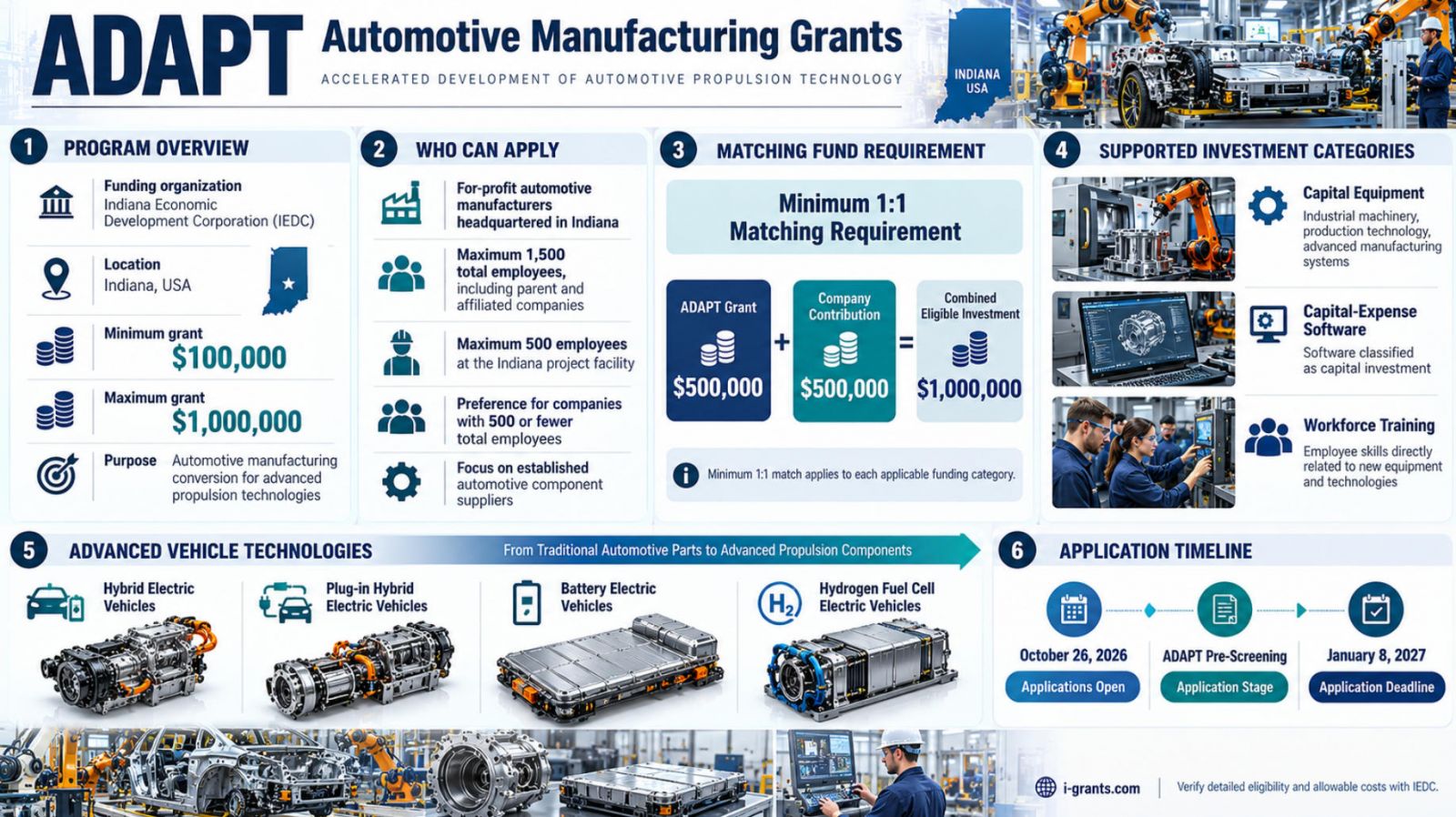
Indiana's Accelerated Development of Automotive Propulsion Technology (ADAPT) program addresses this challenge by offering competitive matching grants ranging from $100,000 to $1 million. Administered by the Indiana Economic Development Corporation (IEDC), the initiative supports established automotive suppliers seeking to develop commercially ready manufacturing capabilities for advanced vehicle technologies.
The current application period opened on October 26, 2026, and closes on January 8, 2027.
However, ADAPT is not a general-purpose manufacturing modernization grant. Its central objective is to help Indiana-based automotive suppliers diversify beyond components associated with internal combustion engine vehicles. Applicants must demonstrate that their proposed investments will create new manufacturing capabilities serving hybrid, plug-in hybrid, battery-electric, or hydrogen fuel cell vehicles.
Understanding this distinction is essential. A proposal to replace outdated machinery or increase existing production capacity may generate substantial business benefits, but it will not necessarily satisfy ADAPT's objectives. A competitive application must connect the investment to a credible market opportunity, a specific new production capability, and measurable economic benefits.
This guide examines the program's confirmed conditions, Indiana's automotive manufacturing landscape, potential investment projects, financial requirements, and practical strategies for preparing a competitive application.
ADAPT Grants in Indiana: Program Overview and Funding Conditions
ADAPT was designed to strengthen the resilience of Indiana's automotive supply chain by supporting manufacturers that are capable of adapting their existing production expertise to emerging propulsion technologies.
The program specifically targets small and medium-sized automotive manufacturers whose current operations are concentrated in components for internal combustion engine (ICE) vehicles. These businesses often possess valuable technical capabilities, including metal forming, precision machining, welding, casting, tooling, and industrial assembly, but may lack the financial resources needed to enter new automotive markets.
Through ADAPT, eligible companies can seek matching grant funding for defined capital investment projects that establish new production capabilities.
The program supports the transition toward manufacturing components and materials for hybrid vehicles, plug-in hybrid vehicles, battery-electric vehicles, and hydrogen fuel cell electric vehicles.
Table 1. ADAPT Grant Program Overview and Eligibility Requirements
| Program feature | Confirmed information |
|---|---|
| Official program name | Accelerated Development of Automotive Propulsion Technology (ADAPT) |
| Administering organization | Indiana Economic Development Corporation (IEDC) |
| Geographic coverage | Indiana, United States |
| Eligible applicants | For-profit automotive manufacturers headquartered in Indiana |
| Minimum grant | $100,000 |
| Maximum grant | $1,000,000 |
| Matching requirement | Minimum 1:1 company investment in each applicable funding category |
| Maximum company size | 1,500 total employees, including parent and affiliated companies |
| Maximum employment at the project facility | 500 employees |
| Priority applicants | Companies with 500 or fewer total employees and significant exposure to traditional ICE components |
| Supported investment categories | Capital equipment, capital-expense software, and workforce training |
| Application opening date | October 26, 2026 |
| Application deadline | January 8, 2027 |
| Application mechanism | ADAPT Pre-Screening through the Euna Grants platform |
| Selection process | Competitive peer review |
The publicly available program information establishes the principal grant amounts, applicant restrictions, funding categories, and application dates. However, the total allocation available specifically for the 2026–2027 ADAPT competition has not been independently confirmed from the published program summary.
Similarly, the precise project implementation deadline, reimbursement schedule, and complete list of allowable expenditures should be verified through the official program documents and application process.
For potential applicants, this creates a practical distinction between understanding the program's general financial structure and confirming whether an individual project's costs and implementation schedule can be approved.
The Federal Funding Context Behind Indiana's Automotive Conversion Efforts
Indiana's automotive conversion initiatives are connected to broader federal efforts to preserve domestic manufacturing capacity while supporting the development of advanced vehicle supply chains.
On November 22, 2024, the U.S. Department of Energy announced the selection of five states for approximately $50 million in proposed support through the Domestic Automotive Manufacturing Conversion Grant program.
Indiana was selected for $10,793,685 in proposed federal funding. Michigan, Kentucky, Tennessee, and Illinois were also included in the announcement.
The initiative aimed to help states work with manufacturers and industry partners to modernize automotive facilities, develop new production capabilities, and retain manufacturing employment.
Importantly, the Department of Energy described these selections as subject to award negotiations. Selection did not constitute a binding funding commitment, and the announced amount should not be treated as the confirmed budget of the current ADAPT application round.
Nevertheless, this federal initiative provides important context for understanding why Indiana is prioritizing the transformation of its established automotive suppliers.
Rather than concentrating exclusively on new electric vehicle factories, the state's approach also recognizes that smaller component manufacturers need access to capital if they are to participate in changing automotive supply chains.
Why Indiana's Automotive Manufacturing Industry Needs ADAPT
Indiana has one of the most established automotive manufacturing ecosystems in the United States.
Its industrial base includes major vehicle assembly operations, engine and transmission manufacturers, precision metalworking companies, component suppliers, materials producers, engineering businesses, and manufacturers of specialized industrial equipment.
Companies such as Toyota, Subaru, Honda, General Motors, and Stellantis have contributed to the state's automotive development, while hundreds of smaller suppliers provide the parts, tooling, production systems, and industrial services necessary to support vehicle manufacturing.
These relationships have created an extensive manufacturing network with substantial economic importance.
According to Conexus Indiana's Future Ready 2025 report, the state's automotive manufacturing subsector accounted for approximately 136,523 jobs and $21.4 billion in gross domestic product using the latest data available to the report, primarily from 2023.
The report also identified more than 628 automotive manufacturing establishments and an average annual wage of $93,411 within the sector.
Table 2. Indiana Automotive Manufacturing Statistics and Industry Transformation Indicators
| Indicator | Reported figure | Reference period |
|---|---|---|
| Automotive manufacturing employment | 136,523 jobs | 2023 |
| Automotive manufacturing establishments | More than 628 | Reported in 2025 |
| Automotive contribution to state GDP | $21.4 billion | 2023 |
| Share of Indiana manufacturing GDP | 20 percent | 2023 |
| Average annual automotive industry wage | $93,411 | 2023 |
| Technology-enabled automotive workers | 12,363 | 2023 |
| Share of technology-enabled workers | 9 percent | 2023 |
| Automotive manufacturers engaged in EV-related activities | More than 200 | Estimate reported in 2025 |
| Announced EV-related investments | More than $12.9 billion | Cumulative estimate reported in 2025 |
| Motor vehicle parts manufacturing jobs in the Kokomo metropolitan area | 7,098 | 2024 |
| Average annual change in Kokomo motor vehicle parts employment | -5.6 percent | 2019–2024 |
Sources: Conexus Indiana, Future Ready 2025; Indiana Business Research Center, Fall 2026. The figures describe different statistical periods and geographic or industry classifications. They should not be interpreted as a single current-year dataset.
The significance of these figures extends beyond the size of the automotive industry.
A considerable proportion of Indiana's manufacturing infrastructure was developed around internal combustion engine vehicles. Suppliers have invested in specialized machinery, production techniques, tooling, and workforce skills that serve established automotive platforms.
As demand for different vehicle technologies evolves, some traditional components may face changing market conditions, while entirely new categories of products create opportunities for manufacturers capable of adapting.
Electric vehicles generally require fewer conventional engine-related components, but they introduce requirements for electric propulsion systems, power electronics, battery enclosures, thermal management, electrical connections, structural protection, and sophisticated electronic controls.
Hybrid vehicles create another production opportunity because they combine conventional powertrain systems with electric propulsion technologies.
For established manufacturers, the challenge is therefore not simply whether electric vehicles will replace conventional vehicles. It is how to position their businesses to serve multiple propulsion technologies while maintaining profitability, preserving valuable skills, and managing investment risk.
The Particular Vulnerability of Traditional Component Suppliers
The ADAPT program description estimates that approximately one in five jobs among Indiana's small and medium-sized automotive suppliers is associated with internal combustion engine component production.
This concentration matters because a supplier's exposure to technological change may be much greater than that of the broader automotive sector.
A manufacturer whose revenue depends heavily on engine-specific components could face substantial business risk if its principal customers reduce orders for those products.
By contrast, a company capable of manufacturing components used across combustion, hybrid, and electric vehicles may be better positioned to manage fluctuations in demand.
The regional evidence illustrates this challenge.
Research published by the Indiana Business Research Center in fall 2026 found that the Kokomo metropolitan area had 7,098 jobs in motor vehicle parts manufacturing in 2024. Employment in that industry declined at an average annual rate of 5.6 percent between 2019 and 2024.
This does not mean that every job loss was caused by electrification. Automation, productivity improvements, changes in customer demand, production restructuring, and broader economic conditions can all influence employment.
However, the figures demonstrate why manufacturing diversification has become a significant regional economic concern.
ADAPT responds to this environment by helping established suppliers finance investments that may otherwise be postponed or considered too risky.
Who Is Eligible for ADAPT Automotive Manufacturing Grants?
Eligibility for ADAPT is more restrictive than general participation in Indiana's automotive industry.
Applicants must be for-profit manufacturers headquartered in Indiana and already engaged in the production of automotive parts or components.
The program is intended to support existing manufacturers that can demonstrate a realistic transition from their current production capabilities into commercially relevant advanced vehicle components.
An enterprise with an innovative electric vehicle concept but no established automotive manufacturing operations should not assume that it qualifies.
Similarly, a foreign manufacturer operating a production facility in Indiana must examine the headquarters requirement carefully. Ownership by an international group does not automatically establish eligibility, particularly where the applicant's headquarters and affiliated employment are relevant.
Company Size and Corporate Group Restrictions
ADAPT limits eligible applicants to companies with no more than 1,500 employees in total, including employees of parent and affiliated companies.
At the same time, the Indiana manufacturing facility where grant-supported equipment will be installed must have no more than 500 employees.
The program gives preference to companies with 500 or fewer total employees, including parent and affiliated businesses.
These conditions can have substantial consequences for manufacturers operating through complex corporate structures.
Consider an Indiana automotive supplier with 240 employees at its local plant.
If the applicant is part of a corporate group employing 1,800 people worldwide, the local facility's comparatively small workforce does not necessarily establish eligibility. The group exceeds the published overall employment threshold.
Alternatively, a company with 420 employees across its entire organization, including 190 workers at the proposed Indiana project location, may satisfy the numerical restrictions, assuming the remaining eligibility requirements are met.
These scenarios are illustrative. The official application determines how employment and corporate relationships must be documented and assessed.
For businesses with multiple subsidiaries, overseas parent companies, or complicated ownership arrangements, employment calculations should be completed before significant resources are invested in preparing a grant proposal.
Geographic Restrictions on Grant-Funded Equipment
ADAPT also includes an important restriction concerning the location of supported equipment.
Grant-funded equipment must remain in the Indiana county where it is installed.
This requirement deserves particular attention from manufacturers operating several facilities or considering future production consolidation.
A business might reasonably expect to relocate a production line to another plant as customer demand changes. However, the geographic restriction means that such a decision could raise grant compliance concerns.
Applicants should therefore select project locations based on a credible long-term manufacturing strategy rather than short-term production convenience.
Before proceeding, companies should also clarify how the final grant agreement treats equipment disposal, replacement, ownership changes, and potential relocation within the same county.
Why Established Manufacturing Experience Matters
IEDC emphasizes an established and successful manufacturing track record and the ability to explain how the proposed project will strengthen long-term competitiveness.
This means the quality of the business case matters as much as the technological ambition.
A company with established customers, a functioning production facility, experienced technical personnel, and a clearly identified new component may have a more credible implementation plan than one proposing to enter an unfamiliar market without evidence of demand.
A particularly relevant applicant could be a metalworking company that already produces precision components for automotive engines and has identified an opportunity to supply electric motor housings or battery-related structural components.
Such a manufacturer can potentially build on its existing machinery, quality systems, employee expertise, and customer relationships while using new investment to overcome technical limitations.
The objective is not to abandon established capabilities, but to adapt them to new industrial requirements.
What Can ADAPT Funding Be Used For?
ADAPT supports well-defined capital investment projects that create new manufacturing capabilities related to advanced propulsion technologies.
The official program description identifies three principal expenditure categories: capital equipment, capital-expense software, and workforce training.
These categories offer meaningful flexibility, but they should not be interpreted as unlimited authorization to finance every cost associated with an industrial modernization project.
Manufacturing Machinery and Capital Equipment
Capital equipment is central to the program.
Depending on the proposed manufacturing process, relevant investments could include computer numerical control machinery, precision forming equipment, automated production systems, robotics, industrial inspection equipment, and specialized manufacturing machinery.
For example, a supplier planning to produce electric motor housings may require equipment capable of meeting tighter dimensional tolerances, processing different materials, or manufacturing components at commercially viable production volumes.
A company entering battery enclosure manufacturing might need specialized forming, welding, or inspection systems to meet customer specifications.
However, the critical factor is the relationship between the machinery and the proposed new product.
Replacing an old machine with a newer version of the same equipment does not, by itself, establish that the investment qualifies for ADAPT.
The applicant must demonstrate how the investment enables a new production capability serving an eligible advanced vehicle technology.
Manufacturing Software and Digital Systems
The program also identifies software treated as a capital expense as a potential funding category.
Advanced automotive manufacturing frequently requires digital integration between machines, sensors, production planning systems, industrial controllers, and quality assurance platforms.
For manufacturers seeking to enter electric propulsion supply chains, software may help control production accuracy, monitor manufacturing parameters, improve traceability, and reduce variation.
A new production line might integrate machine vision, process monitoring, equipment control, or data collection systems.
Nevertheless, applicants should distinguish between software that qualifies as a capital investment and ordinary operating subscriptions or recurring technology expenses.
Not every software purchase necessarily meets ADAPT's requirements.
Before committing to a digital manufacturing investment, businesses should confirm how the program defines capital-expense software, including any restrictions on licenses, subscriptions, integration, maintenance, and related services.
Workforce Training and Technical Skills
Workforce training is a particularly important part of ADAPT.
The official application description indicates that projects including employee training directly related to new equipment and technology will be more competitive.
This reflects a fundamental challenge in industrial transformation: machinery alone does not produce a successful manufacturing transition.
A company investing in advanced robotic equipment also needs employees who can program, operate, troubleshoot, inspect, and maintain the new systems.
Production engineers may require training in new manufacturing methods, while quality technicians may need to understand different inspection standards and material properties.
Other workers may need additional expertise in electrical safety, automation, programmable logic controllers, data analysis, or advanced manufacturing processes.
Conexus Indiana's research identifies manufacturing engineers, robotics and mechatronics engineers, software specialists, quality professionals, and other technology-enabled roles as increasingly important to the state's industrial competitiveness.
A strong ADAPT application should therefore demonstrate that employees will acquire the capabilities necessary to operate the equipment and support commercial production.
Training should not appear as an unrelated addition to the budget. It should be integrated into the project's technical implementation and workforce development strategy.
Expenses That Require Further Confirmation
Manufacturing investments often involve additional costs, including installation, facility modifications, engineering services, testing, certification, tooling, utilities, and commissioning.
These expenses may be commercially necessary, but the public ADAPT summary does not establish that every one of them is grant-eligible.
The same uncertainty applies to buildings, land, ordinary operating expenses, marketing, inventory, and working capital.
Applicants should not place unconfirmed expenditure categories in the grant-funded portion of their budgets without checking the complete application rules or obtaining written clarification from IEDC.
The distinction between commercial necessity and grant eligibility is essential.
A company may need to complete electrical upgrades before installing new machinery, but that does not automatically mean those upgrades can be financed through ADAPT.
Separating confirmed eligible expenses from other project costs will make the financial proposal more transparent and reduce the risk of an unsupported grant request.
How ADAPT's 1:1 Matching Requirement Works
One of the most important financial conditions is the requirement for at least a 1:1 matching investment from the applicant.
In practical terms, a manufacturer requesting $500,000 in grant funding would need to contribute at least $500,000 toward the corresponding eligible project costs.
A company seeking the maximum $1 million grant would ordinarily need to plan for at least $2 million in combined eligible project investment, assuming equal grant and company contributions.
The requirement is more specific than a simple matching commitment at the total project level.
According to the published opportunity description, the minimum 1:1 match applies to each potential funding category: capital equipment, capital-expense software, and workforce training.
This means businesses should structure their budgets to demonstrate adequate matching funds within each relevant category.
Table 3. ADAPT Grant Funding Scenarios for Indiana Automotive Manufacturers
| Illustrative project | ADAPT grant request | Minimum company match | Combined eligible investment |
|---|---|---|---|
| Small production conversion | $100,000 | $100,000 | $200,000 |
| Specialized component manufacturing cell | $250,000 | $250,000 | $500,000 |
| Advanced automated production line | $500,000 | $500,000 | $1,000,000 |
| Large-scale automotive diversification | $1,000,000 | $1,000,000 | $2,000,000 |
Illustrative calculations based on the published minimum 1:1 matching requirement. The figures assume that all relevant costs are eligible and approved. They do not represent actual grant awards or approved company budgets.
A Detailed Example of Category-by-Category Matching
Consider an established Indiana manufacturer planning a $600,000 investment to produce precision components for electric propulsion systems.
Its preliminary budget includes $420,000 for manufacturing equipment, $60,000 for capitalized production software, and $120,000 for specialized workforce training.
If all expenditures are approved as eligible, the company could theoretically request $210,000 toward equipment, $30,000 toward software, and $60,000 toward training.
The combined grant request would be $300,000, with the company financing the remaining $300,000.
This structure would satisfy the minimum 1:1 match in each category, rather than relying on a surplus contribution in one category to compensate for insufficient matching funds in another.
The proposed expenditure amounts are hypothetical, and the example does not imply that ADAPT imposes or allows any particular percentage allocation to training or software. The final distribution must comply with the complete program rules.
Where Can the Company's Matching Funds Come From?
The public opportunity information identifies a cash matching requirement, but it does not provide a complete explanation of every permissible source of company funding.
Businesses may naturally consider retained earnings, available cash reserves, equity investment, or external financing.
However, the treatment of bank loans, shareholder contributions, financing from affiliated companies, and other government programs should be confirmed with IEDC before the applicant relies on these sources.
The funding portal classifies ADAPT as federal or federal pass-through funding, making federal cost-sharing rules particularly relevant.
Under 2 CFR § 200.306, contributions used to satisfy federal cost-sharing obligations generally must be verifiable, necessary, reasonable, allowable, and properly documented.
The regulation also limits the use of funding from another federal award as matching funds, unless a specific statutory exception applies.
Although general federal rules can recognize certain noncash contributions, ADAPT's published cash-match requirement should not be assumed to allow donated equipment or employee time as substitutes for cash.
A manufacturer considering multiple grants must also ensure that the same expenditure is not improperly financed or counted more than once.
The safest approach is to construct a financing plan based on clearly available and documented company funds, then seek written confirmation for any less straightforward financing arrangement.
The Cash Flow Problem That Matching Grants Can Create
Securing the required matching investment does not necessarily solve every financial challenge.
Manufacturers must also determine when project expenses become payable and when grant funds will be disbursed.
If machinery suppliers require deposits or staged payments before the grant is received, a company could face a temporary financing requirement substantially greater than its final share of the project.
The published ADAPT summary does not specify the complete payment schedule or whether funding is advanced or reimbursed after eligible expenses are incurred.
Therefore, prudent financial planning should include a conservative cash flow forecast that accounts for equipment deposits, delivery dates, installation costs, and potential delays.
Applicants should avoid making binding purchasing commitments on the assumption that expenditures incurred before an award agreement will automatically qualify.
The date from which costs become eligible must be verified before purchases are made.
From Internal Combustion Engine Components to Advanced Vehicle Technologies
One of the most significant opportunities created by ADAPT is the ability to reuse established manufacturing expertise in new markets.
An automotive supplier does not necessarily need to develop an entirely unfamiliar technology to participate in electric or hybrid vehicle supply chains.
Many conventional manufacturing processes remain relevant, but the materials, product designs, operating requirements, inspection standards, and customer specifications may change.
A December 2024 guidebook prepared by Argonne National Laboratory, with support from the U.S. Department of Energy, examines practical diversification opportunities for small and medium-sized automotive suppliers.
The research identifies several potential pathways through which manufacturers of conventional automotive components could enter emerging vehicle markets.
Table 4. Automotive Manufacturing Conversion Opportunities for Indiana Suppliers
| Existing manufacturing specialization | Potential advanced vehicle components | Main adaptation requirements |
|---|---|---|
| Engine gaskets and sealing products | Battery system gaskets and specialized EV seals | Greater resistance to fire, chemicals, and electrochemical corrosion |
| Engine blocks and machined housings | Electric motor housings, battery enclosures, and structural components | New geometries, materials, machining processes, and dimensional tolerances |
| Engine valves | Fluid management and battery cooling components | Different flow control, thermal management, and durability requirements |
| Exhaust systems and related components | Automotive heat pump components and electronic sensor applications | Adaptation to thermal systems, sensor integration, and new customer specifications |
| Mufflers and fabricated metal assemblies | Noise, vibration, and harshness components and protective metal housings | Revised structural designs, vibration control, and precision fabrication |
Adapted from Argonne National Laboratory, Business Opportunities in Clean Energy Supply Chains: Guidebook for Small and Medium-Sized Auto Suppliers, December 2024. These are potential industrial diversification pathways, not an official list of automatically eligible ADAPT projects.
These examples demonstrate why an industrial conversion program can be strategically valuable even for manufacturers that are not currently major suppliers of electric vehicle components.
The central question is whether the company's existing capabilities can be transferred into a new product category at an acceptable cost and with a realistic commercial opportunity.
Battery Systems and Structural Components
Battery-related manufacturing can offer opportunities for businesses experienced in metal forming, machining, assembly, and industrial quality control.
Battery packs require protective enclosures, mounting structures, thermal management components, seals, electrical connections, and other specialized products.
However, these components may be subject to requirements that differ considerably from those encountered in traditional engine manufacturing.
Manufacturers may need to demonstrate specific levels of dimensional accuracy, corrosion resistance, thermal performance, mechanical strength, or compatibility with customer manufacturing processes.
A company producing metal housings for internal combustion engine applications may already possess part of the necessary expertise, but it may need new machinery or inspection systems to meet battery-related production specifications.
ADAPT could be relevant where such investment creates a genuinely new eligible manufacturing capability.
Electric Motors, Power Electronics, and Precision Manufacturing
Electric propulsion also creates opportunities for manufacturers with expertise in precision metalworking, mechanical assembly, electrical components, and specialized materials.
Products may include motor housings, structural supports, electrical contact components, or other parts used in electrified propulsion systems.
Entering these markets may require changes to production processes, tooling, quality assurance, and workforce skills.
Some companies may be able to adapt existing equipment, while others may need entirely new production systems.
The investment case should explain why the proposed machinery is necessary, how it differs from existing production assets, and what measurable manufacturing capability will result.
Hybrid Vehicles as a Diversification Opportunity
It would be a mistake to interpret automotive transformation as an immediate elimination of conventional vehicle technologies.
Hybrid and plug-in hybrid vehicles combine elements of established powertrain manufacturing with electric propulsion systems.
For suppliers, this creates potential opportunities to serve both conventional and electrified vehicle platforms.
A company may be able to preserve profitable existing production while developing complementary components for hybrid systems.
This approach can reduce dependence on a single technology pathway.
For ADAPT applicants, the essential requirement remains demonstrating that the funded investment supports production of eligible non-ICE propulsion components, rather than merely increasing output of existing conventional engine parts.
Commercial Readiness: The Difference Between a Promising Idea and a Fundable Project
ADAPT emphasizes the development of new, commercially ready manufacturing capabilities.
This is different from financing early scientific research or supporting an idea that has not yet progressed toward industrial production.
A company may have identified a technically attractive product, but a competitive manufacturing investment proposal should establish that the business can move toward commercial production within a credible timeframe.
Manufacturing readiness has several dimensions.
The product must have a defined function and technical specification. The proposed production process must be capable of delivering the necessary quality and volume. The company must have access to qualified personnel, suitable materials, and the necessary manufacturing infrastructure.
Equally important, the investment should respond to a plausible commercial opportunity.
A manufacturer that has received inquiries from established automotive customers may be better positioned to substantiate potential demand than a company relying exclusively on general market growth forecasts.
A letter of interest, customer request for quotation, technical development agreement, or established supplier relationship may therefore be valuable evidence.
Such documents should be accurately described. A preliminary customer inquiry should not be presented as a binding purchase contract.
Building a Quantifiable Business Case
A convincing investment proposal should explain what the business will be able to produce after the project that it cannot produce today.
For example, a manufacturer may currently operate a production line capable of machining conventional engine components but lack the equipment necessary to achieve the tolerances required for an electric motor housing.
The application could describe the current process limitations, the proposed equipment, the expected technical improvement, and the potential commercial application.
The financial model should then connect the new capability to expected production volumes, costs, and revenue.
Applicants should avoid assuming that new production capacity will automatically translate into sales.
Automotive supply contracts can require extensive customer qualification, quality validation, and commercial negotiations before full-scale orders begin.
A realistic financial forecast should reflect those timelines.
It should also distinguish projected production capacity from confirmed demand.
A company may be capable of manufacturing 200,000 new components annually, but this does not mean that it has secured orders for that quantity.
Transparent assumptions are especially important where the proposed investment depends on a rapidly changing vehicle market.
Measuring the Project's Economic Impact
Applicants should consider measurable results that extend beyond the purchase and installation of machinery.
Potential indicators include annual production capacity, expected output per employee, manufacturing yield, reduction in defective parts, lead times, and the proportion of revenue expected from new product categories.
Workforce impact should be measured with equal care.
A project may preserve existing employment by reducing the company's dependence on declining product lines, create additional technical positions, and provide training for current workers.
These outcomes should be reported separately.
For example, an illustrative project might preserve 35 existing manufacturing jobs, create eight additional positions, and provide advanced technical training to 20 current employees.
The company should not describe this as the creation of 63 new jobs.
The first measure concerns employment retention, the second employment creation, and the third workforce development.
Keeping these indicators separate improves the credibility of the projected economic impact.
Real Examples of Automotive Manufacturing Transformation in Indiana
Indiana already offers documented examples of manufacturers investing in automation, production diversification, and advanced vehicle technologies.
These cases provide useful evidence of what manufacturing transformation can look like in practice.
However, it is essential to distinguish between companies that have received support through earlier programs and recipients of ADAPT itself.
As of October 27, 2026, no official recipient list for the newly opened 2026–2027 ADAPT competition has been identified in the reviewed public materials.
The following examples should therefore be understood as relevant industrial case studies, not confirmed ADAPT awards.
Table 5. Verified Automotive Manufacturing Modernization Cases in Indiana
| Company | Location | Verified development | Funding or implementation context |
|---|---|---|---|
| Mursix Corporation | Yorktown | Expanded automation and manufacturing capabilities to serve EV and hybrid component markets | Documented industrial diversification; not a confirmed ADAPT award |
| Batesville Tool & Die | Batesville | Introduced advanced robotic bin picking and machine vision | $71,912 Manufacturing Readiness Grant awarded in Q4 2021 |
| Chiyoda USA | Greencastle | Developed a fully integrated automated production line with robotics and AI-assisted inspection | $200,000 Manufacturing Readiness Grant awarded in Q4 2022 |
| Subaru of Indiana Automotive | Lafayette | Began mass production of the Forester Hybrid | Hybrid production began February 3, 2026; not an identified ADAPT project |
| Toyota Motor Manufacturing Indiana | Princeton | Announced a battery-electric SUV manufacturing investment, including battery pack assembly capability | $1.4 billion investment announced in April 2024; not an ADAPT grant |
The cases represent different forms of industrial transformation and different funding arrangements. Announced investments and planned employment figures should not be interpreted as independently verified completed outcomes.
Mursix Corporation: Building on Existing Skills to Enter the EV Market
Mursix Corporation provides a particularly relevant example of manufacturing diversification.
Based in Yorktown, Indiana, the company developed from a metalworking business into a diversified manufacturer offering stamping, machining, molding, welding, finishing, and other production services.
Its experience demonstrates that entering the electric vehicle market does not always require a complete reinvention of the manufacturing business.
According to a Conexus Indiana case study, Mursix began examining electric vehicle opportunities more than a decade ago.
The company already manufactured power distribution and current-carrying components for automotive customers. Management recognized that this expertise could potentially be extended into electric propulsion applications.
Instead of abandoning its existing capabilities, the company invested in automation, upgraded machinery, developed technical expertise, and adapted its production processes.
Conexus reports that Mursix now manufactures inverters and other components for fully electric and hybrid vehicles.
The company also used established customer relationships to identify new business opportunities.
This is a particularly important lesson for ADAPT applicants: the strongest diversification strategy may begin with a manufacturer's existing competencies and customer network rather than an entirely new business model.
Mursix has received Manufacturing Readiness Grant support for a separate medical-device production project in the past. That historical award must not be confused with its electric vehicle diversification activities or represented as ADAPT funding.
Batesville Tool & Die: Automation That Supports Manufacturing Flexibility
Batesville Tool & Die, an Indiana manufacturer of precision metal components, received a $71,912 Manufacturing Readiness Grant in the fourth quarter of 2021.
The investment supported a specialized automation system combining robotic handling with machine vision.
The company sought to automate the selection and positioning of parts from bins, a process that becomes technically difficult when components vary in geometry and orientation.
Its solution enabled automated equipment to recognize parts, assess their positions, and prepare them for subsequent manufacturing operations.
The project illustrates how sophisticated manufacturing automation can increase flexibility and support consistent quality.
It also demonstrates the importance of internal engineering capabilities, testing, and gradual implementation.
For ADAPT applicants, the lesson is not that any robotics investment will qualify. Rather, companies should explain how new automation will enable production of specified components for eligible advanced vehicle technologies.
Chiyoda USA: Integrating Equipment, Software, and Workforce Development
Chiyoda USA, located in Greencastle, received a $200,000 Manufacturing Readiness Grant in the fourth quarter of 2022.
The company used the support to develop an integrated automated production line for automotive trim manufacturing.
Its project included robotic equipment, machine vision, automated inspection, and connected software systems.
A notable challenge was moving beyond isolated automated machines toward a coordinated production system.
The company also emphasized technical workforce development, including training employees to operate and maintain advanced equipment.
This experience is relevant to ADAPT because successful industrial investment requires more than purchasing individual machines.
A new manufacturing capability typically depends on the integration of equipment, digital systems, quality processes, and employee expertise.
A proposal that demonstrates this integration is more convincing than one presenting each investment item as an unrelated purchase.
Subaru and Toyota: Why Supplier Diversification Matters
The transformation of major automotive manufacturers helps explain why smaller suppliers need to prepare for new markets.
On February 3, 2026, Subaru of Indiana Automotive began mass production of the Forester Hybrid at its Lafayette facility.
This was a significant milestone in the company's U.S. manufacturing activities and demonstrates the continuing development of hybrid production capabilities in Indiana.
Toyota announced a $1.4 billion investment in its Princeton manufacturing operation in April 2024 to support an all-new battery-electric SUV, including battery pack assembly infrastructure.
The announcement also outlined plans for up to 340 additional jobs by the end of 2025. These were announced targets, not figures that should automatically be treated as independently verified realized employment.
Both examples illustrate why regional automotive suppliers are evaluating new manufacturing capabilities.
Large automakers influence the technical specifications, procurement requirements, and production opportunities throughout their supply chains.
However, an announced vehicle investment does not guarantee that every nearby supplier will secure new contracts.
For smaller manufacturers, successful diversification depends on identifying specific components they can produce competitively and establishing commercial relationships with prospective customers.
How to Prepare a Competitive ADAPT Application
The official ADAPT opportunity is presented through an initial pre-screening process on the Euna Grants platform.
The full eligibility questions are part of that application workflow.
IEDC indicates that proposals will undergo competitive peer review, with consideration given to applicant readiness, operational transformation, capital investment, the business case, workforce impact, the importance of the grant, and economic potential for Indiana.
The publicly available opportunity description does not establish an official numerical scoring matrix or the weighting of these criteria.
Nevertheless, the announced review areas provide a strong foundation for preparing an effective proposal.
Start With an Eligibility Assessment
Before preparing detailed investment materials, companies should establish that they satisfy the organizational conditions.
The assessment should examine the location of the company's headquarters, current automotive manufacturing activities, ownership structure, total workforce, affiliated employment, and the number of employees at the proposed Indiana project facility.
Companies with complex ownership structures should be particularly careful.
A business may qualify as a small manufacturer under one definition but fail ADAPT's specific employment or headquarters requirements.
The company should also verify that the products it intends to manufacture fall within the eligible vehicle categories defined by the program.
Completing this preliminary assessment can prevent unnecessary expenditure on a project that cannot qualify.
Describe the Manufacturing Transformation Precisely
A competitive application should establish a direct connection between existing production, the proposed investment, and the new manufacturing capability.
Rather than explaining that a manufacturer needs to modernize its equipment, the proposal should identify the new component, its intended use, relevant technical requirements, and the manufacturing limitations that currently prevent production.
For example, a manufacturer of machined engine components might propose a new production cell for electric motor housings.
The technical explanation should describe the required machinery, materials, tolerances, quality control systems, and engineering changes.
Where possible, the applicant should demonstrate that the investment represents a meaningful expansion of capability rather than routine equipment replacement.
This technical narrative should be supported by a realistic implementation plan.
Prepare a Manufacturing and Implementation Schedule
A serious industrial investment proposal needs an achievable sequence of activities.
The plan should account for technical specification development, supplier selection, equipment procurement, delivery, installation, commissioning, employee training, qualification testing, and the beginning of commercial production.
Manufacturers should identify dependencies that could affect the timeline.
For example, the delivery of specialized machinery may depend on supplier lead times, while the start of full-scale production may depend on customer approval of initial components.
The implementation schedule should also distinguish between activities already completed and those that require grant funding.
Because the precise maximum implementation period and eligible cost start date have not been confirmed in the public ADAPT summary, applicants must verify these conditions before finalizing their schedules or committing funds.
Demonstrate Market Demand
The business case should make clear why the proposed product has commercial potential.
Applicants should identify the intended customer segment, relevant automotive applications, expected order volumes, competitive position, and market entry requirements.
Where commercial confidentiality permits, evidence from customers can strengthen the proposal.
Existing purchase relationships, technical qualification discussions, requests for quotation, and documented customer interest may help demonstrate that the project responds to a real market opportunity.
However, applicants should clearly distinguish between forecast opportunities and binding commercial commitments.
A projected increase in electric vehicle component demand does not automatically guarantee revenue for a particular manufacturer.
The proposal should therefore include reasonable assumptions about market entry, customer qualification, pricing, and production ramp-up.
Build a Financial Model That Goes Beyond the Grant Request
The investment budget should identify the full project cost, the proposed grant contribution, and the applicant's matching funds.
It should also separate potentially eligible expenditures from costs that will be financed independently.
A credible financial model should explain how the new production capability will affect revenue, operating costs, profitability, and cash flow.
Applicants may also benefit from comparing several business scenarios.
A base-case forecast could reflect expected orders and a normal production ramp-up.
A downside scenario might assume delayed customer approval, lower initial demand, or higher equipment installation costs.
An upside scenario could consider additional customers or faster utilization of the new manufacturing capacity.
These analyses help demonstrate that management understands the project's commercial risks and has considered how the business would respond if conditions change.
The grant should be presented as a means of enabling a justified industrial investment, not as the sole reason the company is undertaking an otherwise unsupported project.
Explain Why ADAPT Funding Is Necessary
One of the published review considerations is the impact of the grant.
Applicants should therefore explain the difference the funding would make to their investment decision.
For example, ADAPT support may allow the company to acquire the full equipment configuration needed to enter a new product market rather than implementing a smaller, less commercially effective project.
Alternatively, grant financing may accelerate the investment timetable, make employee training financially feasible, or reduce the risks of entering an unfamiliar production segment.
The explanation must be credible.
An application that states the company cannot proceed without funding should be consistent with its financial model and supporting evidence.
Likewise, a company that has already fully financed, purchased, and installed the proposed equipment may find it difficult to demonstrate that the grant is necessary, subject to the program's actual rules concerning prior expenditures.
A strong proposal should clearly establish what the funding enables and why that outcome is economically meaningful.
Make Workforce Development Part of the Investment
An advanced manufacturing project often changes the skills required at the production facility.
For example, conventional machine operators may need training in robotics, computerized machining systems, automated inspection, or industrial data analysis.
Maintenance employees may require additional expertise in electrical systems, sensors, and industrial software.
Manufacturing engineers may need to manage new production methods and customer-specific quality requirements.
The workforce plan should identify which employees need training, what competencies they will acquire, how the training will be delivered, and how these capabilities support the proposed equipment.
The plan should also estimate the effects on employment.
Projected job retention, additional hiring, and workforce training should be reported as separate outcomes.
This approach allows reviewers to understand both the technological and human dimensions of the investment.
Address Manufacturing and Financial Risks
Industrial conversion projects involve uncertainties that should be acknowledged rather than ignored.
Machinery delivery may be delayed. New products may require additional testing. Customer orders may materialize more slowly than expected. Manufacturing yields may initially be below target levels.
A financial proposal should also consider the possibility that supplier prices increase or that working capital needs are greater than initially anticipated.
Applicants should explain how these risks will be managed.
Potential responses may include alternative equipment suppliers, phased implementation, contingency reserves, additional technical testing, or diversification across several prospective customers.
The strongest risk assessment identifies not only what might go wrong but also how the business can respond without undermining project objectives.
Additional Funding Opportunities for Indiana Automotive Manufacturers
ADAPT is not the only support mechanism relevant to manufacturers investing in new technologies.
However, different programs finance different activities, and their eligibility rules should be examined independently.
Skills Enhancement Fund
IEDC's Skills Enhancement Fund supports employee training associated with new capital investment.
The program typically reimburses approximately 50 percent of eligible training costs over a period covering two full calendar years from project commencement.
It is designed to support training that leads to postsecondary credentials, recognized industry qualifications, or specialized company training under the program's conditions.
For manufacturers introducing automation or specialized production systems, workforce development support may be relevant.
Nevertheless, an applicant must confirm whether the same training expenses can be associated with ADAPT and another incentive without violating either program's restrictions.
Indiana Employer Training Grant
The Indiana Department of Workforce Development administers the Employer Training Grant, which can provide reimbursement of up to $50,000 per eligible employer.
The program supports training and retention of workers in priority sectors, including advanced manufacturing.
Reimbursement depends on the applicable training and employment retention requirements.
This may be relevant to manufacturers planning workforce development activities, but companies should verify current availability, eligible occupations, training conditions, and compatibility with other funding arrangements.
Federal Industrial Efficiency Support
The U.S. Department of Energy has supported industrial assessment and implementation initiatives designed to help manufacturers improve energy efficiency and operational performance.
These programs may be relevant where a manufacturing company is also planning improvements to industrial energy use, equipment efficiency, or production systems.
However, federal initiatives may have specific application windows, funding limitations, and eligibility restrictions.
They should be investigated as distinct financing opportunities rather than assumed to form part of an ADAPT award.
Indiana Tax Incentives
Indiana also provides investment and employment-related tax incentives, including the Economic Development for a Growing Economy (EDGE) Tax Credit and the Hoosier Business Investment Tax Credit.
These mechanisms differ from direct grants.
Their availability may depend on investment commitments, job creation, qualified expenditures, and other performance conditions.
A manufacturer considering ADAPT alongside tax incentives should seek specific guidance regarding eligibility and the treatment of overlapping costs.
Manufacturing Readiness Grants: A Valuable Historical Example, Not a Currently Open Alternative
Indiana's Manufacturing Readiness Grants program provides substantial evidence of the state's experience in supporting industrial modernization.
According to Conexus Indiana, the initiative awarded 797 grants totaling $81.9 million, supporting project budgets of approximately $1.19 billion across 86 Indiana counties.
The program assisted hundreds of manufacturers with technology adoption and capital investment.
However, Conexus currently states that Manufacturing Readiness Grants are not accepting applications for the foreseeable future.
Consequently, the program is useful as a historical reference and a source of documented industrial case studies, but it should not be presented as an available application opportunity.
For businesses investigating several funding sources, the most important principle is to avoid treating different grants and incentives as automatically interchangeable or combinable.
Each program must be evaluated according to its own rules, deadlines, and funding restrictions.
Common Mistakes That Can Weaken an ADAPT Application
A technically attractive project can still fail to present a convincing case for support if the proposal does not directly address the program's priorities.
One major mistake is emphasizing general automation benefits without demonstrating an actual transition into new propulsion-related manufacturing.
A proposal explaining that new machinery will increase output by 25 percent may be commercially reasonable, but it does not establish eligibility unless the machinery enables production of relevant advanced vehicle components.
Another risk is providing incomplete information about the company's corporate structure.
The distinction between total affiliated employment and employment at the Indiana project facility is central to ADAPT eligibility. Applicants should not rely solely on the size of their local operations.
Financial inconsistencies can also create problems.
A budget that satisfies the overall matching requirement but fails to provide adequate matching funds within individual expenditure categories may not conform to the published rules.
Likewise, a project that relies on unconfirmed sources of matching funds may expose the company to financing risks.
Insufficient evidence of market demand is another weakness.
A manufacturer may possess the technical ability to create a new product, but the application should establish why that product has commercial potential and how the company expects to secure customers.
Overly optimistic sales forecasts are no substitute for a credible market entry plan.
Applicants should also avoid presenting all workforce outcomes as newly created jobs.
Preserving existing positions, hiring additional workers, and training employees represent different economic benefits.
Finally, companies should not overlook compliance restrictions that may affect future manufacturing decisions.
The requirement to keep grant-funded equipment in its Indiana county of installation could influence production restructuring and long-term asset planning.
Addressing these considerations before submission is generally more effective than attempting to resolve them after an award decision.
ADAPT Application Deadline and Submission Process
The current ADAPT application window runs from October 26, 2026, through January 8, 2027.
The official IEDC program website provides access to the ADAPT Pre-Screening opportunity through the Euna Grants platform.
The initial screening stage is intended to determine whether the company and proposed project satisfy the program's requirements.
The detailed eligibility questions should be reviewed before a complete application is prepared.
Because ADAPT operates through a competitive evaluation process, satisfying the minimum requirements does not guarantee funding.
Applicants should confirm the full application instructions, supporting document requirements, submission deadlines, and any additional stages directly through the official portal.
The exact closing time on January 8, 2027, has not been confirmed in the public program summary reviewed for this article. Manufacturers should verify the applicable time zone and submission cut-off in the application platform.
Companies should also avoid waiting until the final day to identify missing documentation, resolve portal registration issues, or seek clarification of eligibility conditions.
For official program inquiries, IEDC identifies Ikia Norris, Program Manager for Innovation Development, as the contact at ADAPT@iedc.in.gov.
The funding portal also lists adapt@conexusindiana.com as an address for application-related questions.
Frequently Asked Questions About ADAPT Grants
Can an Indiana automotive manufacturer receive $1 million through ADAPT?
Yes. The published maximum individual grant amount is $1 million. However, awards are competitive, and companies must satisfy the program's eligibility, matching, and project requirements. A maximum grant request also implies a substantial company investment under the minimum 1:1 matching structure.
Can a company that manufactures traditional engine components apply?
Yes. In fact, ADAPT particularly emphasizes manufacturers with significant exposure to internal combustion engine component production. The proposed investment must establish new manufacturing capabilities for eligible advanced vehicle technologies.
Can a manufacturer headquartered outside Indiana apply if it operates a factory in the state?
The published requirements specify that eligible applicants must be for-profit manufacturers headquartered in Indiana. Simply operating an Indiana facility does not automatically satisfy that requirement. Complex corporate structures should be reviewed directly with IEDC.
Does ADAPT fund robotics and manufacturing automation?
Capital equipment is an identified funding category, so robotics and automation may be relevant when they support an eligible production transformation. However, equipment must be justified in relation to the specific new manufacturing capability, and the acceptability of individual expenditures remains subject to program review.
Is employee training eligible for funding?
Yes. Workforce training is an identified funding category. The official opportunity description further states that applications incorporating training directly related to new equipment and technology will be more competitive.
Can the company use another government grant to provide its matching funds?
Applicants should not assume that other government funding can automatically be used as ADAPT matching investment. Federal cost-sharing requirements restrict the use of funds from other federal awards, subject to specific exceptions. Any proposed combination should be confirmed with the relevant agencies.
Does ADAPT support early-stage electric vehicle startups?
The program primarily targets established for-profit automotive manufacturers already producing parts or components. A startup without qualifying automotive manufacturing operations should not assume eligibility merely because it is developing an innovative vehicle technology.
Has Indiana announced the recipients of the 2026–2027 ADAPT competition?
The application window opened on October 26, 2026. As of October 27, 2026, an official awardee list for this new competition had not been identified in the reviewed public program materials. Examples of manufacturers supported by other Indiana programs should not be described as ADAPT recipients.
Conclusion: ADAPT Offers a Strategic Opportunity for Indiana's Automotive Supply Chain
The Accelerated Development of Automotive Propulsion Technology program represents a targeted response to one of the most important challenges facing Indiana's manufacturing economy.
As automotive technology evolves, traditional component suppliers must evaluate how to preserve their industrial strengths while developing products for emerging vehicle markets.
For many businesses, the transition is technically achievable but financially demanding.
A manufacturer may possess the engineering expertise, established customer relationships, quality systems, and production experience needed to enter a new market, yet still require substantial capital to acquire suitable equipment, integrate software, and train employees.
ADAPT offers an opportunity to reduce part of that investment burden through competitive grants ranging from $100,000 to $1 million.
Its value extends beyond the immediate funding amount.
A well-designed conversion project can help a supplier expand its product portfolio, reduce dependence on a narrow customer or technology segment, improve manufacturing flexibility, and strengthen its ability to compete for future automotive business.
However, successful participation requires more than meeting the published eligibility thresholds.
Applicants must demonstrate a specific new production capability, a commercially credible investment strategy, sufficient matching funds, a realistic implementation plan, and measurable benefits for their company and Indiana's manufacturing economy.
The strongest applications will connect these elements into a single, evidence-based investment case.
For automotive manufacturers considering diversification, the critical question is not simply how much funding ADAPT can provide. It is whether the proposed investment will create a competitive production capability that remains valuable after the grant has been spent.
Companies that approach the application from this perspective will be better prepared to explain both the immediate need for public support and the long-term industrial value of their projects.
The application deadline is January 8, 2027. Eligible Indiana manufacturers should review the official ADAPT screening requirements, confirm the treatment of proposed expenditures and matching funds, and prepare the technical and financial evidence needed for a competitive submission.
For organizations seeking professional assistance with grant applications, i-grants.com connects funding applicants with grant-writing specialists who can help develop structured proposals, financial models, and supporting documentation.
Ultimately, ADAPT is about more than purchasing new machines. It is an opportunity for Indiana's established automotive suppliers to transform existing industrial knowledge into the production capabilities required by the next generation of vehicles.