

 Français
  Deutsch
  Українська
The United States has more than 36.2 million small businesses, employing 62.3 million people, or 45.9% of private-sector workers, according to the U.S. Small Business Administration Office of Advocacy's 2026 data. Yet those numbers do not mean that 36 million companies are automatically eligible for federal small business grants.
One of the most persistent mistakes in the U.S. funding market is treating "small business" as a single legal category with a universal employee limit, ownership test, and right to apply for government funding.
That is not how federal eligibility works.
A company may qualify as small under an SBA size standard but still be excluded from a particular Notice of Funding Opportunity, or NOFO. A business that appears small on a standalone basis may become too large after its affiliates are included. A startup may meet its industry's normal SBA size standard but fail a special ownership requirement under the Small Business Innovation Research, or SBIR, program.
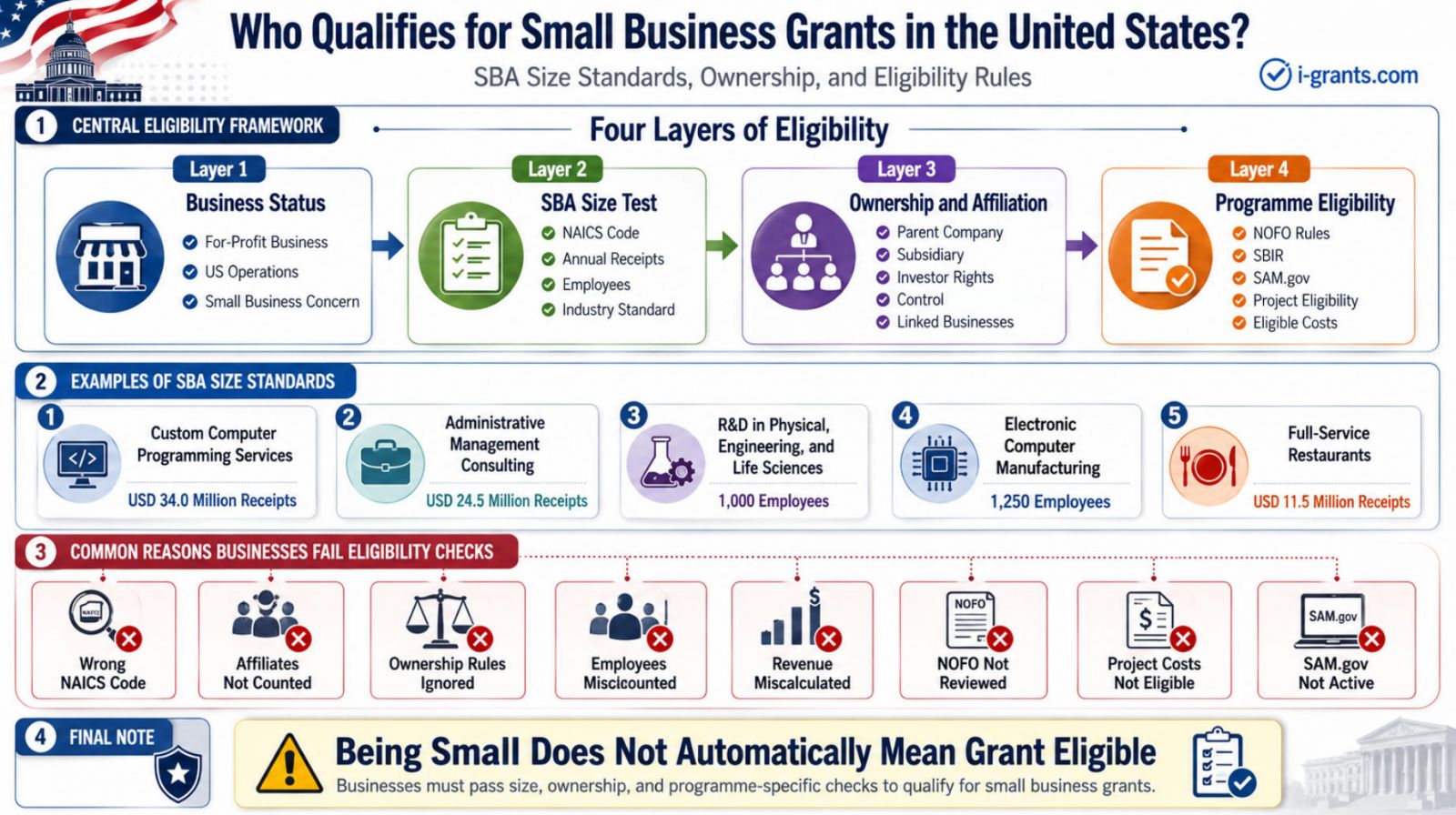
There are therefore several questions to answer before spending time and money on a federal application:
-
Is the applicant a qualifying business concern?
-
Does it meet the applicable SBA size standard?
-
Do ownership, control and affiliation rules change that result?
-
Is a small business actually an eligible applicant under the specific NOFO?
-
Does the programme impose additional ownership, location, research or other conditions?
-
Is the proposed project, activity and budget itself eligible?
Grants.gov explicitly warns applicants to read the eligibility section of each NOFO. Although Small Businesses are a recognized applicant category and may receive grants where the relevant opportunity permits them, eligibility ultimately depends on the individual funding opportunity.
The result is simple but important:
Being an SBA-qualified small business is not the same as being eligible for every federal business grant.
SBA Size Standards Are Not Based on One Universal "500 Employee" Rule
The idea that every U.S. small business must have fewer than 500 employees is wrong.
SBA maintains industry-specific size standards tied primarily to the North American Industry Classification System, or NAICS. A size standard represents the largest size a business, including applicable subsidiaries and affiliates, may reach while remaining classified as small for purposes to which the SBA standard applies. SBA states that these standards are usually based on average annual receipts or average number of employees, and that the definition of small varies by industry.
Some industries therefore have revenue-based thresholds. Others use employee counts. Certain financial industries use assets, while petroleum refining includes a special refining-capacity measure. SBA's 2025 size-standards rulemaking noted that its system contained 102 different size-standard levels across hundreds of NAICS industries and subindustries.
Table 1. Examples of Current SBA Size Standards by Industry
| NAICS Code | Industry | Current Size Standard |
|---|---|---|
| 236220 | Commercial and Institutional Building Construction | $45.0 million average annual receipts |
| 334111 | Electronic Computer Manufacturing | 1,250 employees |
| 541511 | Custom Computer Programming Services | $34.0 million average annual receipts |
| 541611 | Administrative Management and General Management Consulting Services | $24.5 million average annual receipts |
| 541715 | Research and Development in the Physical, Engineering, and Life Sciences, except Nanotechnology and Biotechnology, base standard | 1,000 employees |
| 722511 | Full-Service Restaurants | $11.5 million average annual receipts |
The differences are substantial. A computer manufacturer with 1,100 employees can potentially remain "small" under an employee-based standard, while a consulting business is tested against receipts instead of headcount. A restaurant has a much lower revenue ceiling than a commercial construction company.
This is why applicants should never begin an eligibility assessment with the question, "Do we have fewer than 500 employees?"
They should begin with: "Which NAICS industry and size standard apply to this opportunity?"
A company may conduct activities that fit several NAICS codes, but that does not give it unrestricted freedom to select the most favorable threshold. For a federal opportunity, applicants need to determine the industry classification relevant to that programme, solicitation or activity and apply the corresponding standard.
How SBA Calculates Annual Receipts
Revenue-based size standards are more sophisticated than simply looking at last year's sales.
Under 13 CFR § 121.104, for most size determinations covered by the general rule, a business that has operated for at least five completed fiscal years generally calculates average annual receipts by adding receipts for its five most recently completed fiscal years and dividing by five. A concern operating for fewer than five completed fiscal years generally annualizes its receipts based on the period it has actually been in business. Different measurement options apply to certain SBA loan, disaster, surety bond and SBIC programs.
Receipts can encompass substantially more than conventional product sales. SBA rules rely heavily on tax-return concepts and include income received from business activities subject to specified inclusions and exclusions.
More importantly, an applicant cannot necessarily calculate size using only the receipts appearing under its own corporate name.
If the concern has affiliates, SBA generally adds the average annual receipts of those affiliates to the applicant's receipts. Acquisitions can also affect the calculation across the applicable measurement period.
Consider a hypothetical software company with average annual receipts of $22 million under a $34 million size standard. On its own, the company appears to qualify. If SBA determines that another company with $18 million in average annual receipts is its affiliate, the relevant combined figure could become $40 million. The applicant could then exceed the size standard even though neither its website nor its standalone financial statements make it look like a large company.
How SBA Counts Employees
Employee-based standards have their own traps.
For purposes of 13 CFR § 121.106, SBA counts individuals employed on a full-time, part-time or other basis. Employees supplied through certain temporary agencies, professional employer organizations and leasing arrangements can also be included. Uncompensated volunteers are excluded.
When an employee-based standard applies, SBA generally calculates the average using employee counts for each pay period during the preceding completed 24 calendar months. A company operating for less than 24 months uses the period during which it has been in business.
A particularly important point is that part-time and temporary employees are counted the same as full-time employees for this calculation. The SBA test is therefore not simply a full-time-equivalent, or FTE, calculation.
Employees of domestic and foreign affiliates can also be included. If a concern has an affiliate, the affiliate's average employees are generally added to those of the applicant.
Table 2. How SBA Calculates Business Size
| Issue | General SBA Treatment | Practical Risk for Applicants |
|---|---|---|
| Revenue-based standard | Usually average annual receipts over the applicable measurement period | Looking only at the most recent year's revenue can produce the wrong result |
| Business operating less than five years | Receipts are generally annualized for the period in business | A young company cannot assume that limited operating history automatically keeps it below the threshold |
| Employee-based standard | Average employees across pay periods during the preceding completed 24 calendar months | Current headcount alone may not determine size |
| Part-time employees | Counted the same as full-time employees for employee-count purposes | Using FTE figures can understate SBA size |
| Temporary employees | May be counted | Outsourced staffing does not necessarily remove workers from the calculation |
| Affiliates | Affiliate receipts or employees are generally aggregated | A small standalone company may become other than small after affiliation analysis |
| Acquired affiliates | Historical receipts or employees may be included under applicable rules | Recent M&A activity can unexpectedly affect eligibility |
Affiliation Can Turn a Small Company Into a Large One
Affiliation is one of the most important and misunderstood parts of federal small-business eligibility.
Under SBA's general affiliation principles, concerns are affiliates when one controls or has the power to control the other, or when a third party has the power to control both. SBA explicitly states that the power to control can be enough even when that power is not actually exercised.
This means a company cannot assess eligibility by looking only at its legal name, direct payroll and standalone revenue.
SBA may examine ownership, management, previous relationships, contractual relationships and other factors. Control can also be affirmative or negative.
Ownership Does Not Always Require More Than 50%
Holding 50% or more of voting stock is an obvious control situation, but minority ownership can also matter.
Under the current affiliation rules, SBA can consider a block of voting stock controlling when it is large relative to other ownership blocks. Where several minority holdings are approximately equal and large relative to other holdings, presumptions of control may also arise.
For founders and investors, this makes the cap table only the beginning of the analysis.
Voting agreements, board composition, shareholder rights and other governance arrangements can be equally important.
Minority Investor Rights and Negative Control
A minority investor does not need to run day-to-day operations to create an SBA control issue.
Negative control can exist when a minority shareholder has authority under the company's governance documents to prevent a quorum or block actions of the board or shareholders.
This issue became more relevant to venture-backed startups after SBA clarified its regulations in a final rule published in December 2024. The current rule expressly recognizes several extraordinary corporate actions that a minority investor may be permitted to block without SBA treating that protection, by itself, as negative control. Examples include adding a new equity stakeholder, dissolution, sale of the company or all assets, a merger, bankruptcy and other extraordinary protections crafted solely to protect the minority investment rather than interfere with ordinary business operations.
The distinction matters.
A venture investor's right to protect itself from a sale of the entire company is different from a right that effectively allows the investor to control ordinary budgets, staffing, contracts or operational decisions.
Startup founders should therefore review investor-rights agreements and protective provisions before assuming that minority ownership has no effect on SBA status.
Stock Options and Convertible Securities Can Matter Before Conversion
SBA may also give present effect to certain stock options, convertible securities and agreements to merge when assessing control.
Under 13 CFR § 121.103, SBA generally treats qualifying options, convertible securities and agreements in principle to merge as though the relevant rights had already been exercised. Negotiations that merely contemplate a possible future transaction are treated differently, and speculative or unenforceable rights may not receive present effect.
For startups that have raised money through convertible instruments, this is another reason to conduct an affiliation review based on legal rights, not merely the ownership percentages displayed in the company's current cap-table summary.
Common Management Can Create Affiliation
Two companies do not need to have a traditional parent-subsidiary relationship to be affiliates.
Affiliation may arise where officers, directors, managing members or partners who control one concern also control the management or board of another.
This can affect entrepreneurs operating multiple related companies, founders who have created spin-offs, family businesses, investment structures and groups that share senior managers.
The underlying question is control, not simply whether each business has been incorporated as a separate legal entity.
Economic Dependence and the 70% Rule
Another lesser-known SBA rule concerns economic dependence.
SBA may presume an identity of interest where a business received 70% or more of its receipts from another concern over the previous three fiscal years. The presumption can be rebutted, and SBA's regulation itself gives examples where a young company with only a small number of contracts may be able to show that it is not actually dependent in the relevant sense.
For a mature company that receives most of its revenue from one customer, however, the analysis can become much more serious.
This means that customer concentration can sometimes become an eligibility issue, not merely a commercial-risk metric.
SBA also recognizes certain identity-of-interest situations involving close family relationships when the businesses conduct business with each other or share loans, resources, equipment, locations or employees. Such presumptions can be rebutted where the companies can demonstrate a clear line of fracture.
Foreign Ownership Does Not Create One Universal Answer
Another common misconception is that every company seeking U.S. federal small-business funding must be at least 51% owned by U.S. citizens.
That is too broad.
The general SBA definition of a business concern does not establish one universal 51% U.S.-citizen ownership rule for every federal assistance opportunity. Under 13 CFR § 121.105, the general definition focuses on a for-profit concern with a place of business in the United States that operates primarily in the United States or makes a significant contribution to the U.S. economy through factors such as taxes or the use of American products, materials or labor.
Specific programmes can then impose additional ownership and control requirements.
This distinction is crucial for international founders, immigrant entrepreneurs and U.S. startups with foreign investors.
A foreign shareholder does not automatically answer the federal-grant eligibility question. Applicants need to identify the rule that governs the particular funding programme.
Some NOFOs may permit broader categories of organizations. Others restrict eligibility to U.S. entities or particular types of small businesses. Grants.gov also notes that authorizing legislation and agency policies determine whether foreign organizations may apply for a particular grant.
SBIR and STTR Have Their Own Ownership and Size Rules
SBIR and STTR provide one of the clearest examples of why applicants should not confuse general SBA definitions with programme-specific eligibility.
Under the current SBA regulation governing SBIR and STTR, an awardee together with its affiliates must not have more than 500 employees.
This is a real 500-employee rule. But it is a rule for SBIR/STTR, not proof that 500 employees is the universal threshold for every American small business.
Ownership is also more restrictive.
For a standard SBIR eligibility route, the concern generally must be more than 50% directly owned and controlled by qualifying individuals who are U.S. citizens or permanent resident aliens, qualifying small business concerns, specified tribal or Native entities, or an allowed combination of them. SBIR also permits a separate route involving majority ownership by multiple venture capital operating companies, hedge funds or private equity firms where the participating agency elects to use the relevant statutory authority. STTR has its own ownership provisions.
The SBIR/STTR rules also contain their own detailed affiliation provisions covering ownership, convertible securities, common management, economic dependence and venture-capital portfolio relationships.
Table 3. General SBA Small Business Status vs Programme-Specific Federal Eligibility
| Question | General SBA Size Analysis | SBIR/STTR Example | Specific Federal NOFO |
|---|---|---|---|
| Is there one universal 500-employee limit? | No | Yes, awardee plus affiliates must not exceed 500 employees | Depends on the programme |
| Does NAICS matter? | Usually yes for industry-based size standards | Special SBIR/STTR rules apply | May be relevant depending on the opportunity |
| Are affiliates relevant? | Yes | Yes | Depends on governing programme rules |
| Is 51% U.S.-citizen ownership universally required? | No | Specific U.S. ownership and control rules apply | Depends on the NOFO and underlying authority |
| Does being "small" create automatic grant eligibility? | No | No | No |
| Must the project itself satisfy programme requirements? | Not determined by size status | Yes | Yes |
| Can registration requirements separately block an application? | Yes | Yes | Yes |
The important takeaway is that programme-specific eligibility sits on top of the general small-business analysis.
Women-Owned and Veteran-Owned Status Is Not a Universal Grant Entitlement
Federal small-business policy includes programmes and certifications for Women-Owned Small Businesses, Service-Disabled Veteran-Owned Small Businesses and other categories. But these designations should not be presented as automatic qualification for federal grants.
For example, the Women-Owned Small Business programme is fundamentally a federal contracting programme. Its certification and ownership rules govern access to qualifying contracting opportunities, not every discretionary grant listed on Grants.gov. Likewise, veteran small-business certification operates within a specific federal procurement framework.
A business may encounter a funding opportunity specifically designed for women, veterans, underserved entrepreneurs or another target group, but the legal authority and NOFO must establish that eligibility.
This distinction matters because many commercial websites blur grants, procurement set-asides, loans and technical assistance into one category of "government funding."
For an applicant, they are not interchangeable.
The Eligible Beneficiary May Not Be the Eligible Applicant
Another important distinction appears in programmes designed to support businesses indirectly.
A federal programme may clearly benefit small businesses while making the actual federal award to a state agency, nonprofit organization, university, intermediary or other institution. The intermediary then uses the award to provide grants, services, technical assistance or another form of support to companies.
In that structure, the company is a beneficiary, not necessarily the federal applicant.
This is one reason businesses should not assume that the appearance of words such as "small business development," "entrepreneurship" or "rural business" in a programme title means that a for-profit company can submit the federal application directly.
The NOFO's eligible-applicant section remains decisive. Grants.gov expressly advises applicants to verify this section before preparing an application.
SAM.gov Registration and the Unique Entity ID Do Not Prove Eligibility
Once a business finds an opportunity for which it appears eligible, administrative registration becomes another gate.
Organizations seeking to apply directly for federal awards as prime awardees need an entity registration in SAM.gov. A Unique Entity ID is assigned as part of that registration. SAM.gov also allows an entity to obtain only a Unique Entity ID without completing full registration, but SAM.gov makes clear that an entity with only a UEI cannot apply directly for federal awards.
An active registration must be renewed every 365 days. SAM.gov currently warns that registration can take up to 10 business days to become active.
Applicants should therefore distinguish three different concepts:
Legal eligibility determines whether the organization is permitted to receive the award.
Registration readiness determines whether the organization has completed the administrative prerequisites for applying.
Competitive merit determines whether the proposal is strong enough to win.
Passing one does not guarantee the others.
A business can be fully eligible but unable to submit because its SAM registration has expired. It can have an active SAM registration but be legally ineligible for the NOFO. And it can satisfy both conditions but submit a proposal that does not meet the programme's technical, budget or evaluation requirements.
SBA Size Standards Are Changing, but Proposed Thresholds Are Not Current Thresholds
Applicants also need to pay attention to the current SBA rulemaking cycle.
On August 22, 2025, SBA proposed increases to 263 monetary-based small-business size standards, covering 259 receipts-based industries and four assets-based industries. The proposal forms part of SBA's third five-year review of size standards under the Small Business Jobs Act. SBA is required to review size standards periodically and adjust them where appropriate to reflect industry and market conditions.
SBA estimated that more than 11,200 firms in the 259 industries affected by proposed receipts-based increases could become newly classified as small if the proposal were adopted. Approximately another 110 firms in four financial industries could qualify under proposed increases to asset-based thresholds.
These estimates concern access to federal small-business assistance broadly, including SBA financial assistance and federal procurement programmes. They should not be interpreted as 11,200 businesses suddenly becoming eligible for federal grants.
The proposed rule also illustrates how consequential size-standard revisions can be. SBA estimated that 324 firms active in federal contracting could newly obtain small-business status under the proposed thresholds and potentially receive approximately $647 million annually in federal small-business contracts. Again, this is a regulatory impact estimate concerning contracting, not a grant allocation.
As of August 17, 2026, however, applicants should be careful not to treat the proposed thresholds as already effective.
The SBA's official Table of Size Standards page, last updated July 30, 2026, continues to identify its current table as effective March 17, 2023. At the same time, SBA's regulatory agenda published on August 14, 2026 lists the monetary-based size-standards rule, RIN 3245-AI12, at the Final Rule Stage.
Based on those official sources, the practical conclusion is that applicants should continue using the currently effective published SBA standards until a final rule establishing new thresholds is published and becomes effective.
A proposed rule, a planned final action and an effective regulation are three different things.
A Practical Eligibility Audit Before Applying
Before committing staff time, consultants or grant-writing resources to a U.S. federal opportunity, a small business should complete a structured eligibility review:
-
<input disabled="disabled" type="checkbox" /> Identify the exact federal programme and current NOFO, not merely the general programme name.
-
<input disabled="disabled" type="checkbox" /> Confirm that small businesses or the applicant's specific legal entity type are eligible to apply directly.
-
<input disabled="disabled" type="checkbox" /> Determine the relevant NAICS code and applicable SBA size standard.
-
<input disabled="disabled" type="checkbox" /> Calculate receipts or employees using the correct SBA measurement period and methodology.
-
<input disabled="disabled" type="checkbox" /> Review parent companies, subsidiaries, investors, voting rights, management relationships, convertible securities, family businesses and major commercial dependencies for possible affiliation.
-
<input disabled="disabled" type="checkbox" /> Check programme-specific ownership, citizenship, location, research, sector and other requirements rather than assuming that general SBA status is enough.
-
<input disabled="disabled" type="checkbox" /> Confirm that SAM.gov registration is active and that all required federal and agency-specific registrations can be completed before the deadline.
-
<input disabled="disabled" type="checkbox" /> Separately test the proposed project, activities, costs, timing and use of funds against the NOFO.
For simple owner-operated companies, the analysis may be relatively straightforward. For venture-backed startups, holding-company structures, family groups, businesses with subsidiaries, recently acquired companies or organizations heavily dependent on one customer, an affiliation assessment can be one of the most important parts of the funding process.
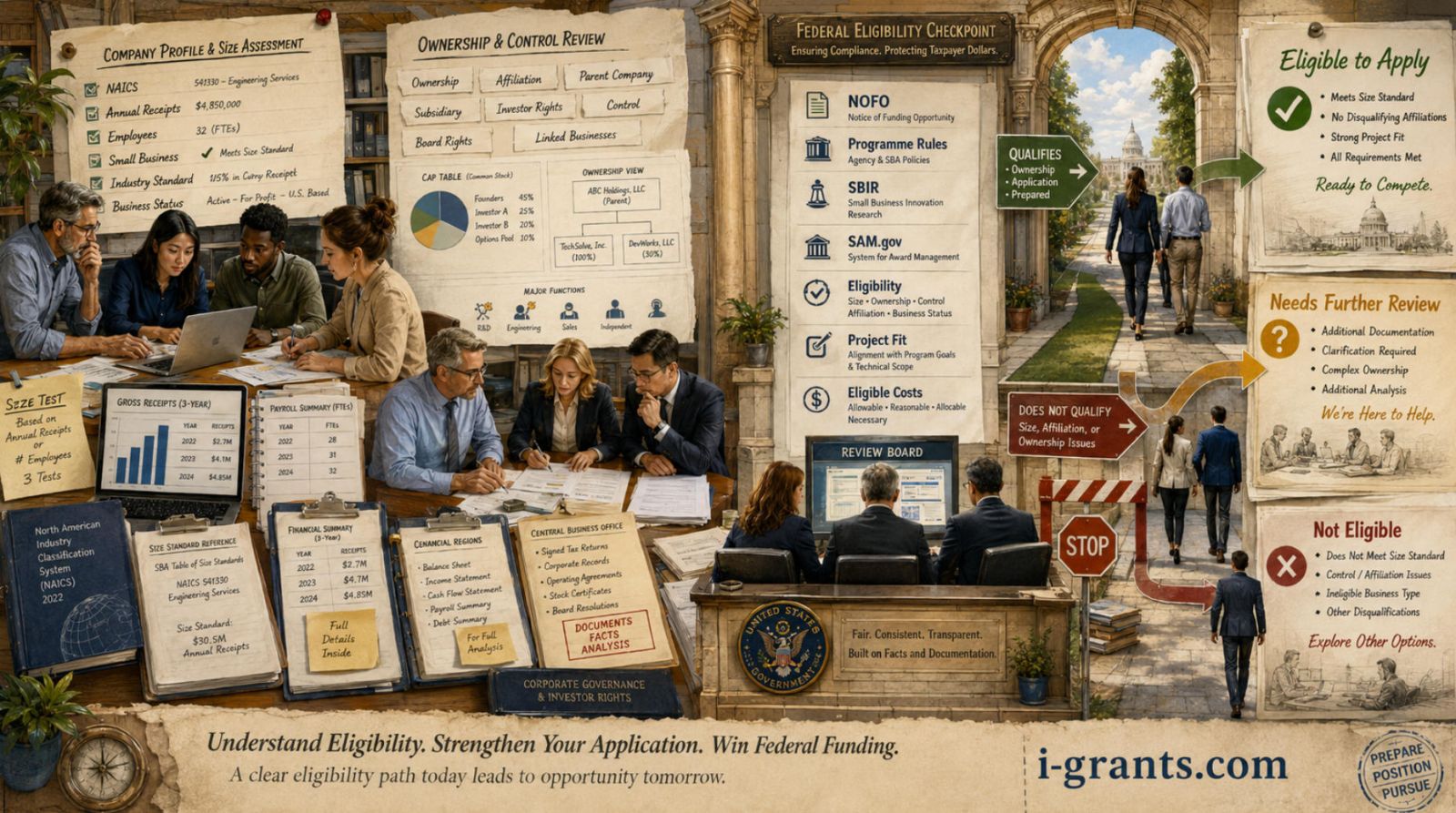
The Four-Layer Test for Small Business Grant Eligibility
A useful way to understand U.S. federal grant eligibility is to treat it as four consecutive tests.
Layer 1: Entity and size. The company must satisfy the relevant definition of a business concern and, where SBA size rules apply, fit within the applicable size standard.
Layer 2: Ownership and affiliation. The applicant needs to determine whether related businesses, investors or other parties must be treated as affiliates and whether a programme imposes additional ownership or control rules.
Layer 3: Opportunity eligibility. The current NOFO must actually allow that type of company to apply. The existence of a government programme does not mean that a competition is currently open, and an open competition does not mean that every small business is eligible.
Layer 4: Project eligibility. The applicant's proposed work, location, technology, beneficiaries, budget, costs and project timing must satisfy the programme's substantive rules.
Only after all four layers are passed does it make sense to evaluate the competitiveness of the proposal itself.
Final Takeaway
Qualifying for small business grants in the United States is not a matter of checking one employee threshold.
The federal system is built around industry-specific SBA size standards, detailed calculations of receipts or employees, affiliation and control rules, programme-specific eligibility requirements and the terms of individual Notices of Funding Opportunity.
A company with fewer than 500 employees may be too large for its industry. A company with more than 500 employees may still meet a different SBA industry standard. A business that qualifies as small may still be excluded from a particular grant. A startup that is small under its ordinary NAICS threshold may face a special 500-employee and ownership test under SBIR or STTR. And an applicant that passes every legal test still needs an active registration and an eligible project.
For businesses searching for federal funding in 2026, the safest sequence is therefore:
find the opportunity, identify the applicable size rule, calculate the business together with relevant affiliates, test ownership and control, read the current NOFO, and only then invest in the application.
That approach does more than prevent an ineligible submission. It helps businesses focus their grant-search resources on opportunities they can actually win.