

 Français
  Deutsch
  Українська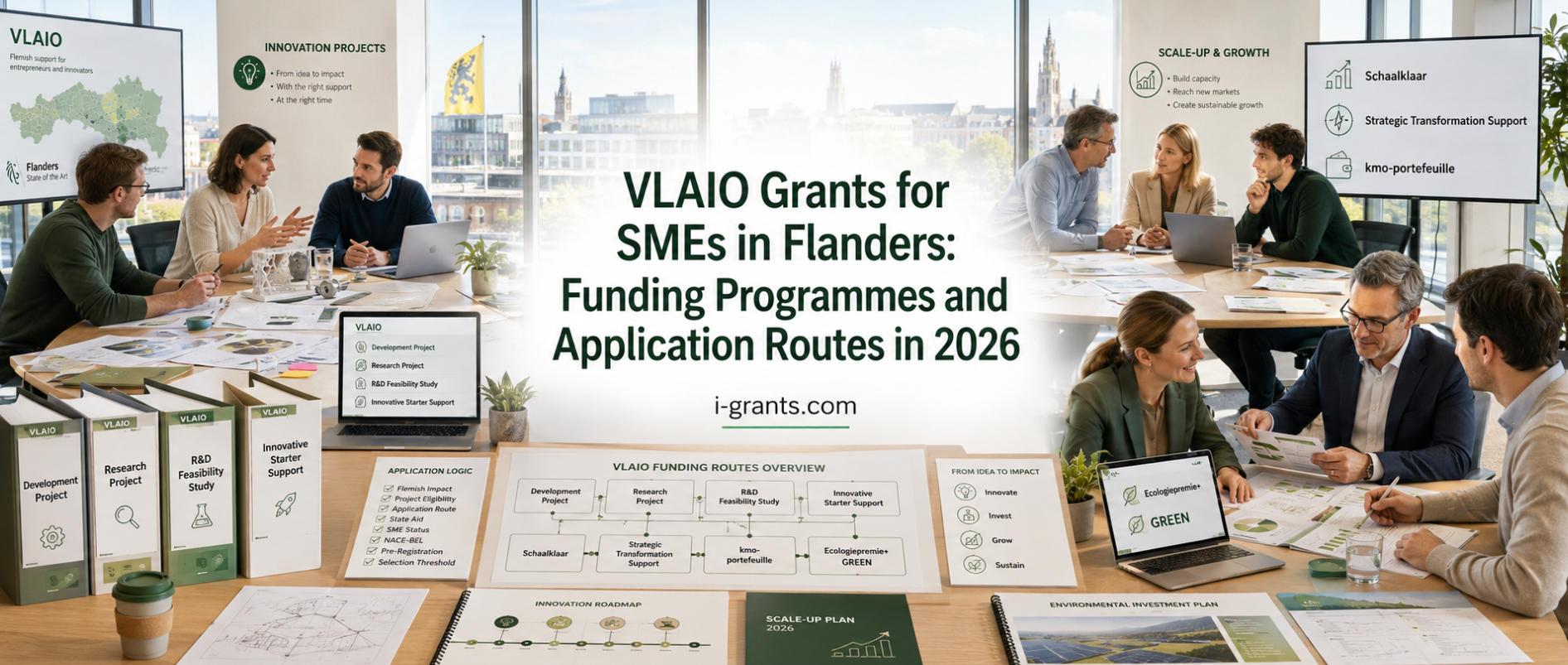
For SMEs in Flanders, VLAIO is one of the most important gateways to public business support. But VLAIO is not a single grant programme, and searching for "a VLAIO grant" can lead businesses in the wrong direction.
The Flanders Innovation & Entrepreneurship agency administers and guides companies through multiple support routes covering research, product and process development, feasibility work, innovative startups, scaling, strategic transformation, cybersecurity, training and environmental investment. Some programmes accept applications throughout the year. Others operate through competitive calls, mandatory pre-registration, approved service providers or VLAIO partner organisations.
The difference became even more important in 2026. New selection thresholds apply to Research and Development Projects, updated application and cost-model documents came into use in July, the kmo-portefeuille was substantially narrowed, Schaalklaar operates through a competitive call with mandatory pre-registration, a continuous defence innovation call is active, and the previously well-known kmo-groeisubsidie is no longer available for new applications.
For applicants, the practical lesson is straightforward:
Do not start by asking which VLAIO grants exist. Start by identifying the type of project, the uncertainty you need to resolve, the stage of the company and the funding route that matches that problem.
What is VLAIO and what does it fund?
VLAIO, Flanders Innovation & Entrepreneurship, is the Flemish government's central agency for entrepreneurship and innovation support. Its funding landscape stretches well beyond conventional innovation grants. Companies can encounter support for research and development, feasibility studies, innovative startups, scaling, environmental investment, cybersecurity, professional training and strategic transformation.
This does not mean that every Flemish SME is eligible for every VLAIO programme. Requirements differ considerably.
Some schemes are specifically for small companies. Some accept medium-sized and large enterprises as well. Some require an operational establishment in the Flemish Region. Others assess where the future economic value of the project will be anchored. NACE-BEL activity, enterprise size, linked-company relationships, financial condition, project costs and State aid rules can all affect eligibility.
The application route is also part of eligibility in practice. A business can have an excellent project but still approach the wrong VLAIO instrument, miss a pre-registration phase, begin expenditure too early or fail to demonstrate sufficient economic impact in Flanders.
Table 1. Main VLAIO Funding Routes for SMEs in Flanders in 2026
| Programme | Main purpose | Typical support | 2026 application route |
|---|---|---|---|
| Development Project | Development of innovative products, processes, services or business concepts involving genuine uncertainty and new knowledge | Generally 25 to 50% of accepted costs, with higher rates possible for qualifying cooperation; minimum support €25,000, maximum €3 million | Applications can be submitted throughout the year and are individually evaluated |
| Research Project | Knowledge-intensive R&D addressing substantial research and technological uncertainty | Support depends on research content and company size; can reach 60%, or 70% in certain qualifying cooperation projects; minimum support €100,000 | Continuous application route with individual evaluation |
| R&D Feasibility Study | Testing whether an ambitious innovation concept can become a supportable follow-up project | 40 |