

 Français
  Deutsch
  Українська
Corporate foundations can finance projects that conventional business grants and public funding schemes do not adequately address. Employment programmes for disadvantaged people, social enterprises, circular economy initiatives, and environmental restoration projects may all benefit from corporate philanthropy. However, obtaining this support often requires more than demonstrating social impact.
VINCI, ENGIE, and Veolia illustrate three distinct approaches to corporate grantmaking. Their foundations support projects that combine social value with practical implementation, but they differ considerably in their eligibility rules, funding levels, geographical coverage, and application procedures.
VINCI Foundation for the City combines financial assistance with employee sponsorship. The Fondation Agir Pour l’Emploi ENGIE (FAPE ENGIE) finances investments that help disadvantaged people enter or return to employment. The Veolia Foundation supports environmental, humanitarian, and social projects, with an established international portfolio and substantial investment grants.
These distinctions matter to applicants. A French nonprofit association, a commercial social enterprise, and an environmental organisation operating elsewhere in Europe may pursue similar objectives while facing completely different eligibility requirements.
This guide examines the three funding mechanisms using official programme conditions, published financial results, and documented grant recipients. Application information reflects the position as of September 17, 2026. Historical awards are distinguished from current opportunities, and published grant amounts should not be interpreted as guaranteed funding.
1. Three Corporate Foundations, Three Different Funding Models
VINCI, ENGIE, and Veolia are internationally recognised companies, but their grantmaking arrangements are not interchangeable.
VINCI Foundation for the City primarily supports nonprofit organisations implementing social and professional inclusion projects in France. Its approach combines financial assistance with the involvement of employees who contribute time and expertise.
FAPE ENGIE operates through a structured application and committee-selection process. It specialises in employment-related investments and considers the social impact and economic sustainability of the organisations seeking support.
The Veolia Foundation has a broader international scope. It supports humanitarian and development initiatives, environmental protection, and employment-related social projects. Employee sponsorship is an essential component of its grantmaking process, and the foundation publishes a relatively clear typical funding range.
The first question for any applicant is therefore not which company offers the largest grant. It is whether the organisation, project, expenditure, and application pathway correspond to the foundation's actual requirements.
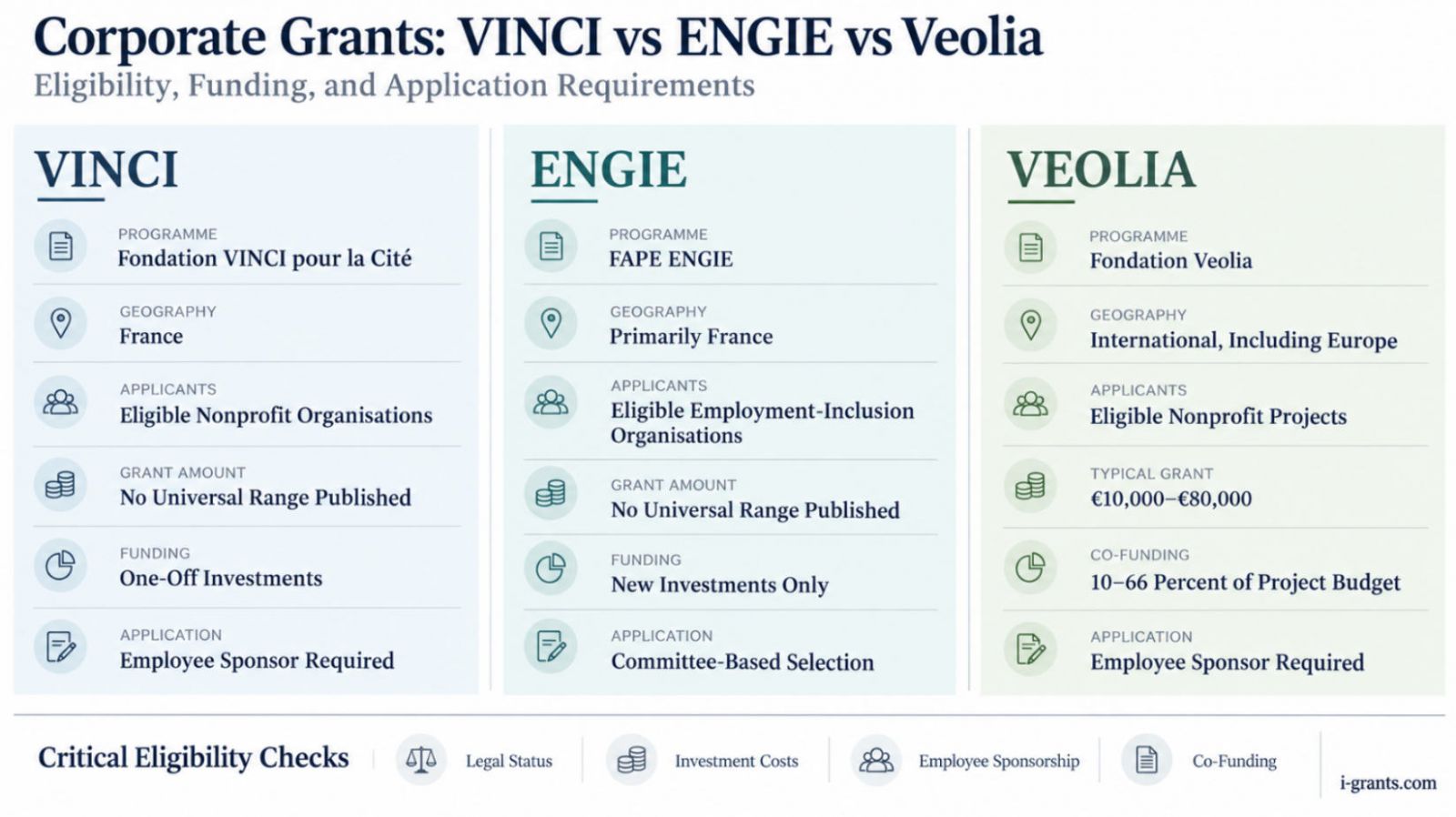
Table 1. VINCI, ENGIE, and Veolia Grant Programme Comparison
| Parameter | VINCI Foundation for the City | FAPE ENGIE | Veolia Foundation |
|---|---|---|---|
| Official programme | Fondation VINCI pour la Cité | Fondation Agir Pour l’Emploi ENGIE | Fondation Veolia |
| Principal focus | Social and professional inclusion, housing, mobility, community cohesion | Employment, professional integration, entrepreneurship among unemployed people | Humanitarian development, environment and biodiversity, employment and social inclusion |
| Geography | France under the French foundation's application rules | Primarily France under the documented programme | International, with Europe among the priority regions |
| Eligible applicants | Independent nonprofit associations, foundations and endowment funds meeting French public-interest requirements | Qualifying employment-integration organisations, local services and entrepreneurship-support structures | Organisations implementing eligible nonprofit projects serving the public interest |
| Funding amount | No universal grant range published | No universal grant range published | Most grants fall between €10,000 and €80,000 |
| Funding mechanism | Investment grant combined with VINCI employee sponsorship | Investment grant awarded through selection and executive committees | Project grant combined with Veolia employee sponsorship |
| Corporate employee sponsor | Required for a funded project | No equivalent universal employee-sponsorship requirement | Required |
| Co-funding | No universal published percentage | No universal published percentage | Veolia contribution must represent between 10 and 66 percent of the total project budget |
| Application status on September 17, 2026 | Online application available; no universal annual deadline published | Next published deadline: December 18, 2026 | General rules published, but the application page directs applicants to return in 2027 |
The geographical distinction is particularly important. VINCI's international philanthropic network should not be confused with the eligibility rules of its French foundation. Similarly, ENGIE's international business operations do not establish worldwide eligibility for FAPE ENGIE.
Veolia has a more explicitly international funding model, but its geographical priorities and sponsorship requirements still limit access. The existence of a supported project in one European country does not automatically establish eligibility for every organisation in that country.
2. VINCI Foundation for the City: Funding Combined With Employee Sponsorship
Fondation VINCI pour la Cité was established in 2002 to support initiatives addressing social and professional exclusion. Its funding model reflects the connection between VINCI's local operations and the communities surrounding them.
The foundation focuses on four areas: access to employment and career guidance, social connections in disadvantaged communities, social mobility, and housing inclusion.
Employment-related projects may include initiatives that help disadvantaged people develop professional skills, prepare for work, or overcome barriers to entering the labour market.
Housing projects can address access to accommodation or support vulnerable households in maintaining stable housing. Social mobility initiatives may help people overcome transport barriers that prevent them from accessing employment.
Community projects can include educational, cultural, recreational, or social initiatives that strengthen relationships in disadvantaged urban neighbourhoods and rural communities.
However, alignment with one of these themes does not automatically establish eligibility.
Strict requirements concerning legal status
VINCI supports nonprofit associations, foundations, and endowment funds that meet its public-interest criteria.
Eligible organisations must have independent governance. Public or semi-public structures, religious organisations, and organisations with political affiliations do not meet the foundation's stated requirements.
A particularly important restriction concerns commercial activity.
An organisation can generate income while maintaining nonprofit status, but its commercial activities must not represent more than 30 percent of its budget under VINCI's published criteria.
Commercial companies are excluded even when they have a recognised social mission.
This creates a distinction between an association running an employment programme and a commercial enterprise delivering similar services.
VINCI also explicitly excludes several categories of organisations, including certain employment-integration enterprises operating under commercial legal forms, temporary employment-integration companies, intermediary associations, approved training organisations, and social real estate agencies.
Applicants should therefore establish their legal eligibility before investing substantial resources in a proposal.
An organisation's social purpose does not override the foundation's legal-status requirements.
What VINCI actually finances
VINCI's grants are primarily intended for one-off investments rather than recurring expenditure.
Eligible material investments can include vehicles, tools, computer equipment, furniture, and improvements to premises.
Certain intangible investments are also eligible, including website development and training directly connected to the supported project.
Construction and renovation expenditure is subject to additional restrictions. The foundation may finance such work when it is performed by an employment-integration structure or when the applicant owns the premises.
Consequently, a nonprofit organisation renting a building should not assume that a planned renovation automatically qualifies.
The distinction between an investment and an operating expense is equally important. Purchasing computers for a new training facility is different from requesting funding for the organisation's regular administrative salaries.
Although VINCI has supported a variety of project-specific activities, its general programme conditions explicitly exclude recurring operating expenditure.
A credible application should identify the asset or investment being financed, demonstrate its relationship to the proposed social activity, and explain how the organisation will maintain it after the grant has been spent.
Employee sponsorship is part of the funding mechanism
VINCI's distinctive feature is its employee-sponsorship model.
Projects receiving financial assistance must be supported by one or more VINCI employees who act as sponsors.
Their involvement is not limited to recommending an application. They may contribute professional expertise, practical assistance, technical advice, or access to relevant networks.
The foundation expects sponsors to accompany organisations during the partnership, including the application process and the assessment conducted after the first year.
Geographical proximity between the employee and the applicant is important because the foundation intends sponsorship to involve meaningful interaction.
An organisation can begin an online application without having already identified a VINCI sponsor. However, the foundation explicitly warns that processing will take longer if no sponsor has been found.
This makes sponsor identification a practical part of application preparation.
For example, an association planning to renovate a social workshop could investigate whether a nearby VINCI business has employees with construction, engineering, logistics, or project-management expertise.
The organisation would still need to satisfy the foundation's eligibility rules, but relevant employee involvement could provide the basis for the required sponsorship relationship.
3. VINCI Funding Results: What the Published Figures Actually Show
VINCI provides sufficient historical information to demonstrate the scale of its philanthropic activities. However, figures reported for its French foundation must be distinguished from those covering its broader international network.
The French Fondation VINCI pour la Cité reported the following results for 2024:
369 supported projects, €4.5 million in funding, and 1,837 instances of VINCI employee engagement.
The foundation's activity was distributed across its four intervention areas, with employment and career guidance accounting for 52.7 percent, social connections for 34.6 percent, solidarity mobility for 9.2 percent, and housing inclusion for 3.5 percent.
These percentages describe the distribution of activities, not a guaranteed allocation of grant funding for future applicants.
VINCI's group-level reporting for 2025 provides a broader perspective.
It records 633 projects supported by Fondation VINCI pour la Cité across its international presence in 19 countries. The group's foundations reported more than 2,500 employee-engagement activities and €7.2 million in financial assistance addressing exclusion and promoting inclusion.
The €7.2 million figure concerns the wider network of VINCI foundations, rather than exclusively the French grant programme discussed in this article.
It would therefore be misleading to treat the difference between €4.5 million in 2024 and €7.2 million in 2025 as growth in the French foundation's annual grant budget.
Different reporting populations are involved.
La Cravate Solidaire Marseille: a documented multi-year funding relationship
La Cravate Solidaire Marseille provides a useful example of how VINCI's financial support can develop over time.
The organisation helps people facing barriers to employment prepare for professional opportunities.
In 2022, VINCI awarded it €6,000 to help establish its premises and create appropriate conditions for receiving its first participants.
The foundation subsequently provided an additional €30,000, distributed across 2024, 2025, and 2026.
The combined assistance therefore reached €36,000.
The partnership also involved sponsorship by a VINCI Autoroutes employee.
This case demonstrates that VINCI's emphasis on one-off investments does not necessarily prevent the development of a longer relationship with a supported organisation.
However, the €36,000 figure represents the total assistance awarded to one organisation across different periods. It is not a standard grant amount or a published funding ceiling.
Jardins de la Voie Romaine: employment and agricultural development
VINCI has also supported Les Jardins de la Voie Romaine, an association combining organic agriculture, local food production, and employment integration.
The organisation operates four organic farms that provide employment-integration activities while producing and distributing agricultural products.
A project listed by VINCI in September 2025 concerned the establishment of a fruit and vegetable processing workshop.
The example illustrates how funding can connect investment in productive infrastructure with a social employment mission.
Rather than financing agricultural expansion simply because farming is environmentally beneficial, VINCI's support relates to a project implemented through an eligible organisation addressing professional integration.
This distinction is essential for agricultural cooperatives and social enterprises assessing whether their projects match the foundation's objectives.
A separate sponsorship award should not be confused with regular grants
In December 2025, VINCI recognised eleven employee sponsors through its first Prix coup de cœur du parrainage associatif.
Their associated organisations received additional grants ranging from €5,000 to €10,000.
These amounts were supplementary awards linked to an employee-sponsorship recognition initiative.
They should not be presented as the standard grant range available to all new applicants.
The initiative nevertheless demonstrates the importance VINCI attaches to sustained employee participation alongside financial support.
4. FAPE ENGIE: Investment Funding Designed Around Employment
ENGIE operates several philanthropic mechanisms. For employment-related grants, the relevant programme is Fondation Agir Pour l’Emploi ENGIE, commonly known as FAPE ENGIE.
It must be distinguished from the broader corporate Fondation ENGIE.
FAPE ENGIE was established in 2013, continuing a tradition of employee-supported solidarity initiatives in the French energy sector.
The foundation operates under the aegis of Fondation de France, which provides financial, accounting, and administrative management.
Its resources include donations from ENGIE employees and retirees, supplemented by contributions from companies within the group.
Under the foundation's stated funding model, participating ENGIE companies match employee donations.
For applicants, however, the principal consideration is not how the foundation collects donations. It is whether the proposed investment directly advances employment and professional integration.
Eligible organisations and employment objectives
FAPE ENGIE supports projects implemented by qualifying employment-integration organisations and other structures that help disadvantaged people enter the labour market.
Its eligibility framework includes employment-integration associations and enterprises, temporary employment-integration companies, intermediary associations, employment and qualification groups, and integration workshops.
Certain local service organisations, neighbourhood associations, and personal-service providers may also qualify.
The foundation additionally supports organisations assisting unemployed people with business creation, including qualifying cooperatives, business incubator structures, and entrepreneurs accompanied through its France Active partnership.
Projects can address employment through a wide range of sectors, including environmental protection, recycling, catering, mobility, housing, personal services, and energy efficiency.
However, the activity must demonstrably contribute to employment or professional integration.
For certain employment-oriented enterprises, including entreprises à but d'emploi and entreprises d'insertion, FAPE ENGIE directs support towards the social component of a project rather than ordinary production activity.
A recycling enterprise, for example, should distinguish investment supporting the integration of disadvantaged workers from equipment purchased exclusively to increase commercial production.
The foundation's funding purpose remains employment inclusion, even when the project operates in an environmentally beneficial industry.
The two principal selection criteria
FAPE ENGIE assesses projects through two central considerations.
The first is the quality of the social approach.
Employment-integration organisations must demonstrate appropriate social and professional support. Local service providers should incorporate training that facilitates sustainable employment, while entrepreneurship-support organisations should accompany unemployed entrepreneurs and provide follow-up after business creation.
Working conditions, professional development, relevant employment agreements, and ongoing support also form part of the assessment.
The second consideration is economic and financial viability.
The foundation expects applicants to demonstrate responsible financial management and a credible operating model.
Its published rules specify that the project's financing should predominantly come from selling products or services rather than relying entirely on subsidies.
This is a significant distinction from grant programmes designed primarily to subsidise free community activities.
An organisation may have a strong social mission but still be unable to demonstrate the economic model expected by FAPE ENGIE.
A proposal should therefore explain both how the investment will support disadvantaged workers and how the resulting activity can remain financially sustainable.
Only new investments qualify
FAPE ENGIE does not provide general operating grants.
Its funding must support a new investment, such as equipment, machinery, vehicles, construction, or improvements to premises.
The foundation also explicitly requires the investment not to have been committed before the application is submitted.
This creates a potentially decisive timing issue.
An organisation planning to purchase a vehicle should submit its application before committing to the purchase. Buying the vehicle first and subsequently seeking reimbursement could make the investment ineligible.
Applicants should also distinguish the date of submitting a proposal from the date on which the funding decision is made.
A submitted application is not a funding commitment. Organisations must still manage procurement timing and financial risk while awaiting a decision.
5. FAPE ENGIE: Verified Grants and Financial Results
FAPE ENGIE's 2025 annual report provides particularly useful evidence because it identifies individual recipients, grant amounts, and the investments supported.
The foundation reported 22 supported projects and €215,000 in grants during 2025.
Dividing the reported funding by the number of projects produces an average of approximately €9,773 per project.
This is an arithmetic average based on the annual results. It is not an officially established standard grant or an indication that future applicants will receive a similar amount.
The published cases show how relatively modest investments can support employment initiatives across different sectors.
Table 2. Verified Grant Recipients and Funding Examples
| Foundation | Recipient and country | Published grant | Funded investment or purpose |
|---|---|---|---|
| VINCI | La Cravate Solidaire Marseille, France | €36,000 in total | Initial €6,000 contribution in 2022 and additional €30,000 distributed across 2024–2026 |
| FAPE ENGIE | Genèses, France | €15,000 | Equipment supporting the launch and development of an employment-integration activity |
| FAPE ENGIE | Singa Nantes, France | €5,000 | Improving the visibility and attractiveness of a social shop |
| FAPE ENGIE | A.C.T.E.S., France | €10,000 | Equipping a workshop associated with electric cargo-bike production |
| FAPE ENGIE | Acti'Val 73, France | €10,000 | Purchasing a van to transport employees |
| FAPE ENGIE | Willa, France | €10,000 | Digital and communications investments supporting unemployed women entering entrepreneurship |
| FAPE ENGIE | Insert-R, France | €10,000 | Purchasing electric gardening equipment |
| FAPE ENGIE | La Brocante Verte, France | €10,000 | Renovating a shop, improving an outdoor nursery area, and adapting a utility vehicle |
| FAPE ENGIE | Métiers à Tisser, France | €12,000 | Purchasing sewing machines for an employment-integration textile activity |
| Veolia | Académie de Renée, France | €30,000 | Establishing a digital learning platform for inclusive electronics-repair training |
| Veolia | Wasser 3.0 gGmbH, Germany | €40,000 | Acquiring and installing technical equipment for cross-border microplastics monitoring |
The figures represent published awards for specific projects. They do not establish future grant entitlements, universal programme limits, or the current availability of funding.
The FAPE ENGIE cases reveal several characteristics of the programme.
First, the financed investments are highly specific. Recipients do not merely receive unrestricted support for their missions. Grants are associated with identifiable equipment, facilities, vehicles, or digital infrastructure.
Second, employment inclusion can take place in sectors not traditionally associated with social assistance.
A.C.T.E.S. combines manufacturing with employment-related objectives, while Insert-R links professional integration to environmentally improved gardening equipment.
La Brocante Verte uses the reuse of plants as a means of employment integration for people experiencing homelessness.
Third, the programme can support organisations facilitating entrepreneurship rather than directly creating jobs through their own commercial activities.
Willa received €10,000 for digital and communications investments associated with supporting unemployed women.
The relevant outcome is not simply the development of a business-support organisation. It is improved access to entrepreneurship and professional opportunities for the intended beneficiaries.
The latest published decisions in 2026
FAPE ENGIE continued its selection activity during 2026.
An executive committee meeting on March 20, 2026, was associated with eight new projects.
A subsequent executive committee meeting on June 19, 2026, concerned nine projects, with the corresponding update published on September 3, 2026.
These announcements establish that the foundation continued making funding decisions during the year.
They should not be added to the 22 projects reported in the 2025 annual report or presented as a complete annual total for 2026.
6. How to Apply to FAPE ENGIE and Understand the Deadline
FAPE ENGIE publishes a structured four-stage application process.
Applicants initially submit the appropriate application form, supporting administrative documents, and a project presentation of no more than four pages describing the social, economic, and financial approach.
Different application forms are available for employment-integration structures, qualifying personal-service organisations, and organisations assisting unemployed people with business creation.
The documents must be submitted electronically through the contact channel identified by the foundation.
The first assessment determines whether the application satisfies the basic eligibility requirements.
An applicant may receive confirmation that the proposal is admissible, a request for missing information, or notice that the project falls outside the foundation's intervention areas.
Eligible proposals then undergo more detailed assessment, including financial examination.
The selection committee determines which applications progress to the executive committee.
The executive committee may approve a grant, approve it subject to additional information, defer a decision, or reject the request.
Following approval, Fondation de France administers payment, subject to the receipt of invoices documenting the relevant purchase or completed work.
Approval should therefore not be confused with immediate, unconditional advance payment.
Organisations must consider their cash-flow capacity and determine how procurement and invoice submission will be handled.
Application calendar as of September 17, 2026
The August 31, 2026, submission deadline has already passed.
The official application page identifies December 18, 2026, as the next deadline.
Applicants should prepare their documentation sufficiently early to allow eligibility checks, investment planning, and completion of the required financial information.
The foundation also states that applications should be submitted at least three months before the relevant executive committee meeting.
Its published calendar contains inconsistent year references for the committee meetings associated with the December deadline.
Consequently, the December 18 application deadline can be reported, but the subsequent decision dates should not be inferred from the inconsistent entries.
Applicants should verify the corrected timetable directly with FAPE ENGIE before making financial commitments dependent on a particular decision date.
7. The Veolia Foundation: Environmental and Social Funding Beyond France
The Veolia Foundation was established in 2004 and operates across three principal areas: humanitarian emergencies and development, environmental conservation and biodiversity, and social inclusion through employment.
Its approach is closely connected to Veolia's professional expertise in water management, waste treatment, environmental services, and resource recovery.
The foundation's funding priorities are more specific than a general commitment to sustainability.
Humanitarian projects may address access to essential services, particularly water, sanitation, and waste management in developing countries.
Environmental initiatives focus particularly on protecting water resources.
Employment projects are expected to connect with the professional activities and expertise of the Veolia group.
The foundation prioritises projects in several international regions, explicitly including Europe.
However, the presence of Europe on its geographical priority list does not constitute an unrestricted eligibility guarantee for every European applicant.
Projects must also meet thematic, financial, sustainability, and employee-sponsorship requirements.
Funding amounts and co-funding conditions
The Veolia Foundation publishes a typical project funding range of €10,000 to €80,000.
Its contribution must represent at least 10 percent and no more than 66 percent of the total project budget.
These conditions make the foundation different from donors that may finance an entire project.
Consider an illustrative project with a total budget of €100,000.
A request for €60,000 from Veolia would represent 60 percent of the budget and would fall within the published proportional limits and typical grant range.
The applicant would still need to account for the remaining €40,000.
This calculation does not mean that the foundation would automatically approve a €60,000 request. It simply demonstrates how the co-funding rule operates.
A credible proposal should identify the entire financing package, including the applicant's own contribution and funding from other sources.
Where external contributions remain unconfirmed, the application should distinguish secured funds from funding that is still being sought.
The foundation primarily finances investment expenditure.
A limited training component may be eligible when it contributes to the project's long-term sustainability.
By contrast, applicants should not assume that ordinary administrative expenditure or recurring organisational costs fall within the foundation's funding model.
Sustainability and measurable results
Veolia requires supported projects to be sustainable, replicable, or both.
One-off events are explicitly excluded from the foundation's general project-funding criteria.
The foundation also expects applicants to establish measurable objectives and evaluation indicators.
An environmental organisation should therefore explain more than the general importance of protecting natural resources.
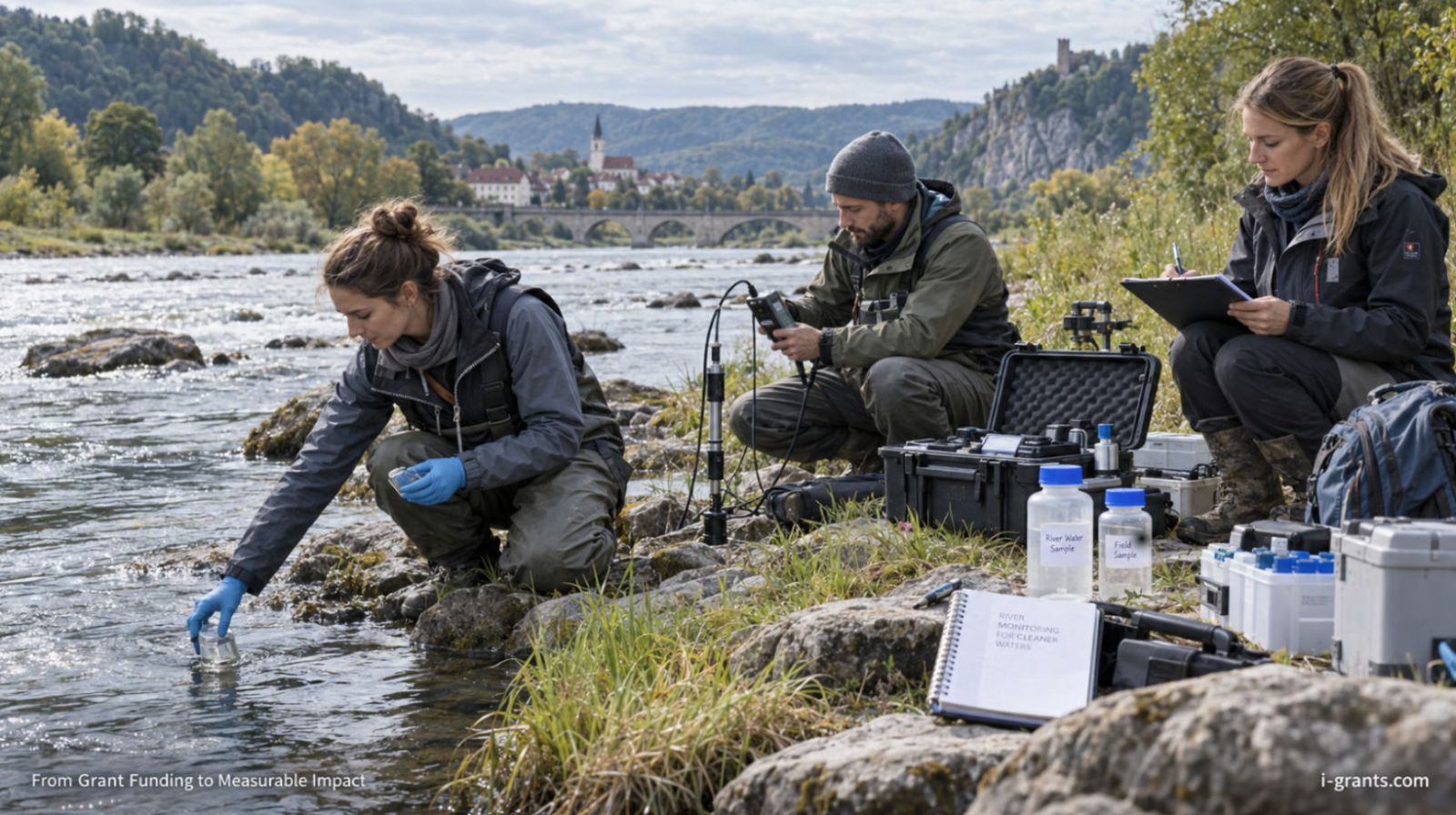
For example, a river-monitoring proposal could identify the geographical area, monitoring methodology, number of measurement sites, intended outputs, and how the results will inform future environmental action.
Similarly, a professional-integration project should demonstrate how the funded investment will improve training capacity or employment opportunities over a defined period.
These indicators should be linked to activities that the applicant can realistically deliver and verify.
8. Veolia's Employee Sponsorship Requirement
Like VINCI, the Veolia Foundation requires corporate employee involvement.
A funding request must be presented by a Veolia employee who agrees to become the project's sponsor.
The applicant is responsible for identifying this person.
The sponsor acts as a connection between the organisation and the foundation, evaluates the technical and financial feasibility of the project, assists with the application, and follows implementation through to completion.
This requirement creates an additional eligibility consideration that does not appear in an ordinary grant budget.
An organisation may have appropriate legal status, a relevant environmental project, and sufficient co-funding, but still lack the required corporate sponsor.
Veolia also prioritises projects capable of benefiting from employee expertise.
Such assistance may involve engineering, water-treatment knowledge, environmental management, operational support, technical training, or other professional capabilities.
The sponsor's participation is not itself a substitute for the financial grant. It is an additional element of the foundation's support model.
Similarly, Veoliaforce missions, which provide professional expertise in humanitarian and development contexts, should be distinguished from cash grants awarded to project organisations.
A technical deployment or training mission is not evidence that an NGO received an unrestricted financial award.
9. Veolia's Latest Results and European Grant Recipients
Since its establishment in 2004, the Veolia Foundation has supported more than 1,500 projects.
Its 2025 activity report, published in June 2026, provides more recent information about the scale of its work.
The foundation reported 32 supported projects, 49 skills-based sponsorship missions, 131 mobilised volunteers, and 1,556 days of professional expertise and solidarity.
For comparison, its 2024 reporting identified 40 supported projects and 27 skills-based sponsorship missions.
The number of supported projects was therefore lower in 2025, while the reported number of expertise missions was higher.
These figures describe different dimensions of philanthropic activity.
A foundation may support fewer projects while increasing the professional assistance provided to its partners.
They do not, by themselves, establish whether the total cash-grant budget increased or decreased.
Individual recipient information provides a more useful picture of the investments financed.
Académie de Renée: €30,000 for inclusive electronics-repair training
On March 23, 2026, the Veolia Foundation's selection committee awarded €30,000 to Association Renée in France's Gironde department.
The supported initiative, Académie de Renée, combines professional training with electronics repair and the circular economy.
The association had previously developed activities involving the collection, repair, and reuse of electrical and electronic equipment.
Its earlier repair activity was subsequently transferred into a separate commercial company, while the association concentrated on developing an inclusive training programme.
This organisational distinction is important. It demonstrates how a nonprofit training initiative can be separated from an associated commercial activity.
The Veolia grant supports the creation of an electronic learning platform, a central component of the academy's training model.
The programme is designed for people who may face barriers to conventional training, including adults with disabilities and individuals distant from the labour market.
The organisation plans to accommodate up to 20 learners in its first year and aims to increase this to more than 50 within three years.
These figures are project targets, not completed outcomes.
Alongside the €30,000 grant, Veolia's recycling and resource-recovery teams are expected to contribute professional expertise, including safety-related audits and training.
This case demonstrates the combination of financial investment and employee expertise within the foundation's model.
It also illustrates why an environmental project can qualify through a social-inclusion objective: electronics repair provides both a circular economy activity and a pathway into employment.
Wasser 3.0: €40,000 for European river monitoring
A second particularly relevant case involves Wasser 3.0 gGmbH, a Germany-based nonprofit organisation specialising in microplastics and micropollutants.
On October 6, 2025, the Veolia Foundation's selection committee awarded the organisation €40,000 for the Neisse Total project.
The initiative concerns the Neisse River and its cross-border environment involving Germany, Poland, and the Czech Republic.
Its objective is to develop an improved approach to detecting microplastics through artificial intelligence, fluorescence analysis, and citizen science.
The project plans to map the 256-kilometre river and involve local schools and organisations in collecting information from 80 measurement points.
Veolia's grant specifically finances the acquisition and installation of technical equipment, including advanced sensors.
The planned implementation period is two years.
These details demonstrate that the foundation can support technically sophisticated environmental projects with a clear European dimension.
They also show the importance of distinguishing funding purpose from project ambition.
The €40,000 award finances defined monitoring infrastructure. It should not be interpreted as unrestricted financing for all of Wasser 3.0's research activities.
What these two awards reveal
The Académie de Renée and Wasser 3.0 cases demonstrate that the foundation's environmental and social priorities can overlap with specialised technical investment.
The first project uses digital training infrastructure to improve professional opportunities in electronics repair.
The second uses scientific monitoring equipment to improve knowledge of transboundary microplastics pollution.
Both awards fall within Veolia's published typical grant range.
Both also involve projects with identifiable outputs extending beyond a single public event.
For applicants, these cases offer more useful guidance than a generic statement that Veolia supports sustainability.
They demonstrate the importance of selecting a clearly defined investment that contributes to a measurable environmental or social result.
10. Veolia in Ukraine: Distinguishing Technical Assistance From Grants
Veolia's international humanitarian activities provide further evidence of its operational capacity, but not every form of assistance represents a conventional grant.
In July 2026, the foundation reported a Veoliaforce mission in the Mykolaiv area of Ukraine.
Two Veoliaforce specialists helped train Ukrainian water professionals in deploying Aquaforce mobile water-treatment units.
This activity contributed professional expertise and technical assistance to humanitarian water operations.
It is relevant to organisations examining potential partnerships in water, sanitation, and emergency response.
However, the mission should not be described as an open Ukrainian NGO grant or as evidence that any Ukrainian organisation can apply for a cash award.
The foundation's financial-grant criteria and humanitarian deployment arrangements are separate mechanisms.
Applicants seeking financial support must establish whether the proposed project qualifies under the foundation's ordinary rules and whether the relevant application route is available.
11. Which Expenses Qualify? A Direct Comparison
The three foundations share an emphasis on investment, but their detailed requirements differ.
VINCI limits its ordinary financial assistance to one-off material and certain intangible investments. FAPE ENGIE expressly excludes operating grants and requires the proposed investment not to have been committed before application. Veolia prioritises investment expenditure and may accept a limited training component when necessary for sustainability.
These conditions create practical differences for organisations preparing budgets.
Table 3. Eligibility, Eligible Expenditure, and Key Restrictions
| Applicant or expenditure issue | VINCI | FAPE ENGIE | Veolia |
|---|---|---|---|
| Commercial social enterprise | Commercial legal forms excluded | Certain qualifying integration enterprises may apply, with restrictions concerning the social component | Nonprofit public-interest project required; organisational eligibility must be established |
| General nonprofit organisation | Possible if French public-interest and other eligibility requirements are met | Not sufficient by itself; the organisation must meet the employment-related eligibility criteria | Possible where the project meets the foundation's requirements |
| Equipment and machinery | Eligible when directly linked to the project | Eligible as new investment | Generally eligible as investment expenditure |
| Vehicles | Eligible project investment | Eligible new investment | Potentially eligible when justified within the project |
| Website or digital infrastructure | Certain project-related intangible investments eligible | Possible where qualifying as a new investment linked to employment inclusion | Possible where qualifying under investment and project criteria |
| Regular operating costs | Recurring expenditure excluded under general rules | Operating grants explicitly excluded | Investment expenditure is prioritised; general operating support should not be assumed eligible |
| Investment committed before application | No universal reimbursement entitlement established | Explicitly ineligible | Applicants should establish eligibility and approval requirements before committing expenditure |
| Construction or renovation | Subject to ownership or employment-integration contractor conditions | New construction and improvements can qualify | Investment may qualify when consistent with programme criteria |
| Employee sponsor | Essential for funded projects | No equivalent universal requirement | Essential |
| Other financing | No universal minimum contribution published | Economic sustainability required; no universal grant-percentage limit published | Foundation contribution must represent 10–66 percent of the total project budget |
| Long-term project results | Social and professional inclusion objectives | Employment outcomes and economic viability | Sustainability, replicability, and measurable objectives |
Applicants should avoid using the published rules of one foundation to fill information gaps in another.
For example, Veolia's maximum funding share of 66 percent does not apply to VINCI or FAPE ENGIE.
Likewise, the published €10,000 to €80,000 Veolia range cannot be used to estimate a VINCI award.
A grant writer should distinguish confirmed rules from assumptions and seek clarification where a foundation has not published a universal threshold.
12. Five Eligibility Mistakes That Can Undermine an Application
The most consequential mistakes usually occur before the proposal is evaluated for quality.
1. Assuming that a social mission guarantees eligibility. VINCI excludes commercial companies even when they pursue recognised social objectives. FAPE ENGIE accepts certain employment-integration enterprises but applies specific restrictions to their supported activities. Legal status and programme-specific requirements must be checked independently.
2. Preparing a general operating-budget request. All three programmes primarily support identifiable investments. An applicant seeking unrestricted funding for salaries, rent, or ordinary administration may be targeting the wrong financing mechanism.
3. Ignoring the employee-sponsorship requirement. VINCI and Veolia both integrate corporate employees into their funding models. Finding an appropriate sponsor can be a substantial preparatory task, particularly for applicants without existing corporate relationships.
4. Committing expenditure too early. FAPE ENGIE explicitly excludes investments already committed before application. More generally, applicants should not assume that submitting a proposal guarantees reimbursement or that a purchase made before approval will be accepted.
5. Treating historical awards as currently available opportunities. Published grants demonstrate that a programme has financed relevant projects, but they do not establish that new applications are being accepted. The latest status must be checked separately.
Avoiding these errors requires a structured eligibility assessment before detailed proposal writing.
13. Which Foundation Fits Different Project Types?
Consider a French nonprofit association seeking to establish a vocational training workshop for disadvantaged young adults.
The organisation may have a potential route through VINCI if it meets the legal and public-interest requirements, can demonstrate a relevant investment, and can establish employee sponsorship.
FAPE ENGIE may also be relevant if the organisation qualifies under its employment-integration rules, proposes a new investment, and demonstrates a financially viable employment model.
The appropriate route depends on more than the subject of vocational training. Legal structure, expenditure, social support, and financial sustainability determine eligibility.
Now consider a French organisation developing a circular economy workshop that employs people facing long-term unemployment.
VINCI may be relevant if the applicant has an acceptable nonprofit legal form and the investment directly supports professional integration.
FAPE ENGIE may be relevant where the project satisfies the rules for employment-integration structures and the grant finances the permitted social component.
Veolia may also be relevant where the project aligns with its employment or environmental priorities, meets its financial conditions, and has an eligible employee sponsor.
In this situation, the same broad initiative could potentially fit several programmes, but the eligible applicant, proposed expenditure, and implementation model would need to satisfy each foundation's separate rules.
A third scenario involves a German nonprofit seeking equipment for a cross-border river-monitoring project.
Veolia's documented €40,000 award to Wasser 3.0 provides evidence that the foundation has supported this type of project in Germany.
However, the organisation would still need to satisfy Veolia's eligibility criteria, arrange corporate sponsorship, establish a financing package, and confirm that the application process is accepting new proposals.
The Wasser 3.0 award is a precedent for the type of project supported, not an entitlement for similar applicants.
These scenarios demonstrate why comparing foundation names without analysing funding mechanisms produces unreliable recommendations.
14. Current Funding Status and Application Planning
Application availability deserves particular attention because the three foundations do not operate on identical schedules.
VINCI provides an online application process and does not publish a single annual deadline applicable to all projects under the French foundation's general rules.
However, organisations without an identified employee sponsor should expect a longer assessment process.
FAPE ENGIE publishes specific submission deadlines. As of September 17, 2026, the next stated deadline is December 18, 2026.
Applicants should verify the subsequent committee timetable because the publicly displayed calendar contains inconsistent year references for the meetings following that deadline.
Veolia's situation is different.
Its general application instructions describe year-round submission and the assessment of proposals as they arrive. The selection committee and board of directors each meet twice annually, with proposals expected approximately two months before the relevant meeting.
Nevertheless, the foundation's current application page directs prospective applicants to return in 2027.
Accordingly, Veolia should not be advertised as accepting new funding applications in September 2026.
No specific reopening date has been established by the published notice.
A suitable application strategy should therefore distinguish between immediate submission, preparation for a stated deadline, and longer-term preparation for a future application window.
For organisations planning a significant investment, that distinction affects procurement, financial commitments, staffing, and project implementation schedules.
15. How Grant Writers Can Turn These Rules Into a Stronger Proposal
Corporate foundations frequently expect applicants to demonstrate that financial support will produce a concrete improvement rather than simply cover an existing organisational need.
A grant writer should begin by identifying the exact investment and explaining the operational problem it solves.
For an employment-integration organisation, this may involve demonstrating why additional machinery will allow more participants to receive practical training or why a vehicle will remove a transport barrier preventing disadvantaged workers from accessing employment.
For an environmental organisation, the investment might involve monitoring equipment that increases geographical coverage, improves measurement quality, or enables systematic environmental data collection.
The financial plan should then identify the full cost of the investment, the requested grant, other funding sources, and expenditure timing.
The proposal must also explain how the asset will remain useful after the grant period.
VINCI applicants should demonstrate how the corporate sponsor will contribute meaningful expertise throughout the partnership.
FAPE ENGIE applicants should connect the investment to professional integration while presenting a credible financial model that does not depend exclusively on subsidies.
Veolia applicants should establish measurable objectives, explain the project's sustainability or replicability, provide a realistic co-funding plan, and demonstrate how employee sponsorship will contribute to implementation.
These differences should influence the proposal itself.
A single generic application, rewritten only to replace the donor's name, is unlikely to address the three foundations' distinct selection requirements adequately.
For organisations without internal grant-writing capacity, working with a specialist familiar with French corporate philanthropy, investment budgeting, and international foundation eligibility can help identify material restrictions before application costs accumulate.
Platforms such as i-grants.com can connect applicants with grant-writing professionals who assist with programme screening, financial planning, project documentation, and proposal preparation.
The professional's role is to establish eligibility and communicate a credible project, not to promise an award or imply that a closed programme is accepting applications.
Conclusion: Match the Project to the Funding Mechanism
VINCI, ENGIE, and Veolia demonstrate how corporate grants can support employment, social inclusion, and environmental initiatives through substantially different funding structures.
VINCI combines investment grants with employee sponsorship and applies strict legal-status requirements to applicants under its French programme.
FAPE ENGIE focuses on new investments that support employment integration, requires applicants to demonstrate social and economic viability, and provides a structured selection process with published submission deadlines.
Veolia offers a broader international perspective, including documented grants in France and Germany. Its typical funding range of €10,000 to €80,000 is accompanied by co-funding requirements, employee sponsorship, and an emphasis on measurable, lasting project results.
The published awards provide concrete evidence of these models in practice. La Cravate Solidaire Marseille received €36,000 in total VINCI support across several years. FAPE ENGIE financed 22 projects with €215,000 in 2025. Veolia awarded €30,000 to Académie de Renée in France and €40,000 to Wasser 3.0 in Germany.
These examples demonstrate what the foundations have funded, but historical results must not be confused with guaranteed future assistance.
As of September 17, 2026, VINCI provides an online application route, FAPE ENGIE identifies December 18 as its next submission deadline, and Veolia directs new applicants towards 2027 without publishing a specific reopening date.
For applicants and grant writers, the central task is to establish the correct match between legal form, geographical eligibility, investment expenditure, financial requirements, corporate sponsorship, and application status.
A well-designed project is valuable, but a fundable project must also fit the precise mechanism through which the foundation provides support.