

 Français
  Deutsch
  Українська
Searching for "small business grants" can give U.S. business owners a distorted picture of how public and publicly supported business finance actually works.
A federal grant is only one instrument in a much larger financing system. Depending on the company, project and use of funds, a more realistic source of capital may be an SBA-guaranteed loan, a state-backed loan participation program, a research tax credit, an investment from an SBIC-backed fund, a surety bond guarantee or a federal procurement contract.
The scale of these non-grant mechanisms is substantial. In fiscal year 2025, the U.S. Small Business Administration reported approximately 85,000 7(a) and 504 loans totaling $45 billion, while its Small Business Investment Company program ended the year with a record $53 billion in portfolio volume.
Demand for external capital also remains significant. The Federal Reserve's 2026 Small Business Credit Survey found that 60 percent of employer firms applied for financing during the previous 12 months. Among applicants, 42 percent received all the financing they sought, 36 percent received some or most of it, and 22 percent received none. The two most common reasons for seeking financing were operating expenses and expansion or new business opportunities.
For a small business, therefore, the right question is often not:
"Which grant can fund my company?"
It is:
"Which financing instrument fits this particular project, cost and stage of growth?"
That distinction becomes increasingly important as a company moves from research to commercialization, from startup to expansion, or from a small project budget to a multimillion-dollar capital investment.
The U.S. Funding System Is Bigger Than Grants
Public support for small businesses in the United States can take very different legal and financial forms.
Some instruments transfer money that generally does not need to be repaid if award conditions are met. Others create debt. Some reduce lender risk rather than business debt. Some reduce taxes. Others provide investment capital in exchange for ownership. Procurement contracts pay a company for delivering goods or services to the government.
These instruments should not be treated as interchangeable.
Table 1. Main U.S. Small Business Funding Instruments and How They Work
| Funding instrument | What the business receives | Repayment required? | Ownership dilution? | Typical route |
|---|---|---|---|---|
| Grant | Funding for an authorized project and eligible costs | Generally no, if award conditions are met | No | Federal or state funding program |
| Cooperative agreement | Financial assistance with substantial agency involvement | Generally no, if award conditions are met | No | Federal agency |
| Direct or intermediary loan | Borrowed capital | Yes | No | Government or intermediary lender |
| Loan guarantee | Private or intermediary loan with public risk sharing | Yes | No | SBA, USDA or state-supported program |
| Loan participation or collateral support | Credit supported by public capital or risk-sharing mechanisms | Yes | No | State programs, including SSBCI-supported programs |
| Tax credit | Reduction of qualifying tax liability, subject to specific tax rules | No | No | Federal or state tax system |
| Equity or investment capital | Capital invested into the business | No scheduled loan repayment, but investors receive economic rights | Usually yes | SBICs, venture funds, state investment programs |
| Procurement contract | Revenue in exchange for goods or services supplied to government | Not a financing repayment obligation | No | Federal, state or local procurement |
| Surety bond guarantee | Support in obtaining required contract bonds | Not direct cash financing | No | SBA Surety Bond Guarantee Program |
| Technical assistance | Advisory, financial readiness or business development support | No | No | SBA partners, state programs, SSBCI and intermediaries |
The legal distinction between these categories is not merely terminology. Under the Federal Grant and Cooperative Agreement Act framework, grants and cooperative agreements are financial assistance instruments. A cooperative agreement differs from a grant because substantial federal agency involvement is anticipated. A procurement contract, by contrast, is used when the government is acquiring goods or services for its own benefit or use.
That legal distinction can completely change the application process, compliance obligations, accounting treatment and commercial logic of the opportunity.
Grants: Powerful, but Usually Project-Specific
A grant can be highly attractive because eligible award funds generally do not create conventional debt and do not require the company to surrender equity.
That does not mean grants are unrestricted business capital.
Federal grants exist to advance purposes authorized by law and implemented by specific agencies and programs. A small business may have to satisfy requirements related to industry, technology, geography, ownership, research stage, project scope, cost categories, matching funds, reporting, intellectual property or commercialization.
The most important practical distinction is between the existence of a program and the availability of money.
A federal program may legally exist without having a current competition. A funding opportunity may have been announced but not yet opened. An application period may be open but the company may not be an eligible applicant. The company itself may qualify while its proposed project does not. And an eligible project can still contain costs that the award will not pay.
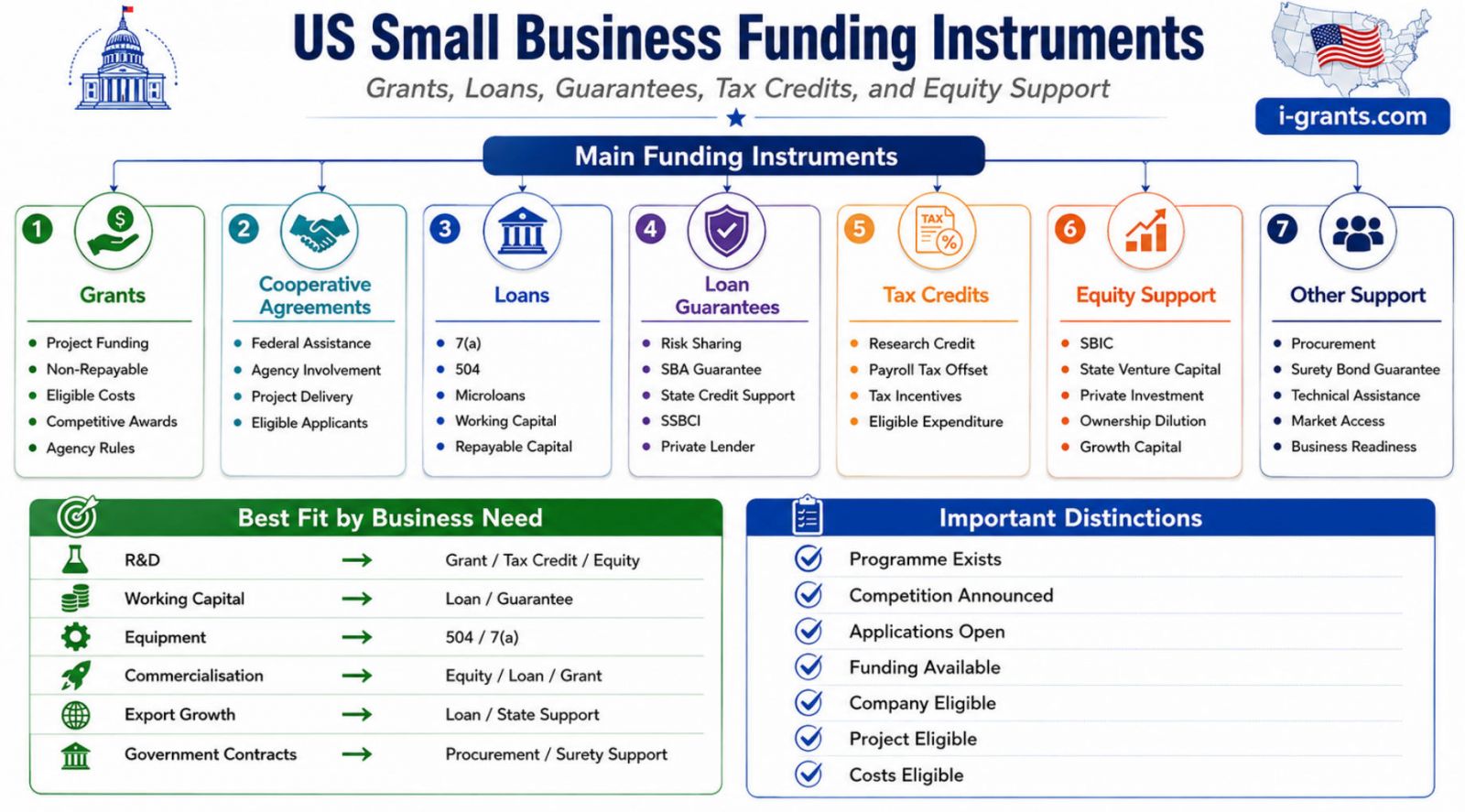
For grant seekers, these are six separate questions: whether the program exists, whether a competition has been announced, whether applications are currently accepted, whether funding is actually available, whether the company is an eligible applicant, and whether the proposed project and expenditures qualify.
This is why an Assistance Listing in SAM.gov should not automatically be interpreted as an open grant. Grants.gov separately publishes federal funding opportunities and defines the specific competitive opportunities through which agencies may make discretionary awards.
Grants can be particularly valuable where commercial lenders would have difficulty underwriting risk, such as early-stage scientific research, experimental technology or public-interest projects without predictable near-term revenue. They are much less likely to be the correct instrument for ordinary working capital, routine inventory purchases or unrestricted business expansion.
The SBA itself describes its direct small-business grant activity as limited and focuses its grant information on areas such as scientific research, entrepreneurship support, exporting and certain manufacturing initiatives.
Cooperative Agreements Are Not Just Another Name for Grants
Small businesses searching federal opportunities may also encounter cooperative agreements.
Both grants and cooperative agreements are forms of federal financial assistance, but a cooperative agreement is used when the awarding agency expects substantial involvement in carrying out the funded activity.
This can matter operationally.
A company entering a cooperative agreement may need to plan for closer interaction with the federal agency, more structured coordination or other forms of agency involvement described in the award terms.
For grant seekers, the practical lesson is simple: never assume that every opportunity listed next to grants operates under identical rules.
Read the actual Notice of Funding Opportunity and award conditions.
Loans: Often a Better Match for Commercial Business Needs
Loans solve a different financing problem.
A grant asks whether a project advances an authorized public purpose. A commercial or government-supported loan asks whether the borrower qualifies, whether the proposed use of proceeds is permitted and whether the business can reasonably repay the debt.
For many established companies, loans can therefore be more appropriate for equipment, property, acquisitions, inventory, working capital and expansion than trying to force those expenses into a grant strategy.
The SBA's 7(a) program illustrates the model particularly well.
SBA 7(a): A Government Guarantee, Not Free Capital
The 7(a) Loan Program is SBA's primary business loan program. The business does not normally receive a standard 7(a) loan directly from SBA. Instead, it applies through a participating lender, while SBA provides a guarantee to the lender.
The maximum 7(a) loan amount is currently $5 million. SBA states that 7(a) proceeds can support uses including real estate, short- and long-term working capital, refinancing certain business debt, machinery and equipment, furniture, fixtures, supplies and qualifying changes of ownership.
For most 7(a) loans, SBA can guarantee up to 85 percent of loans of $150,000 or less and up to 75 percent of loans above $150,000. Certain export programs operate under different guarantee structures.
The distinction is critical.
If a company receives a $1 million SBA-guaranteed loan, SBA has not given that company a $1 million grant. The borrower still owes the debt according to its loan agreement. The guarantee primarily changes the lender's exposure to loss.
This is one of the most important concepts for entrepreneurs comparing "government funding" options.
Working Capital Pilot
SBA's 7(a) Working Capital Pilot provides monitored lines of credit for eligible businesses and can support financing linked to receivables, inventory, contracts and other working-capital requirements.
SBA currently states that eligible businesses may access a line of credit of up to $5 million through the pilot. The program is particularly relevant to businesses such as manufacturers, wholesalers and professional service firms that have sufficient operating history and financial reporting capacity.
This is a fundamentally different tool from a grant. A growing company that has a strong order pipeline but a cash-flow gap may need a revolving credit facility much more urgently than a competitive grant.
SBA 504: Financing Major Fixed Assets
The SBA 504 Loan Program addresses another part of the capital structure.
It provides long-term, fixed-rate financing for major fixed assets that support business growth and job creation. Financing is delivered through Certified Development Companies working with lenders and borrowers.
SBA currently lists a maximum 504 loan amount of $5.5 million. Eligible uses can include qualifying real estate, facilities and long-term machinery and equipment. The program is not designed as a general working-capital or inventory facility.
This makes 504 particularly relevant to capital-intensive companies that need a factory, warehouse, commercial property or expensive production equipment.
A Major 2026 Change: 7(a) and 504 Can Now Be Combined More Effectively
One of the most important SBA financing developments of 2026 took effect on July 4, 2026.
SBA changed its cumulative financing rule so that qualified borrowers can combine up to $5 million through 7(a) and up to $5 million through 504, creating the possibility of as much as $10 million in combined SBA-backed financing under the new structure.
This matters because 7(a) and 504 solve different financing problems.
A growing manufacturer, for example, may need long-term financing for a production facility and machinery while simultaneously needing working capital to hire employees, purchase inputs and execute new orders.
Trying to fund the entire project with one instrument can produce an inefficient financing structure. Pairing different instruments can better match the useful life, risk and cash-flow profile of each expense.
This 2026 change reinforces one of the central principles of business funding: the objective is not necessarily to find one program that pays for everything. It is to build the right capital structure for the project.
Microloans: Smaller Debt for Smaller Capital Needs
Not every business needs millions of dollars.
The SBA Microloan Program provides loans of up to $50,000 through designated nonprofit intermediary lenders. SBA reports an average microloan of approximately $13,000. Eligible uses can include working capital, inventory, supplies, furniture, fixtures, machinery and equipment, while proceeds cannot be used to purchase real estate or repay existing debt.
The structure is important. SBA supplies capital to approved intermediaries, and those intermediaries make loans to eligible borrowers.
For a small startup, local service company or microenterprise, this may be a much more realistic financing route than a major federal grant competition.
State Credit Support: SSBCI Shows How Public Money Can Mobilize Private Capital
The State Small Business Credit Initiative is particularly useful for understanding the modern U.S. funding ecosystem because it includes several different mechanisms under one national framework.
SSBCI is a nearly $10 billion Treasury program that provides resources for small-business financing and technical assistance programs operated by states, territories and Tribal governments. It is not a universal Treasury grant that individual companies can simply request.
As of March 31, 2026, Treasury reported that 145 participating jurisdictions represented more than $8.9 billion in allocations. Those jurisdictions operated 335 credit support and investment programs. More than $3.9 billion in SSBCI funds had been deployed, using Treasury's reporting definition of deployed funds.
The allocation itself demonstrates how diverse public business finance can be.
Approximately 64 percent, or $5.7 billion, had been allocated to programs supporting loans, including mechanisms such as loan guarantees and loan participation. Approximately 36 percent, or $3.2 billion, had been allocated to equity and venture-capital programs, including direct investment, fund investment and hybrid structures.
For a business owner, this means the relevant state opportunity may not have the word "grant" anywhere in its title.
The state may instead use public capital to share part of a lender's risk, participate in a loan, provide collateral support, invest through a venture fund or attract private investors into a financing round.
Loan Guarantees Reduce Lender Risk, Not Borrower Debt
The term "loan guarantee" is often misunderstood.
A government guarantee does not normally mean that the borrower only has to repay the unguaranteed portion. If a qualifying $1 million loan carries a partial government guarantee, the borrower still has a contractual obligation to repay the loan.
The public guarantee primarily protects the participating lender against a defined portion of qualifying loss, subject to program rules.
That risk-sharing mechanism can make financing possible in situations where a lender would otherwise be unwilling to extend credit on acceptable terms. It can also support longer maturities, larger financing needs or borrowers that fall outside conventional lending preferences.
SBA 7(a), export financing programs and state SSBCI-supported facilities all demonstrate variations of this principle.
This distinction should be checked carefully whenever a program is described as "government-backed funding." Government-backed does not mean non-repayable.
Manufacturing Finance Is Becoming More Specialized
U.S. small-business credit policy has also become more specialized in several sectors.
The Manufacturers' Access to Revolving Credit, or MARC, program is available to eligible small businesses engaged in manufacturing under NAICS sectors 31 to 33. SBA currently lists a maximum loan amount of $5 million. MARC financing can be structured as a term or revolving facility and combines elements of Standard 7(a) underwriting with revolving-credit features.
SBA has also continued to operate specialized export financing mechanisms. Its current lender guidance lists a maximum 90 percent guarantee for Export Working Capital and International Trade loans, subject to the applicable program requirements.
These developments are another reason businesses should search by financing need and program purpose, not only by the word "grant."
Tax Credits: Support Through the Tax System
Tax credits operate on an entirely different principle.
A business does not normally apply to a grant agency for a tax credit. Instead, the benefit is determined through tax law, eligibility requirements and tax filings.
A tax credit can reduce a qualifying tax liability. Its economic value and timing depend on the specific credit, the taxpayer's facts and the rules applicable to that tax year.
One of the most important examples for innovative small businesses is the federal Credit for Increasing Research Activities, commonly called the Research Credit.
A qualified small business that meets the statutory requirements may elect to use up to $500,000 of its research credit against payroll tax liability for tax years beginning after December 31, 2022. The election and subsequent payroll tax treatment involve specific IRS forms and timing requirements.
This can be particularly important for qualifying early-stage technology businesses. A startup may be investing heavily in research while generating limited taxable income, yet still incurring payroll tax obligations.
The key lesson is that a tax credit should not be described as a grant.
It is also important not to confuse tax credits with tax deductions. A deduction generally reduces taxable income, while a credit generally reduces tax liability, subject to the relevant statutory rules.
For any capital strategy involving tax incentives, businesses should model not only the headline credit rate but also eligibility, timing, taxable income, payroll obligations, basis adjustments, interaction with other incentives and the treatment of the underlying expenditure.
Tax advice should be obtained for the company's specific circumstances, particularly when a business is attempting to coordinate credits with grants or subsidized financing.
Equity Support: Public Policy Can Also Work Through Investment Funds
Some companies should not finance every growth stage with debt.
A young technology company with substantial research expenses, uncertain early revenue and a long commercialization period may have difficulty supporting conventional debt repayments. Equity can provide risk capital without scheduled principal repayments, but investors normally receive ownership and associated economic rights.
The SBA's Small Business Investment Company program is one of the most important bridges between public policy and private investment capital.
SBICs are privately owned and managed investment funds licensed and regulated by SBA. They raise private capital and may access SBA-guaranteed leverage, generally allowing them to invest more capital into qualifying small businesses than private fundraising alone would support.
The SBIC ecosystem can provide debt, equity and debt-with-equity structures.
SBA currently describes typical SBIC debt financing as ranging from approximately $250,000 to $10 million, while typical equity investments range from approximately $100,000 to $5 million. Debt-with-equity transactions are typically described within an approximate $250,000 to $10 million range. These are published typical ranges, not an entitlement or guaranteed offer to an individual company.
The scale of the system is significant. SBA reported that the SBIC program reached a record $53 billion in combined private capital and SBA leverage in FY2025.
Regulatory changes that took effect in February 2026 were designed to modernize the program and facilitate investment in areas including manufacturing, food production, energy, advanced technologies and critical minerals.
For entrepreneurs, however, SBIC financing should still be viewed as investment capital, not as a government grant.
The actual investor is an SBIC fund. Investment decisions depend on the fund's strategy, expected return, company quality, growth potential, transaction structure and other commercial considerations.
Equity Is Not "Free Money" Either
Equity eliminates the scheduled repayment obligation associated with a loan, but it has a different cost.
Founders may give up part of the company, share future value creation, accept investor rights or governance provisions and face expectations regarding future growth and exit opportunities.
Debt and equity therefore cannot be compared solely by asking which one requires a monthly payment.
A profitable, established company purchasing equipment may prefer debt because the founders can retain ownership. A pre-revenue deep-tech startup may prefer equity because scheduled debt service could constrain the company before commercialization.
Government-supported capital does not eliminate this fundamental financing logic.
Procurement Contracts Create Revenue, Not Financial Assistance
Federal procurement represents another major source of opportunity for small businesses, but it should not be placed in the same category as grants.
Under the federal framework, procurement contracts are used when an agency is acquiring goods or services. Grants and cooperative agreements are used for financial assistance relationships.
A company that wins a $2 million federal contract has not received a $2 million grant.
It has entered into a commercial relationship with the government and must perform the contract according to the applicable requirements. Revenue is earned by delivering the agreed products, services or work.
For some companies, particularly in defense, technology, construction, professional services and manufacturing, becoming a federal contractor may ultimately create a larger and more sustainable opportunity than searching indefinitely for unrestricted grants.
Surety Bond Guarantees Can Unlock Contracts Without Providing a Cash Grant
Some government support mechanisms help businesses obtain opportunities rather than directly paying project expenses.
The SBA Surety Bond Guarantee Program is an example.
Surety bonds can be required on construction and service contracts to protect project owners against certain risks. A small contractor that cannot obtain the required bonding may be unable to compete for or perform a valuable contract even if it is operationally capable of doing the work.
SBA reported that its Surety Bond Guarantee Program supported a record $10.6 billion in contract value in FY2025 and assisted more than 2,200 small businesses.
The economic benefit is therefore access to contracting opportunities, not a grant deposited into the business's bank account.
This is an important reminder that public support can improve a company's access to markets as well as its access to capital.
Technical Assistance Has Value, but It Is Not Cash Financing
Technical assistance is another category that is frequently mixed into lists of "small business funding."
Programs may provide financial planning, accounting support, legal preparation, business development, investment readiness, lender preparation or grant-writing assistance.
SSBCI, for example, also includes a technical-assistance component. As of March 31, 2026, Treasury reported $75 million in competitive technical-assistance grants to 14 jurisdictions and $163 million in formula technical-assistance grants to 101 jurisdictions. Those grants are made to jurisdictions to support assistance systems. They do not mean that an individual business automatically receives those dollar amounts as grant funding.
For a capital-constrained company, good technical assistance can still be economically valuable. It can improve financial records, lender readiness, investment documentation or the quality of a future grant application.
But it should be labeled correctly.
Which Funding Instrument Fits Which Business Need?
The best financing instrument depends on what the company is trying to pay for.
Table 2. Funding Instruments for Common Small Business Needs
| Business need | Potentially relevant instruments | Main issue to evaluate |
|---|---|---|
| Early-stage R&D | Federal grant, SBIR/STTR, research tax credit, equity | Technical eligibility, R&D risk, eligible costs |
| Working capital | 7(a), Working Capital Pilot, MARC, state-supported credit | Repayment capacity and cash-flow cycle |
| Commercial real estate | 504, 7(a), conventional credit | Property eligibility, structure and debt service |
| Machinery and production equipment | 504, 7(a), MARC, state financing, tax incentives | Useful life, project size and permitted use |
| Startup commercialization | Equity, SBIC financing, SSBCI-supported venture capital, selected grants | Revenue stage, valuation and dilution |
| Inventory | 7(a), microloan, working-capital facility | Inventory cycle and lender requirements |
| Rural expansion | USDA mechanisms, SBA finance, state programs, selected grants | Geography and program-specific eligibility |
| Export growth | STEP-related support, Export Working Capital, International Trade financing | Export plan and eligible activity |
| Government contracting | Procurement contract, working-capital financing, surety support | Registration, bonding and performance capacity |
| Clean-energy investment | Tax incentives, loans, state support and selected grants | Technology-specific rules and tax eligibility |
| Hiring and general expansion | Loans, equity, state credit programs | Cash flow and permissible use of funds |
| Fundamental or high-risk innovation | Grant plus equity or follow-on financing | Project stage, technical uncertainty and commercialization plan |
The table also reveals why searching by a single funding label can be inefficient.
If the company needs $2 million to finance accounts receivable generated by confirmed contracts, a grant competition may be a poor match. If it needs $750,000 for technically uncertain experimental research with no immediate commercial revenue, conventional debt may be equally inappropriate.

Building a Capital Stack Instead of Searching for One Perfect Program
Sophisticated financing often involves more than one instrument.
Consider a U.S. manufacturing company planning a major expansion. Its total project might include a new facility, long-life machinery, temporary working-capital needs, product-development expenses and workforce expansion.
Those costs do not necessarily belong in the same financing bucket.
The facility and fixed equipment could potentially fit long-term asset financing. Working capital might require a revolving facility. Experimental R&D could potentially qualify for a grant or research-related incentive. Owners may contribute equity. A state program could support part of the lender risk.
The project can therefore be viewed as a capital stack, where each financing source is matched to the cost it is best designed to finance.
The 2026 SBA change allowing qualified borrowers to combine up to $5 million of 7(a) financing with up to $5 million of 504 financing makes this approach especially relevant for capital-intensive companies.
But combining instruments requires careful compliance.
Can a Business Combine Grants, Loans, Tax Credits and Equity?
Often, yes.
But "these instruments can be combined" should never be interpreted as "the same cost can always be funded several times."
A company may simultaneously have a federal award, bank financing, founder equity, private investment and tax incentives. The legal treatment of each dollar of expenditure still depends on the rules governing each instrument.
Grant agreements may impose restrictions on allowable costs, cost sharing, matching funds or other federal funding. Loan agreements control the permitted use of debt proceeds. Tax law determines whether expenditure qualifies for a credit or deduction and whether another subsidy affects the calculation. Investors may impose contractual conditions on the use of investment capital.
For that reason, funding architecture should be designed at the cost-category level, not simply at the company level.
Table 3. What to Check Before Combining Funding Instruments
| Issue | Why it matters | What the business should verify |
|---|---|---|
| Eligible costs | An expense may qualify under one program but not another | NOFO, award terms, loan use-of-proceeds rules |
| Duplication of funding | The same expenditure may not be claimable twice | Award and program-specific restrictions |
| Cost sharing or matching | Some awards require non-federal contributions | Source and eligibility of matching funds |
| Loan repayment | Grants and credits do not eliminate debt obligations | Cash-flow forecast and repayment schedule |
| Ownership dilution | Equity changes the ownership economics | Investment terms, voting rights and future dilution |
| Tax treatment | Grants, credits, deductions and investments can interact differently | Current federal and state tax rules |
| Timing | Spending too early can affect eligibility under some programs | Application, award and project-start rules |
| Collateral and guarantees | Debt may require security or personal/business guarantees | Lender and program requirements |
| Federal registration | Certain federal opportunities require active registrations | SAM.gov and opportunity-specific rules |
| Reporting | Public funding can create ongoing compliance obligations | Financial, technical and performance reporting |
| State rules | State-supported finance differs by jurisdiction | State program documents and administrator guidance |
| Exit or refinancing | Different capital sources may affect later transactions | Loan covenants, investor rights and award restrictions |
The safest approach is to create a financing map before money is committed.
That map should identify the project cost, the proposed funding source for each cost category, the timing of each expenditure, the legal restrictions attached to each source and the evidence needed to demonstrate compliance.
Example: A $7 Million Manufacturing Expansion
Consider a hypothetical established U.S. manufacturer planning a $7 million expansion.
The project includes a larger facility, automated production equipment, temporary working capital, product-development work and hiring.
There is no reason to assume that a single grant should finance the entire project.
The company might contribute owner or investor equity to provide a project cushion and meet financing requirements. Long-term fixed-asset financing could cover qualifying real estate and equipment. A separate 7(a) or other working-capital facility might finance operational needs associated with the expansion. Qualifying research expenditure could be evaluated separately for applicable R&D funding or tax treatment. A state SSBCI-supported program might improve access to credit or investment capital.
The precise combination would depend on eligibility, lender underwriting, tax law, program availability and the company's financial position.
The conceptual advantage is important: instead of asking whether the company "qualifies for $7 million in grants," management divides a $7 million project into financeable components.
That is how public support becomes part of corporate finance rather than a standalone grant search.
The Funding Instrument Must Match the Company's Stage
Company maturity also changes the appropriate financing strategy.
A pre-revenue research startup may have strong intellectual property but little cash flow. Grant funding and equity may therefore make more sense than conventional debt.
A profitable services company with predictable receivables may have little reason to surrender ownership if a line of credit can finance growth.
A mature manufacturer purchasing a facility may prefer 504 or another long-term debt structure.
A company entering federal procurement may need bonding and contract working capital rather than a grant.
The right capital is therefore determined by the interaction between risk, cash flow, asset life, ownership strategy and project purpose.
Five Questions to Ask Before Choosing a Funding Instrument
Before applying for any form of public or publicly supported financing, a small business should answer five questions:
-
What exactly needs to be financed? Separate R&D, equipment, property, payroll, inventory, export costs, commercialization and working capital.
-
Does the project generate predictable cash flow? If yes, debt may be realistic. If not, grants or equity may be better suited to the risk.
-
Is the company willing to give up ownership? Equity can remove scheduled debt repayment but changes the ownership structure.
-
Does a public program actually support this use of funds? The existence of an agency or funding program is not enough.
-
Can multiple sources coexist without creating duplicate funding, tax or compliance problems? This should be tested before applications and expenditures are finalized.
These questions are often more useful than starting with a database search for the largest advertised award.
What Changed in 2025 and 2026?
Several recent developments make the distinction among financing instruments particularly important.
SBA's FY2025 results illustrate the scale of government-supported credit and investment. The agency reported approximately $45 billion in 7(a) and 504 lending across about 85,000 loans, while the SBIC portfolio reached $53 billion.
The federal-state capital system also continued to expand. By March 31, 2026, SSBCI reporting covered more than $8.9 billion in allocations across 145 participating jurisdictions and 335 credit-support and investment programs, with more than $3.9 billion reported as deployed.
In February 2026, new SBIC regulatory reforms took effect with the stated objective of improving investment flows and reducing barriers in the program, including for several strategic industrial sectors.
And from July 4, 2026, SBA's new cumulative rule created significantly more flexibility for eligible businesses to combine 7(a) and 504 financing, with up to $10 million potentially available across the two programs under the new structure.
These changes do not mean every small company suddenly has access to $10 million or to federal investment capital.
They mean the menu of capital structures available to qualified companies has evolved, making it even more important to distinguish financing instruments accurately.
Common Funding Mistakes Small Businesses Should Avoid
Several errors repeatedly cause businesses to pursue the wrong form of support:
-
Treating every government-backed financing program as a grant.
-
Assuming SBA generally distributes direct grants for ordinary startup or expansion costs.
-
Interpreting an SBA guarantee as forgiveness of the guaranteed portion of a loan.
-
Treating an Assistance Listing as proof that a competition is currently open.
-
Choosing equity because it has no monthly repayment without considering dilution and investor rights.
-
Attempting to charge the same project cost to multiple public-support mechanisms without checking award, tax and financing rules.
Avoiding these mistakes can save substantial application time and improve the quality of a company's overall financing strategy.
Grants vs. Loans vs. Equity: There Is No Universal Best Option
A grant may appear financially superior because it is generally non-repayable if its conditions are satisfied. But a grant that does not fit the company's project has little practical value.
A loan has a financial cost and repayment obligation, but it may offer greater flexibility for ordinary commercial expenses and allow founders to retain ownership.
Equity avoids scheduled debt service but can be significantly more expensive if the company's value grows rapidly.
A tax credit can improve project economics but normally depends on qualifying expenditure and tax rules rather than on the company's general need for money.
A guarantee may unlock financing without giving the company cash directly.
A procurement contract can create revenue and customers rather than subsidizing expenditure.
Each instrument solves a different problem.
A Better Funding Strategy for U.S. Small Businesses
An effective funding strategy should begin with the project budget, not with a grant database.
The business should identify each major cost and determine whether that cost represents research risk, a long-term asset, working capital, commercial expansion, hiring, export activity or another financing need.
Management can then map appropriate instruments to each cost category.
Only after that exercise should the company search for specific programs, lenders, tax provisions or investors.
This approach also makes it easier to evaluate opportunities realistically. A $500,000 grant with a highly restrictive project scope may be less useful than a $2 million credit facility that directly solves the company's working-capital constraint. Conversely, a pre-revenue technology company may benefit far more from a competitive R&D award than from debt it cannot comfortably service.
The objective is not to maximize the number of funding programs used.
The objective is to create a sustainable capital structure.
The Bottom Line
The U.S. small-business funding ecosystem is not a single grant system. It is a layered market combining grants, cooperative agreements, loans, loan guarantees, state credit support, tax incentives, equity investment, procurement, surety support and technical assistance.
The latest data illustrate the scale of that broader system. SBA supported approximately $45 billion in 7(a) and 504 lending in FY2025, while its SBIC portfolio reached $53 billion. Treasury's SSBCI system represented more than $8.9 billion in allocations across 335 credit-support and investment programs by March 31, 2026.
For small-business owners, startup founders and grant professionals, the strategic implication is clear.
Do not ask only whether a company can get a grant.
Determine what must be financed, how risky the project is, whether the business can support debt, whether founders are willing to accept dilution, what tax incentives apply, and whether different instruments can legally and economically work together.
For many U.S. businesses, the strongest funding solution will not be one grant.
It will be a carefully designed combination of capital sources, with each instrument doing the job it was actually created to do.