

 Français
  Deutsch
  Українська
Corporate grant funding in Europe is not limited to technology competitions, major charitable foundations, or large environmental initiatives. Some internationally recognised companies operate specialised funding programmes that support individual innovators, established nonprofit organisations, educational institutions, and small community groups. These programmes can provide financial resources that would otherwise be difficult to obtain through conventional public funding mechanisms.
However, corporate grants are far from uniform. A designer developing sustainable materials may qualify for an international innovation award without establishing a company. A nonprofit organisation working with displaced children may access substantial multi-year funding through a sports foundation. Meanwhile, a community group seeking to transform an abandoned urban space into a garden may receive a relatively small grant designed to finance one clearly defined intervention.
Swarovski Foundation, adidas Foundation, and Bupa Foundation illustrate these three approaches. Their programmes differ in funding amounts, eligible applicants, geographical coverage, application procedures, project duration, and reporting requirements.
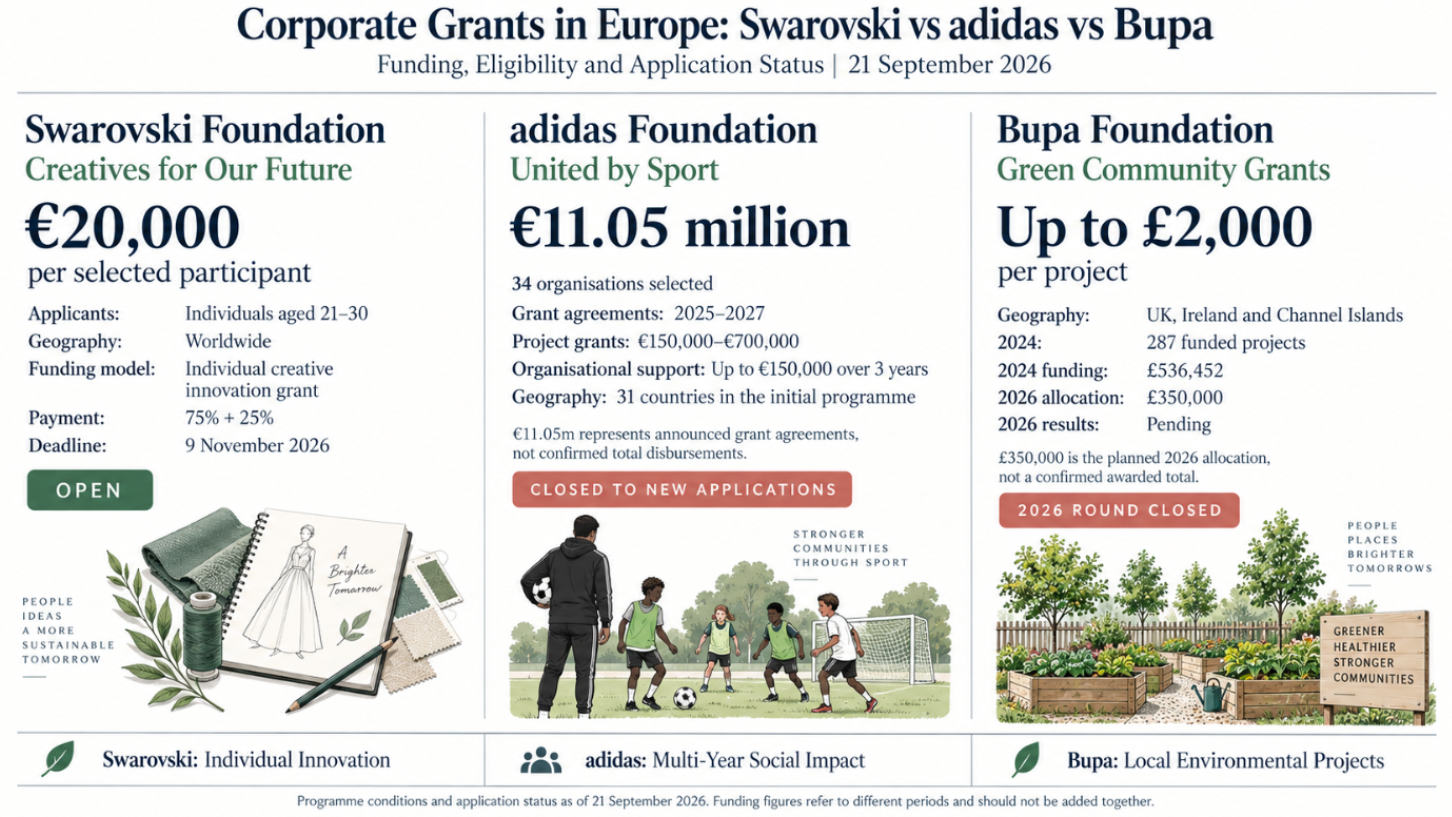
The financial differences are considerable. Swarovski Foundation offers €20,000 grants to selected young creative professionals. The first United by Sport programme of adidas Foundation included project funding ranging from €150,000 to €700,000 and generated grant agreements worth €11.05 million for implementation during 2025-2027. Bupa Foundation's Green Community Grants programme, by contrast, offers grants of up to £2,000 for practical environmental and community projects.
Yet the largest amount does not necessarily represent the most accessible or appropriate opportunity. An individual innovator cannot automatically apply for a programme intended for legally registered nonprofits, and a small community organisation may lack the organisational capacity required to administer a substantial international grant.
Application status is equally important. As of 21 September 2026, Swarovski Foundation's Creatives for Our Future competition is accepting applications. The European adidas Foundation competitions examined in this article have closed, while Bupa Foundation's 2026 Green Community Grants round is awaiting funding decisions.
This article examines the actual funding mechanisms behind these programmes, their financial results, eligibility rules, European beneficiaries, recent developments, and practical implications for grant applicants. It distinguishes confirmed funding from requested amounts, future commitments, and historical grant opportunities.
1. Understanding the Three Corporate Grant Models
The three foundations share a connection to internationally recognised commercial brands, but their approaches to grantmaking reflect different objectives.
Swarovski Foundation focuses on empowering individuals whose creative practices can contribute to sustainable development. Its Creatives for Our Future programme combines a direct financial grant with education, professional mentoring, and international networking. The recipient is an individual rather than necessarily an established organisation.
adidas Foundation uses sport as a vehicle for addressing discrimination, social exclusion, unequal participation, and the effects of crises. Its programmes frequently involve established organisations, multi-year relationships, and investments in organisational capacity. Funding can support either a specific project or an organisation's broader activities, depending on the programme.
Bupa Foundation connects community wellbeing with environmental improvements. Its Green Community Grants programme distributes relatively modest sums to organisations implementing practical improvements in local green spaces. Funding is designed to create identifiable benefits within communities rather than finance large institutional programmes.
These differences affect every stage of the application process, from initial eligibility screening to project budgeting and subsequent reporting.
Table 1. Comparison of Swarovski, adidas, and Bupa Grant Programmes
| Criterion | Swarovski Foundation | adidas Foundation | Bupa Foundation |
|---|---|---|---|
| Main programme | Creatives for Our Future | United by Sport and additional thematic programmes | Green Community Grants |
| Primary objective | Creative innovation for sustainable development | Social inclusion, equality and community development through sport | Environmental improvements and community wellbeing |
| Main applicants | Individual creative professionals aged 21-30 | Eligible nonprofit, sporting and community organisations | Registered charities, nonprofit organisations, non-fee-paying schools, local authorities and eligible housing providers |
| Geographical coverage | Worldwide | Depends on the specific programme, including several European countries | United Kingdom, Republic of Ireland and Channel Islands |
| Funding available | €20,000 per selected individual | United by Sport project grants of €150,000-€700,000; organisational support up to €150,000 over three years | Up to £2,000 per project in 2026 |
| Funding duration | Development programme extending into 2028 for the 2026 application cycle | Frequently multi-year | Defined local projects |
| Additional support | Mentoring, educational activities and professional connections | Organisational development, learning opportunities and collaboration | Grant administration and programme guidance through Groundwork |
| Application status on 21 September 2026 | Open until 9 November 2026 | European competitions reviewed here are closed | 2026 competition closed |
| Main eligibility consideration | Individual ownership, age and creative sustainability objectives | Organisational capacity, thematic alignment and programme-specific geography | Legal status, project location, local need and practical environmental benefits |
The table highlights an important principle for grant research: the legal identity of the applicant must match the funding mechanism.
A nonprofit organisation cannot assume that it can receive Swarovski's individual award simply because its activities involve sustainable design. Likewise, an independent designer cannot submit an application to Bupa's community grant programme without meeting its organisational eligibility requirements.
For international organisations, geographical restrictions require particular attention. Swarovski's competition is worldwide, but adidas Foundation programmes may be restricted to selected countries, and Bupa's Green Community Grants are limited to specific jurisdictions.
2. Swarovski Foundation: Supporting the Next Generation of Creative Innovators
Swarovski Foundation was established in 2013 to advance social and environmental objectives through education and charitable partnerships. Its activities include initiatives connected to equity, creativity, and water.
The Foundation reports that its wider work has reached more than two million people across 93 countries through 85 partnerships. These are cumulative figures covering broader foundation activities, not the number of Creatives for Our Future grant recipients or the amount awarded through that specific competition.
Creatives for Our Future was developed in collaboration with the United Nations Office for Partnerships. Launched in 2021, the programme identifies young creative professionals who use design, technology, artistic practice, and other innovative approaches to address sustainable development challenges.
Its funding model is unusual because the grant is combined with a structured professional development programme.
Selected participants receive financial support, individual mentoring, educational sessions, professional connections, and opportunities to engage with experts from relevant industries.
The objective is not simply to reward an existing idea. It is to help promising individuals develop solutions that can progress towards practical implementation.
2.1. The 2026 Competition: A Confirmed Open Opportunity
The fifth cycle of Creatives for Our Future opened for applications on 9 September 2026.
The confirmed application deadline is 9 November 2026. Successful candidates are expected to be notified by April 2027, with the programme beginning in autumn 2027 and continuing into 2028.
The competition is open to eligible individuals worldwide, including applicants based in European countries.
The programme's international reach should not be confused with unrestricted participation conditions. Successful candidates are expected to travel to the United Kingdom for programme activities, subject to confirmation of the event arrangements. They must therefore be able to meet the necessary passport, visa, and other entry requirements.
The award includes travel support under the Foundation's terms, but participants remain responsible for complying with immigration requirements and checking expenses that may fall outside the travel package.
The Foundation also expects active participation in its educational programme. Participants may need to attend approximately two or three programme activities each month between September 2027 and September 2028.
Consequently, the competition is particularly relevant to individuals who can combine their creative work with a sustained commitment to professional development.
2.2. Who Is Eligible?
Applicants must be between 21 and 30 years old during the application period and meet the age conditions by the deadline.
The programme does not require applicants to hold a university degree, remain enrolled in education, or operate a registered business.
This creates an opportunity for independent designers, early-stage innovators, researchers working outside traditional academic structures, and professionals developing creative solutions independently.
However, applications are accepted from individuals rather than conventional project consortia.
A sole proprietor or an individual who owns a company entirely may apply personally. A company with multiple owners cannot submit an application through one of its co-founders as if that person were the sole applicant.
Similarly, employees cannot submit a project on behalf of an independently owned company unless the conditions concerning individual ownership are satisfied.
This distinction is particularly relevant for startups. A founder developing a sustainable technology within a company owned by several shareholders should not assume that the company automatically qualifies.
The project must also demonstrate a clear connection to sustainable development.
Relevant fields include sustainable fashion, innovative materials, product design, architecture, engineering, environmental technologies, photography, visual communication, and other forms of creative practice capable of generating positive social or environmental change.
Applicants do not need to incorporate Swarovski crystals into their projects.
Nevertheless, the programme is not a universal arts grant. Performing arts such as theatre, music and dance, together with literary writing and journalism, fall outside the supported creative categories.
2.3. What Makes a Project Competitive?
The Foundation evaluates eligible applications against six principal criteria: design and creativity, innovation, potential and feasibility, impact, sustainable development, and funding transparency.
A creative concept should therefore demonstrate more than an original appearance or attractive presentation.
The applicant needs to explain which problem the proposed solution addresses, how the creative process contributes to solving it, and why the solution could generate a meaningful environmental or social benefit.
For example, a designer proposing an alternative textile material should identify the problem associated with conventional production, explain the proposed material's characteristics, and describe the steps required to develop and validate it.
A project intended to reduce waste should clarify which waste stream it addresses, how the proposed process works, and how the results could eventually be measured.
The Foundation also considers whether an applicant understands the realistic development pathway of the project. An early-stage concept can be considered, but it should be supported by a credible plan explaining how the idea could progress beyond its current stage.
Applicants should distinguish between immediate outputs and longer-term ambitions. Producing a prototype during the programme is a different achievement from demonstrating large-scale industrial adoption.
Financial transparency is another explicit selection criterion. The applicant must explain how the grant will contribute to the proposed project and why the intended expenditure aligns with sustainable development objectives.
2.4. Application Documents and Selection Procedure
Candidates must submit an English-language application through the official programme platform.
The supporting materials include a creative portfolio of up to 50 MB, a video introduction lasting no more than two minutes and limited to 150 MB, proof of identity, a valid passport, and an academic or professional reference.
A strong portfolio should demonstrate the applicant's own contribution to previous or ongoing work. It should make the relationship between creative ability and the proposed project understandable to evaluators who may not specialise in the applicant's particular discipline.
The video provides an opportunity to explain the problem, the proposed solution, and the applicant's motivation in a concise and accessible format.
Candidates should also ensure that their plans include tangible outcomes by September 2028.
After the application deadline, submissions undergo an initial assessment of eligibility and completeness. Applications that fail basic requirements may be excluded before the substantive evaluation begins.
Eligible applications are then assessed by a selection committee and expert jury. Leading candidates are expected to be invited to online interviews in January 2027.
Successful participants are scheduled to receive individual notifications by April 2027.
An important administrative detail is that the programme's published documents contain different response periods for accepting an award. The frequently asked questions and application guidance specify four days, while the formal terms refer to seven days in a related provision.
Selected applicants should therefore follow the deadline stated in their individual notification and respond promptly.
The Foundation also recommends contacting its programme team if an applicant does not receive confirmation within 24 hours after submitting a completed application.
2.5. Financial Conditions: Why the Payment Schedule Matters
Each successful applicant receives a grant of €20,000 or an equivalent amount in an agreed currency.
The award is divided into two payments.
The Foundation's terms establish a distribution of 75 percent and 25 percent, with the initial portion associated with completion of the relevant contractual formalities and submission of an invoice. The remaining portion is linked to the submission of a project progress report.
Other provisions connect the administration of payments with the programme's onboarding and award arrangements. Recipients should therefore confirm the precise transfer schedule in their individual documentation rather than assume that the money will arrive immediately after the selection announcement.
Table 2. Swarovski Foundation Grant Conditions and Application Calendar
| Item | Confirmed information | Practical implication |
|---|---|---|
| Application opening | 9 September 2026 | Applications can be submitted |
| Application deadline | 9 November 2026 | Late applications are not eligible for the current cycle |
| Applicant age | 21-30 | Age eligibility must be satisfied during the application period |
| Eligible applicant | Individual or eligible wholly owned business represented by its owner | Ordinary multi-founder company applications are not accepted |
| Grant amount | €20,000 | Funds support the selected creative project |
| First payment | 75 percent, equivalent to €15,000 | Initial expenditure should reflect the agreed payment schedule |
| Second payment | 25 percent, equivalent to €5,000 | Linked to project progress reporting |
| Interviews | Expected January 2027 | Shortlisted candidates must remain available |
| Notification | By April 2027 | Candidates should monitor communications and respond promptly |
| Programme launch | Autumn 2027 | The award should not be treated as funding available immediately in 2026 |
| Programme participation | Educational and mentoring activities into 2028 | Participation requires a sustained commitment |
| Project expenditure | Must support the approved project | University tuition and degree projects are not the intended purpose of the grant |
For applicants, the payment structure raises a practical budgeting question.
A proposed project requiring €18,000 in equipment purchases before any development work begins may encounter difficulties if the first transfer is €15,000.
The applicant should therefore consider whether activities can be organised into stages that correspond to the available financing.
An illustrative project budget might distribute the €20,000 between materials and prototype development, technical testing, specialist services, documentation, and dissemination. Such a breakdown must reflect the actual project and comply with the approved grant agreement. It should not be presented as a standard budget imposed by Swarovski.
The funding is restricted to the project submitted and approved. Major changes to the project may affect eligibility or the award.
2.6. Competition Statistics and Recent Results
The programme's historical results provide useful context.
In 2025, six participants were selected from 487 applicants. By that point, the initiative had received nearly 2,000 applications from more than 90 countries since its establishment in 2021.
These figures demonstrate the international reach of the competition, but they do not establish the number of applications or the selection rate for the 2026 cycle.
The Foundation's announcement of the 2025 participants included projects addressing refugee housing, sustainable textiles, accessibility, electronic waste, and environmentally responsive architecture.
In June 2026, the Foundation also published information celebrating the graduation of its fourth cohort. The update described progress across several areas, including regenerative materials, inclusive technology, circular electronics, and sustainable construction.
However, descriptions of project development should not automatically be interpreted as independently verified commercial results. A prototype's potential to reduce environmental damage is not the same as proof of large-scale adoption.
2.7. European Case Study: Aurélie Fontan and Regen Ink
One of the clearest European examples is Aurélie Fontan, a UK-based designer selected for the 2025 cohort.
Her project, Regen Ink, explores a regenerative approach to textile colour production.
Conventional textile dyeing can involve substantial chemical inputs and contribute to water pollution. Regen Ink investigates an alternative process using plants cultivated on contaminated land to produce natural, non-toxic pigments and textile printing materials.
The project combines two environmental objectives. Plant cultivation is intended to contribute to land restoration, while harvested plant material can be used to develop biodegradable dyes.
The design challenge is not limited to producing a natural colour. The project seeks to develop printing materials capable of meeting practical textile industry requirements.
This creates a research and development pathway involving plant cultivation, pigment extraction, material testing, production methods, and potential applications in fashion and other creative industries.
The Foundation identifies Fontan as a grant recipient and describes its support as a combination of financing, mentoring, and access to professional networks.
The project illustrates the type of innovation Swarovski seeks: a creative approach connecting environmental restoration with a potential industrial application.
At the same time, its future objectives should not be confused with completed outcomes. Commercial-scale deployment and independently quantified reductions in environmental damage should only be reported when supporting evidence becomes available.
For prospective applicants, the case demonstrates how a proposal can connect a specific environmental problem to a creative technical solution and a realistic development pathway.
3. adidas Foundation: Multi-Year Funding for Social Inclusion Through Sport
adidas Foundation was established in 2024 as a separate nonprofit organisation.
Its mission is to use sport to bring communities together and address social challenges, including discrimination, exclusion, unequal participation, and the consequences of crises.
The Foundation's approach is broader than providing sports equipment or sponsoring sporting events. Its programmes support organisations that use physical activity as a tool for social development.
A funded initiative might combine football with activities supporting displaced children, use community sport to address discrimination, or help local organisations establish more inclusive participation practices.
This distinction matters because a proposal focused only on purchasing sports equipment or staging a tournament may not adequately reflect the social objectives of a particular funding programme.
The Foundation employs several partnership mechanisms, including publicly announced requests for proposals and direct invitations to organisations identified through its own research.
It does not accept unrestricted unsolicited grant proposals. Submitting organisational information through its contact system does not guarantee an invitation or funding.
3.1. United by Sport: The First Major Grant Programme
United by Sport is designed to combat discrimination and promote equality through sport.
Its first call for proposals opened on 18 March 2024 and closed on 31 May 2024.
The response was substantial: 754 applications were submitted from 107 countries.
Of these, 347 applications concerned general organisational support, while 407 sought project-specific funding.
Only 366 applications passed the initial eligibility requirements and proceeded to further consideration.
The selection process took place between July and November 2024. Eligible applications underwent evaluations involving Foundation staff and independent external assessors, followed by additional committee review and due diligence.
Ultimately, 34 organisations were selected.
Seventeen received general support and seventeen were selected for project-specific funding.
The initial programme covers activities in 31 countries, including Ukraine and several other European states.
3.2. Understanding the €11.05 Million Funding Figure
The Foundation announced a total grant volume of €11.05 million for the first 34 partnerships.
The funding is intended to be disbursed over three years, from 2025 to 2027.
This is an important financial distinction.
The €11.05 million represents the announced volume of the relevant grant agreements. It does not mean that all funds were transferred to beneficiaries in 2024 or that the entire amount had already been spent by September 2026.
It should also not be confused with the Foundation's total worldwide charitable expenditure across every programme.
The Foundation's later publications refer to 35 United by Sport partners in connection with its organisational learning activities. This differs from the initial selection announcement identifying 34 organisations.
The original €11.05 million figure should therefore remain associated with the first announced group rather than automatically being recalculated or extended to a later partner count.
3.3. Project Grants Versus General Organisational Support
United by Sport offered two distinct funding mechanisms.
Project-specific support financed new initiatives with grant amounts ranging from €150,000 to €700,000.
General support financed organisations whose regular activities were strongly aligned with the programme's objectives. The maximum was €50,000 annually for up to three years, with a total funding range extending from €10,000 to €150,000.
These mechanisms create different possibilities for applicants.
Project funding is appropriate when an organisation can define a specific intervention, establish a realistic implementation timetable, calculate expenditure, identify participants, and demonstrate expected results.
General support addresses a broader institutional need. It can contribute to an organisation's continuing activities when those activities are aligned with the Foundation's mission.
The distinction is particularly important for experienced grant writers. A project proposal should not present ordinary institutional expenses as project-specific expenditure unless those costs are permitted and genuinely attributable to implementation.
Conversely, an organisation applying for flexible support needs to demonstrate why its established activities, governance, and long-term strategy warrant investment.
Both forms of funding require a credible organisational foundation.
3.4. European Beneficiaries: Verified Partnerships and Financial Qualifications
The Foundation publishes information about individual organisations and their projects.
Several partners operate in Europe, including organisations working in Ukraine, Ireland, and the United Kingdom.
Some public project profiles contain a field labelled "Requested grant amount". This is not equivalent to a confirmed payment or an audited final grant expenditure figure.
The organisations can be identified as selected partners, but publicly requested sums should retain their original financial classification.
Table 3. European adidas Foundation Partners and Documented Funding Information
| Organisation | Country | Programme and activities | Published amount | Evidence and qualification |
|---|---|---|---|---|
| All-Ukrainian Foundation for Children's Rights | Ukraine | United by Sport; football-based social integration and support for internally displaced children | €363,562 | Confirmed partner; amount identified as requested funding |
| Sport Against Racism Ireland | Ireland | United by Sport; organisational support for inclusion and anti-discrimination activities | €150,000 | Confirmed partner; public amount identified as requested funding |
| Sporting Equals | United Kingdom | United by Sport; organisational support for participation and inclusion among ethnically diverse communities | €150,000 | Confirmed partner; publicly stated amount should not be treated as independently verified cash transferred |
The Foundation's partner information confirms the relationship with these organisations. Nevertheless, exact payment dates, final disbursement amounts, and audited expenditure are not established by the requested figures alone.
For organisations using historical awards to prepare future applications, this distinction affects financial benchmarking.
A requested amount can illustrate the scale of a proposed project, but it should not be cited as evidence that the Foundation always awards that exact sum to comparable applicants.
3.5. Ukrainian Case Study: Supporting Displaced Children Through Football
The All-Ukrainian Foundation for Children's Rights provides a particularly relevant example of European corporate grant funding.
The organisation is a United by Sport partner for a project running from March 2025 to May 2027.
The initiative supports internally displaced children and young people, together with children living in host communities, through football and related social activities.
Its approach draws on the Open Fun Football Schools methodology and combines sport with anti-discrimination practices and psychosocial support.
The project involves local stakeholders, including schools, families, community representatives, and professionals working with children.
Its activities include football schools, community sports sessions, educational events, and after-school programmes.
The underlying objective is to use shared activities to strengthen relationships between children who have experienced displacement and the communities receiving them.
This is substantially more complex than financing football matches alone.
The programme requires coordination between organisations, appropriate child protection procedures, trained personnel, accessible activities, and attention to the needs of children affected by conflict.
The Foundation's public partner profile identifies a requested grant amount of €363,562.
The organisation's own website also identifies adidas Foundation as a supporter of its work connecting civil society, communities, and sport for reconciliation, social integration, and child protection in Ukraine.
Public reporting from March 2026 described project activities across the Dnipropetrovsk, Ivano-Frankivsk, Kyiv, and Rivne regions.
These details provide evidence of implementation beyond the original proposal, although the complete final results cannot yet be established because the project is scheduled to continue into 2027.
The case highlights a practical characteristic of larger corporate grants: the funder is financing an intervention designed to address a documented social challenge, while sport provides the method through which the intervention is delivered.
3.6. Ireland and the United Kingdom: Organisational Support in Practice
Sport Against Racism Ireland, commonly known as SARI, is another relevant European partner.
The organisation uses sport to promote cultural integration, combat discrimination, and create opportunities for people from different communities to participate together.
Its activities include educational workshops, football programmes, and community events.
A public account of its 2025 Football versus Discrimination programme reported workshops delivered in 67 locations, with 143 workshops and 4,803 participants. The programme identified adidas Foundation among its supporters alongside other funders.
These figures illustrate organisational activity, but they should not be attributed exclusively to adidas funding because the programme involves multiple supporters.
Sporting Equals in the United Kingdom provides another example of institutional support.
Its activities seek to address barriers to participation and improve opportunities for ethnically diverse communities in sport.
The two organisations illustrate why general support can differ from conventional project funding. A foundation may invest in an organisation's broader ability to deliver its mission instead of restricting the entire grant to a single new intervention.
However, the precise permitted expenditure, reporting schedule, and payment arrangements remain dependent on the individual grant agreement.
4. adidas Foundation's New European Funding Initiatives in 2026
United by Sport is not the only relevant programme.
During 2026, adidas Foundation expanded its activities through initiatives addressing specific barriers to sport and social participation.
These programmes provide evidence of the Foundation's evolving priorities, but their application deadlines must be presented accurately.
4.1. Play for Pride: Building More Inclusive Sporting Organisations
Play for Pride was launched as part of the Foundation's Playing for Purpose programme.
The initiative focuses on improving access to sport for LGBTQIA+ young people and strengthening the capacity of organisations to create safe and inclusive environments.
Its initial geographical coverage includes Montenegro, Spain, and the United Kingdom.
The programme was developed with IGLYO, an organisation bringing specialist expertise in LGBTQIA+ youth inclusion.
The partnership model is structured around groups of three organisations in each participating country.
One specialist association acts as a mentor, while two local sporting or sport-for-development organisations participate as partners receiving guidance and support.
Together, the organisations develop an Inclusion Action Plan covering approximately 24 months of organisational change.
Activities can include staff development, policy improvements, changes to sporting facilities, and the creation of more inclusive participation opportunities.
Selected organisations receive multi-year financial support and access to structured learning activities.
The public application window ran from 24 March to 19 April 2026.
Mentor organisations were identified through a separate restricted process, whereas eligible local organisations could apply through the public call.
This difference is important because the programme combines open selection with an invitation-based component.
By 21 September 2026, the application period had ended. Individual financial awards should not be invented where confirmed amounts have not been publicly established.
4.2. Play for the Lead: Supporting Young Women's Participation and Leadership
Play for the Lead focuses on increasing access to sport and strengthening leadership opportunities for young women in France, Germany, and Spain.
The programme pays particular attention to young women whose experiences are shaped by migration, displacement, or ethnic marginalisation.
Rather than designing all activities exclusively at foundation level, the initiative seeks to involve young women directly in identifying problems and developing responses.
The announced model envisages partnerships with six community-based organisations.
Each organisation would identify up to four young women leaders aged 18-25 to participate in a structured leadership programme.
The participants would receive training related to project development, safeguarding, and practical leadership before helping design community sporting initiatives.
The Foundation also created an advisory mechanism intended to incorporate perspectives from young women in the three participating countries.
Selected organisations are offered multi-year financial support and assistance with organisational learning and implementation.
The deadline for organisational applications was 6 July 2026.
Consequently, the programme is relevant as an example of recent European corporate funding, but not as an opportunity currently accepting new applications.
The publicly described project model includes planned activities and intended partnerships. These should not automatically be described as completed results or final grant allocations before the Foundation confirms them.
4.3. Recovery Through Sport: A €6 Million Strategic Partnership Initiative
Recovery Through Sport introduces another funding model.
Announced in July 2026, the initiative seeks to support children and young people affected by crises and displacement.
The Foundation intends to work with one to three strategic partners over an initial period of at least three years.
The total financial commitment is approximately €6 million across selected partners and potential programme activities.
This does not mean that every selected organisation will receive €6 million.
It also does not mean that the money had already been distributed by September 2026.
The call for expressions of interest was open between 15 July and 30 August 2026.
The selection timetable envisaged shortlisting in early September, interviews between 20 and 25 September, organisational checks in October, and contracting during November and December.
The initiative differs from conventional calls for project proposals.
The Foundation explicitly stated that organisations were not expected to submit fully developed budgets, implementation plans, or monitoring frameworks during the initial expression-of-interest stage.
Instead, it sought evidence of established expertise, operational capacity, safeguarding arrangements, experience supporting children and young people, and the willingness to develop a programme collaboratively.
Relevant organisational experience included psychosocial support, work in crisis-affected settings, and the appropriate use of sport or physical activity.
The required documentation included proof of legal registration and nonprofit status, recent financial statements, safeguarding policies, and a summary of psychosocial expertise.
The programme therefore illustrates a strategic partnership model rather than a competition in which the largest or most elaborate initial project budget automatically determines the outcome.
At the research date, new expressions of interest were no longer being accepted, and final partnerships should not be presented as confirmed before the process concludes.
4.4. Why adidas Foundation Does Not Accept Ordinary Unsolicited Proposals
The Foundation selects partners through publicly announced calls and direct invitations.
Under the invitation model, its team researches organisations that appear aligned with the Foundation's strategy and contacts them to explore potential cooperation.
All prospective partners must undergo due diligence before formal agreements are concluded.
The Foundation states that it cannot review unrestricted unsolicited proposals.
Interested organisations may submit their details through the relevant information channel to receive updates or make their activities visible for future research. However, doing so does not constitute a grant application and creates no entitlement to individual feedback or funding.
There was a separate open adidas Foundation funding opportunity in Latin America in September 2026, but its geographical requirements did not make it generally accessible to organisations operating only in Europe.
For European applicants, the practical implication is clear: future opportunities must be identified through the specific programme's official announcements, not inferred from the Foundation's general grantmaking activity.
4.5. Reporting and Organisational Development: Lessons From Existing Partners
Large grants are accompanied by administrative responsibilities, and adidas Foundation has publicly acknowledged this challenge.
During 2025, the Foundation collected feedback from its existing partners.
Organisations appreciated multi-year funding and the opportunity to develop longer-term activities, but some reported difficulties associated with financial reporting and digital administration.
The Foundation subsequently announced changes to its reporting approach.
As of November 2025, it had reduced the frequency of reporting requirements where possible and began reviewing its reporting formats.
It also started work with external specialists to assess and improve its digital systems during 2026.
These changes should not be described as a complete elimination of reporting requirements. Financial accountability remains necessary, and some administrative improvements were still under development.
The Foundation also expanded opportunities for partner learning.
Its United by Sport Community of Practice was launched in November 2025, with 33 of 35 partners reported to have joined.
The distinction between 34 organisations in the first selection announcement and 35 in subsequent learning activities reflects different reporting points and should not be used to imply an undocumented increase in the original funding package.
For applicants and grant writers, the lesson is that institutional readiness matters as much as project quality. Financial management, governance, safeguarding, and the ability to collect meaningful evidence are relevant to the implementation of larger multi-year grants.
5. Bupa Foundation: Small Grants for Healthier and Greener Communities
Bupa Foundation's Green Community Grants programme demonstrates a contrasting approach to corporate funding.
Instead of concentrating resources in a small number of substantial international partnerships, the programme distributes relatively small grants across numerous community-based projects.
It is delivered in partnership with Groundwork, a network of charities working on environmental improvement and community development.
The initiative forms part of Bupa's broader Healthy Cities activities, which connect physical activity with charitable funding and improvements to urban environments.
The Green Community Grants programme should nevertheless be distinguished from the entire Healthy Cities initiative.
The broader initiative may support other charities and activities, while Green Community Grants has its own eligibility rules, grant amounts, deadlines, and financial reporting.
5.1. How the Programme Works
Green Community Grants finance practical projects intended to benefit both people and the environment.
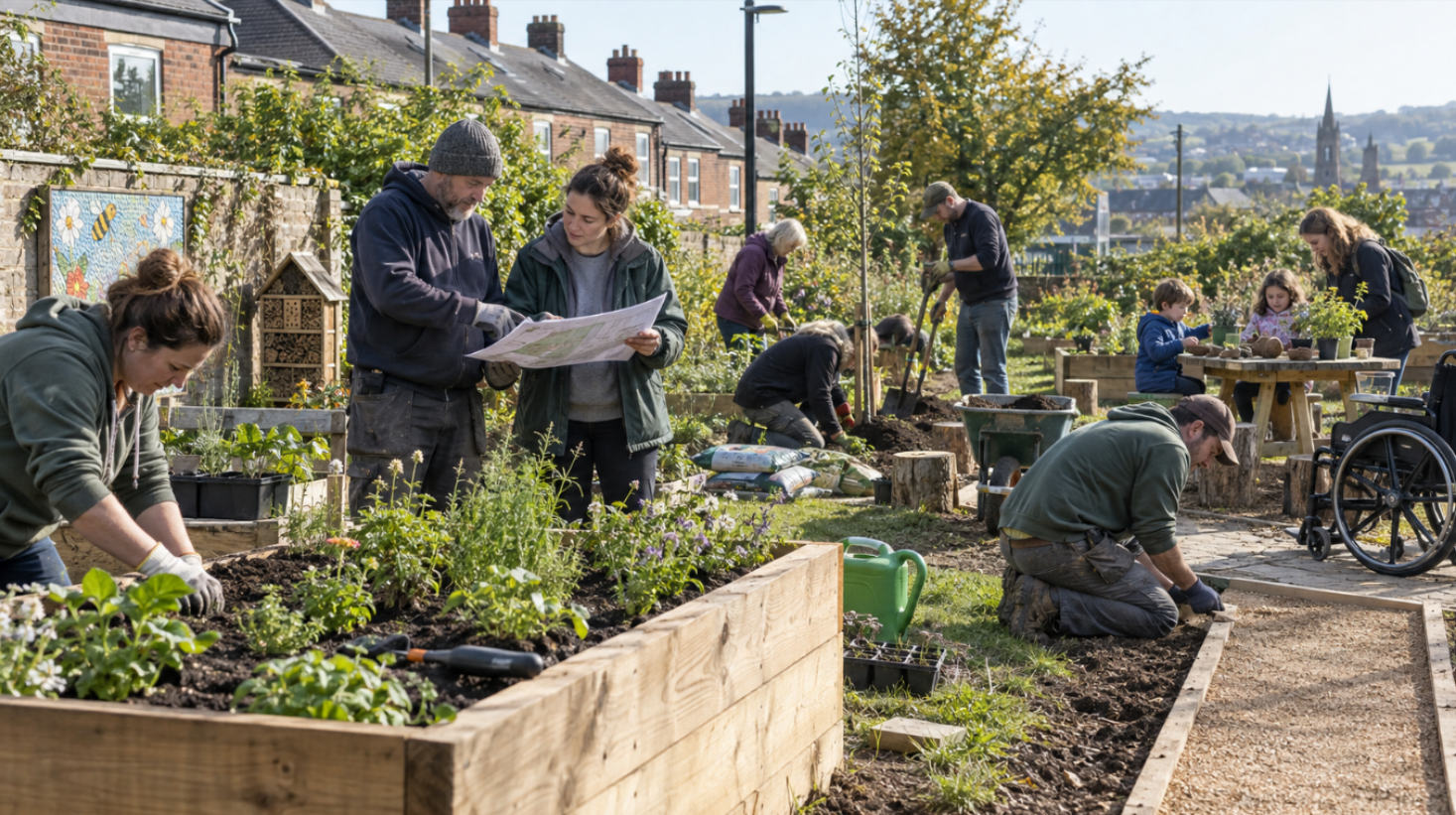
Typical activities include transforming neglected spaces into community gardens, establishing outdoor classrooms, developing food-growing areas, creating small urban parks, improving biodiversity, and making green spaces more accessible.
Projects are generally designed around a particular place and a clearly defined group of beneficiaries.
A school might create a natural learning environment for pupils. A community group could convert an unused site into a garden. A charity might improve access to outdoor activities for people with disabilities or older residents.
The programme's central requirement is a credible connection between environmental improvement and community wellbeing.
Planting trees or creating a garden is not necessarily sufficient by itself. Applicants should explain who will benefit, how the space will be used, and why the intervention is needed.
5.2. Grant Amounts Have Changed Over Time
Green Community Grants began in 2023.
The initial competition offered grants between £250 and £2,500.
The maximum available amount was subsequently reduced to £2,000, which was the ceiling for the 2024 and 2026 competitions.
This historical change matters when reviewing previous recipients. An older grant awarded under the original conditions should not be used to suggest that the same amount remains available in a later competition.
The current programme should always be described using the conditions of the relevant year.
5.3. Financial Results From 2023 to 2026
In 2023, the programme received 1,063 applications and supported 239 projects, distributing more than £500,000.
The first funded group included schools establishing outdoor classrooms and sensory gardens, alongside charities and community organisations improving parks, playgrounds, and food-growing spaces.
The second funding round supported 287 projects in 2024.
The official programme report identifies £536,452 in grant awards for that year.
The programme continued expanding its geographical and thematic reach, funding both educational settings and local community organisations.
The third round, completed in 2025, again distributed more than £500,000.
There is a discrepancy between official reports concerning the number of recipients. The October 2025 announcement identified 271 schools and community organisations, whereas the June 2026 impact report recorded 268 funded organisations.
The later figure is consistent with the cumulative total of 794 organisations reported for the programme's first three years.
The reason for the discrepancy has not been publicly explained in the reviewed materials. It should therefore be acknowledged rather than concealed.
For 2026, the Foundation allocated £350,000 to Green Community Grants and indicated that approximately 175 projects were expected to receive support.
Applications closed on 30 June, with decisions expected by the end of September.
As of 21 September 2026, these figures were planned allocations and expected recipient numbers, not confirmed final results for the fourth competition.
Table 4. Bupa Foundation Green Community Grants: Funding and Results, 2023-2026
| Year | Applications or funded projects | Funding | Maximum grant | Financial status |
|---|---|---|---|---|
| 2023 | 1,063 applications; 239 funded projects | More than £500,000 | £2,500 | Completed historical round |
| 2024 | 287 funded projects | £536,452 | £2,000 | Completed historical round |
| 2025 | 268 recipients in the June 2026 report; 271 in the October 2025 announcement | More than £500,000 | £2,000 | Completed round; recipient totals differ between official publications |
| 2026 | Approximately 175 projects expected | £350,000 allocated | £2,000 | Competition closed; final decisions pending as of 21 September |
The programme's cumulative investment since 2023 exceeds £1.4 million according to its current official information.
An October 2025 announcement rounded total funding over the first three years to £1.5 million.
Both statements concern cumulative funding and should not be presented as additional, separate allocations.
The programme also reports a total of 794 supported organisations over the first three years.
This figure covers historical recipients and does not include an unconfirmed total for the 2026 selection.
5.4. Environmental and Community Results
The programme's impact reports provide unusually detailed information about physical outputs for a small-grant initiative.
The June 2026 report described the results of the third funding round and reported 844 new open spaces, 19,535 square metres of improved outdoor space, and 1,919 trees planted.
The organisers also reported that the programme had directly supported more than 386,600 people since 2023.
These figures represent outcomes and outputs reported by the programme administrators. They should not automatically be interpreted as independently verified improvements in long-term physical or mental health.
For example, creating an accessible garden is a measurable physical achievement. Demonstrating a lasting improvement in participants' health would require additional evidence and appropriate evaluation methods.
Nevertheless, the figures show how a programme distributing relatively small amounts can support a broad portfolio of local environmental interventions.
For grant applicants, the reporting approach offers a practical lesson.
Even small grants benefit from clearly defined outputs. An organisation can record the area improved, the number of people participating, the quantity of planting completed, or the accessibility features installed.
These measures make project implementation easier to explain and provide a stronger basis for future fundraising.
5.5. European Case Studies: What a £2,000 Grant Can Finance
The programme's funded projects demonstrate how modest financial support can produce identifiable local improvements.
Saint Joseph's Nursery School in Northern Ireland received £2,000 to improve an outdoor classroom.
The project created additional opportunities for children to learn and interact with nature. The school's account of the project emphasised increased curiosity, confidence, and engagement among children using the improved space.
This example illustrates a practical relationship between infrastructure and activity. The funding contributes to a physical facility, while the organisation is responsible for ensuring that the space is used for meaningful educational purposes.
R-Urban Poplar, a project developed by Public Works in London, received £2,000 for environmental activities with young people.
Its activities took place at a community garden and environmental centre created on a former car park.
The supported work involved practical workshops in which young participants developed habitats for insects and other small creatures.
The project connects biodiversity improvements with environmental education and local participation.
A third example is Creggan Country Park in Northern Ireland.
The organisation received £2,000 through the 2024 programme to improve a community green space, with activities connected to wellbeing and food growing.
These three examples share a common feature: the grant is tied to a clearly identifiable intervention rather than an unrestricted contribution to the organisation's overall budget.
For applicants, that distinction should shape the proposal from the beginning.
A request to make a community healthier is too broad to explain the practical use of £2,000. A proposal to install accessible planting beds, provide suitable materials, and organise a defined programme of gardening activities offers a much clearer account of the intended expenditure and results.
5.6. Eligibility Requirements for the 2026 Round
The 2026 Green Community Grants competition was available to eligible organisations in the United Kingdom, Republic of Ireland, and Channel Islands.
Potential applicants included registered charities, nonprofit organisations, non-fee-paying schools, local authorities, and social housing providers.
Individuals and profit-making businesses were not eligible.
The published rules also excluded unconstituted organisations, private fee-paying schools, community interest companies with shares, and certain newer community interest companies limited by guarantee.
Consequently, the legal structure of an applicant was a fundamental requirement.
A newly established community initiative without an eligible organisational structure could not assume that its social objectives alone would be sufficient.
Applicants also needed to demonstrate how their projects would improve environmental conditions and community health.
The programme gave priority to practical interventions with clear local benefits.
5.7. Geographic Priorities and Deprivation Criteria
Although the programme covers several jurisdictions, its 2026 competition included specific geographical priorities.
Additional consideration was given to projects in urban areas, particularly London, Staines, Brighton, Leeds, Greater Manchester, especially Salford, Dublin, and Glasgow.
Priority was also given to communities experiencing substantial deprivation.
The programme referred to areas within the most deprived 20 percent according to official deprivation indices, or locations where applicants could provide convincing alternative evidence of significant need.
This does not mean that every organisation outside a named city was automatically ineligible.
It means that eligible applicants had different levels of priority depending on location and demonstrated need.
New applicants who had not previously received a Green Community Grant were also prioritised.
A recommendation from a named Bupa employee or customer could provide an additional consideration where the other priorities were satisfied.
Such a recommendation was not a universal eligibility requirement, and the programme was not restricted to invited organisations.
For future applicants, these distinctions demonstrate why reading only the headline geographical coverage is insufficient.
A programme may technically accept applications across an entire country while concentrating funding on particular communities or types of intervention.
5.8. Eligible Expenditure and Common Budgeting Mistakes
The Green Community Grants programme funds practical activities that improve both environmental conditions and people's wellbeing.
Potentially relevant expenditure includes materials, planting, improvements to outdoor spaces, and other costs directly connected to implementation.
The rules also permit some staff salary expenditure when the staff member is directly responsible for delivering the funded project.
However, general organisational running costs and overheads are excluded.
The programme does not finance activities already completed before the grant is received. Research projects, fundraising events, expenditure intended for redistribution to other charities, overseas appeals, and certain promotional activities are also excluded.
Projects that public authorities are legally required to provide are not eligible for support.
These conditions create important distinctions within project budgets.
An organisation seeking to improve a garden may be able to request materials and direct implementation costs, but it should not assume that the grant can cover existing debts, unrelated administration, or work completed before approval.
A practical budget for an accessible community garden might include planting materials, raised beds, pathway improvements, and direct project delivery costs.
Any proposed expenditure would need to comply with the relevant funding guidance and receive approval through the application process.
Applicants should avoid constructing budgets simply to reach the maximum available amount. Each cost should be necessary, proportionate, and linked to the intended result.
5.9. The 2026 Round Is Closed
Applications for the 2026 Green Community Grants programme opened on 1 June and closed on 30 June.
The organisers indicated that funding decisions would be communicated by the end of September.
Therefore, as of 21 September 2026, a new applicant could not submit a proposal to the current round.
The £350,000 budget and the expectation of approximately 175 supported projects must remain identified as planned figures until confirmed awards are announced.
Similarly, there is no basis for presenting a future competition as open before the Foundation publishes its official conditions and timetable.
Organisations interested in subsequent opportunities should monitor the programme administrator's announcements rather than relying on historical application dates.
6. What Applicants Can Learn From the Three Foundations
The programmes reveal several important differences in the way corporate funders assess applications and manage their financial commitments.
The first concerns the identity of the applicant.
Swarovski invests directly in individuals. adidas Foundation primarily works with eligible organisations capable of implementing social programmes. Bupa Foundation supports eligible local organisations and institutions.
The second concerns the relationship between funding size and administrative responsibility.
A €20,000 individual grant has different requirements from a €500,000 multi-year organisational project. A £2,000 community grant is likely to involve a more narrowly defined intervention than either of them.
The third concerns the definition of impact.
Swarovski seeks creative solutions with potential environmental or social benefits. adidas focuses on social outcomes achieved through sport. Bupa emphasises practical environmental improvements linked to healthier communities.
These objectives should guide proposal development.
An applicant should not begin with the amount of funding desired and then attempt to adapt an unrelated project to the programme.
Instead, the proposal should explain why the project directly addresses the funding programme's objectives and why the applicant has the capacity to deliver it.
6.1. Build the Budget Around the Funding Mechanism
For Swarovski, budgeting should account for the staged payment arrangement, project development requirements, and the programme's longer implementation period.
For adidas, financial planning may involve several years of activities, institutional capacity, safeguarding, monitoring, and project administration.
For Bupa, the emphasis is on a small number of specific costs associated with a practical local intervention.
These different approaches mean that a budget suitable for one foundation may be entirely inappropriate for another.
An individual innovator should not automatically reproduce the financial structure of a large nonprofit programme.
Similarly, a community group seeking £2,000 does not need to present an international implementation structure that bears no relationship to its proposed activities.
6.2. Understand the Difference Between Grant Amounts and Grant Commitments
Financial terminology is essential when comparing corporate funding.
A requested amount represents what an applicant sought.
An approved award represents funding the grantmaker has agreed to provide, subject to any applicable conditions.
A grant agreement may establish payments over several years.
A planned financial commitment represents resources intended for future allocation or implementation.
A disbursement is money that has actually been transferred.
These categories should not be used interchangeably.
The adidas Foundation's €11.05 million represents the initial United by Sport grant volume for the 2025-2027 period.
The €363,562 shown on the Ukrainian partner's public profile is labelled as requested funding.
Recovery Through Sport's €6 million represents planned commitments across strategic partners and potential activities.
Bupa's £350,000 for the 2026 competition is a funding allocation for a selection process whose results were still pending on the research date.
Treating these amounts as equivalent would create a misleading picture of the availability and distribution of corporate grants.
6.3. Do Not Confuse Historical Success With Current Availability
A foundation may publish excellent results from a completed programme while accepting no new applications.
This is especially relevant to adidas Foundation and Bupa Foundation.
United by Sport partners are implementing multi-year projects, but the initial competition is closed.
Play for Pride and Play for the Lead also completed their application periods earlier in 2026.
Bupa's Green Community Grants programme continues as an initiative, but its 2026 submission window has ended.
Swarovski is different at the research date because its fifth Creatives for Our Future cycle is actively accepting applications.
Current eligibility and deadlines must always take precedence over historical programme descriptions when advising applicants.
7. Which Organisations Should Explore These Programmes?
The three foundations serve different applicant profiles.
An independent designer developing biodegradable materials, a young engineer working on sustainable technology, or a creative professional developing an environmental solution may find Swarovski's programme relevant if the age and individual ownership conditions are satisfied.
An established nonprofit organisation working with displaced children, community sports clubs, or groups addressing unequal access to physical activity may be more closely aligned with adidas Foundation's objectives.
A registered charity, school, or community organisation seeking to create a garden, improve an outdoor learning area, or make a local green space more accessible may be aligned with Bupa's Green Community Grants model.
However, thematic alignment does not override geographical, legal, or administrative restrictions.
An organisation based in France cannot assume eligibility for Bupa's Green Community Grants merely because its project concerns community health.
A Ukrainian organisation cannot assume that every adidas Foundation competition accepts Ukrainian applicants simply because United by Sport has supported a Ukrainian partner.
An entrepreneur older than Swarovski's age limit cannot qualify for Creatives for Our Future solely because the proposed project is innovative.
Programme fit requires simultaneous compliance with all relevant conditions.
8. Practical Implications for Professional Grant Writers
For grant writers, corporate programmes create opportunities to provide more specialised services than simply drafting a standard application.
Research must begin with identifying the correct legal entity behind the funding.
A commercial brand, its corporate foundation, and a separately registered charitable organisation may operate different programmes with different requirements.
The next step is establishing whether the opportunity is genuinely open.
A historical grant announcement, a foundation's list of beneficiaries, or a general statement about charitable spending does not prove that new proposals are being accepted.
The applicant's legal status, geographical eligibility, financial capacity, and project objectives must then be checked against the specific programme.
Budget preparation should reflect the permitted expenditure and actual implementation timetable.
For larger grants, the application may require a credible organisational strategy, appropriate governance, safeguarding systems, and the ability to collect reliable evidence.
For smaller grants, the strongest proposal may be a straightforward explanation of a specific problem, clearly costed activities, and measurable local improvements.
Grant writers should also assess the administrative burden associated with the award.
Financial reporting, monitoring, documentation, publicity requirements, and participation in educational or partnership activities can create obligations beyond the direct delivery of the project.
A professionally prepared application should help the applicant understand these responsibilities before accepting funding.
The objective is not simply to submit more applications. It is to identify relevant opportunities and prepare proposals that accurately reflect both the funder's requirements and the applicant's capacity.
9. Funding Status and Opportunities Beyond September 2026
The three programmes have different immediate implications for applicants.
Swarovski Foundation provides a confirmed open opportunity with a deadline of 9 November 2026.
Eligible candidates can use the remaining application period to prepare their portfolios, references, project descriptions, and supporting materials.
adidas Foundation's European programmes discussed in this article have closed their public application windows.
Organisations can study the Foundation's selection methods and programme priorities, but they should not submit unsolicited proposals or assume that previously announced competitions remain available.
Recovery Through Sport is progressing through its partner selection process. Its eventual funding allocations should be reported only after confirmation.
Bupa Foundation's 2026 Green Community Grants competition has also closed. Applicants interested in future rounds should wait for official announcements rather than assume that the 2026 rules and budget will automatically be repeated.
This makes the article's research date essential.
The financial history of a programme may remain useful for years, but application availability is inherently time-sensitive.
Conclusion
Swarovski Foundation, adidas Foundation, and Bupa Foundation demonstrate how corporate grantmaking can support very different forms of social and environmental innovation across Europe.
Swarovski's Creatives for Our Future programme provides €20,000 grants, education, and professional mentoring to selected young innovators. Its 2026 competition remains open until 9 November, making it the immediately accessible opportunity among the three programmes examined.
adidas Foundation has established substantial multi-year grantmaking through United by Sport, with €11.05 million in announced grant agreements for its initial partnerships over 2025-2027. Its European activities include support for organisations working with displaced children, combating discrimination, and improving access to sport. New thematic programmes introduced in 2026 demonstrate the Foundation's developing approach to organisational partnerships and social inclusion, although their relevant application windows have closed.
Bupa Foundation illustrates the value of smaller, targeted grants. Since 2023, Green Community Grants has supported hundreds of organisations and invested more than £1.4 million in local environmental improvements. Its practical projects demonstrate how relatively modest amounts can contribute to outdoor learning spaces, community gardens, biodiversity initiatives, and more accessible green areas.
The central lesson is that grant size alone does not determine suitability.
Applicants should examine the funding mechanism, eligibility conditions, geographical restrictions, permitted costs, reporting obligations, and current application status before committing resources to proposal preparation.
They should also distinguish clearly between historical awards, requested funding, planned commitments, and confirmed financial results.
A successful funding strategy begins with identifying programmes that genuinely match an applicant's objectives and organisational capacity.
For organisations and individuals seeking specialised assistance, i-grants.com connects grant applicants with professionals experienced in funding research, proposal development, budgeting, and grant application preparation. The platform does not guarantee grant awards, but it provides a place where applicants can find relevant expertise and develop a more informed approach to pursuing funding opportunities.