

 Français
  Deutsch
  Українська
Brewing is an energy-intensive business even at relatively modest production volumes. A brewery needs heat for cleaning, hot water, brewing and sometimes pasteurisation, while refrigeration is required for fermentation, conditioning, cold storage and packaging. Compressors, pumps, ventilation and other auxiliary systems add another layer of energy demand. That combination creates an unusual opportunity: the same facility can require substantial heating and cooling at the same time, making energy recovery and fossil-fuel replacement particularly relevant.
Sweden's Klimatklivet programme can support this type of investment. It is not a special brewery grant, and breweries do not receive funding merely because they produce beer. Klimatklivet is a national climate-investment programme available to businesses and other applicants that can demonstrate measurable reductions in greenhouse-gas emissions from a physical investment.
For a brewery, the strongest projects are therefore not ordinary capacity expansions. Buying another fermentation tank, a faster filling line or a larger warehouse does not automatically create a Klimatklivet project. A stronger case might involve replacing an oil or fossil-gas boiler, recovering waste heat from refrigeration, installing a heat pump, electrifying a fossil-fuel process or redesigning the brewery's energy centre so that heat and cooling are used more efficiently.
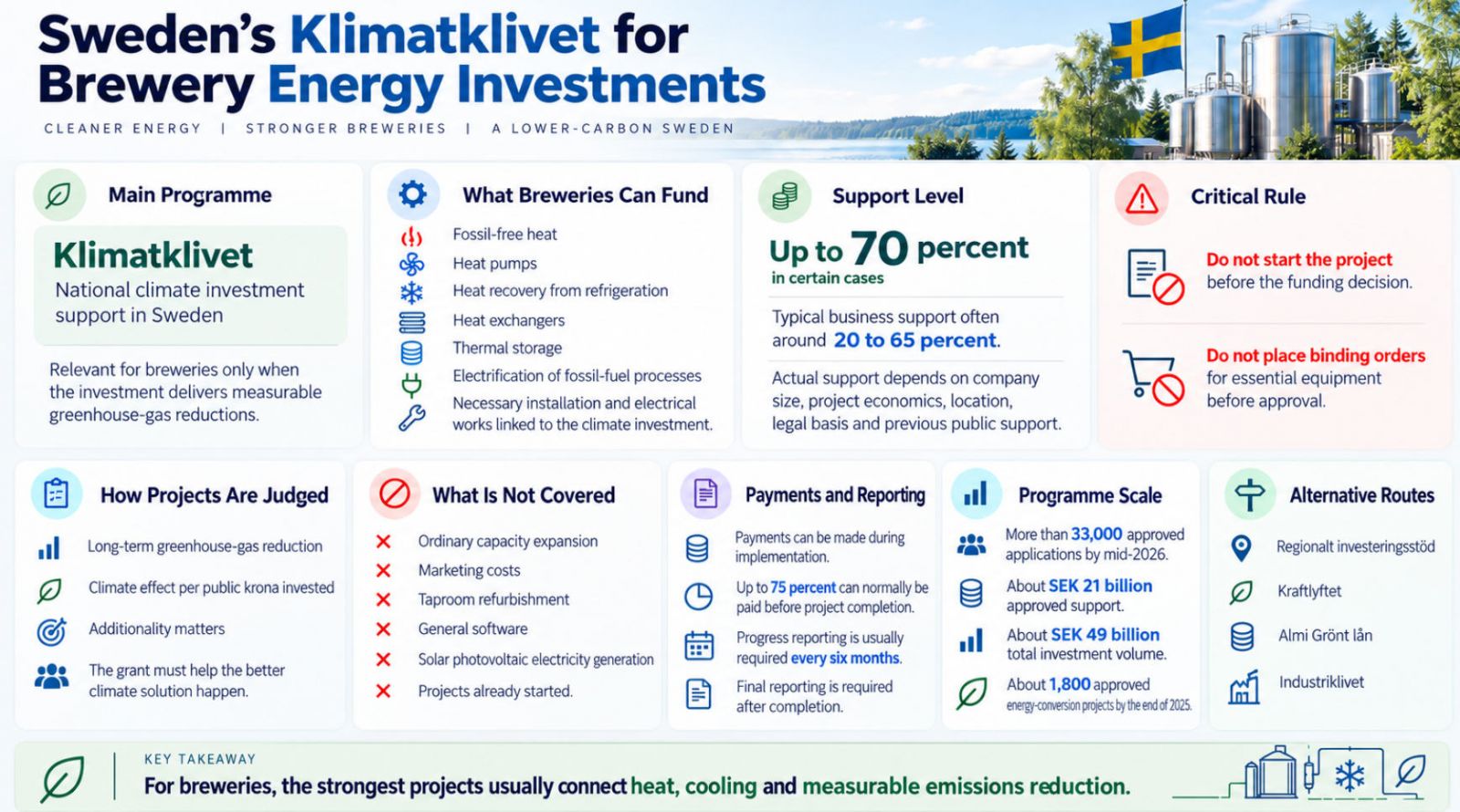
The programme can cover a substantial part of an eligible investment. Businesses may in some circumstances receive support of up to 70 percent of investment costs, although actual support for companies commonly falls within a lower range, often approximately 20 to 65 percent depending on the legal basis, company size, location, economics of the project and previous public support.
That maximum should not be interpreted as a standard brewery subsidy. The important question is not simply how much a brewery spends, but how much long-term greenhouse-gas reduction the proposed investment can produce and whether public support is genuinely needed for the project to go ahead.
Klimatklivet is a national climate programme, not a brewery scheme
Klimatklivet is administered by the Swedish Environmental Protection Agency, Naturvårdsverket. The programme supports local and regional physical investments that deliver significant and lasting reductions in greenhouse-gas emissions.
Businesses throughout Sweden can apply, but applications are assessed against the programme's climate logic. A brewery in Stockholm, a regional drinks producer in central Sweden and a rural family brewery can all potentially apply, yet none receives priority merely because of its industry.
The most relevant category for many breweries is energikonvertering, or energy conversion. This can include the replacement of fossil energy with fossil-free heat, electrification, heat pumps, heat recovery and other systems that reduce emissions associated with energy use.
The programme itself is currently designed to continue until 30 April 2030. Application periods open in rounds rather than continuously. Brewery-relevant application rounds held during 2026 have closed, while the next general windows are provisionally scheduled for 22 February to 5 March 2027 and 30 August to 10 September 2027.
Those dates matter for immediate planning, but the underlying structure of Klimatklivet is more important for a long-term investment strategy. Breweries preparing a project should therefore understand the technical and financial rules before the next application window opens rather than beginning their preparation only when a call is announced.
Table 1. Key Klimatklivet Rules for Swedish Breweries
| Item | Main rule |
|---|---|
| Programme | Klimatklivet |
| Administrator | Swedish Environmental Protection Agency, Naturvårdsverket |
| Geographic scope | Sweden |
| Type of support | Non-repayable investment grant |
| Brewery-specific programme | No |
| Can breweries apply? | Yes, if the investment satisfies climate and state-aid requirements |
| Strongest relevant areas | Fossil-free heat, electrification, heat recovery and energy conversion |
| Programme horizon | Currently scheduled through 30 April 2030 |
| Application method | Applications are submitted during defined application rounds |
| Maximum business support | Up to 70 percent in certain circumstances |
| Typical company range | Often approximately 20 to 65 percent depending on the project and legal basis |
| Main assessment logic | Long-term greenhouse-gas reduction in relation to public support |
| Project start | The investment must not begin before the funding decision |
| Co-financing | Required |
| VAT | Eligible only where it cannot be deducted or recovered |
| State-aid framework | Mainly EU block-exemption rules, with de minimis used in some cases |
Why breweries are technically well suited to energy-conversion projects
A brewery is more than a collection of tanks and a packaging line. It is also a thermal system.
Hot water is required for cleaning vessels, pipework, floors and packaging equipment. Heat may be needed during brewing, sanitation and pasteurisation. At the same time, refrigeration removes substantial amounts of heat during fermentation and cold storage. Compressors and cooling systems can therefore create recoverable heat while another part of the facility is purchasing or generating heat separately.
This creates the possibility of linking energy systems rather than treating each machine independently.
A brewery that currently burns fossil fuel for process heat while discarding heat from its refrigeration plant may have a stronger climate case than a brewery that simply wants to replace one efficient electric machine with a slightly newer version. The first project changes the source and structure of energy use. The second may reduce consumption, but its greenhouse-gas effect may be too limited to compete effectively for Klimatklivet.
The programme can support investments such as biomass boilers replacing fossil fuel, heat pumps, heat exchangers, thermal storage, exhaust-air heat recovery, connection to district heating, modern control systems linked to an eligible climate investment and electrification of equipment that previously depended on fossil fuel.
Necessary installation work can also form part of an eligible investment when directly connected to the supported measure.
Table 2. Brewery Investments That May and May Not Fit Klimatklivet
| Brewery investment | Klimatklivet relevance |
|---|---|
| Replacing an oil-fired boiler with fossil-free heating | Strong potential fit |
| Replacing fossil heat with a heat pump | Potentially eligible |
| Connecting the brewery to district heating | Potentially eligible |
| Heat exchangers for waste-heat recovery | Potentially eligible |
| Recovering heat from refrigeration | Potentially eligible where measurable emissions are reduced |
| Thermal energy storage | Potentially eligible |
| Controls needed for an integrated energy system | Potentially eligible |
| Electrification replacing fossil-fuel equipment | Potentially eligible |
| Necessary installation and electrical work | May be eligible when directly necessary |
| Ordinary fermentation tank for production growth | Not automatically a climate investment |
| New bottling line mainly for higher output | Not automatically eligible |
| General brewery management software | Not a stand-alone Klimatklivet investment |
| Taproom refurbishment | Not the purpose of Klimatklivet |
| Marketing costs | Not eligible |
| Solar photovoltaic electricity generation | Excluded from Klimatklivet |
| Research-only or test facility | Not a standard Klimatklivet investment |
| Investment already started before the decision | Not eligible |
One particularly important exclusion is solar photovoltaic generation. Breweries often associate solar panels with green investment, but Klimatklivet excludes electricity-generation investments such as photovoltaic installations. A brewery may still install solar panels, but it should not assume that this particular programme will pay for them.
The project cannot start simply because the application has been submitted
Klimatklivet has a stricter start rule than many investment programmes.
The investment must not begin before the Swedish Environmental Protection Agency has issued its funding decision. Submitting an application is not enough.
A project can be regarded as started when physical implementation has begun or when essential materials, machinery or equipment have already been ordered. A brewery that files an application on Monday and signs a binding purchase order for a new heat pump on Tuesday may therefore create a serious eligibility problem even if the application itself was submitted on time.
Certain preparatory activities can take place earlier. A brewery may investigate different technologies, prepare emission calculations, obtain quotations, identify a location for the new equipment and work on permits. These activities allow the company to create a credible application.
However, preparation and eligible expenditure are not the same thing. Preliminary-study expenditure is generally not funded simply because it helped prepare the application. Detailed planning costs may be eligible in certain cases only when the relevant work takes place after the funding decision.
For breweries with ageing boilers or refrigeration systems, this sequencing should be built into maintenance planning. Waiting until equipment has reached the point of emergency replacement is risky because the business may no longer have enough time to wait for a funding decision.
Klimatklivet does not reward energy savings alone
A central feature of the programme is its additionality requirement.
Public money is intended to make a climate investment happen, improve it or accelerate it. If a brewery can demonstrate that a proposed investment would not be financially attractive without public support, this strengthens the logic of the application. If the investment is already exceptionally profitable and would clearly proceed in exactly the same form without a grant, the justification for public support becomes weaker.
This can appear counterintuitive.
A brewery might assume that a very short payback period makes an application stronger because it proves that the technology works. Under Klimatklivet, however, an investment that pays for itself extremely quickly may raise the question of why the state needs to subsidise it at all.
The applicant therefore needs to explain the counterfactual scenario. What would the brewery do without support? Would the old fossil-fuel boiler continue operating? Would management choose a cheaper replacement with weaker climate performance? Would heat recovery be postponed? Would only part of the planned energy conversion be implemented?
This does not mean a company should artificially make its project look financially unattractive. The purpose is to show honestly how the grant changes the investment decision.
A strong application connects three elements: the existing energy system, the realistic alternative without support and the better climate outcome made possible by Klimatklivet.
The climate calculation is central to the application
For energy-conversion projects, the brewery needs to quantify emissions before and after the investment.
The starting point is the existing annual energy use. Fuel invoices, utility records and production data can help establish the current situation. The applicant then calculates the expected future energy use after conversion and translates the difference into greenhouse-gas emissions using the programme's applicable emission factors.
The assessment considers long-term effects, not merely the first year.
If production is expected to increase significantly, the brewery should explain that change carefully. Otherwise a larger future facility could appear to have weak energy performance simply because it is producing more beer. The application needs to distinguish changes caused by production volume from changes caused by the climate investment.
This is one reason why heat recovery can be particularly attractive. Instead of analysing refrigeration only as an electricity consumer, the brewery can examine how much useful heat the system produces and whether that energy can replace fossil heat elsewhere in the plant.
The project then becomes an integrated energy-conversion investment rather than a simple equipment replacement.
There is competition, but no simple one-hundred-point scoring table
Klimatklivet is competitive in economic terms, but it is not structured like many regional grant programmes with a simple published scorecard.
Projects are primarily prioritised according to how much lasting greenhouse-gas reduction they achieve in relation to the public money invested.
This means that an expensive project with relatively small emissions savings may compete poorly against a less expensive investment that removes a large quantity of fossil emissions.
Where projects have similar climate performance, additional considerations can include whether the investment helps spread climate technology, supports market introduction, contributes to other environmental objectives or has effects on health and employment.
For a brewery, this changes the way the application should be written. A long description of the company's history, local popularity or product quality is unlikely to compensate for weak climate economics.
The core of the application should instead show a clear technical chain:
current fossil or inefficient energy use, proposed investment, verified investment cost, expected future energy use, greenhouse-gas reduction, project lifetime and the amount of public support required.
A small independent brewery can still compete successfully, but its advantage comes from a strong project rather than from being small.
Company size affects the state-aid ceiling
Klimatklivet uses EU state-aid rules, so company size matters.
A small enterprise generally has fewer than 50 employees and annual turnover or a balance-sheet total not exceeding €10 million. A medium-sized enterprise has fewer than 250 employees and annual turnover not exceeding €50 million or a balance-sheet total not exceeding €43 million.
The calculation may need to include linked and partner enterprises.
This distinction is particularly important in the drinks industry. A brewery may appear small when viewed as a single production site but belong to a much larger group. For state-aid purposes, the wider ownership structure can change the company's classification and therefore the maximum aid intensity available.
Location can also affect the result. Certain eligible assisted areas can receive an additional five percentage points under some state-aid provisions, although this does not apply universally throughout Sweden and specific geographic exceptions exist.
The practical consequence is that the phrase “up to 70 percent” should never be used as a default budget assumption. It is an upper limit available only under particular combinations of project, company and state-aid rules.
What costs can be included
Eligible expenditure can extend beyond the main machine.
Depending on the project and legal basis, a Klimatklivet investment can include equipment, materials, external contractors, installation, necessary technical work, certain internal labour directly connected to the physical investment, commissioning, testing and relevant connection charges.
Required electrical work can be included where it is necessary for an eligible electrification project. A brewery replacing fossil process heat with an electrically driven system may therefore have a wider eligible cost package than simply the price of the heat pump or boiler.
Necessary connection expenditure to an electricity, district-heating, gas, water or other relevant network can also be eligible in certain cases.
However, the rules can distinguish between the total investment cost and the additional investment cost associated specifically with the environmental improvement.
This becomes important under EU state-aid rules. Suppose a brewery must replace an old boiler regardless of whether it receives a grant. A conventional replacement would cost SEK 3 million, while the proposed fossil-free system and associated infrastructure cost SEK 5 million. Depending on the applicable legal basis, the relevant eligible cost may be connected to the additional SEK 2 million rather than simply the entire SEK 5 million.
The exact calculation therefore needs to be determined before the brewery builds its financial model around a headline support rate.
VAT depends on whether the brewery can recover it
VAT is eligible only when it genuinely remains a final cost for the beneficiary.
A normal commercial brewery that can deduct input VAT should not treat recoverable VAT as part of the grant-funded investment base. Where the applicant cannot recover VAT, it may be included if the applicable conditions are satisfied.
For most standard business calculations, the safest starting point is therefore to prepare the investment budget excluding recoverable VAT.
The brewery must finance the part that Klimatklivet does not cover
Klimatklivet is not designed to finance the whole investment.
Applicants must demonstrate sufficient financial capacity to complete the project. Naturvårdsverket can examine whether the company is active, whether it is subject to insolvency or restructuring proceedings, whether there are relevant tax debts and whether there is adequate financing for the non-grant portion.
This can be especially important for small breweries with limited cash reserves.
If the company cannot finance its own contribution from liquidity, it may need evidence of a bank loan or another credible financing commitment. If another organisation is contributing to the investment, documentation of that co-financing may also be required.
There is no universal rule stating that every brewery must provide exactly 30 percent or another fixed percentage from equity. The required contribution depends on the final aid intensity and the approved project cost.
A brewery considering a SEK 10 million conversion should therefore avoid thinking only about the expected grant. It must also answer the more practical question of how the remaining project cost will be financed if the application succeeds.
Financial documentation can be substantial
Klimatklivet applications for businesses require more than a technical quotation.
A brewery may need to provide its latest completed annual accounts, an auditor's report where applicable, current balance-sheet and profit-and-loss information, supplier quotations, calculations demonstrating the climate effect and evidence of how the company's share of the investment will be financed.
Current financial statements should be sufficiently recent to reflect the actual financial condition of the business rather than relying solely on an old annual report.
Supplier offers are used to substantiate the expected investment cost. The current guidance does not establish a universal rule that every brewery must obtain exactly three quotations for every expenditure item, so it would be incorrect to invent such a requirement.
Nevertheless, a brewery should build a strong cost file. Quotations should clearly describe technical specifications, installation work, capacity and included services. If two cost categories are treated differently under the grant, the supplier's proposal should ideally separate them rather than present one undifferentiated total.
Large projects face stronger oversight. Investments receiving at least SEK 10 million in support are subject to mandatory on-site control, and higher-value applications can require deeper financial and risk assessment.
Payments can take place during implementation
Klimatklivet does not operate only as a final reimbursement after the beneficiary has paid the entire investment.
The funding decision sets out the payment schedule. Support can be paid during the period in which project expenditure arises.
However, no more than 75 percent of the total approved grant can normally be paid before the project has been completed and finally reported. The remaining amount is paid after the final report has been assessed and the final eligible support level has been determined.
This is important for brewery cash-flow planning.
A company should not describe the 75 percent figure as an automatic upfront advance. It is a maximum amount that may be paid before completion according to the approved payment plan, not a guaranteed first payment on the date of approval.
Beneficiaries also have ongoing reporting obligations. Progress reporting is normally required every six months, while the final report is usually submitted within the period specified after project completion. Projects receiving more than SEK 500,000 in support require an auditor's statement as part of the final reporting process.
There is no single standard project duration
Klimatklivet does not impose one universal rule saying that every brewery must finish within 12, 18 or 24 months.
The applicant proposes project start and completion dates, and the approved timetable is incorporated into the funding decision.
This flexibility is useful because brewery projects vary widely. Replacing a boiler may be relatively quick, while an integrated energy centre combining heat generation, refrigeration, compressed air, heat recovery and internal distribution can require much more planning and construction.
If the approved schedule later changes, the beneficiary must communicate with the relevant programme authorities. An extension should never be assumed automatically.
For the brewery, the best approach is to build the project schedule around realistic procurement, delivery, installation, commissioning and production-shutdown periods before the application is submitted.
GBER and de minimis must not be confused
Most company support under Klimatklivet is granted under the EU General Block Exemption Regulation, commonly referred to as GBER. De minimis may be used in certain cases where the appropriate GBER provision is not applied.
The distinction matters.
The general de minimis ceiling is €300,000 over a rolling three-year period for a single undertaking under the applicable rules. If a brewery has linked companies, the calculation can extend beyond the individual legal entity.
However, Klimatklivet as a whole is not limited to €300,000 per company. Large projects can receive substantially more assistance when support is granted under an appropriate GBER provision.
A brewery that has already used a significant amount of de minimis aid should therefore not automatically conclude that Klimatklivet is unavailable. The relevant state-aid basis has to be determined for the specific project.
Combining Klimatklivet with other public support requires care
Other public support does not automatically make the project ineligible, but all relevant state aid must be disclosed and the combined support cannot exceed applicable legal limits.
The brewery should therefore create a funding map before submitting applications to multiple agencies.
If Klimatklivet supports the additional cost of a heat-recovery system and another programme supports an entirely separate regional building investment, coexistence may be possible. If two programmes both attempt to finance the same heat exchanger, the state-aid calculation becomes more complicated.
This becomes especially important for breweries located in regions where Sweden offers separate investment support.
The safest approach is to assign every project cost to a clearly identified funding source and avoid assuming that several maximum aid percentages can simply be added together.
The scale of Klimatklivet shows that it is not a pilot programme
Klimatklivet has become one of Sweden's major climate-investment mechanisms.
By the middle of 2026, more than 33,000 applications had received support, while approved Klimatklivet funding totalled approximately SEK 21 billion. Together with beneficiary co-financing, these decisions represented total investments of roughly SEK 49 billion.
Across the portfolio, Klimatklivet has financed an average of approximately 43 percent of total investment expenditure.
The programme's approved investments are expected to reduce greenhouse-gas emissions by around 4.1 million tonnes of carbon-dioxide equivalent per year. The programme's own assessment attributes approximately 3.3 million tonnes of annual reductions to additional effects created by the support.
The average expected lifetime of supported investments is approximately 15 years.
Energy conversion is already a substantial part of the portfolio. By the end of 2025, approximately 1,800 applications in the energy-conversion category had been approved.
Table 3. Scale and Results of Klimatklivet
| Indicator | Reported result |
|---|---|
| Approved applications by mid-2026 | More than 33,000 |
| Total approved support | Approximately SEK 21 billion |
| Total investment including beneficiary funding | Approximately SEK 49 billion |
| Average Klimatklivet share of investment | Approximately 43 percent |
| Expected annual emissions reduction from supported investments | Around 4.1 million tonnes CO₂e |
| Estimated additional annual reduction attributed to support | Around 3.3 million tonnes CO₂e |
| Average expected investment lifetime | Around 15 years |
| Energy-conversion applications approved by end of 2025 | Approximately 1,800 |
Historic Klimatklivet awards range from very small grants to projects receiving hundreds of millions of Swedish kronor. Those figures should not be interpreted as a formal brewery funding range. They simply demonstrate the scale and diversity of the programme.
Kopparbergs Bryggeri shows what an integrated brewery energy project can look like
A particularly useful historical example is Kopparbergs Bryggeri.
The company developed a dedicated energy centre that entered operation in 2016. The investment combined several systems that breweries often treat separately: heat production, refrigeration, compressed air and heat recovery.
The facility included a 3 MW pellet boiler, a 1 MW refrigeration system and a compressed-air centre with capacity of approximately 30 cubic metres per minute. The energy centre occupied a building of roughly 500 square metres and was connected to the brewery through an internal network of approximately 300 metres carrying steam, cooling, compressed air and recovered heat.
The project replaced oil with wood pellets and allowed excess heat from the refrigeration system to be used in production, for hot water and for space heating.
The total investment was approximately SEK 50 million.
Published information indicates that the project reduced the brewery's energy use by about 20 percent, lowered purchased electricity by approximately 400 MWh per year, and reduced climate impact by the equivalent of roughly 3,000 tonnes of carbon dioxide per year.
One figure requires particular caution. Public sources do not fully agree on the exact amount of Klimatklivet support received by the project. One official environmental case study reports SEK 6.9 million, while company and sector materials have referred to a higher figure of around SEK 15 million.
Because those figures conflict, the safest conclusion is that the project did receive Klimatklivet support, while the exact grant amount should not be treated as uncontested without the original funding decision.
That uncertainty does not weaken the case as a technical example. The important lesson is the design of the investment.
Kopparbergs did not merely replace one boiler. It reorganised the brewery's energy flows so that heat, refrigeration and compressed-air systems interacted more efficiently. That is precisely the type of thinking that can turn an ordinary brewery upgrade into a stronger climate-investment project.
Sweden has a large base of breweries, but most are small
Sweden has more than 400 active breweries with their own production, and most are small businesses.
That industry structure matters because smaller breweries often have very different investment economics from major national producers. A large brewery may justify a multi-million-krona integrated energy centre, while a small regional brewery may be considering a single heat pump, refrigeration heat recovery or a replacement for a fossil boiler.
The Swedish brewing market nevertheless operates at substantial scale. Beer sales were approximately 475 million litres in 2025, while total sales across the broader brewing sector approached 1.79 billion litres. Beer sales to hotels and restaurants increased by approximately 4 percent.
Retail beer sales reached approximately SEK 15.7 billion including VAT according to official retail statistics. This figure represents retail sales value rather than brewery turnover, so the two should not be confused.
For small producers, the business environment has also changed in another way. Since June 2025, Sweden has allowed limited farm-gate sales of alcoholic beverages at the production site under specified conditions linked to paid visits. This change can create additional tourism and direct-sales opportunities for some breweries, although it does not alter Klimatklivet eligibility.
The relevance for energy investment is indirect but important. A brewery expanding visitor activities may face rising heating, cooling and production demand. It should separate that commercial expansion from the climate investment and demonstrate clearly which portion of expenditure is responsible for measurable emissions reduction.
Capacity expansion and climate investment must be separated
This distinction deserves special attention for growing breweries.
Suppose a brewery expects production to rise by 40 percent and therefore wants a larger refrigeration system. The new machine is more efficient than the old one, but much of the increased capacity is required simply because the business will produce more beer.
It would be misleading to treat the whole new refrigeration system as an emissions-reduction investment without analysing the expansion effect.
A stronger application separates business growth from climate improvement. The brewery can identify what refrigeration capacity would have been required for the expansion under a conventional scenario, then compare it with the proposed high-efficiency system and heat-recovery design.
The same logic applies to boilers, compressors and process equipment.
Klimatklivet is not intended to subsidise ordinary expansion merely because the new machinery happens to be more modern. The climate benefit needs to be identifiable and additional.
A practical brewery scenario
Consider a regional Swedish brewery currently using a fossil-gas boiler for hot water and process heat. Its refrigeration system rejects heat outdoors, while electricity is purchased separately for cooling and compressed air.
The brewery plans to expand moderately over the next five years.
Instead of simply buying a larger replacement boiler, management considers a new system combining an industrial heat pump, heat recovery from refrigeration, thermal storage, upgraded controls and necessary electrical infrastructure.
The investment costs more than the conventional replacement, but it substantially reduces fossil-fuel consumption.
For Klimatklivet, the brewery would need to document its existing gas use, relevant electricity consumption, annual production and current emissions. It would then calculate the future energy balance and expected greenhouse-gas reduction.
Supplier quotations would support the investment budget. The company would explain the lower-cost alternative it would choose without support and show why the grant enables the more ambitious fossil-free solution.
The brewery would also need to demonstrate how it will finance the portion that Klimatklivet does not cover.
Only after receiving the funding decision should it place the binding equipment orders and begin implementation.
That sequence is more important than the headline aid rate.
What if Klimatklivet is not suitable?
Not every Swedish brewery has a strong Klimatklivet case.
A company may have little fossil-fuel consumption, its proposed investment may produce only modest climate savings, or the measure may already be economically attractive without support. A brewery may also want to finance solar panels, ordinary production equipment or a general factory expansion that does not fit Klimatklivet.
Several alternative routes can then be relevant.
Table 4. Alternative Funding Routes for Swedish Breweries
| Instrument | Type | Potential brewery use | Important limitation |
|---|---|---|---|
| Regionalt investeringsstöd | Regional investment grant | Equipment, production and other qualifying investment in eligible areas | Available only in designated regions |
| Kraftlyftet | Energy-efficiency support | Larger energy-intensive businesses | Relevant threshold is average annual energy consumption above 2.78 GWh; first calls are being developed |
| Almi Grönt lån | Green loan | Energy efficiency and sustainable investment | Loan, not a grant |
| Industriklivet | Industrial decarbonisation grant | Innovative industrial transformation and advanced decarbonisation | Should not be used to rebrand an ordinary equipment replacement as a research project |
Regionalt investeringsstöd can be particularly valuable for breweries located in designated assisted areas. Depending on company size and location, support can reach up to 40 percent in some cases. It is a territorial programme, not a nationwide brewery subsidy, so the brewery's address can completely change eligibility.
Kraftlyftet is emerging as another relevant route for larger energy users. Its energy-efficiency support is aimed at companies with average annual energy use above 2.78 GWh over the previous three years. That threshold will exclude many microbreweries but may be relevant to larger regional and industrial producers.
Almi Grönt lån can finance energy-efficient or environmentally beneficial investment by SMEs, but it is debt financing and must never be described as a grant.
Industriklivet supports more innovative industrial decarbonisation, including studies, demonstration activities and investment projects. It can be relevant to genuinely transformative brewery technology, but a standard replacement of an old boiler with commercially established equipment should not be turned into an artificial research project merely to fit the programme.
A brewery should choose the funding programme after defining the investment
The strongest funding strategy begins with the technical problem, not with the name of a grant.
A brewery should first identify where fossil energy is being used, where heat is being rejected, which systems consume the most electricity and what equipment will need replacement over the next several years.
Only then should management determine whether Klimatklivet, regional investment aid, an energy-efficiency scheme, a loan or another programme fits the proposed project.
This prevents a common mistake in grant planning: choosing a funding programme first and redesigning the business project simply to make it appear eligible.
For breweries, this is particularly important because ordinary production investment and climate investment often take place at the same time. A new energy centre may support future production growth, but the application still needs to isolate the climate benefit that public money is being asked to finance.
Common mistakes that can weaken a brewery application
Several problems can seriously damage an otherwise credible Klimatklivet project.
The first is beginning too early. Ordering the heat pump, boiler or other essential equipment before the funding decision can make the investment ineligible.
The second is treating ordinary capacity expansion as a climate measure. A larger bottling line or fermentation system is not automatically eligible simply because it uses new technology.
The third is overlooking project economics. A brewery that demonstrates an exceptionally profitable investment but cannot explain why public support changes the decision may undermine its own argument for additionality.
The fourth is using the 70 percent programme ceiling as if it were a standard rate. Actual support depends on state-aid rules, company size, location, eligible costs and the economics of the investment.
The fifth is including solar photovoltaic generation in the Klimatklivet budget even though electricity-generation projects of this type are excluded.
The sixth is failing to document existing energy use. Without reliable baseline data, fuel invoices and a credible before-and-after calculation, even an attractive technology can be difficult to evaluate.
The strongest brewery projects connect heat, cooling and emissions
The most interesting opportunity is not necessarily the most expensive machine.
A brewery may discover that the decisive investment is a heat exchanger, a thermal store, an upgraded control system or a new distribution loop that allows energy already produced within the plant to replace purchased fossil heat.
This is why breweries can be particularly well suited to integrated climate investment.
Refrigeration removes heat from fermentation and storage areas. That heat does not have to disappear into the atmosphere. If temperatures and system design allow it, recovered energy can contribute to cleaning water, space heating, preheating or other suitable processes.
Likewise, replacing fossil heat with a heat pump may become more attractive when the heat source is already available inside the brewery.
The resulting investment may reduce fuel consumption, electricity purchases or both, but Klimatklivet will ultimately focus on the greenhouse-gas effect.
A successful funding strategy therefore combines technical engineering with grant logic.
Is Klimatklivet suitable for your brewery?
The programme is most attractive to breweries with a clearly identifiable fossil-energy source or another investment capable of producing substantial long-term emissions reductions.
A brewery still using oil or fossil gas for heat should examine its options closely. So should a business with large refrigeration loads and significant quantities of unused waste heat.
Before the next application window, the brewery should know its annual fuel and electricity consumption, production volumes, existing heating and cooling configuration, expected investment cost, realistic alternative without public funding and expected emissions after implementation.
It should also understand its company size under EU rules, including linked enterprises, and determine how the unfunded share of the project will be financed.
Once those fundamentals are available, supplier quotations and engineering calculations can be converted into a grant-ready investment case.
The goal is not simply to demonstrate that the new technology is efficient. The application needs to demonstrate that the investment produces a strong climate result, that the result is additional, and that the requested level of public support is proportionate.
The opportunity goes beyond a single grant round
Klimatklivet application windows will continue to open and close, but the underlying logic is unlikely to disappear from a brewery's investment planning.
Fossil heat, refrigeration efficiency, heat recovery, electrification and integrated energy management are long-term operational issues. Breweries that map those systems before equipment reaches the end of its life have more options than businesses forced into an emergency replacement.
A small producer may ultimately pursue a relatively modest heat-recovery project. A larger brewery may redesign its entire energy centre. Both can potentially fit the same national programme if the climate impact is strong enough.
The lesson from projects such as Kopparbergs is not that every Swedish brewery should build a SEK 50 million energy centre. It is that breweries can create significant energy and emissions savings when heating, refrigeration and other utilities are designed as one system rather than as unrelated pieces of equipment.
For grant applicants, the central rule is equally clear: build the climate case before buying the equipment.
A brewery that understands its baseline emissions, separates normal capacity expansion from climate expenditure, calculates realistic savings, secures its own financing and waits for the funding decision before starting the project has a much stronger foundation for Klimatklivet than a business that simply finds a grant and then tries to make an ordinary equipment purchase fit it.