

 Français
  Deutsch
  Українська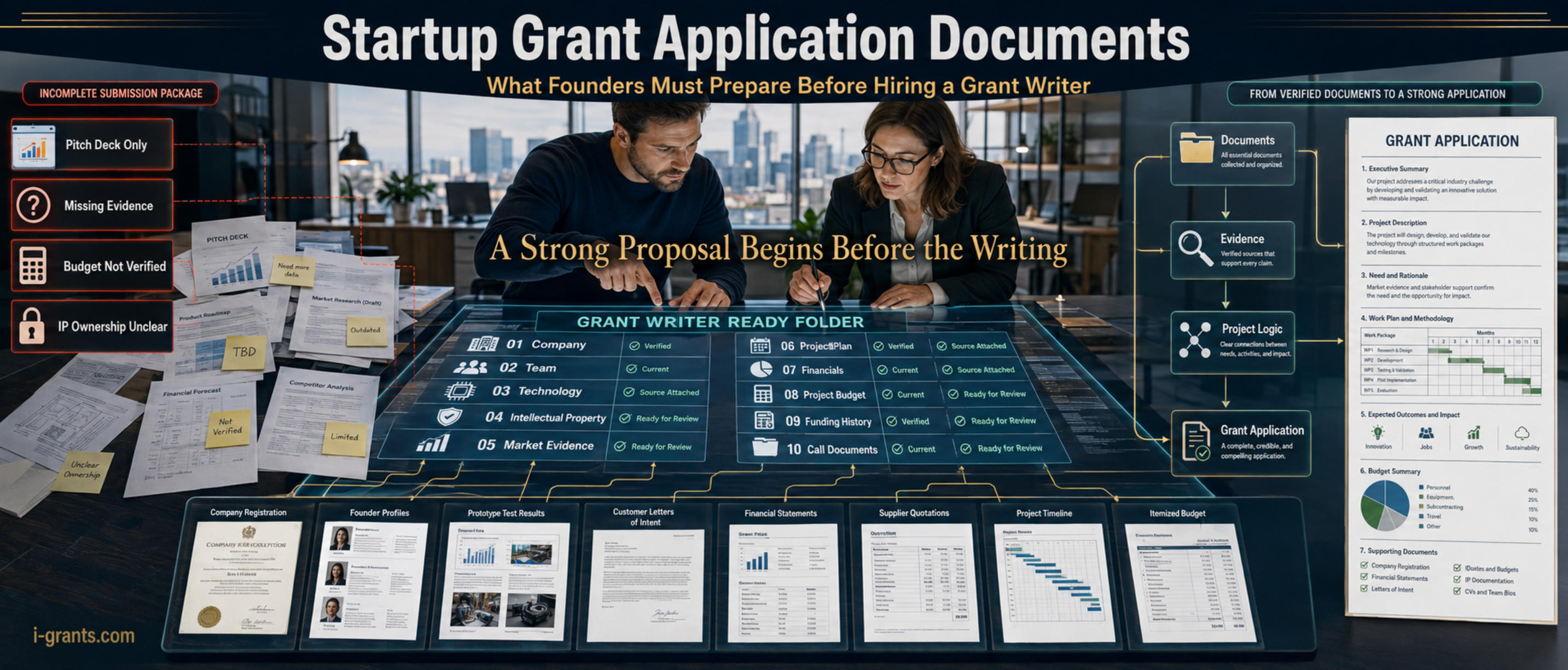
A founder hires a grant writer, shares a pitch deck, and expects a submission-ready proposal two weeks later. Then the real questions begin. Who owns the intellectual property? Which milestones have been achieved? How was the budget calculated? Can the company finance costs the grant will not cover?
If the answers are scattered across emails, outdated spreadsheets, and conversations, the grant writer must reconstruct the startup before writing about it. This delays the application and creates a serious risk: important claims may be inconsistent or unsupported.
The solution is a Grant Writer Ready Folder: a structured collection of startup grant application documents needed to assess the opportunity, shape the project, build the budget, and prepare a credible application.
A Grant Application Is an Evidence System
Grant writing is not simply the conversion of a pitch deck into formal language. A serious application must connect the funder's objective, the innovation, the market need, the team, the work plan, the budget, and the expected impact.
Official programmes make these connections explicit. The EIC Accelerator, for example, asks short-proposal applicants to present their innovation, market, and team, together with a pitch deck and video. The US SBIR and STTR guidance emphasizes evaluation criteria, team composition, commercialization, and preparation schedules. Applications submitted through Grants.gov may also require formal forms, detailed budgets, and budget narratives.
Requirements change between programmes, but the logic does not. Every important statement should be supported by a document, calculation, decision, or named source.
Start With a One-Page Grant Brief
Before sharing dozens of files, the founder should create a one-page grant brief. It gives the writer a reliable starting point and keeps the first meeting focused.
The brief should state:
-
the programme and official call link;
-
the submission deadline;
-
the applicant legal entity;
-
the project objective;
-
the problem being solved;
-
the proposed innovation;
-
the current development stage;
-
the main project activities;
-
the requested funding amount;
-
the expected project duration;
-
the internal decision-maker;
-
the team member responsible for supplying information.
If no funding opportunity has been selected, say so clearly. The first assignment is then grant research or matching, not proposal writing.
Build the Grant Writer Ready Folder
The folder should be organized by subject. A practical structure looks like this:
| Folder | What to include | Why the grant writer needs it |
|---|---|---|
| 01 Company | Registration documents, ownership structure, company address, SME status, tax or registration numbers | Confirms that the legal entity can apply |
| 02 Team | Founder biographies, relevant CVs, roles, availability, advisers, partners, subcontractors | Demonstrates delivery capacity and identifies gaps |
| 03 Technology | Product description, architecture, test results, prototype evidence, development roadmap, technical risks | Supports innovation and feasibility claims |
| 04 Intellectual Property | Patents, applications, licences, assignments, freedom-to-operate work, university or employer agreements | Clarifies whether the startup controls the proposed innovation |
| 05 Market Evidence | Customer interviews, pilots, letters of intent, contracts, usage data, competitor research, market sources | Proves that the problem and commercial opportunity are real |
| 06 Project Plan | Objectives, work packages, tasks, milestones, deliverables, dependencies, timeline | Converts the company vision into a fundable project |
| 07 Financials | Accounts, management figures, cash position, forecasts, current investment, debt, committed funding | Shows financial capacity and supports due diligence |
| 08 Project Budget | Staff calculations, equipment quotes, subcontractor estimates, travel assumptions, indirect costs, co-financing plan | Connects requested funding to eligible and justified costs |
| 09 Funding History | Previous grants, public support, applications, evaluation feedback, reporting status | Reveals restrictions, duplication risks, and useful lessons |
| 10 Call Documents | Official guidelines, annexes, templates, questions, evaluation criteria, FAQs | Keeps the application aligned with the current rules |
File names should also be understandable to an outsider. “Market_Validation_July_2026.pdf” is useful. “Final_v7_USE_THIS_NEW.pdf” is not.
Company and Ownership Information
The grant writer needs the exact legal name of the applicant, jurisdiction, registration date, registered address, company size, and ownership structure. This information may determine eligibility before the project itself is evaluated.
Founders should also disclose connected companies, parent entities, subsidiaries, and major shareholders where relevant. Many public programmes calculate enterprise size or independence using relationships between companies, not only the applicant's headcount. Concealing a complicated structure only moves the problem to a later stage.
Team Evidence, Not Impressive Job Titles
A team slide listing a CEO, CTO, and three advisers is not enough. The grant writer needs to know who will perform the funded work, how much time each person can commit, and which relevant results they have delivered before.
Each CV should emphasize experience connected to the project. Technical staff should show research, engineering, certification, or product-development capability. Commercial staff should demonstrate market access, sales, partnerships, or scaling experience. Consultants and subcontractors need a defined role, estimated cost, and justification.
If a critical position is not yet filled, say so. A transparent recruitment plan is more credible than presenting an adviser as a full-time delivery resource.
Technology, Intellectual Property, and Readiness
Words such as “breakthrough”, “proprietary”, and “AI-powered” are not evidence. The technology folder should show what exists today, what has been tested, what remains uncertain, and what the grant-funded project will achieve.
Evidence may include prototype photographs, laboratory results, technical reports, demonstrations, system diagrams, test protocols, certification plans, and user trials. The founder should clearly separate completed work from future work.
Intellectual property deserves its own review. A startup may use technology developed at a university, by a former employer, or by an external contractor. The grant writer needs to see the relevant licences, assignments, or agreements before claiming that the company owns or controls the innovation.
Market Validation Must Be Traceable
Market evidence should go beyond a large industry forecast. Funders want to know who will buy the solution, why alternatives are insufficient, and how the startup will reach customers.
The strongest material often comes from direct evidence: pilot results, signed letters of intent, customer interviews, paid trials, distributor discussions, conversion data, or a documented procurement need. Each claim should have a source and date. If a market figure cannot be traced to its original source, it should not become a central proposal argument.
The Budget Must Be Built From the Work Plan
A project budget should not begin with the maximum grant amount. It should begin with the tasks required to deliver the project.
For each cost, the founder should be able to answer five questions: What is being purchased? Why is it necessary? How was the amount calculated? When will the cost occur? Is it eligible under the programme rules?
Provide salary assumptions, staff time, supplier quotations, equipment specifications, subcontractor estimates, travel logic, and the source of co-financing. The narrative, timeline, and budget must describe the same project. A six-month technical task cannot quietly become eighteen months of salary in the spreadsheet.
What Not to Do Before the Handover
Do not invent certainty. Mark unknown figures as provisional, identify pending documents, and name the person responsible for providing them. Agree on access before sharing confidential files. Do not assume the grant writer will independently verify every legal, tax, or technical claim unless that work is included.
Most importantly, do not wait until the final week. Official guidance for innovation applications consistently shows that teams must coordinate narrative, evidence, finances, registrations, and attachments. Writing may be the visible output, but information collection is often the real critical path.
The 48-Hour Readiness Test
A startup is ready when it can provide secure folder access, answer questions within forty-eight hours, assign one decision-maker, and review drafts on schedule.
The folder does not need to be perfect. It needs to be honest, current, and navigable. Missing evidence can then become a visible action item rather than a hidden weakness.
Better Preparation Produces Better Grant Work
The quality of a startup grant application depends partly on the writer, but the writer can only use the evidence and decisions available. A prepared handover reduces research time, exposes eligibility problems early, strengthens the budget, and leaves more time for the argument evaluators will read.
For founders, the Grant Writer Ready Folder is not administration for its own sake. It is a test of whether the startup can explain what it is building, why it matters, who can deliver it, and how public funding will be used responsibly.
Through i-grants.com, startups can connect with grant professionals whose experience matches the programme, sector, and stage of development. Arriving with organized startup grant application documents makes that collaboration faster, clearer, and more valuable from the first conversation.