

 Français
  Deutsch
  Українська
For startups looking for non-dilutive capital, international expansion or early-stage investment, the second half of 2026 offers several funding opportunities with deadlines concentrated in September, October and November.
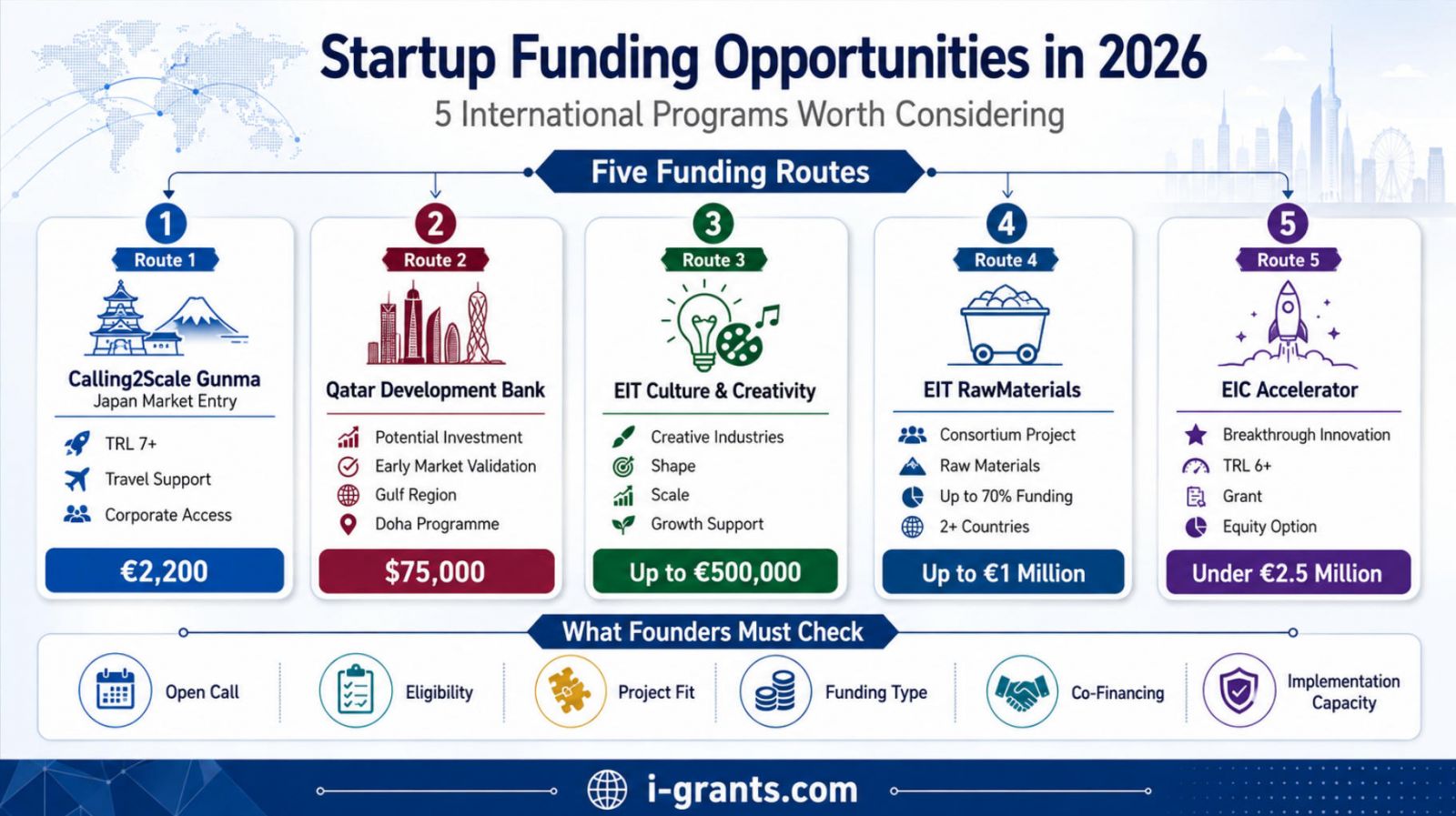
The amounts vary dramatically. One programme offers €2,200 to help a mature startup enter the Japanese market. Another gives creative-tech companies access to as much as €500,000 in financial support. Raw materials innovation projects can receive between €800,000 and €1 million. At the upper end, the EIC Accelerator can provide a startup or SME with a grant below €2.5 million and, where appropriate, an additional equity investment.
But the headline amount is only part of the story.
These programmes fund very different things and target companies at very different stages. A founder with an MVP is not in the same position as a company with a TRL 7 technology ready to work with Japanese corporations. A startup may be eligible for an accelerator but not ready for the investment committee. A company may participate in a €1 million consortium project but receive only part of that project budget. And a startup seeking an EIC Accelerator grant must demonstrate substantially more than technical novelty.
There is another important distinction. Not every opportunity commonly described as a "startup grant" is legally a grant. The Qatar Development Bank programme examined below offers a potential investment of up to $75,000, while Calling2Scale Gunma provides a fixed contribution toward participation in a market-entry programme. EIT RawMaterials finances collaborative innovation projects, while the EIC Accelerator can combine a non-repayable grant with equity investment.
For founders, understanding these differences before applying can save weeks of unnecessary work.
This guide examines five current international startup funding opportunities available in 2026, including who can apply, what the money can actually finance, how applications are assessed, what co-financing may be required, and which opportunities can be relevant to Ukrainian startups.
Startup funding opportunities still available in 2026
Table 1. Five international startup funding opportunities in 2026
| Programme | Maximum financial support | Type of support | Company stage | Current deadline or cut-off |
|---|---|---|---|---|
| Calling2Scale Gunma 2026 | €2,200 | Lump-sum travel and accommodation support plus market-entry programme | Mature startup, TRL 7+ | 3 September 2026 |
| Qatar Development Bank Pre-Accelerator | Up to $75,000 | Potential investment, not guaranteed grant funding | MVP / early product | 5 September 2026 |
| EIT Culture & Creativity Shape / Scale | Up to €500,000 | Financial Support to Third Parties | Startup to scaleup | 12 October 2026 |
| EIT RawMaterials RIS Innovation Projects | €800,000 to €1 million per project | Co-funded innovation project | Technology moving toward demonstration or commercialisation | 16 October 2026 |
| EIC Accelerator 2026 | Grant below €2.5 million plus possible investment | Grant-only, blended finance or investment support | High-risk innovation approaching commercialisation | Full proposal batch: 4 November 2026 |
The programmes should not be ranked purely by the maximum amount available. A €2,200 programme may provide more value to a startup seeking its first Japanese customer than a €1 million consortium call for which that company has no appropriate partners. Similarly, an early-stage SaaS company with an MVP is unlikely to be ready for the EIC Accelerator simply because the potential grant is larger.
The correct question is therefore not "Which programme offers the most money?" but "Which programme finances the next stage of this particular company?"
1. Calling2Scale Gunma 2026: €2,200 plus direct access to Japanese corporations
What the programme is designed to do
Calling2Scale Gunma 2026: Gateway to Japan is a three-month hybrid market-entry programme delivered by EIT Food through EIT Global Outreach in cooperation with the Governor's Office of Gunma Prefecture.
Its purpose is not to finance general R&D or provide working capital. Instead, it connects European startups with Japanese corporations that have already identified technological or business problems for which they are looking for solutions.
The programme plans to select approximately 10 to 14 startups. Successful applicants participate in online preparation, direct meetings with Japanese corporate representatives and an in-person Immersion Lab in Japan. Each selected startup receives a €2,200 lump sum toward travel and accommodation costs.
This makes Calling2Scale fundamentally different from a conventional startup grant. The financial support is relatively small, but the programme is built around corporate market access.
Who can apply
Applicants must be legally incorporated startups established in an EU Member State or an eligible Horizon Europe Associated Country. The company must have a product at Technology Readiness Level 7 or higher and must have completed at least one funding round.
TRL 7 is an important threshold. It generally means that a system prototype has already been demonstrated in an operational environment. An early-stage team with a concept, laboratory prototype or unvalidated MVP is therefore unlikely to fit the programme.
The funding-round requirement provides another maturity test. Calling2Scale is looking for businesses capable of engaging seriously with large corporations, not teams that are still deciding whether there is a market for their technology.
Six Japanese corporations are looking for specific solutions
The 2026 programme is demand-driven. Applicants cannot simply describe their startup and ask for support. Each company must address one of the challenges presented by participating Japanese corporations.
The six corporate partners cover intelligent thermal management and thermal storage for electric vehicles; circular plastics and circular business models; new eyewear and healthcare applications; sustainable packaging, energy efficiency and environmental sensing; green hydrogen, electrochemical carbon capture and drug discovery technologies; and intelligent manufacturing and factory-of-the-future solutions.
That means the strongest application should explain not only why the startup's technology is innovative but how it could solve the selected corporation's actual problem.
A generic company presentation is not enough.
What selected startups actually receive
The programme includes six online training sessions covering the Japanese innovation environment, business culture, regulatory considerations, pitching and corporate collaboration. Selected companies also receive structured one-to-one interactions with innovation teams from participating corporations.
The in-person Immersion Lab is scheduled for the week of 24 November 2026. It includes corporate visits, matchmaking, sector discussions and work on possible Proof-of-Concept projects.
The potential commercial outcome is therefore more important than the €2,200 itself.
A startup could use the programme to move from an introductory conversation to a pilot, Proof of Concept or market-entry roadmap with a Japanese company. For founders who have already decided that Japan is a strategic market, this can materially shorten the market-entry process.
For founders primarily looking for cash to continue product development, however, Calling2Scale is probably not the right programme.
Deadline
Applications opened on 3 August and close on 3 September 2026 at 17:00 CET.
Because applicants must select and respond to a specific corporate challenge, a last-minute application without researching the Japanese partner is particularly risky.
2. Qatar Development Bank Pre-Accelerator 2026: up to $75,000, but it is an investment opportunity
The second opportunity requires a crucial clarification.
The Qatar Development Bank Pre-Accelerator is often included in lists of startup grants, but the headline funding of up to $75,000 is not a guaranteed grant.
The programme states that participating startups will ultimately pitch for an opportunity to receive an investment of up to $75,000 from Qatar Development Bank. The investment decision and amount are subject to QDB's internal approval process.
That distinction affects everything from the founder's expectations to future ownership and financing strategy.
Who is the programme for?
The eight-week Pre-Accelerator targets startups that already have an MVP or early product and are ready to validate market demand, develop traction and strengthen their investment case.
The programme specifically looks for startups with signs such as early customer interest, pilots, traction or revenue potential. Applicants are also expected to be interested in Qatar, GCC or wider MENA market opportunities and to be willing to establish or operate from Qatar.
This is therefore earlier than Calling2Scale in terms of company maturity.
Calling2Scale expects TRL 7+ and a completed funding round. QDB is interested in companies that may still be proving product-market fit.
What happens before a startup is accepted
The process has more than one selection stage.
Applications close on 5 September. Shortlisting is scheduled for 14 September, followed by a Pre-Accelerator Bootcamp on 21 and 22 September. The bootcamp is itself part of the selection process and does not guarantee admission to the full programme.
During the bootcamp, teams work on their use case and pitch before presenting to the programme committee. According to the programme listing, shortlisted startups may also have an opportunity to receive separate grant prizes during this stage.
The main programme begins on 5 October 2026.
The Doha phase is mandatory
The programme is hybrid, but at least one core team member must be able to participate fully, including the in-person phase in Doha from 16 to 25 November 2026.
QDB provides accommodation during that phase. Startups remain responsible for flights and visas.
This matters when calculating the actual cost of participation. A "free accelerator" may still require several thousand dollars in travel costs and more than a week of a founder's time.
What the $75,000 means
At the end of the programme, startups pitch to the QDB Investment Committee. Funding is discretionary. Acceptance into the accelerator does not automatically result in a $75,000 payment.
Qatar Development Bank also operates a broader pre-seed investment mechanism for companies in its incubation and acceleration portfolio. That instrument uses convertible investment structures rather than conventional grant funding. QDB states that pre-seed capital can later convert into shares.
For a founder, this means the funding should be evaluated as investment capital.
The relevant questions are therefore not only "Can we receive $75,000?" but also "Under what instrument?", "What may convert into equity?", "What milestones apply?" and "How does this fit our existing cap table?"
Who should consider applying
This opportunity is strongest for an early-stage company that already has a usable product but needs customer validation, wants to explore Qatar or the Gulf region and is open to investment.
It is much weaker for a founder whose only objective is to obtain non-dilutive grant money without relocating, building a Gulf presence or taking investment.
3. EIT Culture & Creativity Shape and Scale: up to €500,000 for creative-tech startups
One of the most significant new startup calls of August 2026 comes from EIT Culture & Creativity.
The organisation has allocated approximately €8.6 million to its combined Shape Acceleration and Scale Post-Acceleration call. The call is expected to support 50 ventures, with €3.4 million allocated to Shape and €5.2 million to Scale.
Applications opened on 10 August 2026 and close on 12 October 2026 at 17:00 CEST.
Unlike a conventional accelerator that offers mainly mentorship, this programme combines structured business support with direct financial support.
Which sectors qualify?
For the cohort beginning in January 2027, the call focuses on three cultural and creative sectors:
fashion, architecture and audiovisual media.
Supported solutions must be tech-enabled, market-driven and make meaningful use of intellectual property. EIT Culture & Creativity specifically describes activities such as business development, investor outreach, team growth, marketing, international expansion and legal or IP advisory as relevant to the programme.
That creates a relatively broad opportunity within the three target sectors.
A fashion startup does not necessarily have to be a conventional clothing company. Relevant technologies could include new digital production systems, advanced materials, traceability, circular-fashion solutions or tools supporting fashion commerce.
Architecture can encompass digital design, construction-related technologies and other scalable technology-based services linked to the sector.
Audiovisual media can include technology for production, distribution, content infrastructure and other commercially scalable media solutions.
Shape and Scale are not the same programme
The application route depends on maturity.
Shape Acceleration targets startups that have already validated a market need through early traction, for example pilot customers or initial revenues. Initial financial support can reach €100,000. Top-performing ventures following the programme's Demo Day may receive up to another €100,000.
The potential second payment should not be treated as guaranteed when preparing the original budget. EIT Culture & Creativity explicitly states that Shape applicants must budget only for the initial contribution of up to €100,000.
Scale Post-Acceleration is for considerably more mature businesses.
Applicants should have demonstrated product-market fit, recurring revenues and international scaling potential. Standard support can reach €200,000. Companies headquartered in EIT RIS countries can potentially receive up to €500,000.
Scale applicants must also demonstrate that they are genuinely at a fundraising stage.
They need evidence of an active fundraising process with a lead investor and signed term sheet representing at least €200,000, or evidence that at least €200,000 has already been secured from qualified investors during the 18 months before the call deadline.
That is a significant filter.
A startup with recurring revenue but no credible fundraising activity may still fail the Scale requirements.
Up to 100% reimbursement does not mean unrestricted money
EIT Culture & Creativity states that financial support may reimburse up to 100% of total eligible project costs. Costs already financed by another EU programme or another funding source cannot be reimbursed again.
The phrase "up to 100%" is important.
It does not mean the recipient receives unrestricted cash for any business expense. Expenditure must remain eligible under the call and consistent with the approved venture plan and budget.
Applicants therefore need to build the funding request around actual activities needed to execute the next stage of growth.
Documentation requirements are substantial
This is not a one-page accelerator application.
Every applicant needs an application form, pitch deck, proof of company registration, detailed budget and funding request, tangible evidence that the solution exists, and a company bank statement covering the previous six months. Sensitive banking information may be redacted.
Shape applicants additionally submit a Venture Execution Plan.
Scale applicants submit a Venture Scaling Plan plus the evidence supporting their qualifying investment or current fundraising round.
A Participant Identification Code, or PIC, is also required. Companies without one need to register through the EU Funding & Tenders Portal.
When will companies know the result?
Evaluation is scheduled from October to December 2026. Applicants are expected to receive communication of results around mid-December, with public results in mid-January 2027 and programme activities starting in January 2027.
That timeline should be reflected in a startup's cash planning.
A company should not assume that submitting an application in October means receiving funds immediately.
4. EIT RawMaterials RIS Innovation Projects: €800,000 to €1 million for collaborative innovation
EIT RawMaterials offers one of the largest funding amounts in this group, but the figure is frequently misunderstood.
The current RIS Innovation call provides between €800,000 and €1 million per project and offers access to funding of up to 70% of project costs. Projects run for one to two years and must focus on innovations within the raw materials value chain.
The final 2026 submission date is 16 October 2026 at 13:00 CET.
What types of projects qualify?
EIT RawMaterials identifies exploration, sustainable mining, processing, circularity, recycling and substitution among the principal eligible areas.
The call is designed for technologies, products, services or business models capable of strengthening Europe's raw materials value chain.
That positioning is increasingly important because European policy is focused on reducing strategic dependencies in critical raw materials and increasing domestic extraction, processing and recycling capacity.
For a startup, this means a project should not simply be "environmentally innovative." It needs a clear connection to the raw materials value chain.
A startup cannot treat the €1 million as its own individual grant
The €800,000 to €1 million amount applies to the project.
The funding is implemented through a consortium. Partners agree on work packages, responsibilities and budgets. The startup's own allocation therefore depends on its role in the consortium.
This is one of the most important distinctions in the entire article.
A founder reading "€1 million startup grant" could wrongly assume that a successful startup receives €1 million. In practice, the project funding may be divided among a startup, industrial partner, research organisation and other consortium members.
The actual consortium requirement
The current EIT RawMaterials call specifies a minimum of two organisations from different RIS-eligible countries. The consortium must also represent at least two parts of the knowledge triangle: business, research and education. The lead partner must come from an RIS-eligible country.
This differs from some secondary coverage of the programme that has described a three-organisation minimum.
For application planning, the official call conditions should prevail.
Startups, SMEs and large companies can participate, as can universities, research centres, NGOs, government agencies and public institutions.
Co-financing changes the economics
The call advertises access to funding of up to 70% of project costs, with the exact percentage depending on technology readiness and the type of project activities.
Therefore, a €1 million project should not automatically be interpreted as €1 million of EU money plus no financial commitment from the consortium.
If a particular structure receives a 70% contribution, the remaining share must be financed through eligible co-funding arrangements.
Startups should model this before agreeing to lead or join a proposal.
A company can win a grant and still create a cash-flow problem if it cannot finance its own required share, pre-finance expenses where necessary or dedicate key personnel to the project.
Why partner selection matters
The consortium should not be assembled simply to satisfy an eligibility rule.
An industrial technology startup might need a research partner capable of validating a process, an industrial operator capable of testing the solution at scale or a commercial partner with access to the target value chain.
A technically weak consortium can undermine a strong technology.
Conversely, a startup with a narrowly defined but critical technology can become an attractive consortium partner because it fills a specific gap that larger organisations cannot.
That is why startups discovering the call several weeks before the deadline should prioritize consortium design before proposal writing.
5. EIC Accelerator 2026: grants below €2.5 million for Europe's highest-risk innovations
For companies developing breakthrough technology, the EIC Accelerator offers a completely different level of funding.
The 2026 EIC Work Programme allocates €634 million to the Accelerator. It supports startups and SMEs capable of creating new markets or disrupting existing ones. The grant component is below €2.5 million, while investment may also be available through the EIC Fund.
This is not a general startup grant.
The programme is intended for companies whose technology and commercial proposition are already sufficiently mature but whose remaining development and scaling risks make conventional financing difficult.
What stage should the technology have reached?
The EIC tells applicants that they must demonstrate that the innovation has reached at least TRL 6, meaning that TRL 5 has already been completed.
In practical terms, the company should be well beyond an idea, laboratory concept or basic MVP.
The EIC expects breakthrough innovation with credible potential for international or European scale. A product aimed only at a limited domestic market is unlikely to satisfy the programme's impact expectations.
Evaluators also consider intellectual property, market size, competition, commercialisation, team capacity, risk and the company's need for EU support.
Grant-only, blended finance and investment
The Accelerator can support companies through different structures.
A company can request grant funding, blended finance combining the grant with investment, or investment support where permitted by the programme conditions.
A grant-only applicant must demonstrate that it already has, or will be able to obtain, the resources required to commercialise and scale the innovation without relying on an EIC Fund investment.
This prevents companies from using "grant only" simply as a way to avoid discussing their future capital needs.
For founders, the financing request needs to fit the entire capital strategy.
If €2 million is enough to complete technical work but commercial scale-up will require another €15 million, evaluators will want to understand where that money will come from.
Step 1: the short proposal
The first EIC Accelerator application is shorter than the full proposal, but it is still demanding.
Applicants submit a 12-page proposal describing the innovation, potential market and team, a pitch deck of up to 10 slides, and a video pitch of up to three minutes involving core team members.
Short proposals can be submitted continuously and are grouped for evaluation on the first Tuesday of each month. Four EIC expert evaluators assess the submission. Results normally arrive within approximately four to six weeks.
A successful short application receives a GO and allows the company to prepare a full proposal.
Step 2: the full application
The full proposal expands the case substantially.
It includes a 20-page application, pitch deck, implementation plan, detailed financial information, letters of intent, freedom-to-operate analysis and a new or reused video pitch.
Grant-only and blended-finance applicants also prepare a detailed lump-sum budget and implementation plan.
The EIC uses both a technology expert and an evaluation panel for full proposals. Based on the scoring, the highest-ranked proposals are invited to the final jury interview.
Step 3: the EIC Jury
The jury interview is another selection stage, not a formality.
Applicants normally have around 10 minutes to present, followed by an extended question-and-answer period. Consultants and unrelated third parties cannot represent the applicant in the interview. The participating people must have a direct relationship with the company, for example employees, board members or investors.
The jury may challenge technical risk, commercial assumptions, financing strategy, competition, team capability and the need for EIC intervention.
This is one reason EIC applications should not be written as conventional academic grant proposals.
The evaluators are effectively asking whether the company can create a major business around the technology.
2026 submission dates matter more than they appear
Full proposals are batched six times during 2026: 7 January, 4 March, 6 May, 8 July, 2 September and 4 November.
As of 26 August 2026, 2 September is technically the next full-proposal batching date.
But that does not mean a completely new applicant can start an EIC application today and submit a full proposal by 2 September.
A company normally must first receive a GO on its short application. The EIC says short-proposal results usually take four to six weeks and recommends submitting the short proposal at least ten weeks before the intended full-proposal batching date.
For a startup beginning from zero in late August, the 4 November 2026 full-proposal batch is therefore a much more realistic target, and even that requires rapid preparation of the short proposal.
Resubmission is no longer unlimited
Companies should also avoid submitting weak applications simply to "see what happens."
Under the current rules, after three unsuccessful submissions of the same or improved proposal by the same legal entity, across the short proposal, full proposal or interview stages, the applicant cannot apply again to the EIC Accelerator under the current Horizon Europe framework through 2027.
This makes application readiness strategically important.
Submitting an immature proposal has an opportunity cost.
How competitive is the EIC Accelerator?
The programme is highly selective.
In a funding round announced in June 2026, the EIC selected 38 startups and SMEs. These companies were chosen after progressing to the interview stage. The EIC reported €90 million in proposed grant support for the selected cohort, while most selected companies were eligible for blended financing.
Another round announced in February 2026 selected 61 companies.
The figures illustrate an important point.
Companies that reach the jury have already passed multiple filters. The effective competition begins much earlier than the final interview.
A major 2026 change: dual-use technology
The scope of the programme changed in June 2026.
Following an amendment to the EIC 2026 Work Programme, the Accelerator can now support dual-use technologies with both civilian and defence applications. Examples include AI, quantum technologies, robotics and advanced materials.
This can be particularly significant for European and Ukrainian deep-tech companies whose technologies have legitimate civilian and defence markets.
It does not mean that every defence-related project automatically qualifies. Applicants still have to fit the EIC rules and demonstrate the same level of technological excellence, market impact and scaling potential.
How the five programmes differ in practice
Table 2. Eligibility and practical fit of the five startup funding programmes
| Criterion | Calling2Scale Gunma | QDB Pre-Accelerator | EIT Culture & Creativity | EIT RawMaterials | EIC Accelerator |
|---|---|---|---|---|---|
| Idea-stage startup suitable? | No | Generally no, MVP expected | No | No | No |
| MVP sufficient? | Usually no | Yes, if ready for validation | Shape may fit with traction | Usually insufficient | No |
| Revenue required? | Not explicitly the main requirement | No, but traction helps | Scale requires recurring revenues | No universal revenue requirement | Not formally universal, but commercial evidence is important |
| Consortium required? | No | No | No | Yes | No |
| Co-financing may be required? | Travel costs beyond allowance | Founder covers some participation costs | Up to 100% of eligible costs may be reimbursed | Yes | Grant generally covers only eligible project contribution under EIC rules |
| Market-entry focus | Japan | Qatar / GCC / MENA | International creative markets | European raw materials value chain | European and global scale |
| Largest headline support | €2,200 | $75,000 potential investment | €500,000 | €1 million per project | Grant below €2.5 million |
| Best fit | Mature technology seeking Japanese corporate pilots | Early startup seeking validation and investment | Creative-tech growth | Industrial collaboration | Breakthrough high-risk innovation |
This table also shows why "startup grant" is too broad a category to be useful on its own.
The programmes solve different problems.
Can Ukrainian startups apply?
For Ukrainian founders, the answer is potentially yes for several of these programmes, but eligibility needs to be checked at the level of each call rather than assumed from general programme participation.
Ukraine is currently listed by the European Commission among the countries associated with Horizon Europe. Association generally gives entities in associated countries participation rights comparable to those of EU Member States across the parts of the programme covered by the relevant association arrangement.
Ukraine is also part of the EIT's regional innovation ecosystem. The EIT operates a Community Hub in Ukraine as part of its Regional Innovation Scheme presence and has committed to continued support for the Ukrainian innovation ecosystem.
This is directly relevant to several opportunities.
Calling2Scale permits eligible startups from Horizon Europe Associated Countries, subject to its detailed Pillar III eligibility conditions.
EIT Culture & Creativity accepts legal entities from Horizon Europe Associated Countries, and its Scale programme provides enhanced funding for ventures headquartered in qualifying EIT RIS countries.
The EIT RawMaterials RIS call specifically targets RIS-eligible countries, with the lead partner required to come from one of those countries.
The EIC Accelerator is open to eligible startups and SMEs from EU Member States and Horizon Europe Associated Countries.
The QDB programme follows a different logic. Eligibility is connected primarily to the startup's maturity and willingness to engage with Qatar rather than Horizon Europe status. The current programme information explicitly looks for companies targeting Qatar, GCC or MENA opportunities and willing to establish or operate from Qatar.
The practical conclusion is that a company incorporated in Ukraine should not automatically assume that major European startup programmes are inaccessible.
At the same time, "Ukraine is eligible" does not mean "every Ukrainian startup is eligible."
Sector, legal entity status, TRL, financial history, location, consortium structure, ownership, state aid conditions and the specific project's scope may all still determine eligibility.
What does "up to €1 million" actually mean?
Large funding headlines can create unrealistic expectations because at least four different numbers are often compressed into a single figure: total programme budget, maximum project budget, maximum donor contribution and maximum amount available to one recipient.
Table 3. How to interpret the funding headline
| Programme | Headline figure | What it actually means |
|---|---|---|
| Calling2Scale | €2,200 | Fixed contribution toward travel and accommodation for a selected startup |
| QDB Pre-Accelerator | $75,000 | Maximum potential investment after committee assessment, not guaranteed accelerator grant |
| EIT Culture & Creativity | €500,000 | Maximum Scale support for qualifying ventures headquartered in RIS countries |
| EIT RawMaterials | €1 million | Maximum funding per consortium innovation project, not necessarily the amount received by one startup |
| EIC Accelerator | Below €2.5 million | Maximum grant component requested by an individual eligible company, subject to approved eligible activities and budget |
This distinction becomes especially important in consortium funding.
Suppose a RawMaterials project has a €1 million funding allocation and includes four organisations. The startup may lead an important technical work package but receive only €250,000 of the project budget. The remainder could be allocated to demonstration partners, research organisations and other participants.
That is still a €1 million project, but it is not a €1 million startup grant.
Likewise, €500,000 from EIT Culture & Creativity is the highest Scale amount for an eligible RIS-based company, not a standard payment given to every accepted participant.
And an EIC applicant should not automatically request €2.5 million simply because that is the ceiling. The requested funding should correspond to the work necessary to bring the innovation through the proposed development and commercialisation stage.
Which programme should a founder choose?
The easiest way to choose is to start with the company's next bottleneck rather than with the size of the grant.
If the technology is already mature and the company needs customers or industrial partners in Japan, Calling2Scale is a much more natural fit than a broad R&D grant.
If a startup has an MVP but still needs structured customer validation and is seriously considering Qatar or the Gulf region, the QDB Pre-Accelerator could be useful.
A fashion, architecture or audiovisual technology startup that already has market evidence should examine the Shape route. A more mature creative company with recurring revenue and an active fundraising round should investigate Scale.
Raw materials startups should consider the EIT RawMaterials call only when they can define a credible industrial innovation project and assemble the right international consortium.
The EIC Accelerator should be reserved for companies with genuine breakthrough technology, strong IP or defensibility, substantial international market potential and a convincing explanation of why conventional financing cannot adequately address the remaining innovation risk.
What to check before spending time on an application
Before a startup begins writing, it should answer six questions:
-
Is the call actually open now? A programme may exist throughout the year even when applications are not currently accepted.
-
Is the applicant eligible? Check legal incorporation, geography, company size, sector, technology maturity and ownership requirements.
-
Is the project eligible? An eligible startup can still propose an ineligible activity.
-
What exactly is the financial instrument? Confirm whether the money is a grant, project contribution, lump sum, reimbursement, investment or prize.
-
How much co-financing or additional capital is needed? A large grant may still require a significant financial contribution from the recipient.
-
Can the company actually deliver the project? Evaluators increasingly look beyond innovation and examine team capacity, commercialisation, financial credibility, IP and implementation risk.
These checks are especially important for programmes with short deadlines. A company should be willing to reject an opportunity that is a poor fit instead of forcing its business into an unsuitable call.
2026 deadline calendar
As of 26 August 2026, the five opportunities examined here create a relatively concentrated autumn funding calendar.
Calling2Scale Gunma closes on 3 September 2026.
The Qatar Development Bank Pre-Accelerator closes on 5 September 2026.
EIT Culture & Creativity Shape and Scale applications close on 12 October 2026 at 17:00 CEST.
EIT RawMaterials RIS Innovation applications close on 16 October 2026 at 13:00 CET.
For companies that have already passed the short-proposal stage of the EIC Accelerator, the remaining 2026 full-proposal batching dates are 2 September and 4 November 2026. A completely new applicant should not treat 2 September as a realistic starting deadline because the short-proposal evaluation itself normally takes four to six weeks.
Common mistakes that can make a startup funding application weaker
One of the most common mistakes is chasing the largest available grant regardless of fit.
A founder sees €1 million or €2.5 million and begins adapting the company's story to the funding programme. Strong applications normally work the other way around. The company has a clearly defined project, technology stage and commercial problem, then identifies the programme whose objectives match them.
Another mistake is confusing company eligibility with project eligibility. A Ukrainian startup may be legally eligible to participate in Horizon Europe, yet its proposed activity may not correspond to the call. A company can be an SME, satisfy geographic requirements and still fail because the proposed project starts at the wrong TRL, targets the wrong market or lacks an eligible consortium.
A third mistake is underestimating co-financing. Grants rarely eliminate the need for capital. Costs outside the eligible budget, founder time, cash-flow gaps, travel, VAT treatment, working capital and the recipient's own contribution can remain significant.
A fourth mistake is presenting technology without a commercial case. This is particularly dangerous in EIC Accelerator applications. The EIC explicitly evaluates market conditions, competition, scale-up potential, revenues, job creation and commercialisation alongside technical innovation.
A fifth mistake is building artificial partnerships. Consortium calls such as EIT RawMaterials reward complementarity. Adding a university or foreign company solely to satisfy an admission criterion rarely creates a convincing project.
Finally, applicants should never rely exclusively on summaries, social-media posts or funding databases. Secondary sources are useful for discovering opportunities, but the definitive rules are in the current call text, programme guidelines, application templates and official clarifications.
That is particularly important in 2026 because calls can be amended while they are open.
Is it worth hiring a grant writer?
The answer depends on the complexity of the programme.
A relatively concise accelerator application may primarily need strong founder input, an excellent pitch and disciplined editing. A large EIT consortium proposal or EIC Accelerator application is different.
These applications combine technical description, business strategy, financial modelling, implementation planning, impact, eligibility and evidence. A professional grant writer can help translate the company's business and technology into the donor's evaluation framework.
But outsourcing the entire application is rarely a good strategy.
The founders and technical team still need to provide evidence, explain the technology, validate market assumptions, develop the budget and defend the proposal in an interview where applicable.
The strongest model is usually collaboration: the company owns the facts and strategy, while an experienced grant professional structures the case, identifies weaknesses, checks compliance and ensures that evaluators can understand why the project deserves funding.
For platforms such as i-grants.com, this is also where matching matters. A founder preparing an EIC Accelerator application needs a different specialist from a consortium seeking EIT RawMaterials funding or a creative startup applying to EIT Culture & Creativity.
Final comparison: where should startups focus?
There is no single "best startup grant" in 2026.
Calling2Scale Gunma offers only €2,200 in direct financial support, but the real value can be access to Japanese industrial customers. For the right mature startup, one corporate pilot may be worth far more than the travel contribution.
The Qatar Development Bank Pre-Accelerator targets a different company. It is appropriate for startups with an MVP or early product that need customer validation, investment preparation and access to the Gulf. The potential $75,000 should be understood as an investment opportunity, not automatic grant funding.
EIT Culture & Creativity is one of the more accessible high-value opportunities for qualifying creative-tech companies this autumn. Shape can support startups with early commercial evidence, while Scale can provide substantially larger support to companies that already have recurring revenue and serious fundraising activity.
EIT RawMaterials can bring up to €1 million into an international innovation project, but a startup must think like a consortium participant rather than an individual grant applicant. Partner quality, co-financing and the company's precise role in the value chain are central.
Finally, the EIC Accelerator offers the largest conventional grant opportunity in this group, with grant support below €2.5 million and possible additional investment. But it also has the highest entry threshold. A company must demonstrate mature breakthrough innovation, international scaling potential, credible commercial execution and a genuine need for EIC support.
For startup founders, the lesson is straightforward.
Do not begin with the maximum grant amount.
Begin with the company's current stage, the next milestone that needs financing, the market the company wants to enter, the capital it can contribute, and the evidence it already has.
Then find the programme whose rules match that reality.
That is usually a much better funding strategy than submitting more applications.