

 Français
  Deutsch
  Українська
For a startup looking for capital in Europe in 2026, the problem is rarely a complete absence of funding opportunities. The harder problem is understanding what an advertised funding amount actually means.
A programme may announce support of up to €2.5 million, but that money may come through an equity-linked investment rather than a non-repayable grant. Another opportunity may offer €500,000 with no equity dilution, but only one startup will receive it. A European innovation programme may fund an international R&D project worth €1.5 million on average, while each consortium member receives support under different national rules. Another call may cover only half of total project costs.
This distinction matters. A startup that treats every funding opportunity as a "grant" can waste weeks preparing an application for an instrument that does not match its financing strategy, ownership structure, technology maturity or ability to co-finance a project.
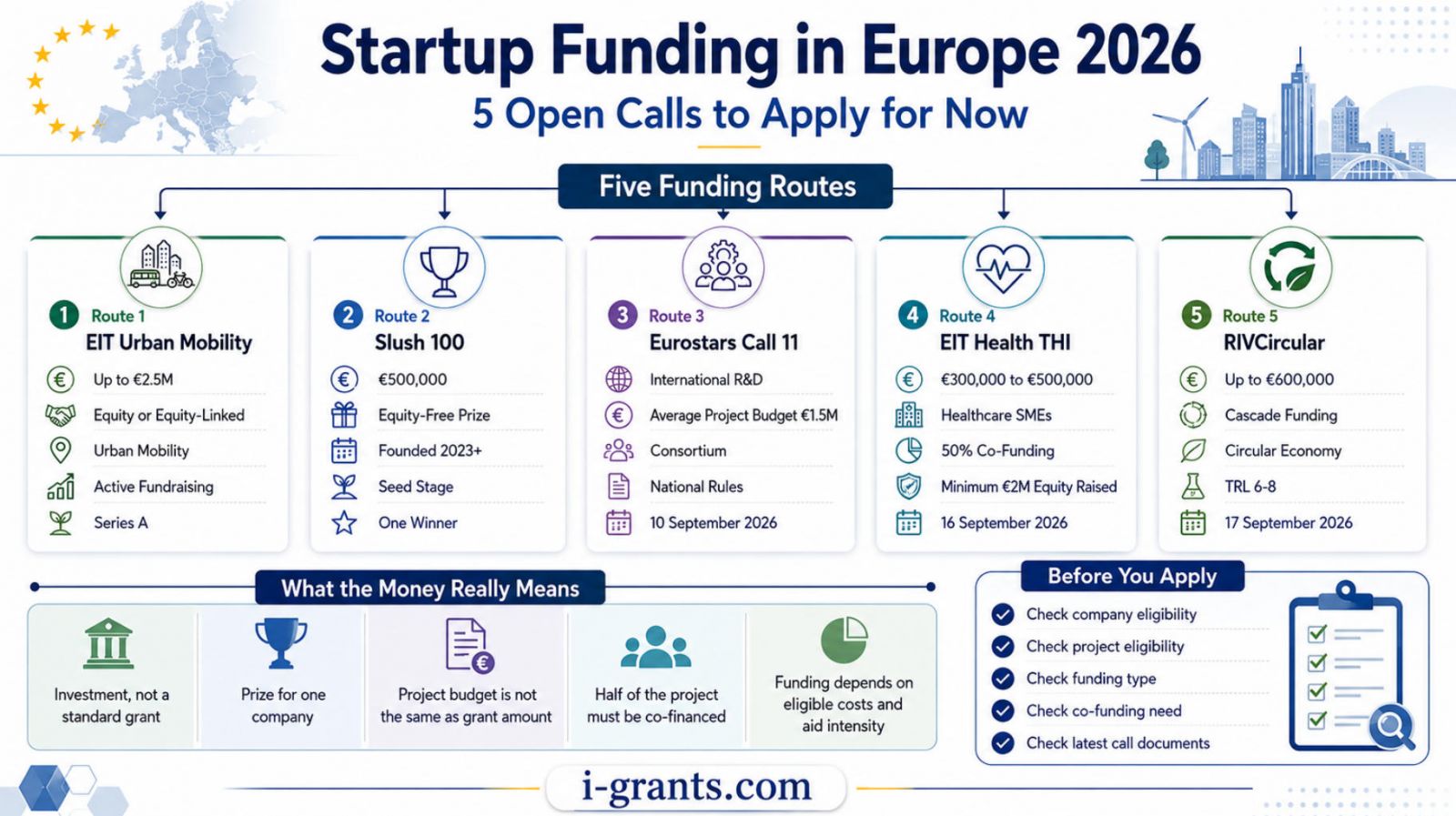
As of 27 August 2026, several significant European and international calls remain open with deadlines between late August and mid-September, while one of them offers another cut-off later in November. They span urban mobility, startup competitions, international R&D, healthcare innovation and the circular economy.
This article examines five of the most relevant opportunities, explains who can realistically qualify and, most importantly, shows what the headline funding amount actually represents.
Five funding opportunities open in late summer 2026
The opportunities below should not be treated as interchangeable. They serve startups at very different stages and use different financing mechanisms.
Table 1. Five Startup Funding Opportunities Open in Europe in 2026
| Programme | Funding available | Funding type | Main target | Deadline |
|---|---|---|---|---|
| EIT Urban Mobility Financial Support to Startups | Up to €2.5 million per company | Equity or equity-linked financial support / co-investment | Pre-seed, Seed and Series A mobility startups | 31 August 2026, with another cut-off on 16 November 2026 |
| Slush 100 | €500,000 for one winner | Equity-free startup competition prize | Young Seed-stage or earlier startups | 7 September 2026 |
| Eurostars Call 11 | Amount depends on national funding rules | International collaborative R&D project funding | Innovative SMEs leading international R&D projects | 10 September 2026, 14:00 CEST |
| EIT Health Transformative Healthcare Instrument | €300,000 to €500,000 | Project funding with mandatory co-financing | More mature healthcare SMEs | 16 September 2026 |
| RIVCircular Cascade Funding | Up to €600,000 per beneficiary | Cascade grant funding / Financial Support to Third Parties | Circular economy innovators in eligible territories | 17 September 2026, 14:00 CET |
The official EIT Urban Mobility call provides up to €2.5 million per company and has 2026 cut-offs on 23 February, 18 May, 31 August and 16 November. Slush 100 applications close on 7 September. Eurostars Call 11 closes on 10 September, the EIT Health call on 16 September and RIVCircular on 17 September.
1. EIT Urban Mobility: up to €2.5 million, but this is not a conventional grant
EIT Urban Mobility's Financial Support to Startups Open Call is one of the largest funding opportunities in this selection.
The programme targets pre-seed, Seed and Series A companies developing solutions for urban mobility. EIT Urban Mobility states that it can provide up to €2.5 million per company. The call has an estimated total EIT funding budget of €14 million, with multiple application cut-offs throughout 2026.
The critical point for founders is the financial mechanism.
This is not a conventional non-dilutive startup grant. EIT Urban Mobility operates as an impact investor and expects the startup to be engaged in a genuine equity or equity-linked fundraising round. The organisation normally participates alongside private investors rather than leading the round. Its current startup investment guidance describes a target equity stake of approximately 5 to 10%, with investment structures that can include a capital increase or SAFE instrument.
That distinction radically changes who should apply. A founder looking exclusively for non-dilutive capital may find the instrument unsuitable even though the headline amount is substantially larger than many European grants.
Who is eligible?
The formal eligibility requirements are unusually specific.
The applicant must be established in an EU Member State or a third country associated with Horizon Europe. It must already be engaged in an active pre-seed, Seed or Series A fundraising round, target the urban mobility market and have at least a prototype, pilot or minimum viable product.
In addition, the company's pre-money valuation must not exceed €50 million, and individual founders or executive team members must jointly own more than 40% of the company's equity before the current fundraising round. Companies already in the EIT Urban Mobility equity portfolio are excluded from applying under the same mechanism.
The ownership test deserves attention. A startup may have excellent technology and strong revenues but still be ineligible if previous financing rounds have already diluted the founders and executive team below the required threshold.
The same applies to valuation. EIT Urban Mobility is clearly targeting venture-scale companies, but not later-stage businesses whose valuation has already moved beyond the €50 million ceiling.
What sectors are targeted?
The 2026 programme focuses on areas including urban logistics, public and shared transport, mobility data management, transport electrification and alternative fuels, and health and mobility. EIT Urban Mobility is therefore not a general-purpose technology investor. A startup must demonstrate a direct connection to urban mobility and a credible impact on challenges such as congestion, emissions, safety or accessibility.
The evaluation goes well beyond checking eligibility. The first stage assesses strategic fit, innovation, impact and implementation. Successful applicants then proceed to a live pitch and due diligence process focused on the team, product, market, financials and potential return on investment.
This makes the programme much closer to an institutional investment process than a simple grant competition.
A useful 2026 benchmark: NexDash
There is also a current example showing that the €2.5 million ceiling is not purely theoretical.
In June 2026, EIT Urban Mobility announced a €2.5 million commitment to Berlin-based NexDash, a company working on the electrification of road freight. EIT Urban Mobility described it as the largest investment in its history at that point. The commitment was structured around NexDash's pre-Series A financing and future Series A participation.
For founders, that example clarifies the programme's intended profile: a company with a scalable commercial model, a live fundraising process and a credible path toward a substantial institutional round.
Can a Ukrainian startup apply?
Potentially, yes.
Ukraine is currently an associated country of Horizon Europe. Since the EIT Urban Mobility call accepts legal entities established in EU Member States and third countries associated with Horizon Europe, a Ukrainian incorporated startup can satisfy the geographical condition, provided it also meets all other requirements.
This does not mean automatic eligibility. The fundraising round, ownership structure, valuation, technology maturity and sector fit must still pass the call's tests.
For Ukrainian mobility founders, however, this is a meaningful distinction from programmes that limit support strictly to EU or EEA entities.
2. Slush 100: €500,000 with zero equity, but only one company wins
Slush 100 represents almost the opposite financing model.
There is no equity dilution, no co-financing requirement and no national funding body. The winner receives €500,000 with 0% equity.
But there is an equally important limitation: the €500,000 is a competition prize for one winning startup, not a €500,000 grant available to every selected participant.
For founders comparing funding programmes, that makes Slush 100 potentially very attractive but statistically very different from an institutional grant scheme.
Applications opened on 12 August 2026 and close on 7 September 2026. The Top 100 are scheduled to be selected on 11 September and the Top 20 on 1 October. Twenty semifinalists will pitch on 18 November during Slush in Helsinki, with three finalists moving to the final on 19 November.
Eligibility is simple, but narrow
A startup must have been founded in 2023 or later, have raised less than €10 million, and remain at Seed Stage or earlier through the final on 19 November.
A Slush ticket is not required to submit the initial application. However, a company selected for the Top 100 must purchase a Slush 2026 Startup Pass to continue in the competition.
This means the competition is particularly relevant for ambitious young companies that can communicate their investment case effectively in a public pitch environment.
It is less appropriate for companies founded before 2023, businesses already beyond Seed Stage or founders who need a predictable funding process rather than an all-or-nothing competition.
Why Slush is relevant even for startups that do not win
The €500,000 prize is the headline attraction, but recent data provides a broader reason to consider the competition and the event around it.
Slush and Dealroom published a 2026 matched-benchmark study examining 2,108 European companies that first attended Slush in 2022, 2023 or 2024, comparing them with 229,866 European peers matched on founding year, country and growth stage.
According to the study, 26.4% of the Slush companies raised institutional venture capital after attending, compared with 7.5% of the benchmark group. That represents a fundraising rate approximately 3.5 times higher. Among companies that subsequently raised a qualifying round, the median round size was $3.8 million, compared with $1.8 million among benchmark companies. Slush companies were also seven times more likely to have a top 0.1% global VC fund on their cap table and approximately 2.5 times more likely to advance to a higher funding stage.
These figures should not be interpreted as proof that attending Slush caused those companies to perform better.
Slush itself explicitly states that the study is correlational. High-quality, fundraising-oriented startups may be more likely to attend the event in the first place. Nevertheless, the data suggests that the ecosystem surrounding the competition can have value far beyond the €500,000 first prize.
For founders, this is an important strategic distinction: the expected value of applying may include investor visibility and network access even when the probability of winning the cash prize is low.
3. Eurostars Call 11: international R&D funding without a universal grant amount
Eurostars is often presented as a European grant for innovative SMEs. That description is incomplete.
The programme supports international collaborative research and development projects led by innovative SMEs, but the funding system is decentralised. There is no single Eurostars grant rate or maximum amount that applies to every participating company.
Eurostars Call 11 opened on 9 July 2026 and closes on 10 September 2026 at 14:00 CEST. The programme is part of the European Partnership on Innovative SMEs and is co-funded by the European Union through Horizon Europe.
How Eurostars funding actually works
Projects are evaluated internationally, but approved participants receive public financing through their respective National Funding Bodies.
That means the national authority decides which types of organisations can receive support, which activities and costs are eligible, the applicable funding rate and any maximum funding amount.
A German SME, French SME and Dutch research organisation participating in the same Eurostars consortium can therefore receive support under three different national funding frameworks.
This is one of the most important practical rules in Eurostars.
The total project budget is not the same as the grant received by the lead startup. A founder must check the national funding conditions before finalising the consortium and project budget.
Eurostars reports an average project budget of approximately €1.5 million, with about 20% of submitted applications passing evaluation and receiving funding. There is no general Eurostars maximum project budget, although individual National Funding Bodies may impose their own caps.
International eligibility requirements
For Call 11, the consortium must be led by an innovative SME from a Eurostars country and include at least two independent entities from at least two Eurostars countries. At least one organisation must come from an EU Member State or Horizon Europe Associated Country.
SMEs from Eurostars countries must account for at least 50% of total project costs, excluding subcontracting. No single participant or country may account for more than 70% of the project budget. Projects must last no more than 36 months and must focus exclusively on civil applications.
Eurostars is technology-neutral. It does not operate as a narrow thematic call for AI, biotechnology or climate technology alone. The main question is whether the consortium is developing an innovative product, process or service with credible international commercial potential.
The programme does not impose a formal starting or finishing TRL as an international eligibility requirement. However, the official Eurostars FAQ notes that projects commonly begin around TRL 4 and finish around TRL 6 or 7 because the programme is intended to support relatively close-to-market R&D.
Competition is substantial
Eurostars Call 10, which closed in March 2026, received 687 applications. Electronics, IT and telecommunications accounted for 220 applications, the largest technology category in that call.
The most recent completed selection supported 110 innovation projects involving 328 organisations across 28 countries.
Together with the approximately 20% historical success rate reported by Eurostars, these figures show that the programme is competitive but not inaccessible. A well-constructed consortium with a credible commercialisation path can have a meaningful chance of success.
A special warning for Ukrainian startups
Ukraine is associated with Horizon Europe, but it is not one of the Eurostars countries listed for the programme.
This produces a crucial distinction.
An organisation from a non-Eurostars country can participate in a Eurostars consortium, but the official rules state that only organisations based in Eurostars countries can receive Eurostars funding. A participant from another country must finance its entire project contribution itself and submit a self-funding declaration.
A Ukrainian startup therefore should not interpret Ukraine's Horizon Europe association as automatic access to Eurostars public funding.
It may participate as a self-funded partner if the consortium remains compliant with Eurostars eligibility rules. However, the coordinator must be an innovative SME from a Eurostars country, and the funded consortium structure must still satisfy the programme requirements.
For a Ukrainian founder, this can make Eurostars valuable for international R&D cooperation but financially much less attractive than a Horizon Europe call under which Ukrainian entities are directly eligible for EU funding.
4. EIT Health Transformative Healthcare Instrument: up to €500,000 for companies that are already relatively mature
The EIT Health Transformative Healthcare Instrument, or THI, is another case where the headline funding amount can be misleading without context.
The programme offers €300,000 to €500,000 in EIT Health funding for high-potential healthcare SMEs working in biotechnology, medical technology, digital health, AI, biomarkers and diagnostics.
The 2026 call opened on 24 June and closes on 16 September 2026.
At first sight, a €500,000 opportunity may sound suitable for an early-stage healthtech startup.
In reality, the entry conditions show that EIT Health is targeting substantially more mature companies.
The €500,000 is only half of the financing equation
EIT Health will cover a maximum of 50% of total project costs.
The company must provide the other 50% from other sources. Consequently, a company requesting the full €500,000 contribution would normally need a project budget of at least approximately €1 million, with the remaining funding secured outside the EIT Health contribution.
This is not a minor administrative detail. It is a basic financial eligibility question.
A company that cannot demonstrate access to its share of the project budget should not treat the €500,000 figure as accessible capital.
Applicants must already have employees and investors
Eligible applicants must be private micro, small or medium-sized enterprises with at least four full-time-equivalent employees.
They must also have closed a minimum of €2 million in total equity investment during the preceding 36 months, including participation from at least one new investor.
This immediately excludes many pre-seed and early Seed startups.
The instrument is designed for businesses that have already passed initial company formation, team building and early fundraising stages and are now trying to advance a healthcare product toward commercialisation and a further financing round.
Technology maturity requirements reinforce this positioning.
For biotechnology, the minimum Innovation Maturity Level is 5, corresponding to a safety or toxicity study stage. Medtech projects require at least IML 6 and an initial clinical proof of concept. Digital health projects require IML 7, described by EIT Health as market validation, while biomarkers and diagnostics also require IML 7.
A digital health startup with a prototype but no market validation therefore does not meet the stated maturity threshold.
EIT Health's broader track record
The size of the EIT Health ecosystem is another useful signal for applicants.
According to its 2024 Annual Report, EIT Health supported 372 startups and scale-ups during 2024, which collectively raised €227 million in investment. Twelve healthcare innovations were launched during the year, reaching more than 283,000 patients and citizens.
Since 2016, EIT Health reports supporting 3,370 ventures, which have attracted €2.4 billion, while innovations supported through the organisation have affected approximately 780,000 lives.
Those figures do not predict the success of an individual THI applicant, but they demonstrate that the programme sits inside a well-established health innovation and investment ecosystem.
Geography should be checked before an applicant commits resources
The public THI page describes the opportunity as support for European startups but does not, on the short call page itself, provide a complete country-by-country eligibility list.
For companies incorporated outside the EU, including Ukrainian healthtech businesses, it is therefore safer to confirm geographical eligibility against the latest official call documentation or directly with EIT Health before committing substantial resources to an application.
Association with Horizon Europe should never be assumed to create automatic eligibility for every EIT programme or individual call.
5. RIVCircular: up to €600,000 per beneficiary, including opportunities in Kyiv Oblast
For companies and innovation organisations connected with the circular economy, RIVCircular is one of the most unusual calls currently open.
It is also directly relevant to part of the Ukrainian innovation ecosystem.
The project is funded under Horizon Europe and uses Financial Support to Third Parties, often called cascade funding, to finance interregional circular economy innovation projects. Applications close on 17 September 2026 at 14:00 CET.
The updated applicant guidelines state that the call mobilises €12.35 million for stakeholders in the participating territories. Earlier promotional material referred to €12.95 million, but Version 2 of the guidelines, issued after the withdrawal of the Košice region, contains the updated €12.35 million figure.
Applicants should also note that the programme updated its budget template to Version 3 on 31 July 2026, and the call page instructs applicants to use the latest version.
This is a practical example of why a startup should never build an application solely from an original launch announcement. Call documents can change after publication.
What does RIVCircular fund?
The call covers five areas: construction and demolition waste circularity; circular energy integration and the use of local waste streams; electric vehicle battery recycling and reuse; circular textiles; and digital solutions for the circular economy.
Projects must operate between TRL 6 and TRL 8, meaning the programme is designed for technologies that are already being demonstrated, validated, piloted or prepared for market replication rather than for basic research or early concept development.
The recommended project budget is €1 million to €2 million for Topics 1 to 4 and €200,000 to €700,000 for the digital circular economy topic.
However, a single beneficiary may request no more than €600,000 in total across the entire call, even if it participates in several proposals.
Once again, the headline project budget and the amount available to one startup are different numbers.
Funding intensity depends on company size
Enterprises do not automatically receive 100% of their project costs.
Table 2. Key Eligibility and Co-Financing Requirements
| Programme | Important company-level requirement | Co-financing / investor requirement | Consortium required? |
|---|---|---|---|
| EIT Urban Mobility | Active fundraising round, MVP/pilot/prototype, valuation ≤ €50M, founders/executives >40% ownership | EIT participates in an equity or equity-linked round alongside investors | No |
| Slush 100 | Founded in 2023 or later, <€10M raised, Seed Stage or earlier | No mandatory co-financing for the €500K prize | No |
| Eurostars Call 11 | Lead must be innovative SME from a Eurostars country | National funding rates vary; some project costs normally remain with beneficiaries | Yes |
| EIT Health THI | ≥4 FTE, ≥€2M equity raised in previous 36 months | EIT Health covers maximum 50% of total project costs | No consortium requirement stated on the public opportunity page |
| RIVCircular | Eligible territory, TRL 6-8, legal entity | Enterprise aid intensity generally ranges from up to 50% to up to 70 |