

 Français
  Deutsch
  Українська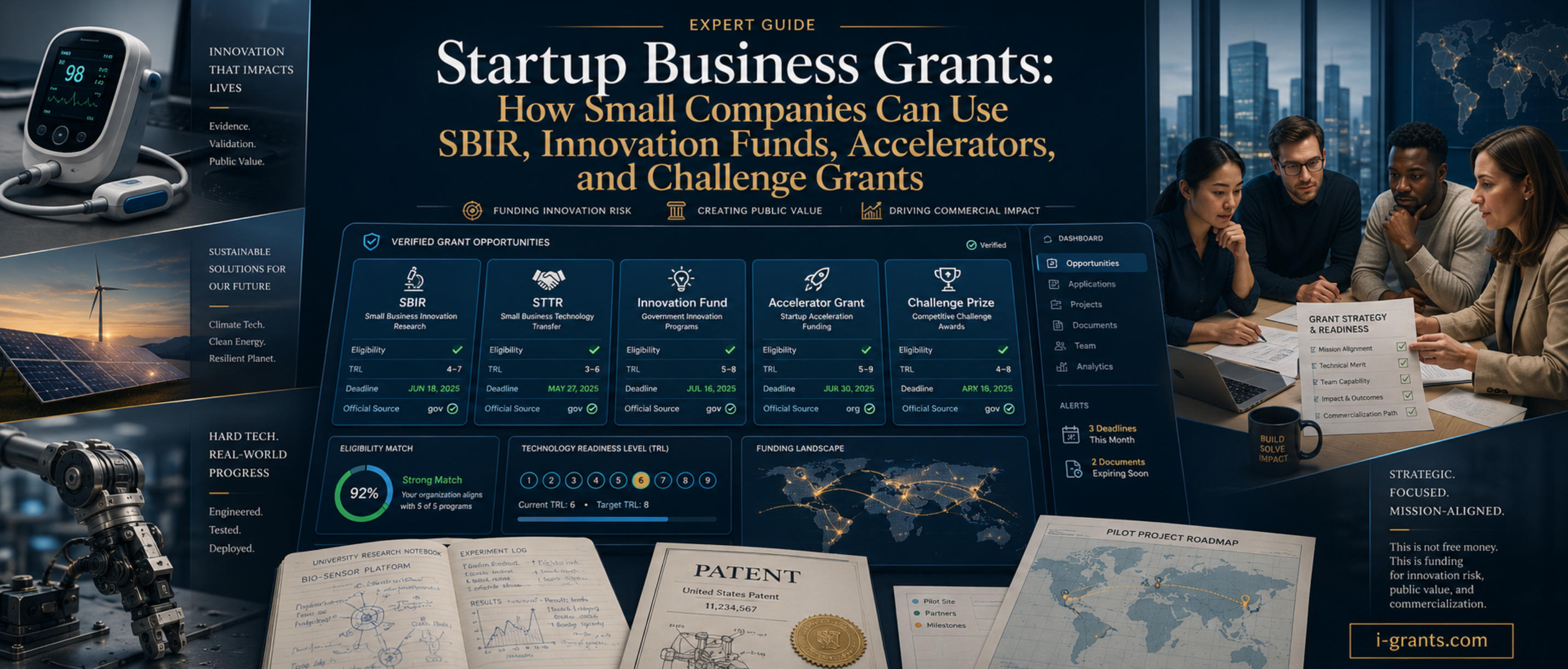
Startup business grants are one of the most attractive funding routes for founders who want to build a company without giving away equity too early. The phrase sounds simple, almost magical: a startup needs money, a grantmaker has money, and the founder applies. In reality, startup business grants work in a much more disciplined way. They are rarely free launch money for any new company. They usually fund a defined innovation project, a technical risk, a public-interest problem, a commercialization path, or a strategic sector that a government, foundation, corporation, research agency, or development institution wants to support.
That distinction matters. A founder looking for startup business grants may be disappointed if the business is only a standard local service, a generic app, or a retail idea with no clear innovation logic. But a founder working on medical technology, climate software, robotics, advanced manufacturing, education technology, clean energy, agriculture innovation, cybersecurity, semiconductors, AI infrastructure, or a university spinout may find that startup business grants are one of the most realistic forms of non-dilutive funding before venture capital, commercial revenue, or public procurement is ready to carry the risk.
The strongest startup business grants do not begin with the question, “Who gives money to startups?” They begin with a better question: “Which funder has a mission problem that this startup can solve?” That is the practical difference between a weak grant search and a serious funding strategy. In practical SEO terms and in real funding work, startup business grants should remain the central phrase because founders search for startup business grants, compare startup business grants, and need to verify startup business grants before they apply.
Startup Business Grants Are Not Free Launch Money
The first rule is simple: startup business grants must be treated as competitive project funding, not as a shortcut around business fundamentals. Startup business grants reward alignment, evidence, and timing.
Startup business grants should not be confused with general startup capital. A grant is usually project-based. It supports a specific activity, not the entire business dream. That activity may be feasibility testing, prototype development, technical validation, regulatory preparation, field demonstration, commercialization planning, customer discovery, export readiness, pilot deployment, or measurable impact work.
This is why startup business grants are different from loans, venture capital, crowdfunding, tax credits, or accelerator investment. A loan must be repaid. Venture capital buys ownership and expects high-growth returns. Crowdfunding depends on public demand or community support. Tax credits usually reduce tax liability after eligible activity. Accelerator investment may include equity or a simple agreement for future equity. Startup business grants, by contrast, can be non-dilutive, but they also come with rules, eligibility criteria, budgets, deadlines, reporting duties, and funder priorities.
A founder should not ask whether startup business grants exist in general. They do. The better question is whether the startup has a fundable project. A fundable project has a defined problem, a credible solution, a realistic work plan, a budget, measurable milestones, and a reason why grant funding is justified. If the project only says “we need money to grow,” it is usually too weak. If it says “we need funding to reduce technical uncertainty, validate a prototype, and prepare a product for commercialization in a priority sector,” it is closer to grant logic.
Why Startup Business Grants Matter in the Funding Stack
Startup business grants matter most when they finance work that ordinary capital will not yet finance. Startup business grants can bridge the gap between research promise and commercial proof.
Startup funding is not one single road. Most companies combine several routes over time: founder savings, customer revenue, research support, grants, accelerators, angel investment, venture capital, debt, strategic partnerships, and public procurement. Startup business grants matter because they can fill a difficult gap between idea and market proof.
Many early-stage companies are too risky for traditional investors. They may have promising technology but no finished product. They may have research results but no validated prototype. They may have a strong scientific idea but a long regulatory path. They may have climate, health, education, or public-sector value that cannot be financed only through short-term market demand. In these cases, startup business grants can help prove the technology, test assumptions, and create evidence.
This is especially important for deep tech startups. A software product can sometimes reach the market with a lean team and fast iteration. But a medical device, battery technology, robotics platform, biotech process, advanced material, precision agriculture system, or industrial decarbonization tool may need laboratory work, specialized equipment, technical staff, regulatory planning, and long validation cycles. Startup business grants can help cover the research and development phase before the company is ready for customers or investors.
The same is true for public-interest innovation. If a startup is solving a problem in health, education, accessibility, climate resilience, disaster response, food security, water, energy, or community infrastructure, the market alone may not reward the work quickly enough. Startup business grants can support projects where public value and commercial potential overlap.
SBIR and STTR: A Core Route for U.S. Innovation Startups
For many U.S. founders, startup business grants become realistic only when the company has a serious R&D project. SBIR and STTR are the clearest examples of startup business grants built around that logic.
For U.S. founders, SBIR and STTR are among the most important startup business grants. The Small Business Innovation Research and Small Business Technology Transfer programmes support small businesses that are developing technology with research and commercialization potential. They are not designed for ordinary business expansion. They are designed to help small companies explore technological innovation, address federal research and development needs, and move promising ideas toward market use.
SBIR is usually led by the small business. STTR requires formal collaboration between the small business and a research institution. Both routes can be powerful for startups connected to science, engineering, health, defense, space, energy, education, agriculture, transportation, or advanced manufacturing.
The practical structure is important. Phase I usually supports feasibility and proof of concept. The funder wants to know whether the idea can work. Phase II usually supports deeper development, validation, prototype improvement, or commercialization preparation. Later-stage support may focus on market transition, procurement, licensing, private investment, or partnerships. This phased approach makes SBIR and STTR different from many generic startup business grants because they follow the logic of technical risk reduction.
Founders should also understand that SBIR and STTR are competitive. A strong application must show the innovation, the technical challenge, the work plan, the team, the budget, the market opportunity, and the public mission fit. A founder who writes only like an investor pitch may miss the point. Reviewers need to see scientific or technical merit, feasibility, impact, and commercialization potential. For this reason, many companies seeking startup business grants through SBIR or STTR work with grant writers who understand both technical proposals and startup commercialization.
NIH, NSF, DOE, NASA, and Mission-Driven Startup Funding
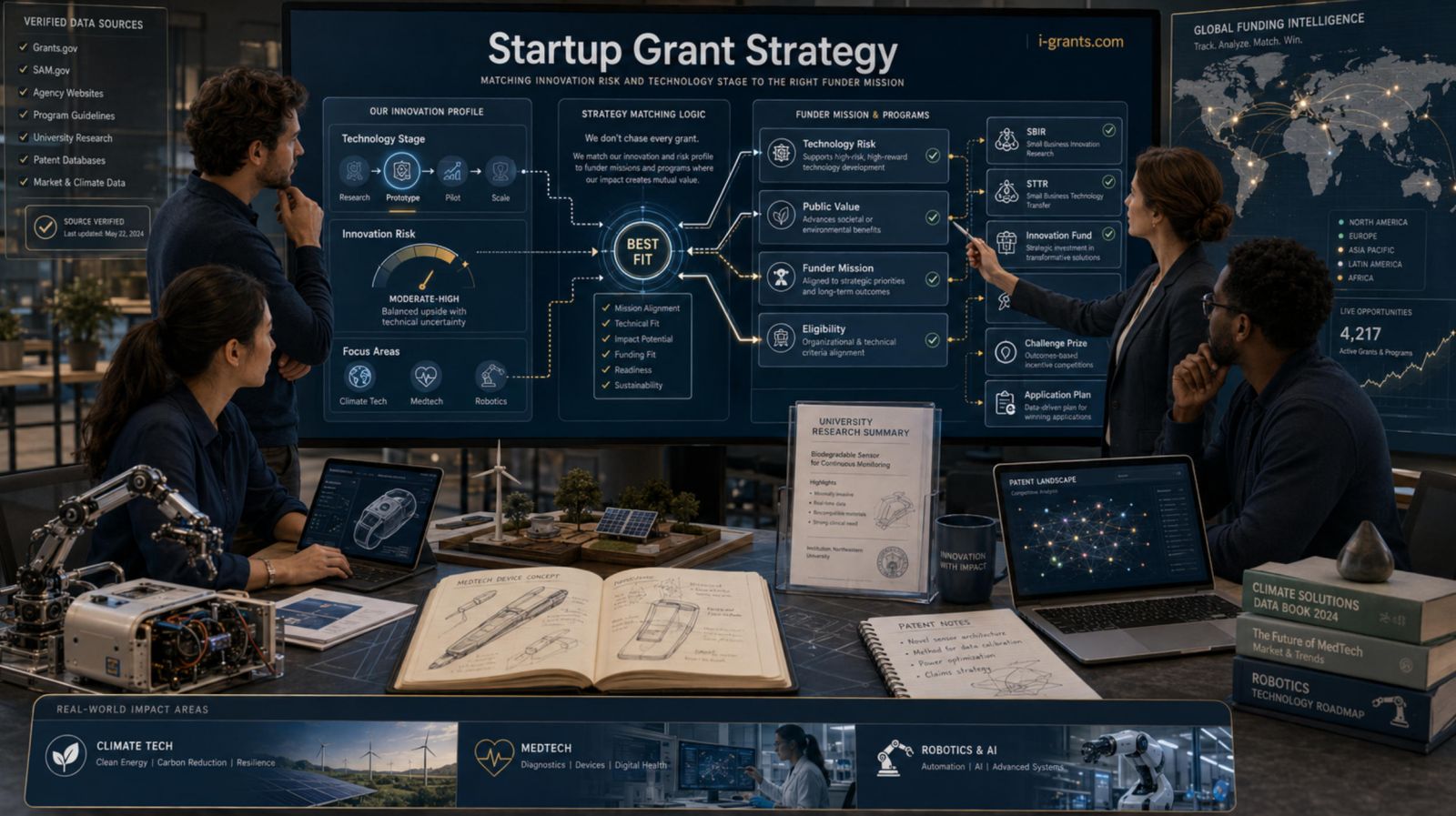
The best startup business grants search is a mission-matching exercise. Startup business grants become more visible when founders stop searching generically and start asking which agency needs their solution.
Different agencies support different kinds of startup business grants because each agency has its own mission. A health technology startup may look at NIH. A deep tech founder may explore NSF America’s Seed Fund. An energy, climate, grid, materials, or industrial technology startup may look at DOE. A space technology company may consider NASA SBIR and STTR opportunities. An education technology startup may monitor education research and innovation programmes.
This is where many founders make a strategic mistake. They search for startup business grants by keyword only. A better method is to map the startup’s technology to a mission owner. If the company is working on a diagnostic tool, which health agency needs better diagnostics? If it is developing low-carbon manufacturing technology, which energy or industrial programme is funding decarbonization? If it builds assistive learning software, which education funder supports evidence-based innovation? If it works on satellite components, robotics, sensors, or advanced materials, which agency has a mission need in that domain?
Startup business grants become easier to understand when the founder thinks like a funder. The funder is not asking, “Is this a cool startup?” The funder is asking, “Does this project advance our mission, reduce a known problem, and produce credible results?”
EIC Accelerator and European Innovation Funding
For European and international founders, startup business grants often sit inside larger innovation policy. Startup business grants in this environment are connected to competitiveness, industrial resilience, strategic technologies, and scale-up capacity.
In Europe, the European Innovation Council is one of the most important frameworks for startup business grants and scale-up support. The EIC Accelerator supports startups and small and medium-sized enterprises developing breakthrough innovations with high risk and strong market potential. It is especially relevant for deep tech, climate tech, health tech, advanced engineering, industrial technologies, digital infrastructure, and other strategic innovation fields.
The EIC Accelerator is not a simple grant for a business idea. It usually expects a startup to be beyond the raw concept stage. Many suitable applicants are working around technology readiness levels where a technology has already been demonstrated in a relevant environment and now needs validation, scaling, or market preparation. The grant component can support eligible innovation activities, while the equity component through the EIC Fund can help companies scale when the project needs larger investment.
This makes the EIC Accelerator a strong example of blended startup funding. It also shows why startup business grants must be classified carefully. A founder may see “grant” and assume the entire package is non-dilutive. In reality, some programmes combine grants, equity, loans, services, pilots, and investor access. For i-grants.com, this classification is essential. Applicants and grant writers need to know whether the opportunity is a pure grant, blended finance, a prize, an accelerator package, or an investment route.
EIC Accelerator Challenges also illustrate another important pattern. Some startup business grants are open-topic, while others are challenge-driven. A challenge-driven call defines the problem area in advance. The startup must show that its innovation fits that problem and can deliver meaningful impact. This is common in climate, energy, health, defense, food systems, AI safety, critical raw materials, industrial resilience, and other strategic sectors.
Innovation Funds Beyond the United States and Europe
A global founder should assume that startup business grants are geography-sensitive. Startup business grants may be open internationally, nationally, regionally, or only through specific partner countries.
Startup business grants are not limited to the United States and the European Union. Many countries have national innovation agencies, export promotion bodies, development banks, climate funds, science foundations, regional technology funds, and entrepreneurship support programmes. Some support early-stage research. Others support commercialization, market entry, internationalization, sustainability, digital transformation, or industrial modernization.
For international founders, geography is one of the most important eligibility filters. A startup registered in Canada, Ukraine, Germany, Kenya, France, Singapore, Poland, or Brazil may face completely different rules. Some startup business grants are open only to domestic companies. Some require local registration. Some allow international consortium partners but not foreign lead applicants. Some are open to companies from associated countries, partner countries, or specific regions. Some require cooperation with a university, nonprofit, municipality, corporate partner, or research organization.
This is why a global grant platform should not treat startup business grants as a simple list. Each opportunity should be classified by donor, donor geography, eligible countries, applicant type, sector, funding amount, deadline, status, language, source type, and official verification link. Without those fields, founders waste time on opportunities they cannot legally apply for.
Accelerators, Incubators, and Startup Business Grants
Accelerator language can confuse founders because not every accelerator provides startup business grants. Startup business grants inside accelerators must be checked against equity terms, deliverables, and official programme rules.
Accelerators and incubators can be useful, but they are not always startup business grants. Some accelerators offer a grant or stipend. Some offer investment in exchange for equity. Some offer mentorship, cloud credits, legal support, pitch training, workspace, corporate introductions, or pilot access. Some are public programmes. Others are corporate or university-based. Some are highly selective and non-dilutive. Others are mostly networking.
Founders must read the terms before applying. The key question is not “Is this an accelerator?” The key question is “What kind of value does this programme actually provide?”
A serious founder should check whether the accelerator offers cash, reimbursed costs, a grant, a prize, investment, services, in-kind support, or only exposure. If money is offered, the founder should check whether it is non-dilutive or tied to equity. If a pilot is offered, the founder should check whether it leads to a real customer, public buyer, corporate partner, or data access. If the programme advertises startup business grants, the founder should verify the official source, eligibility, application method, selection criteria, and legal terms.
Accelerators can be especially valuable when they connect funding with market validation. For example, a climate startup may need a pilot site. A health startup may need clinical or regulatory mentorship. An education technology startup may need school district feedback. A logistics startup may need corporate testing. In these cases, the programme’s non-cash value may be as important as the grant.
Challenge Grants and Prize Competitions
Challenge prizes can function like startup business grants when they provide non-dilutive capital for solving a defined problem. But startup business grants and prizes still require careful classification.
Challenge grants and prize competitions are another route for startup business grants, although they work differently from traditional grants. Instead of funding a broad company plan, a challenge asks participants to solve a defined problem. The funder may want a new technology, prototype, dataset, algorithm, process, product, social innovation, or deployment model.
This model is useful when the funder can define the desired outcome but does not know which team will produce the best solution. For startups, challenge grants can provide money, credibility, visibility, technical validation, partner access, and investor attention. They can also be faster and more focused than large grant programmes.
However, challenge grants are not always easy money. They may require major unpaid work before the award. Some prizes pay only winners. Some require public demonstrations. Some require intellectual property commitments. Some provide recognition more than meaningful capital. A founder should compare the cost of participation with the realistic value of the prize.
Challenge funding is strongest when the startup already has a solution close enough to compete. If the company is too early, it may spend time preparing a weak entry. If it is too mature, the challenge may not justify the effort. As with other startup business grants, fit matters more than excitement.
Which Startups Are Strong Candidates for Grant Funding?
The strongest candidates for startup business grants are not always the loudest founders. They are the companies whose projects make startup business grants logical for the funder.
The strongest candidates for startup business grants usually share several qualities. They have an innovation that is meaningfully different from standard market offerings. They can explain the technical, scientific, operational, or social risk that funding will reduce. They can show why the project matters beyond private profit. They have a credible team. They can produce evidence, milestones, and a budget. They understand the funder’s mission.
Strong candidates often come from sectors where innovation risk is high and public value is visible: health technology, medical devices, biotechnology, climate technology, clean energy, robotics, AI infrastructure, cybersecurity, education technology, assistive technology, agri-tech, advanced manufacturing, semiconductors, space technology, water systems, circular economy, and disaster resilience.
But sector alone is not enough. A startup in AI is not automatically grant-ready. A climate startup is not automatically eligible. A women-led or veteran-led startup does not automatically qualify for every entrepreneurship grant. The project must match the rules. Startup business grants are won through alignment: applicant, geography, sector, stage, funding purpose, evidence, deadline, budget, and official source.
When Startup Business Grants Are the Wrong Route
Not every promising company should chase startup business grants. Startup business grants are useful only when the opportunity fits the company’s stage, evidence, timeline, and compliance capacity.
A serious article about startup business grants must also say when they are not the right route. Grants can be slow, competitive, restrictive, and administratively demanding. They may require months of preparation and review. They may reimburse costs after spending. They may restrict salaries, marketing, equipment, travel, subcontracting, or overhead. They may require reporting, audits, technical deliverables, or public communication.
A startup should be cautious if it needs money immediately to survive. Startup business grants are usually not emergency cash. A company should also be cautious if the project has no innovation, no public value, no measurable work plan, or no eligible applicant structure. A local restaurant, retail shop, agency, or service business may still find local small business support, but it may not fit R&D or innovation grant programmes.
There is also an opportunity cost. A founder can spend weeks preparing an application that has little chance of success. That time might be better spent selling, building, hiring, testing, or raising investment. The correct strategy is not to apply everywhere. The correct strategy is to apply only where the match is strong enough.
A Practical Classification Table for Startup Business Grants
Startup business grants should be classified before a founder decides to apply. This table helps separate startup business grants from adjacent funding tools.
| Category | What founders should check |
|---|---|
| R&D startup business grants | Technical uncertainty, research plan, milestone logic, eligible costs |
| Commercialization startup business grants | Prototype evidence, market path, customer discovery, scale potential |
| Climate startup business grants | Emissions logic, deployment pathway, measurable environmental outcomes |
| Health startup business grants | Clinical need, regulatory pathway, evidence plan, patient or system benefit |
| University-linked startup business grants | IP ownership, research partner, licensing route, spinout structure |
| Challenge-based startup business grants | Problem statement, judging criteria, prize conditions, unpaid work required |
| Accelerator-linked startup business grants | Equity terms, cash value, pilot access, mentor support, reporting rules |
This classification protects founders from treating every opportunity as the same. Startup business grants can look similar in search results, but startup business grants differ sharply by funder purpose, stage, paperwork, and risk.
How to Prepare Before Applying
Preparation is where many startup business grants are won or lost. Startup business grants require organized evidence before the application form is opened.
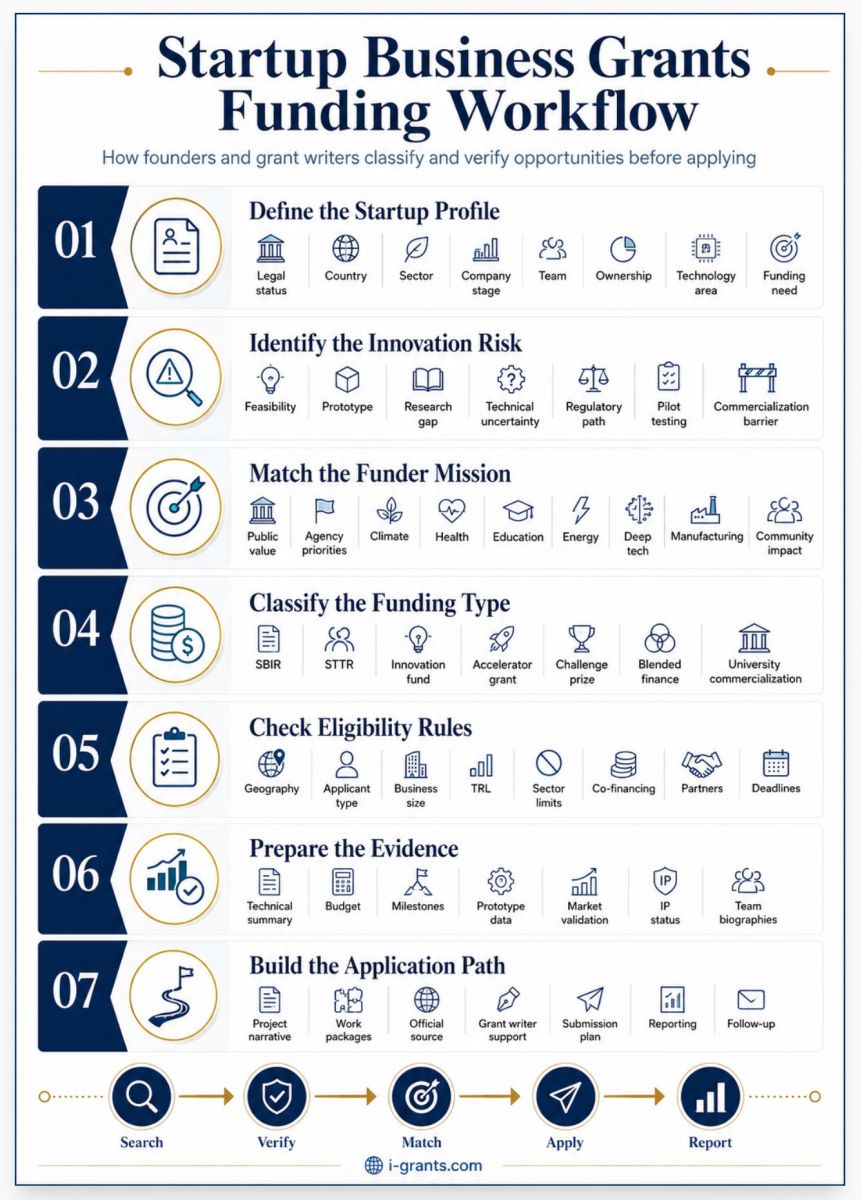
Before applying for startup business grants, a founder should build a grant readiness file. This file should include the company profile, registration documents, ownership structure, financial information, team biographies, product description, technical summary, market analysis, intellectual property status, prototype evidence, customer discovery, pilot results, regulatory pathway if relevant, budget assumptions, milestones, and commercialization plan.
The founder should also prepare two different stories. The investor story focuses on market size, growth, defensibility, traction, and returns. The grant story focuses on problem fit, innovation, feasibility, public value, work packages, measurable outcomes, and funder mission. These stories can overlap, but they are not identical.
For complex startup business grants, professional help can be valuable. A grant writer cannot turn a weak or ineligible project into a strong one. But a good specialist can structure the narrative, translate founder language into reviewer language, prepare the budget, check eligibility, organize attachments, clarify milestones, and reduce compliance risk. For SBIR, STTR, EIC Accelerator, and other competitive innovation calls, this expertise can matter.
How i-grants.com Can Help Startups and Grant Writers
Startup business grants need structure because the information environment is fragmented. Startup business grants are easier to act on when each opportunity is verified, classified, and matched to the right applicant profile.
The biggest problem with startup business grants is not only scarcity. It is fragmentation. Opportunities are spread across agency websites, donor pages, national portals, regional programmes, foundations, corporate challenges, accelerators, and research institutions. Some pages are updated often. Others are old. Some calls are open. Others are closed but still visible in search results. Some opportunities sound relevant but exclude the applicant’s country, legal status, sector, or stage.
i-grants.com can support a better workflow. For applicants, the platform can help identify active and verified opportunities, compare eligibility, understand donor priorities, and decide whether an application is worth the effort. For grant writers, startup business grants create a practical marketplace: specialists can find current calls, match them with startup profiles, and help founders prepare stronger applications.
This matters because startup business grants are rarely won by luck. They are won through fit, evidence, timing, and execution. A startup needs the right opportunity. A grant writer needs clear programme data. A funder needs credible projects. A structured grant intelligence platform can connect these sides more efficiently.
The practical lesson is that startup business grants work best as a disciplined funding strategy. Startup business grants become valuable when founders treat them as mission-aligned project finance.
Startup business grants can be powerful, but they are not simple. They are not general free money for anyone with a business idea. They are targeted funding tools for innovation, research, commercialization, strategic sectors, public value, and measurable impact.
The best startup business grants strategy begins with the funder’s mission and the startup’s innovation risk. A founder should classify the opportunity, verify the official source, check eligibility, understand the funding type, prepare evidence, and decide whether expert grant-writing support is needed. SBIR, STTR, NSF, NIH, DOE, EIC Accelerator, innovation funds, accelerators, and challenge prizes can all be valuable, but only when the project fits the rules.
For startups, the goal is not to chase every grant. The goal is to find the few startup business grants where the company’s technology, stage, geography, team, budget, and public value match the funder’s priorities. That is where grant funding becomes more than a search phrase. It becomes a real path from innovation risk to market-ready progress.