

 Français
  Deutsch
  Українська
Small business grants in the United States are real, sometimes substantial, and potentially transformative for the right company. But the US funding system bears little resemblance to the popular idea that entrepreneurs can simply search for a government grant, submit a short application, and receive free money to open or expand a business.
There is no universal federal grant for starting a restaurant, opening a retail store, buying equipment for an ordinary service company, hiring employees, or covering the general operating expenses of a new business.
Instead, public funding for US companies is distributed through a complex network of federal agencies, state governments, territories, Tribal governments, local economic development organisations, research programmes, agricultural initiatives, export programmes, specialised intermediaries, tax incentives, publicly supported lending, investment programmes, and government procurement.
Some programmes provide grants directly to eligible for-profit companies. Some provide federal money to states that then support businesses. Some fund universities, nonprofits, utilities, accelerators, lenders, or economic development organisations whose activities ultimately benefit small companies. Others provide loans, loan guarantees, tax credits, equity capital, technical assistance, or government contracts rather than grants.
For a company looking for public funding in 2026, understanding these distinctions is more valuable than having a list of hundreds of programme names.
The central question is not:
"Where can I get free money for my small business?"
It is:
"Which federal, state, or specialised funding mechanism matches my company, my project, my location, and my stage of development?"
That difference is the foundation of successful grant research in the United States.
Small Business Is a Major Part of the US Economy
The scale of the US small business sector explains why public funding for entrepreneurs attracts so much attention.
According to the US Small Business Administration Office of Advocacy, the United States has approximately 36.2 million small businesses, representing 99.9 percent of all US businesses. These businesses employ about 62.3 million people, equivalent to approximately 45.9 percent of private-sector employment.
Small businesses also account for a substantial share of economic activity. SBA research has estimated their contribution at roughly 43.5 percent of US gross domestic product.
These figures demonstrate the economic importance of small firms, but they should not be interpreted as evidence that all 36 million businesses qualify for federal grants.
The definition of a small business depends on the relevant SBA size standard and, in many programmes, additional eligibility rules. Size standards vary by industry and can be based on average annual receipts or the number of employees. Affiliates may also have to be included when determining whether a business qualifies as small.
A company can therefore be small in everyday language but too large for a specific federal programme. Conversely, a business with hundreds of employees may still meet the applicable SBA size standard in an industry where the threshold is relatively high.
Table 1. The US Small Business Funding Landscape in 2026
| Indicator | Approximate position |
|---|---|
| Small businesses in the United States | 36.2 million |
| Share of all US businesses | 99.9 percent |
| People employed by small businesses | 62.3 million |
| Share of private-sector employment | 45.9 percent |
| Estimated contribution to US GDP | About 43.5 percent |
| Annual SBIR/STTR funding ecosystem | More than $5 billion |
| Historical SBIR/STTR investment since 1982 | More than $81 billion |
| Businesses supported by SBIR/STTR since 1982 | More than 34,000 |
| FY2025 federal prime contracting awarded to small businesses | Approximately $179 billion |
These numbers also illustrate an important point. Grants are only one component of government-supported business finance. Federal procurement alone represents a much larger commercial market than most grant programmes.
The First Myth to Eliminate: There Is No Universal SBA Startup Grant
Searches for phrases such as "SBA grants for small business", "government startup grants", or "free federal grants for entrepreneurs" often produce misleading results.
The SBA itself is clear: it does not provide grants for starting or expanding an ordinary business.
This does not mean the SBA has no connection to grants. It administers or supports specific grant-related programmes, including initiatives connected to research, export development, entrepreneurship support, and organisations that assist small businesses.
But an entrepreneur should not expect to submit an application to the SBA simply because the company needs capital.
For example, a founder who needs $100,000 to open a café does not become eligible for a federal grant merely because the business qualifies as small.
A consulting company that wants to hire additional employees does not automatically qualify for an SBA grant.
A retailer looking for inventory financing should not assume that Grants.gov contains a federal programme designed to cover ordinary stock purchases.
A conventional local business may still have access to valuable public support, including state incentives, local economic development programmes, workforce assistance, publicly supported loans, guarantees, tax incentives, procurement opportunities, or specialised industry initiatives. But these forms of support should not be described as universal federal small business grants.
The distinction is important because unrealistic expectations waste time.
Where Small Business Grants Actually Come From
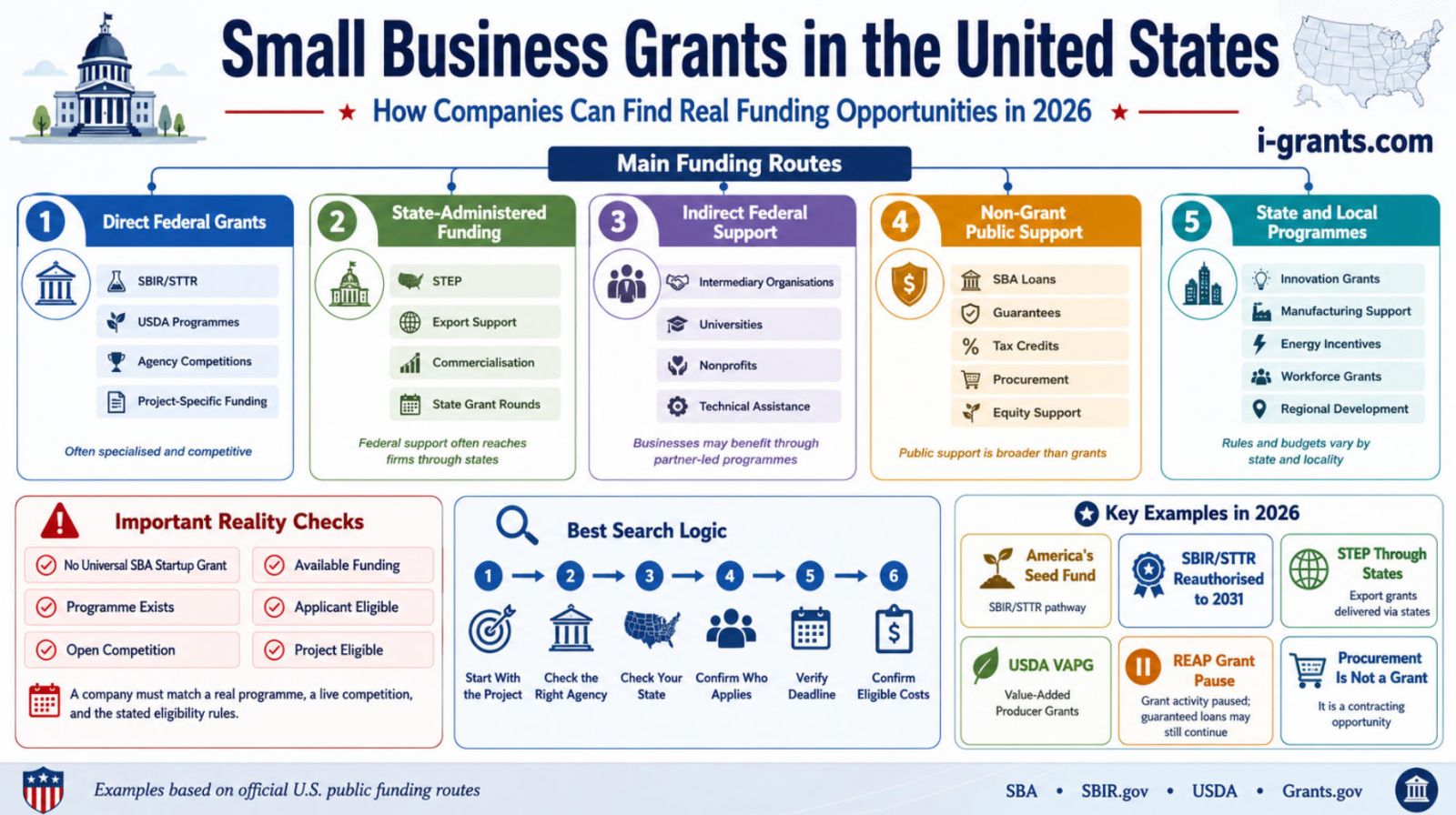
A more useful way to understand the US system is to divide funding opportunities by the path through which public money reaches a company.
Direct federal grants and R&D awards
These are programmes where an eligible for-profit business can apply directly to a federal agency.
The strongest example is the Small Business Innovation Research and Small Business Technology Transfer system, commonly known as SBIR/STTR or America's Seed Fund.
Certain agricultural and sector-specific programmes can also provide direct grants to eligible commercial applicants.
Federal funding administered by states
In these programmes, the federal government awards money to a state or territory. The state then creates its own mechanism for assisting companies.
The State Trade Expansion Program, or STEP, is a good example. Businesses may benefit from STEP-supported export activities, but the federal recipient is generally the state or territory rather than the individual company.
Federal grants to intermediaries
Some federal programmes support small businesses indirectly.
The federal grant may go to a nonprofit organisation, university, public authority, utility, lender, accelerator, economic development organisation, or Tribal government. That organisation then provides training, infrastructure, financing, technical assistance, incubator services, or other support to companies.
State and local business grants
States frequently operate their own grant programmes, particularly for innovation, commercialization, manufacturing, energy efficiency, workforce development, exports, strategic industries, and regional economic development.
These programmes can be extremely important because their eligibility rules may be designed specifically around the economic priorities of an individual state.
Non-grant public support
Loans, guarantees, tax credits, equity programmes, procurement contracts, technical assistance, and subsidised services may be economically valuable even though they are not grants.
A company that searches only for programmes carrying the word "grant" can therefore miss substantial sources of public support.
America's Seed Fund Is the Most Important Federal Grant System for Innovative Small Businesses
For innovative small businesses, America's Seed Fund is one of the most significant sources of non-dilutive funding in the United States.
The system consists of two related programmes:
SBIR, the Small Business Innovation Research programme, and STTR, the Small Business Technology Transfer programme.
Together, they connect small-business R&D with the missions of major federal agencies.
In April 2026, the Small Business Innovation and Economic Security Act reauthorized and reformed the programmes through September 30, 2031.
The reauthorization was important because SBIR/STTR had faced statutory uncertainty. The new legislation created a longer planning horizon while also introducing changes relating to programme security, commercialization, participation, performance, and the treatment of experienced award recipients.
According to SBA figures, SBIR/STTR have invested more than $81 billion in over 34,000 small businesses since 1982. The overall system now distributes more than $5 billion annually in non-dilutive funding.
For startups, the phrase "non-dilutive" is particularly important. A grant or R&D award normally does not require founders to give an investor an ownership stake in return for the funding.
However, this does not make SBIR/STTR easy money.
The programmes fund projects that correspond to defined federal research, technology, scientific, defence, healthcare, energy, or other mission-related priorities. Agencies run different solicitations and use different application procedures.
An NSF application does not operate exactly like an NIH application. DOE topics have different priorities from DoD topics. Commercialization expectations, research requirements, budgets, timelines, and technical review standards vary significantly.
This is why America's Seed Fund deserves an entire group of specialised articles rather than being treated as a single generic grant programme.
How Much Can SBIR/STTR Provide?
As of 2026, the standard award thresholds allow participating agencies to issue Phase I awards up to approximately $323,090 and Phase II awards up to approximately $2.15 million without obtaining a special SBA waiver for an award above the standard limits.
These are not guaranteed award amounts.
Each agency decides how it structures its opportunities within the programme framework.
NSF, for example, has its own award structure. Its current SBIR/STTR model can provide Phase I funding of up to approximately $305,000, followed by substantially larger Phase II support. Additional commercialization or supplemental funding may increase the total support available to successful companies.
NIH, DOE, DoD, NASA, and other participating agencies use their own structures, topics, and award strategies.
The 2026 reauthorization also introduced a potentially important Strategic Breakthrough mechanism. Under defined conditions, certain later-stage SBIR funding can reach much larger amounts, potentially up to $30 million, where statutory requirements are satisfied and substantial matching investment is demonstrated.
This is not a programme for ordinary startups seeking general working capital. It is designed for strategically important technologies with significant prior development and commercialization potential.
The practical lesson is that "SBIR grant" can describe opportunities ranging from early feasibility work to multimillion-dollar technology development programmes.
Direct Federal Grants Exist Outside Technology R&D
A strong overview of US small business grants should not imply that SBIR/STTR is the only route through which a for-profit company can receive a direct federal grant.
Agriculture provides some of the clearest counterexamples.
The USDA Value-Added Producer Grant, known as VAPG, supports agricultural producers seeking to develop value-added products, enter new markets, increase producer income, or create additional value from agricultural production.
For FY2026, approximately $25 million was available through the programme. Planning grants could reach $50,000, while working capital grants could reach $200,000, generally with matching requirements.
Eligible applicants can include agricultural producers, producer groups, cooperatives, and certain producer-controlled business ventures.
But timing matters.
The FY2026 application period ran from February 17 to April 22, 2026. Therefore, the programme exists, but the specific FY2026 competition is no longer open.
This distinction is one of the most important principles in grant research.
A programme can exist without currently accepting applications.
Why Programme Status Must Be Checked Every Time
A common weakness in online grant lists is failure to distinguish between a permanent programme and a current funding opportunity.
A website may say that a federal programme "offers grants" because the programme has statutory authority and an official webpage.
But a business cannot necessarily apply today.
A reliable funding analysis should distinguish among several separate conditions:
-
The programme legally exists.
-
A current funding opportunity has been announced.
-
The application window is open.
-
Funding is available for the relevant fiscal year.
-
The applicant itself is eligible.
-
The proposed project and costs are eligible.
These conditions can produce very different outcomes.
A programme may exist but have no current notice of funding opportunity.
A competition may be open but exclude for-profit businesses.
A company may be eligible while its project is not.
A project may fit technically but become ineligible because work started before the application date.
Funding may also be temporarily paused because regulations, appropriations, or programme guidance are changing.
REAP Demonstrates Why Old Grant Lists Can Be Misleading
The USDA Rural Energy for America Program, or REAP, is a useful 2026 case study.
REAP is widely known for supporting renewable-energy systems and energy-efficiency improvements for agricultural producers and rural small businesses.
Numerous websites therefore list REAP as a current source of small business grants.
However, the actual 2026 situation is more complicated.
USDA stated that new REAP grant awards would not be made until revised regulations take effect. New FY2026 renewable-energy and energy-efficiency grant applications were not being accepted during the pause.
At the same time, the guaranteed loan component continued.
This means several statements can simultaneously be true:
REAP exists.
REAP historically includes grants.
Rural small businesses can be eligible under programme rules.
Yet a company cannot necessarily submit a new grant application at the moment it discovers the programme.
This is exactly why i-grants.com should separate programme existence from current application availability.
Table 2. Examples of Programme Status for US Small Businesses in 2026
| Programme | Can businesses ultimately receive support? | Direct business application? | 2026 position |
|---|---|---|---|
| SBIR/STTR | Yes | Yes, if programme eligibility is met | Reauthorized through September 30, 2031; agencies operate individual competitions |
| NSF SBIR/STTR | Yes | Yes | Active 2026 funding structure for eligible technology companies |
| USDA Value-Added Producer Grants | Yes | Yes, for eligible agricultural applicants | FY2026 application period closed April 22, 2026 |
| USDA REAP grants | Yes under programme rules | Normally yes | New grant awards paused pending revised rules |
| USDA REAP guaranteed loans | Yes | Through applicable financing process | Continued despite the grant pause |
| USDA Rural Business Development Grants | Businesses can benefit | Generally no for ordinary for-profit businesses | Grant recipients are public bodies, Tribes, nonprofits, and other eligible organisations |
| STEP | Yes | Not directly to SBA | Federal funds flow through states and territories |
| SSBCI | Yes | Usually through state programmes, lenders, or investment vehicles | Active capital programmes vary by jurisdiction |
| State innovation grants | Frequently | Usually yes | Availability depends on the individual state and funding round |
Who Receives the Federal Grant Matters as Much as Who Benefits
One of the most misunderstood parts of public funding is the difference between the recipient of an award and the beneficiary of the programme.
The USDA Rural Business Development Grant programme illustrates this distinction.
Its name may lead a business owner to assume that rural businesses can apply for the grants directly.
But ordinary for-profit businesses are not the typical eligible recipients.
The programme funds eligible public bodies, government entities, federally recognized Tribes, and nonprofit organisations. Those recipients can then use projects to strengthen rural business development through technical assistance, incubators, equipment, revolving loan funds, training, economic development services, and related activities.
The small business may receive substantial value.
But legally, the business is not the federal grantee.
This distinction appears across the US funding system.
A state may receive federal funds to support exporters.
A nonprofit may receive a grant to provide manufacturing assistance.
A university may receive federal funds to operate an innovation programme.
A utility may administer incentives for energy upgrades.
A development finance organisation may receive public capital and lend it to businesses.
A company researching grants must therefore always ask:
Who is legally allowed to submit the application?
The answer may be different from:
Who is the programme intended to help?
STEP Is a Federal Small Business Programme, but Businesses Do Not Apply Directly to SBA
The State Trade Expansion Program, or STEP, is one of the clearest examples.
STEP exists to help eligible US small businesses develop international markets.
It can support activities such as export training, international trade missions, foreign trade shows, international marketing, e-commerce development, translation or localization, and selected market-entry services.
However, the federal funding architecture is not a direct grant from the SBA to every participating business.
The SBA awards STEP funding to states and territories. Those jurisdictions then operate their own export support programmes.
This has several practical consequences.
A small business in California may encounter a different STEP process from a business in Michigan, New York, Texas, Florida, or another participating jurisdiction.
Eligible expenses can vary.
Reimbursement percentages can vary.
Maximum awards can vary.
Application windows can vary.
Priority industries may vary.
A company searching for STEP assistance should therefore locate the STEP programme administered by its own state or territory, not simply search Grants.gov for a direct SBA grant.
This model of federal-to-state funding appears frequently in US business support.
State Governments Are Often the Missing Layer in Grant Research
Many businesses search only the federal level.
That can be a major mistake.
State governments operate a wide range of business-support programmes, and in some cases the state level may offer a more realistic grant route than the federal government.
State programmes can target industries that matter to local economic development, including advanced manufacturing, biotechnology, clean technology, agriculture, cybersecurity, semiconductors, life sciences, artificial intelligence, defence supply chains, tourism, exports, and regional innovation.
They can also support commercialization, employee training, equipment purchases, energy upgrades, research partnerships, site development, or market expansion.
The exact programme mix differs radically by state.
California Innovation Grants
In March 2026, California announced that 37 startups had received more than $2 million through CalOSBA Innovation Grant Awards.
Individual awards ranged from approximately $25,000 to $100,000.
More than 70 percent of the recipients were pre-revenue companies, demonstrating that at least some state grant programmes can support businesses before meaningful commercial revenue is established.
Supported sectors included health technology, clean energy, advanced manufacturing, artificial intelligence, and other innovation-oriented industries.
Massachusetts START
Massachusetts provides another example through MassVentures START.
The programme helps companies move federally funded research toward commercialization and business growth.
The 2026 round offered awards ranging from $100,000 to $500,000.
START is especially interesting because it demonstrates how funding can be layered.
A company may first win a federal SBIR or STTR award and later use state support to commercialize the technology.
Federal and state funding are therefore not necessarily competing sources of money. They can form successive stages of a company's financing strategy.
Colorado Advanced Industries
Colorado's Advanced Industries Early-Stage Capital and Retention Grant provides another state-level route for innovative businesses.
Awards can reach $250,000 per project, with programme rounds operating according to Colorado's own calendar and eligibility rules.
The 2026 round included an August deadline, demonstrating how state opportunities can remain available even when particular federal competitions are closed.
These examples are not evidence that every state gives grants to every startup.
They show why the state level must be searched separately.
Grants.gov Is Not a Directory of Free Money
Grants.gov is central to the US federal grant infrastructure, but it is frequently misunderstood.
The portal is not a database of grants designed specifically for entrepreneurs.
It contains federal funding opportunities for many categories of applicants, including:
-
state and local governments;
-
nonprofit organisations;
-
institutions of higher education;
-
Tribal governments;
-
research organisations;
-
public authorities;
-
for-profit companies;
-
small businesses;
-
other applicant categories defined by individual programmes.
A company can therefore search Grants.gov, find a technically interesting opportunity, and still have no legal right to apply.
Applicant eligibility should be checked before the company spends time analysing the full proposal requirements.
Another useful distinction is between SAM.gov Assistance Listings and individual funding opportunities.
Assistance listings describe federal programmes.
A Grants.gov funding notice represents a specific opportunity to apply.
A programme appearing in a federal catalogue does not necessarily mean that an active application window exists.
This is another reason why automated lists of "current small business grants" can become inaccurate quickly.
Federal Registration Can Become a Hidden Deadline
Even when a business finds a suitable federal opportunity, administrative preparation can create another obstacle.
Direct federal applications commonly require registration in SAM.gov, a valid Unique Entity Identifier, and the correct Grants.gov organisational profile.
These registrations should not be left until the final days before a competition closes.
SAM registration requires validation of organisational information, and the process can take time. Grants.gov advises applicants to allow up to ten business days for SAM registration when the necessary information is available.
For a company discovering a grant seven days before the deadline, this can be decisive.
A technically perfect project may fail before proposal review because the organisation cannot complete the required federal registration in time.
Companies interested in recurring federal opportunities should therefore establish the necessary registrations before an ideal grant appears.
Eligibility Has Two Separate Levels: The Company and the Project
One of the most useful distinctions for grant applicants is between applicant eligibility and project eligibility.
A company may qualify as an eligible small business but still submit an ineligible project.
For example, a programme may limit funding to R&D while the applicant wants to finance ordinary commercial production.
A rural programme may require the project to be located in a qualifying area even if the company headquarters is elsewhere.
A state grant may require job creation within that state.
An energy incentive may apply only to specified technologies.
An innovation grant may exclude projects that have already started.
A commercialization programme may require evidence of previous federal R&D funding.
Matching-fund requirements can eliminate otherwise eligible applicants that cannot provide the required contribution.
This is why serious grant screening should never stop at the question, "Is my company eligible?"
The next question must be:
"Is this specific project eligible under this specific funding opportunity?"
SBA Size Standards Are More Complex Than the 500-Employee Rule
The phrase "fewer than 500 employees" appears frequently in discussions of federal small-business programmes, particularly SBIR/STTR.
But it should not be treated as the universal US definition of a small business.
SBA size standards are industry-specific.
Depending on the North American Industry Classification System category, the threshold may be expressed as average annual receipts or employee numbers.
Ownership relationships can also matter.
The SBA affiliation rules can require a business to aggregate data from related companies when calculating size.
A company with 50 employees may therefore fail a size test if it belongs to a much larger controlled group.
Conversely, a company with several hundred employees may remain small for a programme that applies a higher industry-specific threshold.
For grant applicants, this means the correct analysis is:
identify the relevant industry classification, find the applicable SBA size standard, review affiliation rules, and then check any additional size requirements in the programme itself.
A later article in this series will examine US small-business eligibility in much greater detail.
State Small Business Credit Initiative: Huge Public Support, but Not a Grant
The State Small Business Credit Initiative, or SSBCI, is one of the largest examples of why public support should not automatically be labelled as grant funding.
The US Department of the Treasury administers almost $10 billion through SSBCI.
Funds are allocated to states, the District of Columbia, territories, and Tribal governments.
Participating jurisdictions then operate programmes that may include:
loan participation;
loan guarantees;
collateral support;
capital access programmes;
venture capital;
co-investment;
other small-business finance mechanisms.
Treasury expects SSBCI capital to mobilize significant private investment, potentially reaching approximately $10 of private investment for every $1 of SSBCI capital funding over the life of the programme.
For a business, SSBCI-supported capital can be extremely valuable.
But the economic structure matters.
A loan still has to be repaid.
A guarantee does not remove the company's debt.
An equity investment can dilute ownership.
A venture capital investment has a completely different risk and return structure from a grant.
SSBCI therefore belongs in the broader public-financing strategy of a company, but it should not be advertised as a federal grant to the individual business.
Government Loans Can Be Larger Than Many Grants
The SBA's lending programmes demonstrate the scale of government-supported financing outside grant programmes.
In July 2026, SBA rules allowed qualified borrowers to combine up to $5 million of SBA 7(a) financing with up to $5 million of SBA 504 financing in eligible situations.
This can create access to as much as $10 million of SBA-supported financing.
That amount exceeds the value of most small-business grants.
But it remains financing that must be repaid.
The comparison is strategically important.
A profitable manufacturer trying to finance a large facility or equipment investment may have a much stronger case for loan financing than for a grant.
Trying to force every investment into a grant strategy can therefore be counterproductive.
The best instrument depends on the project economics.
Tax Credits Can Be More Valuable Than a Small Grant
Tax incentives are another area commonly omitted from grant searches.
For research-intensive businesses, the federal Research Credit can be particularly important.
Under applicable IRS rules, a qualified small business may elect to apply up to $500,000 of eligible research credit against payroll tax liability, subject to the relevant requirements.
For an early-stage R&D company that has employees but little taxable profit, payroll tax treatment can make the research credit economically valuable before the company becomes a mature profitable taxpayer.
States may also operate their own research, investment, employment, manufacturing, energy, or location-related tax incentives.
These incentives do not normally appear in lists of small-business grants.
Yet in some cases the financial benefit can exceed the value of a grant.
Federal Procurement Is Not a Grant, but the Market Is Enormous
Another major source of government-related business revenue is federal procurement.
The distinction is simple.
A grant finances a public-purpose project under grant rules.
A procurement contract pays a company for supplying products or services to the government.
The federal government purchases technology, construction, consulting, logistics, cybersecurity services, professional services, medical products, manufacturing capacity, research services, software, equipment, maintenance, transportation, and thousands of other goods and services.
In FY2025, small businesses received approximately $179 billion in federal prime contracts, representing close to 28 percent of federal prime contracting dollars.
When subcontracting is included, the total value of federal contracting flowing to small businesses approached $273 billion.
For some companies, the best "government funding" strategy is therefore not a grant strategy at all.
It is a customer acquisition strategy focused on federal procurement.

Grants, Cooperative Agreements, Contracts, Loans, and Credits Are Legally Different
Grant research becomes much easier when businesses understand the basic funding instruments.
Table 3. Major Forms of Public Financial Support for US Small Businesses
| Instrument | What the government is doing | Repayment normally required? | Typical business effect |
|---|---|---|---|
| Grant | Supporting an eligible public-purpose activity | No, if award conditions are met | Non-dilutive funding for specified costs |
| Cooperative agreement | Supporting a public-purpose activity with substantial government involvement | No, if award conditions are met | Similar to a grant but with closer federal participation |
| Procurement contract | Buying goods or services | No | Commercial revenue |
| SBA-backed loan | Supporting access to private-sector debt financing | Yes | Capital for working capital, acquisition, equipment, real estate, or other eligible purposes |
| Loan guarantee | Sharing lender risk | Underlying loan must be repaid | Improved access to credit |
| Tax credit | Reducing qualifying tax liability | No ordinary repayment | Lower tax cost or improved cash flow |
| Equity investment | Providing capital in exchange for investment rights | No loan repayment | Growth capital with ownership implications |
| Technical assistance | Providing subsidised expertise or services | No | Lower advisory, training, export, or business-development costs |
This table explains why the phrase "government funding" is broader and more useful than "government grants" for many businesses.
Direct Grant Does Not Mean No Strings Attached
Even a genuine non-repayable grant is not free money in the ordinary sense.
Federal and state awards can involve detailed obligations.
A grant may restrict eligible personnel costs, equipment, travel, subcontracting, indirect costs, or marketing expenses.
Budgets may need agency approval.
Recipients may have to document every expenditure.
Matching contributions may be required.
Changes in project scope may require approval.
Federal awards can carry reporting and record-retention requirements.
Research awards can involve intellectual-property, invention-reporting, or commercialization obligations.
Programmes can impose environmental, labour, domestic-content, national-security, procurement, or other compliance requirements.
Misuse of grant funds can trigger repayment, suspension, termination, audit findings, or other consequences.
For applicants, "non-repayable" should therefore be understood as:
funding that normally does not have to be repaid if the recipient fully complies with the award conditions.
A Company Should Search by Project Type, Not by the Word "Grant"
The most effective funding research starts with the project.
Before opening Grants.gov, an applicant should be able to describe what it actually wants to finance.
A practical search process is:
-
Define the project. Is the company financing R&D, commercialization, manufacturing, exports, agriculture, clean energy, workforce development, equipment, cybersecurity, expansion, or another clearly defined activity?
-
Determine the likely policy objective. Federal and state programmes exist to achieve public goals, not simply to transfer money to companies.
-
Search at the correct level. Review relevant federal agencies, the company's state, regional economic development organisations, utilities, specialised sector authorities, and local programmes.
-
Identify the legal applicant. Confirm whether the business applies directly or obtains support through a state, lender, nonprofit, university, utility, accelerator, or another intermediary.
-
Check the current funding notice. Verify the actual deadline, available funding, award range, matching requirements, eligible costs, and submission process.
-
Test the company and project separately. Verify size, ownership, industry, location, project scope, start date, technical requirements, matching resources, and other programme-specific conditions.
This method produces fewer apparent opportunities than a broad internet search.
But the opportunities that remain are much more likely to be real.
The Best Funding Strategy Often Combines Several Instruments
Companies should also avoid viewing grants as isolated transactions.
A sophisticated funding strategy can combine multiple instruments at different stages.
Consider an advanced-technology startup.
Early scientific work may be funded through an SBIR Phase I award.
Successful validation may lead to Phase II funding.
A state commercialization programme may then help the company move toward market entry.
Private investors may provide matching or growth capital.
A federal or state research tax credit may reduce the cost of payroll or R&D.
A government procurement contract may provide the first major customer.
An SSBCI-supported investment vehicle may provide later expansion capital.
A loan may finance equipment once the company has commercial revenue.
This does not mean that every programme can finance the same costs simultaneously.
Double funding of the same expenditure can be prohibited.
Cumulation, matching-fund, and cost-allocation rules must therefore be checked carefully.
But the broader principle remains valid:
public funding works best as part of a capital strategy, not as a substitute for one.
Different Companies Should Search in Different Places
There is no single best funding portal for every business.
An advanced robotics company should investigate SBIR/STTR agencies, state innovation programmes, manufacturing incentives, defence opportunities, and potentially procurement.
A biotechnology startup should examine NIH, NSF, state life-sciences programmes, research tax incentives, and commercialization support.
A rural agricultural producer should look at USDA programmes and relevant state agriculture departments.
An exporter should examine STEP and state international trade assistance.
A clean-energy company should investigate federal energy programmes, DOE opportunities, state energy offices, utilities, tax incentives, and local programmes.
A conventional local service business may find few direct federal grants but could have access to state workforce incentives, local economic-development funding, SBA-backed lending, tax incentives, or procurement opportunities.
The funding system rewards specificity.
What Changed in 2026
The 2026 funding environment contains several developments that businesses should understand.
The most significant change is the reauthorization of SBIR/STTR through September 30, 2031.
This restored a longer statutory horizon for America's Seed Fund and introduced programme reforms that will affect applications, award administration, commercialization, and participation in future years.
NSF also moved to restart and expand its SBIR/STTR funding activity in 2026, including hundreds of millions of dollars in planned support for innovative small businesses and new technology initiatives.
At the same time, the funding environment demonstrates how quickly programme availability can change.
USDA VAPG completed its FY2026 round in April.
REAP grants entered a pause while USDA prepared revised programme rules.
State innovation programmes opened their own independent 2026 application rounds.
STEP continued to operate through the federal-to-state model.
SSBCI capital programmes remained active across participating jurisdictions.
For applicants, the lesson is clear:
a programme guide can explain the system, but only the current official funding notice can confirm whether a company can apply now.
Seven Questions to Ask Before Preparing Any Grant Application
Before investing heavily in a proposal, a company should be able to answer seven questions:
-
Is the programme currently accepting applications?
-
Is a for-profit small business an eligible applicant?
-
Does the company meet the applicable size and ownership rules?
-
Does the specific project fit the programme's objectives?
-
Are the proposed costs eligible?
-
Are matching funds, registrations, certifications, or prior awards required?
-
Has the project already started in a way that could make it ineligible?
If any of these answers is uncertain, the company has not completed grant screening.
Why Many Online Lists of US Business Grants Are Misleading
The popularity of grant-related search terms has created an enormous amount of low-quality content.
Some lists include expired opportunities.
Others label loans as grants.
Some treat tax credits as cash awards.
Others describe programmes available only to nonprofits or governments as small-business grants.
A programme that funds an organisation to help businesses may be presented as though every company can apply directly.
Old funding rounds may remain visible long after deadlines have passed.
Temporary pandemic-era programmes can continue to appear in search results years after they closed.
The most reliable approach is therefore to verify every opportunity against an official source.
For federal opportunities, that normally means the relevant agency, Grants.gov, SAM.gov, or an official programme portal.
For state programmes, it means the relevant economic-development, commerce, energy, agriculture, innovation, or other official state agency.
Third-party grant databases can be useful discovery tools, but they should not replace official eligibility and application documents.
What a Real Grant Opportunity Should Tell You
A legitimate funding opportunity should provide enough information to answer several practical questions.
It should identify who may apply.
It should explain the public objective.
It should specify the type of projects supported.
It should provide the award amount or funding range.
It should state the application deadline or explain whether applications are accepted continuously.
It should describe cost-sharing or matching requirements.
It should identify allowable and prohibited costs.
It should explain how applications are evaluated.
It should describe reporting and compliance obligations.
If a webpage merely promises "free business money" without this information, it is unlikely to be a serious grant programme.
How Federal and State Funding Can Work Together
One of the most promising features of the US system is the possibility of moving between different layers of support.
An innovative small company may begin with a federal research award.
The state may then provide commercialization funding.
A local economic development organisation may support workforce development or facility expansion.
Tax incentives may reduce the cost of R&D or investment.
A federal agency may eventually become a procurement customer.
Private capital can enter between or alongside these stages.
This creates a financing pathway rather than a single grant event.
Massachusetts START is a particularly useful example because it is designed to help eligible companies convert technology developed with federal SBIR/STTR support into commercial growth.
That is a more realistic model of public funding than the idea that one grant should finance the entire life of a business.
Is a Grant Always the Best Option?
No.
Grant funding is attractive because it is non-dilutive and generally non-repayable when award conditions are followed.
But grants also have disadvantages.
Applications can require substantial technical and administrative work.
Competition can be intense.
Funding decisions can take time.
Eligible costs can be restrictive.
Reimbursement programmes can create cash-flow pressure because the business may have to spend money before receiving reimbursement.
Reporting obligations can be significant.
Projects may have to follow a predefined scope rather than changing rapidly with market conditions.
A loan may be faster and more flexible for a company with predictable cash flow.
Equity capital may be more appropriate for a startup that needs aggressive expansion.
A tax credit may provide a larger economic benefit than a small grant.
A government contract may generate sustainable recurring revenue.
The objective should therefore be to find the best financing structure, not simply the largest possible number of grant applications.
The Most Important Rule for 2026: Verify Before You Apply
Grant programmes change constantly.
Funding levels change.
Deadlines move.
Programmes can be paused.
Rules are revised.
New appropriations create opportunities.
Others disappear when funding is exhausted.
States change their economic priorities.
Federal agencies issue new solicitations.
A programme that was open six months ago may be closed today.
A programme that had no funding last year may have a new competition this year.
For this reason, every serious grant search should end with verification of the official programme page and the current funding notice.
The correct sequence is:
discover the programme, verify the current opportunity, confirm applicant eligibility, confirm project eligibility, and only then prepare the application.
Final Perspective
Small business grants in the United States are not a myth.
But the idea of a universal pool of free government money for entrepreneurs is.
Real grant funding is connected to public objectives: scientific research, technological innovation, national security, rural development, agriculture, exports, manufacturing, energy transition, economic development, workforce capacity, commercialization, and other strategic priorities.
The strongest direct federal grant route for innovative companies is America's Seed Fund through SBIR and STTR. Specialised federal programmes create additional opportunities in agriculture and other sectors. State governments add another major layer of direct and indirect support. Programmes such as STEP and SSBCI demonstrate how federal money can reach companies through states rather than through direct federal grants.
At the same time, grants represent only one part of the public financing landscape.
SBA-backed lending can provide millions of dollars in repayable capital.
SSBCI can support loans and investment.
Research tax credits can reduce the cost of innovation.
Federal procurement represents a market worth hundreds of billions of dollars for small businesses.
Technical assistance and state-supported services can reduce the cost of expansion even when no cash grant is involved.
For companies, the practical conclusion is straightforward.
Do not begin with the assumption that a government agency should fund your business merely because it is small.
Begin with the project.
Identify the public objective that the project serves.
Determine which agency, state, or programme is responsible for that objective.
Verify whether the company itself is an eligible applicant.
Confirm that the programme is currently open and funded.
Then determine whether the project, timing, costs, location, ownership structure, and financing plan comply with the rules.
That approach produces a smaller list of opportunities, but a much stronger one.
In the United States, successful grant research is not about finding the longest possible list of grants. It is about matching an eligible company and an eligible project with the right programme at the right time.
Programme status, application deadlines, award amounts, funding levels, and eligibility requirements can change. The information in this article reflects official programme information available in August 2026. Applicants should always verify the latest official funding notice, agency guidance, and state programme rules before preparing or submitting an application.