

 Français
  Deutsch
  Українська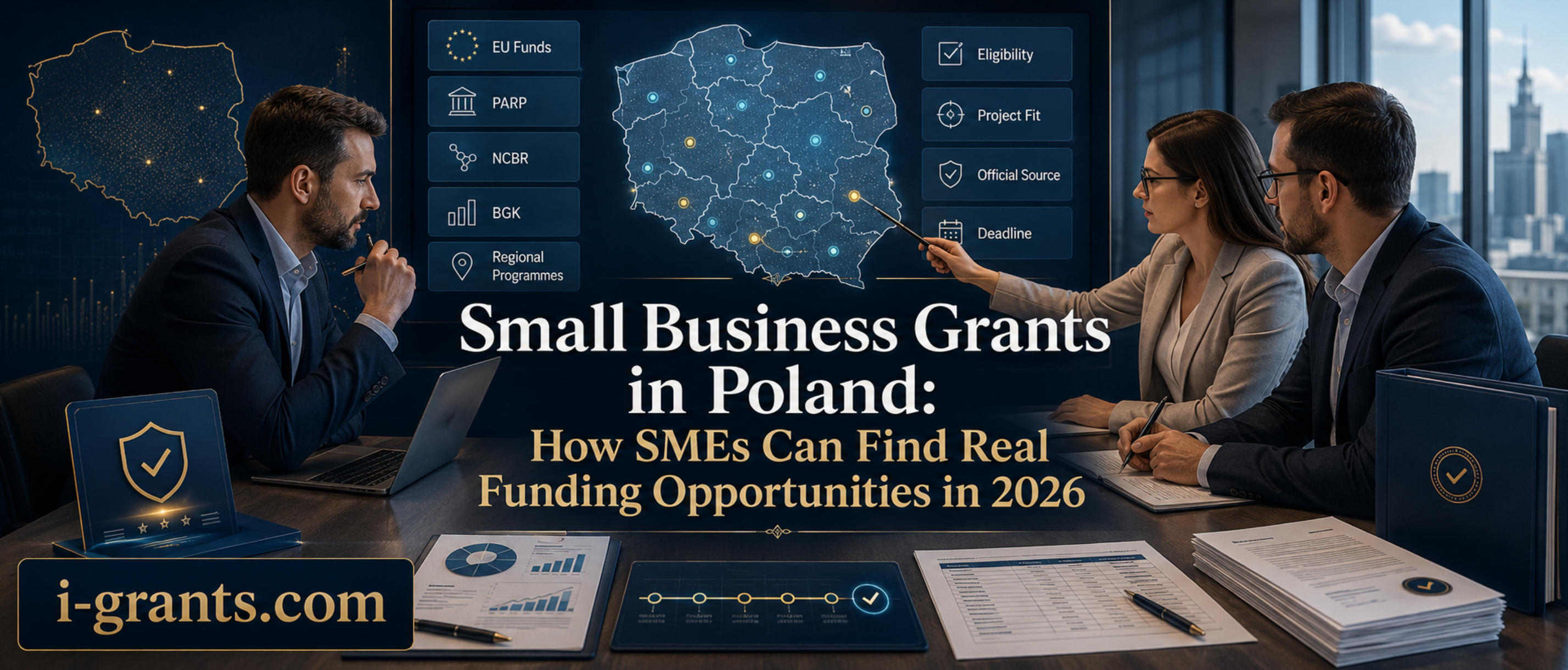
Poland is one of the most important small business funding markets in Europe. For entrepreneurs, startups, family firms, exporters, technology companies and local service businesses, the country offers a wide range of public funding opportunities connected to EU funds, national programmes, regional development, innovation policy, digitalisation, green transformation and recovery investments.
But there is one important clarification. There is no single universal programme called “a small business grant in Poland” that gives free money to any company for any purpose. In practice, small business grants in Poland are usually project-based, competitive and tied to a specific policy objective. A company does not receive funding simply because it is small. It receives funding because it can show that its project fits a programme’s rules, location, eligible costs, expected results and public value.
That difference matters. Many business owners search for small business grants in Poland expecting a simple list of available money. What they actually need is a funding map. They need to understand which institutions manage grants, which projects are usually fundable, how grants differ from loans and guarantees, where official calls are published, and what makes an application credible before a deadline arrives.
In 2026, this knowledge is especially important. Poland is still implementing major EU funding envelopes from the 2021-2027 financial perspective, the National Recovery and Resilience Plan, regional programmes and specialised instruments for innovation, digitalisation and environmental transformation. The opportunity is real, but the market is competitive. Serious applicants need more than a keyword search. They need a structured verification process.
Why Poland Is a Major SME Funding Market
Poland’s business economy is dominated by small and medium-sized enterprises. SMEs represent almost the entire non-financial enterprise population, with microenterprises forming the largest group. This explains why so many public support instruments are designed either directly for SMEs or in a way that allows SMEs to participate.
At the same time, Poland is one of the largest recipients of EU cohesion policy funding. The 2021-2027 Partnership Agreement gives Poland access to a very large investment framework for regional development, competitiveness, green transition, digital transition, skills, infrastructure and social cohesion. This does not mean that every small business can automatically receive a grant. It means that the funding architecture is large enough to create many specialised calls for different sectors, regions and project types.
For a small business, this creates both opportunity and complexity. A manufacturing company in Eastern Poland may need a different programme than a Warsaw-based software startup. A company investing in energy efficiency may fit a different instrument than a firm developing a new medical device. A local service business may have fewer grant options than an exporter or technology company, but it may still qualify for regional support, training, digitalisation assistance or preferential financial instruments.
This is why the first step is not asking, “Where is the grant?” The first step is asking, “What kind of project do we have, and which public funding logic does it fit?”
What “Small Business Grants in Poland” Really Means
In Polish and EU funding practice, the phrase “small business grants” can refer to several different forms of support. Some are direct grants. Some are reimbursed after costs are incurred. Some are loans with preferential terms. Some are guarantees, tax-related incentives or blended instruments. Some calls finance only a percentage of eligible costs, meaning the applicant must provide its own contribution.
This is one of the biggest traps for new applicants. A programme may be attractive, but the company must check whether it can pre-finance costs, provide co-financing, document expenses, meet procurement rules and survive the reporting process. A grant is not just money received. It is a contract with obligations.
The most common funding routes for small businesses in Poland include:
-
EU-funded national programmes, especially those connected to competitiveness, innovation, R&D, digitalisation, green transformation and SME growth.
-
PARP programmes, often focused on enterprise development, innovation, internationalisation, startup support and SME competitiveness.
-
NCBR programmes, usually relevant for research, development, technology projects and innovation-heavy companies.
-
BGK financial instruments, including loans, guarantees and EU-backed financing solutions.
-
Regional and local programmes, where eligibility depends heavily on voivodeship, project location and regional priorities.
This list is important because it shows why a simple “grant search” can be misleading. Two companies may both be small businesses, but one may need PARP, another may need a regional programme, another may need NCBR, and another may need a loan rather than a grant.
The Main Institutions Small Businesses Should Know
The Polish Agency for Enterprise Development, usually known as PARP, is one of the most important institutions for SMEs looking for public support. PARP is associated with programmes for innovation, startup development, export promotion, internationalisation, design, competitiveness and business services. For many entrepreneurs, PARP is one of the first official sources to monitor.
The National Centre for Research and Development, known as NCBR, is more relevant when a company has an R&D component. This may include industrial research, experimental development, prototypes, new technologies, advanced products, process innovation or commercialisation of research results. NCBR-related funding is not usually for ordinary business expenses. It is for projects where novelty, technical risk, measurable innovation and implementation potential can be demonstrated.
BGK, Poland’s development bank, plays a different role. It is important for loans, guarantees and financial instruments. A business owner looking only for a grant may overlook BGK, but in practice, preferential financing can be more realistic for companies that need investment capital but do not fit a direct grant call.
Regional institutions are equally important. Poland’s voivodeships have their own regional programmes, and many calls are tied to the location where the project will be implemented. This is especially relevant for companies outside the largest metropolitan centres. Regional smart specialisations, local development priorities and regional aid intensity can strongly influence whether an SME project is eligible.
There are also direct EU programmes, such as Horizon Europe, LIFE, Digital Europe and other instruments. These are not “Polish small business grants” in a narrow sense, but Polish SMEs may be eligible if they meet the rules. For technology companies, environmental innovators and consortium-based projects, direct EU programmes can sometimes be more relevant than domestic calls.
What Types of Small Business Projects Are Usually Fundable?
The most fundable projects are those that clearly connect a company’s business goal with a public policy goal. A company may want new equipment, software, export support or product development. The funder wants competitiveness, innovation, lower emissions, digital transformation, regional development, better jobs, stronger value chains or measurable social and economic impact. A successful application translates the business need into the funder’s logic.
Common fundable project categories include R&D and product innovation, implementation of research results, automation, digital transformation, cybersecurity, energy efficiency, renewable energy, circular economy, export promotion, internationalisation, design, training, startup acceleration and investment in less-developed regions.
This does not mean that every project in these categories will be funded. The application still has to prove eligibility, relevance, budget realism, technical feasibility, market need and measurable outcomes. A weak digitalisation project that simply buys standard software without strategic justification may fail. A strong digitalisation project that improves productivity, data quality, cybersecurity, customer service or production control may be more competitive.
The same applies to green projects. A vague promise to be “eco-friendly” is not enough. Funders usually expect measurable improvements: lower energy consumption, reduced emissions, resource efficiency, waste reduction, circular business models or clean technology adoption.
Grants, Loans, Guarantees and Blended Support
A serious article about small business grants in Poland must be honest about one point: not all useful public support is a grant. Many SME support instruments are financial instruments rather than direct subsidies. This includes preferential loans, guarantees, partially redeemable loans, credit premiums and other hybrid mechanisms.
For some businesses, this can be disappointing. They searched for “free money” and found a loan. But in practice, an attractive loan with low interest, long repayment period, grace period or partial redemption may be more accessible than a highly competitive grant. It may also be better suited to investment projects that generate revenue but do not meet strict innovation grant criteria.
This distinction is important in 2026 because Poland continues to use both grants and repayable instruments. Digital and environmentally friendly transformation is a good example. Some instruments support SMEs not through a classic grant, but through preferential, partially redeemable financing. For companies planning investments in energy-saving technologies, digital systems, automation or green production, this can still be highly valuable.
The practical conclusion is simple: entrepreneurs should search for funding, not only grants. A good funding strategy compares grants, loans, guarantees, tax incentives and private capital rather than assuming that one instrument is always best.
Who Can Usually Qualify?
Eligibility depends on the programme, but several filters appear again and again. A company normally has to match the required enterprise size, legal form, location, sector, project type, financial condition and compliance status. It may also need to show that it has no serious tax or social security arrears, no exclusion from public funding and enough capacity to implement the project.
SME status is a key filter. EU and Polish programmes often distinguish micro, small and medium-sized enterprises. The distinction affects eligibility, aid intensity and sometimes maximum funding amounts. Applicants should not guess their status. They should calculate it correctly, including ownership links and partner or associated enterprises where relevant.
Location is another major filter. Many programmes require the project to be implemented in a specific region. A company registered in one city but implementing the project elsewhere must check which location matters: headquarters, branch, investment site, place of employment or place where the funded activity will occur.
Foreign founders should be especially careful. In many cases, a non-Polish entrepreneur may participate through a Polish-registered company or a project implemented in Poland, but the exact rules depend on the call. Practical questions include company registration, tax residence, documents, language, local accounting, bank account, signatures, financial statements and proof that the project will be implemented in Poland.
Where to Verify Real Opportunities
The safest approach is to verify every opportunity through an official source before investing time in an application. Aggregators can be useful as radar, but they should not be the final source of truth. Deadlines change. Budgets are exhausted. Calls close. Rules are updated. Some pages are translated poorly. Some “grant lists” online mix real public funding with private lead generation.
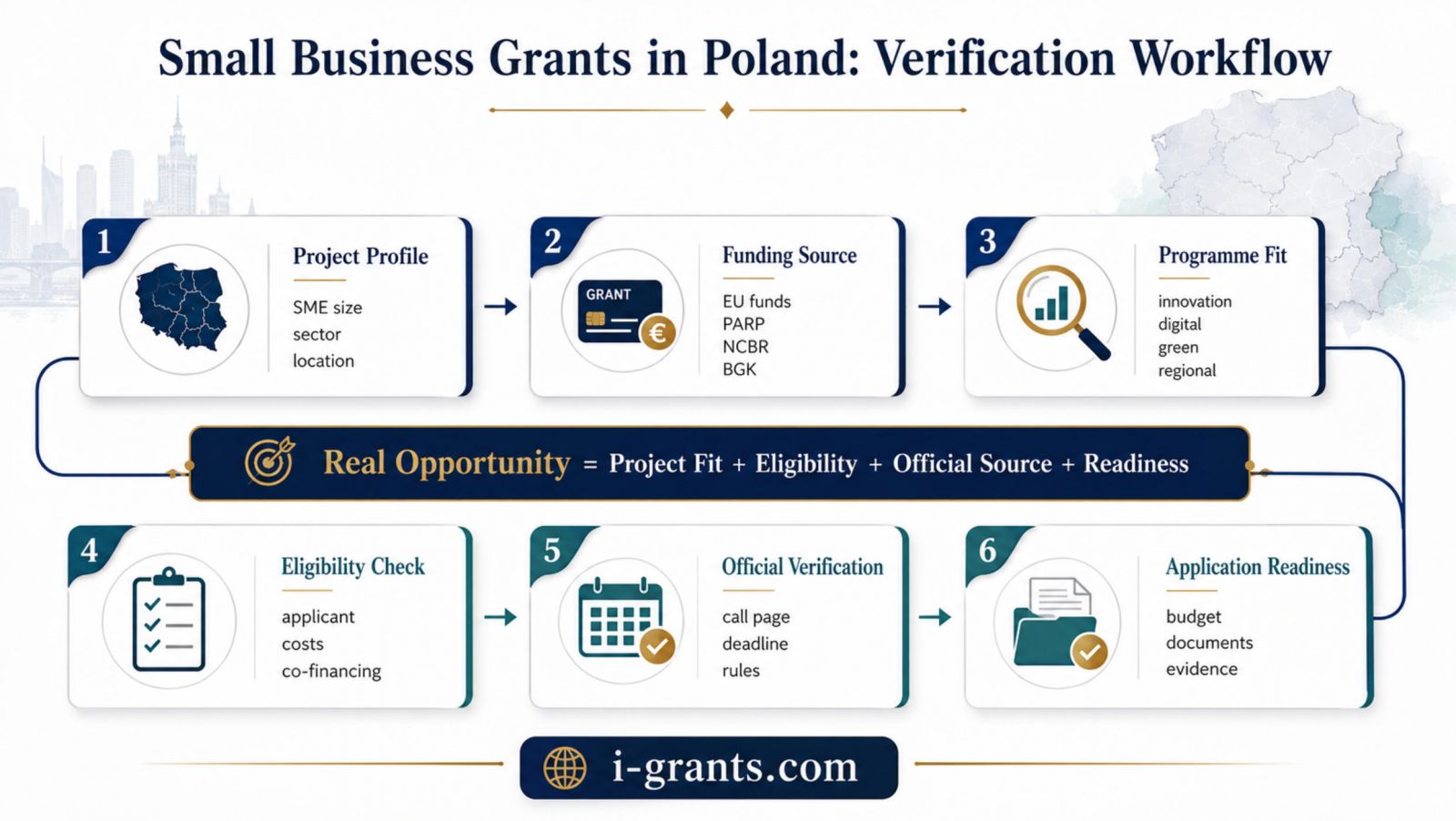
A reliable verification workflow should check:
-
The official programme operator and the original call page.
-
Eligible applicants, including SME size, legal form, location and sector.
-
Eligible project types, eligible costs, aid intensity and co-financing requirement.
-
Deadline, call status, budget, selection criteria and required documents.
-
Last update date, attachments, regulations, contact point and application system.
This checklist should be used before writing the proposal, not after. Many companies lose time because they start preparing a narrative and only later discover that their project location, sector, cost category or enterprise size is not eligible.
For grant writers, this verification step is also a professional standard. A serious grant writer should not promise eligibility based on a headline. They should inspect the official documentation, identify risks and explain whether the company is ready before the applicant commits to full proposal preparation.
A Current Example: Innovation Funding Through SMART Path
One useful way to understand the Polish SME funding market is to look at the SMART Path instrument under European Funds for Modern Economy. It is designed to support micro, small and medium-sized enterprises in areas such as R&D capacity, product or process innovation, digitalisation, sustainable transformation, internationalisation and staff competencies.
The 2026 SMART Path context shows both the scale and competitiveness of the market. A call for implementation of R&D results offered a large programme budget and significant maximum support per company. At the same time, earlier SMART-related demand showed hundreds of applications and billions of zloty in requested funding. This is the reality of serious SME grants in Poland: funding can be substantial, but competition is also substantial.
For applicants, the lesson is not simply “apply to SMART Path.” The lesson is that high-value grants require a mature project. Companies need a clear innovation claim, credible budget, evidence of market need, internal capacity, implementation plan, measurable outputs and compliance readiness. A company that starts searching for documents one week before the deadline is unlikely to compete well.
Common Mistakes Applicants Make
Many small businesses fail before evaluation because they misunderstand the nature of public funding. They treat grants as a financing shortcut rather than a structured project contract. The result is weak eligibility, vague project logic, unrealistic budgets or missed deadlines.
The most common mistakes are:
-
Searching for “free money” instead of matching the project to a specific funding objective.
-
Using outdated aggregator pages instead of official calls and current attachments.
-
Ignoring co-financing, cash flow, procurement, reporting and audit obligations.
-
Applying with a generic business plan rather than a programme-specific project logic.
-
Hiring help too late, when there is not enough time for eligibility analysis, budget design and evidence collection.
These mistakes are avoidable. The strongest applicants usually start with a funding diagnosis. They define the project, classify the business, check location, identify eligible costs, estimate co-financing, verify the official source and only then decide whether a full application is worth preparing.
When a Grant Writer Helps
A grant writer is not a magician who turns any business into an eligible applicant. A professional grant writer helps when there is a real fit between the business, the project and the programme. The value is in structuring the application around the funder’s criteria, translating business goals into fundable logic, identifying weak evidence, organising attachments, building a compliant budget and reducing avoidable errors.
In Poland, grant writing can be especially useful when the project involves R&D, innovation, EU funds, regional aid rules, state aid, eligible cost categories, complex budgets, multi-part attachments or tight deadlines. It is also useful for foreign founders who need help interpreting local requirements and official documentation.
However, hiring a grant writer should happen early. If a call closes in a few days and the company has not yet verified eligibility, prepared financial data, defined the project or collected documents, even a strong consultant may have limited room to help.
For SMEs, the best timing is before the call becomes urgent. A good preparation process builds a funding pipeline: current calls, likely future calls, regional opportunities, project readiness gaps and a document set that can be updated quickly when the right opportunity opens.
How i-grants.com Fits Into This Search
For small businesses, the hardest part is rarely discovering that public funding exists. The harder part is identifying which opportunities are real, current and relevant. A business owner must compare institutions, regions, deadlines, sectors, aid rules, documents and co-financing requirements. A grant writer must do the same, but faster and with more precision.
This is exactly where a verified funding platform and a professional grant-writing marketplace can create value. Applicants need funding intelligence that is checked against official sources. Grant writers need structured opportunities, clear applicant profiles and serious projects. Donors and programme partners need better visibility among qualified applicants.
In the Polish market, this matters because the funding ecosystem is rich but fragmented. EU programmes, national calls, PARP instruments, NCBR competitions, BGK financial tools and regional programmes all operate with different rules. A company that searches randomly may miss the best opportunity or waste time on a call it cannot win.
Poland Has Real SME Funding, But It Rewards Prepared Applicants
Small business grants in Poland are real, but they are not simple giveaways. They are competitive instruments designed to finance specific projects that support innovation, competitiveness, regional development, digital transformation, green transition, export capacity, R&D or economic resilience.
For SMEs, the best approach in 2026 is to stop asking only, “Which grant can I get?” and start asking a more precise question: “Which funding logic does my project fit, and what evidence do I need to prove it?”
The answer will often depend on the company’s size, location, sector, project type, innovation level, budget, co-financing capacity and readiness to comply with reporting rules. Some companies will fit direct grants. Others will be better matched with preferential loans, guarantees, regional support or EU-level programmes.
Poland remains a high-opportunity market for SMEs, but it is also a high-competition market. The companies that succeed are usually not those that search the most. They are those that verify official sources, understand eligibility, prepare early and build applications that match the funder’s priorities with evidence, not slogans.