

 Français
  Deutsch
  Українська
Belgium offers an unusually rich funding environment for small and medium-sized enterprises, but finding the right support can be difficult for one fundamental reason: there is no single centralised Belgian small business grant system.
Most business support is organised at regional level. A company operating in Flanders searches within a different funding ecosystem from a company based in Brussels or Wallonia. The responsible agencies, programme names, eligibility criteria, aid rates and application procedures can all change when a business crosses a regional border.
For SMEs and startups, this makes Belgium both attractive and complex. Public support can cover professional advice, employee training, digitalisation, energy efficiency, machinery, innovation, research and development, scaling, internationalisation and other investments. At the same time, businesses must navigate regional rules, EU State aid requirements, project-start restrictions and changing annual budgets.
The opportunity is significant. Belgium had 1,187,819 VAT-registered enterprises at the end of 2024, an increase of 1.6 percent in one year. Another 113,289 enterprises were created during 2024. Professional, scientific and technical activities alone accounted for 237,240 VAT-registered enterprises, making this the country's largest enterprise sector.
Business survival is also relatively strong. According to Statbel, 89.3 percent of enterprises created in 2023 were still active at the end of 2024, while 63.5 percent of businesses created in 2019 survived for at least five years.
Belgium is also one of Europe's strongest innovation economies. The European Innovation Scoreboard 2026 classifies Belgium as a Strong Innovator, with performance equal to 123.2 percent of the EU average and a ranking of fifth among EU Member States. Belgium performs particularly strongly in business R&D expenditure, employment in innovative enterprises and innovation expenditure per employee.
For businesses looking for funding in Belgium in 2026, however, strong innovation performance does not mean that public support is automatic. The first task is understanding how the system is structured.
How Small Business Funding Works in Belgium
Belgium's federal structure is the key to understanding business grants.
Economic development and business support are largely regional responsibilities. The official Business Belgium portal directs entrepreneurs to VLAIO in Flanders, hub.brussels in the Brussels-Capital Region and 1890 in Wallonia as their main regional entry points.
This means that the question "What grants are available in Belgium?" is usually too broad.
A better starting question is:
Where is the company's operating establishment located?
Table 1. How Small Business Funding Is Organised Across Belgium
| Region or level | Main entry point | Important funding bodies | Typical areas of support |
|---|---|---|---|
| Flanders | VLAIO | VLAIO and regional financing partners | Innovation, R&D, advice, training, SME growth, digitalisation, sustainability |
| Brussels-Capital Region | hub.brussels | Brussels Economy and Employment, Innoviris | Investment, digitalisation, economic transition, entrepreneurship, innovation |
| Wallonia | 1890 | SPW Economy, Employment and Research and regional agencies | Investment, R&D, innovation, business advice, digitalisation, green transition |
| Federal Belgium | Federal authorities | FPS Finance and other federal bodies | Tax incentives, employment measures and selected cross-regional instruments |
| European Union | EU programmes and regional managing authorities | European Commission, regional agencies and programme authorities | R&D, innovation, green investment, international cooperation, regional development |
A business registered in Belgium can therefore face several funding layers at once. Its regional government may offer a direct grant, the federal government may provide a tax incentive, and an EU programme may finance a larger innovation or international cooperation project.
The important point is that these instruments are not interchangeable.
A Belgian "Business Grant" Is Not Always a Grant
Belgian business-support programmes use several forms of financial assistance.
These can include:
-
non-repayable grants or premiums;
-
subsidies for consultancy or training;
-
vouchers;
-
investment aid;
-
R&D grants;
-
recoverable advances;
-
loans and guarantees;
-
tax deductions and other fiscal incentives.
This distinction matters.
For example, Wallonia's Win4Company programme can provide a non-repayable grant for industrial research, while experimental development is financed through a recoverable advance. A federal investment deduction, meanwhile, reduces taxable income rather than transferring grant money directly to the business.
An SME comparing opportunities should therefore look not only at the headline percentage but also at the legal form of the aid, eligible expenditure, repayment conditions and tax treatment.
Small Business Grants in Flanders
Flanders has one of Belgium's most developed business-support ecosystems. The primary agency is VLAIO, the Flanders Innovation & Entrepreneurship agency.
VLAIO manages or directs companies to support covering innovation, research and development, entrepreneurship, professional advice, training and business growth.
One of the best-known instruments is the SME e-Wallet, known locally as the kmo-portefeuille.
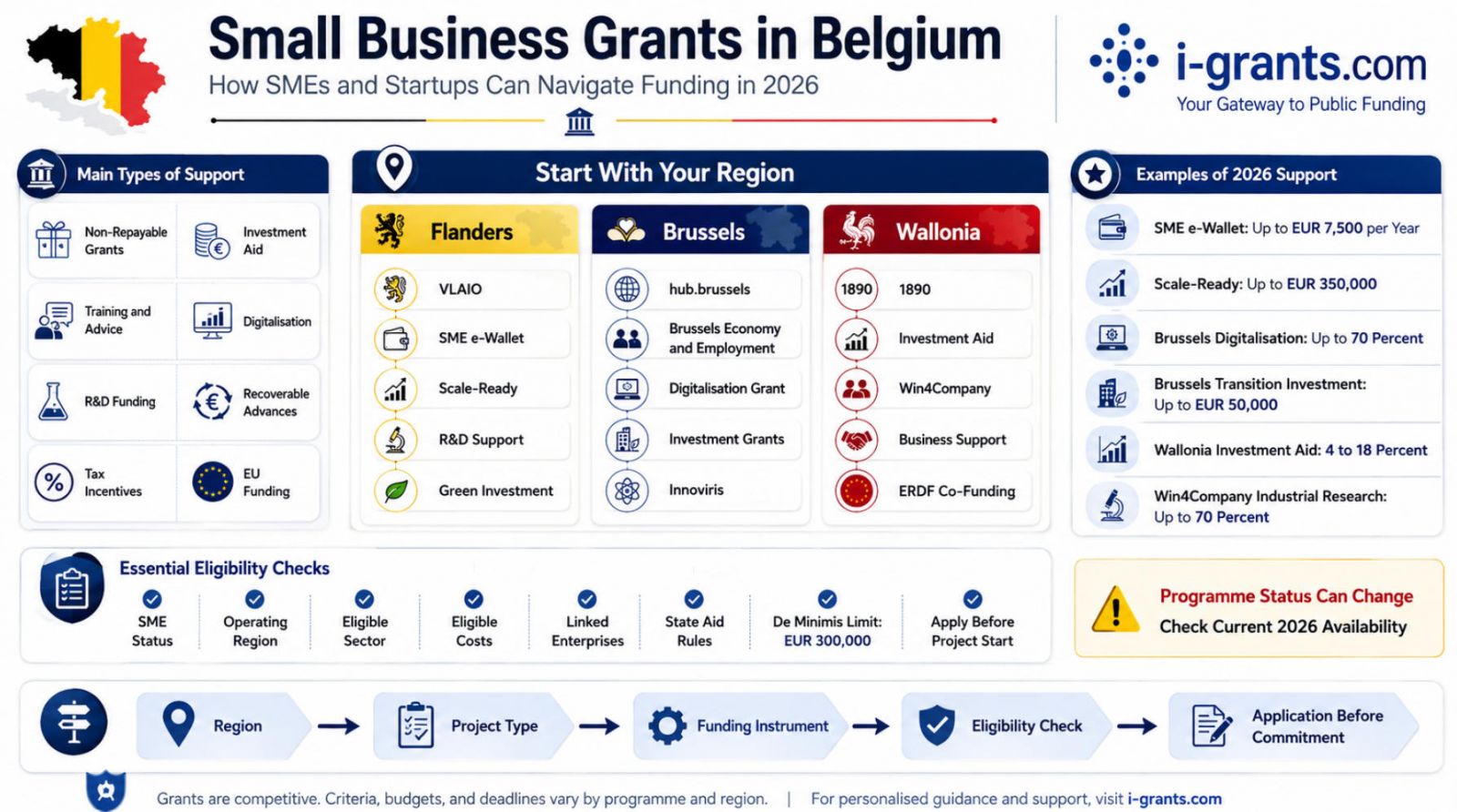
Eligible small enterprises can receive a subsidy of 30 percent of qualifying training and advice costs, while medium-sized enterprises receive 20 percent. The maximum support is €7,500 per enterprise per year.
The instrument is particularly relevant for established SMEs that need external expertise rather than capital investment. A company may use the available subsidy budget for eligible training, advice or a combination of both.
For younger technology-oriented businesses, Flanders introduced another interesting instrument in 2026: Scale-Ready.
Scale-Ready is designed for innovative young companies preparing to become scale-ups. Eligible applicants must meet the small-enterprise definition, have an operational establishment in Flanders and generally have been active for between one and five years. Founders and co-founders must also retain at least 50.1 percent of the company.
The support can reach €350,000 over a maximum period of three years, while the projected project cost must be at least €500,000.
The grant is milestone-based and is not intended simply to finance ordinary expansion. It is designed to fund activities that make the company ready for rapid scaling.
The 2026 programme also illustrates why grant seekers must monitor deadlines closely. Pre-registration ran from 7 to 30 April 2026. Companies receiving a positive recommendation could then submit a full application between 1 June and 20 August 2026, with the 15 highest-ranked projects expected to receive support.
Flanders therefore offers opportunities both for traditional SMEs seeking smaller operational support and for innovation-driven startups preparing much larger growth projects.
Small Business Grants in Brussels
The Brussels-Capital Region operates a separate grant framework through Brussels Economy and Employment, while hub.brussels acts as an important advisory gateway for entrepreneurs.
One of the most accessible examples in 2026 is the Digitalisation Grant.
It supports external consultancy related to the digitalisation of internal processes, production, products and services, IT security, and the technical development or improvement of a company's website.
The business must be an SME with an operating establishment in the Brussels-Capital Region and must operate in an eligible sector.
The basic intervention rate is 25 percent, but increases can raise support to a maximum of 70 percent of eligible expenditure, subject to a ceiling of €10,000 per beneficiary per calendar year. A maximum of two subsidised missions can be supported each year.
Brussels also provides investment support connected to the economic transition.
The Economic Transition Investment Grant supports eligible equipment and investments intended, among other objectives, to reduce energy or raw-material consumption.
Eligible expenditure starts at €2,000. The basic subsidy rate is 30 percent and can rise to 50 percent, with total aid capped at €50,000 per calendar year.
An important rule is that the application must be submitted before the investment programme starts.
A Major Brussels Funding Change in August 2026
The Brussels funding environment is undergoing an important adjustment.
On 31 July 2026, Brussels Economy and Employment announced that, because of rapidly growing demand and budget constraints, part of the business-grant system would be temporarily suspended from 12 August 2026.
Investment grants will remain available. The Digitalisation Grant will also remain available, together with selected startup and skills measures.
However, several operating subsidies will be temporarily suspended, including the general Consultancy Grant, Transition Consultancy, business transfer consultancy, recruitment, training and coworking support.
Applications submitted before 12 August 2026 remain subject to the existing rules.
This is exactly why businesses should verify the current status of a Belgian grant immediately before planning an application. A programme page that was accurate a few months earlier may no longer reflect the practical funding situation.
Innoviris Funding Is a Special Case in 2026
Innovation-focused companies in Brussels also need to understand the status of Innoviris, the Brussels agency for research and innovation.
Historically, Innoviris has operated funding instruments covering company R&D, feasibility studies, innovation vouchers, collaborative research and other innovation activities.
But 2026 is exceptional.
On 24 March 2026, Innoviris announced that existing approved projects would continue to be funded, but no new projects could receive new funding in 2026.
It also confirmed that no new calls would be launched and that its programmes would be suspended for new 2026 funding decisions.
Applications already submitted may continue to be processed for possible financing in 2027, depending on available resources.
This distinction is essential.
A funding database may still display an individual Innoviris programme page, but that does not mean a new applicant can obtain financing from it in 2026.
For Brussels startups, checking programme status is therefore just as important as checking eligibility.
Small Business Grants in Wallonia
Wallonia has its own extensive system of investment, research, innovation and business-development support.
One of the central instruments is the regional SME Investment Allowance.
An eligible SME must have or create an establishment unit in Wallonia, operate in an eligible sector and normally present an investment programme of at least €100,000.
The programme must obtain a minimum assessment score of 30 points out of 100 and satisfy additional conditions.
At least 25 percent of the project financing must come from the company's own resources or external financing without public support.
The standard investment-aid rate ranges from 4 percent to 18 percent of eligible investment. The precise rate depends on factors including company size, project characteristics and location.
Timing is again critical. The company must request authorisation to start the investment programme before making binding commitments, such as placing purchase orders or signing contracts.
Wallonia also provides higher support for certain projects co-financed through the European Regional Development Fund.
Eligible SME investment projects under the relevant ERDF route can receive support of 15 to 35 percent of the investment amount, subject to programme conditions such as location, activity and job creation.
Win4Company: One of the Strongest R&D Examples
Wallonia's Win4Company programme demonstrates how attractive Belgian innovation support can become when a project contains genuine technological risk.
The programme is open to enterprises of different sizes and sectors and supports industrial research and experimental development.
Applications can be submitted throughout the year, rather than only during a fixed annual call.
For industrial research, the maximum grant rate is:
70 percent for a small enterprise, 60 percent for a medium-sized enterprise and 50 percent for a large enterprise.
For experimental development, support takes the form of a recoverable advance covering up to 55 percent for a small enterprise, 45 percent for a medium-sized enterprise and 35 percent for a large enterprise.
Under certain cooperation arrangements, the rates can increase further.
Eligible expenditure can include researchers and technicians, materials and operating expenses, overheads, equipment costs and subcontracting.
Table 2. Examples of Belgian SME Funding Opportunities in 2026
| Programme | Region | Main purpose | Indicative support | Important condition |
|---|---|---|---|---|
| SME e-Wallet | Flanders | Training and professional advice | 30 percent for small enterprises, 20 percent for medium enterprises, up to €7,500/year | Eligible service and provider requirements apply |
| Scale-Ready 2026 | Flanders | Preparing innovative startups for scaling | Up to €350,000, maximum 3 years | Small innovative company, age and ownership requirements, competitive call |
| Digitalisation Grant | Brussels | Digital processes, cybersecurity, website development | 25 to 70 percent, up to €10,000/year | Brussels operating establishment and eligible external mission |
| Economic Transition Investment Grant | Brussels | Energy and resource-efficient investments | 30 to 50 percent, up to €50,000/year | Apply before starting the investment programme |
| Standard SME Investment Allowance | Wallonia | Productive business investment | 4 to 18 percent | Generally at least €100,000 investment plus scoring requirements |
| ERDF co-financed investment aid | Wallonia | Eligible manufacturing and productive investment | 15 to 35 percent | Location, sector, job-creation and programme requirements |
| Win4Company industrial research | Wallonia | R&D and new scientific or technical knowledge | Up to 70 percent for small enterprises | Genuine research project and technological risk |
| Win4Company experimental development | Wallonia | Development of products, processes or services | Recoverable advance up to 55 percent for small enterprises | Repayable form of support |
The table shows why headline comparisons can be misleading.
A 70 percent consultancy subsidy, a 70 percent R&D grant and a 55 percent recoverable advance are three fundamentally different instruments.
Federal Tax Support Can Be as Important as a Grant
Not all valuable Belgian business support is regional.
Belgium's federal investment deduction can reduce taxable profits for qualifying investments.
For eligible fixed assets acquired or created from 1 January 2025, the basic deduction for individuals and small companies is 10 percent.
It rises to 20 percent for eligible digital fixed assets.
A higher thematic deduction can reach 40 percent for individuals and small companies for qualifying investments.
This is a tax deduction, not a cash subsidy.
That distinction matters when a company builds its financing plan.
A grant can reduce the upfront cost of a project, while a tax deduction generally creates value through the tax system and depends on the company's taxable position.
Businesses should therefore search for both direct funding and fiscal support rather than treating grants as the only relevant form of public assistance.
EU Funding Adds Another Layer
Belgian SMEs also operate inside the wider EU funding system.
For the 2021 to 2027 programming period, Belgium benefits from approximately €2.5 billion in Cohesion Policy funding through regional programmes supported by the European Regional Development Fund, the European Social Fund Plus and the Just Transition Fund.
This does not mean that every Belgian SME can simply apply directly for a share of €2.5 billion.
Cohesion funding is implemented through specific programmes, calls and regional schemes.
Other European programmes can also be relevant to Belgian companies, particularly Horizon Europe, the European Innovation Council, Eurostars and Interreg.
These opportunities become especially important for companies carrying out research, deep-tech innovation or international collaborative projects.
Belgium's broader policy environment supports this direction.
The country's 2026 Digital Decade roadmap includes 128 measures with a total budget of €664 million.
The European Commission describes Belgium as having advanced business digitalisation, a highly innovative ecosystem and growing capabilities in areas including artificial intelligence, quantum technologies and edge computing.
At the same time, it identifies scaling innovative companies and advanced digital skills as continuing challenges.
Public funding is therefore increasingly connected to broader priorities such as innovation, digital transformation, competitiveness and sustainability rather than simply providing unrestricted money to small businesses.
Who Qualifies as an SME?
Many Belgian funding programmes rely on the European SME definition.
In general, an SME must employ fewer than 250 people and have annual turnover below €50 million or an annual balance sheet total not exceeding €43 million.
These thresholds are explicitly used, for example, in Wallonia's Win4Company framework.
However, applicants should not determine their SME status by looking only at the company submitting the application.
Ownership relationships matter.
Partner and linked enterprises may have to be included when calculating headcount and financial thresholds.
A startup that appears small when viewed as a standalone legal entity may therefore fail an SME test if it belongs to a larger corporate group.
This is particularly important for companies backed by certain investors, corporate spin-offs and businesses with complex ownership structures.
The De Minimis Limit Is €300,000
Another rule that frequently appears in Belgian regional funding is de minimis State aid.
Under the EU rules applicable since 1 January 2024, the total amount of general de minimis aid granted by one Member State to a single undertaking may not exceed €300,000 over any period of three years.
The term "single undertaking" can include linked companies rather than only the applicant's individual legal entity.
This rule is visible in current Brussels grant requirements, including the Digitalisation Grant and certain economic-transition investment measures.
Older webpages and third-party funding databases may still refer to the previous €200,000 threshold.
Applicants in 2026 should use the current EU regulation and the rules stated in the active funding scheme.
The Most Important Rule: Apply Before Starting the Project
One of the costliest mistakes in Belgian grant applications is beginning a project too early.
Many investment and consultancy programmes require an application to be submitted before the applicant creates a binding commitment.
In Wallonia, an SME seeking investment aid must request authorisation before purchase orders, contracts or similar commitments are made.
In Brussels, applications for several support schemes must likewise be submitted before the relevant investment or consultancy mission begins.
For the Digitalisation Grant, the application must be filed no later than the day before the external mission starts.
For a company, this means funding research should happen before procurement, not after invoices begin arriving.
Public support should be integrated into investment planning from the beginning.
How to Find the Right Belgian Grant
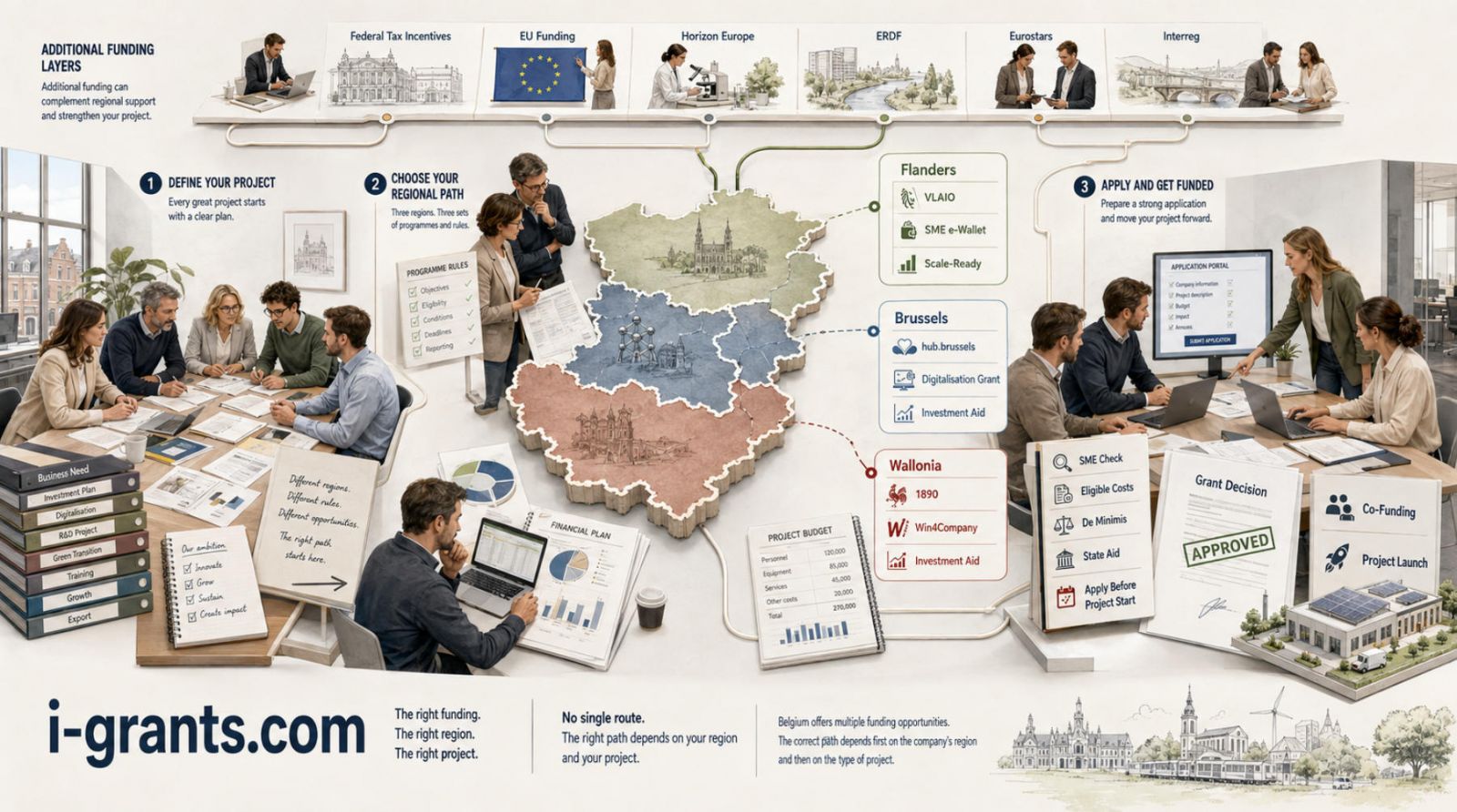
A practical funding search can be organised into seven steps:
-
Identify the operating region. Start with Flanders, Brussels or Wallonia rather than searching Belgium as a single funding jurisdiction.
-
Confirm company size. Calculate SME status while taking linked and partner enterprises into account.
-
Define the project precisely. Separate investment, R&D, digitalisation, training, consultancy, hiring, export and sustainability expenditure.
-
Search the official regional gateway. Use VLAIO for Flanders, hub.brussels and Brussels Economy and Employment for Brussels, and 1890 plus Walloon government portals for Wallonia.
-
Check federal and EU instruments. A regional grant may not be the only funding component available.
-
Verify State aid and programme status. Check de minimis history, sector restrictions, current budget availability and the latest official programme notice.
-
Apply before creating a binding commitment. Do not sign contracts or place orders until the programme's project-start rules have been checked.
This process is more reliable than searching for generic terms such as "Belgium startup grant" and choosing the programme with the largest advertised percentage.
Which Funding Route Fits Your Project?
Table 3. Which Belgian Funding Route Should an SME Check First?
| Business need | Flanders | Brussels | Wallonia | Other layer to check |
|---|---|---|---|---|
| External advice | SME e-Wallet and relevant VLAIO support | Regional consultancy schemes, subject to current suspension rules | Business support and regional advisory schemes | Sector-specific support |
| Employee training | SME e-Wallet | Regional support, subject to current programme status | Regional training and employment instruments | Federal employment measures |
| Digital transformation | VLAIO and SME support routes | Digitalisation Grant | Regional digital-support instruments | Federal digital investment deduction |
| Machinery or productive investment | Regional investment and financing support | Investment grants | SME Investment Allowance | Tax deduction, ERDF routes |
| Energy or resource efficiency | Flemish sustainability programmes | Economic Transition Investment Grant | Green and investment support | EU environmental funding |
| Industrial R&D | VLAIO innovation support | Innoviris normally relevant, but new 2026 funding is suspended | Win4Company | Horizon Europe, Eurostars |
| Startup scaling | Scale-Ready and other VLAIO instruments | Startup support ecosystem | Regional startup and financing instruments | EIC and private co-financing |
| International collaborative innovation | VLAIO plus EU programmes | EU and regional ecosystem | Walloon R&D support plus EU programmes | Horizon Europe, Eurostars, Interreg |
The table should be treated as a starting map rather than an eligibility decision.
Each programme has its own sector rules, application period, expenditure categories and State aid basis.
Five Common Mistakes Belgian Grant Applicants Make
The Belgian system rewards businesses that plan funding early.
Several recurring mistakes can make an otherwise strong project ineligible:
-
searching nationally without first identifying the correct region;
-
treating every subsidy, tax deduction or repayable instrument as a grant;
-
signing contracts or placing orders before checking the incentive-effect rules;
-
ignoring linked companies when calculating SME status or de minimis aid;
-
relying on an old programme page without checking whether funding is still available in 2026.
The final problem is especially important this year.
Brussels provides two clear examples.
Innoviris has suspended new 2026 funding, despite individual programme information remaining useful for understanding the agency's normal instruments.
Separately, Brussels Economy and Employment is temporarily suspending several operating grants from 12 August 2026 while preserving certain investment and digitalisation support.
Programme status is therefore a real eligibility variable, not an administrative detail.
What Makes Belgium Attractive for Innovation-Focused SMEs?
Belgium's public funding system sits inside one of Europe's strongest innovation environments.
In the European Innovation Scoreboard 2026, Belgium ranks first in the EU for business-sector R&D expenditure, first for innovation expenditure per person employed and first for employment in innovative enterprises.
It also performs strongly in public support for business R&D and collaboration between innovative SMEs.
That does not mean every innovative company will receive public funding.
Competitive selection can be strict, and budget availability can interrupt otherwise well-established programmes.
But it helps explain why Belgium has developed such a broad mixture of R&D grants, startup support, investment incentives, university-business collaboration and EU-funded innovation instruments.
The country's economic context also makes targeted support particularly relevant in 2026.
The European Commission forecasts Belgian GDP growth of approximately 0.7 percent in 2026, with inflation at 3.4 percent and unemployment at 6.6 percent.
For SMEs facing higher investment costs and relatively slow economic growth, public co-financing can therefore materially influence whether a digital, industrial or green investment moves forward.
How Much Can a Belgian Small Business Actually Receive?
There is no meaningful single answer.
A traditional SME buying equipment in Wallonia may receive an investment allowance calculated as a percentage of eligible capital expenditure.
A Brussels company hiring a digital consultant may receive several thousand euros.
A Flemish startup accepted into Scale-Ready may obtain up to €350,000.
A Walloon research-intensive small enterprise may have up to 70 percent of qualifying industrial research expenditure covered.
The size of the opportunity depends primarily on five variables: the region, company size, project type, eligible expenditure and State aid framework.
This is why a business should not begin by asking for "the biggest Belgian grant."
It should begin by building a funding architecture around a real project.
For a major investment, that architecture might combine regional investment aid, a federal tax deduction, bank financing and an EU-supported component.
For an innovative startup, the structure could instead include an R&D subsidy, founder capital, venture investment and a European collaborative programme.
The correct combination matters more than any individual headline grant.
Final Takeaway
Belgium is a strong funding location for SMEs and startups, but its system requires a regional mindset.
A Flemish software startup, a Brussels retailer investing in cybersecurity and a Walloon manufacturer buying production equipment are all Belgian small businesses, yet they may use completely different public-support systems.
In 2026, the core gateways are clear: VLAIO in Flanders, hub.brussels and Brussels Economy and Employment in Brussels, and 1890 together with Walloon government funding services in Wallonia.
Federal tax incentives and EU programmes create additional layers of opportunity.
The strongest applicants do not search for grants after deciding to spend money.
They identify funding before the project begins, confirm the correct regional and State aid rules, map eligible costs and only then make binding commitments.
Belgium's funding landscape is also dynamic.
Scale-Ready illustrates the scale of targeted Flemish startup support, Wallonia continues to offer substantial investment and R&D aid, while Brussels has introduced significant budget-driven changes during 2026.
These differences make current, programme-specific research essential.
For SMEs and startups, the practical formula is simple:
region first, project second, funding instrument third, application before commitment.
That approach turns Belgium's complex grant system from an obstacle into a navigable source of business financing.