

 Français
  Deutsch
  Українська
Finding a small business grant is only the beginning. The harder question comes next: should the business prepare the application internally, or should it hire a professional grant writer?
This question matters because grants are not won by enthusiasm alone. A real grant application is not just a form, a pitch, or a well-written story about why a company needs money. It is a structured argument that connects a business project with a funder’s rules, priorities, eligibility criteria, budget logic, measurable outcomes, and reporting expectations.
At the same time, hiring a grant writer is not always the right decision. Some small grants are simple enough for a founder, finance manager, or operations lead to prepare internally. Some microgrants, local business awards, reimbursement programs, and basic community funds do not justify the cost of professional support. In those cases, hiring a grant writer may become overhead rather than strategy.
The real question is not “Can a grant writer make this sound better?” The better question is: “Is this opportunity important enough, competitive enough, complex enough, and risky enough to justify professional preparation?”
That is the decision this article is designed to help small businesses make.
What a Grant Writer Actually Does
Many business owners think a grant writer is someone who writes persuasive text. That is only partly true. In competitive funding, grant writing is closer to strategic translation. A good grant writer translates a business idea into the language of the funder.
A founder may say: “We need money to grow.”
A funder wants to know: “What public, economic, scientific, social, regional, environmental, or innovation purpose will this funding serve?”
A business may say: “We need new equipment.”
A funder asks: “Is this equipment an eligible cost, and how will it produce measurable outcomes?”
A startup may say: “Our product is innovative.”
A reviewer asks: “What is the technical merit, market need, commercialization path, implementation risk, and expected impact?”
This is why professional grant writing is not just about polished language. It includes eligibility review, funder research, project framing, budget structure, evidence gathering, document coordination, compliance checking, narrative development, and sometimes post-award reporting preparation.
For small businesses, this distinction is critical. A professional grant writer cannot turn a weak or ineligible project into a strong one by using better words. But a skilled grant writer can help a fundable project avoid the most common reasons applications fail: unclear fit, weak outcomes, vague budget logic, missing evidence, unrealistic timeline, poor compliance, and a narrative that talks about the company’s needs instead of the funder’s mission.
A good grant application does not beg for money. It proves alignment.
Why This Decision Matters More in 2026
Small businesses are economically central. In the United States alone, there are more than 36 million small businesses, representing nearly all businesses, employing more than 62 million people, and contributing a major share of economic activity. Globally, small and medium-sized enterprises represent about 90 percent of businesses and more than half of employment. In the European Union, small and medium-sized enterprises account for almost all businesses and employ more than 85 million people.
This explains why governments, foundations, development institutions, corporate donors, and local funds continue to support entrepreneurship, innovation, workforce training, exporting, community development, sustainability, and inclusive business growth.
But the scale of the small business sector also means competition is intense. Many companies are looking for funding. Many are reading the same grant announcements. Many submit quickly, with generic narratives and weak evidence. In a competitive environment, the difference between “submitted” and “serious contender” can be large.
The funding landscape is also becoming more technical. Innovation grants, research and development programs, export support, workforce grants, green transition funding, manufacturing support, and government-backed initiatives often require more than a short business description. They may ask for detailed project plans, measurable outputs, cost categories, partner roles, technical milestones, compliance declarations, financial documents, and evidence of implementation capacity.
For example, SBIR and STTR-style innovation programs are not simple “startup grants.” They are competitive funding routes tied to technical merit, commercial potential, public value, and federal research priorities. In 2026, the reauthorization of SBIR and STTR programs confirms that innovation funding remains active, but it also reinforces the need for readiness. In some programs, application limits and stricter submission rules make each proposal more strategic. A rushed or weak application may not only fail. It may consume time, energy, and a valuable funding window.
That is why the grant writer decision should be treated as a business decision, not an emotional reaction to a deadline.
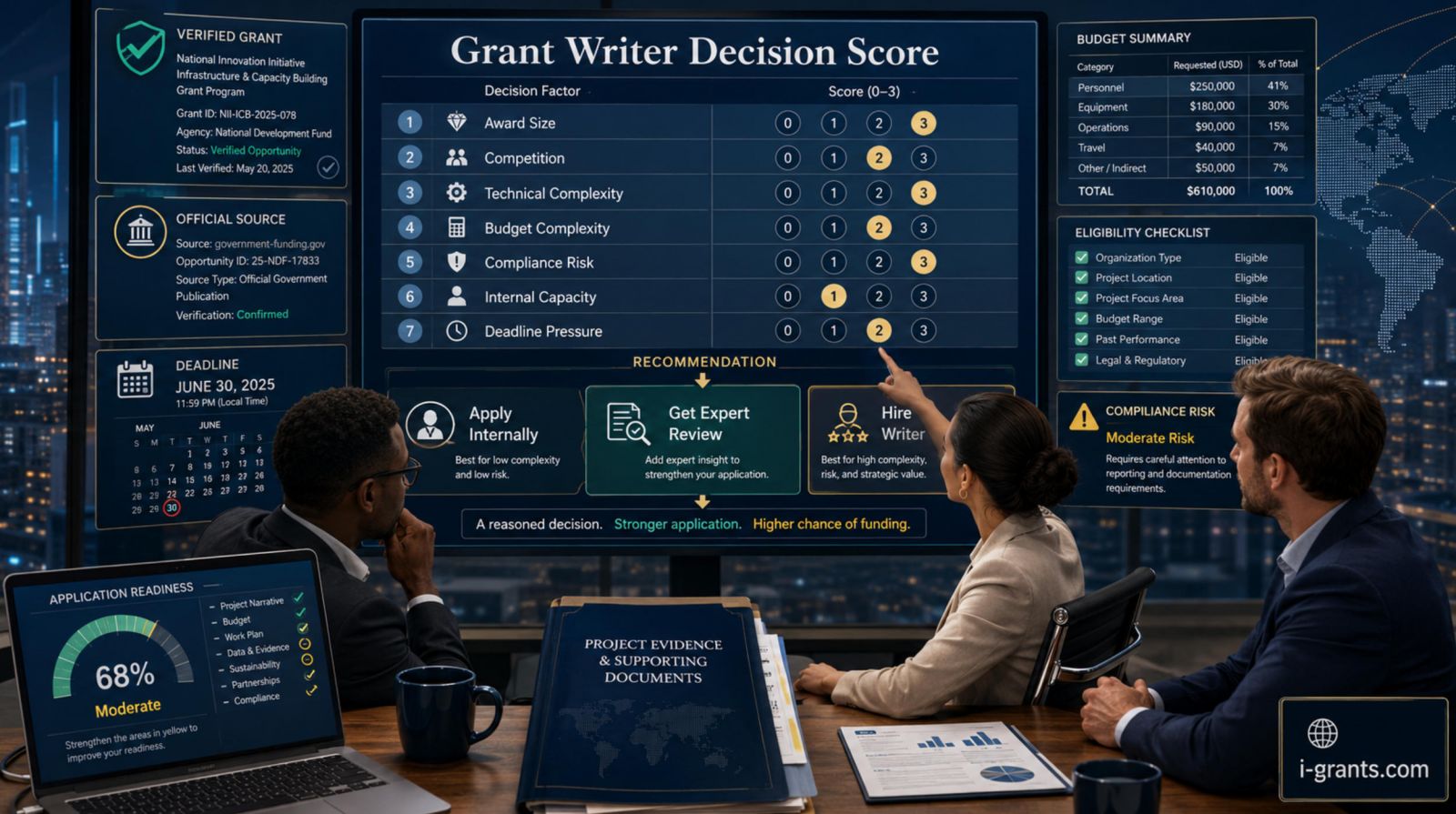
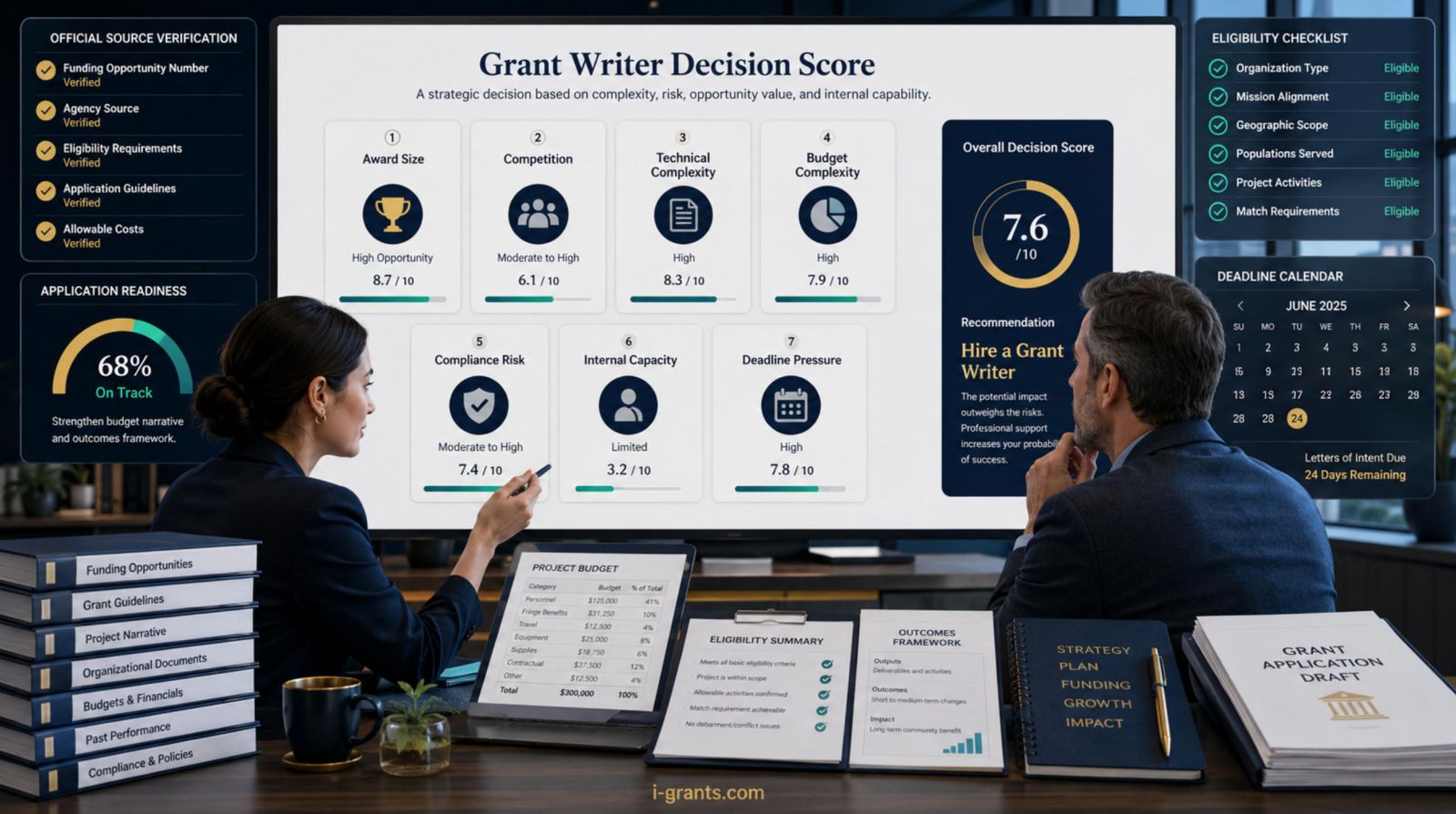
The Grant Writer Decision Score
A practical way to decide is to score the opportunity before hiring anyone. The following framework can help a small business understand whether it should apply internally, request a light review, or bring in professional grant writing support.
| Factor | 0 points | 1 point | 2 points | 3 points |
|---|---|---|---|---|
| Award size | Very small microgrant | Small award | Meaningful award | Major strategic funding |
| Competition | Simple local program | Moderate competition | Competitive program | Highly competitive program |
| Technical complexity | Basic form | Business narrative | Detailed project plan | Research, innovation, consortium, or regulated sector |
| Budget complexity | No detailed budget | Simple cost table | Detailed line budget | Multi-year, matching funds, indirect costs, or strict cost rules |
| Compliance risk | Minimal | Some documents required | Formal reporting required | Government, EU-style, audit, or complex compliance obligations |
| Internal capacity | Experienced internal team | Some relevant experience | Limited time or experience | No grant experience and no dedicated staff |
| Deadline pressure | Comfortable timeline | Manageable timeline | Tight deadline | Urgent deadline with many documents missing |
A score from 0 to 6 usually means the business can probably prepare the application internally. A score from 7 to 12 suggests that an eligibility review, strategy session, or light editing support may be useful. A score from 13 to 17 means the company should seriously consider hiring a grant writer if the opportunity is strategically important. A score from 18 to 21 means professional support is strongly recommended, especially when the grant involves research, technical narrative, government compliance, a detailed budget, partner coordination, or reporting obligations.
This score is not a mathematical guarantee. It is a decision tool. Its value is that it changes the conversation from “Can we afford a grant writer?” to “Can we afford a weak application?”
When a Small Business Can Write the Application Internally
A small business does not need a professional grant writer for every opportunity. In fact, hiring one for every small application can be a poor use of resources.
Internal preparation may be enough when the grant is small, the form is simple, eligibility is obvious, the funder asks for basic business information, and the award size does not justify outside support. Many local microgrants, small chamber of commerce awards, simple reimbursement programs, and monthly business competitions fall into this category.
A founder or manager can often prepare these applications well if the business has the necessary documents ready, understands its own project clearly, and follows the official instructions carefully. For a simple application, discipline may matter more than professional writing. The applicant should answer the actual question, respect the word limit, attach the correct documents, avoid exaggeration, and submit before the deadline.
Internal writing is also realistic when the company already has grant experience. A business that has previously managed public funding, prepared budgets, reported expenses, or worked with donor requirements may have enough capacity to handle moderately simple applications without outside help.
The key is proportionality. If the grant is small, the application is short, the deadline is manageable, and the rules are clear, a professional grant writer may not be necessary.
When Hiring a Grant Writer Can Pay Off
Professional grant writing becomes more valuable when the opportunity is competitive, complex, strategic, or risky. This often happens when the grant is connected to innovation, research and development, export growth, workforce training, sustainability, manufacturing, public benefit, women-owned business support, underserved entrepreneur programs, or local economic development.
In these cases, the application is rarely just a story about the company. It must show why the project fits the funder’s purpose, why the applicant is eligible, why the budget is reasonable, what outcomes will be measured, how the work will be implemented, and how the business will manage reporting after receiving funds.
A grant writer can help build that logic before the first paragraph is drafted.
For a technology startup, the writer may help connect the innovation to technical merit, market need, commercialization potential, and measurable milestones. For a manufacturer, the writer may help frame equipment, workforce training, or process improvement as an economic development project. For a women-owned business, the writer may help document ownership, business readiness, community impact, and growth potential. For a local business applying to a city fund, the writer may help show how the project supports jobs, neighborhood vitality, resilience, or community benefit.
The value is not only better language. The value is better structure.
A strong grant writer can also save founder time. Many small business owners underestimate the real workload behind a serious application. Reading the guidelines, checking eligibility, preparing documents, building a budget, drafting a narrative, collecting evidence, requesting partner letters, reviewing portal requirements, and checking compliance can take far more time than expected. If the founder is also running operations, sales, finance, hiring, and customer delivery, the opportunity cost can be substantial.
In competitive grants, time spent badly is more expensive than money spent wisely.

What a Grant Writer Cannot Fix
This is where many small businesses need a reality check. A grant writer can strengthen a fundable application. A grant writer cannot make an ineligible business eligible.
If the grant is only for companies in a specific region and the applicant is outside that region, writing will not solve the problem. If the program requires a woman-owned business and the ownership structure does not meet the requirement, narrative quality will not change eligibility. If the opportunity funds research and development but the company only needs general working capital, the fit is weak. If the deadline is tomorrow and required registration is missing, even the best writer may not be able to rescue the application.
A grant writer also cannot replace a real project. Many small businesses search for grants before they can define what they would actually do with the funding. “We want to grow” is not a project. “We need cash flow” is not usually a fundable grant objective. “We want marketing money” may not be eligible unless the funder specifically supports export promotion, market access, local revitalization, or another defined purpose.
A fundable project usually has a clear goal, eligible activities, realistic costs, measurable outputs, a timeline, responsible people, and a reason the funder should care. Without that, the grant writer is forced to invent structure from weak material. That creates risk for both the applicant and the writer.
A grant writer also cannot guarantee funding. Any consultant who guarantees approval should be treated with caution. Funders make decisions based on eligibility, criteria, competition, available budget, reviewer judgment, and program priorities. An ethical grant writer can improve readiness and quality. They cannot control the award decision.
The Real Cost Is Not Only the Grant Writer’s Fee
Many business owners focus only on the visible cost of hiring a grant writer. That is understandable. Small businesses must protect cash flow, and professional services need to make economic sense.
But the fee is only one part of the decision. The hidden cost of a weak application may be higher.
A poor application can waste founder time, miss a strategic deadline, damage credibility with a funder, submit an unrealistic budget, create compliance problems, or fail because the project was never properly aligned with the opportunity. In some competitive programs, the cost is even sharper: the business may have a limited number of chances, limited staff capacity, or a narrow application window.
This is especially important for innovation and government funding. If a company submits a rushed proposal for a serious research, technology, health, education, energy, or manufacturing program, the failure may not come from the idea itself. It may come from weak framing, unclear milestones, insufficient evidence, poor budget structure, or failure to answer the review criteria.
The practical question is: what is the opportunity worth if the application is done well, and what is the cost of doing it badly?
For a small local award, the answer may favor internal writing. For a strategic grant that could fund product development, equipment, workforce expansion, commercialization, or market entry, professional preparation may be a rational investment.
How AI Changes Grant Writing in 2026
Artificial intelligence has changed the way many businesses prepare documents, and grant writing is no exception. AI tools can summarize guidelines, generate checklists, organize notes, improve clarity, compare eligibility language, draft early outlines, and help teams move faster.
Used responsibly, AI can be useful. It can reduce blank-page time. It can help a founder understand a long funding announcement. It can support internal preparation for simpler applications. It can help grant writers work more efficiently when organizing information or reviewing consistency.
But AI is not a replacement for professional judgment.
AI does not take responsibility for eligibility. It does not know whether a business has the documents required to prove ownership, financial readiness, regional status, or technical capacity unless those facts are provided and verified. It can produce confident language that sounds persuasive but does not match the funder’s rules. It may miss subtle restrictions in guidelines. It may overstate outcomes. It may produce a generic narrative that looks polished but fails to answer the scoring criteria.
The real advantage in 2026 is not “AI writes the grant.” The advantage is a disciplined human workflow where AI helps with speed and structure while people control strategy, evidence, ethics, compliance, and funder fit.
For small businesses, this means AI can be a useful assistant for early preparation. For competitive grants, it should not be the final decision-maker. A professional grant writer who uses AI responsibly may be more efficient, but the value still comes from human expertise.
How to Choose the Right Grant Writer
Choosing a grant writer should be treated like hiring a strategic professional, not buying a generic writing service. The right person should ask difficult questions before agreeing to write. They should want to see the official guidelines, deadline, eligibility rules, applicant profile, project idea, budget needs, available documents, and expected outcomes.
A serious grant writer will not start with promises. They will start with fit.
They may tell the business not to apply. That can be valuable advice. If the opportunity is weak, the applicant is not eligible, the timeline is unrealistic, or the budget does not match the rules, a good grant writer should say so. The best professional support sometimes prevents a bad application from being written.
Small businesses should be cautious with consultants who guarantee funding, push vague “free money” claims, ignore official sources, use one template for every application, avoid discussing compliance, or request payment before even reviewing eligibility. They should also be careful with anyone who treats grant writing as pure copywriting. In serious funding, the writer must understand strategy, documents, budget, review criteria, and risk.
The strongest grant writer for a small business is not always the most literary writer. It is the person who can connect the business project to the funder’s mission with clarity, evidence, and discipline.
How i-grants.com Fits Into This Workflow
The grant writer decision becomes much easier when the funding opportunity itself is structured and verified. This is where i-grants.com can create value for both sides of the marketplace.
For applicants, the platform can help turn a vague funding search into a clearer decision. Instead of asking, “Are there grants for small businesses?” the business can examine real opportunities by donor, geography, eligible country, applicant type, sector, deadline, status, funding amount, language, and official verification link. That structure helps the applicant understand whether a grant is relevant before investing time or hiring support.
For grant writers, structured grant intelligence creates a better starting point. A professional does not need a random list of old funding links. They need current, classified, verified opportunities that can be matched with real applicants and real projects. When the opportunity is clear, the grant writer can focus on eligibility, strategy, narrative, budget, evidence, and application quality.
This is the difference between content and workflow. A generic article may tell a business that grants exist. A serious grant intelligence platform helps the business move from discovery to verification, from verification to decision, and from decision to application.
That workflow is especially important in the small business grant market because the category is broad. It includes local grants, innovation grants, export grants, women-owned business grants, startup funding, workforce grants, sustainability programs, community development funds, and challenge prizes. Each has different rules, documents, funder priorities, and application logic.
The applicant needs to know whether to apply. The grant writer needs to know whether the project is fundable. i-grants.com can support both by making the opportunity more transparent before the writing begins.
Hire for Complexity, Strategy, and Risk, Not for Hope
A small business should not hire a grant writer simply because it wants funding. It should hire one when the grant opportunity is important, competitive, complex, or risky enough that professional preparation can change the quality of the application.
For simple microgrants, local awards, and basic forms, internal writing may be enough. For strategic grants involving technical narratives, detailed budgets, strict eligibility, government portals, reporting obligations, partner coordination, or high competition, a grant writer can be a practical investment.
The key is honesty. A grant writer cannot fix ineligibility, invent a real project, guarantee funding, or replace business readiness. But a skilled professional can help a strong project speak the funder’s language, avoid preventable mistakes, and compete with more discipline.
The best small business grant strategy is not to chase every opportunity. It is to find verified grants, check real fit, understand the cost of applying, and decide when expert support is worth it.
In that decision, the goal is not just to submit. The goal is to submit the right application for the right opportunity with the right level of preparation.