

 Français
  Deutsch
  Українська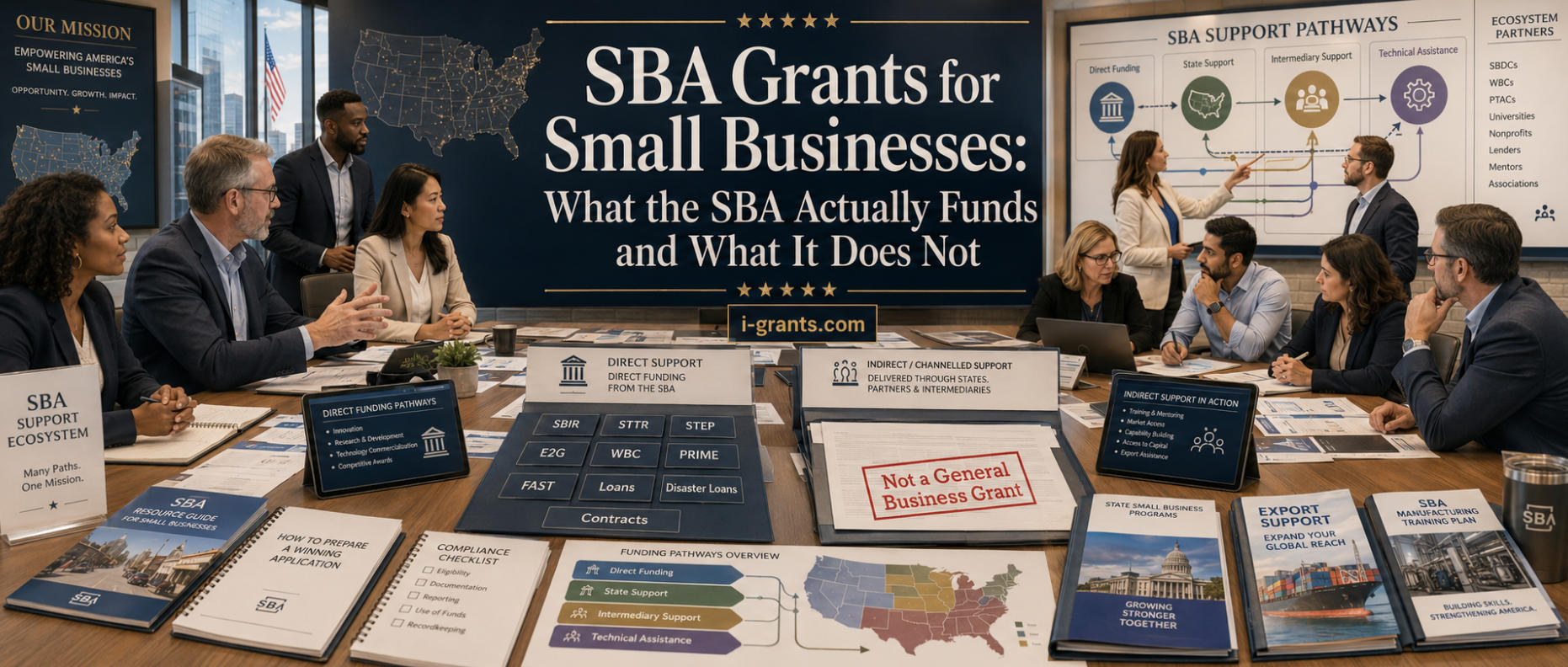
Search for "SBA grants for small businesses" and it is easy to come away with the impression that the U.S. Small Business Administration operates a large pool of free money for entrepreneurs who want to start a company, buy equipment, hire employees or expand an existing business.
That is not how the SBA grant system works.
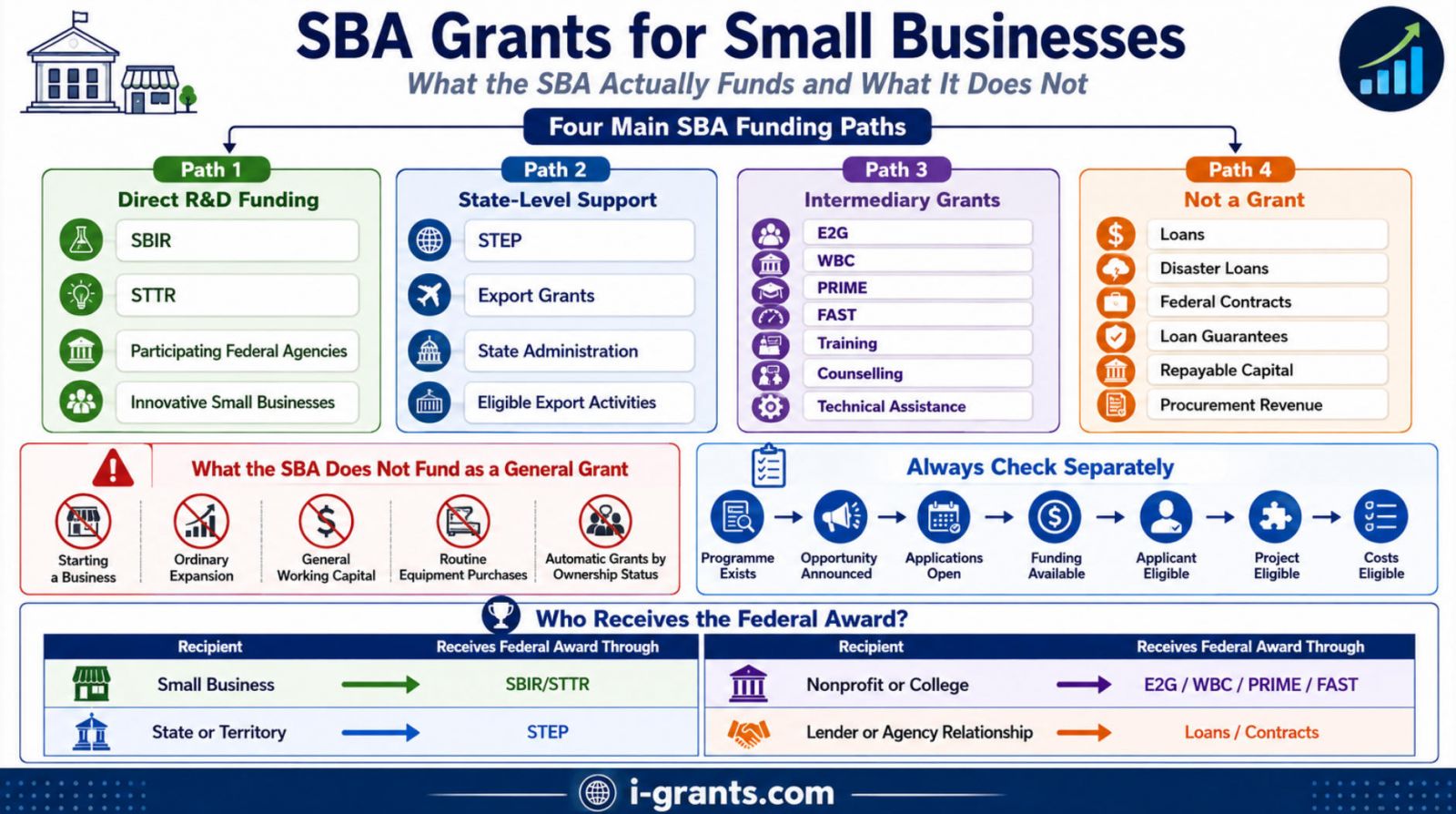
The SBA has an official grants section and administers or supports several genuine grant programs. Yet the agency also states clearly that it does not provide grants for starting and expanding a business. Instead, many SBA grants are awarded to nonprofit organizations, Resource Partners, educational institutions, state and territory governments, training providers and other organizations that then deliver assistance to small businesses.
There are important exceptions and special structures. Small technology companies can receive substantial federal research and development awards through the Small Business Innovation Research and Small Business Technology Transfer programs. Exporting businesses may receive financial support through the State Trade Expansion Program. Manufacturers may benefit from training financed by new SBA grants. Women entrepreneurs, microentrepreneurs and innovative startups may receive services through organizations funded by the agency.
But these arrangements are not equivalent.
The organization that receives an SBA grant and the small business that ultimately benefits from it are often not the same entity.
Understanding that distinction is essential before spending time preparing an application.
Does the SBA Give Grants to Small Businesses?
The most accurate answer is:
Sometimes, but not in the way many entrepreneurs expect.
SBA's own guidance says the agency does not provide grants for ordinary business startup and expansion. At the same time, it identifies research and development programs, manufacturing initiatives, export support and grants to organizations that provide counseling and training.
The confusion comes from using the word "grant" to describe several different relationships.
A grant may be awarded directly to a qualifying organization. A federal program coordinated by SBA may fund small businesses through another agency. SBA may award money to a state, college or nonprofit that later provides financial or nonfinancial support to businesses. Or a business may receive something valuable from SBA that is not a grant at all, such as a guaranteed loan, procurement assistance, training or disaster financing.
Table 1. Major SBA-Linked Grant and Support Routes for Small Businesses
| Program or route | Who receives the federal award? | What the small business receives | Direct SBA cash grant to an ordinary business? |
|---|---|---|---|
| SBIR/STTR | Eligible small business receives an award from a participating federal agency | R&D funding under agency-specific rules | Not normally an SBA-issued award |
| STEP | State or territory government receives the SBA award | State-level export grant or reimbursement support | No, SBA funds the state first |
| E2G Manufacturing in America | Training organizations and institutions | Free manufacturing training and technical assistance | Usually no |
| E2G Tribal College and University Manufacturing Initiative | Eligible tribal-serving colleges and training institutions | Training and reskilling for eligible businesses and workers | No |
| SCALE | Eligible public, private, nonprofit or institutional organizations | Accelerator, supply-chain and technical support | No direct general-purpose business grant |
| Women’s Business Centers | Eligible nonprofit organizations operating centers | Counseling, training and access-to-capital support | No |
| PRIME | Eligible microenterprise development organizations and certain public or Tribal entities | Assistance for disadvantaged microentrepreneurs | No |
| FAST | Organizations operating state or regional innovation support programs | SBIR/STTR proposal and commercialization assistance | No |
| SBA loans and disaster loans | Borrower receives loan proceeds | Repayable financing | No |
| Federal contracting support | Small business competes for procurement awards | Revenue from government contracts | No |
This structure explains why a news release announcing "millions in SBA grants" should never be interpreted automatically as a funding opportunity for an individual small company.
The first question should always be: Who is legally eligible to receive the award?
The Most Important SBA Grant Rule
The most useful sentence on the SBA grants page may also be the simplest: the agency does not provide grants for starting and expanding a business.
This means there is no general SBA program under which an entrepreneur can simply request, for example, $100,000 of non-repayable federal money because the company wants to open a location, purchase ordinary equipment, hire staff or increase inventory.
Those needs may still be financeable. They may fit an SBA-guaranteed loan, a microloan, investment capital, a state program, a tax incentive or another funding route.
But they do not become grant-eligible merely because the applicant is a small business.
This distinction matters particularly for new entrepreneurs. The SBA is heavily involved in helping companies start and grow, but its assistance includes lending, guarantees, investment programs, counseling, contracting support and other mechanisms, not only grants.
Program Existence Is Not the Same as Grant Availability
Even where a genuine SBA grant program exists, a company or organization still needs to determine whether money is actually obtainable now.
These are separate questions:
-
Does the program legally exist?
-
Has a funding opportunity been announced for the relevant fiscal year?
-
Is the application window currently open?
-
Is money actually available for awards?
-
Is the applicant an eligible recipient?
-
Are the proposed project and costs eligible?
The distinction is especially important in August 2026.
For example, SBA's SCALE competition was announced in July with $9 million in total funding and 20 planned grants of up to $500,000, but its application deadline was August 7, 2026. The FY2026 PRIME competition closed on August 12. The Women’s Business Center Modernization competition closed on August 10. By contrast, the separate $10 million Tribal College and University Manufacturing E2G opportunity announced on August 5 has a proposal deadline of August 24, 2026.
All four programs exist. That does not mean all four are currently open.
SBIR and STTR: The Closest Thing to Major Direct Federal Grants for Innovative Small Businesses
For technology companies, the most important exception to the general SBA grant rule is America's Seed Fund, the umbrella name used for the Small Business Innovation Research and Small Business Technology Transfer programs.
These programs are major sources of non-dilutive federal R&D funding for qualifying U.S. small businesses. SBA reported in July 2026 that SBIR and STTR together provide more than $5 billion annually to innovative small businesses and startups.
But there is a crucial institutional distinction.
SBA is the sponsoring and coordinating agency. It administers the government-wide policy framework, guides implementation, aggregates solicitation information, monitors the programs and reports on their progress. Individual participating federal agencies run their own SBIR/STTR programs and make their own awards.
So an NSF SBIR award should not simply be described as "an SBA grant."
It is an award made by NSF under the SBA-coordinated SBIR framework.
The same principle applies to other participating agencies.
As of April 2026, participating agencies may issue Phase I awards, including modifications, up to $323,090, and Phase II awards up to $2,153,927, without obtaining an SBA waiver. Awards above those thresholds require additional approval under the policy directive. Those amounts are ceilings for agency action without a waiver, not guaranteed award sizes for every competition.
Not Every SBIR or STTR Award Is Legally a Grant
This is another detail frequently missed in general grant articles.
Different federal agencies use different award mechanisms.
SBIR.gov identifies USDA, for example, under grant funding, while the wider participating-agency system includes agencies and components that use grants, contracts or other award structures according to their own authorities and missions.
This matters because a grant and a procurement contract create different legal relationships.
The practical lesson is that an entrepreneur should not stop at the label "SBIR." The company needs to identify the specific agency, solicitation, funding instrument, topic, phase, eligibility requirements, performance period and allowable costs.
Articles 6 through 10 in this series will examine those agency-level differences in detail.
STEP: An SBA Grant That Reaches Businesses Through the States
The State Trade Expansion Program is one of the clearest examples of an indirect SBA grant structure.
SBA awards STEP funding to state and territory governments. Those governments then operate programs that help eligible established small businesses enter or expand in international markets.
Depending on the state program, eligible support can include trade missions, export trade shows, translation, international marketing materials, export training, website internationalization, certain U.S. Department of Commerce services and approved consulting or market-entry activities.
For the business, STEP can therefore feel very much like a grant because it may reduce or reimburse eligible export expenses.
But the federal structure is:
SBA → State or Territory → Eligible Small Business
not:
SBA → Any Small Business Applying Directly
That distinction has practical consequences. The amount of support, reimbursement rate, eligible activities, application procedure and timing can differ from one state to another.
SBA's current STEP directory directs established businesses to the relevant state or territory representative to determine how to apply.
For an exporter, therefore, checking SBA is only the first step. The actual application may need to be made through the state economic development agency or another designated STEP administrator.
Manufacturing Grants in 2026: Follow the Money to the Actual Recipient
Manufacturing has become one of the most active areas of new SBA grant activity in 2026.
But it also provides some of the best examples of why entrepreneurs need to distinguish an award recipient from a program beneficiary.
$50 Million E2G Manufacturing in America Awards
On August 5, 2026, SBA announced that it had awarded $50 million to 11 organizations under the Manufacturing in America Empower to Grow initiative. The funded organizations are expected to provide hands-on training and technical assistance to small manufacturers.
The grants are substantial.
For example, the published proposed budgets include approximately $4.99 million for Fletcher Technical Community College, $5 million for Iowa Valley Community College District, and $5 million for Maine Community College System.
But those figures are not grants being handed directly to local manufacturers.
The colleges and other selected organizations receive the federal awards. Eligible manufacturers receive the resulting services, which can include technical training, workforce development, industrial software skills, robotics, automation, welding, maintenance, regulatory support, financial management and federal contracting preparation. SBA describes the E2G benefits to eligible businesses as free courses, practical workshops and individual advising.
The correct interpretation is therefore:
The SBA grant finances the support infrastructure. The manufacturer receives the supported service.
That is materially different from a $5 million capital grant for machinery or factory expansion.
A Separate $10 Million E2G Opportunity Is Still Open as of August 20
SBA announced another manufacturing-related E2G opportunity on August 5, 2026, this time focused on Tribal Colleges and Universities and other qualifying training institutions serving Tribal communities.
The initiative plans up to five grants totaling as much as $10 million to expand manufacturing training and rapid reskilling for employees of eligible 8(a) and HUBZone small businesses in critical industries. Eligible applicants include Tribal Colleges and Universities, qualifying community colleges, trade or vocational schools and other Tribal-serving institutions that meet the program requirements.
The application deadline is August 24, 2026, at 11:59 p.m. Eastern Time.
This is a real, current SBA grant opportunity as of August 20.
But again, an ordinary manufacturing company is not the federal applicant for the grant.
The company is the intended beneficiary of training delivered through the funded institution.
SCALE: $9 Million for Supply-Chain Support, Not General Expansion Grants
The Supply Chain Acceleration and Logistics Enablement program provides another useful case study.
SBA announced SCALE on July 23, 2026, with $9 million in total funding and plans for 20 grants of up to $500,000 each over two years. The program targets supply-chain constraints, production expansion and participation in strategically important industries.
Priority areas included advanced manufacturing, biotechnology and biomanufacturing, defense industrial base technologies, energy and critical materials, food and agriculture, and transportation and logistics.
Yet the eligible federal applicants were not simply manufacturers seeking $500,000 for production equipment.
SBA defined applicants as public or private entities, nonprofit organizations and institutions capable of delivering accelerator programs, technical assistance, industry engagement or related services to small firms.
The FY2026 application deadline was August 7, 2026.
A company researching SCALE on August 20 should therefore make two distinctions.
First, the 2026 application round is no longer open. Second, even while it was open, the competition targeted organizations building support systems for small suppliers, not every small supplier as a direct grant applicant.
Women’s Business Centers: Funding the Support Network
The Women’s Business Center program is another area where grant terminology can create unrealistic expectations.
SBA announced a $6 million Women’s Business Center Modernization Initiative in July 2026. The initiative was designed to establish State Lead Centers and related service networks in selected locations.
The eligible grant applicants were qualifying nonprofit organizations that provide counseling and training services. Individual women entrepreneurs and ordinary women-owned businesses were not the direct applicants for those federal awards.
SBA reported that 138 existing Women’s Business Centers continued receiving FY2026 base awards through their existing cooperative agreements, while the modernization initiative operated as a separate project.
The new grants varied considerably by location. The published amounts included approximately $2.08 million for a Texas Lead Center, $1.54 million for Florida and $930,077 for Pennsylvania, with smaller awards assigned to other eligible locations.
But a woman who owns a small business in Texas cannot read "$2.08 million WBC grant" as meaning she can request $2.08 million from SBA.
The grant funds the organization operating the support network.
The entrepreneur receives access to services such as counseling, training, technical assistance and help navigating capital.
This distinction will also be important in Article 17 of this series, which will examine support for women-owned and veteran-owned businesses.
PRIME: Funding Organizations That Help Microentrepreneurs
The Program for Investment in Microentrepreneurs, or PRIME, follows a similar intermediary model.
The FY2026 PRIME funding opportunity invited applications from private nonprofit microenterprise development organizations, qualifying programs operated by state, local or Tribal governments, and Indian tribes. Its purpose is to support assistance for disadvantaged microentrepreneurs and organizations serving them.
The FY2026 competition expected approximately 27 awards, ranging from $75,000 to $400,000, with a cost-sharing or matching requirement. The opportunity closed on August 12, 2026.
This makes PRIME another good example of misleading headline risk.
"Up to $400,000 in SBA PRIME grants" is technically true at the program level.
But "disadvantaged entrepreneur can get a $400,000 SBA grant" is not an accurate description of the FY2026 opportunity.
The direct applicant is the eligible organization delivering support to microentrepreneurs.
FAST: Helping Companies Compete for Other Federal Awards
The Federal and State Technology Partnership Program occupies another layer of the SBA ecosystem.
FAST provides funding to organizations that operate state and regional initiatives designed to increase participation in SBIR/STTR, improve proposal preparation and provide technical assistance and commercialization support.
Again, the SBA grant generally supports the organization that helps innovative small businesses.
The company then receives proposal assistance, mentoring, commercialization support, networking or related services that may improve its chances of winning an SBIR or STTR award from a participating federal agency.
This creates an important chain:
SBA funds FAST organization → FAST organization helps small business → small business competes for SBIR/STTR award → participating federal agency makes the R&D award.
Understanding the chain prevents the common mistake of describing every dollar in the ecosystem as a direct SBA grant.
What the SBA Does Not Normally Fund With Business Grants
For the majority of ordinary companies, several common business needs should not be approached as if SBA routinely provides a non-repayable grant for them.
These include:
-
Starting an ordinary business. SBA explicitly says it does not provide grants for starting a business.
-
General business expansion. Ordinary expansion is also outside the general direct-grant model described by SBA.
-
Routine working capital. SBA has loan and credit programs for these needs, but there is no universal working-capital grant for small businesses.
-
Ordinary equipment purchases simply because the company is small. Equipment may be eligible under a particular targeted program, but small-business status alone does not create grant eligibility.
-
Automatic grants based solely on ownership status. Women-owned, veteran-owned, HUBZone and other businesses may have access to targeted services, contracting programs or specific competitions, but certification or ownership category is not a universal entitlement to free capital.
-
Ordinary disaster recovery as a business grant. SBA's core business disaster assistance is provided primarily through loans rather than general grants.
Businesses with these needs should not conclude that no support exists.
The correct financing instrument may simply be something other than a grant.
Disaster Assistance Is Usually a Loan
This distinction is particularly important after a hurricane, wildfire, storm or other declared disaster.
SBA's current disaster program provides Business Physical Disaster Loans and other disaster lending mechanisms. Qualified businesses and most private nonprofit organizations may borrow up to $2 million for disaster losses not fully covered by insurance or other sources. Eligible business physical disaster loan proceeds can be used for damaged real property, machinery, equipment, inventory and other qualifying assets.
A business may also qualify for an Economic Injury Disaster Loan under applicable disaster conditions, but the maximum combined amount of physical disaster and EIDL financing is generally $2 million.
These are loans.
The fact that they are federal, low-interest or provided directly through SBA does not convert them into grants.
For small businesses, this distinction affects repayment obligations, financial forecasts and the decision whether to borrow.
SBA Loans Are Funding, but They Are Not SBA Grants
Much of SBA's capital access activity occurs through credit rather than grants.
SBA-backed lending allows participating lenders to make qualifying loans with part of the lender's risk supported by a federal guarantee. The main 7(a) program currently provides loans of up to $5 million for eligible uses such as real estate, working capital, refinancing qualifying debt, machinery and equipment, supplies and certain ownership changes.
A business that receives a $2 million SBA-backed loan has obtained valuable government-supported financing.
It has not received a $2 million government grant.
This point may sound obvious, but it matters because online lists frequently mix grants, loans, guarantees and technical assistance under one heading such as "SBA funding."
For financial planning, those categories must remain separate.
Federal Contracting Can Be Far Larger Than Grants
The federal procurement system provides another useful comparison.
In fiscal year 2025, nearly 28 percent of federal prime contracting dollars, representing approximately $179 billion, went to small businesses. When prime contracts and subcontracts are combined, SBA reported nearly $273 billion in federal contracting with small businesses. Those activities supported an estimated 1.2 million jobs.
That is an enormous economic opportunity.
But none of those figures should be presented as "SBA grants."
A government contract is revenue earned by supplying products or services under procurement rules. SBA helps small businesses access this market through contracting goals, certifications, counseling and related programs, while federal agencies make procurement awards.
For certain manufacturers, defense suppliers, construction firms, professional services companies and technology businesses, winning government contracts may ultimately provide much greater commercial value than searching for unrestricted grants that do not exist.
Three Different Ways SBA Grant Money Can Reach Small Business
The most useful way to understand SBA grants is to follow the path of the federal dollar.
Table 2. How SBA-Linked Grant Funding Reaches Small Businesses
| Funding path | Federal recipient | Business position | Example |
|---|---|---|---|
| Federal agency directly funds the business under an SBA-coordinated framework | Eligible small business | Award recipient | SBIR/STTR |
| SBA funds a state or territory | State or territory government | State-level applicant or beneficiary | STEP |
| SBA funds an intermediary organization | College, nonprofit, center, accelerator or other eligible entity | Receives services or indirect support | E2G, WBC, PRIME, FAST, SCALE |
| SBA provides credit rather than grants | Business borrower | Borrower | 7(a), disaster loans |
| Government buys from the company | Small business contractor | Supplier earning revenue | Federal procurement |
This framework is more reliable than asking whether a program is "an SBA program."
The agency's involvement alone does not determine the legal form of the support.
Current SBA Grant Landscape in August 2026
The following snapshot illustrates why checking dates and applicant categories matters.
Table 3. Selected SBA Grant Initiatives and Their Status as of August 20, 2026
| Program | Funding announced | Direct applicant | Status as of August 20, 2026 |
|---|---|---|---|
| Manufacturing in America E2G | $50 million awarded to 11 organizations | Training and educational organizations | Awards announced August 5, 2026 |
| Tribal College and University Manufacturing E2G | Up to $10 million across up to five grants | Eligible Tribal Colleges, community colleges and training institutions | Open, deadline August 24, 2026 |
| SCALE | $9 million, 20 planned grants up to $500,000 | Eligible support organizations and institutions | Closed August 7, 2026 |
| WBC Modernization | $6 million | Eligible nonprofit organizations | Closed August 10, 2026 |
| PRIME FY2026 | About 27 expected awards, $75,000 to $400,000 | Eligible microenterprise support organizations and public or Tribal entities | Closed August 12, 2026 |
| SBIR/STTR | More than $5 billion annually across the federal system | Eligible innovative small businesses | Availability depends on current agency solicitations |
| STEP | SBA awards funding to states and territories | State or territory government at federal level | Business availability depends on state program |
The E2G, SCALE, WBC and PRIME statuses come from the corresponding FY2026 SBA and federal funding notices. SBIR/STTR operates through multiple agency-specific solicitations rather than one universal SBA application.
The table also demonstrates an important point about time-sensitive content.
A program that was "open in 2026" is not necessarily open today.
How to Check Whether an SBA Grant Is Really Available to Your Business
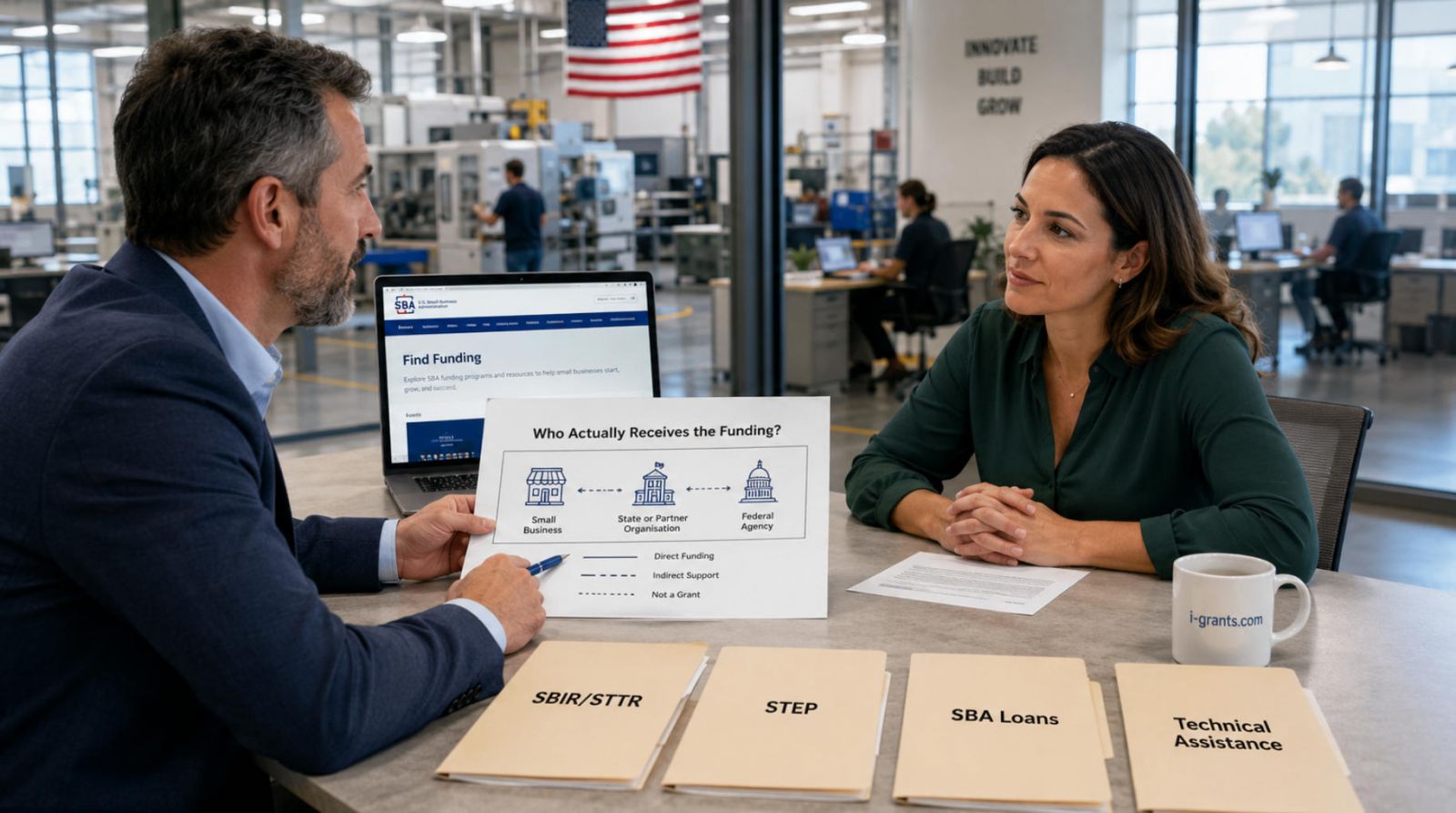
Before preparing an application, businesses should use a disciplined verification process.
First, identify the legal applicant. Read the eligibility section, not just the program title. If eligibility is limited to states, nonprofit organizations, educational institutions or existing SBA partners, an ordinary company cannot submit the federal application.
Second, determine the funding path. Ask whether SBA funds the business directly, another federal agency makes the award, a state receives the money first, or an intermediary delivers services.
Third, check the current funding opportunity, not only the permanent program page. Verify the posting date, opening date, closing date, fiscal year and funding opportunity number.
Fourth, verify company eligibility and project eligibility separately. A company can meet SBA's small-business definition and still be ineligible for a particular grant. Conversely, an eligible applicant can propose a project or cost that the program will not fund.
Fifth, confirm the funding instrument. Determine whether the opportunity is a grant, cooperative agreement, procurement contract, loan, guarantee, reimbursement mechanism or technical-assistance program.
Sixth, check the official application channel. Depending on the program, this may be Grants.gov, SBIR.gov, an agency portal, a state STEP administrator or another official system.
This process is much more reliable than starting from an article claiming to list "free SBA grants."
Small Business Status Does Not Create Grant Entitlement
An important lesson from the broader U.S. funding system is that SBA size status and grant eligibility are different concepts.
A company may qualify as a small business under the applicable SBA size standard and still have no right to a particular grant.
For SBIR/STTR, the business must satisfy program-specific ownership, organizational and research requirements in addition to being small. For STEP, the company needs to meet the conditions of the relevant state program and proposed export activity. For other SBA grants, the eligible federal applicant may not be a business at all.
This is why the statement "my company is SBA-certified as small, therefore it qualifies for SBA grants" is incomplete.
Small-business status is one possible eligibility layer, not a universal grant passport.
What About Women-Owned, Veteran-Owned and Other Certified Businesses?
Ownership and certification categories create another common misunderstanding.
SBA operates or supports programs for women-owned businesses, veteran-owned businesses, HUBZone companies, 8(a) participants and other groups. These programs can provide meaningful advantages through federal contracting, training, counseling, business development and access to specific resources.
But being women-owned, veteran-owned or otherwise certified does not by itself create a general SBA grant entitlement.
The 2026 Women’s Business Center example illustrates this clearly. SBA announced millions of dollars in WBC grants, but the eligible federal applicants were nonprofit organizations operating support centers, not individual women-owned companies.
A business owner should therefore ask what the status actually unlocks: a grant competition, a contracting preference, access to services, certification benefits, a training program or another form of support.
Why SBA Uses Intermediaries
At first glance, providing a grant to a college or nonprofit rather than directly to a company may seem less useful.
In practice, intermediary models allow SBA to build support capacity that can serve multiple businesses.
A manufacturing training provider can purchase or operate specialized equipment, employ instructors and train workers from many small manufacturers. A Women’s Business Center can advise thousands of entrepreneurs. A FAST organization can help local technology companies improve SBIR/STTR applications. A state STEP office can coordinate export support for numerous small exporters.
The federal dollar is therefore used to create infrastructure, expertise or local delivery capacity.
That support may still have substantial economic value to the business, even when no cash is deposited directly into its bank account.
For grant seekers, the important point is to distinguish financial value from direct grant revenue.
Common Misconceptions About SBA Grants
Several claims should immediately trigger closer verification:
-
"SBA gives grants to anyone starting a small business." SBA expressly says it does not provide general startup grants.
-
"Women-owned or veteran-owned businesses automatically qualify for SBA grants." Ownership status alone does not create a universal grant entitlement.
-
"SBIR is simply an SBA grant." SBA coordinates the program, but participating agencies administer their own programs and issue awards.
-
"A $50 million SBA grant announcement means $50 million is available for companies to apply for directly." The 2026 E2G example shows that $50 million was awarded to 11 organizations delivering services to manufacturers.
-
"A disaster assistance program is a grant." SBA's core business disaster assistance is loan-based.
-
"An SBA program listed online is currently open." Program existence, current solicitation status and applicant eligibility must be verified separately.
These misconceptions are not merely semantic. They determine whether a business spends its time on the correct opportunity.
Where Should an Ordinary Small Business Look Instead?
If an SBA direct grant does not fit, the company should not stop searching for support.
The correct alternative depends on the underlying need.
A technology startup may investigate current SBIR/STTR topics. An exporter can contact its state STEP administrator. A manufacturer may look for E2G training, specialized lending or supply-chain programs. A company that needs working capital or equipment financing can evaluate SBA-backed loans. A federal supplier can explore contracting certifications, surety support and procurement opportunities. A business recovering from a declared disaster may qualify for SBA disaster financing.
The broader lesson is the same as in the previous article in this series: choose the instrument based on the business need, not based on the attractiveness of the word "grant."
The Best Way to Read an SBA Funding Announcement
An SBA announcement should be read in a specific order.
Do not begin with the headline amount.
Start with the eligible applicant.
Then find the funding instrument.
Next check the deadline and current status.
After that, identify the intended beneficiary, allowable activities and costs.
Only then should the headline funding amount influence the decision to pursue the opportunity.
For example, the 2026 Tribal College and University Manufacturing E2G opportunity is genuinely worth up to $10 million across as many as five awards and remains open through August 24. But an ordinary HUBZone manufacturer cannot simply apply for one of those grants because the eligible applicants are qualifying colleges and training institutions. The manufacturer may ultimately benefit from the resulting training.
That single distinction can prevent hours of wasted grant research.
The SBA Is Much More Than a Grant Agency
The misconception around SBA grants also understates what the agency actually does.
SBA's small-business role spans lending, investment, disaster recovery, federal contracting, entrepreneurship development, innovation, exports and technical assistance.
The federal contracting figures alone illustrate the scale. In FY2025, small businesses received approximately $179 billion in federal prime contracts, and the combined value of prime and subcontracting activity reached nearly $273 billion.
In other words, a company that cannot find a suitable SBA grant may still have access to much larger economic opportunities elsewhere in the SBA-supported system.
The challenge is not simply finding "free money."
It is identifying the correct pathway.
What Is Actually New in 2026?
The 2026 SBA grant landscape shows a clear emphasis on targeted delivery rather than universal business grants.
The agency awarded $50 million to 11 manufacturing training organizations through E2G in August. It launched a separate up to $10 million E2G initiative for Tribal-serving colleges and training institutions, with an August 24 application deadline. Earlier in the summer, it announced $9 million for SCALE and $6 million for Women’s Business Center modernization, while the FY2026 PRIME competition offered awards of up to $400,000 to qualifying microenterprise-support organizations.
At the same time, SBA continued to coordinate America's Seed Fund, where SBIR/STTR provide more than $5 billion annually in non-dilutive R&D funding through participating federal agencies.
The pattern is consistent.
SBA grant activity is real and financially meaningful, but it is targeted by purpose and delivery model.
The Bottom Line
The statement "SBA does not give grants to small businesses" is too broad.
The statement "SBA gives grants to small businesses to start or expand any business" is also wrong.
The reality is more specific.
SBA does not operate a general-purpose grant program for ordinary startup and expansion expenses. It does, however, administer targeted grant programs, fund organizations that support entrepreneurs, finance state export assistance, coordinate major federal R&D programs and create specialized initiatives for manufacturing, innovation and other policy priorities.
In some cases, such as SBIR/STTR, an eligible small business can be the direct recipient of substantial federal R&D funding, although the actual award is made by the participating federal agency rather than SBA itself. In other cases, such as STEP, federal money flows through a state. In programs such as E2G, WBC, PRIME, FAST and SCALE, an intermediary organization may receive the federal grant and the small business receives services, technical assistance or access to another opportunity.
And many of SBA's most important tools are not grants at all.
Loans are debt. Loan guarantees share lender risk. Disaster assistance is primarily loan-based. Federal contracts pay companies for goods and services. Counseling is a service.
For small businesses, the practical rule is simple:
Do not ask only whether an opportunity has "SBA" and "grant" in its title. Ask who receives the award, what instrument is being offered, whether the current competition is open, whether your company is legally eligible, and whether your specific project and costs qualify.
That approach produces a much more accurate funding strategy than searching for a universal "SBA small business grant" that, for most ordinary business purposes, does not exist.