

 Français
  Deutsch
  Українська
A restaurant owner planning to replace an old professional oven, refrigerator, dishwasher or other energy-intensive kitchen equipment in Spain has an unusually concrete funding opportunity in 2026. Unlike many business-support programmes that are only indirectly relevant to restaurants, Spain introduced a nationwide scheme specifically designed to help hospitality businesses replace existing equipment with more energy-efficient alternatives.
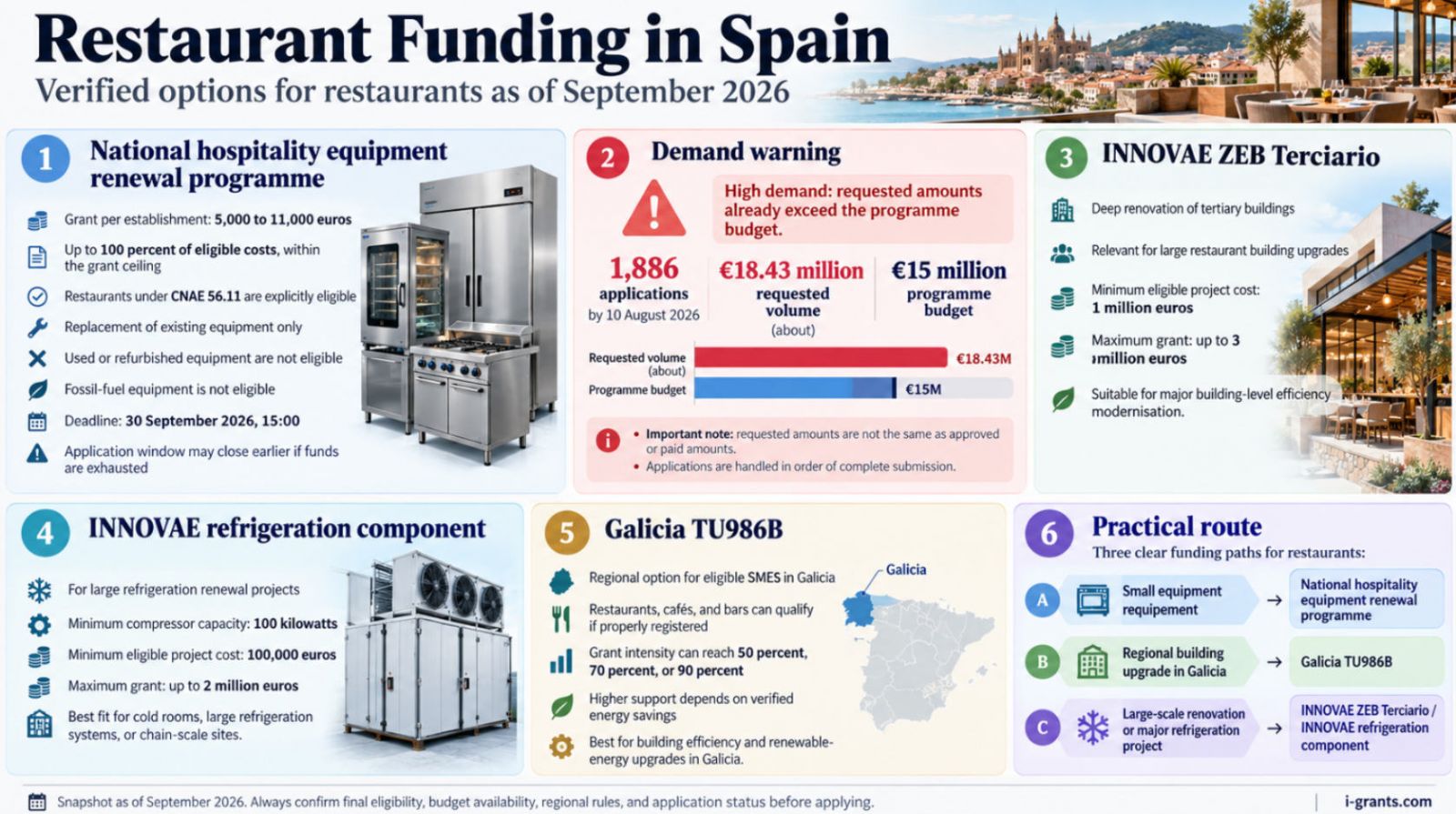
The programme can provide between €5,000 and €11,000 per establishment and can cover up to 100 percent of eligible expenditure within that ceiling. Restaurants are explicitly included among eligible businesses.
That does not mean every restaurant can simply purchase €11,000 of new equipment and request reimbursement. The programme has detailed rules regarding replacement of existing equipment, energy savings, eligible technologies, documentation and timing. It is also highly competitive in practice, despite being structured as direct aid rather than a conventional scored competition. By 10 August 2026, only a few days after applications opened, the Ministry had already recorded 1,886 applications requesting approximately €18.43 million against a total programme budget of €15 million.
Those figures represent requested assistance, not approved grants or money already paid. The programme remained formally open when this article was prepared on 24 September 2026, with a scheduled deadline of 30 September 2026 at 15:00 unless available resources were exhausted earlier. A late applicant therefore cannot assume that sufficient budget remains simply because the application portal is still accepting submissions.
Spain also offers other energy-support routes for restaurants. Large businesses undertaking a deep renovation of an entire restaurant building can examine the national INNOVAE programme. In Galicia, restaurants, cafés and bars can currently apply to a regional energy-efficiency scheme that can cover a substantially larger share of qualifying investments when major energy savings are achieved.
These programmes operate at completely different scales.
A restaurant replacing an old professional refrigerator may need a relatively simple equipment-renewal grant. A restaurant renovating its entire building, ventilation, heating, lighting and energy systems may need a much larger energy-efficiency programme. A large hospitality complex with central refrigeration can potentially fall into another category again.
The most effective approach is therefore not to search for the largest advertised grant. It is to identify the actual investment, determine whether the restaurant meets the territorial and technical conditions, and select the funding mechanism designed for that type of expenditure.
Why Restaurant Energy Costs Have Become a Funding Priority in Spain
Professional kitchens combine several types of intensive energy use in a relatively small space. Ovens, refrigeration, freezers, dishwashers, fryers, coffee machines, extraction systems, ventilation, hot water and air conditioning can operate for long periods every day.
The Spanish government itself identified kitchen and service equipment as the largest block of energy consumption in hospitality businesses when establishing the 2026 equipment-renewal programme. Climate control, lighting, hot-water systems and refrigeration represent additional important sources of consumption.
The economic importance of the wider hospitality sector also explains why energy costs matter nationally.
The latest structural business statistics available from Spain's Instituto Nacional de Estadística show that the broader Hostelería sector, which includes accommodation as well as food and beverage services, generated turnover of approximately €117.44 billion in 2024. Turnover increased by 12.4 percent from the previous year, while average annual employment reached approximately 1.75 million people, an increase of 5.2 percent.
Food and beverage services alone represented around 9 percent of total turnover across Spain's non-financial service sector.
Hospitality businesses also invested approximately €5.39 billion in tangible assets in 2024.
These figures should not be described as statistics for restaurants alone because the Hostelería category is broader. They nevertheless demonstrate the scale of a sector in which energy-intensive equipment is replaced and modernised across thousands of establishments.
Table 1. Selected Official Indicators for Spain's Hospitality Sector
| Indicator | 2024 value | Important qualification |
|---|---|---|
| Hostelería turnover | Approximately €117.44 billion | Includes accommodation and food-service activities |
| Annual turnover growth | 12.4 percent | Applies to the broader Hostelería category |
| Average annual employment | Approximately 1.75 million people | Includes accommodation and food-service activities |
| Annual employment growth | 5.2 percent | Applies to the broader Hostelería category |
| Tangible investment | Approximately €5.39 billion | Includes the wider hospitality sector |
| Food and beverage services share of service-sector turnover | Approximately 9 percent | Broader than restaurants alone |
For restaurant owners, this macroeconomic background matters less than one practical question: can replacing old kitchen equipment now reduce both energy costs and the investment bill?
In 2026, the answer can be yes, but only if the expenditure matches the programme rules.
Spain's New Nationwide Grant for Hospitality Equipment
The most directly relevant programme for an ordinary restaurant is the Plan de Choque para la renovación de equipamiento en el sector de la hostelería, established through Real Decreto 638/2026 of 29 July 2026.
The scheme has a national budget of €15 million and applies across Spain.
Restaurants under CNAE 56.11 are explicitly included. Other eligible hospitality activities include additional food-service and beverage-service categories covered by the programme.
Potential beneficiaries can include self-employed operators, companies and certain other legally recognised forms of business operating eligible hospitality establishments in Spain.
This national coverage is one of the programme's major advantages. Unlike a subsidy offered only by Galicia, Navarra or another autonomous community, the basic equipment-renewal scheme is not restricted to one Spanish region.
However, territorial coverage is only the first test. The restaurant must also meet the business, expenditure and technical conditions.
How Much Can a Restaurant Receive?
The grant available to one establishment ranges from €5,000 to €11,000, excluding VAT.
The programme can cover up to 100 percent of eligible expenditure, but this statement needs to be interpreted correctly.
The maximum grant is still €11,000.
A restaurant with €7,000 of fully eligible expenditure could theoretically receive €7,000 if all programme conditions are satisfied. A restaurant investing €20,000 in qualifying replacement equipment cannot receive €20,000 from this scheme because the maximum contribution remains €11,000.
Similarly, an investment that produces only €4,000 of eligible support would not satisfy the €5,000 minimum grant threshold.
Table 2. Key Rules of Spain's 2026 Hospitality Equipment Grant
| Parameter | Rule |
|---|---|
| Geographic coverage | All of Spain |
| Restaurants | CNAE 56.11 explicitly eligible |
| Total programme budget | €15 million |
| Grant per establishment | €5,000 to €11,000, excluding VAT |
| Maximum aid intensity | Up to 100 percent of eligible expenditure within the grant ceiling |
| Main purpose | Replacement of existing equipment with more energy-efficient equipment |
| Additional equipment without replacement | Not eligible under the basic replacement principle |
| Second-hand or refurbished equipment | Not eligible |
| Fossil-fuel equipment | Not eligible |
| Earliest potentially eligible expenditure date | 1 March 2026, subject to programme conditions |
| Application deadline | 30 September 2026 at 15:00 unless funds are exhausted earlier |
| Implementation after award | Generally one month from notification |
| Justification period | 15 calendar days after the implementation period ends |
| Payment | After verification of implementation and supporting documentation |
The scheme is granted under the de minimis framework. A restaurant must therefore consider other de minimis assistance received by the same undertaking. The general EU limit is €300,000 over a rolling three-year period.
For a typical independent restaurant this ceiling may not be a problem, but businesses that have received several public subsidies, subsidised guarantees or other qualifying forms of aid should not ignore it.
The Programme Is for Replacement, Not Simply for Buying More Equipment
This is probably the single most important eligibility rule for an ordinary restaurant.
The national programme is designed to replace or renew existing hospitality equipment with more energy-efficient equipment.
It is not a general subsidy for expanding a kitchen.
Suppose a restaurant already operates two professional ovens and wants to replace an old inefficient model with a more efficient one. That can fit the logic of the programme if the technical and documentary requirements are satisfied.
If the same restaurant keeps both existing ovens and simply buys a third one to increase production capacity, the investment does not automatically qualify as an energy-efficiency replacement.
The distinction matters because business expansion and energy-efficient replacement are economically different projects.
The government wants the support to reduce energy consumption associated with existing equipment. The restaurant therefore needs to demonstrate what is being replaced and why the new equipment represents an improvement.
This also explains why disposal of old equipment becomes part of the documentation.
What Types of Equipment Can Be Relevant?
The official rules use broader categories rather than publishing a simple shopping list of restaurant appliances.
Eligible expenditure can include household-type equipment where relevant, professional hospitality machinery, certain terminal elements of air-conditioning systems and more efficient awnings or parasols.
For a restaurant, professional refrigeration, cooking, washing and other kitchen equipment may therefore be relevant when it genuinely replaces existing equipment and satisfies the efficiency test.
A useful historical comparison comes from Navarra. A regional programme there previously identified very specific equipment categories for tourism and hospitality businesses, including professional refrigerated cabinets, wine refrigerators and display cabinets, industrial ovens, professional coffee machines, cutlery-polishing machines, industrial fryers, dishwashers and washing systems.
Those Navarra categories demonstrate the type of energy-consuming equipment that Spanish public programmes have previously supported in restaurants. They do not automatically establish eligibility under the 2026 national programme, because every application must follow the current national rules.
The distinction between programmes is important. A restaurant should never assume that an appliance listed in an older regional grant is automatically eligible in a different national call.
Equipment Powered by Fossil Fuels Creates a Problem
The 2026 national scheme is designed around energy-efficiency improvement and excludes replacement solutions based on fossil fuels, including natural gas.
This is particularly important for professional kitchens, where gas equipment remains common.
A restaurant planning to replace an old gas appliance with another gas-powered unit should not assume that the investment qualifies simply because the new model is more efficient.
The funding direction clearly favours equipment compatible with the programme's decarbonisation objectives.
A restaurant comparing technologies should therefore examine grant eligibility before committing to a specific replacement system.
That does not mean the programme decides what equipment is operationally best for every restaurant. It means that the funding rules and the business's technical preferences may not always point toward the same purchase.
Second-Hand and Refurbished Equipment Is Not the Target
Another restriction is particularly relevant to smaller restaurants trying to reduce investment costs.
Second-hand or refurbished equipment is not eligible under the national replacement scheme.
This can create a real financing trade-off.
A used professional oven might be cheaper than a new high-efficiency model even after the grant is considered. A restaurant owner should therefore compare the full economic cost rather than buying new equipment solely because a subsidy exists.
A grant should improve the economics of an investment that the business actually needs. It should not encourage a restaurant to purchase more expensive equipment that provides no realistic operational benefit.
Energy Savings Need Evidence
A restaurant cannot simply write that the new oven, refrigerator or dishwasher is "more modern" and therefore assume it is energy efficient.
The improvement needs to be documented.
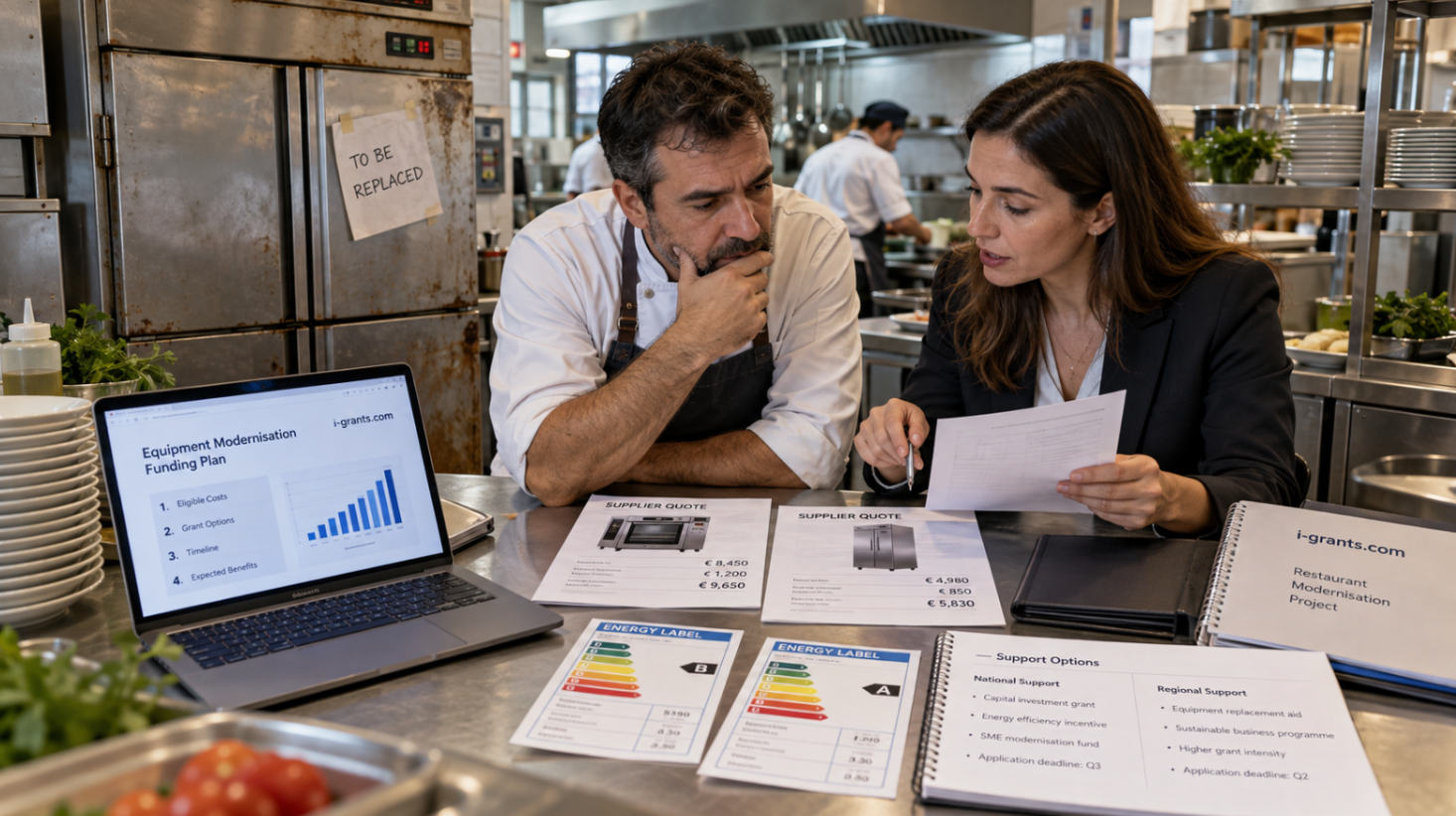
Where equipment has an applicable energy label or recognised efficiency classification, the new unit needs to demonstrate the relevant improvement compared with the equipment being replaced.
Where an appropriate energy label is unavailable, technical evidence may be required comparing the existing and replacement equipment.
The Ministry's guidance provides for an independent technical assessment in relevant cases. The expert should be appropriately qualified and independent from the supplier or installer.
This independence requirement matters.
A manufacturer's advertisement stating that a new machine "uses less energy" is not automatically the same as an independent technical justification acceptable for public funding.
For a restaurant purchasing specialised professional equipment, preparing this evidence early can prevent delays later.
The Old Equipment Normally Has to Leave Service
The logic of the programme also requires the business to demonstrate that the old equipment was genuinely replaced.
Documentation regarding proper removal and treatment of old equipment can therefore be necessary, including transfer to an authorised waste operator where applicable.
This requirement prevents a restaurant from obtaining public funding for an alleged replacement while continuing to use both the old and new units.
From the restaurant owner's perspective, disposal should therefore be planned as part of the project rather than handled as an afterthought.
The supplier may offer removal as part of installation. If so, the restaurant should still ensure that the required documentation is available for the grant file.
More Than the Machine Itself Can Be Eligible
A useful feature of the programme is that eligible expenditure can extend beyond the basic purchase price of the equipment.
Necessary materials, installation work, certain related construction work, removal and proper disposal of replaced equipment and relevant professional technical services can form part of the supported project when they satisfy the official conditions.
The programme also recognises some administrative costs connected with preparing and justifying the application.
Costs related to administrative preparation can be eligible within the programme ceiling, subject to a limit of 4 percent of the relevant underlying replacement expenditure. Costs connected with preparation of final justification can similarly be eligible within the applicable rules, with a limit of 7 percent of the relevant base.
This is relevant to a restaurant owner who needs professional assistance with the application.
The programme permits representation by an authorised consultancy or other representative. Assistance with grant preparation can therefore be incorporated into the project within the official limits when correctly invoiced and documented.
It does not mean that every advisory fee will automatically be reimbursed. The service must satisfy the programme rules and remain within the applicable limits.
A Restaurant May Already Have Purchased the Equipment
One unusual and potentially useful feature of the national programme is that certain eligible expenditure can date back to 1 March 2026, even though the application period opened later.
That means a restaurant that already replaced eligible equipment earlier in 2026 should not automatically assume it is too late to seek support.
However, earlier expenditure is not automatically eligible simply because it occurred after 1 March.
The business still needs to demonstrate compliance with the technical, payment, documentation and programme requirements.
Where equipment has already been acquired, invoices and evidence of payment become central. Where the investment has not yet been completed, the application can rely on a sufficiently detailed supplier quotation or budget according to the programme procedure.
This is different from programmes such as INNOVAE, where beginning the project before the application is submitted can destroy eligibility.
Restaurant owners therefore need to understand the timing rule of the specific programme rather than applying one general "never buy before applying" rule to every Spanish subsidy.
Demand Is Already Greater Than the Entire Programme Budget
The strongest warning for anyone reading this article in late September 2026 is not about technical eligibility. It is about available money.
Applications opened on 5 August 2026 at 10:00.
By 10 August, the Ministry had received 1,886 applications requesting €18,432,764.22.
The entire programme budget is only €15 million.
This does not prove that €15 million has already been legally awarded.
Requested aid is not the same as approved aid. Some applications may be incomplete, rejected, withdrawn or granted at a different amount.
But the figures demonstrate one fact clearly: demand exceeded the programme budget in requested amounts only days after opening.
That dramatically changes the practical meaning of an "open" application period.
At the time of this article's review, the official portal continued to show the application window running until 30 September 2026 at 15:00 unless funds were exhausted earlier. A restaurant submitting late in September should therefore understand that being technically able to send an application does not guarantee that budget remains available for it.
Complete Applications Have a Major Advantage
The programme is not a conventional competition in which a committee scores every restaurant and funds the "best" projects.
Applications are processed according to the order in which complete applications are received, until the available budget is exhausted.
This makes document completeness especially important.
If a restaurant submits an incomplete application and later has to provide a missing document, its relevant position may be determined when the application becomes complete rather than when the first incomplete submission was made.
In a programme where requested funding exceeded the entire budget within days, that difference can be financially decisive.
For a restaurant owner, speed therefore matters, but completeness matters more than rushing an unfinished file into the system.
Requested, Approved and Paid Amounts Are Different
The €18.43 million figure should not be described as €18.43 million already awarded.
Public funding passes through several stages.
An applicant requests an amount. The administration examines eligibility. A decision may approve all, part or none of the request. The award can then become subject to implementation and justification. Payment follows after the relevant conditions are met.
The same distinction applies when discussing beneficiaries.
An announced or awarded grant is not necessarily money already transferred and finally retained by the business. If implementation is incorrect or documentation is insufficient, the final payable amount can change.
For an expert funding article, this distinction is essential because headline grant statistics often combine stages that are legally and financially different.
How Payment Works
The hospitality equipment programme is not simply an advance payment that restaurants receive before visiting a supplier.
After an award, the restaurant generally has one month to complete and pay for the supported investment under the programme timetable.
It then has 15 calendar days after the implementation period to submit the required justification.
Payment is made after the administration verifies that the investment was correctly implemented and documented.
The restaurant may therefore need sufficient cash or external financing to pay invoices before receiving the grant.
This can become significant even with a maximum grant of €11,000.
Suppose a restaurant purchases eligible equipment costing €15,000 plus VAT and expects the maximum €11,000 grant. The business may still need to finance the full supplier payment first and wait for reimbursement.
The funding rate does not eliminate the need for liquidity.
What a Restaurant Should Prepare Before Applying
The documentation burden is smaller than for a million-euro building renovation, but it is still substantial.
The application may require evidence of business registration, an official document confirming the applicable CNAE classification, information describing the establishment and activity, representation documents where another party files the application, and a sufficiently detailed supplier invoice or quotation.
Technical evidence of energy improvement is also critical.
After implementation, the file can require invoices, payment evidence, confirmation of installation, technical documentation and evidence regarding removal or disposal of replaced equipment.
A restaurant should therefore treat grant preparation as part of the purchasing process.
Selecting equipment first and asking about documentation after installation can create avoidable problems.
A Simple €10,000 Replacement Scenario
Consider an independent restaurant replacing an old professional refrigerator and dishwasher with qualifying energy-efficient equipment.
Suppose eligible expenditure totals €10,000 excluding VAT.
If the entire €10,000 meets the programme rules, the grant can theoretically cover that amount because it lies between the €5,000 minimum and €11,000 maximum and remains within the potential 100 percent aid intensity.
That does not make the investment automatically grant funded.
The restaurant still needs to demonstrate that the equipment replaces existing units, that the new systems meet the efficiency requirements, that the application is complete, that funding remains available and that implementation and payment documentation satisfy the programme.
A headline statement such as "Spain pays 100 percent of new restaurant equipment" would therefore be materially misleading.
A €25,000 Kitchen Modernisation Scenario
Now consider a restaurant replacing several major pieces of kitchen equipment at a total eligible cost of €25,000 excluding VAT.
Even if all expenditure is technically eligible, the national grant is capped at €11,000 per establishment.
In the simplified example, the restaurant would need to finance at least €14,000 of the eligible cost itself, plus any non-eligible expenditure and the applicable VAT cash-flow requirement.
The programme can therefore make a meaningful contribution to a larger kitchen upgrade without financing the entire project.
The restaurant owner should model the unsupported amount before committing to the purchase.
The National Equipment Grant Is Not the Only Option
For a normal independent restaurant, the €5,000 to €11,000 equipment-renewal scheme is currently the most directly relevant national programme.
But Spain's 2026 energy-funding landscape extends much further.
The INNOVAE programme operated by IDAE opened its first call on 15 September 2026 and accepts applications until 18 November 2026.
Its initial national budget is €115 million.
The money is divided among sustainable mobility, industrial efficiency, deep renovation of tertiary-sector buildings and replacement of large refrigeration generators.
For the restaurant sector, the last two areas are particularly interesting.
However, their scale and technical requirements are radically different from the small hospitality equipment grant.
Table 3. National Funding Routes for Different Restaurant Investment Scales
| Restaurant project | Most relevant route | Main limitation |
|---|---|---|
| Replacement of existing energy-consuming kitchen equipment | 2026 hospitality equipment Plan de Choque | €11,000 maximum grant and very high demand |
| Purchase of additional equipment without replacing old equipment | Plan de Choque generally unsuitable | Scheme is based on replacement and energy improvement |
| Deep energy renovation of an existing restaurant building | INNOVAE ZEB Terciario | Minimum eligible project cost of €1 million |
| Replacement of a very large central refrigeration installation | INNOVAE refrigeration subprogramme | Minimum 100 kW compressor capacity and €100,000 eligible project cost |
| Replacement of one normal professional refrigerator | Plan de Choque usually much more proportionate | Efficiency improvement and replacement need evidence |
INNOVAE for a Deep Restaurant Building Renovation
One INNOVAE subprogramme supports deep renovation of existing tertiary-sector buildings so that they become zero-emission buildings.
Restaurants, bars, cafés and related hospitality uses can fall within the relevant tertiary building category.
However, this programme is not designed for an ordinary restaurant that wants to replace an oven and several fridges.
The minimum eligible project cost is €1 million.
The maximum grant can reach €3 million per project.
The project needs to combine substantial measures and achieve demanding energy-performance improvements. Among the applicable requirements are a reduction in primary energy consumption of at least 60 percent and final energy savings of at least 20 percent, together with the required post-renovation building energy performance.
A project can potentially combine improvements to the building envelope, ventilation, heating or cooling distribution, internal lighting, control and automation systems, integrated renewable energy and other relevant building systems.
This is a completely different investment from replacing kitchen appliances.
A large restaurant occupying its own substantial building, a major roadside restaurant complex or another large hospitality property undergoing a comprehensive renovation could potentially investigate INNOVAE.
A small rented restaurant in a city centre is unlikely to have a €1 million eligible building project.
How Large Can the INNOVAE Grant Be?
The maximum aid intensity depends on the type of measure, enterprise size and geographic state-aid category.
For energy-efficiency measures in buildings, general maximum rates can reach 45 percent for a large enterprise, 55 percent for a medium-sized enterprise and 65 percent for a small enterprise.
In eligible assisted areas, the maximum can be higher.
Under one regional-aid category, the corresponding maxima can reach 50, 60 and 70 percent. In areas benefiting from the higher regional increase, they can reach 60, 70 and 80 percent respectively.
These figures should never be simplified into "small Spanish restaurants can receive 80 percent".
A small enterprise can only reach the highest rate when the specific investment, location and applicable state-aid conditions support it.
INNOVAE is also competitive. Unlike the hospitality equipment grant, projects are evaluated against one another under a competitive award procedure.
Another major difference is timing. Supported INNOVAE projects must begin after the aid application is registered to preserve the incentive effect of the aid.
A restaurant that begins construction first and applies afterward can therefore destroy its eligibility.
INNOVAE Can Offer an Advance, but There Is a Condition
INNOVAE can provide an advance of up to 80 percent of the awarded grant.
This can significantly improve the cash-flow profile of a large project.
However, the advance requires an appropriate guarantee and compliance with the programme conditions.
A large restaurant project therefore cannot simply assume that 80 percent of the grant will arrive without financial security or administrative preparation.
The maximum implementation period for the deep tertiary-building renovation component is generally 24 months from notification of the award, followed by the applicable justification period.
This timeline reflects the scale of the projects being financed.
Large Refrigeration Projects Have Their Own INNOVAE Route
INNOVAE also dedicates €25 million to projects replacing large refrigeration generators.
This may sound immediately relevant to restaurants because refrigeration is central to food service, but the technical threshold eliminates most ordinary establishments.
The replacement project needs a combined installed electrical compressor capacity of at least 100 kW.
It also needs to achieve final energy savings greater than 20 percent.
The minimum eligible project cost is €100,000, and the maximum grant can reach €2 million.
New refrigeration systems are also subject to requirements concerning refrigerants and global warming potential.
A single restaurant replacing one professional refrigerator is therefore not the intended applicant.
A major hospitality complex, very large kitchen, central production facility or similar operation with a substantial refrigeration system is much more plausible.
This is a good example of why theoretical sector eligibility should never be confused with practical programme suitability.
Galicia Offers a Separate Opportunity for Restaurants, Cafés and Bars
National programmes are only part of Spain's funding landscape.
Autonomous communities can create their own schemes, and in September 2026 Galicia opened a particularly relevant example.
The TU986B programme, Subvenciones para actuaciones de eficiencia energética en empresas turísticas, accepts applications from 7 September 2026 until 7 December 2026 at 20:00, unless the budget is exhausted earlier.
The programme has a budget of €9 million.
Eligible beneficiaries include SMEs operating qualifying tourism accommodation and restaurant establishments in Galicia. Restaurants, cafés and bars are explicitly covered, provided the establishment is properly registered and authorised or classified in the Registro de Empresas y Actividades Turísticas de Galicia, REAT.
That registration requirement is important.
A restaurant operating elsewhere in Spain cannot use the Galicia programme. A Galicia restaurant whose registration details do not correctly correspond to the applicant can also face problems.
What Galicia Can Finance
The Galicia scheme reaches much further into building energy efficiency than the national €11,000 equipment replacement programme.
Eligible measures can include improvements to the thermal envelope, lighting upgrades, solar thermal systems, geothermal energy, biomass, qualifying high-efficiency aerothermal or hydrothermal systems and photovoltaic installations for self-consumption.
An energy audit is required.
The support rate increases with the verified reduction in non-renewable primary energy consumption.
Table 4. Galicia TU986B Grant Rate by Energy Saving
| Verified reduction in non-renewable primary energy consumption | Maximum grant intensity |
|---|---|
| At least 30 percent | 50 percent |
| At least 40 percent | 70 percent |
| At least 50 percent | 90 percent |
This creates a strong incentive for comprehensive energy renovation rather than small isolated changes.
A Galicia restaurant that only replaces one appliance may find the national hospitality equipment scheme more proportionate.
A restaurant that owns a building and plans insulation, heating modernisation, solar energy and other coordinated measures may find TU986B far more relevant.
The two programmes should not be added together casually on the same expenditure. State-aid accumulation and double-financing rules still apply.
The 60 Percent ERDF Figure Does Not Mean Every Galicia Restaurant Receives 60 Percent
Funding documents for the Galicia programme also refer to European Regional Development Fund co-financing of 60 percent.
That figure describes how the public programme itself is financed.
It is not the automatic grant percentage paid to every restaurant.
The beneficiary's actual maximum aid intensity follows the energy-saving structure shown above, with potential rates of 50, 70 or 90 percent depending on the verified improvement and other programme conditions.
This distinction is important because European funding documents often contain several percentages describing different financial relationships.
The percentage used to finance a government programme is not necessarily the percentage awarded to the final business beneficiary.
Galicia Requires Serious Project Preparation
The high potential grant intensity comes with substantial documentation.
Applicants need an energy audit and technical evidence of the existing and proposed energy performance.
Property rights or another valid right to carry out the supported investment need to be documented. Financial information, SME status, project budgets, technical reports and information about linked enterprises can also be required.
Energy certificates before and after the proposed intervention can become part of the file.
For expenditure exceeding certain procurement thresholds, the applicant needs multiple comparable offers. The programme requires three offers where relevant expenditure exceeds €40,000 for works or €15,000 for goods or services, subject to the programme's detailed rules and exceptions.
This means a restaurant should not choose a contractor first and reconstruct the procurement file later.
The grant process needs to be integrated into the investment decision from the beginning.
Navarra Shows That Restaurant Equipment Grants Produce Real Beneficiaries
A previous Navarra programme provides useful evidence that regional energy-efficiency grants for restaurant equipment are not merely theoretical.
The 2025 scheme supported tourism businesses replacing high-energy-consumption equipment and explicitly included restaurants.
It provided assistance equal to 80 percent of eligible investment excluding VAT, subject to the applicable programme limits.
The programme is now closed and should not be presented as a current 2026 opportunity.
Its beneficiary records are nevertheless valuable.
GORRAIZ RESTAURACION SL received an approved grant of €38,994.40 under the programme. ASADOR BODEGAS LEZAUN SL received an approved grant of €6,355.20.
These figures represent awarded grants documented in the official decision.
They should not automatically be described as amounts already paid in full unless separate payment evidence confirms that stage.
The Navarra case also shows that regional programmes can fund amounts considerably above the €11,000 ceiling of the 2026 national equipment-renewal scheme.
That does not make the Navarra terms available to restaurants elsewhere in Spain. It demonstrates why regional funding searches remain important even when a national programme exists.
A Restaurant in Madrid, Galicia and Navarra Can Face Completely Different Funding Options
Spain's decentralised support system means that two otherwise similar restaurants can have very different funding opportunities.
A restaurant in Madrid can examine the national hospitality equipment programme and relevant national energy mechanisms such as INNOVAE.
A restaurant in Galicia can potentially combine the same national search with an assessment of TU986B, provided it satisfies the regional tourism-registration and project requirements.
A restaurant in Navarra should not use the closed 2025 programme as if it were still available, but the historical scheme demonstrates the importance of monitoring new regional calls.
This is why the physical location of the restaurant belongs near the beginning of a funding assessment, not at the end.
A Small Restaurant and a Large Restaurant Need Different Funding Strategies
The scale of the investment changes almost everything.
A family-run restaurant replacing €9,000 of old kitchen equipment does not need a million-euro building programme.
A large restaurant property undertaking a €1.5 million deep energy renovation cannot solve the project with an €11,000 kitchen-equipment grant.
A Galicia restaurant renovating its building may have access to a regional support structure unavailable to both.
Table 5. Practical Funding Routes by Restaurant Investment Size
| Example project | Approximate scale | Funding route to examine first |
|---|---|---|
| Replacement of several old kitchen appliances | €5,000 to €11,000 of eligible support | National hospitality equipment grant |
| Larger kitchen equipment replacement package | €15,000 to €40,000 | National equipment grant for the eligible replacement portion plus own financing or credit |
| Building energy renovation in Galicia | Potentially substantially larger | TU986B if all regional and energy conditions are met |
| Deep energy renovation of a large restaurant building | At least €1 million eligible project cost | INNOVAE ZEB Terciario |
| Large central refrigeration replacement | At least €100,000 eligible project cost and 100 kW compressor threshold | INNOVAE refrigeration component |
This table shows why the word "restaurant grant" is too broad to be useful on its own.
The funding mechanism follows the scale and technical purpose of the project.
What if the Restaurant Wants to Replace an Oven, Dishwasher and Refrigerator Together?
A combined equipment replacement can be sensible under the national hospitality scheme if the machines being purchased genuinely replace existing equipment and satisfy the efficiency requirements.
Grouping several replacements can also help the restaurant reach the €5,000 minimum aid threshold.
However, every element still needs to satisfy the programme.
The business should maintain a clear relationship between each old unit and its replacement, prepare technical evidence where necessary and ensure that invoices and payment records correspond to the approved project.
If one item is an additional expansion purchase rather than a replacement, it should not automatically be included merely because it appears on the same supplier invoice.
A clean cost breakdown can prevent one questionable item from complicating the entire application.
What if the Restaurant Is Opening for the First Time?
The national equipment-replacement programme is much less suitable for a newly opened restaurant purchasing its first kitchen.
Its central logic is replacing existing equipment with more efficient equipment.
A new restaurant that has no old equipment to replace cannot simply use the scheme as a general kitchen start-up grant.
This is an important limitation because search terms such as "restaurant grants Spain" can attract entrepreneurs who have not yet opened their business.
They need a different funding search focused on business creation, regional investment, entrepreneurship programmes, loans or local incentives.
The 2026 hospitality equipment scheme is primarily a modernisation tool for existing operations.
What if the Restaurant Rents the Premises?
For movable kitchen equipment, renting the premises may be less problematic than it is for major building renovation.
However, the business still needs to demonstrate that it is the eligible operator of the establishment.
For building-level programmes such as Galicia TU986B or INNOVAE, property rights become much more important.
A tenant may need a sufficiently strong legal right to carry out the works and maintain the investment for the required period.
A restaurant should therefore distinguish between replacing its own dishwasher and making major structural investments in somebody else's building.
The second project requires a much more careful review of lease terms, owner consent and programme durability requirements.
VAT Needs Separate Attention
The national equipment scheme sets its €5,000 to €11,000 support range excluding VAT.
Restaurant owners should therefore avoid assuming that the grant pays the entire supplier invoice including recoverable tax.
VAT treatment depends on the applicant's tax position and the rules of the relevant scheme.
Even where VAT is not eligible, the restaurant may temporarily need enough liquidity to pay it to the supplier.
The investment budget, eligible grant budget and cash-flow requirement can therefore contain different figures.
That distinction becomes even more important for larger projects.
A Grant Can Still Require Substantial Own Financing
High aid intensity does not mean the business has no financial burden.
The national programme can cover up to 100 percent of eligible expenditure, but the €11,000 ceiling means a larger replacement package requires own funds.
Galicia can theoretically cover up to 90 percent for projects achieving the highest qualifying energy reduction, but the business still needs to finance the unsupported portion and potentially manage significant expenditure before reimbursement.
INNOVAE can provide large grants and even permit an advance under conditions, but million-euro projects require substantial technical, financial and administrative capacity.
Restaurants should therefore calculate the project in at least three ways: total investment cost, eligible expenditure and cash required before public money is received.
Do Not Confuse an Energy Grant With a General Restaurant Renovation Grant
Another common mistake is to assume that once a project improves the restaurant, all renovation expenditure can be included.
An energy-efficiency programme supports costs that are linked to its energy objectives.
Decorative refurbishment, new tables, branding, interior design changes and other commercial improvements do not automatically become eligible because they are completed during the same renovation.
Similarly, INNOVAE does not turn a general restaurant refurbishment into a zero-emission building project simply because new lighting and ventilation are added.
The energy case needs to be technically measurable and central to the investment.
A Restaurant Should Not Artificially Become an "Innovation Project"
INNOVAE includes the word "innovative", but that should not encourage small restaurants to exaggerate ordinary replacement investments.
Replacing an old refrigerator with a commercially available efficient refrigerator belongs much more naturally in the hospitality equipment-renewal scheme.
A genuinely innovative restaurant-building project under INNOVAE operates at a different technical and financial scale.
The strongest application is not the one using the most impressive terminology. It is the one submitted to the programme whose objectives actually match the investment.
Timing Rules Are Different Across Programmes
The equipment Plan de Choque can recognise certain expenditure from 1 March 2026.
INNOVAE requires the supported project to begin after registration of the aid application.
The Galicia programme has its own implementation and eligibility period and should be assessed according to the regional rules.
This difference creates a serious risk for applicants who assume all grants follow the same sequence.
A restaurant that has already ordered equipment may still have a potential route under one scheme but may have disqualified the same expenditure from another.
Every investment decision should therefore begin by checking the "start of works" rule of the intended programme.
A Practical Roadmap for a Restaurant Owner
The most efficient funding strategy begins with the investment rather than the programme name. The owner should determine whether the project is replacing existing kitchen equipment, improving the building, modernising refrigeration or undertaking a complete energy renovation. The physical location of the restaurant comes next because regional support can change the available options substantially.
For a small replacement project, the business should calculate the eligible cost, identify the old and new equipment, prepare evidence of the energy improvement and confirm whether sufficient national budget remains before relying on the grant. For a larger building project, an energy audit and technical feasibility assessment become much more important.
The restaurant should also model VAT, unsupported expenditure, timing of supplier payments and the period before reimbursement. For major projects, state-aid limits and interactions with other subsidies need to be reviewed before costs are allocated to several programmes.
Most importantly, the owner should not begin a project under the assumption that all public programmes permit expenditure before application. The national equipment scheme, Galicia and INNOVAE have different timing structures.
Which Programme Should a Restaurant Check First?
Table 6. Practical Decision Guide for Restaurant Owners in Spain
| Restaurant need | First programme to examine | Key warning |
|---|---|---|
| Replace existing energy-consuming kitchen equipment | National hospitality equipment Plan de Choque | Demand has already exceeded the total programme budget in requested amounts |
| Buy additional kitchen capacity without replacing old equipment | Look beyond the Plan de Choque | The national scheme is fundamentally a replacement programme |
| Improve a restaurant building in Galicia | TU986B | Galicia only, REAT registration and energy audit required |
| Carry out a deep renovation of a large restaurant building | INNOVAE ZEB Terciario | Minimum eligible project cost of €1 million |
| Replace a major central refrigeration system | INNOVAE refrigeration component | Requires at least 100 kW compressor capacity |
| Open a completely new restaurant | Search business creation and regional investment schemes | The national equipment grant is not designed as a start-up kitchen subsidy |
The decision table also illustrates why funding availability cannot be summarised with a single nationwide grant amount.
The Biggest Opportunity Right Now Is Also the Most Time-Sensitive
For a typical existing restaurant, the national equipment-renewal programme is the most immediately relevant opportunity in September 2026.
It has a clear target group, restaurants are directly eligible, the support can reach €11,000 per establishment and the programme can cover a very high share of eligible replacement expenditure.
But its short application window and extraordinary demand make timing critical.
The correct message is not that "€11,000 is still available to every Spanish restaurant until 30 September."
The correct message is that the programme remains formally open according to the latest reviewed status, but requested aid had already exceeded the total budget within the first few days of the application period. Late applicants should therefore verify the live programme status and should be prepared for the possibility of a reserve list or insufficient remaining budget.
This distinction between an open portal and available money is one of the most important lessons in grant research.
Final Takeaway
Spain currently offers one of the clearest restaurant-specific energy funding opportunities in this Business Grant Roadmaps series.
The 2026 hospitality equipment Plan de Choque directly targets the replacement of existing equipment in restaurants and related hospitality businesses. Support ranges from €5,000 to €11,000 per establishment, and the grant can cover up to 100 percent of eligible costs within that limit.
But the programme is not a general restaurant equipment grant. The investment must represent an eligible replacement, the new equipment must improve energy performance, second-hand equipment is excluded, fossil-fuel replacements are not supported, and the restaurant needs adequate technical and financial documentation.
Demand also creates a major practical constraint. By 10 August, applicants had already requested approximately €18.43 million against a programme budget of €15 million. Those are requested rather than approved amounts, but they demonstrate that a technically eligible restaurant should not assume that funding remains available merely because applications are still formally accepted.
For larger investments, Spain offers very different routes.
INNOVAE can support deep renovation of tertiary-sector buildings, including restaurant uses, but its €1 million minimum eligible project cost places it in an entirely different category. A separate INNOVAE component supports large refrigeration replacement projects, but its 100 kW compressor threshold means that it is designed for substantial installations rather than the ordinary refrigerator in a small restaurant kitchen.
Regional programmes can add another layer. In Galicia, eligible restaurant SMEs can currently seek support for building energy-efficiency measures, renewable energy and related investments under TU986B. The potential grant rate can increase from 50 percent to 70 percent and then to 90 percent as verified non-renewable primary-energy savings rise from the relevant 30 percent, 40 percent and 50 percent thresholds.
Historical evidence from Navarra confirms that restaurant equipment schemes can produce substantial real awards. GORRAIZ RESTAURACION SL was approved for €38,994.40 under the region's previous equipment-renewal programme, while ASADOR BODEGAS LEZAUN SL received an approved grant of €6,355.20. Those awards do not make the closed Navarra programme available today, but they demonstrate that regional restaurant-energy support can move from policy documents to actual beneficiary decisions.
The most effective funding strategy therefore depends on the restaurant's real project.
A small business replacing old kitchen equipment should focus first on the national hospitality scheme and its current budget position. A Galicia restaurant planning a deeper building renovation should examine the regional energy programme. A large restaurant property undertaking a million-euro transformation can investigate INNOVAE. A restaurant purchasing extra capacity rather than replacing existing equipment should not force the investment into a replacement grant that was not designed for it.
For businesses that need help distinguishing between these routes, i-grants.com connects applicants with professional grant writers who can assess eligibility, structure project costs, review regional and national programme rules and prepare the required application documentation. i-grants.com does not guarantee that funding will be awarded, but professional preparation can help a restaurant avoid applying to the wrong programme, missing a timing requirement or losing eligibility because an investment was structured incorrectly.