

 Français
  Deutsch
  Українська
France 2030 is often associated with large national calls for deeptech development, collaborative research, decarbonisation, first factories, and strategic industrial investment. However, part of the programme operates through a separate regional structure designed to bring public funding closer to local companies, research organisations, training providers, and industrial ecosystems.
This structure, known as Regionalised France 2030, combines national funding with resources provided by French regions. It supports smaller individual innovation projects, collaborative research and development, shared sector infrastructure, professional training initiatives, and, following an important policy update in July 2026, industrial modernisation and the adoption of advanced technologies.
For French SMEs, startups, industrial companies, clusters, and research partners, the regionalised component can provide a more accessible route than a large national competition. Funding thresholds are often lower, regional priorities are more visible, and applicants generally compete within a defined territorial framework.
Regionalised France 2030 is not a single nationwide grant with identical rules. Each region publishes its own calls, deadlines, eligible sectors, expenditure thresholds, funding forms, and assessment procedures. A programme that is open in Nouvelle-Aquitaine may already be closed in Martinique, use different thresholds in Bretagne, or not yet have launched in another region.
This article explains how the system works, which funding routes are available, how the new industrial modernisation instrument changes the regional funding landscape, and how an SME can identify the most appropriate programme.
Information and call status in this article are current as of 24 July 2026.
What Is Regionalised France 2030?
Regionalised France 2030 is a partnership between the French state and regional authorities. Its purpose is to finance projects that contribute to regional economic transformation while supporting the broader strategic goals of France 2030.
The original public budget for the regionalised component was approximately EUR 1 billion. The state committed EUR 500 million, with regions expected to provide a matching amount. Of the state contribution, EUR 425 million is managed through Bpifrance and EUR 75 million through Caisse des Dépôts and Banque des Territoires.
This shared financing model gives regional authorities an important role in deciding which technologies, sectors, industrial capabilities, and skills should receive support. The priorities may reflect a region’s smart specialisation strategy, industrial base, environmental transition plans, research capabilities, and employment needs.
By 30 June 2025, approximately EUR 525 million had been committed through the regionalised component, supporting about 1,100 projects. Annual reporting published in 2026 also recorded 358 new regionalised laureates during 2025, indicating that implementation continued to expand after the June 2025 reporting date.
The programme became available across metropolitan and overseas French territories after the remaining regional agreements were completed in 2025. However, availability across all territories does not mean that every funding route is continuously open in every region.
Five Funding Routes After the July 2026 Update
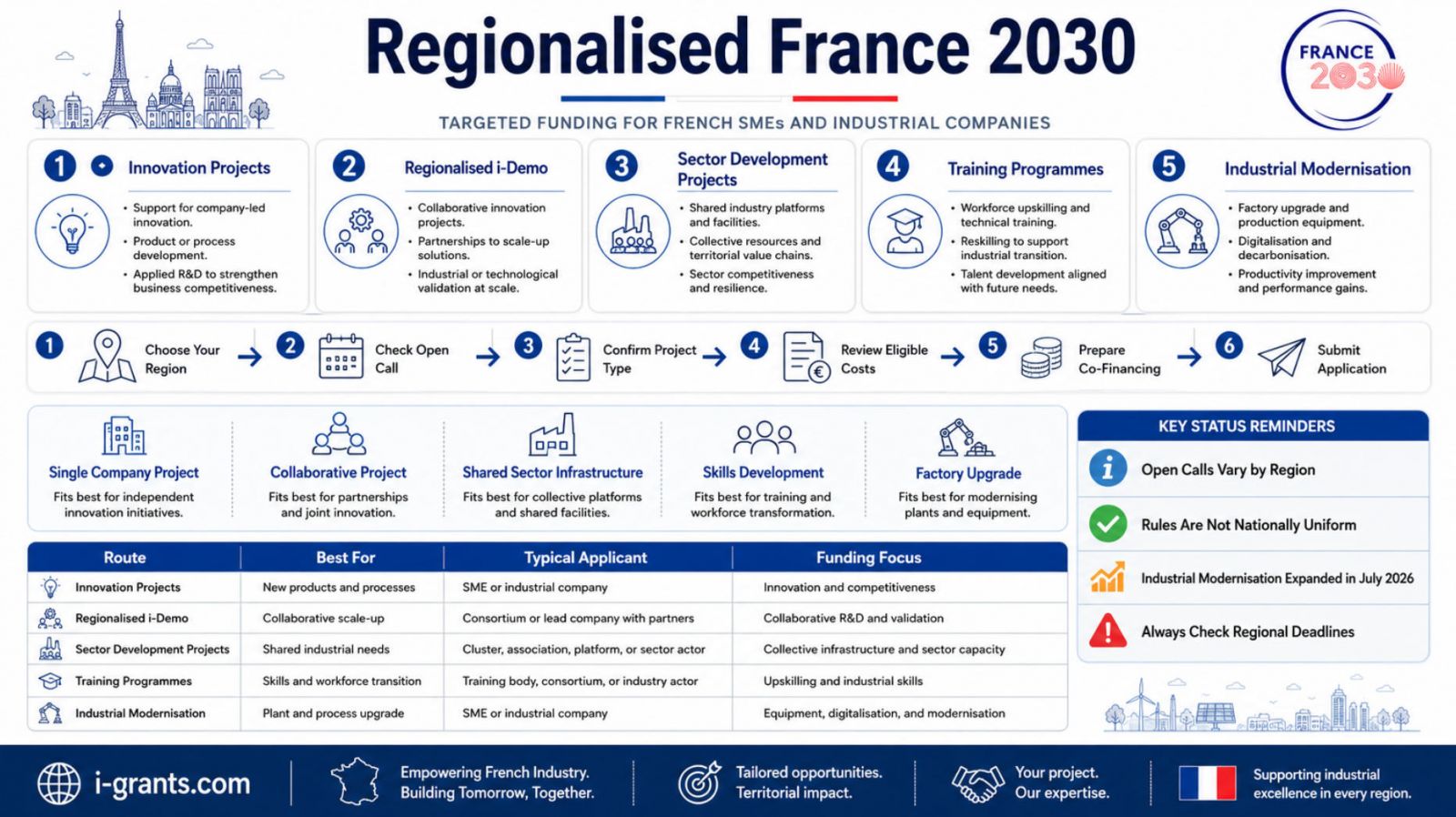
Regionalised France 2030 originally operated through four principal funding routes. On 6 July 2026, the French government and the regions announced a fifth route focused on industrial modernisation and advanced technology adoption.
Table 1. Main Funding Routes Under Regionalised France 2030
| Funding route | Main purpose | Typical applicant | Typical project structure | Main operator |
|---|---|---|---|---|
| Innovation Projects | Development and validation of a new product, process, service, or business model | Individual SME or eligible mid-cap company | Single-company project | Bpifrance |
| Regionalised i-Démo | Collaborative research and experimental development | Consortium of companies and research partners | Multi-partner R&D project | Bpifrance |
| Sector Development Projects | Shared industrial, technological, testing, digital, or research infrastructure | Cluster, sector organisation, company, research body, or consortium | Collective project benefiting a regional sector | Bpifrance |
| Professional Training Engineering | Creation or substantial redesign of training programmes for strategic sectors | Consortium of training providers, companies, professional bodies, and public partners | Partnership-based skills project | Banque des Territoires |
| Industrial Modernisation and Advanced Technology Adoption | Investment in equipment, software, automation, artificial intelligence, digitalisation, and production transformation | Industrial microenterprise, SME, or eligible mid-cap company | Productive investment project | Bpifrance |
The table describes the overall structure, not a single national set of eligibility conditions. Each regional call must be checked separately.
1. Regional Innovation Projects
The Innovation Projects route is generally the most relevant option for an individual SME developing a new product, process, service, or technologically improved business model.
Supported activities may include feasibility studies, technical development, prototyping, testing, industrial validation, software development, intellectual property work, and preparation for market entry. The project must normally contain a credible innovation or transformation component. Routine investment, ordinary commercial expansion, or the replacement of standard equipment is unlikely to qualify.
Regional Innovation Projects often have lower financial thresholds than national France 2030 competitions. In several regions, confirmed aid ranges have been between EUR 75,000 and EUR 500,000. However, this is not a universal national range.
In Nouvelle-Aquitaine, for example, the regional Innovation Projects call provides aid of approximately EUR 75,000 to EUR 500,000 and may cover up to 50 per cent of eligible expenditure. Depending on the project, support may be awarded as a grant, a repayable advance, or a combination of both.
The final scheduled submission date for this Nouvelle-Aquitaine call is 30 September 2026. Bretagne also lists 30 September 2026 as the final submission date for its regional innovation route, even though the wider programme documentation refers to implementation continuing until the end of 2026.
This difference illustrates an important practical rule: applicants must follow the actual submission deadline, not only the general closing date of the regional programme.
2. Regionalised i-Démo
Regionalised i-Démo supports collaborative research and experimental development. It is designed for projects that require several complementary partners, such as technology developers, industrial companies, service providers, universities, laboratories, or research organisations.
A typical consortium includes at least two business partners and one research partner. Regional rules may require the participation of an SME or mid-cap company and may impose additional conditions concerning the location of activities, the distribution of costs, or the composition of the consortium.
The project must be genuinely collaborative. A group of subcontractors working for one lead company is not automatically considered a qualifying consortium. Partners should share technical responsibilities, risks, intellectual property considerations, and expected results.
In several regional calls, eligible projects have had total budgets of approximately EUR 1 million to below EUR 4 million. Projects above that scale may be more suitable for the national i-Démo programme, although applicants must compare the detailed requirements rather than relying only on project size.
Regionalised i-Démo is particularly relevant when a technology requires:
-
several industrial or technical capabilities;
-
substantial experimental development;
-
access to scientific expertise or specialised laboratories;
-
a demonstrator, pilot system, or pre-industrial validation;
-
a clear regional economic and technological impact.
The status of these calls must be checked carefully. Martinique’s regionalised i-Démo call, for example, closed on 1 June 2026. It should not be presented as an open opportunity merely because other Regionalised France 2030 mechanisms in Martinique continue until 31 December 2026.
3. Sector Development Projects
Sector Development Projects support collective assets and services that can strengthen an entire regional ecosystem rather than only one company.
Eligible initiatives may include shared testing facilities, technological platforms, pilot equipment, sector data infrastructure, certification resources, demonstration centres, digital tools, and research capabilities used by several businesses or institutions.
These projects are often led by clusters, industry associations, research organisations, chambers, specialist institutions, or consortia. A private company may participate or lead in some regions, but the proposal must normally demonstrate a broader collective benefit.
The central question is not simply whether the project is innovative. The applicant must show why the proposed facility, platform, or service solves a structural problem for a regional sector.
For example, a shared facility may reduce the cost of product certification for small manufacturers, provide access to equipment that individual SMEs could not afford, or enable several companies to test new materials under industrial conditions.
In Nouvelle-Aquitaine, confirmed examples of the sector development route include projects with more than EUR 400,000 in eligible expenditure and aid ranging from approximately EUR 200,000 to EUR 5 million. These values are specific to the relevant regional framework and should not be treated as standard conditions throughout France.
Île-de-France applies the regionalised approach through mechanisms including SESAME Filières. By April 2026, SESAME Filières had mobilised EUR 41.35 million for 36 projects. Two additional projects announced in April 2026 received a combined EUR 2.85 million.
One of them, InduSPRINT, is developing full-scale continuous and batch production lines that can be used as a testing environment for future industry technologies. Another, LuminEdge, is creating a territorial demonstrator in photonics and optics and received EUR 1.65 million in grant funding.
These examples show that sector development support can finance expensive shared technological resources when the benefit extends beyond one commercial beneficiary.
4. Professional Training Engineering
The Professional Training Engineering route supports the design or substantial transformation of training programmes needed by strategic regional industries.
It is not primarily a subsidy for paying the ordinary training costs of individual employees. Instead, it finances the creation of new educational capacity, new qualifications, redesigned curricula, specialist technical training, digital learning tools, training equipment, and partnerships between employers and training providers.
Eligible projects usually involve a consortium. Participants may include universities, vocational schools, training organisations, companies, industrial clusters, professional associations, public bodies, and research institutions.
A strong proposal must connect the training programme to an identified labour market need. Applicants should demonstrate that companies cannot recruit the required skills, that existing courses are outdated or insufficient, and that the proposed programme supports a concrete regional industrial or technological strategy.
In Centre-Val de Loire, the Campus Pyrotechnie du Futur project provides a practical example. The initiative is intended to modernise initial and continuing professional training for the pyrotechnics sector through new teaching methods and closer alignment with industry requirements.
Bretagne currently lists a Professional Training Engineering route extending to 31 December 2027. Its procedure involves staged submission and periodic selection rounds. Applicants therefore need to prepare for a partnership-building and project-design process that may be more complex than a standard company grant application.
5. Industrial Modernisation and Advanced Technology Adoption
The fifth route is the most important recent development in the regionalised programme.
On 6 July 2026, the French state and the regions officially launched a new funding axis for industrial modernisation and the adoption of advanced technologies. The purpose is to help industrial microenterprises, SMEs, and eligible mid-cap companies invest in productive assets that improve competitiveness, resilience, digital maturity, environmental performance, or technological capability.
The new mechanism addresses a funding gap between research-oriented innovation programmes and large first-factory schemes. A company may already have a functioning production site and a proven market, but still need support to introduce robotics, artificial intelligence, advanced software, new manufacturing systems, or more efficient equipment.
Two broad categories of projects are expected:
-
investment in equipment and software that produces a substantial technological, digital, or environmental transformation;
-
larger projects involving production-line modernisation, capacity expansion, diversification, or the creation of a new industrial activity.
Grand Est is the first region to implement this new route. The initial regional budget is EUR 8 million, financed equally by the state and the region. Applications are scheduled to open on 1 October 2026.
Therefore, as of 24 July 2026, the Grand Est programme is officially announced but not yet open for submission.
Table 2. Confirmed Conditions for the Grand Est Industrial Modernisation Pilot
| Applicant or project type | Minimum eligible expenditure | Maximum support intensity | Main form of support |
|---|---|---|---|
| SME investing in advanced equipment or software | EUR 100,000 | Up to 30 per cent | Grant |
| Eligible mid-cap company investing in advanced equipment or software | EUR 300,000 | Up to 30 per cent | Grant |
| Larger modernisation, capacity, diversification, or new activity project | EUR 400,000 | Up to 30 per cent | Grant |
Potentially eligible expenditure includes industrial machinery, production equipment, specialist software, technology integration into existing machinery, and leasing arrangements that include a mandatory purchase obligation.
Employee costs, land, buildings, equipment already ordered, and simple replacement of existing machinery without a meaningful technological improvement are not expected to qualify.
Priority areas in Grand Est include metallurgy, steelmaking, forging, foundry activities, defence, nuclear and strategic energy industries, cybersecurity, reshoring, and the rebuilding of domestic supply chains.
Other French regions are expected to introduce their own versions from autumn 2026, but their budgets, thresholds, priority sectors, and opening dates should not be assumed until official regional documentation is published.
Current and Announced Regional Opportunities
Regionalised France 2030 requires close attention to dates. A programme may be active at the regional level while one of its individual calls has already closed. Another call may be officially announced but not yet accept applications.
Table 3. Selected Regionalised France 2030 Opportunities as of 24 July 2026
| Region and route | Status | Confirmed date | Main conditions or observations |
|---|---|---|---|
| Nouvelle-Aquitaine, Innovation Projects | Open | Final submission date: 30 September 2026 | Aid generally between EUR 75,000 and EUR 500,000, potentially covering up to 50 per cent of eligible expenditure |
| Bretagne, Innovation Projects | Open | Final submission date: 30 September 2026 | Aid generally between EUR 75,000 and EUR 500,000 |
| Bretagne, Professional Training Engineering | Open | Programme runs until 31 December 2027 | Partnership-based training projects, staged procedure |
| Martinique, Innovation, Sector Development, and Training routes | Open under the regional framework | Up to 31 December 2026 | Combined regional budget of approximately EUR 8.3 million |
| Martinique, Regionalised i-Démo | Closed | Closed on 1 June 2026 | Should not be presented as a current call |
| Grand Est, Industrial Modernisation | Announced, not yet open | Applications scheduled from 1 October 2026 | Grant of up to 30 per cent, with minimum expenditure depending on applicant and project type |
The examples above are not a complete national call list. Applicants should use them to understand the structure and variation of the programme, then verify the current position in their own region.
Regional Results and Supported Projects
Regionalised France 2030 has already financed projects across artificial intelligence, manufacturing, medical technology, energy, defence, robotics, materials, photonics, professional training, and environmental transition.
However, regional statistics should not be used as a simple league table. Regions launched calls at different times, received different budgets, selected different priorities, and may report approvals, commitments, or signed agreements using different methods.
Table 4. Selected Regional Results
| Region | Reporting date | Confirmed result |
|---|---|---|
| Nouvelle-Aquitaine | May 2026 | 22 projects supported with approximately EUR 5.5 million in public aid |
| Île-de-France, SESAME Filières | April 2026 | EUR 41.35 million mobilised for 36 projects |
| Centre-Val de Loire | March 2026 | 68 laureates, EUR 25.9 million in aid, and EUR 68.3 million in total project investment |
| Auvergne-Rhône-Alpes | September 2025 | 71 projects and EUR 37.5 million in committed support |
The Centre-Val de Loire figures are particularly useful for understanding leverage. EUR 25.9 million in public aid was associated with EUR 68.3 million in total investment by supported projects. This suggests that beneficiaries contributed substantial co-financing, although the precise structure differed between projects.
In Nouvelle-Aquitaine, four projects announced in May 2026 received EUR 828,000 for almost EUR 2.7 million in planned investment.
Alouette AI is developing specialised generative artificial intelligence for engineering calculations in sectors including energy, aerospace, and defence. Guyenne Plastique is working on new high-performance plastic components and industrial assembly applications. Holis Consulting is developing artificial intelligence software for industrial inspection and predictive maintenance. Skydrone Robotics is developing a robotic drone for maintaining high-voltage cables without interrupting electricity transmission.
These are confirmed funding decisions. Forecasts concerning future energy savings, market growth, job creation, technical performance, or avoided failures should still be described as company or project objectives until they are independently verified.
How Regionalised Funding Differs From National France 2030 Calls
The regionalised component does not replace national programmes. It creates additional routes for projects that are smaller, more territorially focused, or closely connected to a regional ecosystem.
Table 5. Choosing Between Regional and National France 2030 Instruments
| Project situation | Potentially suitable route |
|---|---|
| One SME is developing a new product and requires up to approximately EUR 500,000 in public aid | Regional Innovation Project |
| Several companies and a laboratory are conducting a collaborative R&D project with a budget of approximately EUR 1 million to below EUR 4 million | Regionalised i-Démo |
| A consortium wants to create a shared testing facility, technology platform, or sector service | Sector Development Project |
| A regional industry needs a new specialist training programme | Professional Training Engineering |
| An existing factory needs robots, software, artificial intelligence, or advanced production equipment | Regional Industrial Modernisation route |
| A large consortium has at least EUR 4 million in eligible collaborative R&D expenditure | National i-Démo may be more appropriate |
| A young innovative company plans its first factory or first industrial production line with more than EUR 5 million in eligible expenditure | Première Usine may be more appropriate |
The table is a screening tool, not an eligibility decision. A project’s sector, technology readiness, location, applicant structure, financial capacity, and regional relevance must also be considered.
Who Can Apply?
Eligibility varies by route and region. Individual Innovation Projects and the new industrial modernisation route are generally intended for companies, particularly SMEs and, where permitted, mid-cap companies.
Regionalised i-Démo requires a consortium. Sector Development Projects may be submitted by companies, clusters, associations, research organisations, sector bodies, or partnerships. Professional Training Engineering normally requires cooperation between training providers, employers, and other relevant institutions.
Companies should usually be financially sound and capable of funding the part of the project not covered by public support. A grant award does not remove the need for working capital, bridge financing, shareholder funding, loans, or other private resources.
A French establishment is generally required, and the funded activities must produce a meaningful economic, industrial, technological, or employment effect in the relevant region.
Regional authorities may also require alignment with documents such as the regional economic development strategy, smart specialisation priorities, industrial roadmaps, or environmental transition plans.
Eligible Expenditure and the Project Start Rule
Eligible expenditure depends on the funding route.
Innovation and collaborative R&D projects may include personnel, subcontracted research, prototypes, testing, intellectual property, equipment depreciation, technical studies, and other development costs.
Sector projects may include equipment, shared facilities, digital infrastructure, technical platforms, and project coordination. Training projects may include curriculum design, educational engineering, specialist equipment, digital content, and pilot delivery.
Industrial modernisation support is more directly focused on productive investment, including machinery, specialist software, automation, robotics, artificial intelligence systems, and technology integration.
One rule is especially important: the project must have an incentive effect.
Applicants should not place binding equipment orders, sign irrevocable supplier contracts, or begin funded work before the application has been formally submitted in accordance with the call rules. Expenditure committed too early may become ineligible even if the project itself would otherwise have qualified.
The exact definition of project start must be checked in the regional call documentation. Preliminary discussions, internal planning, and non-binding quotations may be allowed, while a signed purchase order may disqualify the related expenditure.
How Projects Are Assessed
Although assessment criteria differ between calls, regional authorities and programme operators generally examine several recurring dimensions.
A strong application must demonstrate technical credibility, economic value, financial capacity, regional impact, environmental responsibility, and a realistic implementation plan.
For collaborative projects, evaluators also examine the quality of the consortium, the necessity of each partner, the division of work, intellectual property arrangements, and the capacity of each participant to finance its responsibilities.
For sector development projects, collective benefit is central. A proposal should explain how several businesses, institutions, or users will access the funded infrastructure or service.
For professional training projects, the application should include evidence of an actual skills shortage and formal participation from employers that need the new competencies.
For industrial modernisation, applicants should quantify the expected improvement. Relevant indicators may include production capacity, energy consumption, scrap rates, lead times, product quality, supply-chain resilience, automation levels, and the number of operations brought back to France.
A Practical Application Process
An SME considering Regionalised France 2030 can use the following sequence:
-
Identify the region where the investment, research work, infrastructure, or training activity will take place.
-
Determine whether the project is individual, collaborative, sector-wide, training-related, or focused on productive modernisation.
-
Compare the regional route with national programmes such as i-Démo, i-Nov, or Première Usine.
-
Verify the actual submission deadline, intermediate selection dates, eligible expenditure threshold, and funding form.
-
Contact the regional operator before committing expenditure, particularly when the project structure or eligibility is uncertain.
-
Prepare evidence of innovation, regional impact, co-financing, environmental performance, implementation capacity, and measurable outcomes.
Early contact with Bpifrance, Banque des Territoires, the regional authority, or the organisation named in the call can help identify structural weaknesses before a formal application is submitted.
However, an initial discussion does not replace written eligibility confirmation or the official call documentation.
Common Mistakes
Applicants frequently weaken otherwise promising projects by making avoidable procedural or strategic errors:
-
Treating Regionalised France 2030 as one national programme with identical rules.
-
Relying on an old press release instead of the current call specification.
-
Confusing the programme end date with the final application deadline.
-
Ordering equipment or starting work before formal submission.
-
Applying alone to a route that requires a genuine consortium.
-
Selecting a large national programme when a lower-threshold regional route is better matched to the project.
A further mistake is describing ordinary investment as innovation. A standard machine purchase, routine software upgrade, or normal capacity increase may not qualify unless it creates a measurable technological, environmental, digital, or strategic transformation.
Results Versus Forecasts
Public announcements often combine confirmed funding decisions with projected company outcomes.
A confirmed result may include the identification of a laureate, the amount of public support, a signed financing agreement, or the opening of a funded platform.
Future employment, exports, energy savings, production capacity, patents, revenue, and market share remain forecasts until achieved.
An expert application or article should therefore use precise language. Phrases such as “the company expects,” “the project aims to,” and “the facility is intended to” should be used for future outcomes.
This distinction is particularly important when evaluating recently selected industrial or technology projects that have not yet completed implementation.
The Wider France 2030 Context
Regionalised France 2030 operates within the broader national investment plan.
Official reporting published in July 2026 indicated that approximately EUR 44 billion had been directed to France 2030 projects, including almost EUR 17 billion related to industry. Across the entire plan, each euro of public funding was associated on average with an additional EUR 1.30 in private resources.
Supported industrial companies recorded an average increase of 27 per cent in industrial capital expenditure, while France 2030 projects are expected to avoid approximately 21 million tonnes of carbon dioxide equivalent by 2030.
These figures describe France 2030 as a whole. They should not be attributed solely to its regionalised component.
The broader results nevertheless explain why regional implementation matters. France 2030 is not limited to research grants. It is increasingly being used to connect innovation, industrial investment, regional ecosystems, professional skills, and environmental transformation.
Final Assessment
Regionalised France 2030 has become an important funding route for French SMEs that may be too small for major national competitions but still have credible innovation, industrial, collaborative, or sector-development projects.
Its main advantage is territorial adaptation. Regions can support projects that correspond to their own industrial strengths, research capabilities, environmental priorities, and labour market needs.
Its main difficulty is fragmentation. There is no single set of deadlines or financial conditions. Applicants must analyse the correct regional call, confirm its current status, and compare it with national programmes.
The July 2026 industrial modernisation route makes the system significantly more relevant to existing manufacturers. Regional support is no longer focused only on developing new technologies or creating shared ecosystems. It can also help established industrial companies adopt advanced equipment, robotics, artificial intelligence, digital systems, and more resilient production methods.
For an SME, the best starting point is not to ask, “Is there a France 2030 grant for my company?” The more useful questions are:
-
What type of project are we financing?
-
In which region will the economic impact occur?
-
Is the project individual or collaborative?
-
Are we developing technology, building shared infrastructure, creating training capacity, or modernising production?
-
Which regional and national route offers the most appropriate threshold, timetable, and funding structure?
Answering those questions early can prevent an applicant from spending months preparing for the wrong programme.
Companies that need specialist support can also work with an experienced grant writer to assess programme fit, structure a consortium, calculate eligible expenditure, prepare the financing plan, and translate technical objectives into a credible regional economic case.