

 Français
  Deutsch
  Українська
Corporate grants are not always accessible through conventional application forms. Some American companies fund European nonprofit organisations through invitation-only foundations, local partnerships, or specialised programmes administered by independent organisations. Understanding these differences is essential for applicants seeking funding for environmental protection, youth development, refugee integration, and community projects.
Patagonia, New Balance, and Levi Strauss & Co. illustrate three distinct approaches to corporate philanthropy.
Patagonia supports grassroots environmental organisations working on long-term conservation campaigns. New Balance Foundation invests in youth development through sport, education, health, and employment opportunities. Levi Strauss Foundation supports organisations working on human rights, immigrant inclusion, and the rights and well-being of workers, while Levi Strauss & Co. operates additional community initiatives involving its employees.
All three brands have documented funding relationships with European organisations. However, the existence of past grants does not mean that their programmes are currently accepting applications.
As of September 17, 2026, Patagonia's grant application process in Europe, the Middle East, and Africa is paused. New Balance Foundation and Levi Strauss Foundation operate their principal grantmaking programmes by invitation. Nevertheless, New Balance's Futures in Motion Poland programme conducted an open competition in 2025 and announced its recipients in March 2026.
This distinction creates an important practical lesson: a foundation's general application policy does not necessarily describe every specialised programme operating under its name.
This article examines official programme rules, financial results, documented European recipients, application restrictions, and the differences between cash grants, partnership assistance, and in-kind donations.
1. Three American Brands, Different European Funding Models
Patagonia, New Balance, and Levi Strauss operate in the consumer apparel and footwear industry, but their philanthropic priorities are substantially different.
Patagonia's environmental grantmaking focuses on grassroots organisations addressing the underlying causes of environmental problems. Its international programme favours strategic campaigns with identifiable objectives and measurable results rather than isolated activities.
New Balance Foundation uses sport as a means of supporting broader youth development. Its funding addresses physical health, education, social inclusion, career preparation, and opportunities for young people facing barriers to participation.
Levi Strauss Foundation supports organisations working in its designated social and human rights fields. Its funding model relies on identifying and inviting suitable partners rather than accepting applications from every interested nonprofit.
The companies also operate additional mechanisms that should not be confused with their main foundations.
Patagonia has local retail partnerships. New Balance supports specialised international programmes implemented through Beyond Sport. Levi Strauss & Co. provides corporate community grants connected with employee participation.
Each mechanism has its own eligibility conditions, geographical scope, funding arrangements, and application procedures.
Table 1. Patagonia, New Balance, and Levi Strauss Grant Programme Comparison
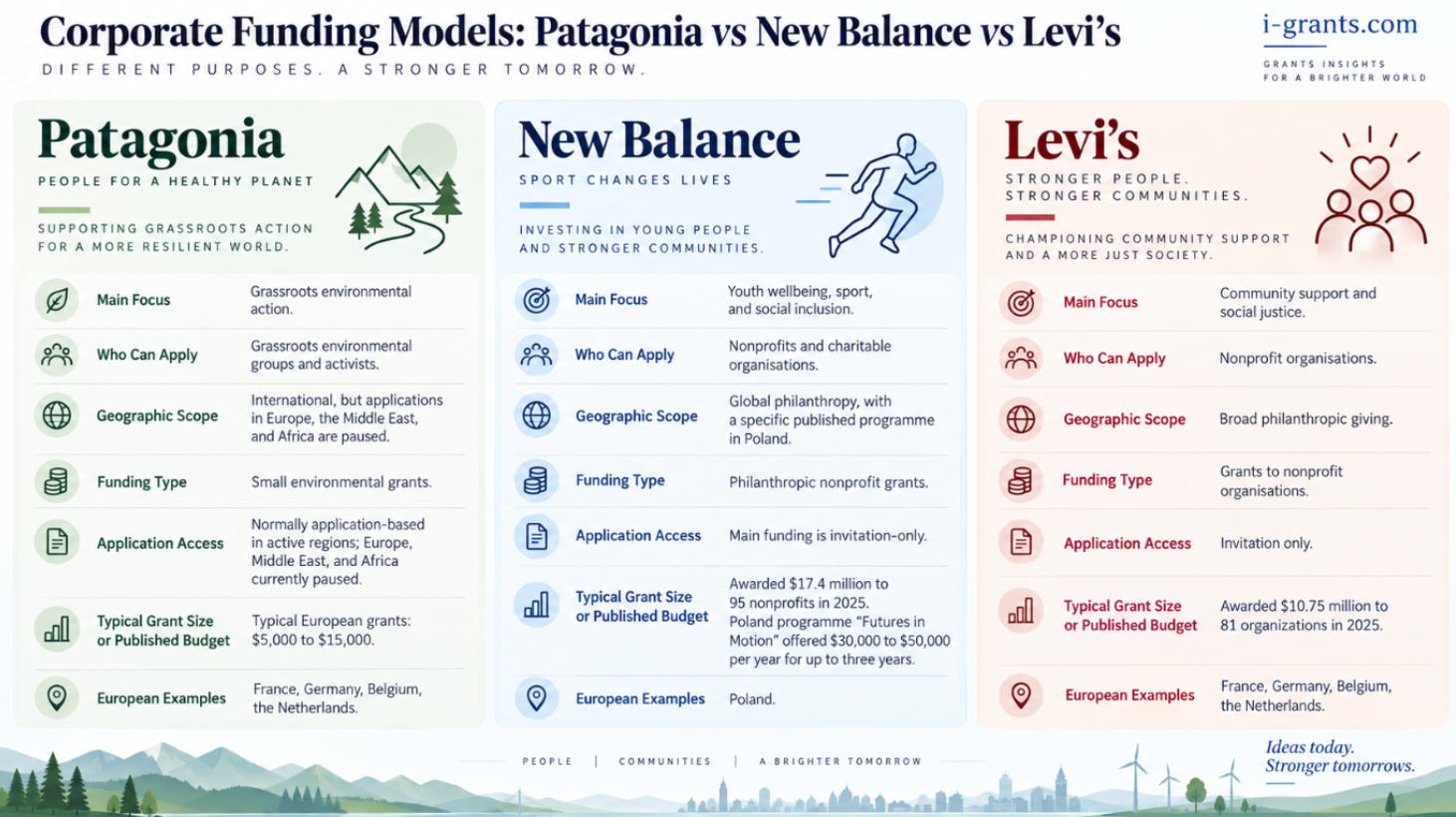
| Programme | Main funding priorities | European eligibility | Published funding | Application status as of September 17, 2026 |
|---|---|---|---|---|
| Patagonia International Grants | Grassroots environmental campaigns and long-term conservation | Environmental activities in specified eligible countries, including France, Germany, Spain, Czechia, and the United Kingdom | Typical European grant: $5,000–$15,000 | Applications in Europe, the Middle East, and Africa are paused |
| Patagonia Retail Partnerships | Local environmental organisations in communities where Patagonia stores operate | Depends on the individual store and local partnership arrangements | No universal amount published | Separate from International Grants; availability must be checked locally |
| New Balance Foundation | Youth health, education, sport, career development, and inclusion | Eligible charitable organisations in countries within the foundation's geographical portfolio | $17.4 million awarded to 95 nonprofits worldwide in 2025 | Main programme operates by invitation |
| Futures in Motion Poland | Youth development through sport and physical activity | Eligible Polish nonprofit organisations serving children and young people up to age 26 | $30,000–$50,000 annually for up to three years; maximum $150,000 per recipient | Open competition closed September 30, 2025; recipients announced in March 2026 |
| Sport Together Fund | Sport-based inclusion for refugees, migrants, and displaced communities | Documented recipients in France, Germany, Spain, and the Netherlands | Grants and organisational development support; individual European award amounts not published in the relevant announcement | Partnership programme; a generally open current application route is not established |
| Levi Strauss Foundation | Human rights, immigrant rights, reproductive justice, democracy, and apparel worker well-being | Selected organisations aligned with the foundation's priorities in countries connected to the company's operations | $10.75 million awarded worldwide in 2025; no universal individual grant range | Invitation-only |
| Levi Strauss & Co. Community Day | Community initiatives connected with employees and nonprofit partners | Documented European recipients, including organisations in France and Greece | $200,000 for 50 nonprofits worldwide in 2024; more than $500,000 in global grants announced in 2025 | Corporate and employee-linked mechanism; no general open competition confirmed |
The figures in this table describe different financial categories.
Patagonia's typical grant size is an amount available under a particular programme. The $17.4 million reported by New Balance Foundation represents worldwide annual funding. Levi Strauss Foundation's $10.75 million similarly describes its global grantmaking rather than funding reserved for Europe.
These figures should not be compared as though they represent the same type of budget.
The European programmes are also not equally accessible. A nonprofit should establish the availability of a specific application route before treating a historical funding example as an actionable opportunity.
2. Patagonia International Grants: Environmental Funding Beyond Conventional Conservation Projects
Patagonia has supported grassroots environmental organisations since 1985 and commits one percent of its sales to environmental initiatives.
Unlike programmes that finance a broad range of corporate social responsibility activities, Patagonia concentrates its grantmaking on organisations undertaking practical environmental action.
Its international programme supports grassroots activist organisations conducting strategic campaigns to protect the natural environment.
The foundation looks for projects that address the underlying causes of environmental problems and demonstrate a commitment to long-term change.
Applicants are expected to present clearly defined goals, an implementation strategy, and indicators that allow progress to be evaluated.
This makes the programme different from a general subsidy for environmental education or an isolated community clean-up event.
For example, an organisation seeking support to protect a threatened river should demonstrate how its proposed activities contribute to an established conservation strategy, rather than relying solely on the general importance of river protection.
The strength of the connection between activities, objectives, and anticipated environmental outcomes is central to the programme's published approach.
Geographical eligibility in Europe
Patagonia's international grant rules identify specific countries in which eligible environmental activities may take place.
The European countries listed include Austria, Belgium, Czechia, Denmark, France, Germany, Ireland, Italy, Luxembourg, the Netherlands, Norway, Spain, Sweden, Switzerland, and the United Kingdom.
The programme also operates in designated countries outside Europe.
An organisation must operate for environmental and public benefit. It or its fiscal sponsor must maintain an appropriate bank account in the name of the relevant organisation.
Activities funded through International Grants must take place outside the United States.
A US-based organisation implementing an eligible international project may potentially qualify, but its proposed programme activities must still satisfy the international programme's geographical requirements.
The list of eligible countries should not be interpreted as covering every European country.
Furthermore, previous support for a multinational campaign does not automatically establish that organisations in every country involved in that campaign can apply under the current rules.
Grant amounts and application frequency
Patagonia's European funding guidance identifies a typical grant range of $5,000 to $15,000.
The programme generally permits one proposal per organisation during a financial year, which runs from May 1 to April 30.
Applications are assessed by an employee grants council in Europe.
The amount requested should correspond to the proposed work and its realistic implementation costs.
However, the published range is not a guarantee of funding, and it does not establish an automatic entitlement to a minimum grant of $5,000.
The distinction between a typical amount and a guaranteed award is important for organisations preparing budgets.
Current application status
Patagonia states that applications for grants in its Europe, Middle East, and Africa region are currently paused.
The company has not published a confirmed date for restarting the regional application process.
Its wider environmental giving programme is also described as invitation-based, with the company identifying potential partners.
Consequently, an eligible organisation should not assume that it can submit a new application immediately simply because the international funding guidelines remain accessible.
The published criteria are useful for understanding Patagonia's funding priorities and preparing for possible future opportunities. They do not constitute evidence of an open competition in September 2026.
3. What Patagonia Does Not Fund: Important Eligibility Restrictions
Patagonia's funding restrictions are particularly significant because several activities commonly associated with environmental nonprofits are not automatically suitable for its grants.
Under the International Grants Program, funds cannot be used to purchase buildings, land, vehicles, or boats.
Repairs, renovations, remodelling, and similar improvements to property are also excluded from the international programme's eligible expenditure.
An organisation seeking to purchase a conservation vehicle or renovate an environmental education centre would therefore face a fundamental mismatch with these conditions.
The company also restricts the use of international grant funds for lobbying specific legislation, electoral campaigning, and certain candidate-related activities.
General public education on environmental issues may be permitted under the programme's rules, but the permitted use of funds must be distinguished from restricted political expenditures.
Another important restriction appears in Patagonia's general grantmaking criteria.
The company excludes organisations whose programming is concentrated at 50 percent or more in certain activities, including beach clean-ups, trail building, tourism, habitat restoration, research or citizen science, and general environmental education that is not connected to a specific campaign or public action.
This is not equivalent to saying that any organisation conducting one of these activities is automatically excluded.
The restriction concerns the concentration of an organisation's programming, while the programme's wider criteria emphasise strategic environmental action.
A nonprofit that conducts occasional clean-ups as part of a broader environmental campaign may therefore present a different eligibility profile from an organisation whose activities consist primarily of isolated clean-up events.
The same distinction applies to research.
Collecting scientific data can contribute to environmental protection, but a grant proposal should explain how the research supports a defined plan of action.
For grant writers, these rules demonstrate why a project's environmental relevance must be assessed separately from its compatibility with the funding programme.
4. Patagonia's Financial Results and Documented European Environmental Support
Patagonia's 2025 Work in Progress Report provides financial information about the company's broader environmental giving.
For the 2025 financial year, Patagonia reported $14.7 million in grants and in-kind support distributed to 824 nonprofit organisations through its environmental giving programme.
It also reported approximately $240 million in cumulative environmental grants since the company's founding.
The $14.7 million figure includes both grants and assistance provided in kind. It must not be described exclusively as money transferred to nonprofit bank accounts.
Similarly, the 824 organisations represent the worldwide recipient population, not the number of European grant beneficiaries.
These distinctions matter when comparing the company's financial results with those of foundations that report only cash grants.
Save the Blue Heart of Europe: a documented European campaign
Patagonia's support for Save the Blue Heart of Europe provides a concrete example of its involvement in European environmental protection.
In a publication dated August 3, 2016, Patagonia stated that its European operations had supported the campaign through grants and communications assistance.
The campaign sought to protect wild rivers in the Balkans from proposed hydropower development.
Its activities included raising awareness about threats to rivers such as Albania's Vjosa and bringing together conservation organisations, campaigners, and local communities.
Patagonia subsequently continued to document its involvement with European river protection initiatives.
This is evidence of an established European environmental funding relationship, but the amount of the individual grant was not disclosed in the verified publication.
It would therefore be inappropriate to assign the campaign Patagonia's typical grant amount or to describe a specific figure as an actual award.
The case also illustrates the difference between historical project support and current country eligibility.
Albania does not appear in the published list of eligible countries under the international programme examined here. Support for a regional campaign does not automatically override the programme's current geographical restrictions.
Retail partnerships operate differently
Patagonia's local retail partnerships provide another route through which environmental organisations may receive assistance.
Individual stores may work with community organisations through financial grants, events, communications support, and employee participation.
These arrangements can involve longer-term relationships with local partners.
However, they are distinct from International Grants.
A store's local funding timetable must not be presented as the application timetable for the company's entire international programme.
Financial assistance, access to a venue, employee volunteering, and publicity support should also be identified as different forms of assistance rather than grouped together as cash grants.
For organisations interested in Patagonia, identifying the correct funding mechanism is therefore as important as demonstrating environmental impact.
5. New Balance Foundation: Youth Development Goes Beyond Sport
New Balance Foundation was established in 1981 and invests in programmes designed to improve opportunities for young people.
Its funding approach combines sport and physical activity with education, health, career preparation, and social inclusion.
The foundation emphasises community-led programmes that address barriers faced by young people in underserved communities.
Sport is therefore a means of achieving wider developmental outcomes rather than an end in itself.
This distinction determines which organisations and projects are appropriate for the foundation.
A football club seeking funds solely to improve competitive performance does not automatically qualify.
By contrast, a nonprofit programme using football to improve participation among disadvantaged young people, support education, develop social skills, and create professional opportunities may correspond more closely to the foundation's objectives.
Latest financial results
New Balance Foundation reports that it has provided more than $165 million in cumulative grants since 1981.
In 2025, it awarded $17.4 million to 95 nonprofit organisations worldwide.
These figures establish the scale of the foundation's international activity.
They should not be presented as a budget specifically available to European applicants.
The foundation's geographical expansion has included the United Kingdom, continental Europe, and other international regions.
However, the presence of organisations from a particular country in its portfolio does not automatically mean that every nonprofit in that country can submit an application.
Eligibility and the invitation-only model
New Balance Foundation currently operates its principal grantmaking programme through invitations.
Its staff identify potential partners and maintain relationships with organisations already receiving support.
Unsolicited grant applications are not accepted.
The foundation also states that its general contact address cannot be used to submit unsolicited funding or sponsorship requests.
Outside the United States, applicants must have charitable status equivalent to the American 501(c)(3) designation.
The foundation supports specific programmes rather than providing unrestricted general operating assistance.
It excludes funding for individual pursuits, team sponsorships, sporting events, fundraising dinners, and certain other activities.
These conditions matter particularly for local sports clubs.
A nonprofit registration or the presence of young participants does not automatically establish eligibility for a programme designed to achieve wider social and educational outcomes.
Nevertheless, the foundation's invitation-only policy does not describe every specialised initiative supported through external partners.
The Polish Futures in Motion competition demonstrates this distinction.
6. Futures in Motion Poland: A Real Open Grant Competition
Futures in Motion was developed by New Balance Foundation and Beyond Sport to support positive youth development through sport and physical activity.
The programme combines financial grants with organisational development, learning opportunities, and exchanges between participating organisations.
In Poland, it conducted an open competition in 2025.
Eligible applicants were Polish nonprofit organisations implementing programmes that use sport to improve opportunities for children and young people up to the age of 26.
The programme sought projects addressing physical inactivity while promoting health, education, employability, and social inclusion.
This is an important difference from the foundation's ordinary invitation-based process.
The Polish competition had a formal application period, published eligibility criteria, specified grant amounts, and a documented selection procedure.
It was therefore a genuine open opportunity for eligible Polish organisations during the announced application period.
Funding amounts and budget restrictions
The competition allowed applicants to request between $30,000 and $50,000 per year for a period of up to three years.
The maximum total award for one organisation was $150,000.
The programme expected to select two or three organisations.
Grants could include indirect costs of up to 20 percent of the requested funding.
An additional 20 percent was intended for staff training and organisational capacity development, with the precise needs to be determined through an assessment process.
These provisions should be treated as programme-specific conditions rather than universal New Balance Foundation rules.
Table 2. Futures in Motion Poland: Grant Rules and Selection Process
| Parameter | Official conditions of the 2025 competition |
|---|---|
| Eligible country | Poland |
| Applicant type | Domestic nonprofit organisations implementing eligible sport-based youth development programmes |
| Target population | Children and young people up to age 26 |
| Annual grant | $30,000–$50,000 |
| Maximum duration | Three years |
| Maximum funding per organisation | $150,000 |
| Indirect costs | Up to 20 percent of the requested grant |
| Staff training and organisational development | An additional 20 percent intended for these purposes, informed by organisational assessment |
| Initial application | Short proposal and video presentation |
| First-round deadline | September 30, 2025 |
| Planned second stage | Detailed project proposal, budget, and supporting documents |
| Planned final stage | Presentation of shortlisted projects |
| Implementation period | January 2026 to December 2028 |
| Confirmed recipients | Fundacja Swim For a Dream and WĘDKA Association |
The grant could not be used exclusively to promote sport or improve athletic performance.
Applicants had to connect physical activity with wider developmental objectives.
For example, a project could combine regular training with educational support, confidence-building activities, mentoring, or preparation for employment.
The design of the budget also required attention.
A proposal allocating all available resources to sports equipment and coaching sessions would not necessarily address the programme's emphasis on organisational capacity and broader youth development.
How the selection process worked
The first stage required a concise application and video presentation.
The competition's published timetable anticipated that 15 organisations would advance to the second stage.
Those applicants would then submit a more detailed project plan, budget, and supporting documentation.
The next stage was expected to identify five or six finalists, who would present their projects before the final selection.
The programme ultimately announced two recipients.
These numbers describe the planned selection pathway and the confirmed outcome. They do not establish how many organisations submitted initial applications.
Consequently, an application success rate cannot be calculated reliably from the published information alone.
Current status
The Polish competition closed on September 30, 2025.
The recipients were announced in March 2026, and the funded activities were designed to operate through 2028.
There is no confirmed reopening date for a new Polish competition in the verified materials.
The existence of a successful 2025 competition should therefore not be used to advertise Futures in Motion Poland as currently accepting applications.
7. The Polish Winners: What New Balance Actually Funded
On March 17, 2026, Beyond Sport announced two Polish grant recipients: Fundacja Swim For a Dream and WĘDKA Association.
Together, the organisations were selected to receive approximately PLN 1,108,030, equivalent to about $300,000, over three years.
This represents the combined funding for both organisations.
The announcement does not provide a separate award amount for each recipient.
It would therefore be incorrect to present PLN 1,108,030 or $300,000 as an individual grant awarded to either organisation.
Fundacja Swim For a Dream: inclusive swimming and professional opportunities
Fundacja Swim For a Dream has worked in Poland's Łódź region since 2013.
Its activities use swimming and other forms of physical activity to support young people's health, development, and social inclusion.
The selected project, Move in the Right Direction, aims to expand access to regular physical activity for children and young people living in orphanages, foster families, and refugee communities, as well as young people with disabilities.
The programme includes free weekly swimming and gym classes, movement-skills training, personal development workshops, and opportunities to gain professional experience in sport-related businesses.
Funding will also support the development of an online course for coaches covering child safeguarding and working with young people who have additional support needs.
The project demonstrates how a sport-based grant can finance a combination of direct services and organisational development.
The swimming lessons are one component. Improving coaching capacity and creating professional pathways are also central to the programme's design.
However, the announced activities should be described as programme commitments and intended outputs rather than completed three-year results.
WĘDKA Association: football, education, and youth leadership
WĘDKA Association operates in Toruń and works with young people who have limited access to organised sport and development opportunities.
Its project, Football for Everyone, combines free and inclusive football activities with educational programmes for participants aged 8 to 26.
The organisation works with the One Passion One Love Association to implement the initiative.
Funding is intended to strengthen regular sports activities, support social and emotional development, and provide opportunities for older participants to assume responsibility.
The project includes a Junior Coach programme and a Youth Council designed to involve young people as mentors and leaders.
This approach illustrates the foundation's emphasis on positive youth development.
The intended value is not limited to the number of football sessions organised. It also includes leadership opportunities, relationships with trusted adults, and the development of skills that can be useful beyond sport.
As with Swim For a Dream, these are funded activities and expected benefits, not evidence that every planned outcome has already been achieved.
What the Polish programme reveals
The Polish competition demonstrates that meaningful eligibility analysis must take place at the level of a specific programme.
New Balance Foundation's general grantmaking is invitation-only, yet Futures in Motion Poland accepted applications from eligible domestic nonprofits during its published competition period.
The programme also shows that international corporate grants may support substantial multi-year projects without making all such funding available through a permanent application portal.
Applicants interested in similar opportunities need to distinguish a completed country-specific competition from the foundation's broader international expansion plans.
8. Sport Together Fund: European Grants for Refugee and Migrant Inclusion
New Balance Foundation also supports the Sport Together Fund, delivered by Beyond Sport.
The initiative uses sport to help people affected by displacement establish social connections, improve well-being, develop skills, and participate in their communities.
Its activities have included support for refugees, migrants, and host communities.
In November 2024, Beyond Sport announced five grant recipients across France, Germany, Spain, and the Netherlands.
The funding combined cash grants with assistance designed to strengthen the participating organisations.
The announcement established that New Balance Foundation was supporting genuine European nonprofit programmes, rather than limiting its international activity to the United States.
Documented recipients across Europe
Kabubu, based in France, received support for its Coop-R Sport initiative, which brings refugees and local residents together through inclusive sports activities.
Fútbol Más Spain received a grant supporting its work with refugee and migrant young people in Madrid and Seville. The programme combines football with activities addressing life skills, emotional well-being, and professional development.
Fútbol Más France received continued support for social sport sessions involving refugee and migrant children, including young people living in shelters.
In Germany, SPORTS for MORE received funding for activities combining boxing with youth social work, educational support, and integration.
Sportief Besteed Groep in the Netherlands received continued support for programmes involving refugees and migrants, including football, other sports, language development, and personal guidance.
These examples demonstrate several ways in which sport can be incorporated into wider social projects.
The relevant funding purpose may involve language development, access to education, confidence-building, community relationships, or preparation for employment.
However, the individual cash amounts allocated to these recipients were not disclosed in the verified announcement.
Their awards should therefore be identified as confirmed grants without assigning invented financial figures.
Latest outcomes published in August 2026
On August 27, 2026, Beyond Sport published an update describing developments among Sport Together Fund participants.
One example concerned Olena, a boxing coach who had previously worked in Kharkiv, Ukraine.
After fleeing Ukraine in 2022, she continued her professional activity in Berlin through SPORTS for MORE, coaching refugee women and children.
The organisation employs qualified coaches with experiences that may be familiar to the young people participating in its programmes.
Its activities extend beyond boxing and include educational support, career guidance, counselling, and personal development.
Beyond Sport reported that two participants had been accepted into vocational training programmes.
This is a specific documented outcome, although it should not be interpreted as proof that every participant will achieve a similar result.
The update also described how organisations in France and Spain involve participants in mentoring and leadership roles.
Such activities demonstrate a progression from receiving support to contributing to the delivery of programmes.
The information comes from the programme operator and participating organisations. It should be presented as reported programme outcomes, not as the findings of an independent impact evaluation.
In-kind support is not a cash grant
The Sport Together Fund has also benefited from product donations and employee participation.
In 2024, New Balance employees prepared approximately 1,000 backpacks containing company products and personal messages for distribution through eleven sport-based nonprofits in seven countries.
The participating countries included France, Germany, Denmark, Greece, Italy, the United Kingdom, and the Netherlands.
These backpacks were in-kind donations.
They should not be added to the cash-grant budget unless a separately verified monetary valuation is available.
Similarly, staff volunteering, organisational development assistance, and financial grants represent different types of support.
The distinction is particularly important for nonprofit organisations preparing funding reports or comparing the contributions of multiple corporate partners.
9. Levi Strauss Foundation: A Different Approach to Corporate Grantmaking
Levi Strauss Foundation was established in 1952 and supports organisations addressing social issues in communities connected to Levi Strauss & Co.'s business presence.
Its current funding priorities include democracy, immigrant rights, reproductive justice, and apparel worker rights and well-being.
The foundation's approach includes multi-year support, organisational strengthening, leadership development, and initiatives intended to improve conditions within its chosen funding areas.
Unlike New Balance's general programme, which funds specific activities rather than unrestricted operating expenses, Levi Strauss Foundation states that it provides multi-year general operating support to strengthen the effectiveness and resilience of its partners.
This difference is highly relevant to applicants.
Funding for a defined youth programme and unrestricted support for an established social organisation address different financial needs.
They also require different approaches to budgeting and reporting.
Financial results for 2025
Levi Strauss Foundation awarded $10.75 million in grants to 81 organisations in 2025.
The foundation's programme information also reports 88 grants awarded across eight countries during that year.
The number of grants and the number of recipient organisations are not identical because an organisation may receive more than one grant.
The foundation's 2025 annual review reports that 45 percent of its grants supported organisations that were new to its portfolio.
It also identifies a share of funding directed towards early-stage organisations and new approaches.
These figures demonstrate that the foundation can establish relationships with new partners.
However, they do not indicate that unsolicited proposals are accepted.
On July 14, 2026, the foundation announced that its cumulative grantmaking had reached $400 million since its establishment in 1952.
This more recent figure supersedes the $397 million total still displayed on some earlier programme materials.
The $400 million amount represents cumulative historical giving rather than an annual budget or a funding pool currently available to applicants.
Invitation-only funding
Levi Strauss Foundation explicitly states that it offers grants by invitation only.
Its staff research potential partners and invite organisations whose activities correspond to the foundation's priorities.
The foundation does not consider unsolicited proposals or letters of inquiry.
Consequently, submitting a general application, sending a speculative project proposal, or assuming that a previous recipient's grant establishes open eligibility would be inconsistent with the published process.
A nonprofit examining the foundation should first establish whether its work corresponds to an existing funding priority and whether a legitimate invitation or established partnership route exists.
The absence of a public application form is an intentional feature of the foundation's grantmaking model, not simply a missing webpage.
10. Levi Strauss Foundation Grants in Europe: Documented Belgian Cases
The foundation's European activity can be demonstrated through specific published grants.
A Levi Strauss & Co. announcement dated June 25, 2020, identified funding for organisations supporting refugees and immigrants in Belgium.
One recipient was microStart, which helps people develop microenterprises and access entrepreneurship opportunities.
The Levi Strauss Foundation provided $275,000 over three years to support microStart's work with refugees and immigrants.
The same publication confirmed a $25,000 grant to Convivialités in 2020 for an integration programme serving refugees and immigrants in Belgium.
These figures provide concrete examples of the foundation's financial support in Europe.
They should nevertheless be identified as historical awards.
The $275,000 received by microStart does not establish a standard three-year grant amount, and the $25,000 awarded to Convivialités should not be presented as a currently available funding opportunity.
The announcement also stated that Levi Strauss Europe had provided nearly $260,000 to local and international community partners serving refugees.
This is a separate corporate funding figure.
It should not be added to microStart's $275,000 as though the two numbers describe components of a single grant.
The Belgian examples demonstrate the importance of separating foundation grants from broader company expenditure.
11. Levi Strauss & Co. Community Day: A Separate Corporate Funding Mechanism
Levi Strauss & Co. also supports nonprofit organisations through employee-related community initiatives.
Community Day is an annual programme in which employees participate in service activities and the company provides grants to nonprofit partners.
This mechanism differs from the Levi Strauss Foundation's regular thematic grantmaking.
In 2024, the company reported that more than 2,000 employees participated in Community Day activities worldwide.
The initiative involved more than 80 projects, while 50 nonprofit organisations received a combined $200,000 in grants.
Les Restaurants du Cœur de Paris was among the named recipients.
The company also reported employee-driven support for GiveOut in Europe and Asia and SafePlace International in Greece.
However, the verified announcement did not disclose the individual financial amounts provided to these organisations.
It would therefore be inappropriate to calculate an average grant of $4,000 and assign it to a specific European recipient.
A mathematical average based on global totals is not evidence of an individual award.
More than $500,000 announced for Community Day in 2025
In May 2025, Levi Strauss & Co. celebrated the twenty-fifth anniversary of Community Day.
The company announced that more than $500,000 would be granted to nonprofit organisations worldwide in connection with the event.
It also reported that Community Day had generated more than $5 million in grants for over 1,600 projects across its history.
The 2025 announcement included funding for initiatives in San Francisco, but the amount allocated specifically to European organisations was not identified in the verified report.
The $500,000 figure is a worldwide corporate total, not a European grants budget.
It is also separate from the Levi Strauss Foundation's $10.75 million in annual grantmaking.
Applicants should therefore distinguish the legal funding entity, the programme's selection process, and the intended beneficiary population before incorporating these figures into an application strategy.
12. Verified European Recipients and Actual Funding Amounts
The most reliable way to evaluate corporate grantmaking is to compare documented recipients while preserving the differences between individual awards, combined funding, and non-financial assistance.
Table 3. Documented European Grant Recipients and Funding Results
| Company and mechanism | Recipient | Country or region | Verified funding or support | Purpose and relevant date |
|---|---|---|---|---|
| Patagonia, environmental grants | Save the Blue Heart of Europe campaign | Balkans | Grants and communications support; individual grant amount not disclosed | River protection campaign documented in 2016 |
| New Balance, Futures in Motion Poland | Fundacja Swim For a Dream | Poland | Part of approximately $300,000 awarded jointly to two organisations over three years | Swimming, inclusion, youth development, and professional opportunities; selected in March 2026 |
| New Balance, Futures in Motion Poland | WĘDKA Association | Poland | Part of the same combined funding; individual allocation not disclosed | Inclusive football, education, and youth leadership; selected in March 2026 |
| New Balance, Sport Together Fund | Kabubu | France | Cash grant confirmed; individual amount not disclosed | Sport-based integration of refugees and local residents; 2024 recipient |
| New Balance, Sport Together Fund | Fútbol Más France | France | Continued grant support; individual amount not disclosed | Social sport activities supporting refugee and migrant children; 2024 recipient |
| New Balance, Sport Together Fund | Fútbol Más Spain | Spain | Cash grant confirmed; individual amount not disclosed | Football, life skills, and youth leadership; 2024 recipient |
| New Balance, Sport Together Fund | SPORTS for MORE | Germany | Continued grant support; individual amount not disclosed | Boxing, social inclusion, educational support, and career development; outcomes reported in August 2026 |
| New Balance, Sport Together Fund | Sportief Besteed Groep | Netherlands | Continued grant support; individual amount not disclosed | Sport and integration programmes for refugees and migrants; 2024 recipient |
| Levi Strauss Foundation | microStart | Belgium | $275,000 over three years | Microenterprise development for refugees and immigrants; funding documented in 2020 |
| Levi Strauss Foundation | Convivialités | Belgium | $25,000 | Refugee and immigrant integration; grant documented in 2020 |
| Levi Strauss & Co., Community Day | Les Restaurants du Cœur de Paris | France | Individual amount not disclosed; included among recipients of the global $200,000 grant total | Corporate community grant documented for 2024 |
| Levi Strauss & Co., employee-driven giving | SafePlace International | Greece | Support confirmed; individual cash amount not disclosed | Support for vulnerable communities, including refugees; documented in 2024 |
The table highlights an important limitation in published corporate funding data.
Some companies disclose individual awards, as demonstrated by the Belgian Levi Strauss Foundation grants.
Others announce recipients and total programme budgets without providing the allocation to each organisation.
The Polish Futures in Motion programme falls into the second category.
Its combined award of approximately $300,000 should not be interpreted as $300,000 per organisation.
Where individual figures are not disclosed, the appropriate approach is to report the existence and purpose of the confirmed grant without estimating an unsupported amount.
13. Comparing Eligibility and Funding Restrictions
Although the three companies operate within the same broad consumer industry, their grantmaking requirements differ across almost every major eligibility dimension.
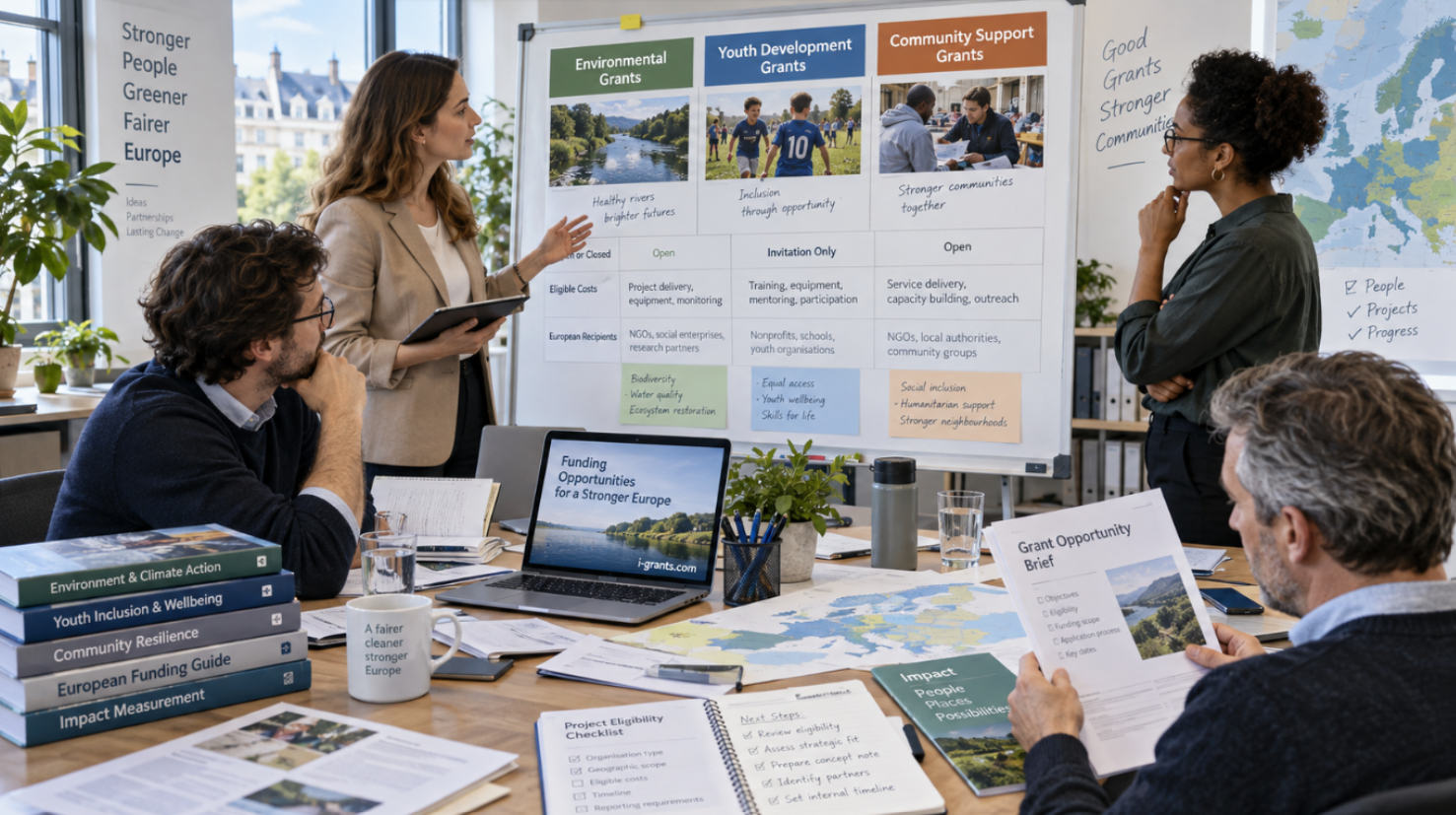
Patagonia prioritises environmental organisations implementing strategic campaigns. New Balance focuses on developmental outcomes for young people. Levi Strauss Foundation selects partners working within its designated social and human rights priorities.
The differences extend to expenditure, legal status, application access, and reporting.
Table 4. Eligibility Rules, Expenditure Restrictions, and Application Access
| Issue | Patagonia International Grants | New Balance Foundation and specialised programmes | Levi Strauss Foundation |
|---|---|---|---|
| Primary applicant profile | Grassroots environmental organisation operating for environmental and public benefit | Eligible charitable organisation delivering youth development programmes | Organisation selected for alignment with the foundation's priorities |
| European geographical access | Limited to published eligible countries and programme rules | Depends on the main foundation or specific country programme | Determined through the foundation's partner-selection process |
| General application process | Environmental grants are invitation-based; regional applications currently paused | Main foundation invitation-only; certain specialised competitions have used open applications | Invitation-only |
| Published individual grant range | Typical European grant: $5,000–$15,000 | No universal range; Polish competition offered $30,000–$50,000 annually | No universal range published |
| General operating expenditure | Expenditure must match the relevant environmental programme rules | Main foundation supports specific programmes rather than general operating expenses | Multi-year general operating support is part of its funding approach |
| Capital expenditure | Buildings, land, vehicles, and property improvements excluded under International Grants | Must follow the relevant programme's eligible-cost rules | Determined by the individual grant arrangement |
| Sports sponsorship | Not the purpose of the environmental programme | Ordinary team sponsorship and sporting events excluded from the main foundation's funding | No general sports grant programme established |
| Indirect costs | No universal percentage established in the reviewed international rules | Polish competition allowed up to 20 percent | Depends on the grant arrangement |
| Current open application confirmed | No | No current Polish competition confirmed; historical open call completed | No |
These distinctions make it risky to develop a single proposal and submit it to several companies without substantial adaptation.
An environmental organisation may have a valid charitable mission but fail Patagonia's country requirements.
A youth sports organisation may be legally eligible for nonprofit funding but fail to demonstrate the broader developmental outcomes sought by New Balance.
A community organisation may undertake activities aligned with Levi Strauss Foundation's funding priorities but lack access to its invitation-only application process.
Eligibility is therefore a combination of organisational status, programme relevance, geographical scope, permitted expenditure, and access to the correct funding mechanism.
14. How to Prepare When Corporate Grant Applications Are Closed
An organisation cannot solve the problem of a closed funding programme simply by writing a stronger proposal.
The appropriate preparation depends on why the programme is inaccessible.
For Patagonia, applicants should establish whether their environmental activities take place in an eligible country and whether their work fits the company's grassroots funding priorities.
They should also distinguish International Grants from local retail partnerships and avoid assuming that the timetable for one mechanism applies to another.
For New Balance, organisations should separate the foundation's invitation-only funding from specialised programmes delivered through partners.
The Polish example demonstrates that a country-specific open competition can exist within a broader invitation-based funding system.
However, the completed Polish competition does not guarantee another round.
For Levi Strauss Foundation, preparation should focus on understanding the foundation's specific priorities and documented funding relationships.
An unsolicited proposal cannot be treated as an available application route when the foundation explicitly excludes such submissions.
Organisations should also avoid spending money on consultants who claim they can guarantee access to invitation-only grants.
Professional assistance can help assess eligibility and prepare a credible project, but it cannot create an application opportunity that the funding organisation has not established.
Establish the exact financial instrument
A corporate partnership may provide several forms of assistance.
A cash grant transfers financial resources subject to the applicable grant conditions.
An in-kind donation provides goods or equipment rather than money.
Employee volunteering contributes time or expertise.
Communications assistance can increase the visibility of an organisation or campaign.
These forms of support may be valuable, but they are not financially interchangeable.
A nonprofit seeking money for staff salaries cannot assume that donated sports equipment will cover its cash needs.
Similarly, an organisation receiving communications support should not record an invented cash-grant amount.
Grant writers should establish the nature, financial value, restrictions, and reporting requirements of each contribution.
Separate verified outcomes from future expectations
The documented cases also show why application research should distinguish between completed results and planned activities.
The Polish Futures in Motion recipients were selected in 2026 for programmes intended to continue through 2028.
Their published project descriptions provide evidence of the planned activities, but not proof that every three-year outcome has been achieved.
The Sport Together Fund's August 2026 update provides more recent implementation evidence, including reported vocational training opportunities and leadership activities.
These observations offer useful examples of programme delivery, but they should be attributed to the operator's reporting rather than presented as an independent evaluation.
Accurate reporting strengthens the credibility of both the applicant and the publication describing the programme.
15. Which Programme Corresponds to Different European Nonprofits?
Consider a Czech environmental association implementing a long-term campaign to protect a threatened river.
Patagonia may be relevant because Czechia appears among the eligible countries and the company supports strategic grassroots environmental action.
However, the association would still need to satisfy the detailed funding conditions, and the European application process is currently paused.
If the organisation primarily seeks funding to purchase a vehicle or renovate a building, the International Grants Program would not match its proposed expenditure.
Now consider a Polish nonprofit providing football and educational activities for disadvantaged teenagers.
The Futures in Motion Poland programme offers a documented example of corporate support for precisely this combination of sport and broader youth development.
However, the 2025 competition has closed and its recipients have already been announced.
The nonprofit should not assume that the former deadline or funding allocation remains available.
A French organisation supporting refugee integration through sport presents another scenario.
The Sport Together Fund has documented recipients in France, including Kabubu and Fútbol Más France.
Their activities show that refugee inclusion, social relationships, and youth development can form the basis of supported projects.
Nevertheless, the existence of these recipients does not establish an open application process for every French organisation.
Finally, consider a Belgian nonprofit helping refugees establish microenterprises.
Levi Strauss Foundation's historical grant to microStart demonstrates that the foundation has supported this type of work in Belgium.
The award provides evidence of thematic and geographical precedent.
It does not constitute a current funding offer or establish that a similar nonprofit can submit an unsolicited application.
These scenarios demonstrate why a relevant historical grant is useful evidence but cannot replace current programme rules.
16. How Grant Writers Can Use Corporate Funding Data Effectively
The value of corporate grant research lies in connecting published information to a specific applicant's circumstances.
A grant writer should identify the exact funding entity before examining the programme's financial statistics.
Patagonia's environmental grants and retail partnerships require separate analysis.
New Balance Foundation's general grants, Futures in Motion, and Sport Together Fund have distinct application arrangements.
Levi Strauss Foundation and Levi Strauss & Co.'s employee-driven corporate giving must also be distinguished.
The next step is to determine whether the applicant meets the relevant legal and geographical requirements.
Only then should the project be assessed against the programme's thematic priorities and eligible expenditure rules.
A financial comparison should use equivalent categories.
An individual award can be compared with another individual award, provided their dates and purposes are clear.
A global annual budget should not be presented as a European funding allocation.
Similarly, cumulative giving since a foundation's establishment should not be interpreted as money available in a new application round.
When only combined funding is disclosed for several recipients, the total should remain attributed to the group rather than distributed through an unsupported calculation.
The project proposal should also reflect the funding mechanism.
A Patagonia-related proposal would need a clear environmental strategy and measurable conservation objectives.
A New Balance youth programme would need to explain the relationship between sport, education, health, inclusion, and wider development.
An organisation working with Levi Strauss Foundation would need to correspond to the foundation's identified priorities and have access to its invitation-based selection process.
These differences cannot be resolved by replacing the company name in an otherwise identical grant application.
For applicants without internal grant-writing expertise, professional support may help establish eligibility, distinguish funding instruments, prepare financial information, and develop a suitable proposal.
International platforms such as i-grants.com can connect organisations with grant-writing specialists who understand different corporate funding models.
However, no consultant or platform can guarantee an award, bypass an invitation-only procedure, or legitimately describe a completed competition as open.
The first responsibility of grant research is to establish whether a real and accessible funding route exists.
Conclusion: Corporate Grants Require More Than Brand Recognition
Patagonia, New Balance, and Levi Strauss demonstrate that American companies can support European nonprofits through different philanthropic structures.
Patagonia provides environmental grants focused on strategic grassroots action. Its typical European grant range is $5,000 to $15,000, but applications in the Europe, Middle East, and Africa region are currently paused.
New Balance Foundation invests in youth development and reported $17.4 million in worldwide grants to 95 nonprofits in 2025. Its principal grantmaking is invitation-only, yet the specialised Futures in Motion Poland programme conducted an open competition in 2025.
That competition resulted in two Polish organisations being selected for approximately $300,000 in combined funding over three years. Other New Balance-supported initiatives have funded sport-based inclusion programmes in France, Germany, Spain, and the Netherlands.
Levi Strauss Foundation awarded $10.75 million to 81 organisations in 2025 and announced $400 million in cumulative giving in July 2026. Its documented European grants include $275,000 for microStart and $25,000 for Convivialités in Belgium, although those historical awards do not constitute current opportunities.
Levi Strauss & Co. also operates separate corporate giving programmes, including Community Day, which announced more than $500,000 in global nonprofit grants in 2025.
For European applicants, these figures establish that substantial corporate philanthropic activity exists, but they do not demonstrate universal access to funding.
The most important distinction is between a company that has previously supported relevant organisations and a programme that currently permits a new application.
Successful preparation begins with identifying the correct funding mechanism, verifying its status, checking organisational and geographical eligibility, and distinguishing cash grants from other forms of assistance.
A documented grant recipient can reveal what a company has supported. Only current programme rules can establish whether another organisation has a legitimate route to apply.