

 Français
  Deutsch
  Українська
Corporate funding in Europe is often described as if it were one broad category of grants. In practice, large companies build very different systems for distributing social-impact funding. Orange, Tesco, and Castorama are useful examples because their programmes operate according to three distinct models.
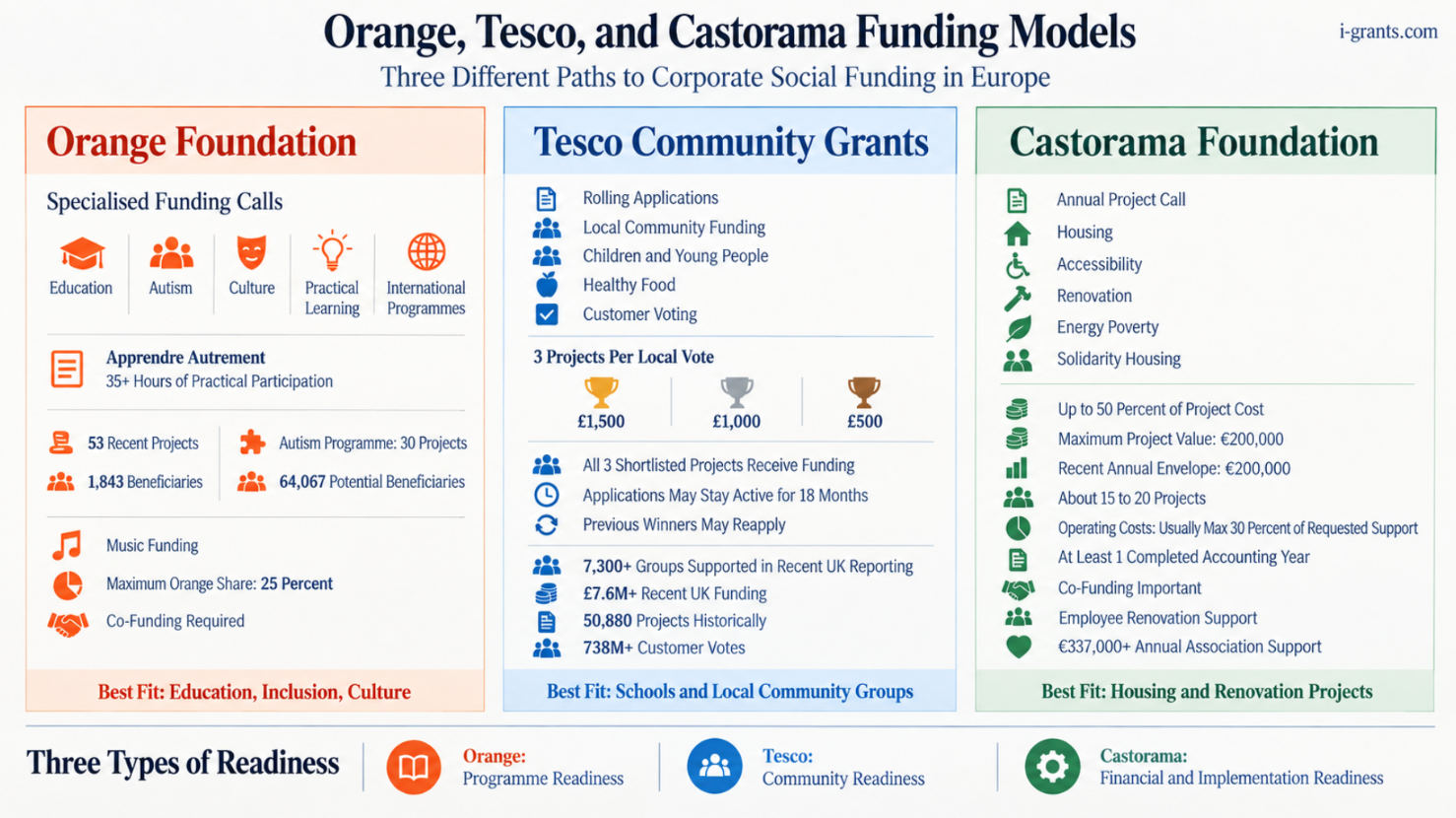
Orange Foundation runs specialised funding streams for education, autism, culture, practical learning, and digital inclusion. Tesco uses recurring community-grant systems built around local selection and customer voting. Castorama Foundation focuses on housing, renovation, accessibility, energy poverty, and practical improvements to living conditions through a more formal annual project-finance model.
For applicants, these differences are more important than headline award values. A nonprofit organisation may have an excellent project and still be applying to the wrong company. A school may fit Tesco because it can translate a relatively small grant into a direct benefit for children. A cultural organisation may find Orange relevant, but only through a specific programme with its own rules. A housing association may be a strong Castorama candidate if it already has co-financing and a developed renovation plan.
The central question is therefore not simply which company gives grants, but which corporate funding model matches the organisation's legal form, beneficiaries, project maturity, budget, geographic location, and ability to demonstrate impact. That distinction makes these programmes useful not only in the current funding cycle, but also for organisations planning their grant pipelines one or two years ahead.
Orange, Tesco, and Castorama operate three fundamentally different funding systems
Orange Foundation is programme-driven. Instead of offering one universal corporate grant, it separates funding into thematic routes. An organisation first needs to identify the right programme and then understand the rules of that specific call.
Tesco is community-driven. Its local grant model is designed around many relatively small awards. Organisations may first be selected for local voting, after which customers determine the final award amount. The programme therefore combines grant eligibility with community visibility.
Castorama is project-driven. Its Foundation expects organisations to bring a structured housing-related project, a credible budget, measurable impact, and other sources of financing. Its annual calls are closer to formal project finance than to neighbourhood microgrants.
Table 1. Orange, Tesco, and Castorama Funding Models at a Glance
| Company | Main funding model | Typical applicants | Main themes | Key decision factor |
|---|---|---|---|---|
| Orange Foundation | Recurring specialised calls | Nonprofits, associations, cultural organisations, education partners | Education, autism, culture, digital inclusion, practical learning | Strong fit with the correct programme |
| Tesco Community Grants | Rolling or recurring local funding | Schools, charities, community groups, selected public-interest bodies | Healthy food, children, community wellbeing, local support | Eligibility plus customer voting |
| Castorama Foundation | Annual project call | Associations, public-interest organisations, selected public bodies, schools, care organisations | Housing insecurity, accessibility, renovation, energy poverty | Project quality, co-financing and measurable impact |
This difference changes what "grant ready" means. For Orange, it means being ready for a specific funding stream. For Tesco, it means being ready for local selection and public voting. For Castorama, it means being ready to finance and implement a structured project that the Foundation will only partly support.
Why Orange Foundation should not be treated as one generic grant
One of the most common mistakes in corporate grant research is searching for a phrase such as "Orange grant" and assuming there must be one annual application portal. Orange Foundation does not work that way. Its funding is divided into several thematic programmes with different purposes, target groups, countries, timelines, and financial rules.
This matters because an organisation can be highly credible in its own field while still being a poor fit for the wrong Orange programme. A youth employment project may align with Apprendre Autrement. An autism organisation may fit the Foundation's autism programme. A conservatory, ensemble, festival, or association supporting young musicians may be more relevant to Orange's music patronage. A school or education partner in selected countries may be connected to a wider education programme.
The first step is therefore programme identification, not proposal writing.
Table 2. Main Orange Foundation Funding Routes
| Funding route | Main purpose | Typical beneficiaries | Geographic focus | Usual funding logic |
|---|---|---|---|---|
| Apprendre Autrement, France | Practical learning, employability and inclusion | Young people facing social or professional difficulties | France | Recurring annual call |
| Apprendre Autrement, International | Practical education linked to local needs | Young people facing social or economic barriers | Selected countries where Orange operates | Recurring international call |
| Autism programme | Learning, autonomy, social inclusion and employment | People with autism spectrum disorders | Primarily France in the current format | Recurring thematic funding |
| Music patronage | Access to classical music, support for young artists and collective musical education | Cultural organisations and musicians | France | Calls during the year |
| Education+ | Access to learning, digital tools and educational resources | School-age children and education partners | Selected countries in Africa and the Middle East | Multi-year programme approach |
For applicants, this programme structure creates both flexibility and complexity. Orange may support a wide range of social-impact activities, but applicants need to understand the exact logic of the relevant call. A strong proposal in the wrong category can still fail.
Apprendre Autrement is about learning through doing
Apprendre Autrement is particularly interesting because the programme does not simply fund education in the broad sense. It promotes active, practical learning. In the recent French model, participating young people were expected to spend at least 35 hours working collectively on the same practical project, and the project should respond to a real need and lead to a concrete result.
This is different from a standard classroom course. A nonprofit cannot simply offer a series of lectures or digital-literacy classes and assume that the project fits. The programme is stronger when participants actively create, repair, build, prototype, design, grow, assemble, manufacture, or solve a practical problem.
A successful project might involve building community furniture, creating a shared garden, repairing objects, developing a useful prototype, producing equipment for a local organisation, or learning technical skills while solving a real need identified by a partner. In other words, the learning is not separate from the output. Participants gain skills through the process of producing something useful.
Local partnerships can strengthen an Orange application
Another important feature of Apprendre Autrement is the value of a real external need. The strongest project is usually not an isolated activity invented only because funding is available. It is more convincing when another organisation, municipality, community centre, company, social institution, or local partner actually needs the result.
For example, an association could work with young people to design and build practical items for a local community centre. A youth group could create equipment for a shared neighbourhood space. Participants could learn digital design and fabrication while producing something that has an identifiable user.
This makes the programme particularly suitable for organisations that can combine education with local partnerships. It also explains why fabrication laboratories, technical workshops, repair spaces, and other hands-on learning environments can be valuable. The project should not simply tell participants about skills. It should allow them to use those skills.
Orange increasingly connects practical education with technology
Recent Orange materials have also introduced the responsible use of artificial intelligence as a possible component of practical learning. This does not mean that simply adding "AI" to a project makes it stronger. The technology still needs to support the project's broader educational purpose.
A meaningful example could involve young participants using artificial intelligence to help design a prototype, organise information, create accessibility tools, test ideas, or support a practical community project. A weak example would be a one-off presentation about artificial intelligence with no sustained activity and no concrete output.
This distinction will remain relevant even when individual annual calls change. Orange is not simply funding technology because it is fashionable. The stronger projects use technology as one tool within a broader process of education, inclusion, and practical problem-solving.
What may look relevant to Orange but still fail
Some projects can appear to match Orange's broad mission while falling outside the intended funding model. A short series of lectures may be educational but insufficiently practical. A general digital workshop may promote digital skills but lack the collective project element. A study trip may be valuable but not create a sustained practical learning process. A mentoring programme may help young people but still be weak if the participants do not actively build or produce anything together.
A building-renovation request may improve an organisation's facilities but fail if construction becomes the main purpose rather than a tool for learning. Applicants therefore need to ask a more precise question. Instead of asking whether the project is educational, they should ask what participants will actually do, create, solve, and learn through the process.
Orange Foundation has meaningful international reach
Orange is also useful for an international funding article because its activities extend beyond France. Recent international Apprendre Autrement calls have included European countries such as Belgium, Spain, Moldova, Poland, Romania, and Slovakia, alongside countries in Africa, the Middle East, and other regions.
This creates opportunities for organisations that might otherwise assume the Foundation is relevant only to France. However, international applicants should not simply copy the French programme rules. Administrative requirements can vary by country, and organisations may need to demonstrate that they are legally able to receive philanthropic support and provide the necessary tax or organisational documentation.
The local Orange structure may also play a significant role in how applications are developed and assessed. International applicants therefore need both thematic fit and national eligibility.
Previous Orange funding can affect future applications
A less visible issue is reporting history. Organisations that previously received Orange support may need to demonstrate that earlier funded projects were properly completed and reported before a new request is considered.
This is important because grant seekers often treat reporting as the final administrative step of an old project. In reality, reporting can affect access to the next grant. An organisation that submits late or incomplete reports may damage its relationship with the funder even if the original project itself was successful. Post-award management is therefore part of future fundraising.
Recent Orange results show the breadth of supported work
Orange publishes useful information about recent selections. In the latest French Apprendre Autrement round, 53 projects were selected, covering 1,843 beneficiaries. The range of activities included practical agriculture, solidarity gardens, woodworking, reuse initiatives, repair activities, digital manufacturing, and projects involving newer technological tools.
The autism programme supported 30 projects expected to reach 64,067 beneficiaries. These projects focused on autonomy, education, inclusion, employment, and support systems for people with autism spectrum disorders.
The Foundation's music support followed a different model. In one recent selection period, 18 projects were supported, with an estimated 59,445 beneficiaries.
Table 3. Recent Orange Foundation Results
| Programme | Projects supported | Reported or projected beneficiaries | Main type of impact |
|---|---|---|---|
| Apprendre Autrement, France | 53 | 1,843 | Practical learning, employability, technical and manual skills |
| Autism programme | 30 | 64,067 | Autonomy, education, employment and social inclusion |
| Music patronage, recent selection period | 18 | 59,445 | Cultural access, support for young artists and collective music education |
These numbers should not be treated as guaranteed future award levels. They do, however, demonstrate that Orange Foundation is operating across very different forms of social impact.
Orange music funding follows a very different financial model
The music programme is an excellent example of why applicants must read each call individually. Recent rules required applicants to be established organisations rather than individual artists, and applicants were also expected to have at least two years of organisational history.
Most importantly, Orange's contribution could not exceed 25 percent of the overall project budget. That is a major structural requirement. If a cultural organisation has a project worth €80,000, Orange would normally contribute no more than €20,000 under a 25 percent ceiling. The remaining €60,000 would need to come from other sources, such as public grants, ticket income, other foundations, sponsors, local authorities, donors, or the organisation's own resources.
This makes Orange a co-funder rather than a full-project funder. A cultural organisation that approaches Orange without a broader financing plan may therefore be structurally weak, even if its artistic concept is strong.
Long-term relationships can matter in Orange music support
Orange has also indicated that it can favour relationships extending over several years, often around three years and potentially longer in some cases. This is particularly important for cultural organisations because a one-off grant may help finance a season or programme, while a multi-year relationship can create much greater stability.
However, organisations should not confuse the possibility of continuity with automatic renewal. Each new cycle still depends on performance, fit, reporting, and Foundation priorities. The long-term opportunity therefore increases the importance of relationship management.
Tesco uses a completely different funding philosophy
Tesco's community-funding model is not built around one large project. It is built around thousands of relatively small local grants.
The current UK Tesco Fruit & Veg Grants programme operates on a rolling basis rather than through a single annual deadline. Its focus is children and young people, particularly projects that improve access to healthy food, fruit, vegetables, food education, and related community support.
This creates a much lower financial ceiling than Orange or Castorama, but also a much wider local reach. Possible projects can include breakfast clubs, after-school food support, healthy snacks at sports clubs, growing activities, cooking projects, food provision during school holidays, and programmes helping children facing food insecurity.
The programme works best where a relatively small grant can produce a visible and understandable local result.
Tesco's local voting system changes what applicants are competing for
Three local projects are generally selected for customer voting. Importantly, all three receive funding. The customer vote determines the amount rather than whether the organisation receives anything at all.
The top project receives £1,500, the second receives £1,000, and the third receives £500. This means the real competition happens in two stages. First, an organisation must be strong enough to reach the local voting stage. Then it needs to communicate its project clearly enough to attract customer support.
Table 4. Tesco Community Grants: Funding and Voting Rules
| Rule | Current model | Practical consequence |
|---|---|---|
| Application model | Rolling | Applicants do not need to wait for one annual opening |
| Local selection | Three projects per voting round | Reaching the shortlist is the main eligibility hurdle |
| First-place award | £1,500 | Determined by customer voting |
| Second-place award | £1,000 | Still receives funding |
| Third-place award | £500 | Still receives funding |
| Main current focus | Healthy food for children and young people | General-purpose projects may be weaker |
| Implementation period | Usually within one year | Project should be practical and ready to deliver |
| Application retention | Up to 18 months for eligible unsuccessful applications | One missed round may not require a new application |
| Previous winners | Can reapply | Repeat funding remains possible |
The customer vote makes Tesco fundamentally different from a foundation where only experts assess applications. Local visibility matters.
Tesco applicants need both a grant narrative and a public narrative
A project description written entirely for professional evaluators may not perform well with the public. "Integrated food resilience capacity-building programme for vulnerable children" and "Fresh fruit and healthy breakfasts for 80 local pupils" may refer to the same project, but the second is much easier for customers to understand.
That matters because Tesco's funding model turns part of the selection process into public communication. Applicants therefore need to think about two audiences. The programme administrator needs clear eligibility, governance, budget, and project information, while local customers need a simple explanation of what the money will achieve.
Organisations that can communicate both ways are better positioned.
Tesco's current focus is narrower than some applicants may expect
Tesco has funded a wide variety of community activities over many years, but the current Fruit & Veg Grants model is more focused. It prioritises children, young people, healthy food, and access to fruit and vegetables.
That means an organisation should not rely on examples from older Tesco programmes without checking current priorities. A general adult wellbeing programme may have been suitable in a previous funding structure but could now be too far from the current purpose.
A community garden may still be relevant, but it becomes stronger if children are actively involved in growing and eating fresh food. A sports club may qualify more clearly when the funding is used for healthy snacks for young participants rather than ordinary sports equipment. A school may be particularly well positioned when it can show direct nutritional benefit.
The broader lesson is simple: the brand may remain the same while the grant's strategic purpose changes.
Tesco has broad institutional eligibility
The current community funding model can include a wide range of organisations, including schools, charities, voluntary groups, community organisations, parent associations, social enterprises, selected Community Interest Companies, some councils, health organisations, housing bodies, and other eligible local structures.
Broad eligibility can make the programme attractive, but broad legal eligibility does not guarantee strong programme fit. A large organisation and a tiny school may both technically qualify. The stronger application will usually be the one with the clearest local benefit and the most direct connection to the programme's current priorities.
The 18-month retention rule is more important than it looks
One of Tesco's most applicant-friendly features is that an eligible proposal may remain under consideration for up to 18 months. This can substantially reduce repeated administrative work because a project that is not selected for one voting period may be considered again later.
The applicant does not necessarily need to rebuild the entire proposal from the beginning. This also changes how organisations should interpret a lack of immediate success. Not appearing in the next customer vote may mean "not selected yet" rather than "rejected forever".
For small charities and schools with limited fundraising capacity, this is a meaningful advantage.
Previous Tesco winners may apply again
Another unusual feature is the possibility of repeat participation. Some grantmakers impose one-year, two-year, or even longer exclusion periods after a successful award. Tesco's current model is more flexible.
Previous winners may apply again. This can make the programme particularly useful for organisations with recurring local needs. A school might use one award for a breakfast initiative and apply again later for a different eligible food project. A youth club may return with a new proposal after successfully delivering the previous one.
Repeat eligibility does not guarantee repeat selection, but it makes Tesco more suitable for long-term community fundraising than a strictly one-off competition.
Tesco's individual awards are small, but the system is huge
Looking only at £500, £1,000, or £1,500 can make Tesco appear insignificant compared with larger corporate foundations. That would be misleading.
The strength of Tesco's model is not the size of one grant. It is the number of grants.
In the UK during the latest reporting period, more than 7,300 local groups, charities, and schools received more than £7.6 million in funding connected to healthy food and community activity. Longer-term figures are much larger. Tesco and its programme partners have reported more than £101.8 million distributed to 50,880 community projects in the UK, while customers have cast more than 738 million votes over the life of the programme.
Funding has reached health and wellbeing, environmental projects, outdoor spaces, education, skills, sport, and other community priorities.
Table 5. Tesco Community Funding Scale
| Geography | Reported scale | Why it matters |
|---|---|---|
| United Kingdom, recent reporting period | More than 7,300 local organisations supported with more than £7.6 million | Shows the scale of recurring small grants |
| United Kingdom, longer-term | More than £101.8 million distributed to 50,880 projects | Demonstrates long-term continuity |
| UK customer voting | More than 738 million votes historically | Confirms that public participation is central |
| Central Europe since 2016 | More than £6.5 million to over 9,000 community groups | Shows that Tesco funding extends beyond Britain |
| Hungary, recent programme round | 171 organisations in 125 settlements shared 57 million HUF | Demonstrates continued regional activity |
| Ireland since 2014 | More than €10 million to more than 27,000 projects | Another established national community-funding route |
These numbers show that Tesco should be viewed as a grant ecosystem rather than one small competition.
Tesco's European model extends beyond the UK
Tesco's community support is particularly interesting because similar approaches operate in several European markets. In Central Europe, Tesco has reported more than £6.5 million in community grants to more than 9,000 groups since 2016.
Recent programme changes in the Czech Republic, Hungary, and Slovakia have increased the focus on children and young people. Customer voting remains an important feature.
Hungary provides a useful example. In one recent round of Tesco's Start a jövőért programme, more than two million customer votes helped determine how 171 organisations across 125 settlements shared 57 million Hungarian forints. Different positions in the local vote received different award values.
Ireland also has a long-running Tesco Community Fund. The company reports more than €10 million distributed to more than 27,000 projects since 2014.
For international grant seekers, this means Tesco should not be treated as one universal European grant. The basic corporate philosophy may be similar across markets, but the exact rules, award values, beneficiaries, and application routes vary by country.
Castorama Foundation is much closer to formal project finance
Castorama occupies a very different position. Its Foundation focuses on housing conditions and the practical improvement of living environments.
Core themes include poor housing conditions, housing insecurity, accessibility, renovation, adaptation of homes, energy poverty, and solidarity housing. The Foundation generally organises one main call for projects each year, which creates a useful planning rhythm.
Unlike Tesco's rolling applications, Castorama applicants can anticipate a more formal annual cycle. The annual theme may change, but the Foundation's broader mission remains relatively stable.
Castorama's annual theme can change significantly
Recent calls illustrate this. One funding cycle focused on ecological transition, energy poverty, and solidarity between generations or population groups. The following annual call placed stronger emphasis on housing adaptation for ageing and solidarity housing that brings different groups together.
This creates both opportunity and risk. An organisation may have a strong housing project but still need to wait for a year when the annual theme fits. At the same time, a well-prepared organisation can monitor the Foundation in advance and adapt its funding calendar accordingly.
This is why Castorama is useful for long-term fundraising planning. Applicants do not need to invent a project after the call opens. They can develop a relevant project first, then watch for the most suitable annual theme.
Castorama usually funds only part of the project
The most important financial rule is the maximum Foundation contribution. In recent annual calls, Castorama funding could cover no more than 50 percent of the total project cost.
The total project value was also limited to €200,000. This means the Foundation expects the applicant to bring other resources.
For a €60,000 project, Castorama could theoretically contribute up to €30,000. For a €120,000 project, the theoretical ceiling would be €60,000. For a €200,000 project, the mathematical maximum would be €100,000.
However, those theoretical ceilings should not be confused with typical grant values. The Foundation's annual funding envelope has recently been around €200,000 for approximately 15 to 20 projects, which means the money must be distributed among many recipients.
A project built around the assumption of receiving the absolute theoretical maximum could therefore be unrealistic.
Castorama's co-financing rule is a strategic signal
The 50 percent ceiling is more than a budget formula. It tells applicants what the Foundation expects.
Castorama generally wants to join a project that already has financial credibility. It does not usually want to become the only funder. That means applicants should think about other sources early.
Possible co-funders could include municipalities, regional authorities, other foundations, public housing programmes, charitable donors, institutional partners, or the organisation's own resources.
A project with confirmed co-financing can appear stronger because it demonstrates that other institutions also consider the project viable. It also reduces the risk that the entire project collapses if one funder changes its decision.
Operating costs have a separate limit
Another easily misunderstood Castorama rule concerns operating expenditure. Recent calls have generally limited operating costs to 30 percent of the amount requested from Castorama.
This is not automatically the same as 30 percent of the full project budget.
Imagine a €100,000 project requesting €40,000 from Castorama. Under a 30 percent rule applied to the requested Foundation contribution, only around €12,000 of the Castorama request would normally be available for operating expenditure.
This distinction matters. A project with high staffing or administration costs may need other funding sources for those expenses. Applicants that misread the rule could submit a budget that appears eligible at first glance but fails during detailed assessment.
Table 6. Castorama Foundation Financial and Eligibility Rules
| Requirement | Recent recurring approach |
|---|---|
| Main application cycle | One call per year |
| Annual Foundation envelope | Around €200,000 in recent calls |
| Approximate number of projects supported | 15 to 20 |
| Maximum Foundation share | 50 percent of total project cost |
| Maximum total project budget | €200,000 |
| Operating expenditure | Normally up to 30 percent of the requested Castorama contribution |
| Minimum organisational history | At least one completed accounting year |
| Main geography | Metropolitan France |
| Store proximity | Helpful but not decisive |
| Other financing | Important to project viability |
| Multiple applications | May be allowed |
| Joint applications | Possible with one lead applicant |
| Ownership of property | Applicant does not always need to own it |
| Multi-year projects | Can be possible |
| Final evaluation | Required |
Castorama accepts more than traditional charities
The Foundation's applicant base can be broad. Recent calls have included associations, public hospitals, nonprofit healthcare organisations, care facilities, municipalities, intermunicipal bodies, public-interest entities, schools, colleges, universities, agricultural education institutions, and public research laboratories.
This gives Castorama access to projects that may be too institutional for a small community fund. An accessible-housing programme run by a nonprofit care organisation may fit. A municipality developing a solidarity-housing initiative may fit. A public institution adapting living conditions for vulnerable people may fit if the project provides additional social value.
However, legal form matters. Commercial structures may be excluded. Certain forms of company cannot receive Foundation philanthropy through the standard route. Political and religious connections may also lead to additional scrutiny or restrictions.
New organisations may face a structural barrier
Applicants generally need at least one completed accounting year. This is an important difference from Tesco, where very small community organisations may have a much lower entry barrier.
A newly created French association with no completed financial year may have an excellent housing project but still be too early for Castorama. This makes organisational maturity part of eligibility.
For applicants planning ahead, the practical lesson is clear. A young organisation should not wait until the call opens to discover that it lacks the required financial history. Eligibility should be checked before investing in detailed project preparation.
Proximity to a Castorama store can help, but it is not everything
Because Castorama has a large retail network, projects near stores can create opportunities for employee involvement. Staff may participate in renovation activities, technical workshops, solidarity workdays, or other practical support.
This can strengthen the relationship between the Foundation and the project. However, proximity is not the primary selection criterion. The Foundation has indicated that originality, social impact, relevance, and project quality remain more important than simple geography.
This matters for applicants outside large urban areas. A project should not automatically be dismissed because it is not located next door to a Castorama store. At the same time, organisations that are close to a store should consider whether employee expertise can become part of the project design.
Castorama can provide more than money
This is one of the programme's most distinctive features. Castorama Foundation also organises solidarity renovation projects involving company employees, so support can combine cash, technical skills, materials, and volunteer labour.
Recent Foundation figures refer to more than €337,000 per year in support for associations, more than 35 solidarity activities involving employees each year, and close to 30 supported associations annually.
This broadens what applicants should consider valuable. A grant seeker may focus only on the cash contribution, but technical expertise can sometimes reduce the project's real cost by thousands of euros. Volunteer labour can accelerate implementation, access to renovation knowledge can improve project quality, and employee involvement can strengthen visibility and long-term corporate relationships.
Real Castorama projects show how the model works
Castorama employees have participated in renovation projects serving vulnerable populations. In one example, teams helped renovate the roof terrace of a shelter serving around 70 vulnerable people each day. In another, employees worked with Compagnons Bâtisseurs to renovate an apartment for a family, including insulation, partition work, electrical work, and plumbing.
A separate financial-support example involved €10,000 toward fitting 11 independent adapted apartments for adults with disabilities. The funding supported accessible kitchen furniture compatible with home-automation systems.
These cases illustrate an important principle. Castorama's strongest social value comes from the intersection of housing need and practical renovation expertise. A project that can use both financial support and technical knowledge may be particularly attractive.
Castorama will not simply replace public budgets
Public institutions require special caution. The Foundation does not exist to pay for standard obligations that should normally be covered by the state or other public authorities.
A municipality cannot simply move an ordinary statutory expense into a corporate grant request. A school cannot assume that essential public maintenance will automatically qualify because the building needs work.
A public organisation needs to demonstrate additional social value. The project should go beyond normal public responsibility or create a specific innovation, inclusion benefit, accessibility improvement, or solidarity outcome. For territorial projects, co-financing from public authorities may strengthen credibility.
Multi-year projects require careful planning
Castorama can support projects that extend beyond a single calendar year. However, multi-year implementation does not necessarily mean that one grant automatically covers multiple years.
An organisation may need to return through future annual calls if it seeks additional Foundation support later. This creates an important budgeting issue.
The applicant should separate committed funding from hoped-for future funding. A project should not depend entirely on winning another Castorama grant the following year unless the organisation can absorb the risk of failure. This is especially important for renovation projects where incomplete work can create financial or operational problems.
The most important hidden rules across all three programmes
Headline grant amounts are often the least interesting part of corporate funding. The conditions that determine whether an organisation can actually access the money are much more important.
Table 7. Hidden Rules Applicants Should Check Before Applying
| Programme | Less visible rule | Practical consequence |
|---|---|---|
| Orange Apprendre Autrement | Participants need sustained practical involvement | A simple course may not fit |
| Orange Foundation | Different funding streams have different eligibility | There is no universal Orange application |
| Orange music patronage | Orange may fund no more than 25 percent of the project budget | Strong co-financing is necessary |
| Orange repeat support | Previous reporting may need to be complete | Weak grant management can affect future funding |
| Tesco | Applications are rolling | Applicants do not need to wait for one annual deadline |
| Tesco | Eligible applications may stay active for up to 18 months | One missed vote does not necessarily mean final rejection |
| Tesco | All shortlisted projects receive funding | Customer voting determines award size |
| Tesco | Previous winners may reapply | Repeat grants are possible |
| Castorama | Foundation contribution is limited to 50 percent | Other funding is essential |
| Castorama | Operating costs are limited separately | Budget structure must be checked carefully |
| Castorama | At least one completed accounting year is normally required | Very new organisations may be excluded |
| Castorama | Public institutions cannot replace statutory funding with corporate money | Additional social value must be demonstrated |
| Castorama | Store proximity helps but is not decisive | Impact matters more than geography |
| Castorama | Annual themes change | Organisations need to monitor the next cycle |
These rules explain why simple grant directories often provide an incomplete picture. A database may correctly state that a company "offers grants" while omitting the conditions that make the programme accessible or inaccessible to a specific organisation.
Which programme is strongest for schools?
Tesco is likely to be the most accessible option for many schools, especially when the project concerns children, healthy food, breakfast provision, growing fruit and vegetables, cooking, or holiday food support. The relatively small award can also be an advantage because a school may not need a complicated multi-funder budget to make meaningful use of £1,500.
Orange can also be relevant to educational organisations, but its programmes are more specialised. The school needs to match the exact funding stream and often demonstrate a more structured social-impact or practical-learning model.
Castorama can be relevant where a school is part of a larger housing, accessibility, educational-facility, or community-space project, but ordinary public-school maintenance is unlikely to be enough.
Which programme is strongest for NGOs?
The answer depends almost entirely on the NGO's field. An organisation working with disadvantaged young people through practical training may be strong for Orange. A local charity supporting children with food access may fit Tesco. A housing or homelessness organisation may be far better aligned with Castorama.
This shows why brand recognition should never be the primary reason to apply. The organisation should begin with mission fit.
Which programme is strongest for cultural organisations?
Orange is the clearest option because its music patronage creates a dedicated route for cultural organisations. However, the 25 percent co-financing ceiling means that applicants need a diversified budget.
This makes Orange more appropriate for established cultural organisations with multiple funding sources than for very early-stage groups searching for a single funder to cover an entire project.
Tesco may occasionally support local cultural organisations where they fit the current community priorities, but culture is not the core of the present UK Fruit & Veg Grants model. Castorama is generally much less relevant unless cultural activity is directly linked to housing, social inclusion, or renovation.
Which programme is strongest for housing organisations?
Castorama is clearly the most relevant because its Foundation's mission directly addresses housing insecurity, poor living conditions, accessibility, adaptation, energy poverty, and related social needs.
The programme is particularly suitable for organisations that already have a developed intervention model and can combine Castorama funding with other sources. Orange and Tesco are not general housing funders, so trying to force a housing project into those programmes would usually be a poor use of grant-writing time.
Which programme is strongest for small grassroots groups?
Tesco has the clearest advantage. Its award size is small, but the administrative and financial scale of the project can also be small, which makes it realistic for schools, local charities, youth clubs, and community groups.
Orange requires stronger thematic alignment, while Castorama often requires greater organisational maturity, project complexity, and co-financing. For a small organisation with limited fundraising experience, Tesco may therefore provide a more realistic entry point into corporate funding.
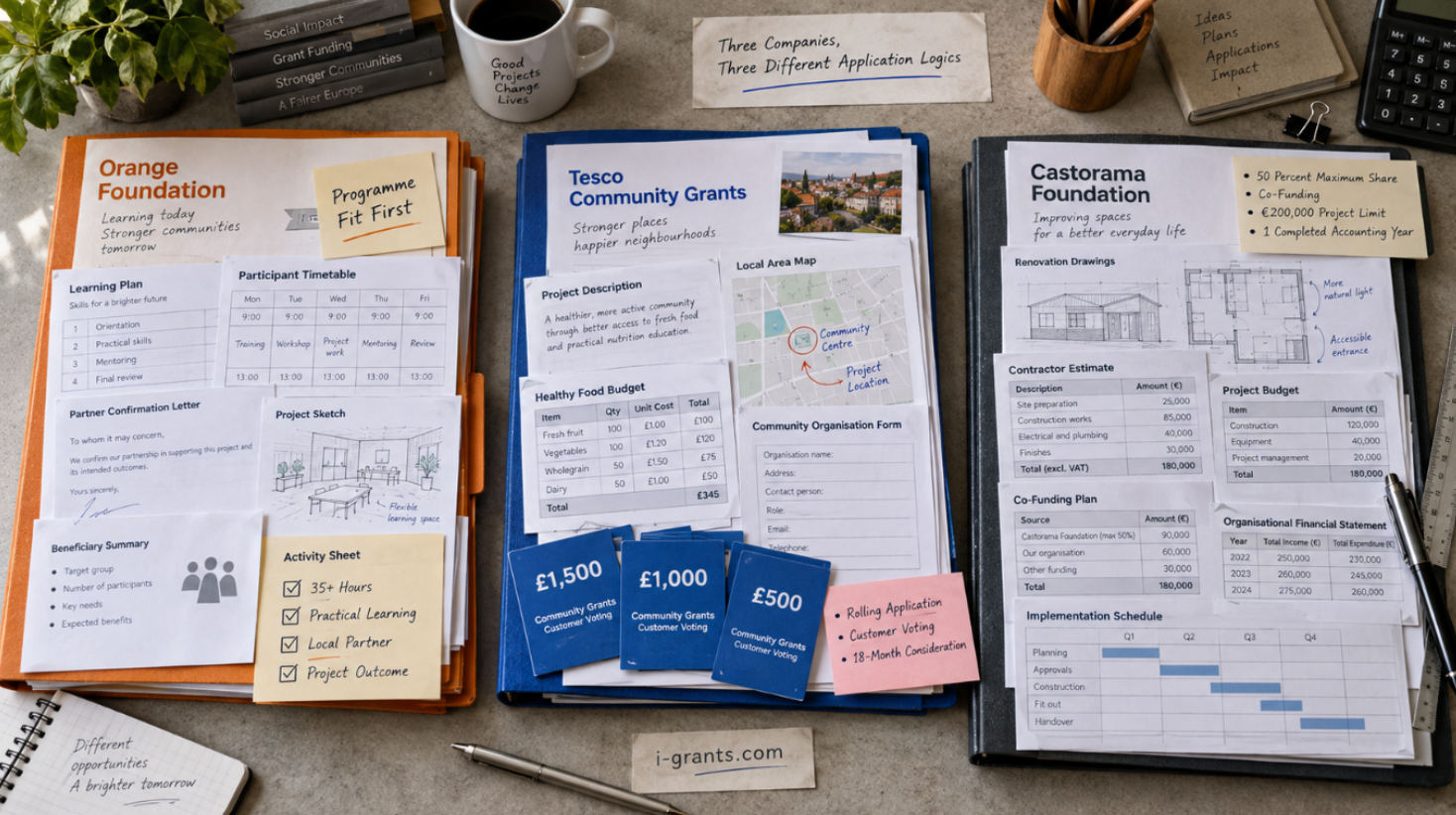
Three companies reward three different forms of readiness
Orange rewards strategic readiness. The organisation must understand the funding stream, beneficiary group, programme purpose, and method of delivery.
Tesco rewards local readiness. The organisation needs a simple, eligible project with a clear local benefit and enough public appeal to perform well in customer voting.
Castorama rewards financial and implementation readiness. The organisation needs a credible housing-related project, a structured budget, other funders, sufficient organisational history, and measurable outcomes.
A project can therefore be grant ready for one company while being completely unprepared for another.
Current dates should be treated as updateable information, not the core of the article
For long-term grant planning, annual deadlines should not dominate the entire funding strategy. Orange's exact application dates change, but its thematic funding architecture is more stable. Tesco's voting cycles and award amounts can evolve, but its local-community model has operated over many years. Castorama's annual theme changes, but its focus on housing and renovation, co-financing, and structured project assessment remains much more durable.
Table 8. What Applicants Should Treat as Evergreen and What They Should Recheck
| Relatively stable information | Information to verify before each application |
|---|---|
| Overall mission of the funder | Current application deadline |
| Typical applicant types | Current annual theme |
| Main beneficiary groups | Current award values |
| General funding mechanism | Current eligible countries or regions |
| Whether public voting is used | Current application form |
| Co-financing philosophy | Current budget restrictions |
| Reporting expectations | Current procurement or documentation rules |
| Organisational maturity requirements | Current programme operator |
| Whether repeat funding is possible | Current selection timetable |
This distinction is especially important for grant professionals. A strong funding database should separate structural knowledge from time-sensitive information. Structural knowledge helps identify fit, while time-sensitive information determines whether the organisation can apply now.
A better long-term strategy for applicants
The strongest organisations do not begin grant research only when a deadline appears. They maintain a pipeline and prepare before calls open.
An organisation working with disadvantaged young people can monitor Orange programmes throughout the year and keep suitable project concepts ready. A school or community group can maintain a Tesco-ready project idea that can be adapted for local rounds. A housing organisation can develop Castorama co-financing months before the annual call opens.
This approach reduces rushed applications and allows organisations to solve eligibility problems in advance. A cultural organisation can secure additional co-funders before approaching Orange. A Tesco applicant can strengthen local visibility before customer voting. A Castorama applicant can complete financial statements, establish partnerships, obtain public co-financing, and refine project indicators before submission.
Preparation therefore becomes part of grant strategy rather than a reaction to a deadline.
Final assessment
Orange, Tesco, and Castorama demonstrate three very different models of corporate social funding in Europe. Orange Foundation operates a portfolio of specialised programmes rather than one universal grant. It is strongest for organisations that understand exactly which funding stream they fit and can demonstrate clear beneficiary outcomes.
Tesco operates a large local-funding ecosystem built around many relatively modest awards. Its strengths are accessibility, recurring application opportunities, broad community reach, and direct public participation through customer voting.
Castorama Foundation uses a more formal project-finance approach. Its annual calls can support substantial housing and renovation projects, but applicants need co-financing, organisational maturity, a realistic budget, measurable social impact, and a clear implementation plan.
The biggest award is therefore not automatically the best opportunity. A £1,500 Tesco grant can be more valuable to a school than a theoretical €50,000 corporate grant it has little chance of winning. A €20,000 Orange contribution can be highly valuable to a cultural organisation that already has the rest of its budget secured. A Castorama contribution may unlock a much larger housing project when combined with municipal and philanthropic finance.
Applicants should therefore compare not only money, but also programme fit, timing, restrictions, competition, administrative burden, co-financing requirements, and the funder's underlying purpose. That is the real difference between simply finding a corporate grant and identifying a corporate funding opportunity an organisation is actually positioned to win.