

 Français
  Deutsch
  Українська
Small meat processors occupy an unusual position in the agricultural funding system because their investment needs can be substantial while their access to capital is often limited. A new cutting line, slaughter equipment, refrigeration, food-safety improvements, wastewater upgrades or a transition to federal inspection can quickly turn into a six-figure project, even for a relatively small operation. Pennsylvania has responded to this problem with a grant programme designed specifically for very small meat and poultry processors, offering up to $100,000 per applicant for qualifying projects.
The $100,000 ceiling is real, and Pennsylvania has documented individual recipients receiving awards at the full programme maximum. However, the headline amount does not mean that every butcher shop can obtain $100,000, nor does it mean that the state transfers the full amount before the business begins spending. Inspection status, eligible cost categories, reimbursement rules, the distinction between equipment and structural construction, and the processor's ability to finance costs before reimbursement all affect how useful the grant will be in practice.
Pennsylvania businesses may also have access to other funding routes depending on the nature of the project. Agricultural innovation funding can support larger technology-based investments, federal programmes have financed major slaughter and processing expansions, value-added grants can help qualifying producer-owned businesses commercialize processed meat products, and planning grants can support feasibility and business development work. In addition, state financing programmes may help with construction, equipment purchases or the temporary cash-flow gap created by reimbursement-based grants.
The result is not one universal "meat processing grant," but a funding landscape in which equipment, construction, inspection, planning, innovation, energy upgrades and working capital may each require a different solution. Understanding those distinctions before signing a supplier contract can be just as important as finding the grant itself.
The Main Pennsylvania Grant: Up to $100,000
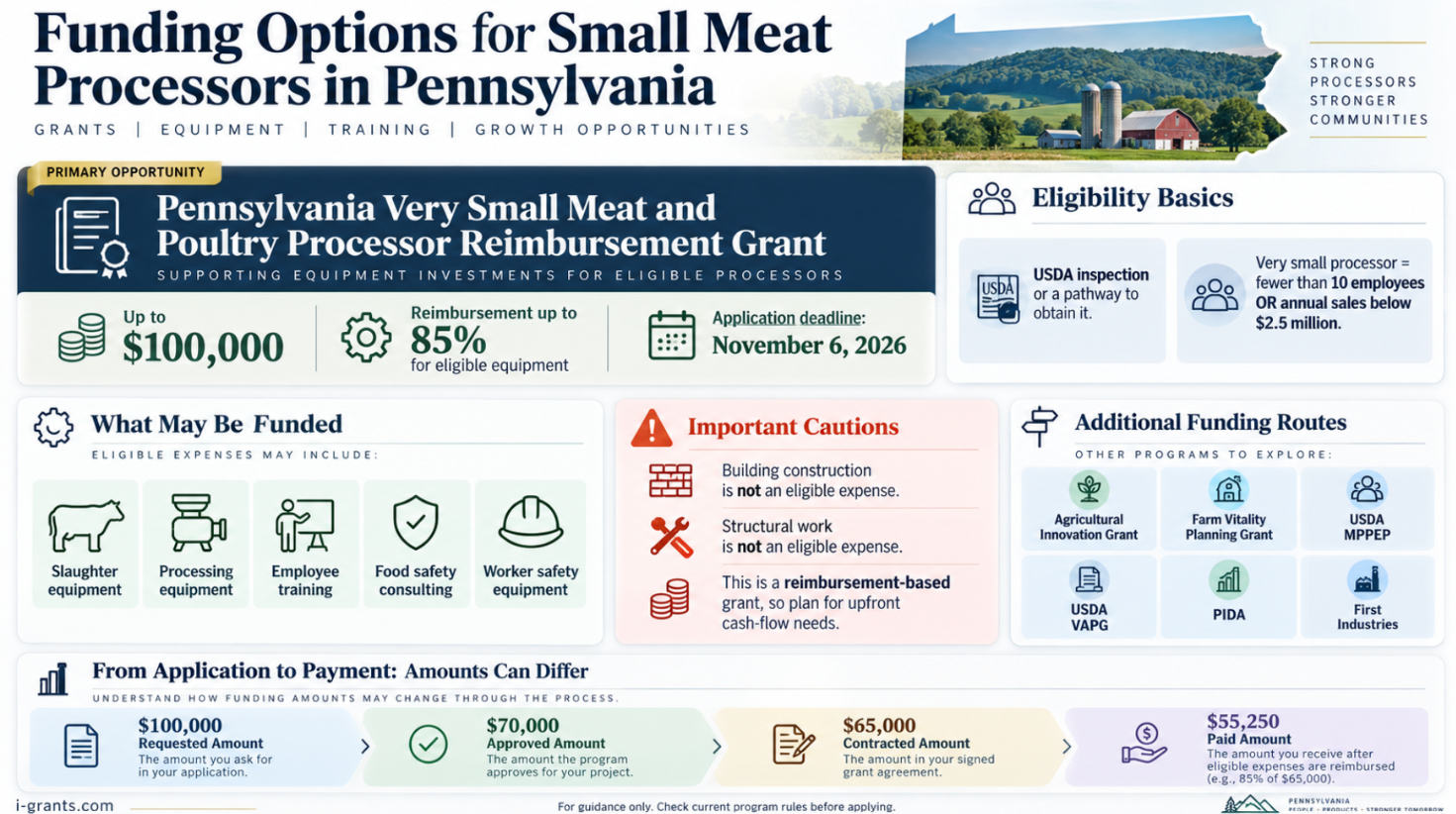
The most directly relevant programme for a small processor is the Very Small Meat and Poultry Processor Reimbursement Grant, administered through the Pennsylvania Department of Agriculture and its Agricultural Business Development Center. The current round provides approximately $500,000 in programme funding, with applications accepted through November 6, 2026, and individual applicants can request up to $100,000.
Unlike broad agricultural programmes that include processing among many possible uses, this grant is specifically designed around the needs of very small meat and poultry processing operations. It can support the opening of a new very small processing operation, expansion of an existing operation and costs associated with obtaining the federal inspection status needed for eligible commercial processing. That makes it particularly relevant to businesses whose main constraint is physical processing capacity, regulatory readiness or the equipment required to operate under inspection.
For eligible slaughter and processing equipment and supplies, reimbursement can reach 85 percent of eligible costs. This means that the business remains financially responsible for part of the investment, and because the programme operates on a reimbursement basis, the processor may also need enough cash or financing to pay suppliers before receiving reimbursement. These two conditions are easy to overlook when focusing only on the $100,000 maximum.
Table 1. Pennsylvania and Federal Funding Options for Small Meat Processors
| Programme | Administrator | Current Status | Maximum Support | Applicant Contribution | Best Fit |
|---|---|---|---|---|---|
| Very Small Meat and Poultry Processor Reimbursement Grant | Pennsylvania Department of Agriculture | Open through November 6, 2026 | $100,000 | Equipment reimbursement up to 85 percent | Small slaughter and processing operations, equipment, inspection readiness |
| Agricultural Innovation Grant | Pennsylvania Department of Agriculture | Latest round closed | $200,000 for onsite projects | Non-state match of at least 50 percent of grant amount | Innovative processing technology, automation, water, waste and efficiency projects |
| Farm Vitality Planning Grant | Pennsylvania Department of Agriculture | Applications accepted while funds remain | $15,000 | Grant generally covers up to 75 percent of eligible planning cost | Feasibility, business, succession and expansion planning |
| Meat and Poultry Processing Expansion Program Phase 4 | USDA Rural Development | Latest round closed | $2 million for expansion; $250,000 for equipment-only projects | Significant project cost share | Larger qualifying cattle-processing projects |
| Value-Added Producer Grant | USDA Rural Development | Latest round closed | $200,000 working capital; $50,000 planning under latest round | Generally 1:1 match | Producer-controlled value-added businesses |
| Local Meat Capacity Grant | USDA Agricultural Marketing Service | No current funding round | Varied in previous round | Project-specific | Historical source for local processing-capacity projects |
| REAP | USDA Rural Development | New grant applications paused under current federal changes | Historically up to $500,000 for energy efficiency and $1 million for renewable energy | Programme-specific cost share | Energy projects rather than general processing expansion |
| PIDA / First Industries | Pennsylvania | Financing rather than grants | Project-dependent | Loan and underwriting requirements | Buildings, equipment, construction and financing gaps |
The programmes in this table address different types of projects and should not be compared only by maximum award size. A $2 million federal programme may appear more attractive than a $100,000 state grant, but a small processor may find the state programme far more realistic if the federal option requires a larger expansion, a substantial match or a business profile that the company does not meet.
Who Can Actually Qualify for the $100,000 Programme?
One of the most important eligibility questions concerns the facility's inspection status. Pennsylvania does not operate its own state meat and poultry inspection programme equivalent to those found in some other states, so USDA Food Safety and Inspection Service requirements play a central role in commercial processing.
For the Pennsylvania reimbursement grant, an applicant generally needs to operate under a USDA grant of inspection or commit to obtaining the necessary inspection as part of the approved project. This creates an important distinction between businesses that may all be described casually as butcher shops. A federally inspected processing establishment is not the same as a custom-exempt processor, and neither is automatically equivalent to a retail-exempt business. A shop performing only exempt activities should not assume that it qualifies simply because it cuts or sells meat.
The programme is intended for very small processing operations. Under the federal HACCP establishment framework, a very small establishment generally has fewer than 10 employees or annual sales below $2.5 million. The Pennsylvania programme can cover processing involving beef, veal, pork, lamb, mutton, goat, chicken, turkey, duck, goose, guinea, squab, ratites, eggs and catfish, subject to the relevant programme and inspection requirements.
For a processor considering an application, regulatory status should therefore be checked before a detailed capital budget is prepared. There is little value in spending weeks gathering machinery quotes if the business's current operating model does not satisfy the inspection pathway required by the programme.
Federal Inspection Can Be Part of the Expansion Strategy
Inspection should not be seen only as a compliance burden or eligibility filter. For some processors, moving toward federal inspection can be part of the growth strategy itself because it may expand the business's ability to process and sell products under a broader commercial model.
The transition can require changes to food-safety procedures, documentation, employee practices, production systems and sometimes equipment. Pennsylvania's reimbursement grant recognizes this reality by allowing certain costs associated with obtaining FSIS inspection, including relevant technical and professional support. This makes the programme potentially useful not only for buying machinery but also for helping a business build the operational systems needed to use that machinery within an inspected environment.
A stronger project therefore connects equipment investment to a clear operational result. Instead of simply stating that the business wants a new grinder, packaging machine or smoker, the application can explain how the investment will increase throughput, improve worker safety, address food-safety requirements, eliminate a documented production bottleneck or support the transition to inspected processing.
What Can a Small Processor Actually Buy?
The Pennsylvania programme can support practical production investments such as slaughter and processing equipment and supplies, professional employee training, technical or consulting support associated with required programmes, employee-safety equipment and qualifying expenses related to obtaining FSIS inspection. For a small processor, this can make the programme more useful than a general business grant that excludes production machinery.
However, the boundary between equipment and construction needs careful attention. A machine installed inside a facility is not automatically treated the same way as the building work needed around it. Planning, erection, repair or modification of a building, roofing and other physical structural improvements should not simply be included in the 85 percent equipment reimbursement calculation.
This distinction becomes important when a processor needs both machinery and facility modifications. A new processing line may be eligible, but enlarging the processing room, modifying floors, changing structural walls or undertaking major building work may require a different funding source. A strong budget should therefore separate equipment, construction and professional services from the beginning rather than presenting them as one undifferentiated capital project.
Table 2. What a Small Pennsylvania Meat Processor Can Fund
| Proposed Investment | Potential Funding Route | Likely Treatment | Important Condition |
|---|---|---|---|
| Slaughter equipment | Very Small Processor Grant | Eligible when programme requirements are met | Equipment reimbursement can reach 85 percent |
| Cutting and processing equipment | Very Small Processor Grant | Eligible | Must form part of an eligible processing project |
| Food-safety or inspection consulting | Very Small Processor Grant | Potentially eligible | Must relate to required processing or inspection programmes |
| Professional employee training | Very Small Processor Grant | Eligible in qualifying circumstances | Training must support programme objectives |
| Employee-safety equipment | Very Small Processor Grant | Eligible | Direct connection to worker safety |
| Building construction | Very Small Processor Grant | Generally not covered as processing equipment | Structural work must be separated from equipment costs |
| Roof or major structural repair | Very Small Processor Grant | Generally ineligible under equipment provision | Physical structural improvements are treated differently |
| Innovative automation | Agricultural Innovation Grant | Potentially eligible | Project needs a genuine innovation component |
| Water or waste-reduction technology | Agricultural Innovation Grant | Potentially eligible | Innovation requirements apply |
| Major cattle-processing expansion | USDA MPPEP | Potentially eligible when an applicable round exists | Federal eligibility and matching requirements apply |
| Value-added meat working capital | USDA VAPG | Potentially eligible | Producer ownership and value-added requirements are critical |
| Expansion feasibility study | Farm Vitality Planning Grant | Potentially eligible for qualifying farm businesses | Capital equipment itself is not funded |
| Energy-efficient refrigeration | REAP | Potential future fit | REAP is an energy programme rather than a general processing grant |
| Facility and equipment financing | PIDA / First Industries | Potentially eligible financing | These instruments are not grants |
What an 85 Percent Reimbursement Means in Practice
The reimbursement percentage becomes much clearer when translated into an actual project budget. If a processor purchases $80,000 of eligible slaughter or processing equipment, an 85 percent reimbursement would equal $68,000, leaving the business responsible for $12,000 of the eligible equipment cost.
A larger equipment purchase of approximately $117,647 would generate an 85 percent reimbursement of roughly $100,000, which is effectively the programme maximum. Once the overall grant ceiling has been reached, buying additional eligible equipment does not increase the maximum award.
For example, a processor with $150,000 of eligible equipment could still face at least $50,000 of unreimbursed equipment cost even before considering construction, ineligible expenses or professional services outside the applicable reimbursement category. This is why applicants should build the budget from actual eligible costs and reimbursement rules rather than beginning with the assumption that the project will receive $100,000.
Approved, Contracted and Paid Are Not the Same Amount
Grant announcements can easily become misleading when different stages of funding are treated as if they were identical. A company may request one amount, receive approval for another, sign a grant agreement for a contracted amount and ultimately receive a different paid amount depending on eligible expenditures, documentation and project completion.
This distinction matters especially in reimbursement programmes. A press release announcing a $100,000 award confirms that the applicant was approved at that level, but it does not automatically prove that the recipient has already received $100,000 in cash. Final payment may depend on eligible spending, reimbursement claims, invoices and other administrative requirements.
For that reason, documented recipient amounts in this article should be understood as announced or approved awards when that is how public sources describe them. They should not automatically be interpreted as final paid amounts.
A Reimbursement Grant Can Create a Cash-Flow Gap
For many small processors, the most important financial question is not how large the grant is, but who pays the supplier first. Pennsylvania requires applicants to consider how project costs will be financed before reimbursement, which means an approved grant may still leave the business with a significant temporary financing requirement.
Consider an eligible $100,000 equipment purchase. At an 85 percent reimbursement rate, the theoretical grant share would be $85,000 and the processor's final share would be $15,000. However, if the supplier requires payment before the reimbursement claim is processed, the processor may temporarily need access to much more than $15,000.
The grant reduces the final economic cost of the investment, but it does not necessarily eliminate the need for cash reserves, a credit line or another source of financing during implementation. This is why liquidity planning should be part of the grant strategy from the beginning rather than treated as a problem to solve after approval.
Pennsylvania Financing Can Cover a Different Part of the Project
Pennsylvania offers financing instruments that may become relevant when the grant itself does not solve the cash-flow or construction problem. The Pennsylvania Industrial Development Authority, or PIDA, can support qualifying projects involving machinery and equipment, buildings, construction and, under applicable structures, working capital. Agricultural processors can fall within the types of businesses served by the programme.
The First Industries Fund can also support agriculture-related financing through loan guarantees. These instruments should not be described as grants because they create repayment obligations, but they can still be valuable when a processor needs bridge financing, construction capital or additional funds to complement a reimbursement grant.
A larger project might therefore combine grant-supported equipment with loan-financed construction and private cash for the remaining contribution. The key is to ensure that the same cost is not claimed twice under different public funding instruments and that all programme combination rules are respected.
Agricultural Innovation Grants Can Reach $200,000
The Pennsylvania Agricultural Innovation Grant provides another route for processors whose projects involve more than ordinary replacement of existing machinery. Under the latest funding structure, onsite project grants can range from $5,000 to $200,000, and processors of agricultural commodities can potentially qualify when they meet the programme's business and sales requirements.
For onsite projects, the required non-state match is at least 50 percent of the grant amount. A processor requesting a $200,000 grant would therefore need at least $100,000 in qualifying non-state matching resources, subject to the detailed programme rules.
The important word, however, is innovation. The programme should not be treated as a second equipment grant with a larger maximum. A conventional like-for-like replacement of an old machine with a new equivalent would not automatically make a strong innovation project. More credible concepts could involve advanced automation, technologies that substantially improve processing efficiency, water-use reduction, innovative waste-management systems, improved biosecurity or other technologies that materially change the way the facility operates.
The latest application round has closed, so processors should view the programme as an opportunity to monitor for future rounds rather than as a currently available application route.
Planning Grants Can Be Useful Before Buying Equipment
A processor does not always need machinery first. In some cases, the immediate problem is determining whether the proposed expansion is commercially viable, whether sufficient livestock supply exists, whether the business can support the required match or whether the additional processing capacity will generate enough revenue to justify the investment.
For eligible farm-related businesses, Pennsylvania's Farm Vitality Planning Grant can provide up to $15,000 and generally cover up to 75 percent of eligible planning costs. It can support business planning, financial analysis, feasibility studies, succession work and expansion planning.
The programme is not designed to buy processing equipment or finance construction, but that limitation makes its role clearer. A farmer-owned processing operation can use professional planning to determine whether a larger project makes sense before committing to expensive equipment or facility expansion.
Federal Meat-Processing Grants Can Be Much Larger
For larger projects, USDA has periodically offered funding through the Meat and Poultry Processing Expansion Program, commonly known as MPPEP. The programme was designed to expand independent processing capacity and strengthen competition and resilience in meat and poultry supply chains.
Under MPPEP Phase 4, qualifying cattle-processing businesses could pursue two principal routes. Processing Expansion Projects could request between $50,000 and $2 million, while Simplified Equipment-Only Projects could request between $10,000 and $250,000.
These larger award ceilings came with substantial cost-sharing requirements. Expansion projects generally required a 50 percent project-cost match, while equipment-only projects required a 25 percent project-cost match. For a small processor, that creates a very different financial proposition from the Pennsylvania programme because a larger grant may also require substantially more private capital.
Phase 4 is no longer accepting applications, so it should be understood as a programme to monitor rather than as currently available funding.
An Open MPPEP Page Does Not Mean Every Processor Can Apply
Federal grant programmes often change significantly from one funding round to another, even when the programme name remains the same. This is particularly important with MPPEP because a current Phase 3 Round 2 opportunity focuses on invasive wild-caught catfish processing rather than general beef, pork or poultry processing.
A Pennsylvania processor searching online could therefore see an open MPPEP opportunity and incorrectly assume that a general meat-processing grant has reopened. In reality, the current Notice of Funding Opportunity determines which commodities, businesses and projects are eligible.
This illustrates a broader rule that applies to nearly all grant searches: an old programme summary or familiar programme name is not enough. The current application documents determine whether the business can actually apply.
Pennsylvania Has Already Produced a Major MPPEP Recipient
Federal meat-processing funding has already reached Pennsylvania. Mark's Custom Meats received a $750,000 MPPEP award for a major processing expansion involving the kill floor, coolers, cutting rooms and workflow improvements.
The case is important not only because of the grant amount but because it illustrates the scale of the processing bottleneck. USDA reported that the expansion would allow the processor to serve additional livestock producers, some of whom had previously faced processing schedules more than two years into the future.
For livestock producers, a two-year processing backlog can affect the entire business model. It can influence livestock marketing, direct-to-consumer sales, herd planning, transportation costs and the timing of production decisions. This is one reason why meat-processing grants are often framed as agricultural infrastructure support rather than simple assistance to individual butcher businesses.
Value-Added Producer Grants Solve a Different Problem
USDA's Value-Added Producer Grant, or VAPG, can also be relevant to meat businesses, but its purpose and applicant structure are different from the Pennsylvania equipment grant. Under the latest funding structure, planning grants could reach $50,000 and working-capital grants could reach $200,000, generally with a 1:1 matching requirement.
The programme is built around agricultural producers, producer groups, cooperatives and qualifying producer-controlled ventures. An independent processor that simply buys livestock or meat from unrelated farms should not assume that it qualifies.
For a producer-owned business, however, VAPG can address a problem that an equipment grant may not solve. A company may already have the machinery required to make a value-added product but still need working capital for eligible production costs, marketing, shipping or commercialization.
A Pennsylvania Beef Business Shows How VAPG Can Work
Vistamont Farms LLC in Washington County received a $250,000 VAPG award under an earlier funding structure for activities connected with value-added beef products, including smoked meat and tallow. The project supported areas such as marketing, supplies, shipping and hired labor.
The case demonstrates why a processor should avoid thinking of funding as one large pool of money. The value chain can contain separate financing needs for production, processing, packaging, marketing, logistics and sales. One programme may support machinery while another supports working capital or commercialization.
Local Meat Capacity Grants Provide Useful Pennsylvania Precedents
USDA's Local Meat Capacity Grant programme is not currently accepting a general funding round, but previous Pennsylvania awards provide useful examples of the kinds of projects supported when federal policy has focused on local processing infrastructure.
Rettland Farm LLC in Gettysburg received $142,186 for a project that included processing equipment and was expected to increase annual processing capacity by approximately 25,000 pounds while improving access for additional small producers.
Miller Charm Farm LLC in Tamaqua received $135,067 for a project involving its pathway toward FSIS inspection, facility improvements and processing equipment. USDA expected the project to help the business serve more local producers and create additional jobs.
These projects show that federal support has historically addressed not only large industrial facilities but also smaller operations whose expansion can improve local processing access.
Table 3. Documented Meat-Processing Funding Recipients in Pennsylvania
| Recipient | Location | Programme | Announced Award | Documented Purpose |
|---|---|---|---|---|
| Moin Halal Meat | Harrisburg area | PA Very Small Processor Grant | $100,000 | Very small meat-processing expansion/support |
| Cabin Hollow Butcher Shop | York County | PA Very Small Processor Grant | $100,000 in an earlier round | Demonstrates that the full programme maximum has been awarded |
| B & P Meats / Meatheads Market | Brookville | PA Very Small Processor Grant | $93,769 | Processing efficiency, worker safety, food safety and expansion into inspected smoked/cooked products |
| Mark's Custom Meats | Pennsylvania | USDA MPPEP | $750,000 | Kill floor, cooler and cutting-room expansion and processing-capacity improvements |
| Rettland Farm LLC | Gettysburg | USDA Local Meat Capacity Grant | $142,186 | Processing equipment and approximately 25,000 pounds of additional annual capacity |
| Miller Charm Farm LLC | Tamaqua | USDA Local Meat Capacity Grant | $135,067 | Inspection pathway, facility improvements and processing equipment |
| Vistamont Farms LLC | Washington County | USDA VAPG | $250,000 under an earlier round | Value-added beef products including smoked meat and tallow |
The amounts shown here should be interpreted as documented announced or approved awards where that is how public records describe them. They should not automatically be treated as final paid amounts.
Recent Pennsylvania Awards Show That the State Programme Is Active
Pennsylvania's support for very small processors is not based only on older funding announcements. A recent funding round awarded almost $600,000 to 10 meat-processing businesses across eight counties, demonstrating that the programme continues to support businesses of different sizes and project scopes.
Recipients included Bryan's Meat Cutting in Bradford County, Clarkco Meats in Chester County, Gary Gibson in Lycoming County, Stryker Farm and Finest Kind Provisions in Monroe County, Waldron Custom Meats in Susquehanna County, Whitmore Quality Custom Cuts in Wayne County, Weimer Meats in Westmoreland County, and DeTraglia Farm and Cabin Hollow Butcher Shop in York County.
Individual awards in that group ranged from approximately $15,000 to more than $71,000. This is useful for prospective applicants because it shows that the programme should not be viewed only through its $100,000 ceiling. A smaller equipment, compliance or capacity project can still receive substantial assistance if the project fits the rules.
Pennsylvania has reported that since 2019 the programme has invested more than $3 million in dozens of small meat and poultry processing businesses, giving it a stronger history than a one-time funding announcement with no established recipient base.
Meatheads Market Shows What the Grant Can Look Like After Approval
One of the most useful Pennsylvania cases is B & P Meats, operating as Meatheads Market in Brookville, which received a $93,769 grant. Pennsylvania later documented how the funding was being used rather than only announcing the award.
The company acquired equipment that improved processing efficiency, employee safety and food safety, while also using professional food-safety consulting as it expanded into USDA-inspected smoked and cooked products. This example shows how a well-designed grant project can combine machinery with compliance and operational changes instead of treating equipment as an isolated purchase.
For small processors, that is an important lesson. A new machine may increase technical capacity, but the business may also need inspection procedures, food-safety systems and staff training before the additional capacity can translate into new sales.
Pennsylvania's Livestock Industry Creates a Large Processing Base
The demand for processing infrastructure becomes easier to understand when placed alongside the size of Pennsylvania agriculture. Recent USDA figures place the state's cattle and calf inventory at approximately 1.4 million head, including roughly 205,000 beef cows and about 455,000 milk cows. The state's hog inventory has also been around 1.4 million head.
Pennsylvania additionally has substantial poultry production, with recent annual output around 244.5 million broilers and approximately 7.6 million turkeys. The state has roughly 48,400 farm operations covering about 7.1 million acres.
Not all of these animals are processed by small Pennsylvania facilities, and large integrated systems account for significant production volumes. However, small and regional processors play an important role for farms selling directly to consumers, supplying local retailers, operating branded meat businesses or seeking alternatives to larger processors.
Table 4. Selected Indicators Behind Pennsylvania's Meat-Processing Demand
| Indicator | Recent Official Figure | Relevance to Processing |
|---|---|---|
| Cattle and calves | About 1.4 million head | Large livestock base requiring slaughter and processing capacity |
| Beef cows | About 205,000 | Relevant to local and direct-market beef supply chains |
| Milk cows | About 455,000 | Dairy and cull animals also interact with meat supply chains |
| Hogs | About 1.4 million head | Supports continuing demand for pork slaughter and processing |
| Broiler production | About 244.5 million birds | Demonstrates the scale of Pennsylvania poultry production |
| Turkey production | About 7.6 million birds | Creates an additional specialized processing market |
| Farms | About 48,400 | Shows the scale and geographic dispersion of the producer base |
| Agricultural land | About 7.1 million acres | Illustrates the physical scale of the state's agricultural economy |
Pennsylvania estimates the broader agriculture and agribusiness economy at approximately $132.5 billion in annual economic activity, supporting roughly 593,000 jobs. Those figures describe the wider agriculture and food system rather than meat processing alone, but they show the economic environment in which processing infrastructure operates.
Meat Processing Also Supports Thousands of Specialized Jobs
Recent Bureau of Labor Statistics occupational data for Pennsylvania identified approximately 4,420 butchers and meat cutters, around 1,430 meat, poultry and fish cutters and trimmers, and approximately 1,850 slaughterers and meat packers.
These figures represent occupational categories rather than a complete industry employment count, so they should not simply be added together and described as the total number of people employed by Pennsylvania meat processors. They nevertheless show that slaughtering, cutting and meat preparation require a significant specialized workforce.
This creates another constraint for expanding facilities. A grant can purchase new machinery, but it cannot automatically create trained meat cutters, slaughter workers or food-safety personnel. That is one reason why employee training and worker-safety investments can be relevant alongside capital equipment.
Why Pennsylvania Funds Small Processing Capacity
Public support for meat processing is not simply intended to subsidize individual butcher businesses. The policy rationale is connected to the wider livestock supply chain and the ability of farmers to reach markets.
When local slaughter and processing capacity is insufficient, producers may need to transport animals farther, accept inconvenient processing dates or book capacity months in advance. These problems can be particularly difficult for smaller farms selling meat directly to households, restaurants, farm shops or local retailers.
Pennsylvania has linked investment in small processors to shorter transportation distances, stronger local livestock markets, greater availability of Pennsylvania-produced food and improved resilience of regional supply chains. The processing bottleneck is not hypothetical. During periods of unusually high demand, farms have reported difficulty securing processing slots, and in the Mark's Custom Meats case USDA documented producers facing processing schedules more than two years into the future.
For a farmer trying to build a reliable direct-market business, waiting that long for slaughter or processing capacity can fundamentally limit growth.
Cold Storage and Refrigeration Require Careful Programme Matching
Refrigeration is one of the largest cost areas in meat processing, but it is also a good example of why applicants need to separate project components carefully. A processor may need additional cooler or freezer capacity because a production expansion generates more product than the existing cold-storage system can handle.
The appropriate funding route depends on what is actually being purchased. Refrigeration equipment directly integrated into an eligible processing project may be treated differently from construction of a new cold-storage building. An energy-efficient refrigeration replacement may also fit an energy programme more naturally than a general processing grant.
Applicants should therefore avoid writing "cold storage" as a single budget line. Refrigeration machinery, insulated structural space, electrical work, building modifications and energy-efficiency measures can fall under different eligibility rules. Separating these components early makes it easier to identify the correct funding source.
Wastewater Can Become a Hidden Expansion Constraint
Processing capacity is not determined only by the size of the slaughter floor or the speed of the cutting line. Water and wastewater systems can become important constraints as throughput increases, particularly where slaughter or cleaning processes generate additional wastewater volume.
A processor planning a major expansion should consider whether additional production changes treatment requirements, discharge obligations or other environmental responsibilities. An innovation programme may potentially become relevant when a project introduces qualifying technology that reduces water use or waste, while larger federal processing projects have historically allowed some infrastructure necessary to support expansion.
However, applicants should not assume that a general processing-equipment grant will automatically pay for extensive wastewater construction. A project combining slaughter equipment with major wastewater infrastructure may need a separate eligibility analysis and potentially a different financing source.
Not Every Food Infrastructure Grant Covers Meat
One of the most common grant-search mistakes is finding a programme that supports "food processing" and assuming meat processing is included. Pennsylvania's Resilient Food Systems Infrastructure Program, or RFSI, is a good example because it supports middle-of-the-supply-chain infrastructure such as processing, storage and distribution.
At first glance, this sounds highly relevant to a meat processor. However, meat and poultry products are excluded from the programme's eligible products because USDA established separate funding routes for those sectors.
A processor should therefore not build a project around RFSI simply because the programme description mentions food-processing infrastructure. The detailed commodity exclusions are more important than the broad programme title.
REAP Is an Energy Programme, Not a General Meat Grant
USDA's Rural Energy for America Program, or REAP, often appears in searches for agricultural business grants. It can be relevant to processors because meat facilities can consume significant energy through refrigeration, freezing, ventilation, hot water and production equipment.
Historically, REAP has supported renewable-energy and energy-efficiency projects with grant ceilings substantially larger than the Pennsylvania processor programme. However, REAP should not be described as a general grant for meat-processing machinery because the investment must satisfy energy-specific eligibility requirements.
New REAP grant applications have also been paused while USDA works through programme changes. For that reason, processors should monitor future rules rather than assume that a grant can currently be filed.
If the programme becomes available again under suitable rules, a business may be able to separate a qualifying energy project from the wider processing expansion. For example, processing machinery might belong in one programme while a renewable-energy system or energy-efficiency upgrade follows another funding route.
Construction Is Often the Hardest Part of the Funding Stack
Equipment grants are attractive because machinery can usually be identified, priced and connected to a specific operational function. Construction is more complicated.
A processor may need to expand a building, create new processing rooms, improve floors and drainage, modify electrical systems, add loading areas or undertake structural changes before equipment can be installed. The Pennsylvania Very Small Processor Grant should not be treated as a universal construction grant.
Larger federal programmes have historically offered more flexibility for qualifying expansion projects, but their funding rounds, match requirements and eligibility conditions can be much more demanding. Where grants do not cover structural work, processors may need to combine private capital, commercial financing or Pennsylvania development financing with grant-supported equipment.
This is the basis of a realistic funding stack. The purpose is not to collect as many programmes as possible, but to assign each cost to the most appropriate funding source without duplicating reimbursement.
A $300,000 Expansion May Need Several Funding Sources
Consider a hypothetical small processor planning a $300,000 expansion that includes $120,000 of eligible processing equipment, $110,000 of building and structural improvements, $20,000 of professional, compliance and training expenses, and $50,000 of additional working capital and implementation costs.
Even if the processor qualifies for Pennsylvania's $100,000 grant, it would be incorrect to assume that the state programme simply pays one-third of the entire project. The equipment component has its own reimbursement rules and overall grant cap, structural construction requires separate treatment, some professional services may qualify only under specific conditions and working capital may require a different source altogether.
A realistic project could therefore combine a processing grant, owner investment and financing. If the project also contains a genuine innovation component or a separate qualifying energy investment, additional programmes might become relevant, but only if programme rules allow the proposed combination.
What a Strong Application Should Explain
A strong grant application should make clear why the investment is necessary and what measurable problem it will solve. For a meat processor, this can involve documenting existing throughput, processing backlogs, customer demand, producer demand, inspection limitations, worker-safety problems or inefficiencies in current equipment.
The requested investment should then be linked directly to an operating result. A new cutting line might increase weekly throughput, a packaging system might improve shelf life or support inspected retail products, food-safety consulting might enable a new production activity, and employee training might be necessary to operate new equipment safely and consistently.
The strongest project is therefore not necessarily the one with the largest machinery budget. It is the one where the business problem, investment, compliance requirements and expected result fit together logically.
Documents Worth Preparing Early
Applicants should not wait until the final days of a funding round to determine what the project will cost or what documents are needed. A processor considering a grant should begin collecting business and ownership information, inspection documentation, an itemized project budget, equipment specifications, supplier quotations, evidence of available matching resources and a clear plan for financing costs before reimbursement.
Where professional services are involved, the scope of work should be well defined. Where facility changes are necessary, engineering information, permits or approvals may also be required outside the grant programme.
Food-safety, zoning, building, environmental and wastewater obligations do not disappear simply because a project receives public funding. A grant approval authorizes financial support under a specific programme, but it does not replace the regulatory approvals needed to build or operate the project.
Do Not Start Spending Too Early
Timing can determine whether an otherwise appropriate project remains eligible. A processor may find a suitable machine at an attractive price and want to place an order immediately, but if the programme restricts costs incurred before application, approval or another defined eligibility date, that early purchase can create a serious problem.
The same issue can apply to deposits, signed construction contracts, professional services and other financial commitments. Applicants should therefore confirm the programme's eligible expenditure start date before spending money.
This is especially important when several funding instruments are being combined because each programme can have its own rules on when costs become eligible.
Common Mistakes Can Be Expensive
Some of the most common mistakes in meat-processing grant searches are surprisingly basic. Businesses may assume that every butcher shop qualifies for a programme aimed at inspected processing establishments, treat the $100,000 maximum as an automatic award, combine equipment and structural construction into one cost category or forget that reimbursement requires enough liquidity to pay project expenses first.
Other errors arise from outdated programme information. A business may see an old federal programme page and assume that the opportunity is still open, or find a food infrastructure programme and overlook a specific exclusion for meat and poultry. Loans and loan guarantees can also be mistaken for grants if the financing structure is not examined carefully.
Avoiding these mistakes can save more time than identifying another funding opportunity.
A Practical Funding Strategy for a Pennsylvania Processor
A small processor should begin by identifying the primary constraint on growth. If the problem is slaughter or processing equipment and the operation meets the inspection pathway, the Very Small Meat and Poultry Processor Reimbursement Grant should be one of the first programmes examined.
If the project involves genuinely innovative processing technology, automation, water efficiency or waste reduction, the Agricultural Innovation Grant may be more appropriate when another application round opens. If the business is producer-owned and needs working capital to commercialize a value-added meat product, VAPG may be relevant. If the processor is not yet sure whether expansion is financially viable, planning support such as Farm Vitality can help answer that question before major spending begins.
When construction or temporary financing is the main obstacle, a financing programme may be more useful than another grant. If the investment is primarily about energy reduction or renewable energy, an energy programme should be evaluated separately from the core processing project.
The best strategy is therefore based on the project's real constraint rather than on the largest advertised grant amount.
The Best Project May Use More Than One Instrument
There is no single Pennsylvania programme that neatly pays for every component of a processing expansion, and that does not necessarily make the project weaker. Separating the project into equipment, construction, planning, compliance, working capital and energy components can reveal a more realistic and defensible funding structure.
A grant may reduce the cost of processing equipment, a planning grant may finance professional analysis before expansion, a loan may support building work or temporary cash-flow needs, private capital may satisfy matching requirements and a future energy programme may support a separate refrigeration or renewable-energy investment.
The critical principle is that different programmes should complement each other rather than reimburse the same cost twice. Applicants should document which source is paying for each expenditure and confirm programme combination rules before relying on a funding stack.
The $100,000 Opportunity Is Real, but the Details Determine Its Value
Pennsylvania's meat-processing funding landscape contains something relatively unusual: a state grant designed specifically for very small meat and poultry processing operations. The headline figure is genuine, with eligible businesses able to receive up to $100,000, and Pennsylvania has documented recipients receiving awards at the full programme maximum.
The value of the programme becomes clearer only after the headline is unpacked. Equipment reimbursement can reach 85 percent rather than automatically covering an entire purchase, inspection status can determine whether the business belongs in the programme at all, structural construction needs separate treatment, reimbursement creates a cash-flow requirement and an announced award should not automatically be confused with the final amount ultimately paid.
For businesses planning larger or more specialized projects, the funding roadmap extends beyond the $100,000 programme. Pennsylvania's Agricultural Innovation Grant can support qualifying innovative processing investments when a funding round is available, USDA's MPPEP has financed substantial expansions and has already produced a major Pennsylvania recipient, VAPG can support qualifying producer-controlled value-added businesses, Farm Vitality can help determine whether expansion makes commercial sense, and Pennsylvania financing programmes can address construction, equipment or liquidity needs that grants do not fully solve.
The most effective strategy is therefore not to search for one grant that pays for everything. A processor should first determine its inspection status, identify the exact production bottleneck, separate equipment from construction and working capital, calculate the required applicant contribution, determine how expenditures will be financed before reimbursement and then match each part of the project to the appropriate funding instrument.
For a small Pennsylvania meat processor, that preparation can turn the phrase "up to $100,000" from an attractive headline into a realistic investment plan.