

 Français
  Deutsch
  Українська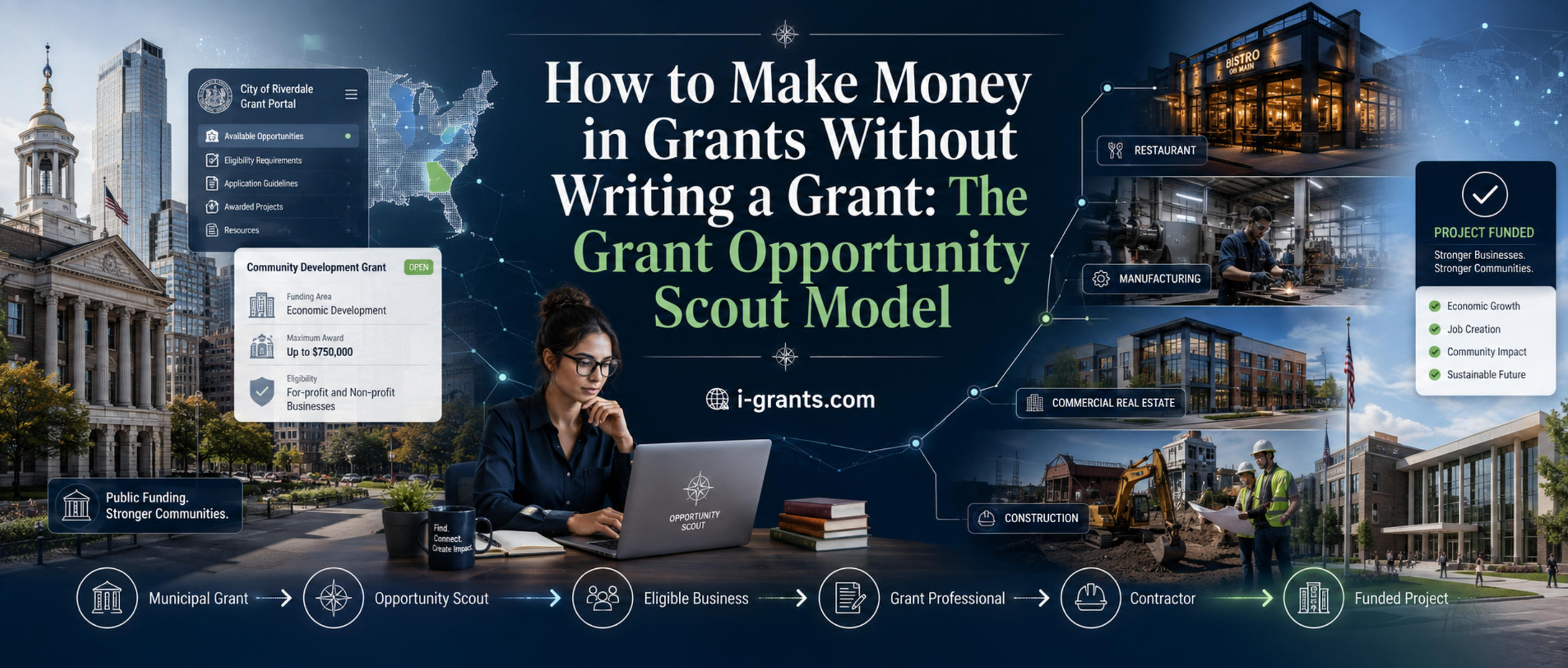
There is a peculiar moment in the life of many public grants.
The money exists. The programme is officially open. The municipality has published the rules. A local business needs exactly the type of improvement the programme was created to support. Qualified contractors are available to do the work. Professional grant specialists are available to handle the application.
And still, nothing happens.
The owner of the business simply does not know that the opportunity exists.
That gap may be a business opportunity of its own.
You do not necessarily need to know how to write a sophisticated grant proposal to participate in the grant economy. You can become the person who finds an overlooked funding opportunity, identifies a business that might genuinely benefit from it, starts the conversation, brings in the right professional and helps connect all the pieces.
We call this role the Grant Opportunity Scout.
It is not a grant writer in disguise. It is closer to opportunity research, business development and project origination. And when we tested the idea against a real municipal programme in the United States, we discovered something remarkable: the underlying mechanism is not theoretical at all. In Chicago, organizations working with the city already perform many of the same functions, including outreach to businesses, contractor connections, financing assistance and help with reimbursement paperwork.
Even better, there is a live programme we can use to follow the entire chain.
As of August 16, 2026, Chicago's Small Business Improvement Fund, known as SBIF, is accepting applications in five Tax Increment Financing districts. The August window opened on August 1 and closes on August 30 at 5:00 p.m. The current districts are 43rd/Cottage Grove, Clark/Montrose, Goose Island, Northwest Industrial Corridor and West Woodlawn.
So let us forget hypothetical "free money" for a moment and follow a real grant opportunity from a municipal website toward a real business project.
The Money Is Already There
SBIF is administered by SomerCor on behalf of the Chicago Department of Planning and Development. It uses Tax Increment Financing resources to reimburse eligible building owners and tenants for permanent improvements to commercial and industrial properties. The current programme rules were updated in January 2026.
The word reimburse matters.
This is not a programme where a company fills in a form on Monday and receives government cash on Friday. The applicant must qualify, the project must be approved before construction begins, the work must be completed according to the rules, and the applicant must document the expenses before reimbursement is made.
But the amounts are large enough to change a business decision.
Table 1. Chicago SBIF Funding Mechanics in 2026
| Applicant situation | Potential reimbursement | Key financial limit |
|---|---|---|
| Commercial applicant with qualifying annual sales or net worth below $3 million | Up to 90 percent of eligible costs | Single-tenant commercial property generally capped below $150,000 |
| Commercial applicant from $3 million to below $6 million | Up to 60 percent of eligible costs | Subject to applicable property cap |
| Commercial applicant from $6 million to below $9 million | Up to 30 percent of eligible costs | Subject to applicable property cap |
| Eligible industrial business with no more than 200 full-time equivalent employees | Up to 50 percent of eligible costs | Industrial property generally capped below $250,000 |
| Reimbursement structure | Payment after approved work and documentation | Applicant must demonstrate financing capacity during the process |
The official rules specify the 90, 60 and 30 percent commercial tiers and the 50 percent industrial reimbursement rate. They also establish maximum programme assistance levels for different property types.
Now imagine a small commercial company considering $120,000 of eligible renovation work.
If it ultimately qualifies for the 90 percent tier, and if the entire $120,000 project is accepted as eligible, the potential reimbursement would be $108,000.
That does not mean the business has "won $108,000." Nothing should be presented that way before eligibility and project costs are formally reviewed.
But from the owner's perspective, a project that previously looked like a $120,000 capital expense may suddenly deserve a second look.
And this is precisely where the Grant Opportunity Scout becomes useful.
Start With Geography, Not With a Mailing List
A poor version of this business model would be extremely easy to create.
Find a grant. Scrape thousands of email addresses. Send everyone a message saying, "You may qualify for free government money."
That is not opportunity scouting. It is spam.
A good scout works in the opposite direction.
SBIF is geographically specific. A project property must be in a participating TIF district, and each district has its own application period. The SomerCor website even provides a dedicated locator tool for checking addresses.
So the research starts with a map.
Suppose we choose Goose Island, one of the districts open in August 2026.
We are no longer searching all of Chicago. We are searching a defined economic area for commercial or industrial businesses that occupy real buildings and may have a reason to invest in those buildings.
That is an enormous improvement in targeting.
The SBIF rules tell us what type of problems to look for. Eligible costs can include roofing and facade work, HVAC and other mechanical systems, plumbing, electrical work, permanent interior renovation, ADA-related improvements, solar panels and certain project-related architectural and construction-management costs.
Now the scout's question becomes concrete:
Which businesses in this exact district may already be planning a roof replacement, HVAC upgrade, electrical renovation or interior improvement?
That is not really a grant-writing question.
It is a business-development question.
A Real Business Appears on the Map
Consider Goose Island Shrimp House at 1011 W. Division Street in Chicago.
This is not an invented example. The restaurant publishes the address and phone number on its website, while North Branch Works describes it as a family-owned business that has operated at the location for more than fifty years.
Now an important distinction.
We are not saying that Goose Island Shrimp House currently needs a new roof. We are not saying it has applied for SBIF. We are not saying it qualifies. We are not suggesting that its owners have expressed any interest in such a project.
It is simply a real business that illustrates how an opportunity scout might build a prospect list.
The scout could first verify the exact property against the official SBIF locator and then contact the business with a very different message from the usual "we found free money for you" pitch.
The conversation could sound like this:
"I am researching the City of Chicago's current SBIF funding window for Goose Island businesses. The programme may reimburse eligible permanent building improvements such as roofing, HVAC, electrical work and interior renovation. I am not assuming that your business qualifies, but if you are considering any major building improvements, I can help identify whether the project is worth reviewing with a funding professional."
That is a legitimate business conversation.
The scout is not promising an award.
The scout is discovering whether an actual investment need exists.
And sometimes one question changes everything.
"Are you planning any building improvements?"
If the answer is no, the prospect goes nowhere.
If the answer is, "Actually, we need to replace our roof next year," an abstract government programme has just collided with a real private-sector project.
That collision is where value is created.
The Grant Does Not Create the Roof
This distinction deserves more attention because it changes the entire philosophy of grant prospecting.
The strongest project is not:
"We found a grant, so let us invent something to spend it on."
It is:
"We found a business investment that was already needed, and then discovered that public funding may reduce the cost of making it happen."
There is hard evidence that SBIF works exactly this way.
SomerCor's FY2025 Impact Report documents 146 SBIF grants paid during the fiscal year, totaling $15,996,363, connected to projects with total costs of $25,361,507.
One recipient was Damron Corporation, a coffee and tea manufacturer in Chicago's Northwest Industrial Corridor.
This is especially relevant because Northwest Industrial Corridor is again one of the districts open for applications in August 2026.
Damron's example shows what a real grant-funded building project looks like after all the theory disappears.
The company received an SBIF grant of $90,396. SomerCor reports that the project helped the company improve its building through re-roofing over the existing roof, flashings, reinforced TPO roofing, a new rooftop HVAC unit and replacement sprinkler heads. The company reported 18 jobs created or retained.
This is exactly the kind of connection a scout should be looking for.
Not "Who would like grant money?"
But:
Who has a building problem that a current grant programme was designed to solve?
Then the Contractors Enter
Suppose our hypothetical Goose Island prospect confirms that its roof needs replacement.
The next step is no longer abstract grant research. Someone has to inspect the building, define the scope and quote the work.
Chicago has real commercial roofing companies capable of doing precisely that.
Matthews Roofing operates from 3737 W. North Ave. in Chicago and advertises commercial roof repair, replacement, restoration and maintenance. The company states that it is licensed, bonded and fully insured and publishes Chicago License No. 2204330.
L. Marshall Roofing & Sheet Metal describes itself as a fully licensed and bonded Chicago and Midwest commercial roofing company serving commercial, industrial and institutional roofing projects.
Knickerbocker Roofing also provides commercial and industrial roofing services throughout the Chicago area, including low-slope systems, TPO roofing, maintenance, repair and other building-roof services.
These names are not endorsements, and the applicant would need to verify current licensing, insurance, availability and project fit.
But here is the fascinating part: finding contractors is not merely something we added to make the business model more interesting.
SBIF itself requires it.
At Stage 2, applicants must provide at least two competing, comparable contractor bids. Each contractor must submit its City of Chicago licence and proof of insurance. The applicant cannot simply serve as its own contractor.
So the physical economy and the grant economy are formally connected.
The programme needs a real contractor.
The contractor needs a real project.
The business needs the improvement.
The funder wants the investment to happen.
The only question is whether somebody manages to connect these participants before the opportunity disappears.
This Is Where You Stop Pretending to Be a Grant Writer
Now suppose the scout has done the following.
The programme has been identified and checked.
The business has expressed genuine interest.
The property appears to be in the relevant district.
The owner confirms that a significant building project is being considered.
Potential contractors can be approached for quotations.
At this point, the inexperienced scout should not suddenly decide that a weekend of internet research has turned them into a professional grant writer.
This is the point where specialization becomes an advantage.
A professional grant specialist can review the eligibility position, help organize the application, examine documentation requirements, work through financial information and keep the project aligned with the programme rules.
This is also where a specialized platform such as i-grants.com can close the circle.
Organizations can post a project on i-grants.com, receive bids, evaluate candidates and hire a professional on a project or hourly basis. The platform also provides a searchable professionals section for identifying specialists by skills and other criteria.
Instead of posting a vague request such as "Find grants for my restaurant," the opportunity scout can help transform the situation into a professional assignment:
Chicago SBIF application support for a Goose Island business considering a commercial building renovation. Need eligibility review, application guidance, contractor-bid coordination and assistance through the reimbursement process.
That is a radically better project brief.
The grant professional no longer has to begin with an empty page.
The business no longer has to understand the entire funding ecosystem.
The scout does not have to write a grant they are not qualified to write.
Everyone performs the function where they add the most value.
What the Full Chain Really Looks Like
At this point, we can map the entire transaction.
Table 2. From Municipal Grant to Real Business Project
| Stage | What happens in the real SBIF process | Where the Grant Opportunity Scout can add value |
|---|---|---|
| 1. Funding is published | Chicago opens SBIF applications for specific TIF districts during scheduled monthly windows | Monitor municipal and economic-development websites and identify live opportunities |
| 2. Geography is defined | Only properties in eligible districts can proceed | Map eligible areas and build a tightly targeted list of businesses |
| 3. A real project is discovered | Business confirms a possible roof, HVAC, electrical, plumbing or renovation need | Conduct initial outreach and identify whether a genuine investment project exists |
| 4. Eligibility is examined | Business size, site control, property status and other rules are reviewed | Gather preliminary facts and bring in an experienced grant professional |
| 5. Contractors quote the project | SBIF requires at least two comparable bids from appropriately licensed contractors | Help organize introductions and quotation requests |
| 6. Formal project review begins | SomerCor and the City review applicant and project documentation | Keep the owner, grant professional and contractors working from the same project information |
| 7. City approval is obtained | Conditional Commitment Letter authorizes construction | Ensure nobody mistakenly starts grant-funded work before approval |
| 8. Construction takes place | Approved contractor performs the physical work | Coordinate information and deadlines without replacing licensed professionals |
| 9. Costs are documented | Applicant provides invoices, payment evidence, permits and other closing documents | Help maintain the administrative trail |
| 10. Reimbursement is processed | After approved documentation is complete, reimbursement is prepared | Close the information loop and document the completed opportunity |
The official process is more demanding than simply submitting an online form.
After the application period closes, a lottery can be used if requests exceed the funds available. Remaining applicants may stay on a waiting list for up to 24 months. Stage 1 documentation generally has a 20-day deadline after the request. Stage 2 allows 120 days for project eligibility work and contractor bids. Construction cannot begin before approval. After approval, the applicant receives a Conditional Commitment Letter and generally has ten months to complete construction, while proof of financing and required permits must be provided within 120 days of the commitment letter.
Once construction and the required payment documentation are complete, SomerCor states that reimbursement generally takes another four to six weeks to process.
The process is not simple.
And that is precisely why coordination can have value.
The Unexpected Proof That the "Scout" Function Is Real
At first glance, Grant Opportunity Scout might sound like a name invented for this article.
The name is ours.
The economic function is not.
North Branch Works, a Chicago economic-development organization, announced in February 2026 that it would lead outreach to commercial, manufacturing and industrial companies in areas where SBIF was opening. It also stated that it regularly connects businesses with contractors, helps them obtain low-interest loans and assists with reimbursement paperwork.
The formal SBIF rules go even further. They state that delegate agencies, including local chambers of commerce and economic-development organizations, are contracted by the City to assist applicants. SomerCor itself provides technical assistance with contractor selection, bids and proper work contracts.
That is an extraordinary validation of the central idea.
There is already recognized value in finding businesses, explaining programmes, helping assemble the project ecosystem and getting applicants through a complicated process.
A private scout must not misrepresent themselves as a City delegate agency, and should never imply official affiliation where none exists.
But the broader lesson is unmistakable:
information intermediation is part of the grant economy because information does not move automatically.
Why Businesses Still Miss Grants That Are Publicly Available
It would be unfair to say that Chicago hides SBIF.
It does not.
The City publishes information. SomerCor operates a dedicated website, application process, calendar, locator and webinars. North Branch Works performs direct outreach.
Yet consider what the owner of an ordinary restaurant, workshop or manufacturing company would have to know at exactly the right moment.
They would need to know that SBIF exists.
They would need to know that their address falls inside a relevant TIF district.
They would need to know which month their district accepts applications.
They would need to understand which construction costs may qualify.
They would need to avoid beginning work too early.
They would need contractors willing to prepare comparable bids.
They would need financing capacity because this is fundamentally a reimbursement programme.
They would need enough confidence in the opportunity to start the process.
Public information can be completely transparent and still remain commercially invisible to the person who needs it.
This is one of the most interesting inefficiencies in public funding.
The information is not secret.
It is simply not where the business owner is looking.
The Scout's Most Valuable Tool May Be the Telephone
Imagine researching one active TIF district and identifying twenty independently owned businesses that occupy older commercial buildings.
You do not need twenty clients.
You do not even need twenty interested businesses.
You need a few genuine conversations.
One owner may say that nothing is planned.
Another may already have completed the work and therefore be too late.
Another may not meet the programme's financial thresholds.
But then one owner says:
"We have been putting off replacing the HVAC system because the quote is too expensive."
That sentence is the opportunity.
The scout did not create the government programme.
The scout did not create the HVAC problem.
The scout did not create the contractor.
The scout did not create the grant writer.
The value came from noticing that these separate facts belong together.
That is opportunity origination.
And it is a skill that exists far beyond grants.
Real estate brokers do it.
Recruiters do it.
Business-development professionals do it.
Investment bankers do it.
Sales agents do it.
People are paid every day not because they manufactured the underlying asset, but because they found a valuable match that would otherwise have been missed.
There is no reason the grant economy should be immune to the same logic.
One Important Correction: Do Not Build the Model Around Taking a Percentage of the Grant
There is one part of the original Grant Opportunity Scout idea that becomes problematic when we move from enthusiasm to professional practice.
It is tempting to say:
"I found you a $100,000 grant. If you win, give me ten percent."
That looks commercially elegant.
It is also exactly the kind of compensation structure that should trigger caution.
The Grant Professionals Association Code of Ethics states that members should not accept or pay a finder's fee, commission or percentage compensation based on grants. Its ethics guidance instead points professionals toward salary or fee-based compensation.
Federal funding introduces its own rules. Under 2 CFR 200.459, allowable professional and consultant service costs under federal awards must, among other conditions, not be contingent on recovery of costs from the Federal Government.
SBIF is a municipal TIF programme rather than a federal grant, so federal cost rules should not simply be declared applicable to every Chicago consulting arrangement. Nor does the GPA ethics rule automatically govern every person who performs business-development research.
Still, the business lesson is clear.
There is no reason to build the Grant Opportunity Scout model around its most ethically sensitive payment method.
A scout can instead be paid for research, qualification, introductions and coordination.
A business might pay a fixed fee for identifying relevant programmes.
It might purchase an eligibility and opportunity assessment.
It might retain someone monthly to monitor municipal, state and foundation funding programmes.
A scout might be paid a fixed project-origination fee for researching a programme and assembling the preliminary project information.
Or the company might retain the scout for administrative coordination while the specialist grant professional separately handles the actual application.
That is a much more durable business model because the fee compensates the work performed, not the size of a government cheque that may or may not arrive.
There Is Another Reality Check: The Business Needs Money Before It Gets Money
Reimbursement grants create a second trap for inexperienced intermediaries.
Suppose you tell a company:
"I found a programme that could give you $100,000."
The owner may reasonably assume that $100,000 will be available to pay the contractor.
SBIF does not work that way.
The programme rules explicitly describe SBIF as a reimbursement grant and say applicants should be prepared to pay out of pocket or finance their projects. During the construction phase, applicants must show proof of financing for at least 50 percent of the project contract price. The programme can allow reimbursement in up to three phases in qualifying cases, but applicants still need financing capacity and approval of the full scope before starting construction.
This makes the scout's role more sophisticated, not less.
A useful scout does not sell excitement.
They translate programme mechanics into business reality.
Instead of saying:
"You can get $108,000."
The professional version is:
"If your company, property and project qualify for the highest commercial reimbursement tier, a $120,000 fully eligible project could theoretically produce reimbursement of up to $108,000, subject to programme approval. You would still need the required financing capacity, approved contractors, documentation and compliance with the programme timeline."
That is less sensational.
It is also infinitely more credible.
The Business Model Is Bigger Than One Chicago Grant
SBIF makes a good case study because it is concrete, local and connected to physical economic activity.
But the same research logic can be repeated elsewhere.
Instead of asking, "What grants exist in America?" a scout can work one city at a time.
A municipal facade-improvement programme leads naturally to shops and commercial property owners in a defined corridor.
An energy-efficiency incentive leads to companies operating buildings with costly heating, cooling or lighting systems.
A manufacturing-modernization grant leads to factories planning capital upgrades.
A downtown revitalization programme leads to property owners considering renovations.
A workforce subsidy leads to companies that are already hiring or retraining people.
The formula remains remarkably consistent:
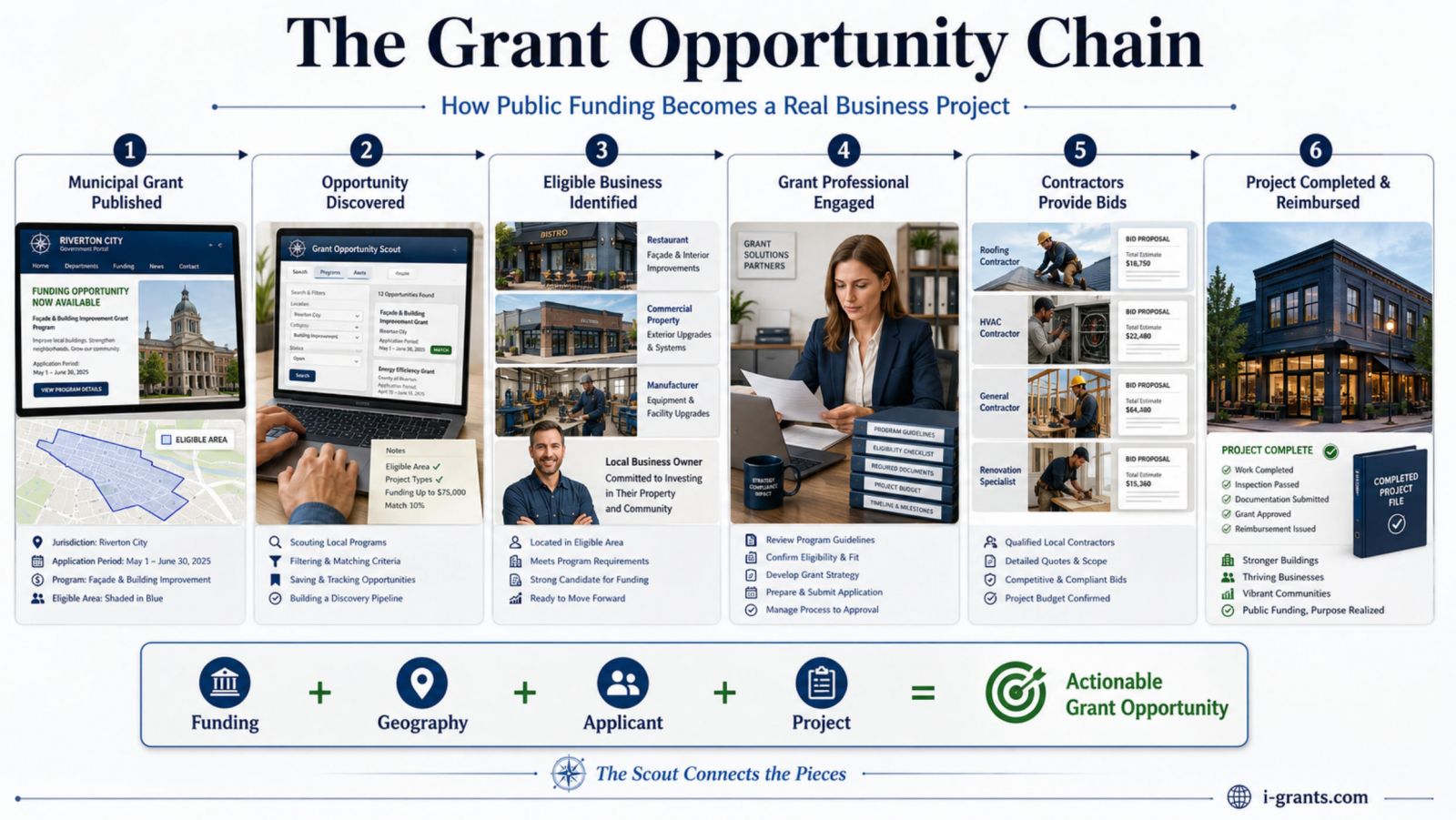
Funding + Geography + Applicant + Real Project = Actionable Grant Opportunity
The skill is not collecting thousands of links.
The skill is converting one link into one economically meaningful conversation.
Why This Could Become a Genuine Side Business
The barrier to entry is surprisingly low, but the standard of work should be high.
A Grant Opportunity Scout needs internet research skills, discipline, curiosity, communication ability and enough commercial judgment to recognize when a programme and a business problem may fit together.
The scout does not have to know how to write every grant.
In fact, knowing when not to write the grant is part of the value.
A person could begin with one city and one programme.
Study the official rules until the major exclusions are clear.
Map the eligible district.
Identify twenty businesses that appear relevant.
Research their public information.
Contact a small number with a precise, honest proposition.
Find out whether a real project exists.
If it does, verify the opportunity further.
Then bring an experienced grant specialist into the project through i-grants.com. The platform's core workflow allows an organization to post a project, compare bids and choose a professional suited to the assignment.
The first successful project does not need to produce a fortune.
The important discovery is that you can create economic value without being the person who writes the proposal.
The Most Beautiful Part of the Mechanism
There is something unusually elegant about this model.
Everybody can gain from the connection.
The municipality has already decided that it wants certain investments to happen.
The business has a building that needs work.
The contractor wants a legitimate commercial project.
The grant professional wants a serious client with a defined funding opportunity.
The scout wants to be paid for discovering and coordinating that opportunity.
And none of these participants needs to lose for another participant to win.
Consider Damron Corporation again.
A real Chicago manufacturer improved a real building. The work included a real roof, real HVAC equipment and real fire-protection infrastructure. The company received $90,396 through SBIF and reported 18 jobs created or retained.
That is what sits at the end of all those municipal webpages, eligibility rules, contractor bids and application documents.
Not a grant database.
A building changed.
A business invested.
Contractors worked.
Public money achieved an economic-development objective.
Now imagine finding the next Damron before the company itself realizes that the funding opportunity exists.
That is the Grant Opportunity Scout model.
You Do Not Have to Start as an Expert
The grant industry can look intimidating from the outside.
There are regulations, budgets, forms, evaluation criteria, compliance rules, funding terminology and professionals who have spent years mastering them.
That often leads beginners to a false conclusion:
"I cannot write grants, so there is no place for me here."
There is another entry point.
Do not begin by trying to become the person who knows everything.
Become the person who finds something worth knowing.
Find the municipal programme nobody in your network has noticed yet.
Understand what it is trying to finance.
Find the real businesses sitting inside its geography.
Ask them what they are planning.
Listen.
When one of those businesses has the right project, bring in the professionals who know how to take it further.
i-grants.com can become the meeting point where that discovered opportunity acquires professional grant expertise.
The scout finds the door.
The business brings the real need.
The contractor turns the need into a physical project.
The grant professional builds the funding case.
The funder supplies the public capital when the rules are satisfied.
And suddenly a municipal programme that was once just another page on a government website becomes a roof, an HVAC system, a renovated commercial space, a contractor's invoice, a stronger local business and a real funding transaction.
The money was already there.
The business was already there.
The professionals were already there.
Sometimes the missing piece is simply the person who realizes that they should all be talking to each other.

Programme information was checked against current City of Chicago, SomerCor and related sources on August 16, 2026. Funding windows, eligibility rules, reimbursement terms, contractor status and individual business circumstances can change. A business should verify current programme requirements and obtain appropriate professional advice before applying or beginning work.