

 Français
  Deutsch
  Українська
Corporate philanthropy can be misleadingly simple from the outside. A global company creates a foundation, announces a social mission and funds external organisations. For applicants, however, the real funding structures can be dramatically different.
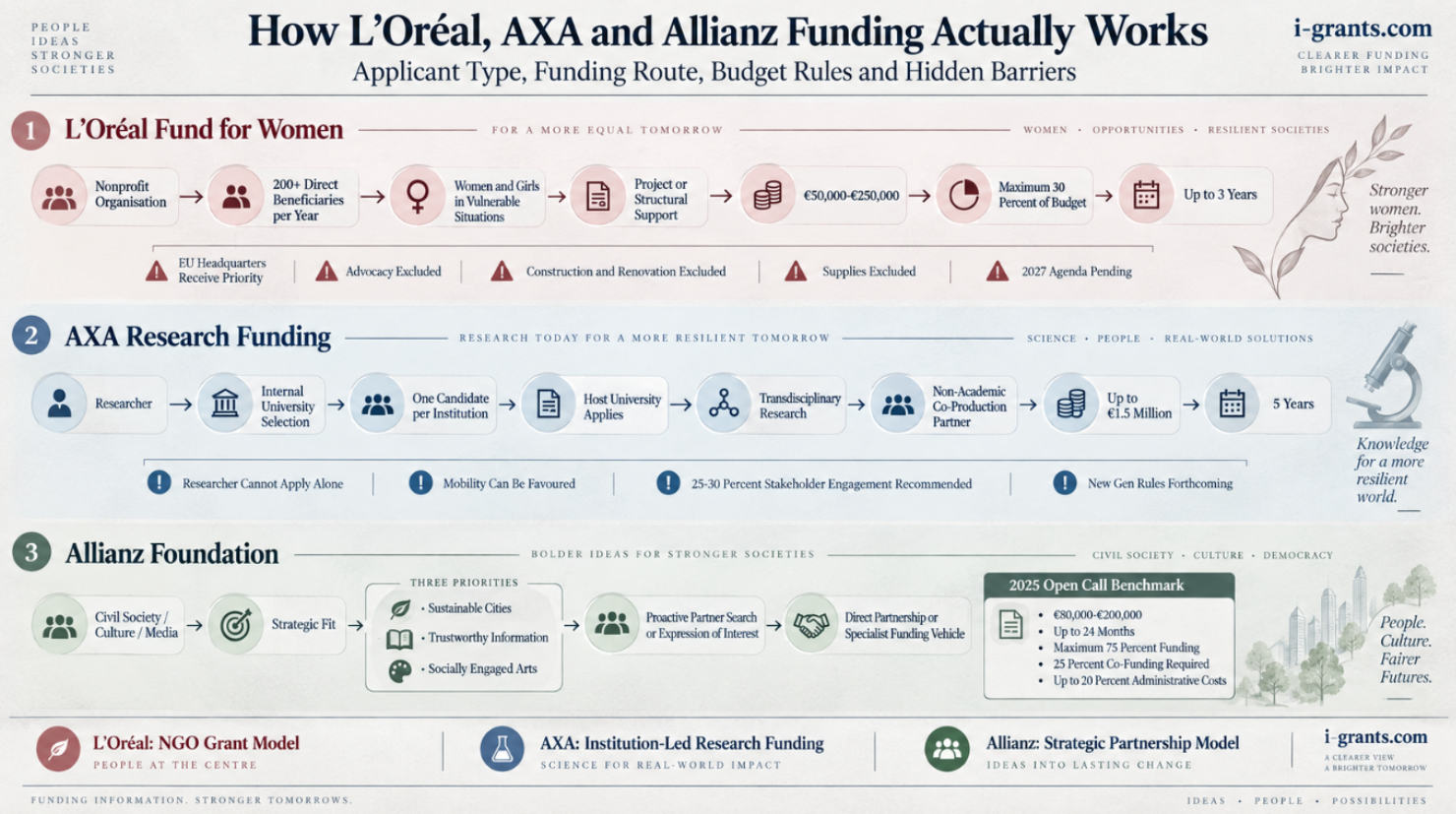
The L’Oréal Fund for Women operates much like a traditional international grantmaker supporting nonprofit organisations that work directly with vulnerable women and girls. AXA takes a very different approach. Its largest research programmes are built around universities, research institutions and named scientists, meaning that an individual researcher cannot simply submit an application independently. Allianz Foundation represents a third model, combining direct grantmaking with proactively selected partnerships, expressions of interest and specialist collaborative funding vehicles.
Those differences matter much more than the headline award size. A nonprofit may see that L’Oréal can provide up to €250,000 but discover that the Fund cannot cover more than 30 percent of its project budget. A scientist may be interested in an AXA Chair worth up to €1.5 million but first need to become the only candidate nominated by their university. An NGO may find an old Allianz call offering €80,000 to €200,000 and incorrectly assume that the same open competition still operates under the Foundation’s new strategy.
For applicants looking beyond one short funding cycle, there is also an encouraging conclusion. None of these three funding ecosystems appears to be a one-off corporate campaign. L’Oréal has renewed the Fund for Women through 2030. AXA has supported research since 2008 and is currently reorganising its science programmes rather than withdrawing from them. Allianz Foundation has a substantial endowment and a multi-year financing commitment from Allianz SE, although the way organisations gain access to its funding is changing.
This makes all three worth understanding in detail.
Three funders, three completely different application models
The easiest way to compare the three organisations is not by sector, but by the way money actually reaches beneficiaries.
L’Oréal primarily funds nonprofit organisations. AXA primarily funds research through universities and public research institutions. Allianz Foundation supports nonprofit, civil-society, cultural and media ecosystems, but increasingly uses targeted partnerships instead of relying exclusively on broad annual calls.
Table 1. L’Oréal, AXA and Allianz Funding Models at a Glance
| Funding mechanism | Main applicant | Published funding level | Typical duration | Main focus | Long-term outlook |
|---|---|---|---|---|---|
| L’Oréal Fund for Women | Nonprofit or not-for-profit organisation | Latest published criteria: €50,000 to €250,000 | Up to 3 years | Vulnerable women and girls | Very strong, with a new €50 million commitment for 2026-2030 |
| AXA Chairs | University or public research organisation | Up to €1.5 million | 5 years | Major societal risks and transdisciplinary research | Very strong |
| AXA Postdoctoral Fellowships | Host research institution | Latest documented model: up to €140,000 | 2 years | Early-career research | Transitional rather than guaranteed to repeat unchanged |
| AXA New Gen | Detailed rules pending | Not yet published as of September 2026 | To be announced | Young researchers | New strategic programme |
| Allianz Foundation | Nonprofit, civil-society and cultural partners depending on the mechanism | No single current universal range | Depends on partnership | Sustainable Cities, Trustworthy Information, Socially Engaged Arts | Strong institutionally, but application model is changing |
| Allianz Foundation Grants Program 2025 | Eligible organisations in Europe and the Mediterranean | €80,000 to €200,000 | Up to 24 months | Environment, civil society, arts and culture | Historical benchmark, not a guaranteed future format |
The differences become even more important once eligibility, budget structure and internal selection procedures are examined.
L’Oréal Fund for Women: a long-term philanthropic programme, not a temporary campaign
Among the three funders, the L’Oréal Fund for Women currently offers the clearest long-term outlook for nonprofit organisations.
The Fund was created in 2020 as social and economic pressures on vulnerable women intensified during the COVID-19 crisis. L’Oréal initially committed €50 million. The company later expanded that commitment by another €30 million, and in March 2026 announced a new €50 million allocation for the period from 2026 to 2030.
That new commitment is particularly important for organisations deciding whether it is worth investing time in understanding the programme. The Fund has not merely survived its original emergency phase. L’Oréal has transformed it into a longer-term philanthropic instrument with a defined horizon through 2030.
By the end of the latest reporting period, more than €72.4 million had been allocated to more than 560 organisations in over 110 countries. L’Oréal reported that these partnerships had contributed to direct support for more than 6.6 million women and girls.
The new 2026-2030 phase concentrates funding around four major priorities: economic empowerment, access to education, combating violence, and access to sexual and reproductive health. These areas are broad enough to include employment and entrepreneurship programmes, education initiatives, services for survivors of gender-based violence, health interventions and programmes addressing severe social exclusion.
The Fund is international, but international eligibility should not be interpreted as geographically neutral competition. Under the latest published criteria, organisations headquartered in the European Union receive priority. The criteria also favour organisations capable of issuing tax receipts in France or elsewhere in the EU.
Who can actually qualify for L’Oréal funding?
The Fund is aimed at established nonprofit or not-for-profit organisations of general interest. Applicants need official statutes, a recognised legal structure and the legal ability to receive private philanthropic funding. Income cannot be distributed directly or indirectly among members.
Normally, an organisation must have existed officially for more than two years. There is an exception for younger organisations with a particularly strong and documented innovative approach to an unmet need, but this should not be treated as an easy route for newly established NGOs. A new organisation would need to demonstrate why its model is sufficiently distinctive and credible to justify an exception.
A much less obvious eligibility rule concerns scale. An applicant is expected to support at least 200 direct beneficiaries per year through its overall activities.
This threshold can exclude very small organisations even when their programmes are highly specialised and effective. A community organisation working intensively with 60 survivors of violence may have a strong track record, but it may still fall below L’Oréal’s expected organisational scale.
The target population must include women or girls facing significant vulnerability. Relevant situations can include poverty, insufficient income, homelessness, single parenthood, geographic isolation, violence, disability and refugee status.
There is another important distinction between structural support and project funding. An organisation working directly and exclusively with vulnerable women and girls may request support for its organisational structure or for a specific programme. An organisation serving a wider population, for example women, men and children affected by displacement, may still be eligible, but only for a project that specifically benefits women and girls.
That difference can substantially affect how an NGO designs its request.
The €250,000 maximum is not the real financial limit
The latest published L’Oréal criteria provide a funding range from €50,000 to €250,000, with annual or multi-year support of up to three years.
At first glance, this makes the programme look accessible to organisations of very different sizes. The 30 percent rule changes that picture.
For project funding, the L’Oréal contribution cannot exceed 30 percent of the total project budget. For structural support, it cannot exceed 30 percent of the organisation’s overall budget.
Therefore, an NGO requesting the full €250,000 for a project would need a project budget of at least approximately €833,333. A request of €100,000 implies a project budget of at least approximately €333,333. Even the minimum €50,000 request requires a project budget of around €166,667 if L’Oréal finances the maximum permitted share.
Table 2. How the L’Oréal 30 Percent Rule Changes the Real Grant Size
| Requested from L’Oréal | Minimum total budget if L’Oréal covers 30 percent |
|---|---|
| €50,000 | Approximately €166,667 |
| €75,000 | €250,000 |
| €100,000 | Approximately €333,333 |
| €150,000 | €500,000 |
| €200,000 | Approximately €666,667 |
| €250,000 | Approximately €833,333 |
This is not a conventional requirement that the organisation contribute the remaining 70 percent from its own unrestricted cash. The rest of the budget can come from other donors and financing sources. However, L’Oréal expects the applicant to show other secured, pending or planned funding.
In practice, the programme is therefore better suited to organisations with diversified funding than to an NGO hoping that L’Oréal will finance almost the entire project.
Some obvious women-focused projects are still ineligible
Mission alignment does not make every activity fundable.
The latest application criteria exclude advocacy activities, construction work, renovation and fitting-out, and the financing of supplies. These exclusions matter particularly for humanitarian organisations, women’s shelters and rights-based NGOs.
Consider a nonprofit supporting survivors of domestic violence. A programme offering counselling, legal support, skills development and employment services may fit the Fund well. A proposal dominated by the renovation of a shelter, furniture purchases and distribution of hygiene products may not.
Similarly, an organisation campaigning for legislative reform on women’s rights may have a mission closely connected to women’s empowerment but still be poorly matched if advocacy is the central activity for which funding is requested.
The Fund also excludes organisations or activities connected to discriminatory practices, forced labour, child labour, serious human-rights concerns, harmful environmental impacts and certain political, military or religious objectives.
This means a strong L’Oréal proposal needs more than a compelling social problem. It needs a delivery model that fits the Fund’s specific interpretation of direct support.
What real L’Oréal grantees tell us
The portfolio is geographically and programmatically diverse.
Among the organisations highlighted in L’Oréal reporting are the Panzi Foundation in the Democratic Republic of the Congo, known for comprehensive assistance to survivors of sexual violence; Maison des femmes de Saint-Denis in France; Fundación Ana Bella in Spain; Rêv’Elles in France; Flying Kites in Kenya; and initiatives supporting women and girls in Afghanistan and other fragile environments.
The Georges Malaika Foundation provides another example of the Fund’s education focus. Its work includes free education for girls in the Democratic Republic of the Congo.
Financial statements from grantees can provide even more practical information than general corporate reporting. Women on Wings reported €100,000 in recurring income from the L’Oréal Fund for Women in its 2024-2025 financial year and stated that the partnership had been renewed for another two years.
This is important for two reasons. It shows that awards can sit well below the nominal €250,000 ceiling, and it confirms that L’Oréal may build multi-year relationships with organisations rather than treating every grant as an isolated one-year transaction.
The Fund also offers capacity-building support beyond direct grant money. Its latest reporting describes support for hundreds of associations and social-sector professionals through webinars, coaching and peer-learning formats.
What happens after 2026?
L’Oréal has already committed financing for 2026-2030, but there is no Fund for Women application call in 2026. The company has stated that information about the 2027 agenda will be communicated separately.
This distinction is important. The Fund itself is clearly continuing, but organisations should not assume that every detail of the previous application cycle will remain unchanged.
The €50,000 to €250,000 range, 30 percent budget limit, beneficiary threshold and other rules are the latest published conditions. They remain highly useful for preparation, but applicants should verify the next official call before finalising a budget.
For organisations hoping to apply in the future, the waiting period can be used productively. They can check whether their annual beneficiary numbers are high enough, test whether a realistic project can satisfy the 30 percent rule, identify alternative funders and remove expenditure categories that are likely to be excluded.
AXA Research Fund: the scientist matters, but the institution applies
AXA operates at a completely different scale and through a different legal structure.
The AXA Research Fund was created in 2008 to support research addressing major risks to society. Since then, AXA reports more than 800 supported projects in 39 countries and approximately €300 million in cumulative research funding.
Science now sits within the broader AXA Foundation for Human Progress, which brings together philanthropic activities in science, nature, solidarity and culture. AXA has not withdrawn from research funding. Instead, it is redesigning how different stages of academic careers are supported.
At present, the clearest long-term science programme is the AXA Chair. AXA has also announced New Gen as a new programme for young researchers. The familiar AXA Postdoctoral Fellowship remains important historically and produced a new cohort in 2026, but applicants should no longer assume that an identical fellowship call will automatically return every year.
Table 3. AXA Research Funding for Different Career Stages
| Programme | Target profile | Funding | Duration | Formal applicant | Current relevance |
|---|---|---|---|---|---|
| AXA Chair | Senior researcher | Up to €1.5 million | 5 years | University or public research organisation | Current flagship programme |
| AXA Postdoctoral Fellowship | Early-career researcher | Latest documented cycle: up to €140,000 | 2 years | Host institution | Important recent model, but future repetition in the same form is uncertain |
| AXA New Gen | Young researchers | To be announced | To be announced | Detailed rules pending | New strategic programme expected to shape future early-career funding |
Why an AXA Chair is not a personal grant
An AXA Chair can provide up to €1.5 million over five years, but a researcher cannot submit the application alone.
The formal applicant is the host academic institution or public research organisation. The institution must be registered with AXA and submit through its authorised operational contact.
This creates an internal selection process before the external competition even begins. Under the current Chair rules, an institution can submit only one candidate per campaign as the lead institution.
For researchers at large universities, this is a major practical barrier. A scientifically strong candidate may first need to compete against colleagues from completely different faculties for the institution’s single nomination.
AXA Chairs are designed for senior academic leaders. The proposed Chairholder is normally expected to have held a PhD for at least ten years and to demonstrate a strong international research profile, experience with transdisciplinary work and the ability to collaborate with non-academic stakeholders.
The researcher must hold, or be given, a full-time academic position at the host institution for the five-year duration of the Chair. If the candidate is being recruited from elsewhere, the institution must be prepared to establish the required position if the project is selected.
Recruiting someone new can be stronger than promoting internally
One of the less obvious AXA rules concerns mobility.
When two proposals are otherwise comparable in scientific excellence and transformational potential, AXA indicates a preference for mobility, meaning situations in which a host institution recruits a Chairholder from another institution.
The programme is not intended simply to finance an internal promotion.
An existing professor is not automatically excluded, but a university proposing an internal candidate needs a particularly strong explanation of why the Chair creates something genuinely new rather than merely financing existing research.
This makes AXA Chairs partly a research grant and partly a strategic institutional-development instrument.
AXA wants genuine interdisciplinarity
Many grant programmes use the word "interdisciplinary" loosely. AXA Chairs make the requirement more concrete.
The current model expects meaningful integration between at least two academic disciplinary groups. At least one component should come from social sciences, humanities or economics, while another comes from natural sciences, engineering or technology.
A climate-risk project, for example, might combine climate science and engineering with economics, governance or behavioural research. A public-health Chair could combine epidemiology with social policy, health economics or data science.
Simply listing researchers from different departments is not enough. AXA expects the disciplines to influence the research questions, methods and interpretation of results.
The non-academic partner is not there for decoration
At least one non-academic partner must be meaningfully involved in the Chair.
Possible partners include NGOs, municipalities, public authorities, public hospitals, professional associations and community organisations. Their role should involve co-design and co-implementation rather than a symbolic letter of support.
That means a university should not write the entire project and then add an NGO at the final stage simply to satisfy the requirement. A stronger application can show that non-academic partners helped define the problem, shape research questions, provide contextual knowledge, participate in implementation and use the findings.
There is also an unusual restriction: private for-profit companies cannot serve as formal project partners under the current AXA Chair rules.
A company may still be relevant to the ecosystem around a project, but it cannot simply occupy the same formal partner role as a municipality, NGO or public institution.
AXA expects a significant share of the budget to leave the academic bubble
The €1.5 million ceiling can cover a wide range of direct research expenses.
Eligible spending can include costs associated with the Chairholder, postdoctoral researchers, PhD candidates, research assistants, scientific equipment, databases, surveys, consumables, coordination, workshops, travel, facilitation, translation, communication and other activities directly connected to the research programme.
Under appropriate institutional and legal arrangements, non-academic partners may also receive justified compensation or project-related support.
The most revealing budget guidance concerns stakeholder engagement. AXA recommends that roughly 25 to 30 percent of the total Chair budget be dedicated to stakeholder engagement, facilitation, partner compensation and communication.
This is not an absolute mandatory percentage. However, a project that spends almost everything on salaries and equipment and very little on co-production may appear inconsistent with the philosophy of the programme.
Table 4. Key Financial and Administrative Rules for AXA Chairs
| Rule | AXA Chair approach | Practical consequence |
|---|---|---|
| Maximum grant | Up to €1.5 million | Applicants should justify the budget rather than automatically request the ceiling |
| Duration | 5 years | Long-term institutional commitment is required |
| Institutional applications | One lead candidate per institution per campaign | Internal nomination may be highly competitive |
| Chairholder profile | Normally PhD + at least 10 years | Programme is aimed at senior research leadership |
| Employment | Full-time academic position at host institution | Recruitment commitments may be required |
| Disciplines | Real integration across disciplinary groups | Token interdisciplinarity is weak |
| Non-academic participation | At least one genuine co-production partner | Stakeholder involvement must begin before dissemination |
| For-profit partners | Cannot be formal partners under current rules | Industry participation needs another structure |
| Stakeholder spending | Around 25 to 30 percent of budget recommended | Engagement is expected to be financially meaningful |
| Co-financing | No universal fixed matching percentage | Host contribution is still expected |
| Reporting | Annual activity and financial reporting | Future instalments depend on proper administration |
The host institution is also expected to contribute to the success of the Chair through resources, staff, facilities, studentships or other forms of institutional commitment. AXA does not impose one universal co-financing percentage, but that should not be interpreted as meaning the Foundation expects to carry the entire institutional burden.
AXA evaluates leadership as well as science
The process begins with an Expression of Interest submitted by the host institution.
Only selected proposals progress to the full-application stage. Full proposals are assessed by external reviewers and later stages may include rebuttal and direct interaction with AXA’s scientific evaluation bodies.
This matters because an AXA Chair is not evaluated purely as a research paper.
Scientific originality remains central, but reviewers also examine whether the disciplines have genuinely been integrated, whether non-academic partners are involved in knowledge creation, whether the network has credible governance and whether the programme could influence policy, practice or wider society.
AXA also links continued funding to annual reporting. Host institutions must provide activity and financial reports. The Chair therefore requires administrative capacity for the full five-year period, not only during application preparation.
The Foundation does not take ownership of the research results, but researchers are expected to acknowledge AXA support and comply with applicable open-access requirements.
A €1 million AXA Chair in practice
A useful example comes from the University of Geneva.
In 2026, the University announced an AXA Chair in Mountain Disaster Risks led by Professor Markus Stoffel. The Chair receives €200,000 per year for five years, producing a total award of €1 million.
The research examines the growing risks created by climate warming in mountain regions, including glacier retreat, permafrost degradation and changing precipitation patterns. The programme is expected to support three PhD candidates and two senior researchers.
The University reported that the proposal was selected through a highly competitive process involving more than 100 applications.
This case demonstrates an important point about maximum award figures. The AXA ceiling is €1.5 million, but a successful Chair does not need to request the maximum. A well-designed five-year programme can receive a lower amount if that budget matches the actual research architecture.
What is happening to AXA Postdoctoral Fellowships?
The most recent fully documented AXA Postdoctoral Fellowship model offered up to €140,000 over two years.
Researchers had to be within a defined period after their PhD and could not hold a permanent tenured or tenure-track position. The fellowship was designed primarily as a full-time research appointment, with teaching limited.
Once again, the institution played a central role. Under the latest documented cycle, an institution could present only one candidate.
This is a major hidden barrier for applicants. A postdoctoral researcher might satisfy every scientific eligibility rule and still never reach AXA because their university selects another internal candidate.
AXA announced seven fellowship recipients in 2026 under the theme "Rethinking the Social Contract: Demographic Change, Social Protection, and Solidarity." Their projects addressed subjects such as migration, pensions, ageing, gig work, homelessness, employment and social institutions.
However, the strategic direction is changing. AXA now presents AXA Chairs and the forthcoming New Gen programme as its two flagship science mechanisms.
For researchers planning for 2027 and beyond, New Gen may therefore become more relevant than old Postdoctoral Fellowship pages. Until the detailed rules are published, applicants should avoid assuming that the previous €140,000 model, career-age rules or institutional quota will remain unchanged.
Allianz Foundation: stable funding, but a less predictable route to access it
Allianz Foundation presents a different challenge.
The Foundation itself appears financially stable. It has an endowment capital of €100 million, and Allianz SE has committed to providing €5 million annually through 2031. Its portfolio has expanded significantly since the current Foundation structure was launched.
The uncertainty lies not in whether Allianz Foundation will continue funding projects, but in how organisations will gain access to that funding.
The Foundation has reorganised its strategy around three areas: Sustainable Cities, Trustworthy Information and Socially Engaged Arts.
At the same time, it has moved toward a more proactive funding model. Rather than relying entirely on one broad public competition, the Foundation now says it primarily identifies prospective partners through proactive outreach. It has also announced an expression-of-interest mechanism intended to give organisations outside its existing network a way to present themselves.
For grant seekers, this is a significant change.
A strong proposal may fit Allianz Foundation perfectly but still need a different entry strategy than simply waiting for an annual call and uploading a full application.
Sustainable Cities: climate funding with a social dimension
The Sustainable Cities priority is broader than a standard environmental grant.
Allianz Foundation is interested in how cities can manage environmental transformation without deepening social inequality. Relevant issues include affordable and sustainable land use, renovation instead of demolition, circular construction, regenerative materials and new approaches to urban development.
The strongest projects are likely to connect ecological outcomes with changes in governance, housing or community participation.
A conventional environmental awareness campaign may therefore be less attractive than a project demonstrating how an existing building can be renovated rather than demolished while keeping housing affordable and reducing emissions.
The emphasis is on transformation that can change how cities work, not simply on isolated environmental activities.
Trustworthy Information: more than journalism grants
The Trustworthy Information priority responds to declining trust, weakened media business models, disinformation and the growing difficulty of financing reliable public-interest information.
Allianz Foundation approaches the information ecosystem broadly. Journalism is important, but so are civil-society organisations, scientific actors and cross-sector collaborations.
Projects may explore new formats for public-interest reporting, strengthen independent media, create sustainable revenue models, build collaborations between journalists and researchers or improve the way high-quality information reaches communities.
This creates opportunities beyond traditional newsrooms, but projects still need to show why their work strengthens trustworthy information rather than simply producing communications content.
Socially Engaged Arts: artistic quality is not enough
The Foundation’s third priority focuses on art that engages directly with social or ecological issues.
This can include participatory art, community-based work, co-creation, cultural responses to political and environmental change, and projects that strengthen the resilience of cultural organisations.
The distinction between ordinary arts funding and socially engaged arts is important.
A technically excellent exhibition may still be a weak fit if audiences remain passive and the project produces little wider social effect. A smaller project involving artists and communities in changing local institutions, creating new public dialogue or addressing exclusion may fit the strategy much better.
The Foundation’s support for projects in Ukraine demonstrates this logic particularly clearly.
What the 2025 Allianz call still teaches applicants
The broad Allianz Foundation Grants Program held in 2025 is no longer a safe template for future applications, but its rules reveal a great deal about the Foundation’s grantmaking philosophy.
The programme offered €80,000 to €200,000 per project for a maximum of 24 months. Allianz Foundation could finance no more than 75 percent of total project costs.
Applicants therefore needed to secure at least 25 percent of the financing elsewhere.
The important detail was that this third-party financing needed to be confirmed before the project started. An organisation could not simply begin implementation with the Allianz contribution and hope to raise the matching funds later.
In-kind contributions did not count toward the co-financing requirement.
At the same time, the programme permitted administrative costs of up to 20 percent, giving organisations more operational flexibility than many restrictive project-only grant schemes.
Table 5. What the Allianz Foundation 2025 Call Revealed About Its Funding Logic
| Rule in the 2025 call | Published condition | Practical lesson |
|---|---|---|
| Grant size | €80,000 to €200,000 | Useful historical benchmark, not a guaranteed future range |
| Project duration | Up to 24 months | Foundation supported substantial multi-year work |
| Allianz contribution | Maximum 75 percent of project costs | External financing was essential |
| Co-financing | At least 25 percent | Applicant could not rely entirely on Allianz |
| Timing of third-party funds | Needed to be confirmed before project start | Funding gaps could delay or block implementation |
| In-kind contributions | Did not count toward co-financing | Volunteer time could not replace the financial contribution |
| Administrative costs | Up to 20 percent | Significant flexibility for organisational overhead |
| Application structure | Outline followed by full proposal for shortlisted applicants | Preparing a full dossier did not guarantee entry into final review |
The 2025 programme placed strong emphasis on systemic approaches, measurable impact, long-term effects beyond the funded period and strong local roots combined with wider relevance.
It also encouraged participatory project development and paid particular attention to organisations led by women, young people and marginalised groups.
Sustainability was considered in the method of implementation as well as the project topic. Applicants were encouraged to think about travel, material reuse, public transport, event practices and other operational choices.
This is a useful insight for future applicants even if the exact financial rules change.
Not everything called "Allianz funding" is a direct Allianz Foundation grant
Applicants should also distinguish between direct Foundation grants and specialist funding vehicles that Allianz Foundation helps finance or establish.
The Media Forward Fund is one example.
It was created with multiple philanthropic partners to strengthen public-interest journalism and sustainable media business models in Germany, Austria and Switzerland.
Its grants can be significantly larger than the figures associated with the Foundation’s old broad call. Early recipients included Reflekt with €300,000, Dossier with €390,000, andererseits with €400,000 and Tsüri with €400,000.
These were not standard Allianz Foundation grants submitted through the Foundation’s general grant programme. They were awards from a specialised pooled fund with its own objectives and procedures.
The Alliance for Socially Engaged Arts represents another model. Allianz Foundation is one of the foundations behind the initiative, but the programme is a collaborative European funding structure.
In its first fellowship cohort, the organisations of 15 selected fellows received €60,000 in core funding alongside an 18-month programme of organisational development and international collaboration.
Table 6. Allianz Foundation and Related Funding Mechanisms
| Mechanism | Type of support | Example amount | Main target group |
|---|---|---|---|
| Allianz Foundation direct partnerships | Foundation grant or strategic partnership | No single current universal range | Civil society, cultural and social-impact organisations |
| Allianz Foundation Grants Program 2025 | Open competitive grant | €80,000 to €200,000 | Eligible organisations across Europe and the Mediterranean |
| Media Forward Fund | Pooled specialist fund | Up to around €400,000 in early calls | Public-interest media |
| Alliance for Socially Engaged Arts | Collaborative fellowship and organisational funding | €60,000 core grant to fellows’ organisations in first cohort | Socially engaged arts organisations |
These distinctions are important because an organisation can be highly aligned with Allianz Foundation’s mission without necessarily applying directly to the Foundation.
In some sectors, the best opportunity may come through a specialist vehicle that Allianz helped create.
A Ukrainian example: theatre as democratic infrastructure
Ukraine appears directly in the Allianz Foundation portfolio.
One of the projects supported through the 2025 programme was "Democratic Future for Ukrainian Theatre, Act by Act", implemented by Nafta Theatre in Kharkiv.
The project gives emerging artists opportunities to develop new performances with professional mentorship, but its objectives go beyond producing theatre. It addresses problems such as rigid hierarchies, gender inequality, passivity and institutional resilience during the war.
This is an excellent illustration of what Allianz means by socially engaged arts.
The funded activity is not simply "make a performance." Art is being used as a method for changing relationships, creating participation, strengthening younger professionals and challenging institutional practices.
Allianz Foundation has also supported initiatives connected to documentation and investigation of human-rights violations and international crimes affecting Ukraine and Syria.
For Ukrainian organisations, these examples are particularly useful because they demonstrate that the Foundation’s European orientation does not exclude Ukraine. More importantly, they show what type of framing is competitive: the strongest project is rarely a one-off cultural event. It connects artistic, civic or informational activity with wider structural change.
Hidden rules that matter more than the headline grant
Across all three funders, the most valuable information often sits below the advertised amount.
Table 7. Hidden Rules That Can Weaken or Eliminate a Strong Application
| Funder | Less obvious rule | Why it matters |
|---|---|---|
| L’Oréal | Organisation should directly reach at least 200 beneficiaries per year | Small specialist NGOs may fall below the expected scale |
| L’Oréal | Latest minimum request is €50,000 | Micro-projects can be too small |
| L’Oréal | L’Oréal can cover no more than 30 percent of the relevant budget | €250,000 requires a budget of about €833,333 |
| L’Oréal | Structural support is available only to organisations directly and exclusively focused on vulnerable women and girls | Broader humanitarian NGOs may be limited to project funding |
| L’Oréal | Advocacy, supplies, construction and renovation are excluded under the latest criteria | Many otherwise relevant programmes may need substantial redesign |
| AXA | Researcher cannot submit an AXA Chair alone | University backing is mandatory |
| AXA | One Chair candidate per institution per campaign | Institutional competition begins before AXA review |
| AXA | Mobility may be preferred when proposals are otherwise equal | Recruiting an external researcher can be strategically stronger |
| AXA | Non-academic co-production is required | A symbolic NGO partner adds little |
| AXA | Private companies cannot serve as formal partners under the current Chair rules | Industry collaboration must be structured differently |
| AXA | Around 25 to 30 percent stakeholder-related spending is recommended | Purely academic budgets may look poorly aligned |
| Allianz | Current strategy relies heavily on proactive partner identification | A perfect project may still have no immediate public application route |
| Allianz 2025 | Co-financing had to be confirmed before the project started | Applicants could not fill the gap later |
| Allianz 2025 | In-kind contributions did not count as match funding | Volunteer labour did not solve the financing requirement |
| Allianz 2025 | Up to 20 percent administrative costs were permitted | The programme offered relatively strong overhead flexibility |
These rules show why searching only for "maximum grant amount" is often a poor way to evaluate a funding opportunity.
The real question is whether the applicant fits the financing architecture.
Which of the three funders is the best fit?
For an established NGO working directly with vulnerable women and girls, L’Oréal is the clearest option.
The organisation should already operate at meaningful scale, have a diversified funding base and deliver direct services rather than relying predominantly on advocacy. Economic empowerment, education, responses to violence and sexual and reproductive health are currently the most important strategic themes.
For a university or public research organisation, AXA offers much larger individual funding potential.
An AXA Chair can provide up to €1.5 million over five years, but success requires more than a strong professor and a strong publication record. The host institution needs to commit to the Chair, integrate different academic disciplines, involve non-academic partners from the beginning and demonstrate how knowledge will move beyond academia.
Allianz Foundation is potentially attractive to NGOs, civil-society initiatives, independent media and cultural organisations, but applicants should approach it differently.
The strongest concepts are likely to show structural change within Sustainable Cities, Trustworthy Information or Socially Engaged Arts. A standard workshop series, one-off event or equipment request is less likely to reflect the Foundation’s current direction than a project changing how a local system works.
The route to funding may also be less straightforward. Organisations should monitor the Foundation’s expression-of-interest mechanism and specialist funding vehicles rather than relying only on the expectation of a traditional annual open call.
Are these programmes worth following for 2027 and 2028?
Yes, but for different reasons.
L’Oréal has the clearest timeline. The company has committed another €50 million to the Fund for Women for 2026-2030. The absence of a 2026 call does not indicate the end of the programme. It means applicants need to wait for the 2027 application agenda.
AXA also has strong long-term credibility. The Research Fund has operated since 2008, has financed more than 800 projects and continues to develop new mechanisms. AXA Chairs remain a major programme, while New Gen is expected to become an important route for younger researchers.
The main caution concerns old Postdoctoral Fellowship information. Researchers should not build a 2027 strategy around the assumption that the previous €140,000 fellowship will return unchanged.
Allianz Foundation is similarly stable at institutional level. Its €100 million endowment and annual support from Allianz SE through 2031 provide a strong financial base.
What is changing is the Foundation’s grantmaking architecture. The transition toward proactive partner sourcing, expressions of interest and specialist collaborative funds makes Allianz more difficult to monitor through simple annual deadline lists, but it does not make the Foundation less relevant.
For an evergreen funding strategy, this is an important distinction.
A disappearing funding programme should be removed from an applicant’s pipeline. A stable foundation that changes its application model should remain in the pipeline, but the applicant needs to change how it approaches the funder.
Final assessment
L’Oréal, AXA and Allianz are three strong examples of why corporate philanthropy cannot be reduced to a single category called "grants."
The L’Oréal Fund for Women is the closest to a conventional international NGO grant programme. It offers multi-year funding, has a major financial commitment through 2030 and supports organisations working directly with vulnerable women and girls. Its hidden difficulty lies in the details: minimum organisational scale, the €50,000 entry point, the 30 percent funding ceiling and exclusions that can make seemingly relevant humanitarian or advocacy projects ineligible.
AXA provides far larger research funding but operates through universities and public research institutions. The scientist is central to the project, yet the institution controls access to the competition. Internal nomination, mobility, transdisciplinary integration, non-academic co-production and a meaningful stakeholder budget can be just as important as the research idea itself.
Allianz Foundation has the least predictable public application route of the three, but that should not be confused with weak financial continuity. Its endowment, long-term corporate support and growing portfolio indicate a durable philanthropic institution. The opportunity is shifting from a simple annual grant call toward strategic partnerships, expressions of interest and specialised funds focused on cities, information and socially engaged arts.
For applicants, the central lesson is to look beyond the maximum award.
A €250,000 grant is not really a €250,000 opportunity if it can cover only 30 percent of the budget. A €1.5 million research programme is not an individual grant if the researcher cannot submit without university nomination. A well-capitalised foundation is not an open competition if it currently finds most of its partners proactively.
The organisations and researchers most likely to succeed are those that understand these rules before they start writing the application.