

 Français
  Deutsch
  Українська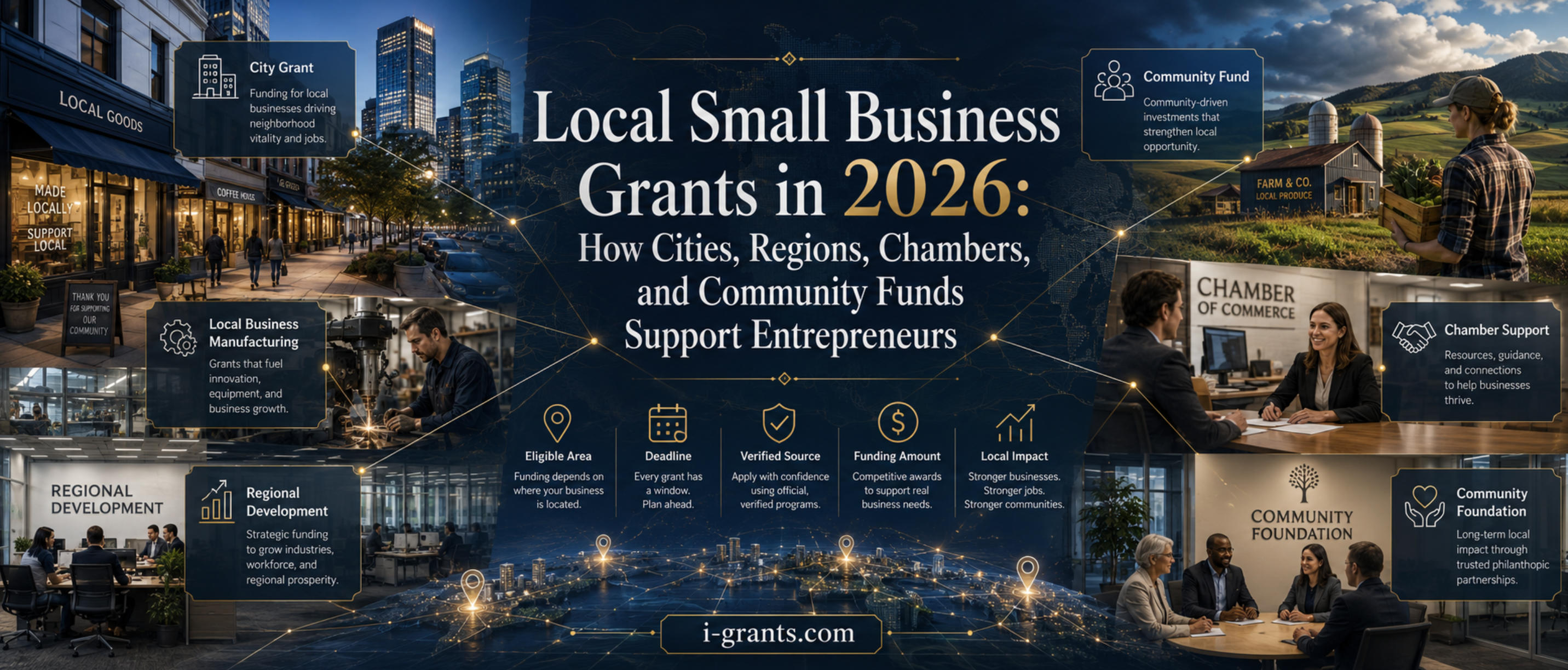
Local small business grants are often misunderstood. Many entrepreneurs search for them as if there were one national pool of “free money” waiting for any business that needs cash. In reality, some of the most practical funding opportunities for small businesses are not national at all. They are local, regional, community-based, sector-specific, or delivered through organizations that know the economic needs of a particular place.
That is why local small business grants deserve a separate conversation. They are not just smaller versions of federal grants. They work differently. They are shaped by geography, public priorities, neighborhood needs, job creation, commercial corridors, rural development, downtown recovery, underserved entrepreneurs, workforce gaps, climate goals, and local economic resilience.
In 2026, this place-based logic is more important than ever. Small businesses remain central to the economy. In the United States, there are more than 36.2 million small businesses, representing 99.9 percent of all businesses. They employ more than 62 million people and contribute a major share of economic activity. Globally, small and medium-sized enterprises represent around 90 percent of businesses and more than half of employment. These numbers explain why governments, regions, chambers of commerce, community foundations, development agencies, and corporate partners continue to support local business ecosystems.
But the key word is “ecosystem”. A local grant is rarely just a payment to one company. It is usually a tool for improving a place.
A grant may help a shop renovate its storefront because a stronger commercial street benefits the district. It may support a rural business because that business keeps services, jobs, or production capacity in the region. It may fund training because local employers cannot grow without skilled workers. It may support women-owned, minority-owned, veteran-owned, or immigrant-owned businesses because access to capital is uneven. It may fund energy efficiency because cities and regions are trying to reduce emissions. It may support export readiness because a regional economy needs companies that can sell beyond local demand.
The strongest way to understand local small business grants is this: the business address is not just contact information. It is eligibility data.
What Makes a Small Business Grant “Local”?
A local small business grant is not defined only by the size of the award. It is defined by the relationship between the business, the funder, the administrator, and the place where the economic impact is expected to happen.
A city may offer a grant to businesses located in a designated commercial corridor. A county may support companies that create jobs in a rural area. A chamber of commerce may administer microgrants for local entrepreneurs. A community foundation may fund businesses connected to neighborhood recovery, food access, childcare, culture, or social enterprise. A regional development agency may support manufacturers, exporters, tourism businesses, or innovation clusters. A national programme may provide money, but a local authority may decide how it is spent.
This last point is especially important. Local grants are not always funded locally. Sometimes the money comes from a federal, national, or regional source, but the programme is delivered locally. In the United States, Community Development Block Grant funding can support economic development and job creation or retention activities, including assistance to profit-motivated businesses under eligible conditions. Yet the practical path for a business often runs through a city, county, or local administrator, not through a direct federal application.
The same principle appears internationally. The United Kingdom’s Shared Prosperity Fund uses local delivery through lead local authorities. European regional funding often supports small and medium-sized enterprises through regional competitiveness, digital transition, sustainability, and innovation programmes. Canada’s regional development agencies fund business scale-up, productivity, innovation ecosystems, tourism, artificial intelligence adoption, and regional responses to economic disruption.
For entrepreneurs, this means that the best local grant search is not just a keyword search. It is a map.
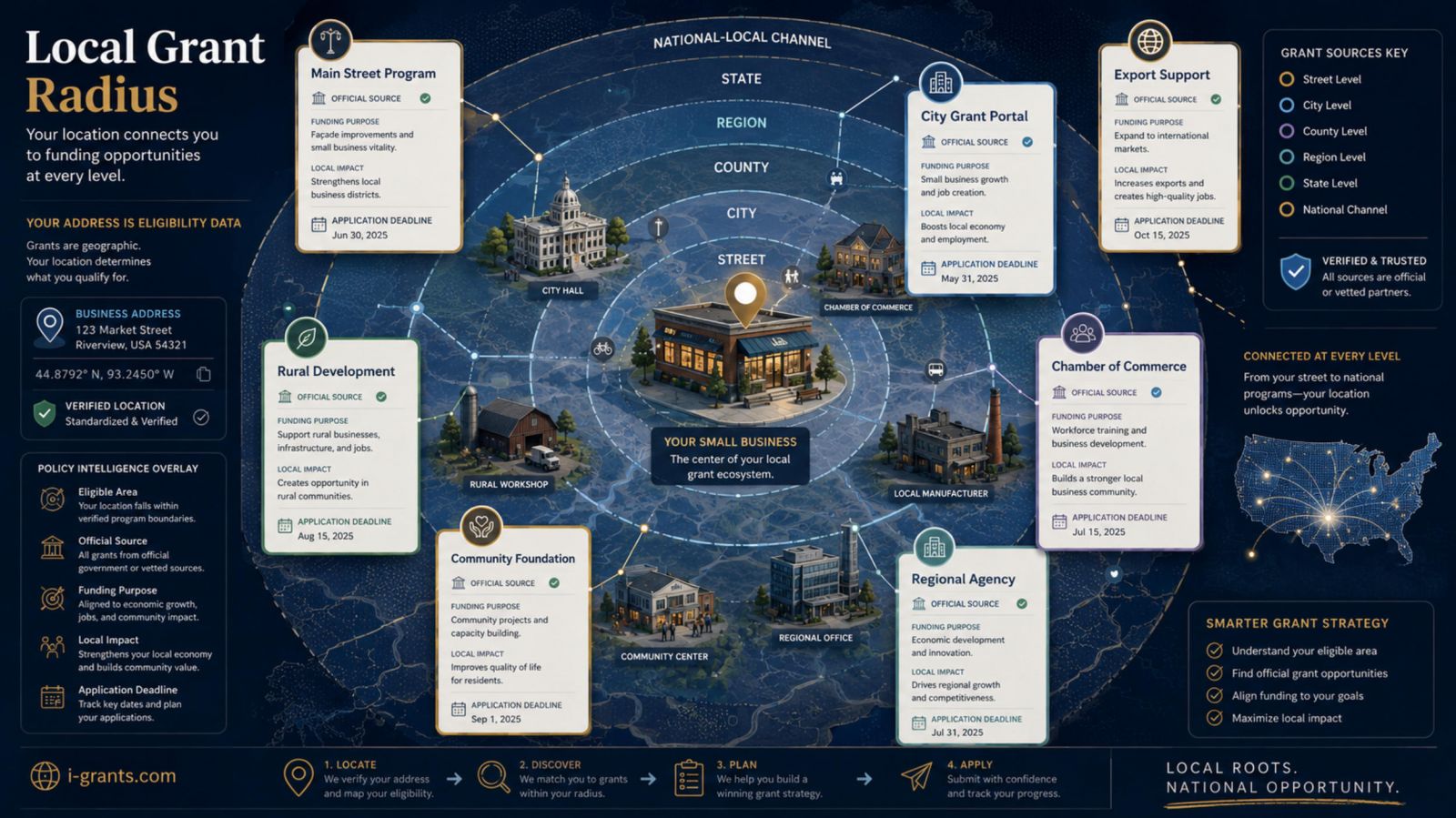
The Local Grant Radius: A Better Way to Search
The mistake many entrepreneurs make is starting too broadly. They search for “small business grants” and open national lists that may be outdated, closed, irrelevant, or mixed with loans and competitions. A better method is to search by funding radius.
| Funding radius | Where to look | Typical local funding logic |
|---|---|---|
| Street or district | Main Street programme, downtown organization, business improvement district | Storefronts, signage, foot traffic, façade improvement, vacant space activation |
| City | Economic development office, city grant portal, mayor’s business programme | Local hiring, equipment, resilience, commercial corridors, digital adoption |
| County | County development office, chamber partnership, local foundation | Job retention, rural enterprise, capacity building, workforce needs |
| Region | Regional development agency, innovation hub, tourism board | Sector clusters, export readiness, manufacturing, tourism, skills |
| State or province | State economic development agency, export office, workforce board | Training, trade, energy efficiency, underserved entrepreneurs, growth sectors |
| National-local channel | CDBG, USDA rural programmes, UKSPF, regional funds | Higher-level funding delivered through local or regional administrators |
| Corporate-community layer | Foundations, banks, telecoms, Main Street partners | Microgrants, digital tools, recovery, inclusion, local business visibility |
This “Local Grant Radius” helps business owners think more strategically. A café in a historic downtown district, a rural food processor, a small manufacturer, a woman-owned design studio, a local childcare provider, and an export-ready software startup may all be “small businesses”. But they do not live in the same funding radius. Their strongest opportunities may come from completely different sources.
For local grants, the first question is not only “What does my business need?” The better question is: “Which funder cares about the place, sector, community, or economic result connected to my project?”
The Main Types of Local Small Business Grants
Local small business grants usually fall into several practical categories.
Storefront and façade improvement grants support visible improvements to commercial areas. They may fund signs, lighting, windows, entrances, accessibility upgrades, awnings, exterior repairs, paint, or historic district improvements. These grants are often connected to downtown revitalization, tourism, main street recovery, or neighborhood identity.
Equipment and capacity-building grants help businesses purchase tools, machinery, technology, or operational assets that increase productivity. A bakery may need a commercial oven. A small manufacturer may need specialized equipment. A local service company may need scheduling software or safety tools. Funders may support these costs if they connect to jobs, service access, production capacity, or local economic growth.
Workforce and training grants support employee skills, apprenticeships, certifications, safety training, digital skills, manufacturing training, or sector-specific workforce development. These grants are especially relevant when local employers cannot expand because the labor market lacks specific skills.
Rural business development grants focus on companies, intermediaries, and community organizations serving rural areas. In many cases, the applicant may be a public body, tribe, nonprofit, or development organization rather than a private business directly. The business may benefit through infrastructure, technical assistance, training, incubator support, feasibility studies, or community economic development facilities.
Digital adoption grants help small businesses modernize operations. They may support e-commerce, digital payments, cybersecurity, customer relationship management, online booking, inventory systems, digital marketing, or basic technology upgrades. These grants often appear through chambers, corporate partners, local authorities, or small business support organizations.
Export and regional growth grants help companies prepare for international markets. They may cover trade shows, market research, translation, certification, export planning, or participation in trade missions. For a local economy, export-ready businesses matter because they bring external revenue into the region.
Sustainability and energy grants support energy efficiency, renewable energy adoption, low-carbon equipment, circular economy models, waste reduction, or climate resilience. These grants are increasingly tied to city climate goals, regional energy strategies, and European or national transition funds.
Inclusive entrepreneurship grants support businesses owned by women, minorities, veterans, immigrants, indigenous entrepreneurs, rural founders, or other groups that face structural barriers to capital. They may be delivered through foundations, community development institutions, corporate partners, government agencies, or chambers of commerce.
The important point is that these grants are not interchangeable. A business should not chase every local grant. It should identify the type of local value its project can prove.
Why Local Grants Are Often Reimbursement-Based
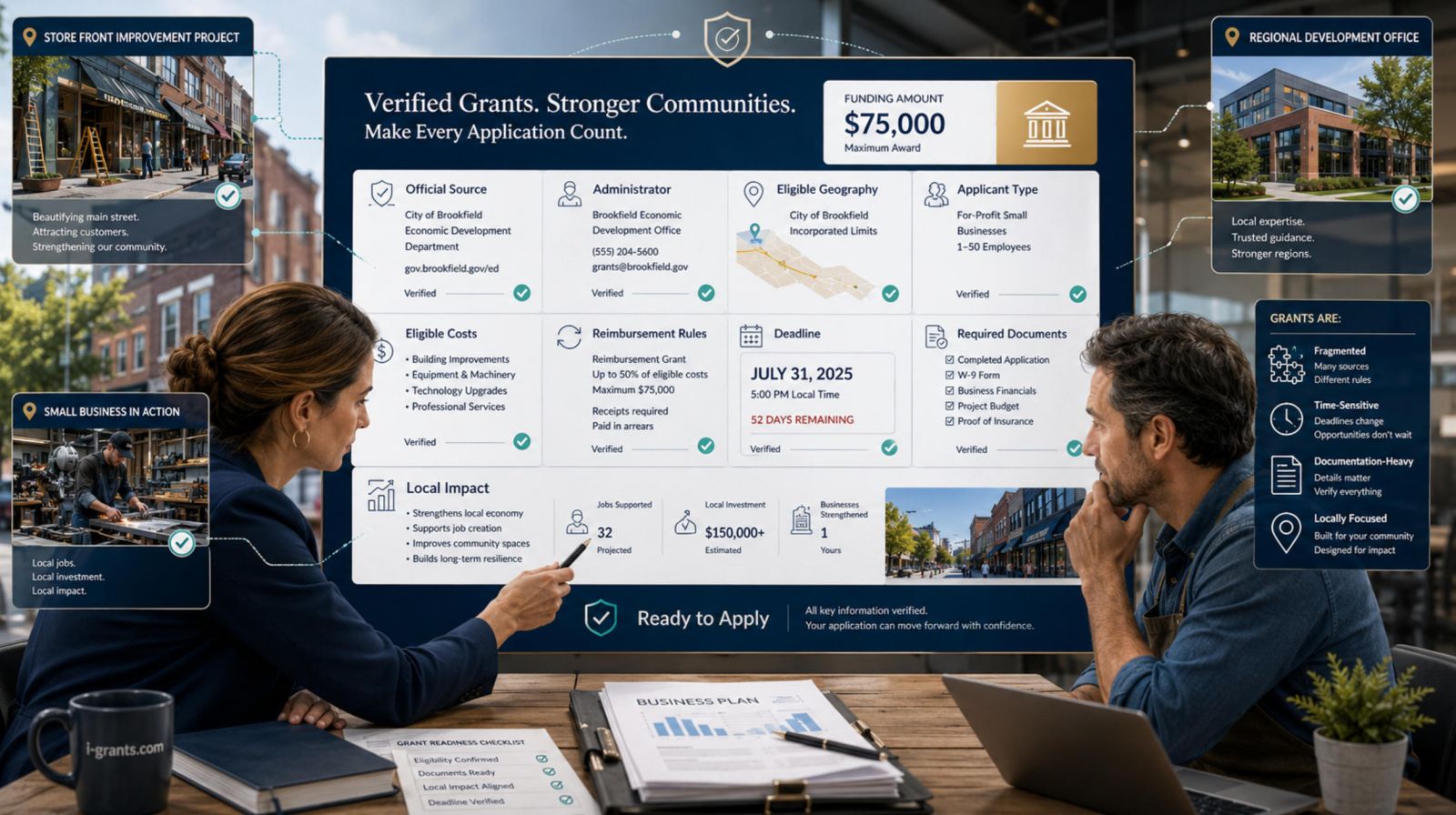
Many local small business grants do not work like an upfront cash award. They are reimbursement-based. This means the business may need to get approval first, spend money on eligible costs, submit documentation, and then receive partial reimbursement.
This structure can surprise entrepreneurs. A business owner may think, “I won the grant, so I will receive money immediately.” In practice, the funder may require invoices, receipts, proof of payment, photographs, permits, vendor details, tax compliance, business registration, payroll records, or a final completion report.
A local grant is often not a blank check. It is a documented reimbursement path.
This matters for cash flow. If a grant reimburses 50 percent of eligible expenses after completion, the business still needs enough working capital to pay vendors first. If a façade grant requires city approval before work begins, expenses paid too early may become ineligible. If equipment must be purchased from an approved vendor or within a defined period, the business must follow those rules precisely.
For grant writers and advisors, this creates an important role. A strong local grant application is not only about persuasive writing. It is also about compliance, budget logic, documentation, timeline control, and evidence collection. The application should be written in a way that the business can actually execute.
What Local Funders Usually Want to See
Local funders do not usually support a business just because it wants money. They support a project because it advances a local priority. That priority may be economic, social, environmental, cultural, or workforce-related.
A strong local grant application usually answers several practical questions. Is the business located in the eligible area? Is the project aligned with the programme purpose? Will the grant create or retain jobs? Will it improve a commercial corridor? Will it support underserved entrepreneurs? Will it bring services to a rural or low-income community? Will it improve productivity, safety, accessibility, sustainability, or resilience? Can the business complete the project within the required timeline? Can it document every eligible expense?
This is why local grants reward specificity. A vague statement like “we need funds to grow” is weak. A stronger statement is: “This grant will help us purchase energy-efficient refrigeration equipment, reduce operating costs, retain five jobs, expand local food distribution, and serve three additional neighborhoods within the city.”
Local funders often care about measurable outcomes. They may want numbers: jobs created, people trained, storefronts improved, square footage activated, energy saved, businesses served, customers reached, local suppliers used, or revenue growth supported. The more local the grant, the more concrete the impact should be.
Why Local Small Business Grants Are Hard to Find
Local small business grants can be difficult to discover because they are fragmented. They may not appear on major national grant portals. They may be hidden inside city council pages, regional agency websites, chamber newsletters, PDF documents, local foundation announcements, or temporary business recovery pages.
Some grants open for only a short period. Some close when funds are exhausted. Some are announced through local partner networks before they are widely indexed by search engines. Some are not called “grants” at all. They may be named business improvement funds, façade programmes, recovery funds, corridor initiatives, voucher schemes, digital readiness awards, main street support, innovation challenges, or reimbursement programmes.
This creates a practical problem for entrepreneurs. A search result can be old but still visible. A grant page can remain online after a deadline has passed. A programme can change eligibility rules without changing its title. A local government can launch a new round with a different funding source. A foundation can pause a programme for a year and reopen it later.
That is why every local small business grant needs verification. The business should confirm the official source, administrator, eligible geography, eligible applicant type, eligible expenses, funding amount, deadline, payment method, documents, reporting obligations, and last checked date.
For i-grants.com, this is where the platform model becomes valuable. The goal is not to repeat generic grant lists. The goal is to turn scattered funding information into structured grant intelligence: donor, administrator, geography, eligible countries or regions, applicant type, sector, deadline, status, funding amount, language, source type, and official verification link.
The 2026 Angle: Recovery Funds, Regional Priorities, and Faster Policy Response
In 2026, local grant search also requires attention to timing. Some local business support programmes may still be connected to earlier recovery funding streams, including pandemic-era funds that were obligated earlier and must be spent within defined timeframes. This does not make those programmes illegitimate, but it makes date verification essential. A page created during a recovery period may still be online even if the money is closed, reallocated, or available only through a final reimbursement cycle.
At the same time, new local and regional funding continues to respond to current economic pressures. Workforce shortages, tariff exposure, energy costs, commercial vacancies, climate resilience, digital adoption, and sector competitiveness are shaping local funding priorities. In some regions, small business support is moving toward innovation, artificial intelligence, clean technology, life sciences, robotics, tourism, advanced manufacturing, and export readiness. In other places, the priority is more basic: keeping shops open, restoring commercial streets, supporting rural services, and helping businesses survive cost pressure.
This is why “local small business grants” is not one stable category. It is a moving map of policy priorities.
A restaurant, a childcare provider, a small manufacturer, a rural tourism operator, an export-ready startup, and a community-serving retailer may all find local funding, but not through the same route. One may fit a city corridor grant. Another may fit a workforce programme. Another may need a rural development intermediary. Another may be better suited to an energy efficiency incentive or a regional innovation call.
The practical achievement for a business is not finding the longest list of grants. It is finding the right match before the deadline closes.
How Grant Writers Can Use Local Grants
Local small business grants create a strong opportunity for professional grant writers, but the work is different from large federal or international proposals. Local applications may be shorter, but they require precision. A small mistake in geography, eligible expenses, permits, reimbursement rules, or documentation can make an otherwise good project fail.
A grant writer can help a business define a fundable local project, not just describe a business need. This distinction is crucial. “We need money for equipment” is not yet a grant narrative. “We need equipment to expand production, retain jobs, reduce delivery delays, serve local buyers, and strengthen regional supply chains” is closer to a fundable argument.
Grant writers can also build repeatable local funding workflows. For example, they can monitor city, county, regional, chamber, and community foundation sources. They can classify opportunities by address eligibility, sector, applicant type, award size, reimbursement rules, and required evidence. They can help businesses prepare standard documents in advance: registration, tax records, financial summaries, project budgets, vendor quotes, proof of location, ownership certification, photos, and local impact statements.
This is especially useful because many local grants move quickly. A business that starts collecting documents after the call opens may already be late. A business with prepared documentation and a clear project profile can respond faster.
How i-grants.com Fits the Local Grant Workflow
The value of i-grants.com is not simply publishing another article about small business grants. The stronger opportunity is to build a workflow where applicants and grant writers can act on verified funding intelligence.
For applicants, local grant intelligence helps answer practical questions: Is this grant still open? Is my business address eligible? Is my sector included? Can a for-profit business apply directly? Is the grant reimbursement-based? Are my planned costs eligible? What documents are required? Is there a match requirement? Should I apply myself or hire a grant writer?
For grant writers, local grant intelligence creates a structured way to find client-relevant opportunities. Instead of searching randomly, a grant writer can identify grants by geography, sector, applicant type, funding purpose, deadline, and complexity. That makes it easier to connect with businesses that actually need application support.
This is where the marketplace logic becomes clear. Active grant opportunities are not just content. They are the operational foundation for matching. A local business sees a grant that fits its project. A grant writer sees a fundable opportunity with a clear applicant profile. The platform becomes the meeting point where funding information turns into real application work.
Local small business grants are especially suitable for this model because they are numerous, fragmented, practical, and time-sensitive. They need verification. They need classification. They need human judgment. They need clear communication between the applicant and the grant writer.
Local small business grants in 2026 are not a simple promise of free money. They are place-based funding tools designed to support specific economic, community, workforce, sustainability, innovation, or recovery goals. They can help entrepreneurs improve storefronts, buy equipment, train workers, adopt technology, expand exports, reduce energy costs, strengthen rural economies, and serve underserved communities.
But local grants require discipline. The applicant must understand the eligible geography, official source, administrator, expenses, deadline, reimbursement rules, documents, reporting obligations, and local impact logic. A strong application does not only ask for money. It proves that the project creates measurable value for a specific place.
That is the real lesson for entrepreneurs and grant writers. The best local grant search is not the broadest search. It is the most accurately matched search.
For small businesses, this means treating location as part of funding strategy. For grant writers, it means turning fragmented local opportunities into structured application work. For i-grants.com, it means building a grant intelligence workflow where verified opportunities, applicant needs, and professional grant-writing expertise can meet in one practical system.
Local grants may be smaller than national programmes, but their impact can be immediate. A sign installed, a worker trained, a machine purchased, a storefront restored, a rural service preserved, a digital system adopted, a local supplier strengthened - these are the practical outcomes that funders often want to see. Local small business grants reward businesses that can connect their own growth to the future of the place around them.