

 Français
  Deutsch
  Українська
France’s Jeune entreprise innovante status, usually known as JEI, can significantly reduce the employment cost of an eligible research and development team. However, the regime has changed substantially. The standard research expenditure threshold increased from 15 percent to 20 percent in 2025, the profit tax exemption is no longer available to companies created from 2024, and a new impact-oriented category, JEII, entered into force in February 2026.
These changes make older summaries of the regime potentially misleading. A startup cannot assume that an innovative product, a patent, a Bpifrance grant, or eligibility for the Crédit d’impôt innovation automatically establishes JEI status. Qualification depends on a detailed annual test covering company size, age, ownership, business history, research expenditure and, in some cases, university links, employment growth or social economy status.
For an eligible company, the principal benefit in 2026 is generally the exemption from selected employer social security contributions for qualifying R&D employees and corporate officers. Local tax exemptions may also be available, but only where the relevant local authority has adopted them.
JEI in 2026: the essential points
A company assessing JEI status should begin with five facts:
-
JEI is a legal and tax status, not a grant or an automatic certification of innovation.
-
The standard R&D threshold is now at least 20 percent of tax-deductible expenses.
-
The conditions are assessed for each financial year, not only when the company is created.
-
Companies created from 1 January 2024 cannot use the historical JEI profit tax exemption.
-
JEU, JEC and JEII provide alternative qualification routes for certain university spinouts, fast-growing businesses and impact enterprises.
The regime can coexist with several other forms of innovation support, including the Crédit d’impôt recherche, known as CIR. Nevertheless, each instrument has its own eligibility rules, cost base and documentation requirements.
What is JEI status?
The JEI regime was introduced in 2004 to support young small and medium-sized enterprises carrying out substantial research and development activities. It is designed primarily for businesses whose early growth depends on scientific or technical work and whose payroll includes researchers, engineers, technicians and other specialised personnel.
JEI is not limited to biotechnology laboratories or industrial deeptech companies. Software, digital technology, engineering, scientific services, advanced materials, health technology, energy, aerospace and other sectors can qualify where their activities satisfy the relevant R&D tests.
The critical issue is not whether the company describes itself as innovative. The business must demonstrate that its eligible research expenditure and corporate structure meet the statutory conditions.
What changed in 2025 and 2026?
The most important recent change was introduced by the French Social Security Financing Act for 2025. It increased the standard research expenditure threshold from 15 percent to 20 percent.
The higher threshold entered into force on 1 March 2025. For companies subject to French corporate income tax, it applies to financial years closed on or after that date. For businesses taxed under personal income tax rules, it applies to tax due from 2025. A corporate taxpayer whose financial year closed before 1 March 2025 could still apply the former 15 percent threshold to that period.
The second major development was the creation of the Jeune entreprise d’innovation à impact, or JEII. This category entered into force on 21 February 2026. It is intended for qualifying social and solidarity economy enterprises with research expenditure between 5 percent and 20 percent of tax-deductible expenses.
Under the legislation in force in July 2026, JEII applies only to financial years closed before 1 January 2029. It should therefore be treated as a temporary regime unless future legislation extends it.
Local property tax and business property contribution exemptions for the JEI family of statuses have also been extended to companies created no later than 31 December 2028.
Table 1. Major Changes to the French JEI Regime
| Effective date | Change | Practical consequence |
|---|---|---|
| 1 January 2023 | The standard maximum company age returned to less than eight years for companies created from this date | Companies created from 2023 generally lose JEI qualification in the year of their eighth anniversary |
| 1 January 2024 | The profit tax exemption was removed for newly created companies | A startup created in 2024, 2025 or 2026 may qualify as a JEI but cannot receive the historical JEI profit tax exemption |
| 1 June 2024 | The detailed JEC economic performance criteria became operational | Companies with lower R&D intensity can qualify only if they meet demanding employment growth conditions |
| 1 March 2025 | The standard JEI R&D threshold increased from 15 percent to 20 percent | Companies previously positioned between 15 percent and 20 percent must reassess their status |
| 21 February 2026 | JEII entered into force | Certain impact enterprises with R&D expenditure between 5 percent and 20 percent received a new qualification route |
| 31 December 2028 | Current creation deadline for social and specified local tax exemptions | Companies created after this date will not qualify for these exemptions unless legislation is extended |
| 1 January 2029 | Scheduled repeal of JEII | The impact category currently applies only to financial years closed before this date |
The five core JEI eligibility conditions
A standard JEI must satisfy all the relevant conditions at the end of the financial year for which it claims the status.
1. The company must qualify as an SME
The company must employ fewer than 250 people. It must also have either annual turnover below EUR 50 million or a balance sheet total below EUR 43 million.
The test is not limited to the French establishment where the R&D team works. Group relationships and the applicable SME calculation rules must be reviewed, particularly where the applicant has linked or partner enterprises.
An otherwise innovative French subsidiary may fail the test if its wider ownership structure causes it to exceed the SME limits.
2. The company must satisfy the age condition
For companies created from 1 January 2023, the company must be less than eight years old at the end of the relevant financial year. Qualification is normally available until the year preceding the company’s eighth anniversary.
Transitional rules apply to companies created between 1 January 2014 and 31 December 2022. These companies may retain the tax qualification until the year preceding their eleventh anniversary, provided that all other conditions continue to be satisfied.
This extended age test should not be confused with the duration of every associated exemption. In particular, the social contribution exemption is subject to separate rules linked to the age of the establishment and the company. A company should therefore calculate three timelines independently:
-
the period during which it can legally qualify as a JEI;
-
the period during which its establishment can apply the social exemption;
-
the period, if any, during which it can still use the historical profit tax exemption.
3. At least 20 percent of deductible expenses must relate to eligible R&D
For the standard JEI route, eligible research expenditure must represent at least 20 percent of the company’s tax-deductible expenses for the same financial year.
The ratio can be presented as follows:
Eligible R&D expenditure ÷ adjusted tax-deductible expenses × 100
This is not a percentage of turnover, investment raised, payroll, cash expenditure or the cost of one innovation project.
A company with EUR 1 million of relevant deductible expenses and EUR 225,000 of qualifying research expenditure has a ratio of 22.5 percent and may satisfy the threshold. If qualifying expenditure is EUR 190,000, the ratio is 19 percent and the standard JEI threshold is not met.
The calculation excludes certain items, including specified foreign exchange losses, net losses on sales of investment securities and eligible costs invoiced by other qualifying young innovative or growth companies carrying out R&D projects.
4. The ownership condition must be satisfied continuously
At least 50 percent of the company’s capital must be held continuously by permitted persons or entities. These can include natural persons, certain investment structures, qualifying research foundations, public research or higher education institutions and, under specific conditions, other qualifying young innovative companies.
The ownership test deserves particular attention before an investment round. A new corporate shareholder, holding company, strategic investor or reorganisation may change the analysis even when the startup’s R&D activities remain unchanged.
The condition is not simply tested on the last day of the year. The required ownership must generally be maintained continuously.
5. The activity must be genuinely new
The company must not have been created through a concentration, restructuring, extension of a pre-existing activity or takeover of such an activity.
Registering a new legal entity does not necessarily create a new activity for JEI purposes. The tax authorities can examine whether the company has merely continued an existing team, customer portfolio, technology, contracts or business operations.
A spinout or reorganisation may still qualify in specific circumstances, particularly where the predecessor entities already had JEI status and the new entity independently satisfies the conditions. However, this requires a transaction-specific assessment.
Table 2. Standard JEI Eligibility Requirements in 2026
| Requirement | Main rule | Frequent risk |
|---|---|---|
| SME status | Fewer than 250 employees and turnover below EUR 50 million or balance sheet total below EUR 43 million | Ignoring linked or partner companies |
| Company age | Generally less than eight years for companies created from 2023 | Assuming that every tax and social benefit lasts for the same period |
| R&D intensity | At least 20 percent of adjusted tax-deductible expenses | Calculating the ratio against turnover or including routine product work |
| Ownership | At least 50 percent continuously held by permitted owners | Closing an investment round without reassessing the capital test |
| New activity | No creation through a prohibited concentration, restructuring, extension or takeover | Moving an existing activity into a new legal entity |
| Annual compliance | Conditions assessed for each financial year | Treating a previous qualification as permanent approval |
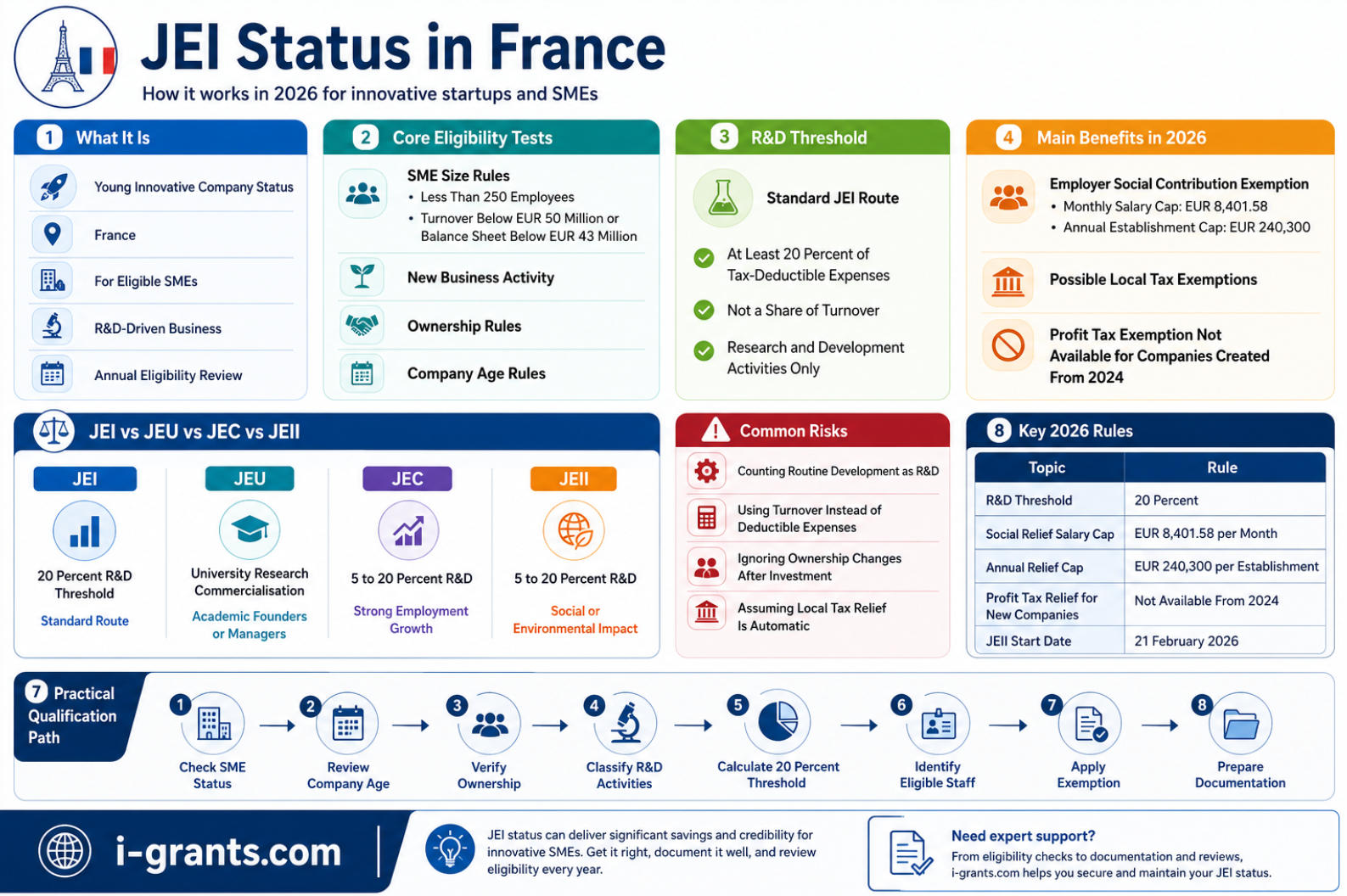
Which research expenditure counts toward the 20 percent threshold?
The JEI rules refer mainly to categories of research expenditure used in the French CIR framework. However, the JEI calculation is not identical to the CIR calculation.
For JEI, the nature of the expenditure is considered without automatically importing every CIR ceiling, multiplier or flat-rate calculation. This distinction can materially change the ratio.
Eligible costs may include depreciation on new assets directly used for scientific or technical research, qualifying personnel costs, specified outsourced research expenditure, patent-related costs and certain other categories defined by French tax law.
The company must first demonstrate that the underlying activities constitute eligible R&D. A technical team’s entire payroll cannot be included merely because employees work for a technology company.
Qualifying work normally requires the company to address a scientific or technical uncertainty that cannot be resolved through readily available knowledge or standard professional practice. The company should be able to identify the existing state of knowledge, the unresolved difficulty, the experimental approach, the work performed and the conclusions reached.
Routine software configuration, standard engineering, customer-specific adaptation, ordinary debugging, aesthetic design, commercial testing and implementation of established methods do not automatically qualify.
Where an employee divides time between research, product development, customer delivery, sales support and management, only the defensible R&D share should normally be allocated to the research calculation.
JEI and CIR use related costs, but they are not the same test
JEI and CIR are complementary, but businesses should avoid using one calculation as a substitute for the other.
CIR determines a tax credit based on eligible research expenditure and its own calculation rules. JEI determines whether the company itself satisfies a status test, including the 20 percent expenditure ratio, age, ownership and new activity conditions.
A company may qualify for CIR without being a JEI. For example, an older company or a larger enterprise may claim CIR but fail the JEI age or size condition.
A JEI may generally claim CIR where the relevant expenditure qualifies. However, the company must prepare separate reconciliations explaining how each cost has been treated for CIR, for the JEI ratio and for the social contribution exemption.
The Crédit d’impôt innovation, or CII, should be treated with additional caution. CII covers certain prototype and pilot installation expenditure related to new products for qualifying SMEs. It does not convert all product innovation costs into R&D expenditure for the JEI 20 percent test. A cost may count for CII but fail the scientific or technical research requirements relevant to the standard JEI ratio.
JEI, JEU, JEC and JEII compared
French legislation now provides four related qualification routes. The alternatives do not remove the core requirements concerning SME status, age, ownership and genuinely new activity. Instead, they provide different ways of meeting the innovation-related condition.
Table 3. JEI, JEU, JEC and JEII Compared
| Status | Research or innovation test | Additional conditions | Typical candidate |
|---|---|---|---|
| JEI | Eligible R&D expenditure of at least 20 percent of adjusted tax-deductible expenses | Standard SME, age, ownership and new activity conditions | R&D-intensive technology or deeptech company |
| JEU | Commercialisation of research in which qualifying founders or managers participated | At least 10 percent ownership or management by eligible students, recent master’s or doctoral graduates, or research and teaching personnel; formal agreement with an eligible higher education institution | University spinout or academic startup |
| JEC | R&D expenditure between 5 percent and 20 percent | Employment must increase by at least 100 percent and at least 10 full-time equivalents compared with the end of the third preceding financial year; R&D expenditure must not decrease from the previous year | Established young company rapidly scaling its team |
| JEII | R&D expenditure between 5 percent and 20 percent | ESUS approval or compliance with the statutory conditions for a commercial social and solidarity economy enterprise | Social or environmental impact startup |
JEU for university-based companies
The Jeune entreprise universitaire route is designed for companies commercialising research linked to a higher education institution.
The business must be managed or owned at a level of at least 10 percent by eligible persons, such as students, individuals who obtained a qualifying master’s degree or doctorate less than five years earlier, or persons carrying out teaching or research activities.
The principal activity must involve the commercialisation of research in which those persons participated personally. A formal agreement setting out the commercialisation arrangements must be concluded with the relevant higher education institution.
JEU can be valuable where an academic spinout has strong research foundations but has not yet reached the standard 20 percent expenditure threshold.
JEC for fast-growing young companies
The Jeune entreprise de croissance route applies where R&D expenditure is between 5 percent and 20 percent of the relevant expenses and the company meets demanding economic performance indicators.
Its workforce must have increased by at least 100 percent and by at least 10 full-time-equivalent employees compared with the workforce at the end of the third preceding financial year. The amount of research expenditure must also not have decreased compared with the previous financial year.
In practice, the company must have closed at least three earlier financial years. JEC is therefore not a realistic route for most businesses in their first or second year.
JEII for innovation with social or environmental impact
JEII was introduced by the Finance Act for 2026. It applies to companies with research expenditure between 5 percent and 20 percent that also satisfy specified social and solidarity economy requirements.
A company may qualify through ESUS approval or by being a commercial company whose statutes and operations meet the legal requirements for participation in the social and solidarity economy.
A general claim that the product produces a positive social or environmental impact is insufficient. The company must satisfy the formal legal conditions.
A company created in 2026 may use JEII for relevant social and local tax benefits, but it cannot use the historical JEI profit tax exemption because that exemption is limited to companies created no later than 31 December 2023.

What financial benefits can a JEI receive in 2026?
The principal current benefit is the exemption from specified employer contributions for eligible employees and corporate officers participating in the company’s R&D, prototype or pilot installation activities.
The exemption concerns employer contributions for social insurance and family allowances. It does not eliminate every employer or employee payroll charge.
For 2026, the portion of monthly remuneration taken into account is capped at EUR 8,401.58 per person. The total exemption is capped at EUR 240,300 per establishment and per calendar year. Where an establishment is created or closed during the year, the establishment cap is adjusted according to the relevant number of months.
Table 4. Main JEI Benefits and Limitations in 2026
| Benefit | 2026 rule | Important limitation |
|---|---|---|
| Employer social contribution exemption | Applies to specified employer social insurance and family allowance contributions for eligible personnel | It does not exempt all payroll charges |
| Monthly remuneration cap | Up to EUR 8,401.58 of monthly remuneration per eligible person is taken into account | Remuneration above the cap does not generate an additional JEI exemption |
| Annual establishment cap | Maximum exemption of EUR 240,300 per establishment and calendar year | The cap is prorated for certain establishments created or closed during the year |
| Profit tax exemption | Potentially 100 percent for the first qualifying profitable period and 50 percent for the following qualifying profitable period | Only companies created no later than 31 December 2023 can use it |
| Business property contribution | Seven-year CFE exemption may be available | It requires a decision by the relevant municipality or intermunicipal authority and a timely application |
| Property tax on developed property | Seven-year exemption may be available for qualifying property | The company must own the property and the local authority must adopt the exemption |
| CIR combination | CIR can generally be claimed alongside JEI where the separate conditions are met | CIR and JEI calculations must be documented separately |
Which employees and officers can generate the social exemption?
The exemption may apply to remuneration paid to qualifying personnel performing eligible functions, including:
-
research engineers and researchers;
-
technicians directly supporting eligible research;
-
R&D project managers;
-
industrial property specialists working on protection and technology agreements connected with the project;
-
personnel responsible for pre-competitive testing or directly involved in prototypes and pilot installations for new products;
-
qualifying corporate officers whose principal activity involves the company’s R&D projects, prototypes or pilot installations.
Job titles alone are not sufficient. The company should establish the employee’s actual duties, technical contribution and time allocation.
For mixed roles, the safest approach is to maintain contemporaneous records showing how much time was spent on qualifying and non-qualifying activities. This is particularly important for founders, chief technology officers, product managers and senior engineers.
The employer must also be up to date with its social security declarations and payments.
Is there an application for JEI status?
A company does not normally submit a general application and wait for a formal JEI certificate before applying the social exemption. The employer self-assesses its eligibility and applies the exemption through its payroll and social declarations.
This creates a practical cash-flow advantage, but it also transfers significant responsibility to the company. If the business later fails an eligibility test, the authorities may reassess contributions and potentially apply interest or penalties.
A company can request a formal opinion from the French tax administration using the official JEI opinion procedure. The request is submitted to the relevant departmental public finance directorate.
Obtaining an opinion is not a legal prerequisite for using the regime. It can nevertheless be valuable where the R&D classification, ownership structure, company history or expenditure calculation is uncertain.
A weak or incomplete request can provide limited protection. The facts and activities presented to the administration should correspond to the company’s real operations, and material changes after the opinion should be reassessed.
The profit tax exemption no longer applies to new startups
Many articles still describe JEI as offering full profit tax exemption for a first profitable period and a 50 percent exemption for the following qualifying profitable period.
That description is now incomplete.
Only companies created no later than 31 December 2023 may benefit from the JEI profit tax exemption, subject to the remaining statutory conditions and rules governing the sequence of profitable and loss-making periods.
A company created on or after 1 January 2024 can qualify for JEI, JEU, JEC or JEII status but cannot receive the historical corporate income tax or personal income tax exemption attached to the regime.
For a newly established startup in 2026, the financial case for JEI will normally depend on payroll savings and any available local tax exemptions, not on a general exemption from profit tax.
This distinction is particularly important when estimating the value of the regime. Early-stage companies may generate accounting or tax losses during their first years, making a profit exemption less immediately valuable than reduced employer contributions on a highly qualified R&D team.
Local tax exemptions are not automatic
Municipalities and intermunicipal authorities with their own taxing powers may grant eligible JEI-family companies an exemption from the cotisation foncière des entreprises, or CFE, for seven years.
They may also grant a seven-year property tax exemption for qualifying developed property owned by an eligible company.
These exemptions depend on a local decision. A JEI cannot assume that they are available throughout France. The company must check the rules applicable to every establishment and submit the required declarations within the prescribed deadlines.
The CFE request is made separately for each establishment. A startup opening an R&D centre in another municipality should therefore check the local regime before finalising its location decision.
Can JEI be combined with grants and other public support?
JEI can form part of a wider French innovation financing strategy. A company may use the social contribution exemption while also receiving Bpifrance support, France 2030 funding, regional aid, European funding or CIR, provided that it complies with the rules of every instrument.
The fact that a project receives a grant does not automatically prove that its activities qualify as R&D for JEI purposes. Grant selection criteria and tax definitions may differ.
Public funding can also affect the calculation of another instrument. For example, subsidies allocated to eligible research expenditure may require specific treatment in the CIR calculation. The company should therefore prepare an integrated funding reconciliation rather than calculate each benefit in isolation.
The financial model should distinguish:
-
gross project expenditure;
-
expenditure eligible under each programme;
-
grants or repayable advances received;
-
CIR or other tax credits;
-
JEI payroll contribution savings;
-
the company’s remaining net financing requirement.
This approach reduces the risk of double funding, inconsistent cost treatment or an unrealistic presentation of the company’s own contribution.
What do the official statistics show?
The most recent detailed official structural profile publicly available for the JEI population relates to 2021. It should not be presented as a 2026 beneficiary count, but it remains useful for understanding the companies that use the regime.
In 2021, 4,338 legal entities benefited from JEI exemptions, compared with 4,164 in 2020. The value of the exemptions increased from EUR 217 million to EUR 248 million.
JEI companies reported EUR 1.507 billion of internal R&D expenditure and employed approximately 20,600 R&D personnel measured in full-time equivalents. Around 84 percent of JEI legal entities employed fewer than 20 people.
The average JEI recorded EUR 433,000 of internal R&D expenditure, compared with EUR 306,000 among all R&D-performing businesses with fewer than 20 employees. Median JEI internal R&D expenditure was EUR 292,000.
The average JEI employed 5.9 R&D full-time equivalents, including 4.1 researchers and engineers. Researchers and engineers represented approximately 69 percent of JEI R&D personnel.
Approximately 24 percent of JEI businesses outsourced research work to public organisations or other companies. Direct public financing, excluding tax measures such as CIR and social contribution exemptions, amounted to EUR 242 million and covered approximately 14.5 percent of their total research expenditure.
The sector profile was strongly service-oriented. Specialised scientific and technical activities, information technology and information services, and publishing, audiovisual and broadcasting activities together represented 76 percent of JEI internal R&D expenditure in 2021.
Does the JEI regime create additional R&D employment?
Official evaluations support a cautious conclusion.
Between 2004 and 2015, 8,868 companies used the JEI regime at least once. They received approximately EUR 1.505 billion in employer social contribution exemptions. Around 60 percent began using the regime during their first year of activity.
The beneficiaries were concentrated in services. Approximately 41 percent operated in computer programming, 34 percent in research and development services and 11 percent in business services. Manufacturing represented only around 5 percent.
An Insee evaluation found evidence that JEI participation may have increased total employment and R&D employment for a potentially limited but statistically significant proportion of beneficiaries. It did not identify an effect on employee remuneration.
However, the estimated employment effect was described as weak and uncertain. Companies using JEI often also use CIR, Bpifrance support and other innovation programmes, which makes it difficult to isolate the effect of the JEI exemption itself.
The evidence therefore supports describing JEI as a tool that reduces the cost of hiring and retaining specialised R&D personnel. It does not justify claiming that the regime alone guarantees faster growth, successful innovation, additional investment or commercial performance.
The documentation a company should maintain
A defensible JEI file should include:
-
a technical description of each R&D project, including the state of knowledge, scientific or technical uncertainty, experimental work and results;
-
time records linking researchers, technicians, officers and other personnel to qualifying activities;
-
an annual calculation of the 20 percent ratio reconciled with the tax accounts;
-
employment contracts, job descriptions, payroll records and explanations of mixed-role allocations;
-
agreements with universities, research organisations, subcontractors and other innovation partners;
-
shareholder registers, investment documents and evidence that the ownership condition was continuously satisfied.
Documentation should be created during the financial year. A technical narrative reconstructed only after an audit has started will generally be less persuasive than contemporaneous project records.
Common JEI mistakes
A recurring mistake is to treat all software or product development as research. A commercially new platform can still be based entirely on known tools and standard engineering methods.
Another mistake is to use the CIR figure directly as the JEI numerator without reconciling differences in calculations, ceilings and flat-rate elements.
Some companies calculate the 20 percent threshold against turnover rather than deductible expenses. Others include the entire payroll of developers whose work combines research, routine development and customer implementation.
Startups can also lose eligibility after an investment round if the ownership test is not reviewed. The same risk arises where a new company has taken over an existing business activity and cannot establish that it is genuinely new.
Finally, local tax exemptions are sometimes included in financial forecasts without checking whether the municipality has adopted the relevant measure.
A practical JEI assessment process
A startup preparing to use JEI in 2026 should follow this sequence:
-
confirm the company’s SME status, including linked and partner enterprises;
-
determine the applicable age rule and separately map the duration of each exemption;
-
review the ownership structure before and after every financing transaction;
-
classify projects and costs, then calculate the R&D ratio from the tax accounts;
-
identify eligible employees and corporate officers, supported by time and activity records;
-
assess whether a formal opinion request is advisable before applying material payroll exemptions.
The calculation should be updated before the end of the financial year. Waiting until the annual tax return has been prepared may leave too little time to correct cost allocation, employment records or corporate structure.
Is JEI still valuable in 2026?
JEI remains one of France’s most useful mechanisms for reducing the cost of an R&D-intensive startup team. It can improve monthly cash flow because the social contribution exemption is applied through payroll rather than received after a competitive grant procedure.
Nevertheless, the regime is now more selective. The increase of the standard R&D threshold to 20 percent means that some companies previously eligible under the 15 percent rule no longer qualify as standard JEIs.
The removal of the profit tax exemption for companies created from 2024 also changes the financial value proposition. A new startup should not market JEI internally or to investors as a general corporate tax holiday.
JEU may offer a suitable route for a university spinout. JEC can help a more established young company with substantial employment growth. JEII opens a new, although currently temporary, route for qualifying social and environmental impact businesses.
For most applicants, the decisive issue is not whether their product is innovative. It is whether their corporate structure, research programme, expenditure ratio and personnel records can withstand a detailed annual review.
Final assessment
A French startup can obtain significant value from JEI status in 2026, particularly where it employs a substantial team of researchers, engineers and technicians. The exemption can reduce eligible employer contributions within the applicable employee and establishment limits, and it can be combined with CIR and other innovation funding where the separate rules are respected.
Qualification should never be treated as automatic. The company must satisfy the SME, age, ownership, new activity and R&D conditions for the relevant year. It must also distinguish the JEI status period from the duration of the social exemption and from the restricted historical profit tax benefit.
The strongest JEI strategy combines technical evidence, accurate tax calculations, payroll documentation and corporate planning. For startups close to the 20 percent threshold or preparing a financing round, eligibility should be modelled before decisions are finalised, not reconstructed after the exemption has already been claimed.