

 Français
  Deutsch
  Українська
French industrial companies are under growing pressure to reduce greenhouse gas emissions while maintaining production, employment, competitiveness, and security of supply. For many factories, the required transformation involves more than replacing lighting or improving energy monitoring. It may require electrifying high-temperature processes, recovering industrial heat, changing raw materials, installing more efficient production equipment, reducing nitrous oxide or methane emissions, or developing carbon capture infrastructure.
France has created several public funding routes for these investments. The principal programmes differ according to project size, applicant type, emissions impact, technical maturity, and the amount of public support requested.
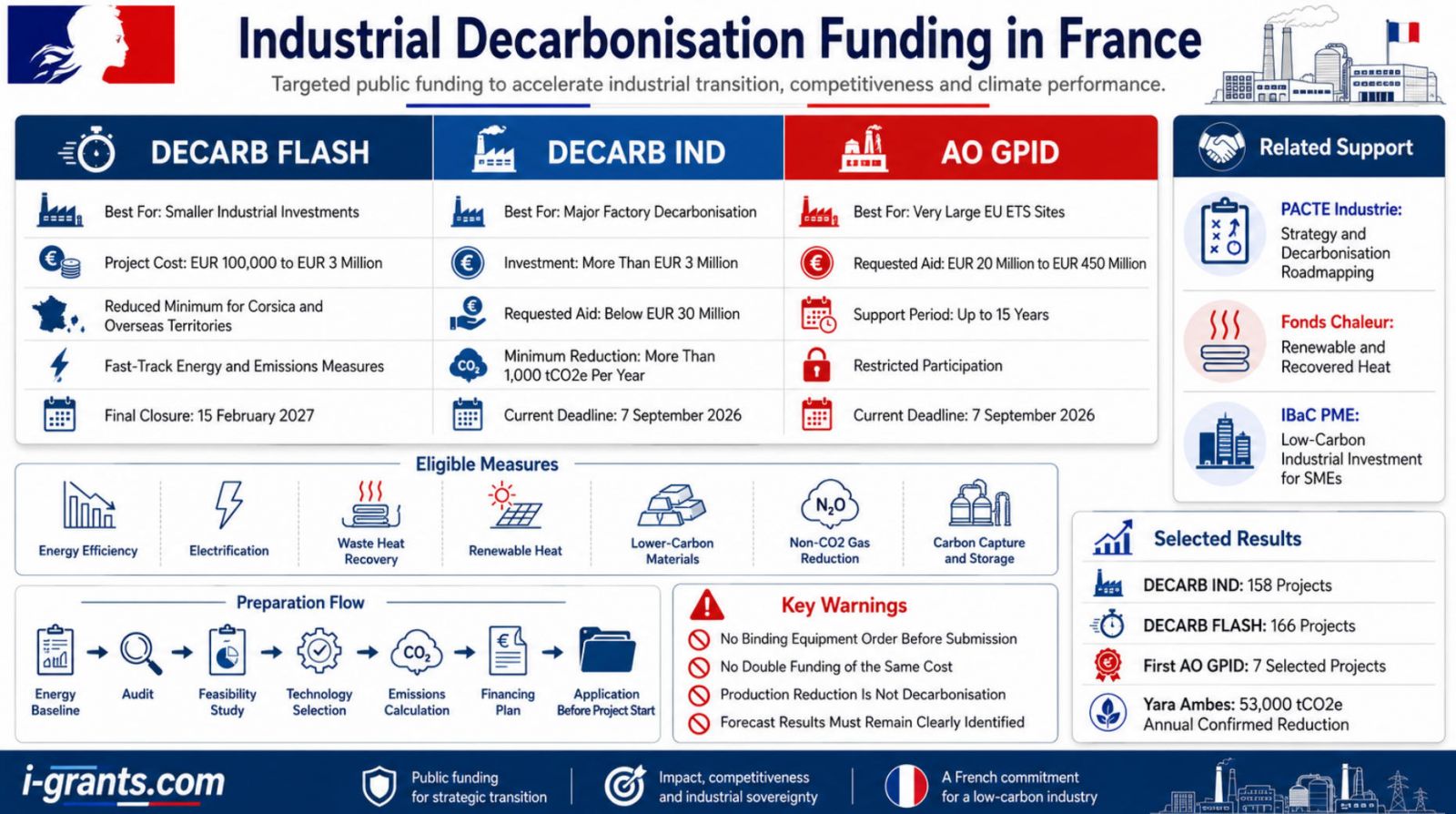
DECARB FLASH is intended mainly for smaller, rapidly deployable investments. DECARB IND supports larger industrial decarbonisation projects with more than EUR 3 million in investment. The 2026 Grands Projets Industriels de Décarbonation auction, generally referred to as AO GPID, is designed for a limited group of very large industrial projects requiring long-term public support.
These programmes should not be treated as interchangeable grant schemes. A project suitable for DECARB FLASH may be too small for DECARB IND. A large project may exceed the normal DECARB IND aid ceiling but still be unable to enter AO GPID because the 2026 auction is restricted to previously identified participants.
This article explains how the three main routes operate, which investments may qualify, what evidence applicants must prepare, and how confirmed programme results should be distinguished from projected emissions reductions.
The programme conditions and application status in this article are current as of 25 July 2026.
Why Industrial Decarbonisation Has Become a Funding Priority
Industry accounted for approximately 62 million tonnes of carbon dioxide equivalent emissions in France in 2024. This represented around 17 per cent of the country’s gross greenhouse gas emissions.
France’s updated national low-carbon strategy sets a target of reducing industrial emissions to approximately 42 million tonnes of carbon dioxide equivalent by 2030. By 2050, residual industrial emissions are expected to fall to around six million tonnes before taking technological carbon removals into account.
Industrial emissions are concentrated in a limited number of sectors and sites. Chemicals, non-metallic mineral production, and metallurgy together account for approximately 69 per cent of industrial emissions. The 50 largest industrial sites generate about half of the sector’s total emissions.
This concentration explains the structure of French public support. Smaller industrial sites require a simplified route for investments that can be implemented quickly. Medium and large sites need support for technically complex capital projects. The largest emitting installations may require multi-year contracts because their decarbonisation costs cannot be covered through a conventional one-off grant.
The national strategy expects industrial electricity use to increase substantially. Electricity represented approximately 36 per cent of industrial energy consumption in 2023. The target trajectory increases this share to around 45 per cent by 2030 and 58 per cent by 2050.
Energy efficiency is also expected to contribute materially. Average industrial energy efficiency is intended to improve by approximately eight per cent between 2023 and 2030, generating an estimated reduction of about three million tonnes of carbon dioxide equivalent per year.
Carbon capture will have a significant role in sectors where process emissions cannot be eliminated through energy efficiency or electrification alone. The central national scenario envisages the capture of approximately 4.4 million tonnes of industrial emissions per year by 2030 and around 21 million tonnes by 2050.
The Main Industrial Decarbonisation Funding Routes
The three principal investment mechanisms cover different parts of the market. Companies should compare total project expenditure, requested aid, annual emissions reduction, site classification, and application restrictions before selecting a programme.
Table 1. DECARB FLASH, DECARB IND, and AO GPID Compared
| Programme | Main target group | Project or aid threshold | Minimum emissions condition | Current status as of 25 July 2026 |
|---|---|---|---|---|
| DECARB FLASH 2025-2027 | Industrial SME sites and non-EU ETS sites belonging to larger companies | Total eligible measures from EUR 100,000 to EUR 3 million; minimum EUR 25,000 in Corsica and overseas territories | No single national annual threshold stated in the same form as DECARB IND | Open, with the next review date on 15 October 2026 and final closure on 15 February 2027 |
| DECARB IND 25, second submission round | Eligible industrial sites in France | More than EUR 3 million in investment; requested aid below EUR 30 million | More than 1,000 tonnes of carbon dioxide equivalent avoided per year at comparable production volume | Open until 7 September 2026 at 15:00 |
| DECARB IND 25, third submission round | Eligible industrial sites in France | Same core financial structure, subject to the final call documentation | More than 1,000 tonnes of carbon dioxide equivalent avoided per year | Scheduled for 20 May 2027 |
| AO GPID 2026 | Large EU ETS manufacturing sites that satisfy the restricted participation conditions | Requested public support from EUR 20 million to EUR 450 million | Major reduction of difficult-to-abate industrial emissions | Open until 7 September 2026 at 15:00, but only for previously eligible participants |
| PACTE Industrie and feasibility study support | Industrial companies preparing an investment | Diagnostic, audit, feasibility, and transition-planning costs | Not an investment call with a common emissions threshold | Available through relevant 2026 support routes |
The table provides an initial screening framework. Formal eligibility depends on the full rules of the selected programme.
DECARB FLASH for Smaller and Rapidly Deployable Investments
DECARB FLASH is the principal route for smaller industrial decarbonisation projects that can be implemented relatively quickly.
The programme is open to industrial sites operated by SMEs, including certain SME sites covered by the European Union Emissions Trading System. Larger companies may participate only for sites that are not covered by the EU ETS.
The site must be located in metropolitan France or an eligible overseas territory. Total expenditure for the group of proposed measures must generally be between EUR 100,000 and EUR 3 million. The minimum is reduced to EUR 25,000 for projects in Corsica and overseas territories.
DECARB FLASH can support several categories of investment, including industrial heat recovery, energy efficiency, changes in the energy mix, insulation measures, and the replacement of fossil energy with renewable energy production.
A project may combine several smaller measures into one coherent application. For example, a company could improve process efficiency, recover waste heat, and replace a fossil-fuel boiler with a lower-carbon system as part of the same decarbonisation plan.
The programme is not intended to subsidise ordinary maintenance or the simple replacement of standard equipment without measurable environmental improvement. Applicants must quantify energy savings, fossil fuel displacement, or emissions reductions and explain how the measures contribute to a broader site-level transition.
A preliminary meeting with ADEME is mandatory before submission. The company must also possess a sufficiently recent technical basis for the project. This may include an energy audit completed within the previous four years, a low-carbon energy transition study conducted through PACTE Industrie, or a qualifying energy review under an ISO 50001-certified management system.
The next scheduled assessment date after July 2026 is 15 October 2026. The final closure date is 15 February 2027.
ADEME has also announced that the eligible measure list may be updated after the adoption of the relevant regulatory text. Potential changes include removing certain insulation measures for equipment and piping and adding electric systems for drying liquids. Until those changes are formally adopted, companies should treat them as planned amendments rather than current rules.
DECARB IND for Major Industrial Investment
DECARB IND is designed for larger capital projects that produce significant and measurable reductions in industrial greenhouse gas emissions.
The second submission round of DECARB IND 25 opened on 7 May 2026 and closes on 7 September 2026 at 15:00. A third submission round is scheduled for 20 May 2027. ADEME may close a round earlier if the available budget is fully allocated.
A qualifying project must generally meet three important thresholds. Investment expenditure must exceed EUR 3 million. Requested public support must remain below EUR 30 million. The project must reduce emissions by more than 1,000 tonnes of carbon dioxide equivalent per year at a comparable level of production.
The production-volume condition is important. A company cannot demonstrate apparent decarbonisation simply by reducing output. The application must show that emissions intensity and total emissions improve because of the investment itself.
An applicant must be a private legal entity implementing the project at an industrial site in France. Where a third party finances or operates part of the equipment, the industrial beneficiary must still submit the application, and the financed assets must ultimately become its property under the applicable structure.
Eligible DECARB IND Technologies
DECARB IND is technology-neutral within defined categories. It supports investments that generate measurable site-level emissions reductions rather than favouring one universal technical solution.
Table 2. Eligible Decarbonisation Measures and the Most Relevant Funding Route
| Investment category | Examples | Most relevant route | Important limitation |
|---|---|---|---|
| Energy efficiency | Higher-efficiency production equipment, process optimisation, reduced thermal losses, improved utilities, on-site heat recovery | DECARB FLASH for smaller packages; DECARB IND for major investment | Routine replacement without substantial improvement may not qualify |
| Electrification | Electric furnaces, induction heating, electric boilers, heat pumps, mechanical vapour recompression, plasma or infrared processes | DECARB FLASH or DECARB IND depending on scale | The project must replace or materially reduce fossil energy use |
| Renewable energy substitution | Biomass, renewable heat, or other low-carbon energy integrated into industrial production | DECARB FLASH, DECARB IND, or Fonds Chaleur depending on structure | Standalone renewable heat projects may belong under Fonds Chaleur |
| Material efficiency and lower-carbon inputs | Increased use of recycled material, lower-carbon raw materials, redesigned recipes, reduced material losses | Primarily DECARB IND | The applicant must calculate emissions reductions within a defined industrial process |
| Reduction of non-CO₂ gases | Nitrous oxide, methane, fluorinated gases, or other industrial greenhouse gases | DECARB IND | Reductions must be converted into carbon dioxide equivalent using the required method |
| Carbon capture, use, and storage | Carbon capture equipment, transport preparation, geological storage, selected durable uses | DECARB IND or AO GPID | A credible transport, storage, or use chain is required |
| Large-scale process transformation | Major kiln, furnace, chemical, cement, steel, or aluminium process conversion | AO GPID where the participation and scale conditions are met | The 2026 auction is not open to all new applicants |
DECARB IND generally excludes ordinary service-sector projects, most primary agricultural activities, fishing, mobile construction sites, conventional waste incineration, and activities whose principal purpose is selling energy into public networks.
Food processing may remain eligible even though primary agriculture is excluded. A site with an ineligible refining activity may also contain another industrial process that could be assessed separately, provided that the project boundary is clearly defined.
How DECARB IND Projects Are Scored
DECARB IND is not assessed only on the total number of tonnes avoided.
The published scoring structure places strong emphasis on the economic efficiency of public support. Up to 70 points may be linked to the cost-effectiveness of emissions reduction, while up to 30 points may relate to the ambition of the decarbonisation pathway.
A project may therefore produce a large absolute reduction and still perform poorly if the requested public aid per avoided tonne is excessively high. Conversely, a project with a smaller absolute impact may be competitive if it produces reliable reductions at a lower public cost and supports a credible long-term site strategy.
Applicants should calculate several indicators, including annual emissions avoided, lifetime emissions avoided, aid requested per tonne, operating-cost changes, energy-price exposure, and the project’s contribution to the company’s wider decarbonisation pathway.
Technical maturity also matters. ADEME expects more than an early concept. Applicants should normally have completed feasibility work, selected the main technical solution, developed capital and operating cost estimates, identified regulatory constraints, and obtained sufficiently detailed supplier information.
AO GPID 2026 for the Largest Industrial Projects
The Grands Projets Industriels de Décarbonation auction addresses the largest and most difficult industrial decarbonisation investments.
The second edition remains open until 7 September 2026 at 15:00. However, it is not a general open call for every industrial company.
Participation is restricted to companies that either took part in the public consultation held between 25 June and 24 September 2025 or submitted a project to the previous 2024 auction without being selected.
A new company that did not participate in either process cannot assume that it may submit a fresh application in 2026 merely because the competition is technically open.
The industrial site must be covered by the EU ETS, perform a manufacturing activity, possess a French SIRET registration number, and hold the required authorisation to operate its industrial installation. Refining activities are excluded.
Table 3. Key Conditions of AO GPID 2026
| Parameter | Confirmed condition |
|---|---|
| Minimum requested public support | EUR 20 million |
| Maximum requested public support | EUR 450 million |
| Maximum operating-support period | Up to 15 years |
| Final submission deadline | 7 September 2026 at 15:00 |
| Planned commissioning deadline | By 31 December 2032 |
| Required technical preparation | Front-end engineering work, feasibility studies, supplier proposals, or relevant demonstration results |
| Support structure | Multi-year payments linked to verified emissions reductions and the competitive decarbonisation price |
| Participation | Restricted to previously eligible applicants |
AO GPID does not operate like a conventional one-time capital grant. Successful participants enter into a long-term agreement with the state.
Annual payments are linked to actual emissions reductions and to the relationship between the applicant’s competitive bid and an established carbon-price trajectory. This structure is intended to cover part of the additional cost of operating a low-carbon industrial process where market revenues and carbon prices are not yet sufficient.
The model transfers more performance risk to the beneficiary than a simple upfront grant. If the installation does not operate as planned or fails to deliver verified reductions, support may be lower than forecast.
Projects requesting more than EUR 20 million in public support require a socio-economic assessment. Where requested support exceeds EUR 100 million, that assessment must also undergo independent review.
Preparing a Project Through PACTE Industrie
Industrial decarbonisation applications are stronger when they are developed through a structured preparation process.
PACTE Industrie supports companies in understanding energy use, defining a low-carbon pathway, strengthening internal skills, and preparing investment decisions. ADEME also supports feasibility studies for energy-efficiency and industrial decarbonisation projects.
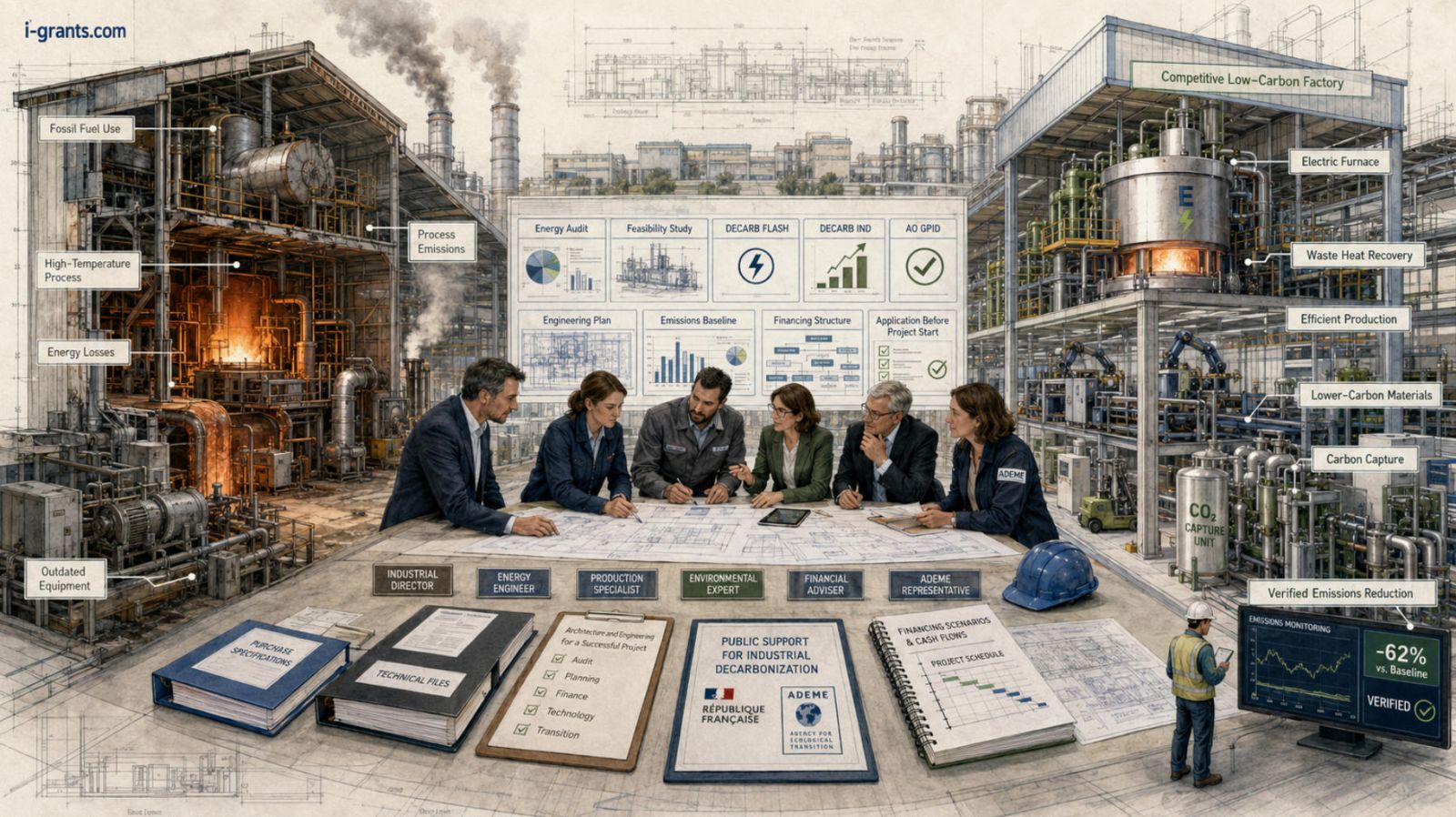
A robust feasibility study should determine the technical solution, investment cost, operating cost, energy requirements, regulatory constraints, expected emissions reduction, implementation schedule, production risks, and possible financing structure.
The preparation sequence should normally follow these stages:
-
Establish a verified energy and greenhouse gas baseline for the industrial site.
-
Identify technical opportunities and compare several decarbonisation routes.
-
Complete the required audit, engineering work, and feasibility studies.
-
Calculate capital expenditure, operating expenditure, emissions impact, and funding needs.
-
Compare DECARB FLASH, DECARB IND, AO GPID, Fonds Chaleur, and other relevant instruments.
-
Submit the application before entering into an irreversible commitment.
This preparation is especially important for electrification projects. A company may need to verify grid capacity, connection timing, electricity-price exposure, required transformers, production interruptions, and the effect of the new system on product quality.
For carbon capture, the project must also address carbon dioxide purification, compression, transport, access to storage, infrastructure timing, regulatory responsibility, and long-term operating costs.
The Project Start Rule
The incentive effect of public aid is a fundamental condition across the main programmes.
The company must submit its application before the project becomes irreversible. An irreversible commitment may include a binding equipment order, a final construction contract, the start of installation work, or another contractual obligation that makes the investment unavoidable.
Preliminary studies, internal planning, engineering analysis, and non-binding quotations are usually compatible with the application process. A signed purchase order marked as a final commitment may not be.
For AO GPID, an accepted supplier offer that constitutes a definitive order may make the entire project ineligible. For DECARB IND and DECARB FLASH, early commitments can remove specific expenditure or the full project from the eligible cost base.
Companies should create a documented internal approval process that prevents procurement teams from issuing binding orders before the grant application has been formally submitted.
A technical meeting with ADEME does not itself authorise the start of the project. Applicants must rely on the written programme rules and, where necessary, obtain formal clarification.
Combining Public Support
Industrial companies may use several public instruments within one wider decarbonisation strategy, but the same cost cannot normally be financed twice.
DECARB IND may be combined with French energy savings certificates, known as CEE, although ADEME support may be adjusted to take other assistance into account.
A company cannot submit the same equipment expenditure simultaneously to two ADEME programmes and expect both to fund it. Where an overlapping application has already been filed, the company may need to withdraw one request formally.
Projects focused exclusively on renewable heat production or on the external use of recovered heat may be more appropriate for Fonds Chaleur. DECARB IND is generally more suitable when heat recovery or renewable heat is one element of a broader industrial process transformation.
Applicants should prepare a complete aid map showing the requested programme, eligible cost base, CEE value, regional assistance, tax support, loans, and private financing. This helps demonstrate that the financing structure is complete and that no expenditure has been counted twice.
Confirmed Programme Results
France has supported industrial decarbonisation projects through successive programmes since 2020.
The results must be interpreted carefully. A project award is a confirmed financing decision. A forecast reduction is not necessarily an emissions saving already achieved. Many supported investments remain under construction or have not yet reached full production.
Table 4. Confirmed Funding Results and Selected Industrial Projects
| Programme or project | Confirmed public support | Number of projects | Reported emissions effect |
|---|---|---|---|
| DECARB IND since 2020 | Approximately EUR 570 million | 158 projects | Projected portfolio reduction of about 2.8 million tonnes of carbon dioxide equivalent |
| DECARB FLASH since 2022, reported in February 2026 | Approximately EUR 22 million | 166 projects | Projected reduction of about 106,000 tonnes |
| First AO GPID | EUR 1.6 billion | 7 selected projects | Projected reduction of about 3.8 million tonnes per year after implementation |
| Yara Ambès catalyst project | EUR 4 million from ADEME within a EUR 10 million investment | 1 completed project | Confirmed reduction of approximately 53,000 tonnes per year after commissioning |
The DECARB IND portfolio has an estimated average public cost of approximately EUR 10 per avoided tonne when assessed over a 20-year period. Around half of the supported projects involved electrification.
The 2.8 million tonne figure is a projected portfolio effect. It should not be presented as an already verified annual reduction from every supported installation.
The first AO GPID attracted 19 applications requesting more than EUR 8 billion in public support. Seven projects were selected for EUR 1.6 billion. Their combined expected reduction is approximately 3.8 million tonnes per year once fully operational.
That figure represented around 24 per cent of the industrial emissions reduction required by 2030 under the government estimate used when the results were announced. It remains a forecast dependent on construction, commissioning, operating performance, and verification.
Yara Ambès: A Completed DECARB IND Example
The Yara France project at Ambès is especially useful because the equipment has already been commissioned.
The site produces nitrogen fertilisers. A major source of emissions was nitrous oxide generated during nitric acid production. Nitrous oxide has a much higher global warming effect than carbon dioxide, so reducing relatively small physical volumes can generate a substantial reduction in carbon dioxide equivalent.
The company modified the catalyst support system, improving the quantity and distribution of catalyst and the movement of gas through the installation.
The total investment was EUR 10 million. ADEME provided EUR 4 million through DECARB IND. The equipment entered service in 2024.
The nitrous oxide abatement rate increased from approximately 95 per cent to 99 per cent. ADEME reports an annual reduction of about 53,000 tonnes of carbon dioxide equivalent. The agency also reports that emissions from the site’s activities fell by more than 75 per cent compared with 2018.
The investment amount, public support, commissioning date, and annual reduction are presented as confirmed project results. Broader statements about achieving almost complete decarbonisation should still be attributed to the company or site management where they reflect management’s assessment.
This project also illustrates that industrial decarbonisation is not limited to energy use. Process emissions and non-carbon dioxide greenhouse gases can be equally important.
Large Projects Selected but Not Yet Completed
The first AO GPID selected major projects involving companies including Vicat, Heidelberg Materials, Holcim, and Aluminium Dunkerque.
These are confirmed selections. Their planned carbon capture installations, process conversions, or other large-scale measures may be described as funded or selected projects.
Future capture volumes, operating dates, job creation, production performance, and cost reductions should not be described as achieved results until the installations are completed and independently verified.
This distinction is essential because major industrial projects can require several years for engineering, permitting, infrastructure development, construction, and commissioning. Carbon capture projects may also depend on transport networks and geological storage facilities that are developed by separate organisations.
Choosing the Correct Programme
The best programme depends on more than the size of the company.
Table 5. Practical Programme Selection Matrix
| Project situation | Most likely route |
|---|---|
| An industrial SME plans several rapid energy-efficiency measures costing EUR 600,000 | DECARB FLASH |
| An SME in an overseas territory plans a EUR 60,000 eligible decarbonisation package | DECARB FLASH may be relevant because of the reduced territorial minimum |
| A factory plans a EUR 7 million furnace electrification project reducing 4,000 tonnes per year | DECARB IND |
| A company seeks EUR 35 million for a large industrial decarbonisation project | DECARB IND is above its normal aid ceiling; AO GPID or another structure must be examined |
| A large EU ETS site needs long-term operating support for a major process conversion | AO GPID may be relevant if the applicant satisfies the restricted participation conditions |
| A company has identified a general decarbonisation objective but has not completed an audit or feasibility study | PACTE Industrie and feasibility-study support should come first |
| A project focuses only on producing renewable industrial heat | Fonds Chaleur may be more appropriate |
| An SME is developing a new decarbonisation technology for sale to industrial customers | IBaC PME may be more appropriate than a site-investment programme |
The selection process should also consider the project schedule. DECARB FLASH is intended for relatively rapid deployment. DECARB IND requires greater technical maturity and measurable annual reductions. AO GPID requires major project preparation and commissioning by the specified long-term deadline.
Common Application Mistakes
Industrial companies frequently make avoidable errors that reduce eligibility or weaken the business case:
-
selecting a programme based only on company size rather than project scale and emissions impact;
-
ordering equipment before the application is formally submitted;
-
presenting reduced production as an emissions reduction;
-
using an outdated energy audit or an unverified baseline;
-
failing to include grid connection, permitting, downtime, and operating-cost risks;
-
presenting projected emissions reductions as already achieved results.
Another frequent problem is focusing only on capital expenditure. A low-carbon system may have higher electricity, maintenance, raw material, transport, or storage costs. The application should explain how these costs will be managed after public support ends.
Applicants should also avoid assuming that the maximum theoretical aid rate will automatically be awarded. Competitive programmes may provide less support than requested, particularly where the public cost per avoided tonne is high.
What a Strong Application Must Demonstrate
A credible application connects technical engineering, environmental impact, and financial viability.
The emissions baseline must be transparent and based on a representative production period. The applicant should explain the selected project boundary, energy sources, process emissions, production assumptions, and calculation method.
Technical evidence should show that the proposed solution is sufficiently mature for investment. Supplier quotations, engineering studies, pilot results, site layouts, permitting plans, and integration studies may all be relevant.
The financing plan should demonstrate that the company can fund the remaining investment and absorb operating risks. Public assistance should close a genuine financing or competitiveness gap rather than replace spending the company would undertake under the same conditions without aid.
The project should also fit within a longer-term site pathway. Evaluators may be less persuaded by an isolated investment that leaves the majority of emissions unchanged without a credible plan for subsequent phases.
Final Assessment
France now has a layered funding system for industrial decarbonisation.
DECARB FLASH provides a relatively accessible route for smaller industrial measures. DECARB IND supports large capital projects capable of reducing more than 1,000 tonnes of carbon dioxide equivalent per year. AO GPID addresses a restricted group of major industrial installations that require long-term contractual support.
The most important strategic decision is not simply whether a company should apply for a decarbonisation grant. It is whether the technical maturity, project scale, emissions impact, aid request, and implementation timetable match the chosen instrument.
For many companies, the correct first step is not an investment application. It is an energy audit, a low-carbon pathway, or a feasibility study. These documents establish the baseline, compare technologies, identify infrastructure constraints, and produce the calculations required for a credible funding request.
The second critical step is to protect eligibility. No binding order or irreversible construction commitment should be made before the application is formally submitted under the relevant rules.
The third is to separate confirmed facts from projections. A selected project is not the same as a completed project. Expected emissions reductions, production performance, and future employment should remain clearly identified as forecasts until verified.
Companies that follow this sequence can use French public support not only to reduce emissions but also to improve energy security, modernise production, reduce exposure to fossil fuel prices, and prepare their industrial sites for the regulatory and market conditions of the 2030s.
An experienced grant writer or industrial funding adviser can help compare programmes, structure the emissions baseline, organise technical evidence, calculate eligible expenditure, prepare the financing plan, and present the project as a credible combination of industrial competitiveness and measurable decarbonisation.