

 Français
  Deutsch
  Українська
Searching for small business grants in Poland can produce hundreds of pages, programme summaries, advisory articles and commercial offers. The difficulty is not finding a page that mentions funding. The difficulty is determining whether the opportunity is official, current, open to the right type of company and suitable for the planned project.
This distinction is essential in 2026. Poland is implementing national and regional programmes under the European Union’s 2021-2027 financial framework, alongside recovery investments, research programmes, preferential financial instruments and direct European funding. New calls appear, schedules are revised, application rounds close and programme documentation changes.
A business owner who relies on an old article or an unverified funding list may spend days preparing for a call that has already closed or never applied to the company’s region. A grant writer who checks only the programme title may overlook restrictions hidden in the selection criteria, state aid rules or eligible cost catalogue.
The best grant search result is therefore not a promising headline. It is an officially verified call that matches the applicant, project, location, budget, timetable and implementation capacity.
This guide explains how to find small business grants in Poland through official sources, how to distinguish an open call from a planned programme, when to search PARP, NCBR, BGK and regional portals, and how to verify an opportunity before preparing an application.
Grant Discovery and Grant Verification Are Different Tasks
Grant discovery is the process of identifying a programme that may be relevant. It usually begins with a broad search based on the company’s size, region, sector or investment purpose.
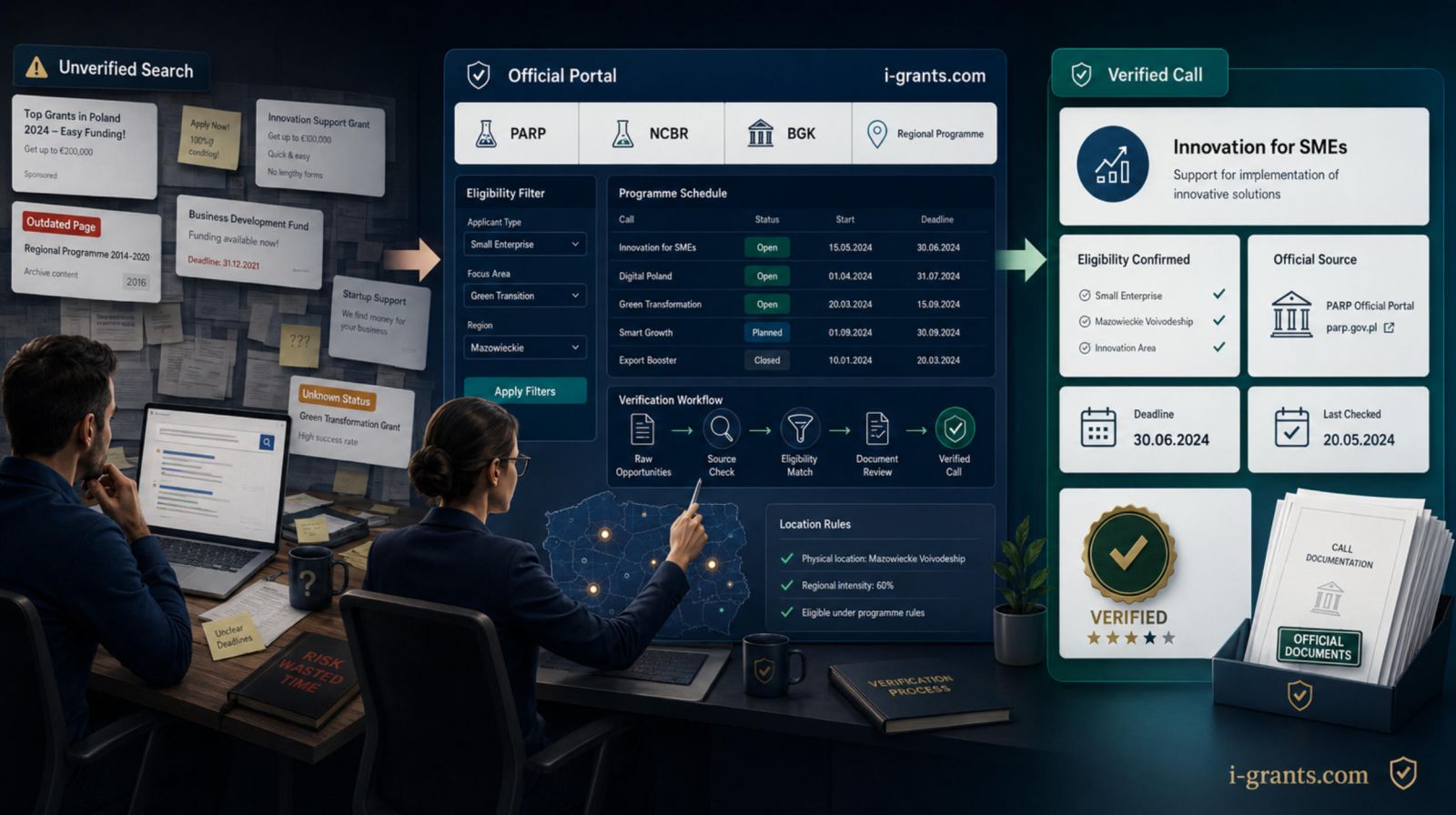
Grant verification is a deeper process. It confirms whether the programme is real, whether a specific application round is open or officially planned, whether the business and project are eligible, and whether the company can meet the financial and administrative conditions.
This difference explains why an attractive search result should never be treated as an immediate invitation to start writing an application. A programme page may describe the general purpose of an instrument without showing whether a current round exists. A funding schedule may include a planned call whose dates and budget are still subject to change. A commercial article may mention a programme that has already closed.
Before treating a call as a real opportunity, an applicant should verify:
-
The official programme operator and the original call page.
-
The current status and dates of the specific application round.
-
Eligible applicants, sectors, regions and legal forms.
-
Eligible project activities, costs and funding form.
-
Required co-financing, financial capacity and implementation period.
-
The current rules, selection criteria, attachments and submission system.
This is the first major principle of a reliable search: discovery creates a lead, but verification creates a funding opportunity.
Start With the Official European Funds Portal
The official European Funds portal is the most logical starting point for companies looking for support in Poland. It provides access to national and regional programmes, application calls, funding schedules, guidance materials, events and contact points.
However, users should understand that the portal contains several tools with different purposes.
The funding search tool helps applicants identify potentially relevant forms of support. It can be used to filter opportunities according to the applicant, region, project purpose or programme area.
The application call section presents calls that have been formally published by participating institutions. These announcements are more specific than general programme descriptions and usually lead to the responsible operator.
The funding schedules show calls expected under national and regional programmes. They are particularly useful for companies that need several months to prepare technical documentation, financial data, energy audits, research plans or investment budgets.
These three tools answer different questions:
-
The search tool asks: what type of support may suit this business?
-
The call database asks: what can the business apply for now?
-
The schedule asks: what may become available later?
A strong funding search uses all three. A company that checks only current calls may miss an important programme opening in three months. A company that reads only the schedule may incorrectly assume that a planned call is already available.
Table 1. Official Sources for Finding Small Business Grants in Poland
| Official source | Primary role | What an SME should check | Main limitation |
|---|---|---|---|
| European Funds portal | Central entry point for national and regional EU-funded support | Funding search, calls, schedules, programme documents and information points | Search results still require confirmation on the operator’s page |
| PARP | SME development, innovation, internationalisation and support for young companies | Current rounds, planned calls, budgets, maximum support and programme documentation | Covers only instruments managed by PARP |
| NCBR | Research, development and technology funding | R&D calls, strategic programmes, international competitions and research requirements | Many calls require genuine technological novelty or research activity |
| BGK | Preferential loans, guarantees and EU-backed financial instruments | Financing purpose, region, intermediary, repayment rules and grant components | Many products are repayable and are not direct grants |
| Regional programme portals | Funding for projects implemented in individual voivodeships | Regional priorities, project location, managing institution and local schedule | Rules and schedules differ between regions |
| Direct EU portals | EU-wide programmes for innovation, environment and digital development | Horizon Europe, LIFE, Digital Europe and international consortium opportunities | Applications may be more complex and internationally competitive |
The table should be read as a routing map. It is not necessary to check every institution for every project. The purpose is to identify which source matches the company’s investment logic.
Define the Project Before Searching
Many entrepreneurs begin with the phrase “I need a grant.” This is too broad to produce a reliable result.
Public funding systems do not normally finance the general wish to grow a business. They finance defined projects connected to policy objectives. The same company may qualify for one programme when developing a new production process, another when improving energy efficiency and a third when entering foreign markets.
Before opening a funding portal, the applicant should classify the project as precisely as possible:
-
Research and development or experimental development.
-
Implementation of a new product, service or production process.
-
Digitalisation, automation, data management or cybersecurity.
-
Energy efficiency, renewable energy or circular economy investment.
-
Export development, internationalisation or participation in foreign markets.
-
Regional investment, skills development or support for a young company.
This classification determines where the search should continue.
A technology project with real scientific or engineering uncertainty may belong under NCBR or a research-oriented PARP instrument. A standard machinery purchase may be more suitable for a regional programme, preferential loan or investment instrument. A company seeking working capital is unlikely to qualify for an innovation grant merely because it plans to grow.
The more precisely the company defines the project, the fewer irrelevant calls it must evaluate.
How to Search PARP Calls Correctly
PARP is one of the most important institutions for Polish SMEs. Its programmes may support innovation, internationalisation, startup development, design, digital transformation, skills and enterprise competitiveness.
However, a PARP programme should not be treated as one continuously open source of funding. Many programmes operate through separate application rounds. The general instrument may exist for several years, while individual rounds open and close within specific periods.
This creates a common misunderstanding. A company may find a programme page showing that an instrument belongs to the 2021-2027 financial perspective and assume that applications can be submitted at any time. In reality, the company must identify the exact round, its start date, end date, budget, target group and rules.
PARP also publishes and updates schedules for several major European Fund programmes. These schedules may change during the year. A company should therefore record the version date of the schedule rather than downloading a file once and relying on it indefinitely.
A reliable PARP search should answer five questions in sequence. Is the programme relevant to the project? Is there a specific current or planned round? Does the company fit the target group? Are the costs and activities eligible? Can the company prepare the required documentation before the closing date?
The last question is often underestimated. A technically suitable call may still be a poor opportunity if the company needs an audit, technical study, market analysis or internal approval that cannot be completed in time.
When NCBR Should Be Part of the Search
NCBR is particularly important for companies working with research, engineering, industrial development and technological innovation. Its programmes may support research projects, experimental development, sector-specific technologies, international cooperation and the commercialisation of scientific results.
In 2026, the NCBR competition schedule includes a broad portfolio of national, strategic and international calls. This makes NCBR a major funding source, but not a universal one.
The central question is whether the project contains genuine research or technological uncertainty. Purchasing available technology and installing it in a business is not automatically research and development. A project usually needs a defined technical problem, a research or development method, uncertain results and a credible route toward practical implementation.
For example, a food producer buying a standard packaging line is planning an investment. A food producer developing a new preservation process, testing materials and validating a prototype may have an R&D project.
The distinction determines not only where to search, but also what evidence must be prepared. NCBR-related applications may require technical work packages, research milestones, risk analysis, staff competencies, intellectual property planning and a commercialisation strategy.
For this reason, companies should classify the project before they search NCBR. Otherwise, they may either overlook a suitable technology programme or waste time trying to force an ordinary investment into an R&D framework.
Why BGK Belongs in a Grant Search
Business owners often search only for non-repayable grants. This can exclude some of the most practical public financing available in Poland.
BGK manages and supports a range of EU-backed financial instruments, including preferential loans, guarantees, credit-linked support and regional financing products. Some instruments contain a grant element, partial redemption or favourable conditions, while others are fully repayable.
This matters because the best financial instrument depends on the project.
A grant may be preferable when the project creates strong public value but has high implementation risk. A low-interest loan may be more appropriate when the investment is commercially viable and can generate predictable cash flow. A guarantee may help a company obtain bank financing when collateral is limited. A credit premium may reduce the effective cost of an investment after specified conditions are met.
The name of an instrument does not always explain its complete structure. An offer may include a grant component but still require a bank loan. Another may be described as a loan but allow part of the principal to be written off after successful implementation.
Before excluding a BGK product because it is not a classic grant, the applicant should check who provides the money, whether an intermediary bank is involved, which part is repayable, whether redemption is possible, when support is paid and what post-investment obligations apply.
This wider approach prevents the company from rejecting a realistic financing route while waiting for a highly competitive grant that may never fit the project.
Regional Funding Requires a Separate Search
Poland has 16 voivodeships, each with its own regional programme. For many small businesses, the regional programme may offer a more realistic route than a large national innovation competition.
Regional support may cover enterprise investment, digitalisation, energy efficiency, renewable energy, workforce development, social services, local infrastructure and competitiveness. The exact priorities differ because each region has its own economic structure and development needs.
The decisive factor is often the place where the project will be implemented, not simply the company’s registered address.
A company registered in Warsaw but investing in a production facility in another voivodeship may need to examine the programme for the investment location. A business with several branches may need to determine which site will receive the equipment, employ the staff or deliver the funded activity.
A regional search should follow a clear sequence:
-
Identify the actual location of project implementation.
-
Open the programme page for the relevant voivodeship.
-
Review current calls and download the latest schedule.
-
Compare the project with regional priorities and smart specialisations.
-
Identify the managing authority or intermediary institution.
-
Confirm whether the call is regional, subregional or limited to a specific territory.
Regional schedules are frequently revised. A planned call may move to another quarter, receive a new budget or be divided into separate rounds. The company should therefore use the latest dated version and confirm important information on the call page.
Table 2. National and Regional Grant Search: Key Differences
| Criterion | National programmes | Regional programmes |
|---|---|---|
| Geographic scope | Usually open across Poland, subject to programme rules | Limited to a particular voivodeship or eligible area |
| Typical operators | PARP, NCBR, BGK and national ministries | Regional managing authorities and intermediary institutions |
| Common project themes | R&D, innovation, internationalisation, digital and green transformation | Regional investment, energy efficiency, workforce development and local competitiveness |
| Main location test | Varies according to the programme | Usually strongly connected to the place of implementation |
| Where to verify | National portal and operator’s website | Central portal, regional programme website and current regional schedule |
| Main risk | Confusing a general programme with an active application round | Searching the wrong region or using an outdated schedule |
The regional and national systems should not be treated as competitors. A company may monitor both because different elements of its development plan may fit different programmes.
Open Call, Planned Call or Closed Round?
One of the most important tasks in grant verification is identifying the exact status of an opportunity.
A page may remain online after a call has closed. A programme may be announced before applications begin. A schedule may show a planned quarter without providing full documentation. A multi-round programme may still appear active even though the current round has ended.
The status determines what the company should do next.
Table 3. Verification Statuses an Applicant Should Distinguish
| Status | What it means | Recommended action |
|---|---|---|
| Open call | Applications are currently accepted | Verify documentation and assess readiness immediately |
| Announced call | The call is official, but submissions have not started | Prepare documents and confirm eligibility |
| Planned call | The call appears in a schedule, but final documentation may not yet exist | Monitor changes and prepare the project concept |
| Multi-round call | The programme has separate application periods | Verify the dates and rules of the relevant round |
| Closed call | The submission period has ended | Use the information only for future planning or programme analysis |
| Financial instrument through intermediaries | Support is distributed through banks or regional partners | Identify the intermediary and check the financing conditions |
This table highlights why a search result without a date and status is incomplete. A grant database should never display an opportunity without showing when it was last checked.
Read More Than the Programme Summary
Programme summaries are useful for understanding the broad purpose of an instrument, but they rarely contain all conditions needed for an application decision.
Important restrictions may appear in the detailed regulations, eligible cost catalogue, assessment criteria, state aid provisions, application form or annexes. A company that reads only the summary may misunderstand the minimum project value, required innovation level, excluded sectors or co-financing rules.
A practical verification rule is to review three levels of information.
The first is the general programme page. It explains the purpose and broader policy context.
The second is the official page of the specific call or application round. It provides the dates, budget, eligible applicants and submission route.
The third is the binding documentation. This includes regulations, selection criteria, annexes, cost rules, forms and official clarifications.
Only after checking all three should the company decide that the opportunity is worth preparing.
This approach also protects grant writers. It allows them to explain risks before drafting begins and prevents the applicant from paying for a proposal that cannot pass the basic eligibility test.
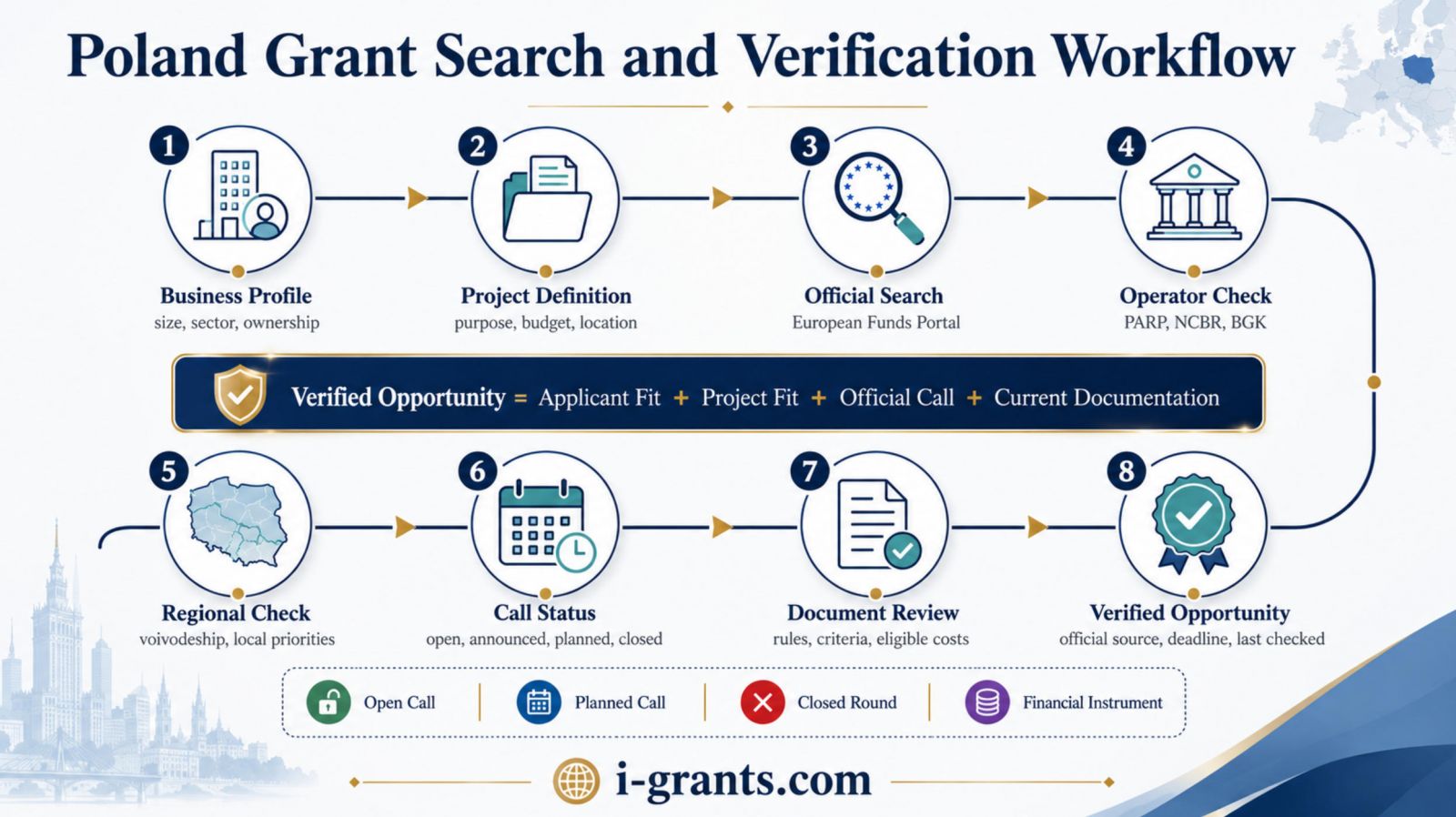
The Eight-Step Verification Workflow
A consistent workflow makes grant searching faster and more reliable. It also allows several team members or external advisers to work from the same information.
The recommended process is:
-
Define the company profile, including size, ownership, legal form, sector and financial condition.
-
Define the project, location, investment purpose, budget and expected results.
-
Search the official European Funds portal for national and regional options.
-
Check the relevant operator, including PARP, NCBR, BGK or the regional managing authority.
-
Confirm the status, dates and exact application round.
-
Read the rules, assessment criteria, cost guidance and attachments.
-
Test eligibility, co-financing, cash flow and implementation capacity.
-
Record the official source and the date of the last verification.
For every opportunity, the company or grant writer should create a short verification record. It should include the programme name, operator, official call page, eligible applicant type, territory, funding form, project type, opening and closing dates, budget, maximum support, co-financing requirement and last checked date.
This is more useful than keeping a folder of unsorted bookmarks. It creates an auditable funding pipeline and makes it easier to compare several opportunities.
Free European Funds Information Points
Poland operates a network of European Funds Information Points. These offices provide free information to entrepreneurs, public institutions, organisations and individuals looking for European funding.
They can help a business understand the structure of available programmes, identify possible support routes and locate the responsible institution. Some points also organise information meetings, online consultations and mobile advisory sessions in smaller towns.
Free information points can help with:
-
Identifying potentially relevant programmes.
-
Explaining the difference between national and regional funding.
-
Directing the applicant to an official call or programme operator.
-
Clarifying general rules and administrative procedures.
-
Providing information about training sessions and consultations.
-
Explaining where to find schedules, regulations and application systems.
Their role should not be misunderstood. An information point is not a substitute for technical project design, legal advice, financial modelling or full proposal preparation. Staff may explain general conditions, but the applicant remains responsible for reading the documents and preparing a compliant application.
For early-stage applicants, however, these consultations can be extremely useful. They provide a free way to test whether a project idea belongs in the funding system before investing heavily in preparation.
Why Searching Only in English Is Risky
International entrepreneurs often begin with English-language searches. This may be sufficient for learning which institutions exist, but it is rarely sufficient for final verification.
Many official Polish institutions provide English information about their mission and major programmes. However, the most current call announcements, amendments, schedules, detailed criteria and attachments are often published first or exclusively in Polish.
Automatic translation can help with an initial review, but technical and legal terminology must be treated carefully. Words relating to state aid, eligible costs, linked enterprises, project indicators, procurement or regional location can change the practical meaning of a condition.
A foreign founder should therefore distinguish between reading for orientation and reading for compliance. The first can often be done in English. The second may require Polish-language competence or professional support.
This is especially important when the business structure involves foreign ownership, associated companies, cross-border activities or financial data prepared under another accounting system.
Common Grant Search and Verification Mistakes
A reliable process should protect the applicant from the mistakes that most often waste time.
The most common errors are:
-
Searching only in English and missing current Polish documentation.
-
Treating a funding schedule as proof that applications are open.
-
Reading only the programme summary and ignoring the regulations.
-
Failing to check the programme for the project’s voivodeship.
-
Assuming that every public financing instrument is a direct grant.
-
Saving a link without recording the source, status and verification date.
Another serious error is waiting for the ideal grant before defining the project. This produces reactive applications built around programme language rather than real business needs. A stronger strategy begins with the investment plan and then identifies the funding mechanism that fits it.
When a Grant Writer Should Enter the Process
A grant writer can add the most value after the company has defined the project but before the budget and application structure are fixed.
At this point, the specialist can test the project against the programme’s objectives, identify eligibility risks, map the assessment criteria and determine what evidence is missing. The grant writer can also help translate the business plan into the language expected by the evaluator without changing the underlying project.
Hiring a writer only after all decisions have been made may reduce their ability to improve the application. For example, the chosen investment structure may include ineligible costs, the timetable may be unrealistic or the project indicators may not match the programme.
The grant writer should also verify the official source independently. A professional should not rely solely on a link sent by the applicant or on a third-party article. They should confirm the call status, documentation version and all material conditions.
For complex research, innovation or regional investment projects, a wider team may be needed. This can include technical experts, financial advisers, energy auditors, lawyers, accountants or research partners. The grant writer coordinates the evidence but cannot replace every specialist.
How i-grants.com Can Support a Verified Search
The Polish funding system contains many valuable opportunities, but the information is distributed across national portals, programme operators, regional authorities, banks and European institutions.
This creates two separate needs.
Applicants need current, verified opportunities that can be filtered by company type, region, sector, funding form and deadline. They also need access to grant writers who understand the relevant programme and language.
Grant writers need structured information, serious applicant profiles and a clear record of the project’s readiness. They also need to know when an opportunity was last checked and whether the source is official.
A platform such as i-grants.com can connect these needs by treating every funding opportunity as structured data rather than a promotional article. The record should include the official source, status, eligible territory, applicant type, funding amount, deadline, last checked date and programme operator.
This does not remove the need to read the call documentation. It makes the first stage faster and reduces the risk of following outdated or irrelevant leads.
Search Broadly, Verify Narrowly
Finding small business grants in Poland is not a matter of discovering one perfect website. It is a process of moving from a broad funding search to a narrow, documented verification.
The official European Funds portal is the best general starting point. PARP is essential for many SME, innovation and internationalisation programmes. NCBR becomes important when a project includes genuine research or technological development. BGK should be checked when loans, guarantees or blended instruments may fit the investment. Regional portals are necessary whenever project location affects eligibility.
The most important discipline is to separate a possible opportunity from a verified call.
A possible opportunity appears in a search result or programme schedule. A verified call has an official operator, a current status, a specific round, binding documentation, eligible applicants, defined costs and a realistic deadline.
Companies that follow this process spend less time on unsuitable programmes. Grant writers can assess opportunities more accurately. Both can prepare earlier and build applications around evidence rather than assumptions.
In the Polish funding market, the best search result is not the programme with the largest headline budget. It is the programme that fits the applicant, project, region, financing capacity and implementation plan.