

 Français
  Deutsch
  Українська
Finding a business grant in the United States is not primarily a problem of locating a website with a long list of funding programmes.
The harder problem is knowing where to search, what each government platform actually represents, how to interpret a search result, and when to move from a general federal database to an agency-specific or state-specific funding system.
That distinction matters because the US public funding system is highly decentralised.
A company searching for research and development funding may need to use Grants.gov, SBIR.gov, and the website of a specific federal agency. An exporter may ultimately need to apply through its own state's State Trade Expansion Program. A technology startup may find federal research funding through SBIR/STTR but later obtain commercialization support from a state innovation programme. A rural business may need to work through USDA Rural Development. A conventional local business may discover that its strongest opportunities are not federal grants at all, but state incentives, local economic development support, workforce programmes, tax incentives, publicly supported financing, or government procurement.
The result is a funding landscape where searching for the phrase "small business grants" is usually much less effective than understanding the architecture behind the search.
For companies in 2026, the most useful approach is therefore to treat grant research as a sequence:
find the right funding system, identify the right programme, verify the current opportunity, confirm who can legally apply, and only then determine whether the company and project qualify.
This article explains how to do that.
Grants.gov Is the Main Federal Opportunity Search, but It Is Not a Small Business Grant Database
Grants.gov remains the central federal infrastructure for discovering and applying for many federal assistance opportunities.
But it should not be understood as a catalogue of grants created specifically for entrepreneurs.
Federal funding opportunities published through the system can be intended for state governments, local authorities, Tribal governments, nonprofit organisations, universities, research institutions, healthcare organisations, public agencies, for-profit businesses, small businesses, or combinations of these applicant categories.
A company can therefore find an opportunity that appears relevant to its industry and still have no legal right to apply.
This is one of the most important differences between finding a search result and finding a usable funding opportunity.
In 2026, that distinction became even more important because the Grants.gov search experience changed significantly.
Simpler.Grants.gov Became the Default Federal Funding Search in 2026
The federal government has been rebuilding the Grants.gov experience through Simpler.Grants.gov.
By 2026, Simpler Search had become the default search experience for federal funding opportunities. The project is designed to make federal funding information easier to search and understand while using the Grants.gov opportunity data.
For businesses, this change is more than cosmetic.
The search system allows users to work with filters such as applicant eligibility, federal agency, opportunity status, funding instrument, dates, and other characteristics.
As of August 2026, the search interface displayed approximately 776 opportunities under the "Small businesses" eligibility filter. That figure is dynamic and should not be interpreted as 776 grants currently available to every small business. It includes opportunities with different agencies, purposes, deadlines, eligibility conditions, and statuses.
This is an excellent illustration of why raw search-result counts can be misleading.
A search system may classify hundreds of opportunities as potentially relevant to small businesses while only a small fraction match a particular company's:
industry,
technology,
geographic location,
ownership structure,
project stage,
cost structure,
timing,
and programme-specific eligibility.
The search result is therefore the beginning of due diligence, not the end.
Programme, Opportunity, and Application Are Three Different Things
One of the most useful concepts for US grant research is the distinction between a federal assistance programme, a specific funding opportunity, and an application package.
A programme can exist for years.
A specific competition may open only periodically.
An applicant then submits against the current Notice of Funding Opportunity, solicitation, or other governing document.
This is why SAM.gov Assistance Listings and Grants.gov should not be treated as interchangeable databases.
SAM.gov Assistance Listings describe federal assistance programmes and the forms of assistance they may provide. Grants.gov and Simpler.Grants.gov are used to identify specific funding opportunities associated with those programmes.
A company can therefore find a programme description in a federal catalogue and still have nothing it can apply for today.
Likewise, a company can find a current opportunity and still fail the applicant-eligibility test.
Table 1. Where US Small Businesses Should Search for Public Funding in 2026
| Platform or Source | Best Use | What It Contains | Can a Business Apply There? | Main Risk |
|---|---|---|---|---|
| Simpler.Grants.gov / Grants.gov | Finding current and forecasted federal opportunities | Federal funding notices, deadlines, agencies, eligibility categories and application information | Sometimes | Assuming every relevant search result is open to the company |
| SAM.gov Assistance Listings | Understanding federal programmes | Descriptions of federal assistance programmes and instruments | Not usually the final application point | Confusing a programme listing with an open competition |
| SBA.gov | Finding SBA financing, specialised grant-related programmes and business-support routes | SBA grants information, STEP, loans, Resource Partners and specialised initiatives | Depends on the programme | Assuming SBA provides general startup grants |
| SBIR.gov | Discovering federal innovation topics | SBIR/STTR topics and agency solicitations | Eligible small businesses can apply through the relevant agency process | Treating the aggregator as the final authoritative solicitation |
| Federal agency websites | Understanding programme-specific rules | Official guidance, research priorities, calendars, forms and submission rules | Frequently, where the programme allows businesses | Relying on a third-party summary instead of current agency rules |
| State economic development agencies | Finding state grants and incentives | Innovation, export, workforce, manufacturing, energy and regional programmes | Frequently | Searching only at federal level and missing state opportunities |
| SBA Resource Partners | Local guidance and navigation | Counselling, training and business-support services | They generally advise rather than award ordinary grants | Expecting the adviser itself to be the funding programme |
The practical lesson is simple:
SAM.gov can tell you that a programme exists. Grants.gov can tell you that a competition exists. The current funding notice tells you whether you can actually apply.
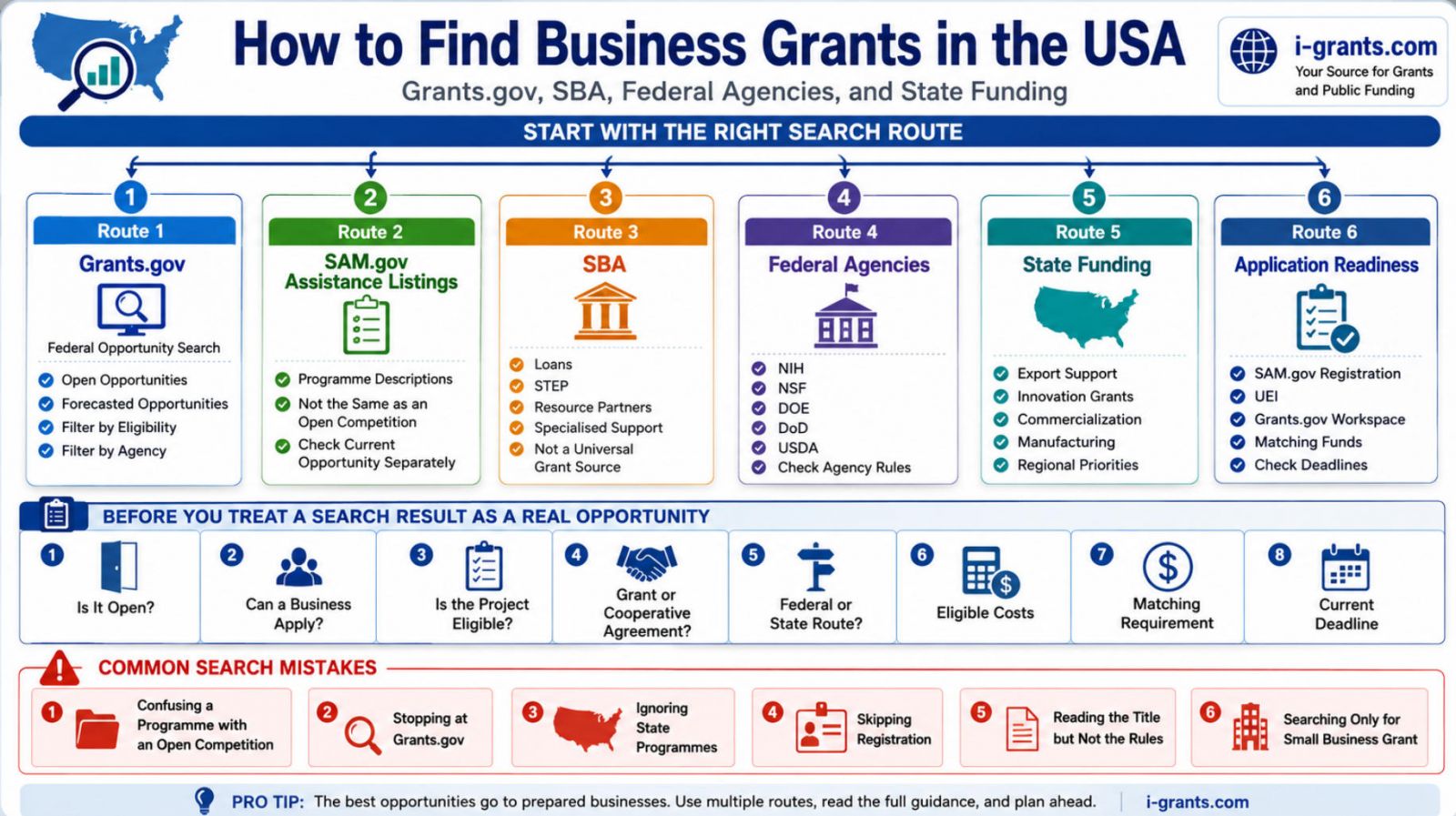
Search by Project, Not by the Phrase "Small Business Grant"
One of the weakest ways to search federal funding is to enter only:
small business grant
This phrase describes the applicant, but usually not the public purpose of the funding.
Federal agencies generally fund activities that advance specific government missions. They may be looking for new medical technologies, manufacturing capability, cybersecurity research, agricultural development, clean-energy systems, export growth, transportation technology, public-health innovation, or other defined outcomes.
A better search begins with the project.
A company developing a new battery technology should search around energy storage, advanced materials, manufacturing, grid resilience, and related agency priorities.
A biotechnology startup should search disease areas, diagnostics, therapeutic platforms, medical devices, and the agencies that fund those areas.
A rural food producer may need to search USDA value-added agriculture or rural business programmes.
A cybersecurity company may need to examine programmes across the Department of Defense, Department of Energy, Department of Homeland Security, National Science Foundation, and other agencies depending on the technology.
SBIR.gov itself advises companies to identify relevant agencies and then search open solicitations using project-related keywords, starting with broader terms before narrowing the search.
This approach produces fewer irrelevant results because it searches for the government problem the project solves, not merely the legal size of the company.
Filter the Federal Search Before Reading Dozens of Opportunities
Once a business has identified the project area, the next step is filtering.
A useful federal search process is:
-
Search by the project or technology, not only by the applicant type.
-
Set applicant eligibility, including Small businesses or the appropriate for-profit category where relevant.
-
Check opportunity status, especially Open and Forecasted.
-
Narrow by federal agency when the likely funder is known.
-
Check the funding instrument, because some results may be cooperative agreements or other forms of assistance rather than ordinary grants.
-
Open the current funding notice and verify eligibility before preparing anything substantial.
The exact filters and interface can evolve, but the logic should remain the same.
This method prevents one of the most expensive mistakes in grant research: spending several hours reading a technically interesting opportunity before discovering that the company is not an eligible applicant.
Open and Forecasted Opportunities Serve Different Purposes
Businesses should pay particular attention to the difference between Open and Forecasted opportunities.
An open competition answers:
Where can we apply now?
A forecasted competition answers:
What should we begin preparing for now?
That distinction matters because federal grant preparation can involve technical writing, budgets, registrations, collaborations, letters, commercialization planning, regulatory analysis, and other work that cannot always be completed efficiently in the final days before a deadline.
Current NIH search results provide a useful example. In August 2026, Simpler.Grants.gov showed both open NIH small-business opportunities and forecasted notices, including future Small Business Transition Grant opportunities for new entrepreneurs whose closing dates were still listed as to be determined.
For an experienced grant team, forecasted opportunities can therefore be almost as valuable as open opportunities.
They create preparation time.
The Programme Title Is Not an Eligibility Decision
Businesses often assume that if a funding title contains words such as innovation, manufacturing, rural business, export, or small business, they are probably eligible.
That is unsafe.
The programme title describes the policy objective, not necessarily the legal applicant.
A good 2026 example comes directly from the SBA.
In May, the SBA announced the Manufacturing in America E2G Grant Initiative, with up to $50 million in grant awards intended to strengthen training and technical assistance for small manufacturers.
At first glance, this looks like a major new manufacturing grant for small businesses.
But the SBA stated that the funding would go to as many as ten eligible applicant organisations, which would then provide training and technical assistance to small manufacturers. The individual manufacturers were the intended beneficiaries, not necessarily the direct federal grantees.
This is precisely why an applicant should never make an eligibility decision from the title alone.
A funding programme can:
support small businesses,
be administered by the SBA,
contain the word grant,
and still not permit an ordinary small business to apply directly.
SBA.gov Should Be Used as a Navigation and Support Platform, Not a Universal Grant Catalogue
The SBA remains one of the first government websites entrepreneurs visit when searching for business funding.
That is useful, but only if its role is understood correctly.
The SBA explicitly states that it does not provide grants for starting and expanding a business. Its grant activity is targeted, including programmes supporting research and development, state export assistance, Resource Partners, nonprofit and educational organisations, and specialised initiatives.
The broader SBA funding section is also heavily focused on loans and investment capital rather than universal direct grants.
For businesses, SBA.gov is therefore valuable for four different reasons.
First, it explains which SBA-related grant routes genuinely exist.
Second, it helps companies understand publicly supported lending.
Third, it connects firms to export programmes such as STEP.
Fourth, it provides access to local business-support networks that can help companies navigate financing and government programmes.
This is a much more accurate use of SBA.gov than searching it for a mythical general business grant.
STEP Demonstrates Why Federal Funding Often Has a State-Level Application Route
The State Trade Expansion Program, or STEP, is one of the clearest examples of why federal programme research must sometimes move immediately to the state level.
SBA awards STEP funding to state and territory governments so they can help eligible small businesses develop exports.
That means an individual exporter normally does not apply to the SBA for a universal federal STEP grant.
It looks for the programme administered by its own state or territory.
This distinction matters because states can apply different:
award limits,
eligible activities,
reimbursement structures,
application periods,
administrative procedures,
and funding priorities.
New York provides an excellent current example.
Its STEP 13 funding period runs from July 24, 2026 through September 29, 2027. Eligible companies may receive a combined maximum of $10,000, and the programme states that awards are issued on a first-come, first-served basis until programme funds are exhausted. The programme also requires businesses to apply before beginning the activity they want supported.
A company searching only for "SBA STEP grant" would therefore be looking at the wrong administrative level.
A better query is:
STEP + company state
Federal Agency Websites Are the Second Search Layer
Grants.gov is excellent for discovering opportunities.
It is not always the best place to understand the deeper structure of a specialised programme.
Once a company finds a serious lead, it should normally move to the relevant agency website.
This is particularly important in research and technology funding.
SBIR.gov provides a searchable collection of SBIR/STTR topics across federal agencies. But the portal itself warns that the solicitations and topics displayed there are copies from the different agencies and may not be the latest versions. It instructs users to visit the relevant agency's own SBIR site for the official solicitation, forms, and rules.
That warning is extremely important.
Even an official government aggregation system should not automatically replace the source agency.
The correct hierarchy is:
discovery portal → agency page → current solicitation or NOFO
For specialised federal funding, the last document in that sequence is normally the one that governs the actual application.
Different Federal Agencies Have Different Funding Journeys
There is no single universal SBIR/STTR application process.
NIH, NSF, DOE, DoD, NASA, and other agencies implement the broader small-business research framework differently.
Current NIH searches, for example, include active parent SBIR and STTR opportunities as well as specialised commercialization programmes and forecasted notices.
NSF has historically used an initial Project Pitch mechanism to determine whether an innovative company should proceed toward a Phase I proposal.
Other agencies publish agency-specific topics or solicitations tied more directly to mission needs.
This means the search process has two levels:
Level one: Which federal agency is likely to care about this technology?
Level two: How does that agency actually accept small-business proposals?
The second question is often where generic grant articles fail.
Registration Can Become a Hidden Grant Deadline
Finding the right opportunity is not enough.
Federal registration requirements can prevent a company from submitting even when the business and project appear eligible.
For many organisational applicants, the process requires an active registration in SAM.gov, a Unique Entity Identifier, and the correct Grants.gov organisation profile.
Grants.gov currently warns that full SAM processing can take an average of 7 to 10 business days after all required information has been entered and specifically advises applicants to begin early.
That creates a hidden deadline.
Imagine a company discovering a perfect federal competition seven days before closing.
The technical proposal may be achievable.
The budget may be ready.
The founders may understand the technology better than any competing applicant.
But if the required federal registration is incomplete, the company may still be unable to submit.
For organisations that plan to pursue federal funding repeatedly, registration should therefore be treated as infrastructure, not as something to begin after finding the ideal opportunity.
Workspace Is Where Federal Search Becomes Federal Application
Finding an opportunity and preparing an application are separate stages.
Grants.gov uses Workspace as the collaborative environment for many federal applications. It allows members of a grant team to work with different application forms within the same application package and supports role-based collaboration. Official federal funding notices regularly direct applicants to use Workspace for submission.
For a company, the simple distinction is:
Simpler.Grants.gov helps you find the opportunity. Workspace helps you build and submit the application.
This matters particularly for companies using outside grant writers, technical staff, finance managers, researchers, and authorised organisational representatives.
Federal grant applications are often team processes.
A Search Result Must Pass Several Tests Before It Becomes a Real Opportunity
The most important discipline in professional grant research is refusing to call something a "grant opportunity for the company" until it has passed a structured verification.
Table 2. What a Business Must Verify Before Treating a Search Result as a Real Grant Opportunity
| Check | What to Verify | Why It Matters |
|---|---|---|
| Opportunity status | Open, forecasted, closed, archived or otherwise unavailable | A real programme may not currently accept applications |
| Applicant eligibility | Whether small or for-profit businesses can legally apply | A programme can help businesses without allowing them to be direct applicants |
| Funding instrument | Grant, cooperative agreement or another form of assistance | The financial and administrative structure may differ |
| Project fit | Whether the proposed activity matches the funding objective | Company eligibility does not make every project eligible |
| Award range | Minimum, maximum and expected award size | Determines whether the programme fits the financing need |
| Cost sharing | Required company contribution or matching funds | A company may be eligible but unable to finance the required match |
| Eligible costs | Personnel, equipment, subcontracting, travel and other cost categories | A project can fit while its intended expenditure does not |
| Deadline and timing | Submission date and project-start restrictions | Starting work too early can create eligibility problems |
| Registration | SAM.gov, UEI, Grants.gov and agency-specific accounts | Missing registration can make submission impossible |
| Governing document | Current NOFO, solicitation or programme rules | Summaries and databases cannot replace the legal funding conditions |
This table should be used as a screening tool.
If one of these questions remains unanswered, the company has not yet completed its funding research.
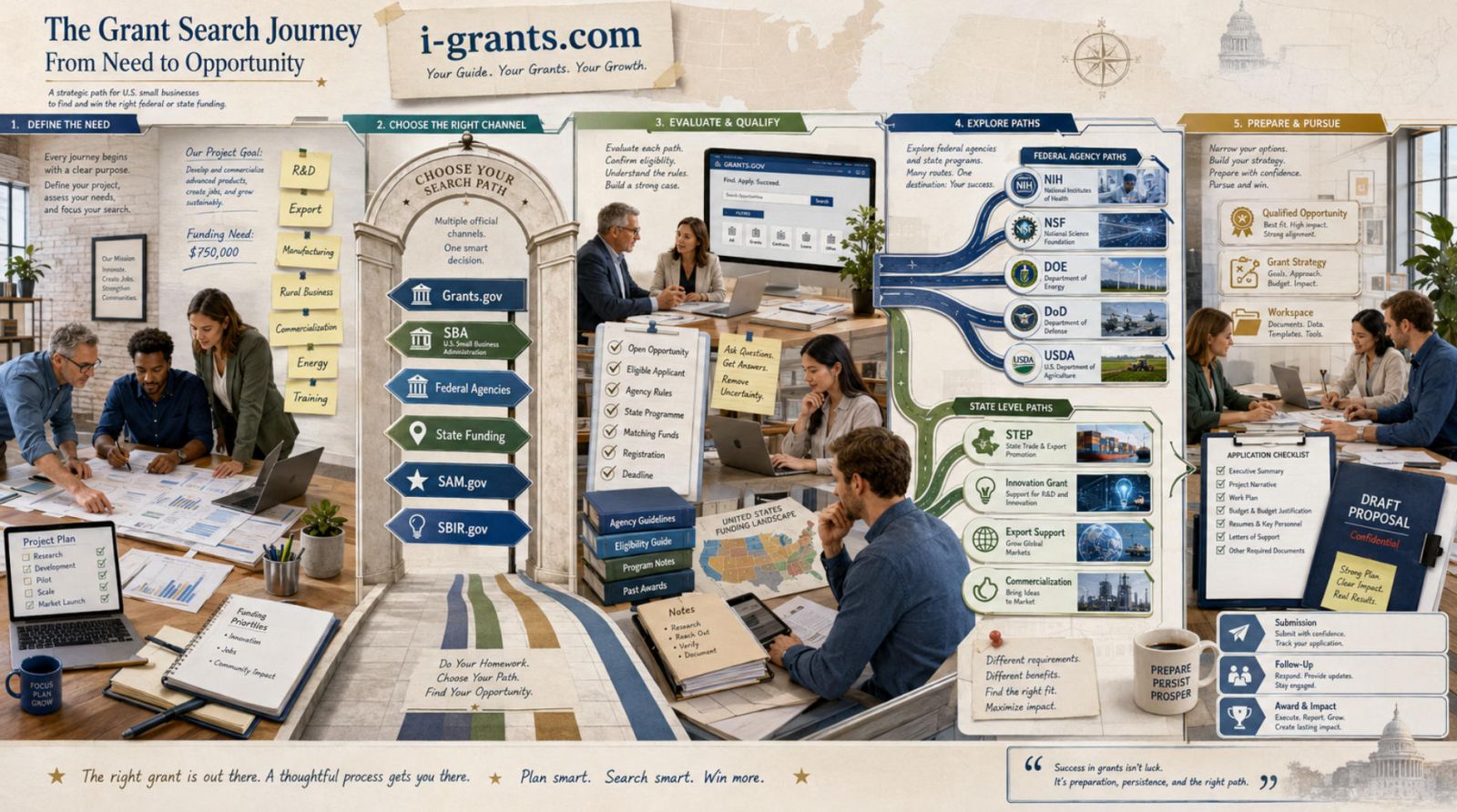
Searching at State Level Is Not Optional
For many businesses, the state level is where federal funding research becomes much more practical.
States can operate direct grants, commercialization programmes, export reimbursements, training assistance, manufacturing support, clean-energy incentives, regional development programmes, tax incentives, and publicly supported financing.
They also receive federal money and redesign it into state-specific programmes.
There is no single national state-grant system equivalent to Grants.gov that standardises every programme across all 50 states.
A business therefore needs to identify its state's official economic development, commerce, innovation, energy, agriculture, or small-business agency.
The programmes can be highly specialised.
That is a disadvantage for broad national searching but an advantage for companies that fit the state's strategic industries.
California Shows the Scale State-Administered Federal Support Can Reach
California's State Trade Expansion Program demonstrates that state-administered support should not be considered marginal.
According to California GO-Biz, during federal fiscal year 2025, California STEP supported 204 small businesses, which reported approximately $33 million in export sales and the creation or retention of 254 jobs.
Those figures are useful because they show how a federal programme can produce measurable business outcomes without individual firms applying directly to the federal agency.
The SBA provides federal awards.
California operates the business-facing support.
Companies receive the economic benefit.
Understanding that chain is essential to finding the programme in the first place.
Colorado Provides a Current Example of a Direct State Innovation Grant
State funding can also involve direct company applications.
Colorado's Advanced Industries Early-Stage Capital and Retention Grant is open in August 2026 and can provide up to $250,000 per project. The current application deadline is August 27, 2026 at 5:00 p.m. Mountain Time, and the programme applies a two-to-one matching requirement.
This is a completely different structure from STEP.
The federal government is not the business-facing route.
The state programme itself is the relevant opportunity.
For an eligible advanced-industry company in Colorado, this programme could therefore be much more immediately useful than a broad search for federal startup grants.
Massachusetts Shows How State Funding Can Follow Federal R&D Funding
Massachusetts provides an especially strong example of funding sequencing.
The MassVentures SBIR Targeted Technologies START Program supports Massachusetts companies that have received qualifying federal SBIR/STTR funding and need help moving toward commercialization.
The programme offers a staged structure that begins with $100,000 grants, can progress to $200,000, and includes later opportunities of up to $500,000 for the strongest participating companies.
Since 2012, START has awarded $46.2 million to 157 companies. MassVentures reports that these companies have subsequently raised more than $5 billion and employ more than 3,400 people in Massachusetts. The next application window is scheduled to reopen on February 1, 2027.
This is important for more than the programme itself.
It demonstrates how the US funding system often works in stages:
federal research support first,
state commercialization support later,
private capital after technical and commercial milestones have been reached.
A company searching only for one large grant may miss this entire financing pathway.
New York Shows Why State Programme Rules Must Be Checked Independently
New York STEP demonstrates another reason to leave the federal portal and examine the state administrator.
The current STEP 13 programme allows grants of $2,000 to $5,000 per activity, with an overall company cap of $10,000 for the funding period. The programme operates from July 24, 2026 through September 29, 2027 and uses a first-come, first-served model while funds remain available.
These are not generic nationwide STEP rules for every company.
They are the operational conditions of New York's programme.
The same federal programme can therefore produce materially different business-facing opportunities depending on the state.
Table 3. Examples of State-Level Business Funding Routes in 2026
| State | Programme or Route | Business-Facing Support | Current or Recent 2026 Example | What It Demonstrates |
|---|---|---|---|---|
| California | California STEP / GO-Biz | Export assistance | 204 small businesses supported in FY2025, with about $33 million in reported export sales | Federal money can reach companies through a state programme |
| Colorado | Advanced Industries Early-Stage Capital and Retention Grant | Direct innovation grant | Up to $250,000; August 27, 2026 deadline | States can operate significant direct grants for eligible companies |
| Massachusetts | MassVentures START | Commercialization support after SBIR/STTR | $100,000 to later-stage awards up to $500,000; next window February 2027 | State money can extend the impact of federal R&D funding |
| New York | STEP 13 | Export reimbursement grants | Up to $10,000 combined support during the current funding period | The same federal programme can have state-specific amounts and rules |
These examples should not be interpreted as a complete ranking of state grant systems.
Their purpose is to show four different ways a company can encounter public funding after leaving the federal search environment.
Alerts Are Better Than Repeating the Same Search Every Week
The availability of federal opportunities changes continuously.
A programme can be announced.
A forecast can become an open competition.
A deadline can approach.
An amendment can change the requirements.
A company that manually performs the same broad search every few weeks risks missing important changes.
Grants.gov supports subscriptions and notifications for new or modified funding opportunities, and the Simpler.Grants.gov development has also incorporated saved-search and notification functionality.
For companies that depend on recurring federal innovation or sector funding, this turns grant research into a monitoring process rather than an occasional search exercise.
A biotechnology company should not discover every NIH opportunity from scratch.
A defence-technology startup should not restart its topic search from zero every month.
An exporter should know when its state's STEP funding changes.
A professional funding strategy builds repeatable search channels.
A Practical Search Workflow for a US Business
A company can reduce wasted research substantially by following one consistent process:
-
Define exactly what needs financing. Separate R&D, commercialization, equipment, manufacturing, exports, workforce development, energy, market expansion and ordinary working capital.
-
Identify the likely government level. Determine whether the project is more likely to fit a federal mission, state economic priority, local programme or another public-support mechanism.
-
Search the correct discovery system. Use Simpler.Grants.gov for federal opportunities, agency systems for specialised programmes, and the company's own state agencies for state-level support.
-
Filter before reading deeply. Check applicant type, programme status, agency, funding instrument and major project restrictions.
-
Verify the authoritative source. Move from the search result to the agency website and then to the current NOFO, solicitation or programme guidelines.
-
Confirm administrative readiness. Check SAM.gov, UEI, Grants.gov, agency registrations, matching funds and internal approval before committing to proposal development.
This workflow is deliberately designed to eliminate opportunities early.
That is a feature, not a problem.
A company does not need 100 possible grants.
It needs a small number of programmes it can actually win and use.
The Most Common Search Mistakes
The same errors appear repeatedly in US grant research.
One is treating a programme page as evidence of an open competition.
Another is assuming that "small business" in a search filter means the specific company qualifies.
A third is reading the programme title but not the applicant eligibility section.
A fourth is stopping at Grants.gov instead of moving to the relevant federal agency.
A fifth is ignoring state programmes entirely.
A sixth is beginning federal registration only after an ideal competition appears.
A seventh is treating loans, export reimbursements, tax incentives, technical assistance, equity programmes, and grants as though they were financially identical.
These mistakes are especially dangerous because the initial search result may still look credible.
The programme can be real.
The government website can be real.
The money can be real.
But the opportunity can still be wrong for the company.
The Best Funding Search Usually Moves Across Several Systems
A sophisticated funding search does not stay on one portal.
Consider a US technology company developing a new industrial sensing system.
It may first identify relevant terminology using SBIR.gov.
Then it may locate an open or forecasted federal opportunity through Simpler.Grants.gov.
It should move to the responsible agency's website to read the official solicitation.
If the company wins federal R&D funding, it may later search its state for commercialization support similar to Massachusetts START.
It may use state export assistance when entering foreign markets.
It may explore publicly supported financing for production equipment.
Eventually, a federal or state government agency may become a procurement customer.
This is the real architecture of US public funding.
It is not a single database.
It is a sequence of interconnected funding systems.
What Businesses Should Do Before Paying Someone to Write a Grant
Finding a grant writer does not replace grant screening.
Before commissioning a full application, a company should already know that:
the programme is active,
the company can legally apply,
the project matches the programme,
the proposed costs are eligible,
the required registrations can be completed,
the company can satisfy any matching requirement,
and the timetable is realistic.
Only after these points are established does proposal quality become the main problem.
This distinction is particularly important for grant marketplaces and professional grant-writing relationships.
The first expert task is not writing.
It is opportunity qualification.
A beautifully written application submitted to the wrong programme is still a failed funding strategy.
Final Perspective
Finding real business grants in the United States requires more than knowing the addresses of Grants.gov and SBA.gov.
The US system is distributed across federal programme catalogues, active funding notices, individual agency portals, SBA programmes, SBIR/STTR systems, state economic development agencies, export programmes, and other specialised funding channels.
Each source answers a different question.
SAM.gov helps explain what federal assistance programmes exist.
Simpler.Grants.gov and Grants.gov help locate current and forecasted federal funding opportunities.
SBA.gov helps businesses understand specialised SBA-related support, lending, STEP, and other business resources.
SBIR.gov helps innovative companies discover federal R&D topics.
The websites of NIH, NSF, DOE, DoD, USDA, and other agencies provide the specialised rules that determine how their programmes actually work.
States then add an entirely separate layer of grants, commercialization funding, export support, workforce programmes, financing and incentives.
The most important lesson is that finding a programme is not the same as finding a fundable opportunity.
A real opportunity exists only after several questions have been answered:
Is the programme accepting applications?
Can this type of company apply?
Does the project match the funding objective?
Are the costs eligible?
Can the business meet the registration and matching requirements?
Is the current application timetable realistic?
Once these questions have been answered, grant writing becomes meaningful.
Until then, the company is still conducting research.
The most effective way to find business grants in the United States is therefore not to search for the largest possible number of programmes. It is to move systematically from the right search platform to the right agency, from the agency to the current funding notice, and from the federal level to the state level whenever the project requires it.
That process produces fewer opportunities.
But the opportunities it produces are real.
Federal and state funding opportunities, deadlines, award amounts, eligibility requirements, and application systems can change. The information in this article reflects official sources available in August 2026. Businesses should verify the current Notice of Funding Opportunity, agency guidance, and applicable state programme rules before preparing or submitting an application.