

 Français
  Deutsch
  Українська
Finding a business grant in Belgium is rarely as simple as entering "Belgium business grants" into a search engine.
The country has a highly developed system of public support for companies, but that system is divided between regions, federal authorities and European programmes. A Flemish startup looking for innovation funding, a Brussels retailer planning a digitalisation project and a Walloon manufacturer buying new production equipment should not begin their searches in the same place.
The practical challenge is therefore not merely identifying whether public funding exists. It is knowing which official database to search, which authority manages the programme, whether the programme is currently accepting applications, and where the application must actually be submitted.
Belgium's official business portal directs entrepreneurs to three principal regional gateways: VLAIO in Flanders, hub.brussels in the Brussels-Capital Region and 1890 in Wallonia. These organisations provide information or guidance appropriate to the company's region.
For SMEs, this leads to a useful rule:
Do not start with the grant. Start with the location of the business and the purpose of the project.
Why Belgium Does Not Have One Business Grant Search Portal
Belgium's federal structure explains why entrepreneurs encounter several different funding systems.
Regional governments have significant responsibility for economic development and business support. Consequently, Flanders, the Brussels-Capital Region and Wallonia each maintain their own databases, eligibility tools, advisory organisations and application platforms.
Federal support adds another layer, particularly through tax measures, employment instruments and certain financing mechanisms.
European Union funding creates yet another layer. Some EU programmes are managed directly by the European Commission, while others are implemented through Belgian or regional authorities.
This means that "Belgian grants" is not a single category.
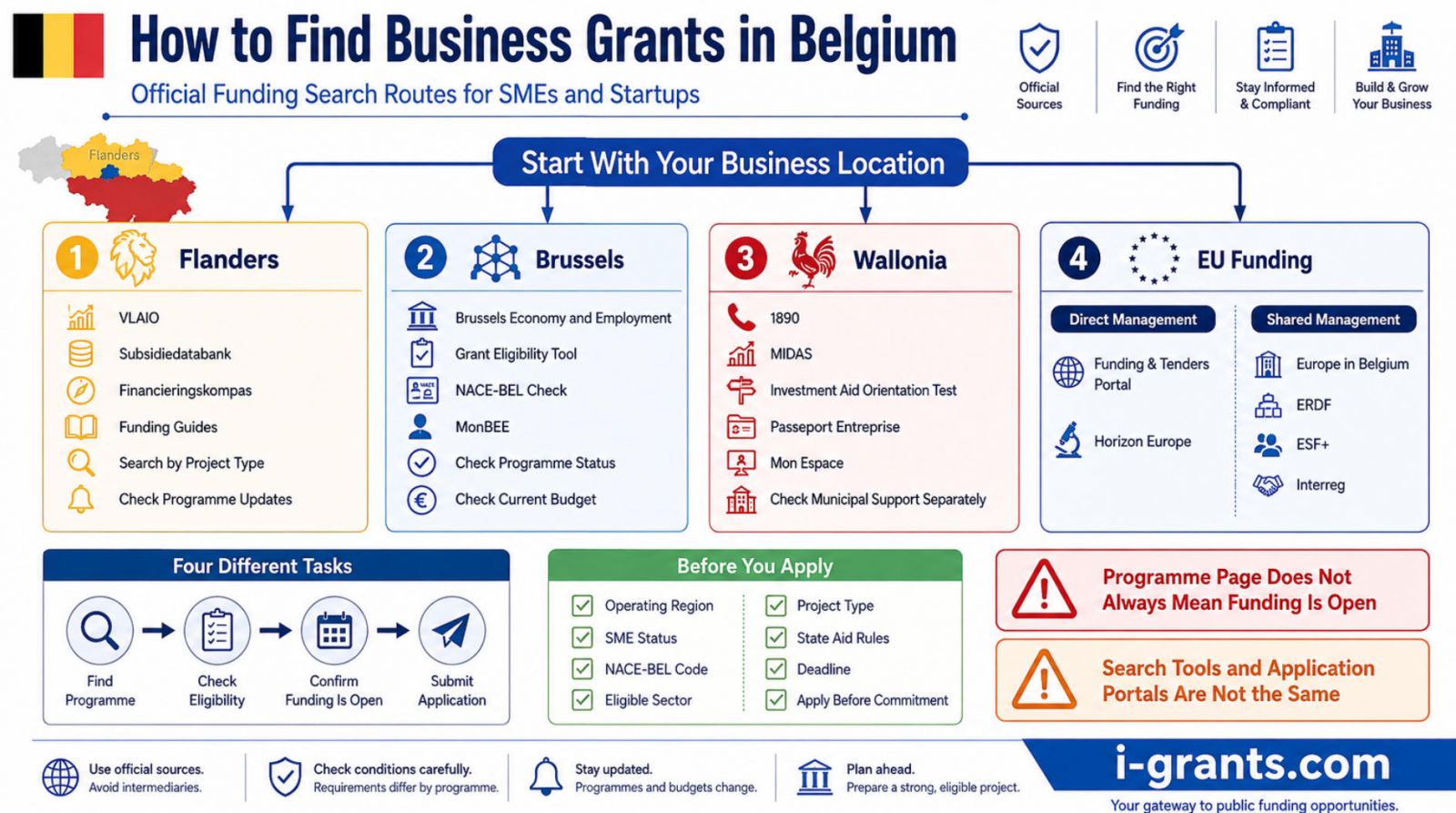
A funding search usually involves at least four separate tasks:
finding a programme, checking eligibility, confirming that funding is currently available, and submitting the application through the correct platform.
These steps may take place on four different websites.
Table 1. Where Belgian Businesses Should Search for Funding
| Business location or funding level | Main search tool | What it does | Best use |
|---|---|---|---|
| Flanders | VLAIO Subsidiedatabank | Lists major regional, provincial, federal and EU support relevant to Flemish businesses | Broad search for grants and financing |
| Flanders | VLAIO Financieringskompas | Matches funding options to company and project characteristics | Personalised financing search |
| Brussels | Brussels Economy and Employment | Presents regional grants, conditions and programme information | Finding Brussels business grants |
| Brussels | "Which subsidies are you entitled to?" tool | Provides preliminary matching based on company information | Quick eligibility screening |
| Brussels | MonBEE | Electronic application and administration system | Submitting and managing applications |
| Wallonia | 1890 | Provides information and directs entrepreneurs to the relevant organisation or programme | First orientation |
| Wallonia | MIDAS | Database of official public aid available to Walloon companies | Comprehensive funding search |
| Wallonia | Investment aid orientation test | Gives an initial indication of suitable investment support | Screening investment projects |
| Wallonia | Mon Espace | Regional electronic administration platform | Formal applications |
| EU direct funding | Funding & Tenders Portal | Publishes calls directly managed by EU institutions and agencies | Horizon Europe and other direct EU programmes |
| EU shared management | Europe in Belgium | Maps EU funds implemented through Belgian and regional authorities | ERDF, ESF+, JTF and related regional programmes |
Understanding the distinction between these tools saves time. A funding database is not necessarily an application portal, and an application portal is not necessarily designed to help a company discover suitable programmes.
Finding Grants in Flanders: Start With VLAIO
For businesses operating in Flanders, VLAIO's Subsidiedatabank is one of the most useful starting points.
The database is broader than a catalogue of VLAIO grants. It includes major support measures from provincial authorities, the Flemish government, federal authorities and the European Union that are relevant to businesses active in the Flemish Region.
This is important because an entrepreneur does not need to know in advance which level of government finances the programme.
Instead, the user can search by business objective.
The database currently groups support under themes including starting a business, investment, financing, innovation, employment, training, sustainable business, internationalisation, business transfer and professional advice. It also provides keyword search and an alphabetical list of measures.
A company should therefore search according to what it plans to do, rather than simply entering the word "grant".
A manufacturer buying efficient machinery could search both investment and sustainability measures. A software company developing a technically uncertain product should explore innovation rather than general financing. A business entering foreign markets should start with internationalisation.
This project-based approach usually produces more relevant results.
VLAIO Funding Guides Are Useful for a First Screening
VLAIO also publishes thematic funding guides that combine relevant support measures into practical collections.
The freshness of these guides is particularly useful in 2026. As of July 2026, the guide for startup plans had been updated on 14 July, the SME investment guide on 22 July, and the innovation and sustainable business guides on 23 July.
The Subsidiedatabank also allows users to generate selections of relevant measures and subscribe to monthly notifications about new or modified support programmes.
This suggests an important funding-search principle:
grant research should be treated as an ongoing monitoring process, not as a one-time search conducted only when the company is ready to spend money.
A programme may appear, close, change its budget or modify eligibility requirements during the year.
Use the Financieringskompas When You Do Not Know Which Instrument You Need
A second important Flemish tool is the Financieringskompas.
The difference is conceptual.
The Subsidiedatabank allows a company to search the market of available measures. The Financieringskompas is designed to help determine which types of financing may fit the business and its project.
This is particularly useful because SMEs often search for "grants" when another instrument would be more realistic.
For example, a company may discover that the most suitable solution is a subordinated loan, guarantee, equity financing or combination of public and private finance.
The VLAIO ecosystem reflects this broader approach. The database includes financing instruments such as the Winwinlening, Flemish guarantee arrangements, microcredit and the new Kompaslening alongside grant schemes.
The Kompaslening, launched in 2026 and updated in the VLAIO database in July, provides subordinated financing of between €10,000 and €50,000 for micro-enterprises that have difficulty obtaining ordinary bank credit. It is not a grant, but its inclusion demonstrates why companies should search for funding rather than grants alone.
Brussels: Search With the Company, Not Just the Project
The Brussels-Capital Region uses a somewhat different model.
The main source of information on regional business grants is Brussels Economy and Employment.
Its grant section covers areas such as investment, economic transition, recruitment and training, external expertise and services, construction-related disruption and export support. The current portal also clearly marks export grants as suspended.
One particularly useful feature is the "Which subsidies are you entitled to?" tool.
Instead of simply presenting a generic catalogue, this tool uses information relating to the business and its situation to display potential support measures. The administration notes that results are informative rather than a formal eligibility decision. The final decision is made only when the actual grant application is assessed.
This distinction is important.
A preliminary eligibility tool can eliminate obviously unsuitable programmes, but it does not replace reading the full conditions.
Why the NACE-BEL Code Matters in Brussels
One of the most important search variables in Brussels is the company's registered economic activity.
Brussels Economy and Employment states that its eligibility assessment considers the company's NACE activity codes recorded in the Crossroads Bank for Enterprises and its corporate purpose.
Many grant pages now also warn companies that NACE-BEL 2008 codes have been updated to NACE-BEL 2025.
This is more than an administrative detail.
If the registered economic activity does not accurately reflect the activity actually carried out at the relevant establishment, the company may receive misleading search results or encounter problems during the formal assessment.
A Brussels business should therefore check its enterprise information before relying on an automated grant search.
The region's general SME support rules also illustrate the importance of location. For many regional grants, the enterprise must carry out an economic activity in the Brussels-Capital Region and have at least one establishment unit with a postcode between 1000 and 1210.
Finding a Programme and Applying Are Different Steps
After identifying a suitable Brussels programme, companies often move to MonBEE.
MonBEE is primarily an administrative platform rather than a discovery database.
A user can create an account through itsme, an electronic identity card, or an email address and password.
Individual schemes then direct eligible applicants to the appropriate electronic form.
This separation is worth remembering:
Brussels Economy and Employment helps you understand the programme. The eligibility tool helps narrow the options. MonBEE is generally where the formal administrative process takes place.
Confusing these functions can lead applicants to search an application system for programmes that should first have been researched elsewhere.
Programme Status Is Part of Eligibility
Brussels provides one of the clearest examples of why a funding search cannot stop at discovering an attractive programme page.
The regional grant portal currently identifies export subsidies as suspended.
The situation is even more important for innovation funding through Innoviris.
On 24 March 2026, Innoviris announced that existing projects would continue to be financed, but no new projects could receive funding during 2026. No new calls will be launched in 2026, and all programmes are suspended for new financing. Applications already submitted may continue to be processed for possible 2027 funding, depending on available resources.
This creates a major trap for grant research.
A search engine may still return a programme page explaining an Innoviris R&D instrument. The eligibility criteria and historical funding rates on that page may still be technically correct.
But the programme may not represent a real 2026 funding opportunity for a new applicant.
For that reason, every funding search should include a separate check for:
current calls, latest news, available budget, opening and closing dates, and whether the application function is actually active.
Wallonia: Start With 1890 When You Need Direction
For businesses in Wallonia, 1890 is one of the best places to begin when the company does not yet know which authority or programme is relevant.
It is designed as an information and orientation service for entrepreneurs.
Rather than forcing users to understand the entire Walloon administrative structure, 1890 helps direct them to the appropriate public or private contact according to their profile, objective and needs.
The service is particularly useful during the early phase of a funding search, when a company knows what it wants to achieve but does not yet know whether the solution is an investment grant, financing, advisory support, innovation instrument or another measure.
MIDAS: The Walloon Public Aid Database
Once the business needs a broader search, MIDAS becomes particularly important.
1890 describes MIDAS as the reference source for official and validated information on public aid available to businesses in Wallonia.
Its coverage is unusually broad.
MIDAS includes measures from the European Union, federal authorities, the Walloon Region, Communities and Provinces. However, local municipal support is excluded.
This creates a useful practical rule for Walloon SMEs:
Use MIDAS for a broad multi-level public funding search, but check the municipality separately for local schemes.
MIDAS also contains references to important State aid frameworks, including de minimis rules and the General Block Exemption Regulation, helping advisers and businesses understand the legal context behind individual measures.
Wallonia Introduced a New Investment Aid Orientation Tool in 2026
Wallonia made an important improvement to the investment-aid search process in May 2026.
On 21 May, the regional government announced two administrative simplifications: a new orientation test to help companies identify the investment-aid route most suitable for their project, and a modernisation of the Company Passport, or Passeport Entreprise, procedure.
The orientation test is now linked directly from investment-aid pages.
It provides an initial indication of whether a proposed investment may fit the regional scheme.
Again, this is not a final award decision. But it is valuable because investment aid in Wallonia is divided into several routes, including standard investment aid, EU co-financed schemes and specific GREEN support.
The tool can therefore prevent an SME from preparing an application under the wrong framework.
In Wallonia, Search Before You Order
For investment grants, the timing of the search is critical.
Current Walloon guidance states that a company must submit a request for authorisation to begin an investment programme before entering into the first binding commitment, such as a purchase order or contract.
This means the correct sequence is:
find support → check preliminary eligibility → request permission to start → complete the formal procedure → make the investment according to programme rules.
Searching for grants only after equipment has already been ordered may be too late.
This is one of the most important practical differences between grant research and reimbursement research. Public investment aid frequently depends on the funding having an incentive effect before the project is irrevocably underway.
Mon Espace Is the Application Layer
Wallonia also illustrates why a funding database should not be confused with an application system.
For relevant investment-aid procedures, formal electronic steps are completed through Mon Espace. Current Walloon investment pages link the authorisation request, Company Passport and formal aid application through the regional electronic system.
A business should therefore prepare access to the required administrative environment before a deadline or planned investment date.
The sequence is not "find MIDAS and apply in MIDAS."
Rather, MIDAS helps identify the measure. The relevant programme page explains the legal requirements. The orientation test may provide preliminary screening. Mon Espace supports the formal administrative process.
That distinction applies across much of the Belgian funding landscape.
Table 2. What the Main Belgian Funding Tools Actually Do
| Tool | Finds programmes | Provides preliminary matching or screening | Accepts formal applications | Covers more than one government level |
|---|---|---|---|---|
| VLAIO Subsidiedatabank | Yes | Through filters | Usually no | Yes |
| VLAIO Financieringskompas | Yes | Yes | No | Yes |
| Brussels grant finder | Yes | Yes | No | Mainly regional |
| MonBEE | Limited discovery role | Programme-specific | Yes | Mainly Brussels |
| 1890 | Through orientation | Advisory rather than automated | No | Broad orientation |
| MIDAS | Yes | Information-based | No | Yes, except municipal |
| Wallonia investment orientation test | Only investment routes | Yes | No | Regional |
| Mon Espace | No, primarily administration | Programme-specific | Yes | Wallonia |
| Funding & Tenders Portal | Yes | Call-specific | Yes | EU direct management |
| Europe in Belgium | Directs users to funds and authorities | Programme-dependent | Usually through relevant authority | EU shared management |
Searching for EU Funding: First Identify How the Programme Is Managed
EU funding causes some of the greatest confusion for Belgian SMEs.
The European Commission distinguishes three main management modes:
-
direct management, where the European Commission manages the funding;
-
shared management, where the Commission and Member State authorities jointly manage the funds;
-
indirect management, where funding is implemented through partner organisations or other authorities.
The management mode determines where calls are published, who evaluates proposals and where applications are submitted.
This is why there is no single EU application portal for every programme.
Direct EU Funding: Use the Funding & Tenders Portal
For programmes under direct management, the European Commission or one of its agencies generally manages the call and grant process.
The Funding & Tenders Portal is therefore the central search and application environment for many directly managed EU programmes.
Horizon Europe is one of the most important examples for innovative SMEs. The broader EU programme architecture also includes numerous instruments under the 2021-2027 Multiannual Financial Framework.
For a directly managed call, the company normally needs to find the relevant opportunity, verify eligibility, register the organisation, form a consortium when required and submit the proposal electronically according to the call conditions.
This route is fundamentally different from applying for a local Belgian investment premium.
Shared Management: Search Through Belgian and Regional Authorities
Structural and cohesion funds work differently.
Under shared management, Member State administrations are responsible for selection, award procedures, monitoring, management and payments within the EU framework.
The European Commission identifies Europe in Belgium as Belgium's national single portal for EU funds managed through national and regional authorities.
The portal maps funds by territory, including Flanders, Brussels-Capital Region, Wallonia, Wallonia-Brussels, the German-speaking Community and federal programmes. It also provides access to Interreg programmes.
This distinction has a major practical consequence:
A Belgian SME searching for ERDF support should normally investigate the relevant regional programme and managing authority rather than expecting to find one universal Belgian SME grant on the Funding & Tenders Portal.
Table 3. Examples of EU Structural Funding Behind Belgian Regional Programmes
| Programme | Territory | Official programme budget | Main relevance |
|---|---|---|---|
| ERDF 2021-2027 | Flanders | €276.08 million | Sustainable innovation, digitalisation, low-carbon development |
| ERDF 2021-2027 | Brussels-Capital Region | €121.28 million | Economic, social and territorial development |
| ESF+ 2021-2027 | Wallonia-Brussels | €779.48 million | Employment, skills, training and social inclusion |
| EU shared-management funds | Belgium | Multiple regional and federal programmes | Funding delivered through programme-specific calls and authorities |
The Flemish ERDF programme has an official budget of approximately €276.08 million and focuses on sustainable innovative growth, digitalisation and a low-carbon economy.
The Brussels-Capital Region ERDF programme lists approximately €121.28 million.
The Wallonia-Brussels ESF+ programme lists an EU budget of approximately €779.48 million, focusing primarily on employment, skills, vocational training and inclusion.
These figures provide important context, but they should not be interpreted as money directly available to individual SMEs. A programme budget finances many projects, beneficiaries and policy priorities.
A Step-by-Step Belgian Grant Search
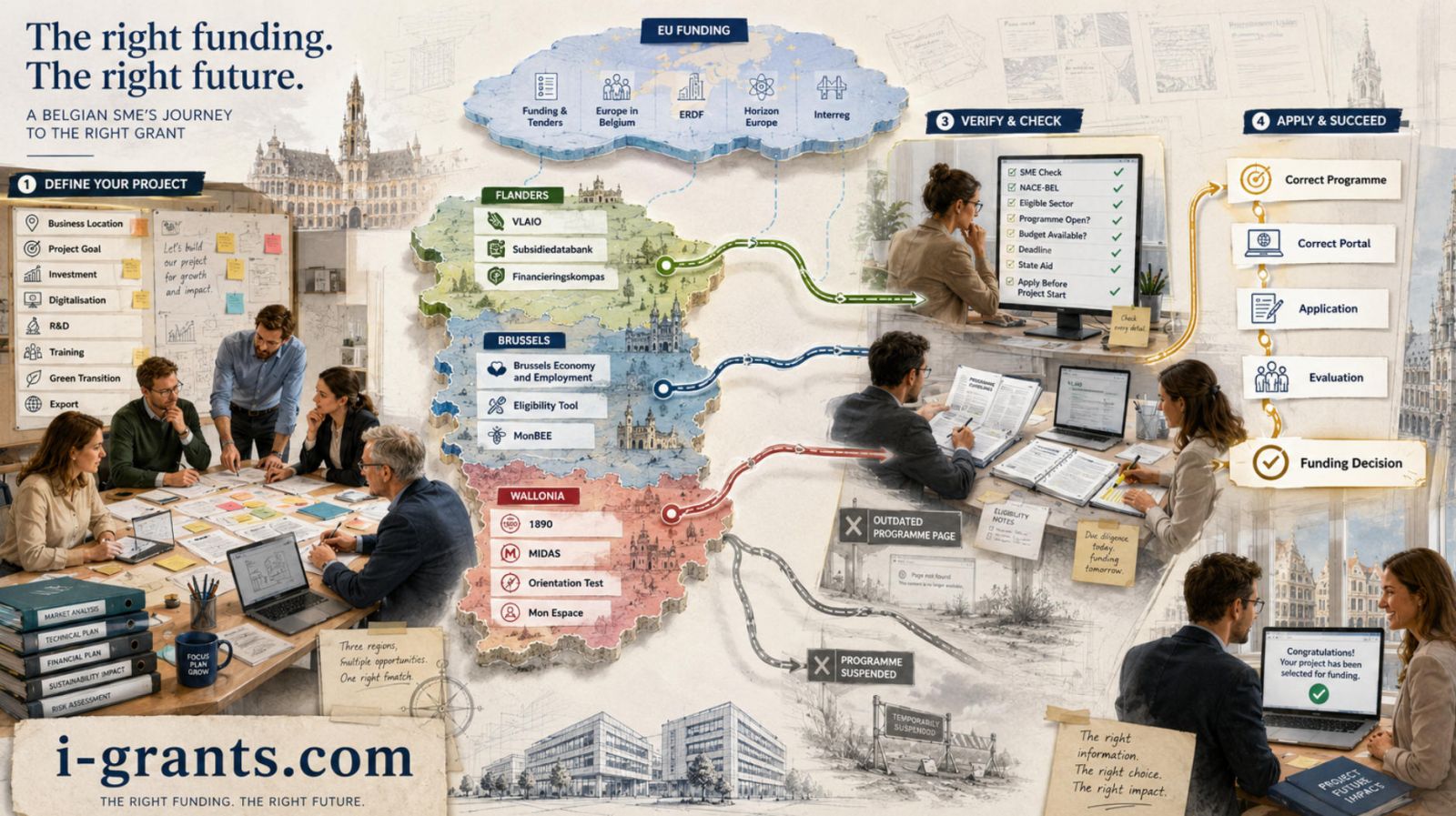
A practical search can be organised as follows:
-
Identify the establishment region. Determine whether the relevant operation or investment is in Flanders, Brussels or Wallonia.
-
Define the project. Search for the actual activity, such as R&D, machinery, energy efficiency, digitalisation, hiring, training, consultancy or export.
-
Use the official regional database or matching tool. Begin with VLAIO, Brussels Economy and Employment, 1890 or MIDAS.
-
Check company characteristics. Verify SME status, establishment location, economic activity and relevant NACE-BEL codes.
-
Confirm that the programme is actually open. Check current calls, budget notices, suspension announcements and deadlines.
-
Check project-start rules. Determine whether contracts, orders or work can begin before the application or authorisation.
-
Identify the management level. Decide whether the support is regional, federal, directly managed by the EU or implemented through shared management.
-
Move to the correct application platform. Only after these checks should the company prepare and submit the formal application.
This sequence reduces one of the biggest risks in grant research: spending significant time preparing an application for a programme that is geographically irrelevant, closed, legally incompatible with the project or already too late to use.
Common Funding Search Mistakes
Belgian SMEs should particularly avoid the following mistakes:
-
relying on search-engine snippets or commercial databases without checking the official programme page;
-
assuming that every programme page represents an open funding opportunity;
-
searching only in English when important regional information is primarily available in Dutch or French;
-
using the Funding & Tenders Portal as if it contained every EU-funded regional scheme;
-
forgetting municipal support, which is not covered by MIDAS;
-
beginning an investment or signing a contract before checking the programme's project-start requirements.
Language can be especially important.
Many detailed Flemish funding pages are primarily available in Dutch, while Walloon programmes often contain their most complete administrative materials in French. An international entrepreneur who searches only in English may therefore overlook relevant information.
How to Verify a Grant Before Investing Time in an Application
A credible funding opportunity should pass several checks before a company spends substantial time preparing documents.
First, the programme should appear on an official government, regional agency or EU source.
Second, the applicant should verify that the information is current. The date of the latest programme update, call calendar and recent news can be as important as the formal eligibility section.
Third, the company should check whether there is an active route to apply.
A programme can exist legally while no budget is currently available.
Innoviris in 2026 is a clear example. The programmes still exist as policy instruments, but new projects cannot receive 2026 funding.
Fourth, applicants should distinguish between the maximum theoretical aid and what their own company is likely to receive.
Finally, they should verify whether assistance is granted automatically to eligible companies or whether projects compete against one another.
These are very different funding situations.
Grant Search Should Become Part of Business Planning
The most successful funding search often begins before the company urgently needs money.
A business planning a major equipment purchase six months from now has time to compare regional investment support, check project-start rules and structure financing properly.
A company that searches for a grant after signing the supplier contract may discover that the relevant support required an application before commitment.
This is why funding research should form part of strategic planning.
Flemish businesses can subscribe to VLAIO funding updates. Walloon companies can use 1890 and MIDAS before moving into the formal investment procedure. Brussels businesses can screen available support using company-specific information and then verify the programme through Brussels Economy and Employment. EU applicants can monitor direct calls separately from regional EU-funded programmes.
The search process itself becomes a business capability.
Final Takeaway
Belgium offers an extensive public funding system, but there is no single website that performs every step.
In Flanders, VLAIO's Subsidiedatabank is the primary broad search tool, while the Financieringskompas helps businesses identify suitable forms of financing.
In the Brussels-Capital Region, Brussels Economy and Employment provides programme information and company-based preliminary matching, while MonBEE supports formal electronic procedures.
In Wallonia, 1890 helps entrepreneurs find the right direction, MIDAS provides broad official funding information, the new 2026 investment orientation tool helps screen projects, and Mon Espace is used for important administrative procedures.
For EU funding, the first question is whether the programme is directly managed by the European Commission or implemented through shared management. The Funding & Tenders Portal is central to many direct EU calls, while Europe in Belgium guides users through EU funds implemented by Belgian and regional authorities.
The most important lesson is therefore simple:
finding a funding programme, proving eligibility, confirming that the programme is currently funded, and submitting an application are four different tasks.
A good Belgian grant search does not begin with "Where can I get free money?"
It begins with four practical questions:
Where is the business located? What exactly is the project? Which authority manages the relevant support? Is the funding actually available now?
Once those questions are answered, Belgium's fragmented funding system becomes much easier to navigate.