

 Français
  Deutsch
  Українська
Austria's hotel sector operates in a market where energy performance is increasingly becoming a financial issue rather than simply an environmental one. Hotels heat guest rooms, corridors, restaurants, wellness areas and service spaces for long operating periods, while older alpine and regional properties often occupy buildings constructed long before modern energy standards were introduced. Replacing windows, insulating roofs and façades, reducing heat loss and modernising energy systems can therefore produce a very different investment case from an ordinary cosmetic renovation.
Austria has a federal funding route that is particularly relevant to such projects. The Umfassende Gebäudesanierung, or comprehensive building renovation programme, supports thermal renovation of predominantly non-residential buildings and explicitly identifies hotels and guesthouses among the types of commercial properties that can qualify. It is administered by Kommunalkredit Public Consulting, commonly known as KPC, within Austria's environmental and energy-efficiency funding system.
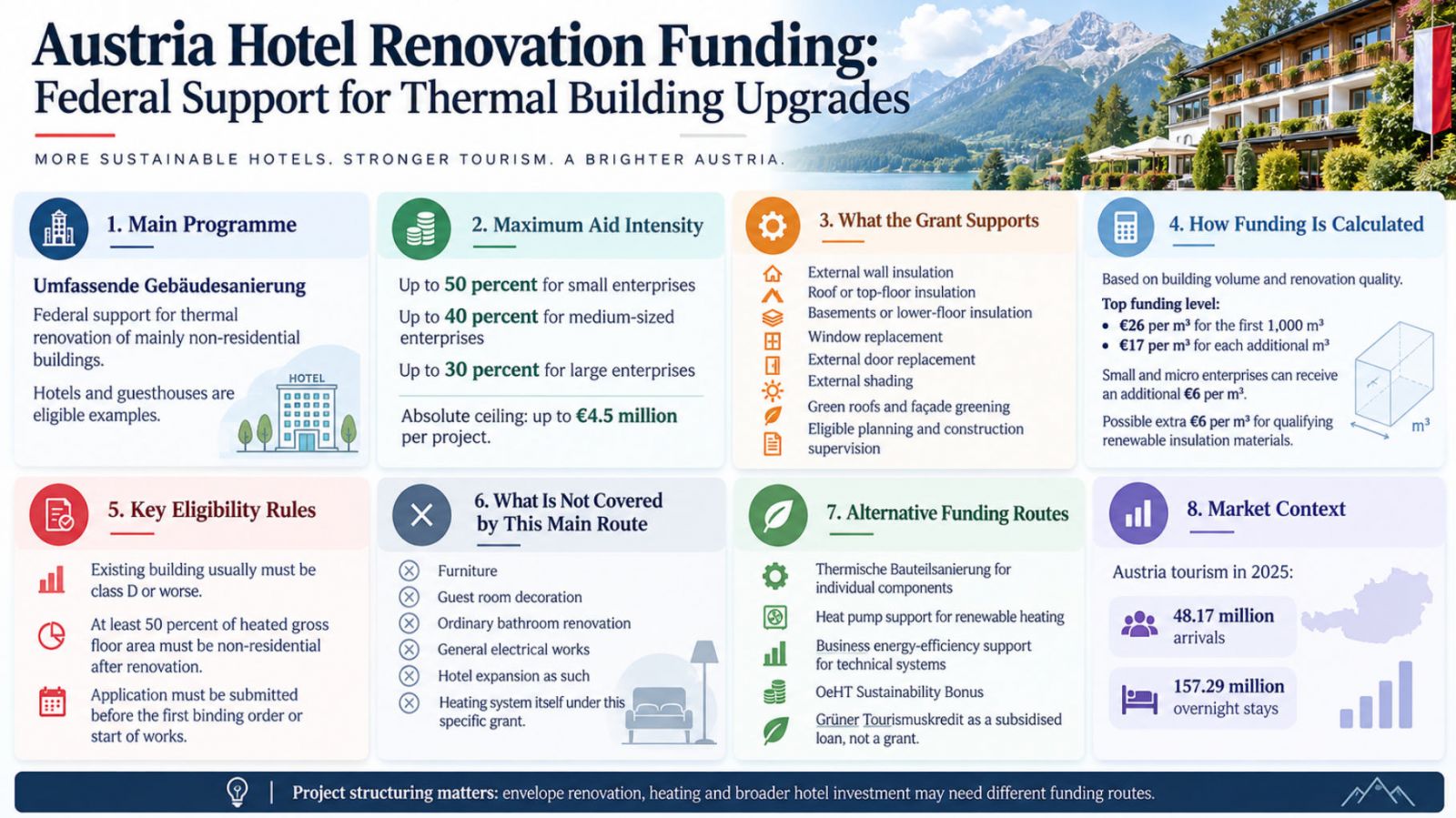
The programme can look unusually generous at first glance. Depending on company size, support may be limited to as much as 50 percent of eligible incremental investment costs, while the absolute ceiling can reach €4.5 million per project. Those figures are real, but they should not be read as a promise that a small family hotel will receive half of its renovation bill or anything close to €4.5 million. Austria uses a more detailed calculation based on the size of the existing building, the quality of the thermal renovation, eligible costs and state-aid limits.
For a hotel owner, the central question is therefore not simply, "How much can I get?" A better question is, "Which part of my renovation belongs in which funding route, and what must be decided before I sign a contract with a contractor?" That distinction can determine whether a project qualifies at all.
Why hotel energy renovation matters in Austria
Austria remains one of Europe's most tourism-intensive destinations. In 2025, accommodation establishments recorded about 157.29 million overnight stays and 48.17 million arrivals, setting another record for the country. International guests accounted for roughly three quarters of overnight stays. Tyrol and Salzburg alone generated more than half of the national total, while Vienna also continued to expand strongly as an urban tourism destination.
The supply side is equally substantial. During tourism year 2024/25, Austria had more than 73,000 accommodation establishments and approximately 1.2 million beds, excluding campsites. Hotels remain a major part of that capacity, and many properties operate in areas where cold winters, high heating requirements and long operating seasons make the building envelope a major cost factor.
This is also a sector in which investment continues even when operating costs are under pressure. Austria's tourism bank, OeHT, reported 337 financing and funding approvals in 2025 that helped trigger approximately €539 million of tourism investment, compared with around €499 million in the previous year. That does not mean all of that money went into energy renovation, but it demonstrates that hotel and tourism SMEs remain active investors in refurbishment, quality improvements, sustainability and business modernisation.
For owners of older hotels, this creates an important opportunity. A renovation that was originally planned as a necessary replacement of ageing windows or roofing can sometimes be redesigned as a measurable energy-efficiency project. However, the funding programme rewards technical performance, not simply the fact that a building is old.
The main federal route: Umfassende Gebäudesanierung
The comprehensive renovation programme is intended for substantial thermal improvement of non-residential buildings. Hotels, guesthouses, production buildings, warehouses and offices are specifically recognised as examples of eligible commercial properties.
A hotel does not qualify simply because it plans construction work. The existing building must meet the programme's energy-performance conditions. Under the applicable framework, the property generally needs to correspond to energy-efficiency class D or worse, or meet the alternative technical heating-demand threshold defined by the programme. After the project, the renovation must reach one of the required improvement levels.
The building must also remain predominantly non-residential. At least half of the heated gross floor area after renovation must be used for non-residential purposes. This matters for mixed properties where the hotel operator's private residence occupies a significant part of the same building.
Table 1. Key Conditions of Austria's Comprehensive Building Renovation Funding
| Item | Main rule |
|---|---|
| Main programme | Umfassende Gebäudesanierung, Thermische Gebäudesanierung |
| Administrator | Kommunalkredit Public Consulting |
| Geographic scope | Austria |
| Relevant businesses | Hotels and guesthouses are explicitly included among eligible commercial buildings |
| Applicant types | Businesses and other entrepreneurial organisations, with additional eligible institutional categories |
| Main objective | Reduction of energy use and greenhouse-gas emissions through improved thermal performance |
| Existing building condition | Generally energy-efficiency class D or worse, or the applicable alternative technical threshold |
| Commercial use | At least 50 percent of heated gross floor area after renovation must be non-residential |
| Maximum project support ceiling | €4.5 million |
| Maximum state-aid intensity | Up to 50 percent for small enterprises, 40 percent for medium-sized enterprises and 30 percent for large enterprises |
| Application timing | Before the first legally binding order, delivery, construction start or other irreversible commitment, except eligible planning activity |
| Implementation period | Normally within 24 months from approval under the funding contract, and within the programme's final implementation deadline |
| Payment | Generally after project completion and final settlement |
| Application availability | Applications are accepted while programme budget remains available |
The programme's legal framework is based on EU state-aid rules, particularly Article 38a of the General Block Exemption Regulation, together with Austria's national investment funding rules. This is important because the main comprehensive renovation grant is not simply a de minimis subsidy with a small three-year ceiling.
What a hotel can actually finance
A comprehensive hotel refurbishment often contains several completely different investment categories. An owner might plan façade insulation, new windows, guest-room bathrooms, furniture, new electrical wiring, a heat pump, photovoltaic panels, a renovated restaurant and an extension containing ten additional rooms. From an operational perspective, that is one renovation project. From a funding perspective, it is several different projects.
The comprehensive building renovation programme is focused on measures that reduce heating demand through improvements to the building envelope. Eligible work can include insulation of external walls, roofs or upper-floor ceilings, insulation of the lowest floor or cellar ceiling, replacement or renovation of windows and external doors, and external shading designed to reduce cooling demand.
Green roofs and façade greening may also qualify when implemented together with a comprehensive thermal renovation. Planning expenditure, an energy-performance certificate, construction supervision and certain construction-site overhead costs may be recognised, although planning costs are capped in relation to eligible material investment costs.
Internal refurbishment is a different matter. Replacing carpets, redesigning hotel rooms, purchasing beds and furniture, renovating bathrooms or carrying out ordinary decorative work does not become eligible merely because it happens at the same time as an energy project.
Table 2. What Belongs in the Comprehensive Renovation Grant and What Does Not
| Potential hotel investment | Treatment under the main comprehensive renovation route |
|---|---|
| External wall insulation | Potentially eligible |
| Roof or upper-floor ceiling insulation | Potentially eligible |
| Insulation of lowest floor or cellar ceiling | Potentially eligible |
| Replacement or renovation of windows | Potentially eligible |
| Replacement of external doors | Potentially eligible |
| External solar shading | Potentially eligible |
| Green roof | Potentially eligible as part of comprehensive renovation |
| Façade greening | Potentially eligible as part of comprehensive renovation |
| Energy-performance certificates and eligible planning | Potentially eligible within programme limits |
| Construction supervision | Potentially eligible |
| Guest-room furniture | Not part of this thermal renovation grant |
| Interior decoration | Not eligible as thermal renovation expenditure |
| Ordinary bathroom refurbishment | Not eligible merely because it forms part of the hotel renovation |
| Standard electrical installations | Generally outside this funding category |
| Heating installation itself | Requires another funding route rather than being treated as building-envelope expenditure |
| Ordinary hotel extension | The extension itself is not treated like renovation of the existing building |
| New guest rooms without meaningful renovation of the existing building | Not the purpose of the programme |
This division is one of the most important planning lessons for hotel owners. Trying to force an entire hotel redevelopment into one environmental grant can create an unrealistic funding plan. A stronger strategy is to divide the investment into packages: thermal envelope, renewable heating, technical energy efficiency, general hotel investment and, where relevant, digitalisation or tourism-specific financing.
The €4.5 million ceiling is not the normal grant calculation
The maximum legal ceiling attracts attention, but the normal grant calculation starts elsewhere. Austria uses a funding amount per cubic metre of the building's gross conditioned volume before renovation. The rate depends on the energy quality achieved after the renovation.
For the highest renovation category, the base rate is €26 per cubic metre for the first 1,000 cubic metres and €17 for every additional cubic metre. A second quality level uses €18 and €15 respectively. A project that qualifies by reducing reference heating demand by at least 50 percent receives a lower base of €12 per cubic metre for the first 1,000 cubic metres and €6 for each additional cubic metre. Historic or ensemble-protected buildings have a separate route where a reduction of at least 25 percent can qualify.
Small and micro enterprises may receive an additional €6 per cubic metre. A further €6 per cubic metre may be available when at least 25 percent of insulation materials are made from renewable raw materials, subject to the detailed programme rules.
Table 3. Indicative Funding Rates for Comprehensive Thermal Renovation
| Renovation result | First 1,000 m⊃3; | Each additional m⊃3; |
|---|---|---|
| Significant overperformance against the relevant OIB requirements | €26/m⊃3; | €17/m⊃3; |
| Achievement of the second qualifying OIB performance level | €18/m⊃3; | €15/m⊃3; |
| Reduction of reference heating demand by at least 50 percent | €12/m⊃3; | €6/m⊃3; |
| Listed or ensemble-protected building with at least 25 percent reduction | €18/m⊃3; | €15/m⊃3; |
| Additional bonus for small and micro enterprises | +€6/m⊃3; | +€6/m⊃3; |
| Potential renewable insulation-material bonus | +€6/m⊃3; | +€6/m⊃3; |
There are also separate fixed amounts for approved building greening. Façade-bound greening can attract €120 per square metre, ground-based façade greening €60 per square metre, and green roofs €18 per square metre under the relevant calculation framework.
These fixed rates explain why "up to 50 percent" must be interpreted carefully. The programme first establishes the calculated funding amount. It then applies limits connected to eligible incremental investment expenditure and company size. A small enterprise may have a maximum state-aid intensity of 50 percent, but that does not mean it automatically receives 50 percent of every euro invoiced.
The €4.5 million figure operates as an absolute project ceiling above these calculations. It is therefore far more relevant to exceptionally large properties than to a normal independent hotel.
Consider a hypothetical small hotel that qualifies for the strongest basic renovation rate and the €6 per cubic metre small-enterprise bonus. If its existing conditioned volume is 10,000 cubic metres, the simple volume-based calculation would produce approximately €239,000 before the other state-aid and eligibility limits are applied. At 20,000 cubic metres, the same illustrative formula produces approximately €469,000.
Those figures are still not guaranteed grants. They simply demonstrate why a technically correct €4.5 million ceiling should not be interpreted as the likely award for a small hotel.
Small, medium or large can materially change the result
EU SME classification matters because it affects the aid ceiling and, in the case of small and micro enterprises, the additional per-cubic-metre bonus.
A microenterprise generally has fewer than ten employees and turnover or a balance-sheet total not exceeding €2 million. A small enterprise has fewer than 50 employees and turnover or a balance-sheet total of no more than €10 million. A medium-sized enterprise has fewer than 250 employees and annual turnover of no more than €50 million or a balance-sheet total of no more than €43 million.
The important complication is that an individual hotel cannot always be assessed in isolation. Partner enterprises and linked enterprises may have to be included when determining SME status. A 40-room hotel owned by a much larger hotel group can therefore have a different state-aid status from an independently owned 40-room hotel, even if their properties appear similar.
For the comprehensive renovation grant, the maximum relevant state-aid intensity can reach 50 percent for a small enterprise, 40 percent for a medium-sized enterprise and 30 percent for a large enterprise. Again, these are ceilings on the relevant eligible incremental investment cost, not guaranteed reimbursement rates.
The project-start rule can decide eligibility before construction begins
One of the easiest ways to lose access to this type of grant is to move too quickly.
The funding application must be submitted before the earliest legally binding project commitment. This can be the first binding order for works, delivery of equipment or materials, the start of construction, or another commitment that makes the investment irreversible. Eligible planning services are treated differently, allowing a business to develop the project sufficiently to prepare a credible application.
This means a hotel can commission planning, technical calculations and energy-performance documentation before submitting the funding application. What it should not do is sign an unconditional construction contract for the funded works, order the replacement windows, allow delivery to take place or start insulation work and only then look for a grant.
After KPC confirms receipt of the application, the applicant may begin the project at its own risk. This is a useful feature because the business does not necessarily have to wait for the final funding contract before every physical activity begins. However, starting after submission does not guarantee approval. The hotel remains exposed to the risk that some costs are rejected or the application is unsuccessful.
This sequencing should be built into the renovation calendar from the beginning. For projects dependent on a seasonal closure, for example an alpine hotel trying to complete major works between winter and summer operations, a grant application submitted too late can disrupt the entire construction timetable.
Documents should be prepared as part of the technical project, not after it
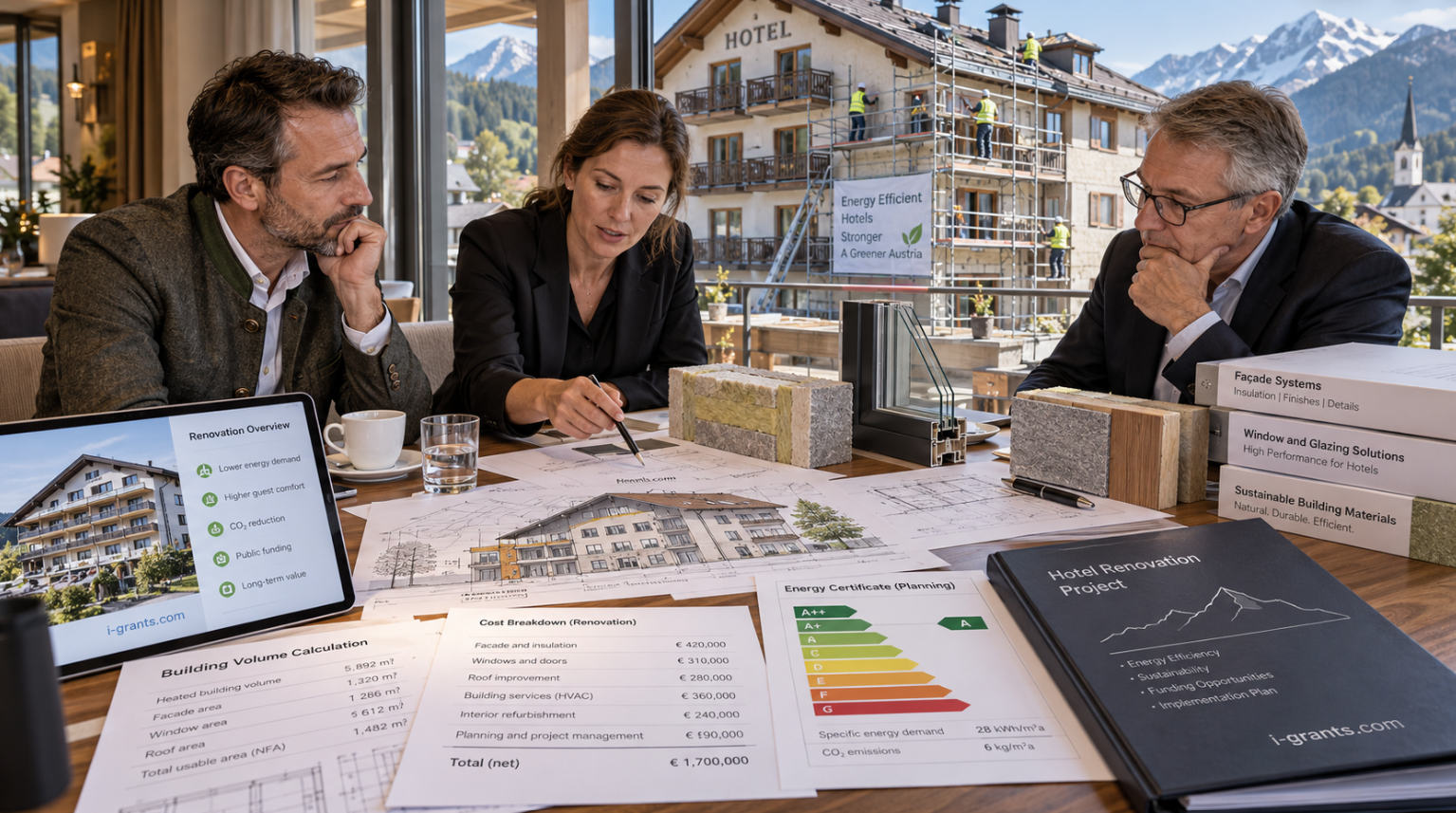
The programme requires a substantial technical file. A non-residential energy-performance certificate is needed for the building before and after the proposed renovation, including documentation for any relevant privately used residential section. Existing plans and proposed plans must correspond with the energy calculations and the proposed works.
Cost estimates must identify the activities that are relevant to reducing heating demand or implementing eligible greening. When the total investment volume exceeds €500,000, a report from the applicant's credit institution is also required.
The application materials need to tell one consistent story. If the energy certificate describes one thermal envelope, the architectural plans show another, and the contractor quotation includes a much larger refurbishment project without separating eligible thermal work, assessment becomes more difficult. The programme documentation explicitly warns applicants about consistency between plans, certificates, offers and the renovation described in the application.
At the end of a comprehensive renovation, implementation must also be certified as consistent with the submitted energy documentation. For buildings above 2,000 cubic metres, this confirmation generally needs to come from an appropriately qualified construction professional or technical office. The simplified possibility for an energy consultant is limited to smaller properties.
The practical lesson is simple: grant administration should not be separated from engineering. The architect, energy specialist, hotel owner, funding adviser and accountant should work from the same investment structure.
Procurement rules are more nuanced than a universal "three quotations" rule
There is no general rule in this programme saying that every private hotel must always collect exactly three quotations for every eligible item. That type of requirement exists in some grant systems, but it should not be imported into this programme without a legal basis.
Applicants that are subject to Austria's public procurement legislation must comply with those rules and retain the necessary documentation. Private companies must still be able to demonstrate the legitimacy and reasonableness of their project costs, particularly during final settlement.
Another layer may arise from European Regional Development Fund co-financing. An application for the comprehensive renovation programme also triggers examination of whether EU regional funding can contribute. If EFRE co-financing becomes applicable, additional documentation and cost-reasonableness requirements may apply, including evidence from independent comparative offers under the applicable settlement rules.
For a private hotel, the safest approach is therefore not to obsess over an arbitrary number of quotations but to create a transparent procurement file. Comparable specifications, documented supplier selection, clear separation of eligible and non-eligible costs and evidence that the price is reasonable are valuable even where a rigid three-offer rule does not apply.
VAT, financing and cash flow require separate planning
For a normal VAT-registered hotel that can deduct input VAT, recoverable VAT is not an eligible grant cost. A business that cannot recover VAT may be treated differently where it can prove that the tax genuinely remains a final cost, but applicants should not build a funding model around VAT without confirming their own tax position.
Cash flow is another major issue. The comprehensive renovation grant is generally paid after project implementation and final settlement. That means a €1 million renovation with a potentially substantial grant still requires the hotel to finance construction before the subsidy is finally paid.
This is where owners often confuse a grant with project finance. A grant reduces the ultimate investment burden, but it does not necessarily provide the liquidity needed to pay contractors month by month. Bank financing, owner equity or tourism-specific financing may still be required.
There is no simple universal rule under the programme requiring, for example, exactly 25 percent owner equity. However, the applicant must be able to finance the unfunded portion of the project and bridge the period before reimbursement. The requirement for a bank report on investments exceeding €500,000 reinforces the importance of financial capacity.
Leasing, hire purchase or contracting structures can potentially be used under specified conditions, but the funded asset must ultimately pass into the beneficiary's ownership no later than the final instalment where the applicable rules require it.
A hotel extension cannot simply be presented as an energy renovation
Austria's rules do allow a comprehensive renovation to take place alongside an extension, but the character of the project must remain the thermal renovation of the existing building. The increase in heated volume must remain below the volume threshold defined by the programme, and the share attributable to the extension is deducted from the funding basis.
This distinction matters for hotels because renovation projects frequently combine energy work with new rooms, a spa extension, restaurant enlargement or additional service areas.
If the commercial objective is primarily to create 30 new rooms and thermal work on the existing hotel is secondary, the project should not be designed around the assumption that the comprehensive renovation grant will finance the expansion. Instead, the existing building's thermal renovation should be calculated independently, while the extension is financed through the appropriate tourism or commercial investment instruments.
Heating systems should be treated as a separate funding package
A common mistake is to assume that because the comprehensive renovation programme is about energy efficiency, the hotel's new heating system must automatically belong inside it. The programme's main eligible-cost list focuses on the thermal building envelope. Standard heating, sanitary and electrical installations are explicitly outside that category.
Austria nevertheless provides separate environmental funding routes for renewable heat and energy-saving equipment.
For example, electrically driven heat pumps with thermal output of at least 100 kW have their own KPC programme. Large heat pumps are subject to technical performance requirements. Under the framework introduced for 2026, the refrigerant needs a global-warming-potential value below 750 and the system requires a seasonal performance factor of at least 3.8. As with the comprehensive renovation, the application for this category must be submitted before the first binding project commitment.
This opens the possibility of structuring a hotel transformation in parallel packages. The building envelope might use Umfassende Gebäudesanierung, while the heating plant is assessed under a renewable-heating programme. Heat recovery, efficient pumps, control technology or other operational energy measures may fall under dedicated business energy-efficiency support.
The exact combination needs to respect cumulation rules. The same expenditure cannot simply receive several public subsidies without limit, and all relevant public support must be disclosed.
What if the hotel is replacing only windows or a roof?
A hotel does not necessarily need a comprehensive renovation.
Austria also has Thermische Bauteilsanierung, an individual-component route for eligible commercial buildings more than 15 years old. It is relevant when a business is replacing or thermally improving specific parts of the building, such as windows, external doors, roof areas or the upper-floor ceiling, without carrying out a full envelope renovation that meets the comprehensive programme's energy targets.
This route operates very differently from Umfassende Gebäudesanierung. Applications for the individual-component programme are submitted after implementation, with a deadline based on the invoice date. Under the existing mechanism, the applicant normally needs to submit within six months of invoicing.
That difference is extremely important. One programme requires an application before commitment, while another is designed for application after completion. Treating all Austrian building grants as if they had the same start rule can therefore be expensive.
The component route also has technical standards for the renovated elements. For example, qualifying windows and doors must satisfy specified U-values, and invoices need to contain enough technical information to verify compliance.
Funding options should be matched to the actual hotel project
A hotel planning a major transformation may ultimately use several instruments, but each has a different purpose.
Table 4. Funding Map for Different Austrian Hotel Investments
| Hotel investment need | Potential route | Type of support | Key distinction |
|---|---|---|---|
| Comprehensive insulation, windows and building-envelope renovation | Umfassende Gebäudesanierung | Investment grant | Application before project commitment |
| Only windows, doors, roof or upper-floor ceiling | Thermische Bauteilsanierung | Investment grant | Designed for individual components and normally applied for after implementation |
| Large heat pump | KPC renewable-heat funding | Investment grant | Separate technical requirements and separate application |
| Heat recovery, efficient pumps, controls or process-related energy savings | Business energy-efficiency funding | Investment grant | Eligibility depends on the specific measure and energy-saving calculation |
| Broad sustainable hotel investment | OeHT financing with Nachhaltigkeitsbonus | Loan plus grant component | Tourism-specific financing, not a pure stand-alone grant |
| Larger green hotel investment | Grüner Tourismuskredit | Subsidised loan plus eligible bonus | Loan must not be described as a grant |
| Very large energy-efficiency transformation | Competitive energy-efficiency tender when available | Competitive investment grant | Intended for projects above specified investment and energy-saving thresholds |
This funding map is more useful than searching for one "hotel grant". It reflects how Austrian public financing actually works.
The OeHT Sustainability Bonus can cover a broader investment logic
The Nachhaltigkeitsbonus of the Austrian Hotel and Tourism Bank is particularly relevant when the investment extends beyond the narrow thermal envelope. It is available to eligible small and medium-sized tourism and leisure businesses and can support qualifying investments in ecology, employees and regions, as well as digitalisation and economic transformation.
For applications under the adjusted framework introduced from July 2025, the bonus can amount to 3.5 percent of the relevant eligible investment portion, with a maximum of €175,000 per case. The relevant sustainability component must account for at least 20 percent of the eligible total project cost.
However, the Nachhaltigkeitsbonus is not a free-standing general grant that a hotel simply adds to any project. It is available only in combination with an OeHT investment loan.
This makes it useful for a different type of investment strategy. A hotel might have a €2 million modernisation involving energy improvements, operational reorganisation, employee accommodation, digital systems and general quality improvements. Only the thermal envelope may belong in the KPC building grant, while the wider investment package could potentially be structured using OeHT instruments.
The Green Tourism Loan is financing, not a grant
The Grüner Tourismuskredit is another useful instrument, particularly because hotel renovation projects often require substantial cash before grants are paid.
It is a long-term investment loan for tourism SMEs rather than a grant. Eligible projects start at €100,000 in investment volume. The loan can finance up to 70 percent of eligible project costs, with a loan amount generally ranging from €70,000 to €1 million.
The federal government provides an interest subsidy for the first ten years, and qualifying green project expenditure can also receive the Sustainability Bonus. To satisfy the green logic of the product, at least 20 percent of eligible total investment costs must relate to measures that improve energy efficiency, reduce emissions or save resources.
This combination is particularly relevant to a hotel owner who has identified a grant opportunity but still faces a financing gap. The building grant may reduce the final cost, while a tourism loan can help fund the investment period. They remain legally and financially different instruments and should be presented separately in any business plan.
A real Austrian hotel renovation shows what a deep retrofit can look like
A useful historical reference is Hotel Monika in Gaschurn, operated by Bergauer GmbH. The case belongs to the separate Mustersanierung demonstration programme rather than the standard comprehensive renovation grant described above, so it should not be used to claim that every hotel can receive the same funding rate.
It is nevertheless valuable because it shows the scale and technical structure of a real Austrian hotel retrofit.
The property was originally built in 1970 and extended in 1984. It has 23 rooms and capacity for 55 guests. The renovation stripped the building back extensively, comprehensively improved its thermal performance and connected it to the local district-heating network. The project ran from September 2024 to July 2025.
The official project documentation records investment costs of €1,070,520 and an expected funding amount of €365,205 under the Mustersanierung programme.
The project's published technical targets included an expected reduction in reference heating demand of around 81 percent, an expected improvement in the overall energy-efficiency factor of around 74 percent and projected annual carbon-dioxide savings of approximately 53 tonnes.
Those figures should be understood as project calculations and expected outcomes, not automatically as independently measured long-term operating savings after several years of use. Even so, the case demonstrates how far a hotel energy renovation can go beyond simply replacing a few windows.
The best project is not necessarily the one that claims the largest grant
A hotel owner deciding whether to pursue comprehensive renovation should first establish the business case without assuming any grant. The building needs a technically credible energy concept, realistic cost estimates and a financing plan capable of supporting the project until reimbursement.
The funding should then improve the economics of an investment that already makes sense operationally.
A useful sequence is to establish the condition of the existing building and prepare the before-renovation energy certificate; define the target thermal performance; separate building-envelope expenditure from heating, electrical, interior, expansion and general hotel expenditure; model the potential KPC grant using the building volume and renovation-quality category; identify additional funding routes for heating or other energy measures; and only then finalise binding procurement and construction decisions.
For an older hotel with poor thermal performance, this process can transform the project. A simple window replacement might become a coordinated façade, roof, window and shading renovation capable of reaching a stronger funding category. Conversely, a planned luxury refurbishment with only minor energy improvements may discover that the thermal grant covers a much smaller portion of the project than originally expected.
There is no universal €4.5 million hotel grant
This point deserves emphasis because maximum figures are easily misunderstood in funding searches.
Austria does allow comprehensive thermal renovation projects to reach a funding ceiling of €4.5 million. Small enterprises can also face a maximum state-aid intensity of 50 percent of relevant incremental investment costs. Neither figure represents the standard award for a small hotel.
The grant formula is linked to cubic volume, renovation quality, recognised expenditure and applicable state-aid limits. For many independent hotels, the realistic grant will therefore be measured in tens or hundreds of thousands of euros rather than millions.
That does not make the programme weak. A six-figure subsidy for work that a hotel already needs to carry out can materially change financing requirements and payback periods. The programme becomes especially attractive when the owner coordinates thermal renovation with other properly separated energy and tourism-finance instruments.
Large hotel complexes have a different route again
Austria also uses competitive energy-efficiency tenders for very large commercial projects. These should not be confused with the standard comprehensive renovation programme.
A recent federal tender for business energy efficiency required at least €1 million of environmental investment costs and annual eligible final-energy savings of at least 1 GWh. Eligible measures included major efficiency improvements in existing systems and processes, heat recovery, utilisation of previously unused waste heat, certain heat-pump applications, optimisation of heating systems, efficient pumps and control technology.
The key lesson is not the deadline of one particular tender, because competitive calls open and close. The more durable lesson is that Austria now has a separate competitive funding route for projects whose investment and energy-saving impact are too large for ordinary fixed-rate energy-efficiency schemes.
A small rural guesthouse is unlikely to belong there. A large resort, thermal spa hotel or hotel complex with major central heating, cooling and ventilation systems might.
State-aid cumulation must be planned before combining programmes
Receiving one public subsidy does not automatically prevent a hotel from receiving another. Austria's environmental funding system can interact with regional funding, tourism financing and, in some projects, European regional development support.
The restrictions arise when the same eligible expenditure is supported more than the law allows.
Applicants are therefore required to disclose other public funding requested or awarded for the project. If two schemes support different clearly separated cost categories, combination may be possible. If they both support the same window invoice, the state-aid calculation becomes more restrictive.
A hotel could, for example, potentially have façade insulation funded under the comprehensive building programme, a separately eligible renewable heating system under another environmental programme, and an OeHT financing instrument for the broader investment. That does not mean the owner can simply stack every headline rate on top of the same costs.
For complex projects, a cost-allocation matrix prepared before submission is far safer than trying to separate invoices after construction has started.
Common mistakes that can make a strong hotel project ineligible
The most expensive mistakes often happen before the funding authority has seen the application.
A hotel owner may sign a construction order before submitting the comprehensive renovation application, only to discover that the project has legally started too early. Another applicant may include guest-room interiors, furniture and bathrooms in the thermal renovation budget and expect them to receive the same funding treatment as insulation. A third may plan only new rooms and a major extension but attempt to classify the project as renovation of the existing building.
Other risks include using inconsistent cost estimates and energy certificates, assuming recoverable VAT is eligible, overlooking linked companies when determining SME status, failing to separate residential use from commercial hotel use, or treating the 50 percent small-enterprise ceiling as a guaranteed reimbursement rate.
A technically excellent project can also fail if the application itself is incomplete. The programme requires complete documentation, and the information submitted across energy certificates, plans and cost estimates needs to correspond.
A practical example of how an independent hotel could structure its project
Consider an independent alpine hotel built several decades ago. The owners want to insulate the façade and roof, replace old windows, install external shading, replace an ageing fossil-fuel heating system with a heat pump, refurbish bathrooms, redesign rooms and install a modern hotel-management system.
Treating this as one €2 million "green hotel renovation grant" would be misleading.
The façade, roof, windows and shading could form the comprehensive thermal renovation package if the existing building and post-renovation energy performance meet the programme's requirements. The heat pump would need to be assessed under the relevant renewable-heat programme. Room interiors and bathrooms would generally be financed as normal hotel investment rather than thermal-renovation expenditure. Digital systems could be considered under tourism investment instruments where applicable.
The hotel's funding adviser would then test whether an OeHT investment loan, Sustainability Bonus or other financing instrument can support parts of the broader project without breaching state-aid cumulation rules.
This approach produces a more complex application strategy, but also a more realistic one. It allows each public instrument to finance the type of investment it was designed to support.
Is Austria's comprehensive renovation grant suitable for your hotel?
The programme is most compelling for an existing hotel or guesthouse with poor thermal performance that is planning substantial work on the building envelope. Properties needing major insulation, window and roof improvements are much stronger candidates than recently renovated hotels seeking support mainly for interior upgrades.
Before committing to construction, the owner should know the existing energy classification, conditioned gross building volume, expected post-renovation performance, approximate eligible envelope costs, company size under EU SME rules and whether the building contains a significant residential component.
If those fundamentals are favourable, the next step is not to ask a contractor for a generic "hotel renovation" quote. It is to design a grant-ready technical package in which each eligible measure can be traced to the energy certificate and the expected reduction in heating demand.
For projects that do not meet the comprehensive-renovation threshold, Austria's individual-component programme may still support specific windows, doors or roof measures. Hotels planning renewable heating can investigate the corresponding KPC route, while larger sustainability projects may use OeHT grants attached to tourism investment financing. Very large energy-efficiency projects can watch for competitive federal calls.
The wider opportunity for Austrian hotels
Austria's hotel-funding landscape is valuable precisely because there is no single programme that pretends to finance every aspect of a renovation. The building envelope, renewable heating, energy-saving technology and broader hotel investment are treated as different economic activities, each with its own rules.
For owners, this requires more planning but can produce a stronger capital structure.
A hotel that starts with a €1 million renovation plan may initially think in terms of one contractor and one bank loan. After proper funding analysis, the same investment could become several coordinated packages with different eligibility rules, application dates and financing sources. The objective is not to maximise the number of subsidies, but to avoid using expensive private capital for an investment category that has a legitimate public-support route.
Austria's record tourism volumes also mean that renovation is not occurring in a declining market. Hotels are investing in a sector with sustained international demand, while energy performance, operating efficiency and building quality are becoming increasingly important to long-term competitiveness.
For an older hotel, the most valuable public support may therefore begin before construction starts. The energy certificate, building-volume calculation and separation of eligible costs can determine whether a necessary refurbishment remains a conventional capital expense or becomes a structured energy-investment project with federal support.
The central rule is simple: design the funding architecture before signing the construction contract. A hotel that understands which costs belong to the building-envelope grant, which belong to renewable-energy programmes and which must remain normal commercial investment has a much better chance of turning renovation into a financially sustainable project rather than simply a large construction bill.